• Skip to content
  • Skip to primary sidebar

Right Attitudes

Ideas for Impact

Thought Process

How to Boost Your Willpower // Book Summary of Baumeister & Tierney’s ‘Willpower’

December 6, 2016 By Nagesh Belludi Leave a Comment

'Willpower: Rediscovering the Greatest Human Strength' by Roy F. Baumeister and John Tierney (ISBN 0143122231) In previous articles, I have discussed a key differentiating trait I’ve observed in successful people: they get things done not by pursuing motivation but through discipline, self-control, determination, and willpower. They actively seek a way to work at whatever must be done even when they do not really feel like doing it.

In Willpower: Rediscovering the Greatest Human Strength (2011,) New York Times science writer John Tierney and Florida State University psychologist Roy Baumeister discuss the virtues of self-control, and the concepts of ego depletion and decision fatigue. This informative tome is grounded in thirty years of academic research into willfulness and self-discipline.

Willpower starts with the assertion that intelligence and willpower are your two best predictors of achieving success in life. You may not be able to meaningfully increase your intelligence, but you can surely enhance your capacity for self-control. Parenthetically, when people were inquired about their failings in life, a lack of self-control was consistently at the top of the list.

The book’s central theorem is the much-debated “strength model of self-control.” This “muscle metaphor” states that willpower is like a muscle that tires out—or runs out of energy—as you use it, but can be fortified through practice.

How to Boost Your Willpower

Here are some prominent insights and tips from Willpower:

  • You have a limited amount of willpower, which, in the short term, depletes as you use it and must be replenished. Each instance of applying willpower (e.g. repressing your thoughts and actions, working intensely, stressing at work, making decisions, and dealing with difficult people) drains the same psychological reservoir of self-control. Expending willpower in one sphere of life leaves you less able to exercise self-control in another.
  • Just as muscles can get overworked and become tired and feeble until they can recuperate, the exercise of self-control causes fatigue.
  • Willpower is fuelled by blood glucose. Therefore, acts of self-control drain the glucose. When glucose is low, self-control failures are more likely. Restoring glucose to a sufficient level usually improves self-control. Willpower can be restored by boosting blood sugar. Foods like white bread, potatoes, white rice, and sugared snacks cause boom-and-bust cycles of willpower since these foods are quickly converted into glucose. Vegetables, nuts, raw fruits, and cheese are converted more slowly, and therefore provide ‘fuel’ more progressively.
  • Being in a tidy room seems to increase self-control and being in a messy room seems to curb self-control.
  • Your daily supply of willpower is limited. If you exhaust most of your willpower during the day at work, you will have less self-control, tolerance, and imperturbability when you come home to family. Many marriages go bad when stress at work is at its worst: people use up all their willpower on the job; their home lives suffer because they gave much to their work.
  • When your willpower is low, you’ll find it more arduous to make tougher decisions. Moreover, during decision-making, you’ll be more reluctant to eliminate some of the options you could choose from.
  • In the long term, practicing willpower strengthens it, just as a muscle develops stamina and power when consistently exercised. Even small, inconsequential acts of self-control—avoiding slouching, for example—can strengthen your capacity for self-discipline in the long term.
  • When you resist one temptation but cannot resist another, your egos have been fatigued by the exercise of willpower. Conversely, you can resist temptations across the board when your ego has been strengthened by exercise.
  • Stress instigates many negative emotions because stress depletes willpower, which consequently diminishes your ability to control and overcome those negative emotions.
  • The best use of willpower is in setting priorities and getting things done. Given you have a limited amount of willpower on a given day, you’re best served by budgeting your willpower and spending it where and when you need it the most.
  • Clear, attainable goals combined with rewards strengthen willpower. Monitoring goals and committing yourself publicly to your goals can help you counteract weakness of will.
  • Live as much of your life as possible on an autopilot. Eliminate distractions, temptations, and unnecessary choices. Simplify. Develop routines and cultivate habits that you can eventually do robotically.
  • Organize your life to decrease the need for willpower. Conserve willpower for demanding circumstances.

Recommendation: Read Willpower. This New York Times best seller is filled with guidance about how best to deploy willpower to overcome temptation and how to build up your willpower ‘strength’ with small—but regular and methodical—exercises. Even if somewhat academic for a self-help book, this worthwhile volume is filled with resourceful research, practical advice, and enthralling stories of people who’ve achieved personal transformation owing to the strength of their will.

Wondering what to read next?

  1. Thinking Straight in the Age of Overload // Book Summary of Daniel Levitin’s ‘The Organized Mind’
  2. Elevate Timing from Art to Science // Book Summary of Daniel Pink’s ‘When: The Scientific Secrets of Perfect Timing’
  3. Dear Hoarder, Learn to Let Go
  4. Everything in Life Has an Opportunity Cost
  5. What Your Messy Desk Says About You

Filed Under: Living the Good Life, Sharpening Your Skills Tagged With: Books, Decision-Making, Discipline, Mindfulness, Relationships, Simple Living, Stress, Thought Process

The Curse of Teamwork: Groupthink

October 11, 2016 By Nagesh Belludi Leave a Comment

Many teams tend to compromise their decisions for the sake of consensus, harmony, and “esprit de corps.” The result is often a lowest-common-denominator decision upon which everybody in the team agrees. This predisposition for a team to minimize conflict and value conformity is the psychological phenomenon of Groupthink.

'Victims of Groupthink' by Irving Janis (ISBN 0395317045) In the 1970s, American psychologist Irving Janis defined Groupthink as “a mode of thinking that people engage in when deeply involved in a cohesive in-group, when the members’ strivings for unanimity override their motivation to realistically appraise alternative courses of action.” Janis argued that Groupthink “undermines critical analysis, legitimizes ignorance, reinforces collective biases, and promotes a group self-image of infallibility.”

Negative Effects of Groupthink in Teamwork

Teams are prone to Groupthink and a variety of other detrimental decision-making approaches, but are seldom aware of it.

  • Groupthink suppresses dissent Individuals resign to group pressure, thereby conforming their opinions to a decision that they believe will achieve consensus. Groupthink discourages dissenters from “rocking the boat.” Over time, nonconformists are gradually shunted aside or excluded from the team altogether.
  • Groupthink engenders self-censorship. Individuals who disagree with the chosen course of action remain silent because they reason they cannot change others’ minds. Consequently, the team tends to focus its discussions on ideas that everyone agrees about rather than ideas that everyone disagrees about.
  • Groupthink gives team members greater confidence in their collective decisions than their individual decisions. Therefore, Groupthink leads individuals to publicly endorse ideas and decisions that they view as common for the group, even if they personally have reservations about them.
  • Groupthink stifles creativity and independent thinking. When individuals are unwilling to bring up and confront difficult issues, the team fails to examine alternative viewpoints that could be contentious. This leads to irrational and flawed decisions.

Antidote to Groupthink in Teamwork

An awareness of Groupthink and other group dynamic biases combined with some hands-on intervention, self-reflection, and control can help teams make better decisions.

  • Create an organizational environment where individuals can freely voice their ideas, challenges, and concerns. Individuals must feel comfortable with taking interpersonal risks, admitting hesitations, and challenging one-another. Absent an inclination to avoid conflict, a team can easily discuss and debate different perspectives.
  • Think about the right information required to make sound decisions. Consider the strongest counter-argument to every idea.
  • Do not suppress disagreements or dominate the dissenters. Carefully examine the reasons and implications of alternate viewpoints.
  • Divide a team into sub-teams or partnerships and set each sub-team to work on a problem independently. Encourage them to take into account the plusses and the minuses of each idea.
  • Designate one team member as a devil’s advocate to argue enthusiastically against all contemplated ideas. This can force the team to discuss and debate the concomitant merits and demerits of different ideas. In Edward De Bono’s Six Thinking Hats process (see my book summary), the devil’s advocate wears the “black hat.”
  • Invite outside consultants and subject-matter experts to discuss key issues and review decisions.
  • Appoint a moderator who can engage the team collectively and individually by gathering all points of view, giving feedback, and challenging the team’s thinking. Ideally, the moderator should be an independent third party who can be comprehensive and forthright.
  • Step back regularly from the team’s deliberation process to reflect on the effectiveness of the team’s decision-making and intervene where necessary. In the Six Thinking Hats process, De Bono suggests adding reflection time at the end of each meeting to analyze the process’ effectiveness.

Idea for Impact: Sometimes, Teamwork is Overrated

Don’t get me wrong: teamwork can be very powerful, but only when teams consist of individuals who have the right expertise and who are willing to voice their forthright opinions, dissent, and build consensus. Avoid teamwork when one person or a partnership with complementary skills and styles may achieve identical objectives.

To prevent Groupthink, establish an environment where speaking up is encouraged and rewarded. Welcome disagreements, avoid dominating dissenters, and contemplate the strongest counter-argument to every idea.

Wondering what to read next?

  1. How to Stimulate Group Creativity // Book Summary of Edward de Bono’s ‘Six Thinking Hats’
  2. The Abilene Paradox: Just ‘Cause Everyone Agrees Doesn’t Mean They Do
  3. Why Group Brainstorming Falls Short on Creativity and How to Improve It
  4. To Know Is to Contradict: The Power of Nuanced Thinking
  5. Silence is Consent

Filed Under: Managing People, Mental Models, Sharpening Your Skills Tagged With: Conversations, Meetings, Networking, Social Dynamics, Social Skills, Teams, Thinking Tools, Thought Process

Lessons from Charlie Munger: Destroy Your Previous Ideas & Reexamine Your Convictions

September 9, 2016 By Nagesh Belludi Leave a Comment

Reexamine your deep-rooted ideas

Here is one of the many nuggets of wisdom from the 2016 Berkshire Hathaway Annual Meeting. At the 4:39:39 mark in the meeting’s webcast by Yahoo! Finance, Warren Buffett and Charlie Munger discuss an effective strategy for persuasion and argumentation:

Charlie Munger: We try and avoid the worst anchoring effect which is always your previous conclusion. We really try and destroy our previous ideas.

Warren Buffett: Charlie says that if you disagree with somebody, you want to be able to state their case better than they can.

Charlie Munger: Absolutely.

Warren Buffett: And at that point you’ve earned the right to disagree with them.

Charlie Munger: Otherwise you should keep quiet. It would do wonders for our politics if everybody followed my system.

Actively seek counterarguments to consolidate your arguments

Munger’s advice comports with the following wisdom on using critique for reasoned judgments and critical thinking:

  • 'A Rulebook for Arguments' by Anthony Weston (ISBN 0872209547) Professor Anthony Weston, a contemporary exponent of critical thinking, wrote in his Rulebook for Arguments, “If you can’t imagine how anyone could hold the view you are attacking, you just don’t understand it yet.”
  • The great Roman philosopher and orator Cicero wrote in his influential work De Oratore (55 BCE, Eng. trans. On the Orator,) “The man who can hold forth on every matter under debate in two contradictory ways of pleading, or can argue for and against every proposition that can be laid down—such a man is the true, the complete, and the only orator.” [See my previous article on how to argue like the Wright brothers.]
  • Advocating observable evidence and rational investigation, the great English natural philosopher Francis Bacon wrote in his Novum Organum (1620,) “The human understanding when it has once adopted an opinion draws all things else to support and agree with it. And though there be a greater number and weight of instances to be found on the other side, yet these it either neglects and despises, or else-by some distinction sets aside and rejects, in order that by this great and pernicious predetermination the authority of its former conclusion may remain inviolate.”

You cannot effectively argue for your side if you don’t comprehend the arguments of the other

'Poor Charlie's Almanack' by Charlie Munger (ISBN 1578645018) Once a belief is added to your collection of viewpoints, you indulge in “intellectual censorship”—you instinctively and unconsciously protect and defend it. You cling to your beliefs instead of objectively reassessing and questioning them. Moreover, owing to confirmation bias, you seek narratives that convey to you what you want to hear, substantiate your beliefs, and entitle you to continue to feel as you already do.

An important constituent of critical thinking is taking your beliefs and opinions apart methodically, analyzing each part, assessing it for soundness by means of arguments and counterarguments, and then improving it.

When you stop arguing against an opposite perspective and try arguing for it, that is to say when you can switch your point of view briefly, you will witness a profound shift in your thinking. Your own convictions may look different when seen from the opposite perspective. Justifying the counterarguments can help you reinforce your own beliefs and attitudes.

Idea for Impact: Only when your deep-rooted convictions and viewpoints are challenged by contradictory evidence, will your beliefs actually get stronger.

Wondering what to read next?

  1. Charlie Munger’s Iron Prescription
  2. One of the Tests of Leadership is the Ability to Sniff out a Fire Quickly
  3. Overcoming Personal Constraints is a Key to Success
  4. Avoid Defining the Problem Based on a Proposed Solution
  5. What Isn’t Matters Too

Filed Under: Great Personalities, Mental Models, Sharpening Your Skills Tagged With: Critical Thinking, Mental Models, Persuasion, Thinking Tools, Thought Process

Make Decisions Using Bill Hewlett’s “Hat-Wearing Process”

September 6, 2016 By Nagesh Belludi Leave a Comment

“Reasons pro and con are not present at the same time”

My previous article about Ben Franklin’s T-Chart method in making difficult decisions quoted him mentioning this as a key challenge of fact-collecting and decision-making:

When difficult cases occur, they are difficult chiefly because while we have them under consideration all the reasons pro and con are not present to the mind at the same time; but sometimes one set present themselves, and at other times another, the first being out of sight. Hence the various purposes or inclinations that alternately prevail, and the uncertainty that perplexes us.

Bill Hewlett’s “Hat-Wearing Process”

Bill Hewlett, co-founder of Hewlett-Packard (HP,) developed an effective “hat-wearing process” in his decision-making. When confronted with a challenge, Hewlett used a three-pronged approach to take the time to reflect, collect input from others, and develop a sound judgment about the matter at hand.

  1. Whenever an HP employee approached Hewlett with an innovative idea, he put on his “enthusiasm” hat. He listened, expressed enthusiasm, appreciated the creative process, and asked wide-ranging but not-too-pointed questions about the idea.
  2. A few days later, Hewlett wore his “inquisition” hat and met the inventor. Hewlett asked many pointed questions and meticulously examined the facts and the virtues. He critically examined the idea, but adjourned without a final decision.
  3. A few days later, Hewlett wore his “decision” hat and met with the inventor. Hewlett discussed his opinions and conveyed his decision with logic and sensitivity.

In a discussion about the corporate culture of enthusiasm and creativity that the founders engendered at Hewlett-Packard, cofounder David Packard recalls in The HP Way (see my review / summary) that even if the decision went against the inventor, Bill Hewlett’s “Hat-Wearing Process” provided the inventor with a sense of satisfaction that Hewlett had carefully considered the ideas.

Idea for Impact: Make Considered Decisions

Use the “hat-wearing process” to listen to and mull over facts about a decision to be made, collect input from others, develop perspective that comes only with time, and make sound, thoughtful decisions.

Compliment with Edward de Bono’s ‘Six Thinking Hats’ thought process to stimulate creativity.

Wondering what to read next?

  1. Make a Difficult Decision Like Benjamin Franklin
  2. Question the Now, Imagine the Next
  3. Disproven Hypotheses Are Useful Too
  4. This is Yoga for the Brain: Multidisciplinary Learning
  5. Avoid Decision Fatigue: Don’t Let Small Decisions Destroy Your Productivity

Filed Under: Great Personalities, Leading Teams, Mental Models, Sharpening Your Skills Tagged With: Creativity, Decision-Making, Discipline, Thinking Tools, Thought Process

What Will You Regret?

August 30, 2016 By Nagesh Belludi 2 Comments

'The Top Five Regrets of the Dying' by Bronnie Ware (ISBN 140194065X) You’ve probably read about an interesting study by Bronnie Ware regarding the most common regrets of people in their deathbeds. Ware, a palliative nurse who counseled the dying in their last days, studied a cohort of people between the ages of 60 and 95. One question she asked her patients was, “what do you regret in your life?” The answers were remarkable: the regrets of the dying had nothing to do with their wealth, possessions, or status. They regretted most missed opportunities in their life—not having tried something, not having taken that chance, and not having stepped out of their comfort zones when they knew they wanted to do something and could have done it.

  • “I wish I’d had the courage to live a life true to myself, not the life others expected of me.”
  • “I wish I didn’t work so hard.”
  • “I wish I’d had the courage to express my feelings.”
  • “I wish I had stayed in touch with my friends.”
  • “I wish that I had let myself be happier.”

Ware published her studies first on a popular internet article and later expanded it into a mediocre book called The Top Five Regrets of the Dying.

Wistful feeling of missing out on life’s pleasures

Younger people shared comparable sentiments on regretting not taking chances to have fun. Ran Kivetz of Columbia University and Anat Keinan of Harvard University conducted a study of how college students felt about the balance of study/work and amusement during their winter breaks. Immediately after the break, the students regretted not having studied enough, not working, and not saving money. However, a year later, they regretted not having enough fun and not traveling.

Further along, when the students regrouped for their 40th reunion, they had even stronger regrets about not fully using their college breaks to travel and enjoy life. Kivetz explained, “People feel guilty about hedonism right afterwards, but as time passes the guilt dissipates. At some point there’s a reversal, and what builds up is this wistful feeling of missing out on life’s pleasures.”

Long-Term Regrets Are Usually About Not Taking More Risks

Regrets take two forms: regrets of co-mission (regrets regarding things you did that you wish you hadn’t) and regrets of omission (regrets regarding things you didn’t do that you wish you had.) As people get older and look back at their lives in retrospect, they tend to ruminate more about the things they didn’t do but should have. Deciding not to take gap year and travel around Asia, shying away from telling that girl you love her, holding a grudge against a sibling for years, not learning to surf, and other what-ifs will come to dominate your pangs of regret.

It’s Easier to Live With Disappointment Than With Regret

As you grow older, you will realize that the only things you regret are the things you didn’t do—things that you didn’t commit to when you had the opportunity. The following three quotes echo this life-lesson:

  • “I don’t regret a single ‘excess’ of my responsive youth. I only regret, in my chilled age, certain occasions and possibilities I didn’t embrace,” wrote the American writer Henry James at age 70 to English novelist Hugh Walpole
  • “The best advice I got from my aunt, the great singer Rosemary Clooney, and from my dad, who was a game show host and news anchor, was: don’t wake up at seventy years old sighing over what you should have tried. Just do it, be willing to fail, and at least you gave it a shot. That’s echoed for me all through the last few years,” said the American actor and activist George Clooney
  • “Twenty years from now you will be more disappointed by the things that you didn’t do than by the ones you did do. So throw off the bowlines. Sail away from the safe harbor. Catch the trade winds in your sails. Explore. Dream. Discover,” wrote H. Jackson Brown, Jr., the American bestselling author of the inspirational book Life’s Little Instruction Book. (He possibly incorporated a famous quote attributed to Mark Twain.)

Idea for Impact: You will Come to Regret Your Inactions Far Longer than Your Actions

A fascinating way of looking at life is to think about your life and your career in the context of future regret-avoidance. Regrets for the things you did are likely to be tempered by the passage of time, but regrets for the things you do not do will be upsetting in retrospect. Therefore, contemplating about what you may come to regret in the future could transform you into taking different actions today.

One key to helpful decision-making is to forestall subsequent regret. Many of the questions you will grapple with in life are about taking risk—stepping out of your comfort zone and trying something new. You know what you want to try but you’re not sure if you should try it.

The best things in life may happen just beyond your comfort zone. Don’t ruminate excessively before making a decision. Make a habit of embracing the adventure of uncertainty by taking low-risk actions. Being wrong and failing costs very little in the long-term. You can bounce back faster than you imagine.

Slow down, reassess your options, and question if the choices you’re making at the moment are part of a life-trail you’ll come to regret sooner or later.

Wondering what to read next?

  1. Chances Fade, Regrets Linger
  2. That Burning “What If” Question
  3. The Data Never “Says”
  4. Question the Now, Imagine the Next
  5. Situational Blindness, Fatal Consequences: Lessons from American Airlines 5342

Filed Under: Living the Good Life, Sharpening Your Skills Tagged With: Biases, Mortality, Opportunities, Problem Solving, Regret, Thought Process

How to Solve a Problem By Standing It on Its Head

July 19, 2016 By Nagesh Belludi 1 Comment

Fixed Mental Set or Fixation

Psychologists use the terms ‘fixation’ and ‘fixed mental set’ to describe a person’s inability to see his/her problem from a fresh perspective. Fixation impedes problem-solvers from approaching problems from a different angle and from finding novel solutions.

Fixation is a persistent impasse in problem-solving in which predispositions towards a previously-reliable process, unwarranted postulations, unjustifiable assumptions, conventional thinking in identifiable contexts (called Einstellung Effect,) or recent experiences block awareness of possible solutions that may exist within other contexts. A period of rest, entertainment, or exposure to an alternative environment frequently can dissipate fixation.

Problem Reversal in Problem-Solving

If you’re stuck on a problem and can’t solve it because you’re fixated on a reliable process, try reversing the problem to reframe your thinking and consider alternate perspectives.

As the following three case studies illustrate, reversing a problem simply involves taking a problem and turning it on its head.

  • A top-level executive at a large American corporation loved his job, his company, his employees, and his salary. However, he despised his boss. The executive and his boss were both long tenured; neither was likely to move out of their jobs anytime soon. The executive decided to find a new job at a different company. A headhunter assured the executive that a new job could be easily arranged. While speaking to his wife in the evening, the executive realized that he could easily reverse the problem. So he returned to the headhunter the next day and provided the boss’s name. Within days, the headhunter found an appealing new job for the unwary boss, who accepted. The executive then got his boss’s job and was even more content with his career.
  • A herd of sheep was moving slowly along a narrow country lane that was surrounded by high banks. An ambulance in a great hurry came up behind the herd and requested the shepherd to move his sheep to the side so that the ambulance could drive through. The shepherd declined because getting the ambulance past the sheep would be slow and he wasn’t sure of keeping all his sheep out of the way of the ambulance on a narrow lane. Instead, he reversed the problem: he got the sheep past the ambulance. He asked the ambulance to halt and then gently turned the herd round and guided it back past the stationary ambulance.
  • An ethical used-car salesman loathed his job because he felt compelled to sell cars with problematic features to unsuspecting buyers. He was eager for a career change, but the only thing he knew was cars. Therefore, he reversed his problem: he started a new business of locating, inspecting, and recommending used cars to prospective buyers. For a reasonable fee, he helped car buyers by scrutinizing used cars, listing current and prospective problems, and offering an estimate for repairs. His business boomed and he was much happier than he was as a used-car salesman.

Idea for Impact: Solve Problems by Reversing Them

When you’re stuck and can’t see how to solve the problem at hand, try reversing it or “standing the problem on its head.” Reversal as a problem-solving technique can free you from old ways of looking at problems.

Wondering what to read next?

  1. The “Ashtray in the Sky” Mental Model: Idiot-Proofing by Design
  2. Overcoming Personal Constraints is a Key to Success
  3. The Solution to a Problem Often Depends on How You State It
  4. Avoid Defining the Problem Based on a Proposed Solution
  5. Four Ideas for Business Improvement Ideas

Filed Under: Mental Models, Sharpening Your Skills Tagged With: Creativity, Critical Thinking, Decision-Making, Mental Models, Problem Solving, Thinking Tools, Thought Process, Wisdom

How to Prepare an Action Plan at a New Job [Two-Minute Mentor #6]

July 1, 2016 By Nagesh Belludi Leave a Comment

Meet with all the people your new role interacts with—bosses, peers, suppliers, internal and external customers, and your employees.

Inquire what they expect to see you accomplish in five weeks, five months, and five years. Ask,

  • “What should we continue to do?”
  • “What should we change?”
  • “What should we do?”
  • “What shouldn’t we do?”
  • “What are the two or three levers that, if pulled correctly, can enable us to make the biggest impact?”

Synthesize their responses and prepare a one-page “plan for action.” Keep it as simple as possible for all your constituencies to understand and buy-in.

Communicate your proposals across your organization: “Here’s what I heard from you. Here’s what I think about it. Here’s our list of priorities and an action plan.”

For more guidelines on preparing an action plan, see my article on doing a job analysis; it’s part of my three-part (parts 1, 2, 3) series of articles on how to write a job description for your present position.

Wondering what to read next?

  1. Howard Gardner’s Five Minds for the Future // Books in Brief
  2. This is Yoga for the Brain: Multidisciplinary Learning
  3. Stuck on a Problem? Shift Your Perspective!
  4. Good Questions Encourage Creative Thinking
  5. Four Ideas for Business Improvement Ideas

Filed Under: Career Development, Mental Models, Sharpening Your Skills Tagged With: Creativity, Goals, Thought Process, Winning on the Job

Finding Potential Problems & Risk Analysis: A Case Study on ‘The Three Faces of Eve’

June 24, 2016 By Nagesh Belludi Leave a Comment

The Three Faces of Eve (1957)

Risk Analysis is a Forerunner to Risk Reduction

My previous article stressed the importance of problem finding as an intellectual skill and as a definitive forerunner to any creative process. In this article, I will draw attention to another facet of problem finding: thinking through potential problems.

Sometimes people are unaware of the harmful, unintended side effects of their actions. They fail to realize that a current state of affairs may lead to problems later on. Their actions and decisions could result in outcomes that are different from those planned. Risk analysis reduces the chance of non-optimal results.

The Three Contracts of Eve

'The 3 Faces of Eve' by Corbett H. Thigpen and Hervey M. Cleckley (ISBN 0445081376) A particularly instructive example of finding potential problems and mitigating risk concerns the Hollywood classic The Three Faces of Eve (1957). This psychological drama features the true story of Chris Sizemore who suffered from dissociative identity disorder (also called multiple personality disorder.) Based on The Three Faces of Eve by her psychiatrists Corbett Thigpen and Hervey Cleckley, the movie portrays Sizemore’s three personalities, which manifest in three characters: Eve White, Eve Black, and Jane.

Before filming started on The Three Faces of Eve, the legal department of the 20th Century Fox studio insisted that Sizemore sign three separate contracts—one for each of her personalities—to cover the studio from any possible legal action. For that reason, Sizemore was asked to evoke “Eve White,” “Eve Black,” and “Jane,” and then sign an agreement while manifesting each of these respective personalities. According to Aubrey Solomon’s The Films of 20th Century-Fox and her commentary on the movie’s DVD, the three signatures on the three contracts were all different because they were a product of three distinct personalities that Sizemore had invoked because of her multiple personality disorder.

Idea for Impact: Risk analysis and risk reduction should be one of the primary goals of any intellectual process.

Postscript Notes

  • I recommend the movie The Three Faces of Eve for its captivating glimpse into the mind of a person afflicted with dissociative identity disorder. Actress Joanne Woodward won the 1958 Academy Award (Oscar) for best actress for her portrayal of the three Eves.
  • The automotive, aerospace, and other engineering disciplines use a formal risk analysis procedure called “failure mode and effects analysis” (FEMA.) FEMA examines the key risk factors that may fail a project, system, design, or process, the potential effects of those failures, and the seriousness of these effects.

Wondering what to read next?

  1. Howard Gardner’s Five Minds for the Future // Books in Brief
  2. You Can’t Develop Solutions Unless You Realize You Got Problems: Problem Finding is an Undervalued Skill
  3. This is Yoga for the Brain: Multidisciplinary Learning
  4. Turning a Minus Into a Plus … Constraints are Catalysts for Innovation
  5. Creativity by Imitation: How to Steal Others’ Ideas and Innovate

Filed Under: Mental Models, Sharpening Your Skills Tagged With: Creativity, Critical Thinking, Innovation, Mental Models, Personality, Risk, Thinking Tools, Thought Process, Winning on the Job

You Can’t Develop Solutions Unless You Realize You Got Problems: Problem Finding is an Undervalued Skill

June 21, 2016 By Nagesh Belludi Leave a Comment

Problem finding plays an important role in creative thinking

Problem finding is one of the most significant parts of problem solving. However, it tends to be an underappreciated skill. Many managers naively consider it strange to encourage employees to look for problems at work: “Why look for new problems when we’ve got no resources to work on ones we’ve already identified?”

Many courses and books on problem solving and creativity overlook problem finding. Many educational resources tend to assume that problem solving really begins only after problems have been identified.

Problem-identification lead to the invention of the ballpoint pen

The story of the invention of the ballpoint pen demonstrates the importance of problem finding. Had the inventors not recognized a problem with the existing writing instruments of their day, they would not have developed their invention.

In the 1920s, Hungarian journalist Laszlo Biro spent much time proofreading and checking for errors in others’ writings. To communicate these errors to the authors, Laszlo could not use pencils because their impressions fade quickly. He tried using a fountain pen, but the ink from the fountain pen dried slowly and often left smudges on paper.

Laszlo observed that the ink used in newspaper printing dried quickly and left the paper smudge-free. When he tried using that ink in his fountain pen, however, the ink was too viscous to flow into the tip of the fountain pen.

Laszlo then collaborated with his chemist-brother Gyorgy Biro to invent a new pen tip consisting of a ball that was enclosed within a socket. As the ball rolled inside the socket, the ball could pick up ink from a reservoir or cartridge and then continue to roll to deposit the ink on the paper. The Biro brothers thus invented the ballpoint pen. The company they created is now part of the BIC Company. The ballpoint pen continues to be called a ‘Biro’ in some countries.

Often, creativity is the outcome of discovered problem solving

Greek Philosopher Plato famously wrote in The Republic, “Let us begin and create in idea a State; and yet a true creator is necessity, which is the mother of our invention.”

One reason we fail to identify problems is that we do not stop to think about improving various situations that we encounter. Very often, these problems are directly in front of us; we need to consciously identify them and convert them into opportunities for problem solving. Instead, we tend to take inconveniences and unpleasant situations for granted and assume they are merely “facts of life.”

  • The grain mill was not invented until somebody in antiquity identified the ineffectiveness of two hours of pounding grain to make a cup of flour.
  • The world’s first traffic lights were installed around the British Houses of Parliament in London only after somebody thought of the problem of traffic congestion. In other words, up until the problems from congestion were identified in the 1860s, no one attempted to systematically consider how the problem might be solved.
  • James Watt invented his seminal separate-condenser steam engine after discovering an interesting problem with the Newcomen steam engine. In 1763, when Watt was working as an instrument maker at the University of Glasgow, he was assigned to repair a model of a Newcomen engine for a lecture-demonstration. Watt initially had difficulty getting the Newcomen engine to work because its parts were poorly constructed. When he finally had it running, he was surprised at its efficiency. Watt observed that the engine was constantly running out of coal because the constant heating and cooling of the cylinder resulted in a large waste of energy. Watt then devised a system whereby the cylinder and the condenser were separate. This led to his invention of the “steam engine” (or, more precisely, the separate-condenser steam engine.)
  • As I mentioned in a previous article on the opportunities in customers’ pain points, crispy potato chips were invented only when Chef George Crum of New York’s Saratoga Springs attempted to appease a cranky customer who frequently sent Crum’s fried potatoes back to the kitchen complaining that they were mushy and not crunchy enough. Decades later, Laura Scudder invented airtight packaging for potato chips only after becoming conscious of customers’ complaints that chips packaged in metal containers quickly go stale and crumble during handling.

If problems are not identified, solutions are unlikely to be proposed

It pays to keep your eyes open and look at inconveniences, difficulties, and troubles as creative problems to be solved. Don’t ignore these merely as facts of life.

Curiosity, intrigue, and motivation influence problem finding (and problem solving.) One of the easiest ways to develop your skills in problem finding is to ponder at anything around you and wonder why those gadgets and contraptions were ever invented. Analyze carefully and you’ll learn that the first step taken by the inventors of these objects was the identification of the problems the objects were designed to solve.

When you look around various objects in your life, think about what life was before these objects were invented. What problems could these inventions have solved? Why was the zipper invented? What problems motivated Bjarne Stroustrup to create C++? What was internet search like before Google? How did commerce transpire before the advent of coins and bills and money?

Some people make a career out of problem finding. Managers who want to know if their organizations are running efficiently frequently hire consultants to look for problems that managers do not know exist in their businesses.

And finally, if you want to become an inventor or an entrepreneur, try to start with problems you already have in your work or in your life. Ideally, identify problems shared by a large number of people to increase the probability that your inventions will be put in widespread use.

Idea for Impact: A creative solution to a problem often depends on first finding and defining a creative problem. Very often, the solution to a problem becomes obvious when the problem has been properly identified, defined, and represented.

Wondering what to read next?

  1. Four Ideas for Business Improvement Ideas
  2. Overcoming Personal Constraints is a Key to Success
  3. Avoid Defining the Problem Based on a Proposed Solution
  4. You Never Know What’ll Spark Your Imagination (and When)
  5. Van Gogh Didn’t Just Copy—He Reinvented

Filed Under: Mental Models, Sharpening Your Skills Tagged With: Artists, Creativity, Critical Thinking, Luck, Mental Models, Problem Solving, Scientists, Thinking Tools, Thought Process, Winning on the Job

How to Stimulate Group Creativity // Book Summary of Edward de Bono’s ‘Six Thinking Hats’

May 13, 2016 By Nagesh Belludi

Stimulate Group Creativity Using Edward de Bono's 'Six Thinking Hats'

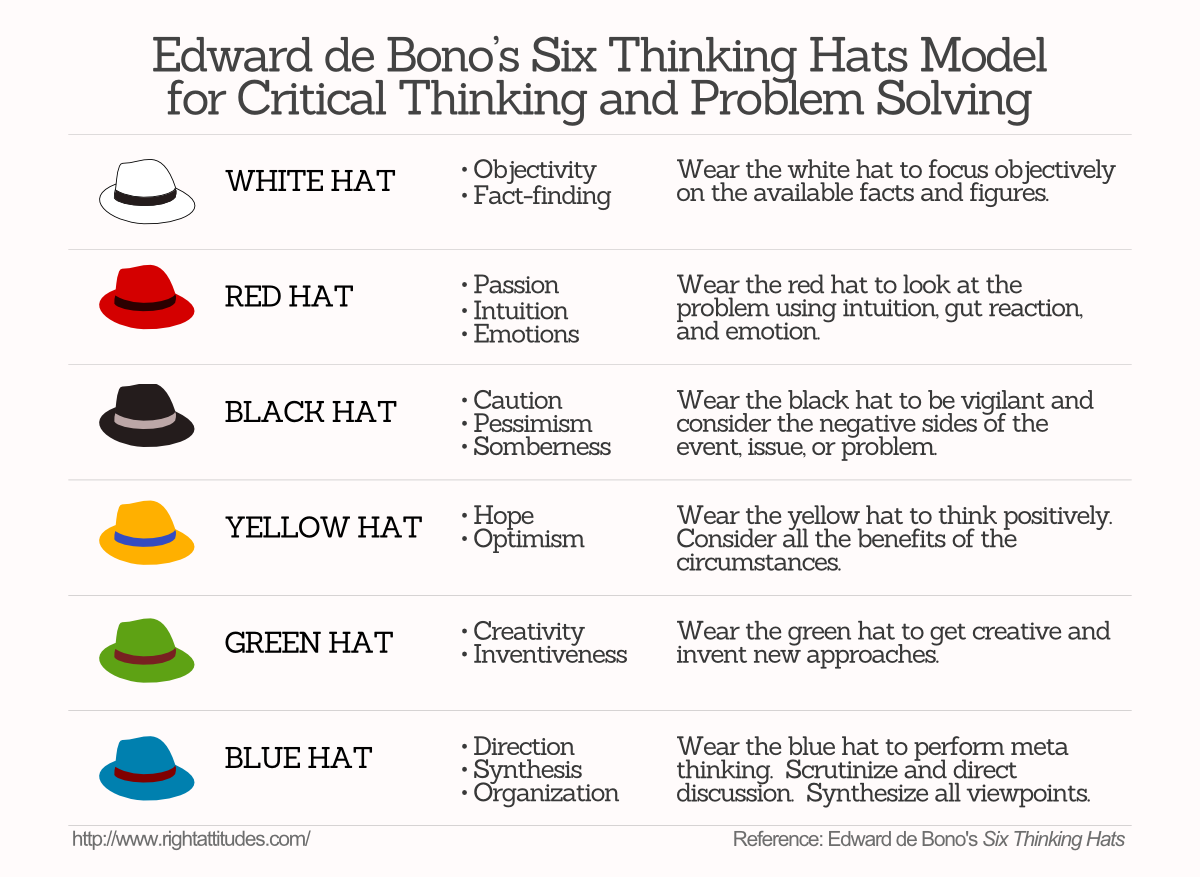
In his bestselling book Six Thinking Hats, Edward de Bono describes a powerful problem-solving approach that enriches mental flexibility by encouraging individuals and groups to attack an issue from six independent but complementary perspectives.

Edward de Bono is a leading authority in creative thinking. He is widely regarded as the father of lateral thinking. De Bono has written over 70 books on thinking and creativity.

Using the ‘Six Thinking Hats’ for Structured Brainstorming

De Bono created the ‘six thinking hats’ method after identifying six distinct lines of human thought in problem solving. De Bono calls each approach a “hat” and assigns them different colors.

At the heart of the ‘six thinking hats’ method are six different colored hats that participants put on—literally or metaphorically—to represent the type of thinking they should concentrate on while wearing each.

  1. White is neutral, objective, and fact-based. A white hat is concerned with objective data: “What information do we have? What information do we need? What information are we missing? How can get the information we need? What objective questions should be asked?”
  2. Red denotes passion, anger, intuition, and emotions. A red hat considers the emotional side of problem solving, which is often neglected or masked in meetings: “What are our gut reactions to the matter at hand?”
  3. Black is somber, serious, and cautious. A black hat is vigilant, plays devil’s advocate, and encourages derogatory and judgmental behavior: “what are the weaknesses of these ideas? What are the risks? What could go wrong?”
  4. Yellow represents positive thinking, hope, and optimism to counteract the black hat’s power. A yellow hat plays “the angel’s advocate” and is cheerful and confident: “What are the best-case scenarios? What are the best aspects of this? What are the advantages? Who can benefit from this?”
  5. Green signifies abundance, growth, richness, and fertility. A green hat is the hat of creativity; it rejects established rules and norms, and invents new approaches: “What are some new ideas on this subject? What is interesting about this idea? What are the variances in these ideas?”
  6. Blue represents the sky and therefore provides the overarching perspective. A blue hat performs “meta thinking” and is concerned with the organization of the thinking process and the use of other hats. The blue hat synthesizes and reconciles different viewpoints. At the start of a brainstorming session, the blue hat sets the stage for where the discussion may go. The blue hat guides and sustains the discussion, often restating its purposes: “What are we thinking about? What is the goal? What should we do next? What have we achieved so far? What should we do to achieve more?” At the conclusion of the brainstorming session, the blue hat appraises the discussion, and proposes a plan of action.

Use De Bono’s Six Thinking Hats Model for Critical Thinking and Problem Solving

'Six Thinking Hats' by Edward de Bono (ISBN 0316178314) An individual working alone may use the approach to consider broader, distinct lines of thought. By changing hats, the individual can switch viewpoints and ensure that he/she is not stuck in specific thinking patterns.

However, the approach is best suited to group discussions (when chaired by a skilled facilitator) in which conflicting ideas may never otherwise be fully synthesized into plans of action. By persuading each participant to think constructively alongside other participants, the ‘six thinking hats’ method taps into group members’diverse perspectives and uses their collective knowledge without destructive conflict.

Using these hats nurtures creativity by letting participants step beyond their typical roles and contribute to developing, organizing, and progressing ideas. Participants can also identify how their cognitive state at any one time shapes how they approach problems.

Recommendation: Read. Edward de Bono’s Six Thinking Hats presents a very effective technique for stimulating group creativity. The method can remove mental blocks, organize ideas and information, foster cross-fertilization, and help conduct thinking sessions more productively than do other brainstorming methods.

Complement with Dan Ciampa’s Taking Advice for an excellent framework on the kind of advice network you need on strategic, operational, political, and personal elements of your work and life. Read my summary in this article.

Wondering what to read next?

  1. Howard Gardner’s Five Minds for the Future // Books in Brief
  2. You Can’t Develop Solutions Unless You Realize You Got Problems: Problem Finding is an Undervalued Skill
  3. Finding Potential Problems & Risk Analysis: A Case Study on ‘The Three Faces of Eve’
  4. This is Yoga for the Brain: Multidisciplinary Learning
  5. Creativity by Imitation: How to Steal Others’ Ideas and Innovate

Filed Under: Mental Models, Sharpening Your Skills Tagged With: Conversations, Creativity, Critical Thinking, Mental Models, Networking, Social Dynamics, Teams, Thinking Tools, Thought Process, Winning on the Job

« Previous Page
Next Page »

Primary Sidebar

Popular Now

Anxiety Assertiveness Attitudes Balance Biases Coaching Conflict Conversations Creativity Critical Thinking Decision-Making Discipline Emotions Entrepreneurs Etiquette Feedback Getting Along Getting Things Done Goals Great Manager Innovation Leadership Leadership Lessons Likeability Mental Models Mentoring Mindfulness Motivation Networking Parables Performance Management Persuasion Philosophy Problem Solving Procrastination Relationships Simple Living Social Skills Stress Suffering Thinking Tools Thought Process Time Management Winning on the Job Wisdom

About: Nagesh Belludi [hire] is a St. Petersburg, Florida-based freethinker, investor, and leadership coach. He specializes in helping executives and companies ensure that the overall quality of their decision-making benefits isn’t compromised by a lack of a big-picture understanding.

Get Updates

Signup for emails

Subscribe via RSS

Contact Nagesh Belludi

RECOMMENDED BOOK:
Doing Business In China

Doing Business In China: Ted Plafker

The Economist's Beijing-correspondent Ted Plafker on the challenges of entering the Chinese market, conducting business in China, and not falling flat on your face.

Explore

  • Announcements
  • Belief and Spirituality
  • Business Stories
  • Career Development
  • Effective Communication
  • Great Personalities
  • Health and Well-being
  • Ideas and Insights
  • Inspirational Quotations
  • Leadership
  • Leadership Reading
  • Leading Teams
  • Living the Good Life
  • Managing Business Functions
  • Managing People
  • MBA in a Nutshell
  • Mental Models
  • News Analysis
  • Personal Finance
  • Podcasts
  • Project Management
  • Proverbs & Maxims
  • Sharpening Your Skills
  • The Great Innovators

Recently,

  • Design for the 80% Experience
  • Inspirational Quotations #1143
  • The Hot-Desking Lie: How It Killed Focus and Gutted Collaboration
  • Unreliable Narrators Make a Story Sounds Too Neat
  • Bertrand Russell on The Value of Philosophy: Doubt in an Age of Dogma
  • Inspirational Quotations #1142
  • The Law of Petty Irritations

Unless otherwise stated in the individual document, the works above are © Nagesh Belludi under a Creative Commons BY-NC-ND license. You may quote, copy and share them freely, as long as you link back to RightAttitudes.com, don't make money with them, and don't modify the content. Enjoy!