• Skip to content
  • Skip to primary sidebar

Right Attitudes

Ideas for Impact

Teams

How to Hire People Who Are Smarter Than You Are

June 27, 2019 By Nagesh Belludi Leave a Comment

Apple’s Steve Jobs frequently pointed to the risk of a “bozo explosion,” which is what happens within a company that makes the mistake of hiring B-grade managers early on. As the company expands, these bozos—Jobs’s label for well-meaning, but less-competent managers—tend to emerge through the ranks and run important divisions of the company.

When bozos hire other people, they prefer to hire bozos. As entrepreneur (and bonafide Steve Jobs’s coattail-rider) Guy Kawasaki explains, “B players hire C players so they can feel superior to them, and C players hire D players.” Lo and behold, entire divisions are soon swarming with hordes of bozos.

How to Prevent a Bozo Explosion

How to Prevent a Bozo Explosion

The heuristic “hire people smarter than you” is obvious enough, but, every so often, smart people can be a terrible fit within your team.

In this Startup School 2013 interview with venture capitalist Paul Graham, Facebook’s Mark Zuckerberg offers a better heuristic to hiring and keeping smart people who aren’t jerks and can get things done:

What’s the right heuristic for determining if someone is really good? Over time, what I figured out was that the only actual way to let someone analyze whether someone was really good was if they would work for that person. I don’t think that needs to recurse too many levels down in the organization but I basically think that’s a really good heuristic. I believe that. If you look at my management team today if we were in an alternate universe and I hadn’t started the company it would be an honor to work for any of these people. I think if you build a company that has those kind of values, rather than just saying ‘oh I want to hire the best person I can find’ or whatever, if you hold yourself to that standard then I think you’ll build a pretty strong company.

Idea for Impact: Mediocre managers often feel threatened by employees who seem more intelligent than they are, and could potentially pinch their jobs. In contrast, a wise manager knows that she reveals well on her own ability to discover and nurture talent.

  • As with advertising tycoon David Ogilvy’s Russian nesting dolls metaphor for building “a company of giants,” insist that managers hire folks who are better than themselves. For example, a product manager should hire a designer who is better at design than the manager is, not worse.
  • Insist that each interviewer ask themselves of job candidates, “Would I want to work for this person?”
  • Remember, the best don’t come cheap.

Wondering what to read next?

  1. Fire Fast—It’s Heartless to Hang on to Bad Employees
  2. Never Hire a Warm Body
  3. General Electric’s Jack Welch Identifies Four Types of Managers
  4. The Jerk Dilemma: The Double-Edged Sword of a ‘No Jerks Here’ Policy
  5. Why Hiring Self-Leaders is the Best Strategy

Filed Under: Leading Teams, Managing People, Sharpening Your Skills Tagged With: Coaching, Feedback, Getting Ahead, Great Manager, Hiring, Hiring & Firing, Interviewing, Teams

Doesn’t Facebook Make You Unhappy?

June 5, 2019 By Nagesh Belludi 1 Comment

If rampant trust and privacy issues, unrestricted tracking and misuse of your personal data, the superficiality of online relationships, and the perils of group polarization haven’t persuaded you yet to quit social media, consider the risks of “Facebook envy.” The pretenses of perfection on social media can make you compare your own life to an ideal that doesn’t really exist.

The Age of Envy: Seeing Your Friends Happy Can Make You Sad

Study after study confirms that Facebook and other social media contribute to unhappiness and feelings of inadequacy by providing a glimpse of just the highlights reel of other people’s lives.

When posting on Facebook, many people present their very best takes on their lives—their filtered descriptions tend to make their lives look more exciting. Everyone else’s vacations seem more fun, their relationships happier, and their jobs more exciting than your daily grind. Incidentally, they look younger, well dressed, and in-shape than you do too.

The Embellishment of Truths Makes Others Feel Discontented by Comparison

Catching up with others on social media can indeed make you feel jealous and envious. It’s in human nature that comparisons to lives that appear better than yours can bring you down. As the 18th century French philosopher Montesquieu wrote, “If one only wished to be happy, this could be horrible for the rest of civilization; but we wish to be happier than other people, and this is always difficult, for we believe others to be happier than they are.”

The obsession with self-image and the shallowness of friendships can stimulate your competitive inclinations to cherry-pick and portray an even sunnier facade of your lives.

The Never-ending One-upmanship on Facebook

Facebook is an outlet for the self-publicizing, narcissist human tendency—it is about creating positive impressions, often with the purpose of either enchanting or annoying others. And “where jealousy and selfish ambition exist, there is disorder and every evil thing” (New Testament, James 3:16.)

Social media have created this annoying compulsion to preserve a coherent and cheerful, public persona at all times. Your life must look picture-perfect, even if, under the wraps, you’re dealing with the burdens of everyday life. Moreover, given the urge to build this deceptive identity on social media, there’s little room for pessimism or honest portrayal of life’s realities.

Studies even detail how social media are contributing factors to cultivating feelings of inadequacy, depression, and other mental health issues in teenagers.

Idea for Impact: You Don’t Need Social Media to Participate in Society

Being on social media is a utility, a conduit—not an end in itself.

If you find yourself wasting time on social media or getting demotivated, consider using Facebook less or quitting it totally. Shun the narcissistic inclination to publicize the excruciating minutiae of your life.

Go engage flesh and blood people. Don’t just be interesting—be interested! You’ll be happier.

Wondering what to read next?

  1. The Curse of Teamwork: Groupthink
  2. Keep Politics and Religion Out of the Office
  3. How to Stimulate Group Creativity // Book Summary of Edward de Bono’s ‘Six Thinking Hats’
  4. Group Polarization: Like-Mindedness is Dangerous, Especially with Social Media
  5. The Pros and Cons of Leading by Consensus: Compromise and Accountability

Filed Under: Managing People Tagged With: Conversations, Networking, Social Dynamics, Teams

Don’t Lead a Dysfunctional Team

November 22, 2017 By Nagesh Belludi Leave a Comment

The difference between functional and dysfunctional teams often boils down to effective team leadership. If you’ve been asked to lead a team, you’ll get more from your team members if you know what’s expected of the team, and manage your roles and responsibilities.

  1. Define the charter. Find out what your customers want. Find out how much latitude your team has—decision-making, reporting procedure, access to resources and information. Make sure there’s organizational support for these matters.
  2. Build on strengths. If team members are selected for you, determine what each person can contribute to the team’s effort. Ask members to identify their strengths.
  3. Set ground rules. Discuss how the team will operate. Be clear about performance expectations. If necessary, write down the rules agreed upon by team members.
  4. Develop a mission and goals. Get your team talking about what needs to get done, by whom, and when.
  5. “Herd the sheep.” Part of your job is to be a sheepdog. Keep people together and herd them toward goals.
  6. Break up conflicts. Disagreements are fine, even healthy, but outright hostility or anger is counterproductive. Stop the discussion, clarify positions, and try to find areas of agreement.
  7. Avoid groupthink. Don’t compromise too much for the sake of consensus, harmony, and “esprit de corps.” Don’t settle on the lowest-common-denominator decision upon which everybody agrees.
  8. Build bridges. Keep your sponsor, your manager, and each team member’s boss informed of the progress of the team’s assignment.
  9. Be visible. Any crisis calls for constant, candid communication. Knowing how to step up your communications efforts to the right levels during confusion is a powerful tool in managing a crisis.
  10. Captain the ship. You’re responsible for your team’s every outcome—good or bad. You are wholly accountable for everything that happens under your authority. Never pass the blame should things go wrong.
  11. Make the work fun. Give your team lots of recognition. Celebrate the team’s accomplishments.
  12. Establish freedom and autonomy. Empower team members to innovate and make decisions. Encourage all ideas and make sure that they are respected, no matter how strange they may sound. Micromanage only when you must.
  13. Assess performance. Periodically, ask the team to rate its performance. Resolve any problems as quickly as possible.
  14. Get stuff done. Don’t lose sight of your goals and your mission. The only thing that matters is the relevant results.

Wondering what to read next?

  1. Ditch Deadlines That Deceive
  2. Why Your Employees Don’t Trust You—and What to Do About it
  3. 20 Reasons People Don’t Change
  4. Don’t One-up Others’ Ideas
  5. We’re All Trying to Control Others

Filed Under: Managing People, Sharpening Your Skills Tagged With: Coaching, Getting Along, Great Manager, Mental Models, Mentoring, Persuasion, Relationships, Teams

Surround Yourself with Smarter People

October 18, 2017 By Nagesh Belludi Leave a Comment

The American economist and Nobel Laureate Robert Shiller (b.1946) once said, “Your own thoughts are not really your own thoughts. Everything you think is a product of the people you meet and the experiences you’ve had.”

Associate with men and women who are smarter than you are—they should not only possess both superior intellectual and emotional intelligence, but also share your drive to succeed.

Remember, the most effective teams are those that have people with complementary skills, and similar work ethic.

Wondering what to read next?

  1. Five Signs of Excessive Confidence
  2. Let Others Shine
  3. Champion Positives, Sideline Negatives
  4. Don’t Blatantly Imitate a Hero: Be Yourself
  5. The Curse of Teamwork: Groupthink

Filed Under: Mental Models, Sharpening Your Skills Tagged With: Getting Ahead, Role Models, Social Skills, Teams

Group Polarization: Like-Mindedness is Dangerous, Especially with Social Media

August 15, 2017 By Nagesh Belludi Leave a Comment

Group Polarization Strengthens of the Opinions of Each Person in the Group

When people who share opinions and beliefs get together in groups, they tend to be even more persuaded in their beliefs—they become extreme in their views. In other words, a group of likeminded people will reinforce one another’s viewpoints. This phenomenon is called group polarization.

Social psychologists reason that people use the choices and persuasions of others as heuristics to steer their lives in this complex world. As the English philosopher and mathematician Alfred North Whitehead once said, “Civilization advances by extending the number of operations we can perform without thinking about them.”

Social Media and Group Polarization

As people converge to likeminded people in virtual neighborhoods, they tend to operate in intellectual bubbles. Given that social media allows participants to curate their sources of information, it is easier than ever before for people to cruise through their day-to-day lives without meeting anyone who disagrees with them. Studies have shown that hanging around a group of likeminded folks makes people more scornful of differing viewpoints, than they are as individuals.

Group polarization explains partly the proliferation of fake news on social media—people accept dubious claims that support their own viewpoint while disregarding facts that conflict with their views. In the confusing times we live in, people get lost in the unstructured, unattributed noise of headlines and repeat the loudest declarations as facts without checking their soundness.

In 1996, MIT scholars Marshall Van Alstyne and Erik Brynjolfsson forewarned of an impending dark side to the newly interconnected world:

Individuals empowered to screen out material that does not conform to their existing preferences may form virtual cliques, insulate themselves from opposing points of view, and reinforce their biases. Internet users can seek out interactions with like-minded individuals who have similar values, and thus become less likely to trust important decisions to people whose values differ from their own.

The Persuasive Ability of Social Proof in Consumer Behavior

'Influence: The Psychology of Persuasion' by Robert Cialdini (ISBN 006124189X) In the bestselling Influence: The Psychology of Persuasion, psychologist Robert Cialdini observes that advertisers tend to describe their products as “fastest-growing,” “#1 in the market,” or “best-selling.” Advertisers believe that consumers need to hear not only that a product is good, but also that others think so.

As per group polarization, when people are considering what to do or buy, they often look to what others are doing or have done, and take their cue from others. When a product, service, or an idea strikes out as particularly admired or prevailing, consumers intuitively take social proof that this is the right—and acceptable—choice.

Idea for Impact: Hanging Around with Like-Minded People is a Dangerous Intellectual Trap

The French entomologist Jean-Henri Fabre once wrote, “Seek those who find your road agreeable, your personality and mind stimulating, your philosophy acceptable, and your experiences helpful. Let those who do not, seek their own kind.”

Look for people who respect your worldview—even if drastically different from theirs—but can present alternative perspectives.

Regular exposure to differing views serves to sharpen your thinking and reasoning abilities—and may perhaps even reexamine your positions. As I’ve said before, wisdom comes from facing counter-arguments. The only test of a well-constructed opinion is that it can defend itself.

Wondering what to read next?

  1. Surrounded by Yes
  2. Could Limiting Social Media Reduce Your Anxiety About Work?
  3. How to Stimulate Group Creativity // Book Summary of Edward de Bono’s ‘Six Thinking Hats’
  4. Consensus is Dangerous
  5. Presenting Facts Can Sometimes Backfire

Filed Under: Mental Models, Sharpening Your Skills Tagged With: Confidence, Conversations, Conviction, Critical Thinking, Mental Models, Networking, Persuasion, Social Dynamics, Social Media, Teams, Wisdom

The Curse of Teamwork: Groupthink

October 11, 2016 By Nagesh Belludi Leave a Comment

Many teams tend to compromise their decisions for the sake of consensus, harmony, and “esprit de corps.” The result is often a lowest-common-denominator decision upon which everybody in the team agrees. This predisposition for a team to minimize conflict and value conformity is the psychological phenomenon of Groupthink.

'Victims of Groupthink' by Irving Janis (ISBN 0395317045) In the 1970s, American psychologist Irving Janis defined Groupthink as “a mode of thinking that people engage in when deeply involved in a cohesive in-group, when the members’ strivings for unanimity override their motivation to realistically appraise alternative courses of action.” Janis argued that Groupthink “undermines critical analysis, legitimizes ignorance, reinforces collective biases, and promotes a group self-image of infallibility.”

Negative Effects of Groupthink in Teamwork

Teams are prone to Groupthink and a variety of other detrimental decision-making approaches, but are seldom aware of it.

  • Groupthink suppresses dissent Individuals resign to group pressure, thereby conforming their opinions to a decision that they believe will achieve consensus. Groupthink discourages dissenters from “rocking the boat.” Over time, nonconformists are gradually shunted aside or excluded from the team altogether.
  • Groupthink engenders self-censorship. Individuals who disagree with the chosen course of action remain silent because they reason they cannot change others’ minds. Consequently, the team tends to focus its discussions on ideas that everyone agrees about rather than ideas that everyone disagrees about.
  • Groupthink gives team members greater confidence in their collective decisions than their individual decisions. Therefore, Groupthink leads individuals to publicly endorse ideas and decisions that they view as common for the group, even if they personally have reservations about them.
  • Groupthink stifles creativity and independent thinking. When individuals are unwilling to bring up and confront difficult issues, the team fails to examine alternative viewpoints that could be contentious. This leads to irrational and flawed decisions.

Antidote to Groupthink in Teamwork

An awareness of Groupthink and other group dynamic biases combined with some hands-on intervention, self-reflection, and control can help teams make better decisions.

  • Create an organizational environment where individuals can freely voice their ideas, challenges, and concerns. Individuals must feel comfortable with taking interpersonal risks, admitting hesitations, and challenging one-another. Absent an inclination to avoid conflict, a team can easily discuss and debate different perspectives.
  • Think about the right information required to make sound decisions. Consider the strongest counter-argument to every idea.
  • Do not suppress disagreements or dominate the dissenters. Carefully examine the reasons and implications of alternate viewpoints.
  • Divide a team into sub-teams or partnerships and set each sub-team to work on a problem independently. Encourage them to take into account the plusses and the minuses of each idea.
  • Designate one team member as a devil’s advocate to argue enthusiastically against all contemplated ideas. This can force the team to discuss and debate the concomitant merits and demerits of different ideas. In Edward De Bono’s Six Thinking Hats process (see my book summary), the devil’s advocate wears the “black hat.”
  • Invite outside consultants and subject-matter experts to discuss key issues and review decisions.
  • Appoint a moderator who can engage the team collectively and individually by gathering all points of view, giving feedback, and challenging the team’s thinking. Ideally, the moderator should be an independent third party who can be comprehensive and forthright.
  • Step back regularly from the team’s deliberation process to reflect on the effectiveness of the team’s decision-making and intervene where necessary. In the Six Thinking Hats process, De Bono suggests adding reflection time at the end of each meeting to analyze the process’ effectiveness.

Idea for Impact: Sometimes, Teamwork is Overrated

Don’t get me wrong: teamwork can be very powerful, but only when teams consist of individuals who have the right expertise and who are willing to voice their forthright opinions, dissent, and build consensus. Avoid teamwork when one person or a partnership with complementary skills and styles may achieve identical objectives.

To prevent Groupthink, establish an environment where speaking up is encouraged and rewarded. Welcome disagreements, avoid dominating dissenters, and contemplate the strongest counter-argument to every idea.

Wondering what to read next?

  1. How to Stimulate Group Creativity // Book Summary of Edward de Bono’s ‘Six Thinking Hats’
  2. The Abilene Paradox: Just ‘Cause Everyone Agrees Doesn’t Mean They Do
  3. Why Group Brainstorming Falls Short on Creativity and How to Improve It
  4. To Know Is to Contradict: The Power of Nuanced Thinking
  5. Silence is Consent

Filed Under: Managing People, Mental Models, Sharpening Your Skills Tagged With: Conversations, Meetings, Networking, Social Dynamics, Social Skills, Teams, Thinking Tools, Thought Process

How to Stimulate Group Creativity // Book Summary of Edward de Bono’s ‘Six Thinking Hats’

May 13, 2016 By Nagesh Belludi

Stimulate Group Creativity Using Edward de Bono's 'Six Thinking Hats'

In his bestselling book Six Thinking Hats, Edward de Bono describes a powerful problem-solving approach that enriches mental flexibility by encouraging individuals and groups to attack an issue from six independent but complementary perspectives.

Edward de Bono is a leading authority in creative thinking. He is widely regarded as the father of lateral thinking. De Bono has written over 70 books on thinking and creativity.

Using the ‘Six Thinking Hats’ for Structured Brainstorming

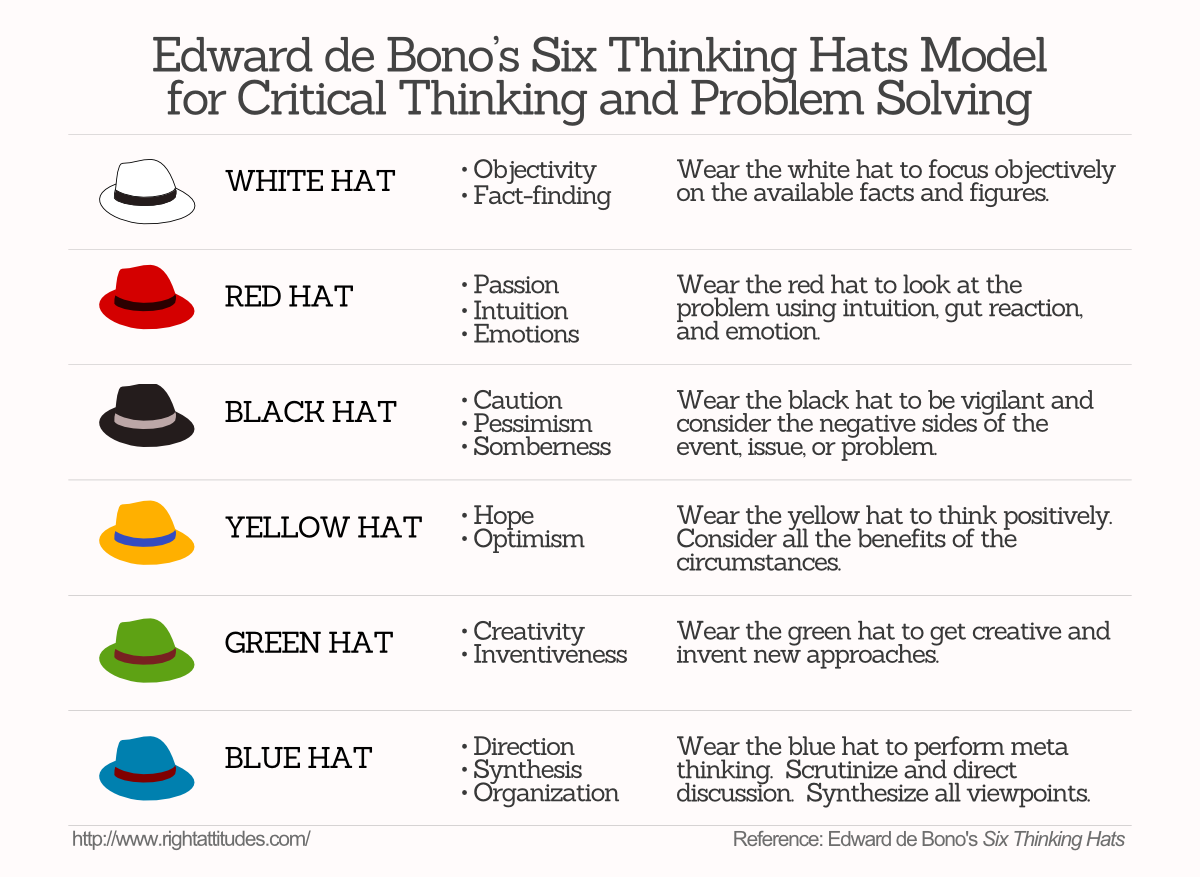
De Bono created the ‘six thinking hats’ method after identifying six distinct lines of human thought in problem solving. De Bono calls each approach a “hat” and assigns them different colors.

At the heart of the ‘six thinking hats’ method are six different colored hats that participants put on—literally or metaphorically—to represent the type of thinking they should concentrate on while wearing each.

  1. White is neutral, objective, and fact-based. A white hat is concerned with objective data: “What information do we have? What information do we need? What information are we missing? How can get the information we need? What objective questions should be asked?”
  2. Red denotes passion, anger, intuition, and emotions. A red hat considers the emotional side of problem solving, which is often neglected or masked in meetings: “What are our gut reactions to the matter at hand?”
  3. Black is somber, serious, and cautious. A black hat is vigilant, plays devil’s advocate, and encourages derogatory and judgmental behavior: “what are the weaknesses of these ideas? What are the risks? What could go wrong?”
  4. Yellow represents positive thinking, hope, and optimism to counteract the black hat’s power. A yellow hat plays “the angel’s advocate” and is cheerful and confident: “What are the best-case scenarios? What are the best aspects of this? What are the advantages? Who can benefit from this?”
  5. Green signifies abundance, growth, richness, and fertility. A green hat is the hat of creativity; it rejects established rules and norms, and invents new approaches: “What are some new ideas on this subject? What is interesting about this idea? What are the variances in these ideas?”
  6. Blue represents the sky and therefore provides the overarching perspective. A blue hat performs “meta thinking” and is concerned with the organization of the thinking process and the use of other hats. The blue hat synthesizes and reconciles different viewpoints. At the start of a brainstorming session, the blue hat sets the stage for where the discussion may go. The blue hat guides and sustains the discussion, often restating its purposes: “What are we thinking about? What is the goal? What should we do next? What have we achieved so far? What should we do to achieve more?” At the conclusion of the brainstorming session, the blue hat appraises the discussion, and proposes a plan of action.

Use De Bono’s Six Thinking Hats Model for Critical Thinking and Problem Solving

'Six Thinking Hats' by Edward de Bono (ISBN 0316178314) An individual working alone may use the approach to consider broader, distinct lines of thought. By changing hats, the individual can switch viewpoints and ensure that he/she is not stuck in specific thinking patterns.

However, the approach is best suited to group discussions (when chaired by a skilled facilitator) in which conflicting ideas may never otherwise be fully synthesized into plans of action. By persuading each participant to think constructively alongside other participants, the ‘six thinking hats’ method taps into group members’diverse perspectives and uses their collective knowledge without destructive conflict.

Using these hats nurtures creativity by letting participants step beyond their typical roles and contribute to developing, organizing, and progressing ideas. Participants can also identify how their cognitive state at any one time shapes how they approach problems.

Recommendation: Read. Edward de Bono’s Six Thinking Hats presents a very effective technique for stimulating group creativity. The method can remove mental blocks, organize ideas and information, foster cross-fertilization, and help conduct thinking sessions more productively than do other brainstorming methods.

Complement with Dan Ciampa’s Taking Advice for an excellent framework on the kind of advice network you need on strategic, operational, political, and personal elements of your work and life. Read my summary in this article.

Wondering what to read next?

  1. The Curse of Teamwork: Groupthink
  2. This is Yoga for the Brain: Multidisciplinary Learning
  3. Group Polarization: Like-Mindedness is Dangerous, Especially with Social Media
  4. Four Ideas for Business Improvement Ideas
  5. Charlie Munger’s Iron Prescription

Filed Under: Mental Models, Sharpening Your Skills Tagged With: Conversations, Creativity, Critical Thinking, Mental Models, Networking, Social Dynamics, Teams, Thinking Tools, Thought Process, Winning on the Job

« Previous Page

Primary Sidebar

Popular Now

Anxiety Assertiveness Attitudes Balance Biases Coaching Conflict Conversations Creativity Critical Thinking Decision-Making Discipline Emotions Entrepreneurs Etiquette Feedback Getting Along Getting Things Done Goals Great Manager Innovation Leadership Leadership Lessons Likeability Mental Models Mentoring Mindfulness Motivation Networking Parables Performance Management Persuasion Philosophy Problem Solving Procrastination Relationships Simple Living Social Skills Stress Suffering Thinking Tools Thought Process Time Management Winning on the Job Wisdom

About: Nagesh Belludi [hire] is a St. Petersburg, Florida-based freethinker, investor, and leadership coach. He specializes in helping executives and companies ensure that the overall quality of their decision-making benefits isn’t compromised by a lack of a big-picture understanding.

Get Updates

Signup for emails

Subscribe via RSS

Contact Nagesh Belludi

RECOMMENDED BOOK:
A Guide to the Good Life

A Guide to the Good Life: William Irvine

Philosophy professor William Irvine's practical handbook includes actionable advice for self-improvement by applying the ancient stoic wisdom to contemporary life.

Explore

  • Announcements
  • Belief and Spirituality
  • Business Stories
  • Career Development
  • Effective Communication
  • Great Personalities
  • Health and Well-being
  • Ideas and Insights
  • Inspirational Quotations
  • Leadership
  • Leadership Reading
  • Leading Teams
  • Living the Good Life
  • Managing Business Functions
  • Managing People
  • MBA in a Nutshell
  • Mental Models
  • News Analysis
  • Personal Finance
  • Podcasts
  • Project Management
  • Proverbs & Maxims
  • Sharpening Your Skills
  • The Great Innovators

Recently,

  • What Appears Self-Evident to One May Be Entirely Opaque to Another: How the Dalai Lama Apology Highlights Cultural Relativism
  • Inspirational Quotations #1136
  • Ditch Deadlines That Deceive
  • Invention is Refined Theft
  • You Need to Stop Turning Warren Buffett Into a Prophet
  • Inspirational Quotations #1135
  • What the Dry January Trap Shows Us About Extremes

Unless otherwise stated in the individual document, the works above are © Nagesh Belludi under a Creative Commons BY-NC-ND license. You may quote, copy and share them freely, as long as you link back to RightAttitudes.com, don't make money with them, and don't modify the content. Enjoy!