• Skip to content
  • Skip to primary sidebar

Right Attitudes

Ideas for Impact

Targets

This Hack Will Help You Think Opportunity Costs

March 29, 2021 By Nagesh Belludi Leave a Comment

Making decisions is all about opportunity costs. For instance, every time you spend money to get something, you should ask yourself what else, perhaps of better value, you could get with that money—now or later.

The problem is, when forced to choose between something immediate and concrete and something else that’s comparatively abstract and distant, the opportunity cost could lack clarity.

Duke University behavioral economist Dan Ariely proposes the notion of “anti-goals” to help examine the trade-offs you’re forced to make. Ariely encourages pairing goals such that if you satisfy one, you’ll impede the other. For example, when choosing to spend $100 on an evening out today, you can consider a tangible anti-goal—say, saving for the family’s summer vacation—that’ll be held back.

Idea for Impact: Thinking about what you want to avoid—the anti-goal—is a potent tool. It allows you to focus on things that really matter.

Wondering what to read next?

  1. Everything in Life Has an Opportunity Cost
  2. Master the Middle: Where Success Sets Sail
  3. Steering the Course: Leadership’s Flight with the Instrument Scan Mental Model
  4. The Simple Life, The Good Life // Book Summary of Greg McKeown’s ‘Essentialism’
  5. More from Less // Book Summary of Richard Koch’s ’80/20 Principle’

Filed Under: MBA in a Nutshell, Mental Models, Sharpening Your Skills Tagged With: Balance, Decision-Making, Discipline, Goals, Negotiation, Problem Solving, Risk, Simple Living, Targets

How to Clear Your Mental Horizon

June 8, 2020 By Nagesh Belludi Leave a Comment

This anecdote about a reclusive Nobel laureate is scarcely practical advice, but an excellent reminder of the importance of eliminating internal and external distractions.

Peter Higgs is not a fan of modern technology. The British theoretical physicist, 84, is so consumed with work that he has never sent an email, looked at the internet, or used a cellphone. He’s so cut off from modes of modern communication that he didn’t know he’d won this year’s Nobel Prize in physics—for his 1964 paper predicting the Higgs boson, which imbues other particles with mass—until a neighbor congratulated him on the street. “I resent being disturbed in this way,” says Higgs. “Why should people be able to interrupt me like that?” Because they want to keep in touch? “But I don’t want to be in touch,” he laughs. “It’s an intrusion into my way of life, and certainly on principle I don’t feel obliged to accept it.” He doesn’t own a TV, but not because he lacks interest in the outside world. “I don’t regard television as the outside world,” he offers dryly. “I regard it as an artifact.”

And, the Guardian notes that Higgs isn’t interested in being accessible:

Higgs struck upon his [Higgs boson] theory while walking in the Cairngorms one weekend in 1964. An unworldly and donnish academic, he was so immersed in particle physics research that when his first son was born he was miles away in a university library, and so remote from contemporary reality that to this day he owns neither a TV nor mobile phone, and only acquired his first computer on his 80th birthday.

Make Conditions as Favorable as Possible

Good jobs are overwhelming, and accomplishing important things is really, really hard. As the following anecdotes will illuminate, many of the greatest achievements in life are often accomplished by people who (1) have a particular desire that becomes the foundational building block for everything they do, (2) focus on what they want to achieve, and (3) divest themselves of internal and external distractions.

  • The physicist and 1965 Nobel laureate Richard Feynman famously invented the falsehood that he’s irresponsible so that he could avoid mundane tasks. He wrote, “I tell everybody. “I don’t do anything.” If anybody asks me to be on a committee to take care of admissions … “No! I’m irresponsible. … I don’t give a damn about the students!” Of course I give a damn about the students, but I know that somebody else’ll do it! … because I like to do physics, and I want to see if I can still do it. I am selfish, okay? I want to do my physics.”
  • The American crime writer James Ellroy said, “I’m interested in doing very few things. I don’t have a cell phone. Don’t have a computer. Don’t have a TV set. Don’t go to movies. Don’t read. I ignore the world so I might live obsessively.”
  • Asked about his vacations, the German filmmaker Werner Herzog once revealed that he has never taken vacation, “I work steadily and methodically, with great focus. There is never anything frantic about how I do my job; I’m no workaholic. A holiday is a necessity for someone whose work is an unchanged daily routine, but for me, everything is constantly fresh and always new. I love what I do, and my life feels like one long vacation.”

Idea for Impact: Find the Focus That’ll Take to Do Your Best

Success is a product of unremitting attention to purpose. Avoid, disconnect, eliminate, automate, delegate, reduce, or minimize mundane concerns and routine affairs that could dissuade you from focusing on what you want to achieve.

Wondering what to read next?

  1. Everything in Life Has an Opportunity Cost
  2. To Rejuvenate Your Brain, Give it a Break
  3. Zen in a Minute: Centering with Micro-Meditations
  4. Zeigarnik Effect: How Incomplete Tasks Trigger Stress
  5. Hofstadter’s Law: Why Everything Takes Longer Than Anticipated

Filed Under: Sharpening Your Skills Tagged With: Balance, Decision-Making, Discipline, Mindfulness, Stress, Targets, Time Management

What Happens When You Talk About Too Many Goals

February 28, 2020 By Nagesh Belludi Leave a Comment

To supplement this illustrious sketch by the British cartoonist Matt Pritchett, an excerpt from HuffPost’s article on “How Jeremy Corbyn Lost The Election,”

One big problem was the sheer size of the [Labour Party] manifesto and the number of policies on offer. Candidates complained that they didn’t have a single five-point pledge card like the one Tony Blair made famous. While the Tories had a simple message of ‘Get Brexit Done,’ Labour lacked a similarly easy ‘doorstep offer.’ “We had so much in the manifesto we almost had too much,” one senior source said. “It felt like none of it was cutting through. You needed to boil it down.”

“We tried to give a retail offer and also a grand vision and ended up falling between the two stools. To get across ‘you’ll be better off with Labour,’ we should have made our position clearer much earlier.”

Idea for Impact: Distill your goals into simple messages that others will find relevant and timely. When it comes to persuasion, clarity and conciseness are critical. Weak messages meander. Smart messages immediately express what’s important and help rally your resources towards your mission.

Wondering what to read next?

  1. Serve the ‘Lazy Grapefruit’
  2. The Best Leaders Make the Complex Simple
  3. Everything in Life Has an Opportunity Cost
  4. Never Give a Boring Presentation Again
  5. The Rule of Three

Filed Under: Effective Communication, Mental Models, Sharpening Your Skills Tagged With: Communication, Decision-Making, Etiquette, Goals, Meetings, Persuasion, Presentations, Simple Living, Targets, Thought Process, Winning on the Job

The Best Leaders Make the Complex Simple

February 17, 2020 By Nagesh Belludi Leave a Comment

The New York Times‘s Adam Bryant interviewed 525 CEOs for his Corner Office column and compiled two excellent books, The Corner Office (2012) and Quick and Nimble (2014,) on leadership and management advice. Foremost among the themes common with successful leaders, Bryant says, is “a simple mindset”—the ability to synthesize the simple from the complex and create organizational priorities.

There’s a really important quality [in great CEOs] that I call a “simple mindset,” which is the ability to take a lot of complicated information and really boil it down to the one or two or three things that really matter, and in a simple way, communicate that to people.

In big organizations—frankly, in any company—there are always a dozen or more competing priorities. And it is the leader’s job to stand up in front of the troops and say, “These are the three things that we are going to focus on this year,” or “These are the goals and this is how we are going to measure them.” If you really want to galvanize people and get them operating as a team, you’ve got to create a simple scoreboard that everybody understands.

The communication style, to me, is secondary to getting the content right. And what I’ve been so often impressed by is leaders who can essentially boil down the company’s goals and operating model into, literally, less than a page.

This is a real trick to leadership—creating a simple structure so that everybody in the organization can understand how the work they are doing contributes to the broader goals.

Rob Andrews, CEO of the executive headhunting firm Allen Austin, underscores this “boil the complex into the simple” approach in his leadership manual, High-Performance Human Capital Leadership (2015,)

I have found that when I go into a company to lead, it is important to have a plan and to make that plan a simple one that everybody can understand. I am constantly asking the question,—What are the two or three levers that, if done right, if pulled correctly, will really turn this business? What are the two or three things that really matter? And I find that most leaders do not really do that often.

Idea for Impact: One of the essential attributes of a modern leader is the ability to cut complexity everywhere. Develop the ability to take large, complicated things—and information—and make them very simple.

Wondering what to read next?

  1. What Happens When You Talk About Too Many Goals
  2. Hofstadter’s Law: Why Everything Takes Longer Than Anticipated
  3. Ask This One Question Every Morning to Find Your Focus
  4. Plan Your Week, Not Your Whole Life
  5. Warren Buffett’s Advice on How to Focus on Priorities and Subdue Distractions

Filed Under: Mental Models, Sharpening Your Skills Tagged With: Books, Decision-Making, Goals, Leadership, Targets, Task Management, Thought Process, Winning on the Job

How to Develop a Vision for Year 2020?

January 2, 2020 By Nagesh Belludi Leave a Comment


Four Rules for Priority-Setting

As you think about what you want to achieve in the New Year, consider these four rules for priority setting laid down by the original management guru Peter Drucker in his seminal The Effective Executive (1966; my summary):

Courage rather than analysis dictates the truly important rules for identifying priorities:

  1. Pick the future as against the past;
  2. Focus on opportunity rather than on problems;
  3. Choose your own direction—rather than climb on the bandwagon; and
  4. Aim high, aim for something that will make a difference, rather than for something that is “safe” and easy to do.

How to Develop a Vision for 2020?

The first thing to do before thinking too far ahead in the future is to identify what success really means to you. Ask yourself, “It’s 31-Dec-2020 and the year 2020 is almost over. I am getting ready to celebrate the turn of the year with a tremendous sense of accomplishment. What have I achieved?”

Visualize a year 2020 wherein everything has turned out the way you’ve wanted. You have given it your best, worked your hardest, and achieved all your goals. Now write down what you imagine.

Take the time to think through and develop a clear picture of where you want yourself and your work- and personal lives to be in three months, six months, and one year.

This exercise is generally effective at helping folks differentiate between tasks that simply feel urgent or top-of-mind from those that are truly important.

Idea for Impact: Getting clear on your vision will help you create a path that feels the most meaningful, stimulating, and fulfilling to you.

Wondering what to read next?

  1. How to Turn Your Procrastination Time into Productive Time
  2. Be Careful What You Start
  3. Your To-Do List Isn’t a Wish List: Add to It Selectively
  4. What the Dry January Trap Shows Us About Extremes
  5. Ask This One Question Every Morning to Find Your Focus

Filed Under: Career Development, Living the Good Life Tagged With: Discipline, Employee Development, Getting Ahead, Goals, Motivation, Targets, Time Management

How to Turn Your Procrastination Time into Productive Time

August 1, 2019 By Nagesh Belludi Leave a Comment

“Energy, not time, is the fundamental currency of high performance,” assert Tony Schwartz and Jim Loehr in The Power of Full Engagement. They advocate practicing energy management in addition to time management and prescribe “pulsing,” or interspersing periods of intense work with breaks to renew your energy levels.

This idea of energy management comports with the much-debated “muscle metaphor” of willpower. Mental stamina and personal energy are reservoirs. They get depleted as you go about your day, and need to be filled up every so often.

Idea for Impact: Match your tasks to your energy levels throughout the day

If you know yourself sufficiently well, you can make deliberate, proactive choices that can help you sustain your drive and feel more energetic all through the day.

First, identify the kinds of tasks that deplete or sustain your energy.

Once you discover your working pattern, match your tasks to your energy levels throughout the day. If you are at your best first thing in the morning, work on something complex and challenging as soon as you get to the office.

Relegate routine task tasks and administrative chores—processing emails, scheduling appointments, filing reports—for the afternoon.

Create a “Procrastination To-Do List”

Consider preparing a special “to-do” list with low-energy, low-brainpower, low-priority, but got-to-do tasks for when you don’t feel like doing anything else. (See this list of 10 smart things you can do in 10 minutes.)

In other words, whenever your brain needs time to rest, you can idle productively by getting something else done. You can tackle this list whenever you find yourself with time on hand, but without the energy, focus, or excitement that you need to deal with something important. Some folks call this the “procrastination to-do list.”

Be warned, though, that doing mindless-but-productive tasks during procrastinating is the thin end of the wedge—it can simply feed your propensity to procrastinate. Under the illusion of not procrastinating and “getting something done,” you will want to do all the less-important things that you can do instead of building momentum and switching to the few high-priority things that you must do.

Wondering what to read next?

  1. What the Dry January Trap Shows Us About Extremes
  2. Use This Trick to Make Daily Habits Stick This Year
  3. Resolution Reboot: February’s Your Fresh Start
  4. Ask This One Question Every Morning to Find Your Focus
  5. Be Careful What You Start

Filed Under: Mental Models, Sharpening Your Skills Tagged With: Discipline, Goals, Lifehacks, Mindfulness, Motivation, Procrastination, Targets, Time Management

Ask This One Question Every Morning to Find Your Focus

July 29, 2019 By Nagesh Belludi Leave a Comment

Here’s a précis of psychologist Ron Friedman’s HBR article on how to spend the first ten minutes of your day:

Ask yourself this question the moment you sit at your desk: The day is over and I am leaving the office with a tremendous sense of accomplishment. What have I achieved?

This exercise is usually effective at helping people distinguish between tasks that simply feel urgent from those that are truly important. Use it to determine the activities you want to focus your energy on.

Then—and this is important—create a plan of attack by breaking down complex tasks into specific actions. Studies show that when it comes to goals, the more specific you are about what you’re trying to achieve, the better your chances of success.

Idea for Impact: Organize Yourself Good Concentration

Starting your day by mulling over proactively on “what should I have achieved” is a wonderful aid in keeping the mind headed in the right direction.

Planning is easier when your energy levels are highest, which, for most people, is first thing in the morning.

Knowing what your goals are before you launch your day can help you focus the mind and hold it steadily to one thing at a time and in the right order.

Wondering what to read next?

  1. Don’t Do the Easiest Jobs First
  2. Did School Turn You Into a Procrastinator?
  3. How to … Kickstart Your Day with Focus & Set a Daily Highlight to Stay on Track
  4. A Guaranteed Formula for Success: Identify Your #1 Priority and Finish It First
  5. Keep Your Eyes on the Prize [Two-Minute Mentor #9]

Filed Under: Living the Good Life, Mental Models, Sharpening Your Skills Tagged With: Decision-Making, Discipline, Efficiency, Getting Things Done, Mindfulness, Motivation, Procrastination, Questioning, Tardiness, Targets, Task Management, Time Management, Winning on the Job

How to Prevent Employee Exhaustion

November 8, 2018 By Nagesh Belludi Leave a Comment

Feeling exhausted, irritated, unhappy, and lacking in control are all signs of burnout—a temporary decline in an employee’s well-being.

If you notice a drop in energy, motivation, or productivity, try these simple ways to help combat employee exhaustion:

  • Clarify expectations
  • Where possible, lower the standards and relax the deadlines. Encourage less perfection.
  • Give employees the right tools and resources that they need to do their job effectively
  • Allocate some tasks to other employees
  • Appreciate, reward, recognize
  • Give employees some time off
  • Reduce travel and meetings
  • Offer counseling and mentoring

Employee stress and problems at work that are not dealt with effectively can quickly spill out into other parts of an employee’s life. In fact, many marriages go bad when stress at work is at its worst: people use up all their willpower on the job; their home lives suffer because they give much to their work.

Make employee welfare a key area of focus to promote better work environments and keep employees engaged.

Wondering what to read next?

  1. Managing the Overwhelmed: How to Coach Stressed Employees
  2. Four Telltale Signs of an Unhappy Employee
  3. How to Clear Your Mental Horizon
  4. Don’t Push Employees to Change
  5. Everything in Life Has an Opportunity Cost

Filed Under: Health and Well-being, Leading Teams, Managing People, Sharpening Your Skills Tagged With: Balance, Coaching, Emotions, Great Manager, Mentoring, Stress, Targets, Time Management

When Stress is Good

November 5, 2018 By Nagesh Belludi Leave a Comment

Stress and Anxiety Can Lead to Improved Performance

Why Some Stress Is Good for You Many people claim that they work best under pressure. There’s some truth to that. Stress is a natural response in highly competitive environments. Before an exam, important meeting, or contest, your heart rate rises and so does your blood pressure. You become more absorbed, alert, and efficient.

However, this favorable relationship applies only up to a certain level of stress. Past this level, stress impairs your performance—and eventually your heart.

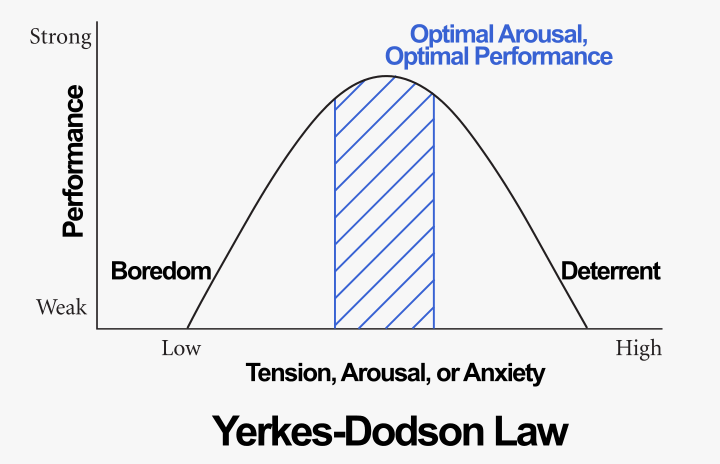
In 1908, Harvard psychologists Robert Yerkes and John Dodson first described the beneficial and harmful effects of stress (“psychological arousal”) on performance in a graph the shape of an upside-down U. According to the Yerkes-Dodson Law, the ascendant curve reflects the energizing effect of arousal. The descendant curve reflects the negative effects of stress on thinking and learning, or performance in general.

Too Much Anxiety and Stress Impairs Performance, but so Does Too Little: The Yerkes-Dodson Law

Many physiological studies have demonstrated that stress enhances your performance by causing your brain to use more of its capabilities, improve memory and intelligence, and increase productivity. Without stress, athletes, performers, executives, and students are likely to underachieve.

There is an optimum level of arousal for every kind of task. So how do you find the right balance? How do you get yourself into the performance zone where stress is most helpful? How much stress is good? The answers depend on individual disposition, the types of stressors, the nature of the task itself, and perceptions of what is stressful to you.

When Stress is Good: The Yerkes-Dodson Law

Idea for Impact: Stress at Work May Be Inevitable but it Doesn’t Have to Be Detrimental

Stress can be a motivator. But don’t seek out stress—less of it is better. Make the stress you do have work for you. Becoming conscious of stress as a potential positive can reduce the harm it causes.

  • Develop an awareness of when you hit the limits beyond which working longer or harder is counter-productive (sportsmen tend to choke under intense pressure.) When you feel overwhelmed, look for ways to reduce or eliminate the stressors so you can become more productive again. Ask for help.
  • Performance deteriorates when your stress level is either too high or too low for a given task. Seek the optimal level of anxiety that can impel you forward without causing you to fight back or give up.

Idea for Impact: The Right Level of Anxiety Can Be a Positive Force for Driving Employees Forward

Anxiety and optimal performance is an individual affair. The Yerkes-Dodson Curve shifts as the performers become established and experienced with the undertaking.

Astute managers repeatedly assess and re-assess where their team members land on the Yerkes-Dodson Curve. Managers can identify over-stressed or under-motivated circumstances with employees and intervene quickly to tailor the level of stress.

Wondering what to read next?

  1. Some Worry is Useful
  2. “Fly the Aircraft First”
  3. Cope with Anxiety and Stop Obsessive Worrying by Creating a Worry Box
  4. What Airline Disasters Teach About Cognitive Impairment and Decision-Making Under Stress
  5. Ask This One Question Every Morning to Find Your Focus

Filed Under: Managing People, Sharpening Your Skills Tagged With: Anxiety, Decision-Making, Introspection, Mindfulness, Motivation, Procrastination, Stress, Targets, Worry

Lessons from Peter Drucker: Quit What You Suck At

March 1, 2018 By Nagesh Belludi 1 Comment

The essence of leadership is risk- and opportunity-assessment and resource allocation. It follows that one of the persistent responsibilities of leadership is to mull over each individual and organizational endeavor and investigate, “Do we produce results that are meaningful and profitable enough for us to justify investing our resources to this purpose?”

Jack Welch’s Strategy for General Electric: #1 or #2 Businesses Only

When Jack Welch became CEO of General Electric (GE) in 1981, he set out to make GE “the world’s most competitive enterprise.” However, the company was a hodgepodge of many businesses—some unrelated or irrelevant, several unprofitable, and a few at the brink of failure.

Management pioneer Peter Drucker famously advised Welch to ask of each constituent of the GE business portfolio he now presided over, “If you weren’t already this business, would you enter it today? And, if the answer is no, what are you going to do about it?”

Welch’s responded with his legendary dictum that every GE division be—or become—the leading or the runner-up business in its respective industry, or plan to exit it completely.

Welch argued that in many markets, the number three, four, five, or six players suffered the most during cyclical downturns. On the contrary, number one or number two businesses could protect their market share by way of aggressive pricing approaches or by developing new products. Welch’s approach portended the emergence of oligopolies in many industries.

The resultant strategic focus eventually led to an immense restructuring of GE. Welch sold or discontinued dozens of divisions—including computers and time-shares. Over the next decade, he cut nearly one in four jobs at GE, warranting the nickname “Neutron Jack.”

By year 2000, GE had reached dominance or near dominance in most of its business markets across the globe.

Peter Drucker on Strategic Reprioritization

'Post-Capitalist Society' by Peter Drucker (ISBN 0887306616) Explaining this method of strategic reprioritization, Drucker wrote in Post-Capitalist Society (1993,)

To turn around any institution—whether a business, a labor union, a university, a hospital, or a government—requires always the same three steps:

  1. Abandonment of the things that do not work, the things that have never worked; the things that have outlived their usefulness and their capacity to contribute;
  2. Concentration on the things that do work, the things that produce results, the things that improve the organization’s capacity to perform; and
  3. Analysis of the half successes, half failures. A turnaround requires abandoning whatever does not perform and doing more of whatever does perform.

'Five Most Important Questions' by Peter Drucker (ISBN 0470227567) Drucker further elaborated on abandonment as the keystone for strategic reprioritization in his Five Most Important Questions (2015,)

To abandon anything is always bitterly resisted. People in any organization are always attached to the obsolete—the things that should have worked but did not, the things that once were productive and no longer are. They are most attached to what in an earlier book I called “investments in managerial ego.” Yet abandonment comes first. Until that has been accomplished, little else gets done. The acrimonious and emotional debate over what to abandon holds everybody in its grip. Abandoning anything is thus difficult, but only for a fairly short spell. Rebirth can begin once the dead are buried; six months later, everybody wonders, “Why did it take us so long?”

Idea for Impact: Assess What Endeavors Must Be Intensified or Abandoned

Don’t do—or continue to do—something just because it’s been a tradition, custom, or habit. Strengthen, abandon, or stay on. Align your efforts with your mission, your values, and the results you want to achieve.

If you abandon something important mistakenly, you can quickly pick up where you left off.

Invest your precious resources where the returns are rich.

Figure out what’s vital and stay focused, even if you have to cut your losses (read about sunk costs.)

Wondering what to read next?

  1. Let Go of Sunk Costs
  2. Why Major Projects Fail: Summary of Bent Flyvbjerg’s Book ‘How Big Things Get Done’
  3. Book Summary: Jack Welch, ‘The’ Man Who Broke Capitalism?
  4. Hofstadter’s Law: Why Everything Takes Longer Than Anticipated
  5. Everything in Life Has an Opportunity Cost

Filed Under: Business Stories, Leadership, Leading Teams, Sharpening Your Skills Tagged With: Biases, Decision-Making, Discipline, Jack Welch, Leadership, Leadership Lessons, Management, Peter Drucker, Strategy, Targets, Time Management, Wisdom

« Previous Page
Next Page »

Primary Sidebar

Popular Now

Anxiety Assertiveness Attitudes Balance Biases Coaching Conflict Conversations Creativity Critical Thinking Decision-Making Discipline Emotions Entrepreneurs Etiquette Feedback Getting Along Getting Things Done Goals Great Manager Innovation Leadership Leadership Lessons Likeability Mental Models Mentoring Mindfulness Motivation Networking Parables Performance Management Persuasion Philosophy Problem Solving Procrastination Relationships Simple Living Social Skills Stress Suffering Thinking Tools Thought Process Time Management Winning on the Job Wisdom

About: Nagesh Belludi [hire] is a St. Petersburg, Florida-based freethinker, investor, and leadership coach. He specializes in helping executives and companies ensure that the overall quality of their decision-making benefits isn’t compromised by a lack of a big-picture understanding.

Get Updates

Signup for emails

Subscribe via RSS

Contact Nagesh Belludi

RECOMMENDED BOOK:
The Effective Executive

The Effective Executive: Peter Drucker

Management guru Peter Drucker's insightful perspective and suggestions for making executives more effective managers of both themselves and others.

Explore

  • Announcements
  • Belief and Spirituality
  • Business Stories
  • Career Development
  • Effective Communication
  • Great Personalities
  • Health and Well-being
  • Ideas and Insights
  • Inspirational Quotations
  • Leadership
  • Leadership Reading
  • Leading Teams
  • Living the Good Life
  • Managing Business Functions
  • Managing People
  • MBA in a Nutshell
  • Mental Models
  • News Analysis
  • Personal Finance
  • Podcasts
  • Project Management
  • Proverbs & Maxims
  • Sharpening Your Skills
  • The Great Innovators

Recently,

  • What Appears Self-Evident to One May Be Entirely Opaque to Another: How the Dalai Lama Apology Highlights Cultural Relativism
  • Inspirational Quotations #1136
  • Ditch Deadlines That Deceive
  • Invention is Refined Theft
  • You Need to Stop Turning Warren Buffett Into a Prophet
  • Inspirational Quotations #1135
  • What the Dry January Trap Shows Us About Extremes

Unless otherwise stated in the individual document, the works above are © Nagesh Belludi under a Creative Commons BY-NC-ND license. You may quote, copy and share them freely, as long as you link back to RightAttitudes.com, don't make money with them, and don't modify the content. Enjoy!