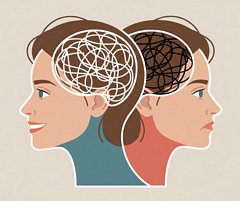
 All-or-nothing thinking—the habit of seeing life in rigid extremes—distorts how you interpret events, relationships, and even your own ability to change. It works beneath conscious attention, which is why it’s so persistent.
A tough review feels like proof you’re bad at your job. A single fight feels like the relationship is broken. One missed workout feels like weeks of effort wasted. The distortion feels true in the moment, and it piles up until ordinary life seems heavier than it really is.
The problem is you don’t experience it as distortion. You experience it as clarity. The verdict feels more honest than the nuanced truth it replaces. That’s why the best way to break the pattern isn’t reflection—it’s catching the language that signals it.
- “Always” / “Never”—Turns one bad day into a permanent law.
- “Everyone” / “No one”—Collapses individuals into sweeping verdicts.
- “Ruined” / “Total failure” / “Hopeless”—Treats partial setbacks as absolute disasters.
- “If I’m not the best, I’m worthless”—Makes perfection the only acceptable outcome.
- “Since I already blew it…”—Stops effort cold, as if one mistake decides everything.
Idea for Impact: All-or-nothing thinking isn’t clarity—it’s distortion. Catch the words, break the spell, and act from accuracy instead of extremes.
 In
In 
 Minor annoyances can drain you more than you realize. They don’t vanish after the moment passes; they linger, filling every bit of mental space you allow them. The irritation itself is brief, but the
 Real connection isn’t in the highlight reel of coffee dates or parties. It’s forged in the unglamorous trenches of daily life.
 A lie is rarely noble. A truth without tact is often cruelty dressed up as virtue.
 When stress builds, some people instinctively take a few minutes to clean. It’s more than a quick break—it’s a
  My friend Jack recently offered a retrospective on his decade-long dalliance with sneaker trends—a ride as unpredictable as it was swift. He began faithfully attached to New Balance, those once-maligned “dad shoes” that screamed suburban resignation. Then came Converse, adopted not for comfort but for credibility, as his children entered the age of judgment and he entered the age of trying not to embarrass them. Shortly thereafter, he flirted with On sneakers during a Lululemon-inspired phase that boldly declared, “I’m trendy, indeed!” Yet as fashion’s fickle currents swept him toward HOKA’s cloud-like comforts, Jack eventually circled back to a reinvented New Balance—now celebrated as a bona fide streetwear icon. Worn out by the relentless trend chase, he