• Skip to content
  • Skip to primary sidebar

Right Attitudes

Ideas for Impact

Mindfulness

Make Friends Now with the People You’ll Need Later

June 10, 2019 By Nagesh Belludi Leave a Comment

Addison Schonland of the commercial aerospace consulting firm AirInsight describes how the 737 MAX hullabaloos have exposed shortfalls in Boeing’s crisis communications and public relations:

The MAX crisis demonstrated to everyone in aerospace media how poorly Boeing was prepared for the recent crashes. More importantly, Boeing was unprepared for the onslaught of information that started to flow freely after the crashes. … In the absence of communications from Boeing, subject matter experts, whether highly qualified or not, become media stars overnight. An information vacuum cannot exist in today’s 24-hour news cycle and the Internet. The demand for information is great, and somebody will fill the vacuum.

The fact that Boeing had to clam up about the crashes for legal reasons is well understood. But the lack of transparency about design decisions, how the company made trade-off choices when creating the MAX, and issues related to the certification process left Boeing exposed.

Rival Airbus has traditionally reached out and established relationships with the aerospace media:

Airbus spends a lot of money once per year inviting the media to an event it calls “Innovation Days”. A week ago, at the most recent event, there were 130 media members from almost every country. Airbus briefed the media on both their products and plans …. Airbus provided access to the key leaders so attendees could speak with them and ask questions, with unrestricted Q&As with C-Suite executives who stayed for a substantial period of time.

Airbus clearly has an ROI. From the perspective of an attendee, and having attended several, is that the media comes away from the event informed. But more importantly, attendees feel they understand what Airbus is doing.

Airbus, through these events, communicates with the trade and news media. This communication provides attendees with, de minimis, a sympathetic view. If Airbus had suffered the two crashes, we believe the press would not have attacked the company the same way it has Boeing.

Schonland highlights how such a web of relationships becomes indispensable during a crisis, whether the crisis is self-inflicted or caused by external events:

By not being more open Boeing has helped create a gap between itself and much of the media. … Boeing has lost any control of the [737 MAX disaster] story. Whatever Boeing does provide now is seen as biased and self-serving—there is little goodwill from the media. When [Boeing CEO] Dennis Muilenburg goes on television for the rare interview, he does not come across as well as he might. Why is that? Because everything he says is now filtered through a non-sympathetic, hyper-critical lens.

Boeing needs to invest in the small army of trade and press media that cover the industry—not just a handful of selectees. This small army provides crucial perspective en masse during a crisis and fills the vacuum with educated views and perspective.

Businesses that fail to develop such goodwill or simply lose their way with regard to public relations become vulnerable to condemnation and backlash. This can result in a wide-ranging loss of credibility, as has transpired with Boeing and its leadership.

Idea for Impact: Invest in formal and informal relationships with key external constituents who can help your business—and personal—interests. The Guanxi tradition in the Chinese culture has it just about right in placing a huge emphasis on building social capital through relationships. From Wikipedia,

At its most basic, guanxi describes a personal connection between two people in which one is able to prevail upon another to perform a favor or service, or be prevailed upon, that is, one’s standing with another. … Guanxi can also be used to describe a network of contacts, which an individual can call upon when something needs to be done, and through which he or she can exert influence on behalf of another.

Wondering what to read next?

  1. No Boss Likes a Surprise—Good or Bad
  2. Any Crisis Calls for Constant, Candid Communication
  3. The Likeability Factor: Whose “Do Not Pair” List Includes You?
  4. Could Limiting Social Media Reduce Your Anxiety About Work?
  5. Leadership is Being Visible at Times of Crises

Filed Under: Effective Communication, Leadership Tagged With: Aviation, Conflict, Getting Along, Leadership, Leadership Lessons, Mindfulness, Networking, Relationships, Skills for Success, Stress, Winning on the Job

When Stress is Good

November 5, 2018 By Nagesh Belludi Leave a Comment

Stress and Anxiety Can Lead to Improved Performance

Why Some Stress Is Good for You Many people claim that they work best under pressure. There’s some truth to that. Stress is a natural response in highly competitive environments. Before an exam, important meeting, or contest, your heart rate rises and so does your blood pressure. You become more absorbed, alert, and efficient.

However, this favorable relationship applies only up to a certain level of stress. Past this level, stress impairs your performance—and eventually your heart.

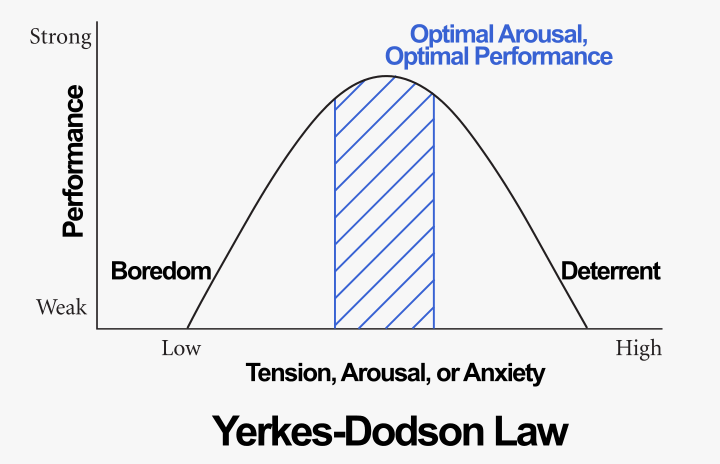
In 1908, Harvard psychologists Robert Yerkes and John Dodson first described the beneficial and harmful effects of stress (“psychological arousal”) on performance in a graph the shape of an upside-down U. According to the Yerkes-Dodson Law, the ascendant curve reflects the energizing effect of arousal. The descendant curve reflects the negative effects of stress on thinking and learning, or performance in general.

Too Much Anxiety and Stress Impairs Performance, but so Does Too Little: The Yerkes-Dodson Law

Many physiological studies have demonstrated that stress enhances your performance by causing your brain to use more of its capabilities, improve memory and intelligence, and increase productivity. Without stress, athletes, performers, executives, and students are likely to underachieve.

There is an optimum level of arousal for every kind of task. So how do you find the right balance? How do you get yourself into the performance zone where stress is most helpful? How much stress is good? The answers depend on individual disposition, the types of stressors, the nature of the task itself, and perceptions of what is stressful to you.

When Stress is Good: The Yerkes-Dodson Law

Idea for Impact: Stress at Work May Be Inevitable but it Doesn’t Have to Be Detrimental

Stress can be a motivator. But don’t seek out stress—less of it is better. Make the stress you do have work for you. Becoming conscious of stress as a potential positive can reduce the harm it causes.

  • Develop an awareness of when you hit the limits beyond which working longer or harder is counter-productive (sportsmen tend to choke under intense pressure.) When you feel overwhelmed, look for ways to reduce or eliminate the stressors so you can become more productive again. Ask for help.
  • Performance deteriorates when your stress level is either too high or too low for a given task. Seek the optimal level of anxiety that can impel you forward without causing you to fight back or give up.

Idea for Impact: The Right Level of Anxiety Can Be a Positive Force for Driving Employees Forward

Anxiety and optimal performance is an individual affair. The Yerkes-Dodson Curve shifts as the performers become established and experienced with the undertaking.

Astute managers repeatedly assess and re-assess where their team members land on the Yerkes-Dodson Curve. Managers can identify over-stressed or under-motivated circumstances with employees and intervene quickly to tailor the level of stress.

Wondering what to read next?

  1. The Power of Negative Thinking
  2. Get Everything Out of Your Head
  3. Cope with Anxiety and Stop Obsessive Worrying by Creating a Worry Box
  4. What Airline Disasters Teach About Cognitive Impairment and Decision-Making Under Stress
  5. The Law of Petty Irritations

Filed Under: Managing People, Sharpening Your Skills Tagged With: Anxiety, Decision-Making, Introspection, Mindfulness, Motivation, Procrastination, Stress, Targets, Worry

I’ll Be Happy When …

October 19, 2018 By Nagesh Belludi Leave a Comment

It is fallacious to let life slip away in the pursuit of the illusion that, “When I achieve something, I will be free to live in happiness.”

If you pursue a job, a relationship, a house, a material possession, or the settlement of a debt, happiness will never come because there is always another “something” that will follow the present one. The circumstances that you thus wait for do provide a transitory elation, but, too soon, they withdraw into the dull and mundane, only to be replaced by the next fantasy of happiness.

The Art of Simple Existence is One of the Most Difficult to Master

According to Buddhism, the art of simple existence is one of the most difficult to master. If you aren’t living in peace and happiness at this moment, you’ll never be able to. If you truly want to be at peace, you must be at peace right now. Otherwise, there is only the aspiration of peace “someday when I accomplish something.”

The experience of pleasure, freedom, and love are available now, whatever your circumstance. The American clinical psychologist John Welwood reminds us of this in Ordinary Magic: Everyday Life as Spiritual Path:

Our society would have us believe that inner satisfaction depends on outer success and achievement. Yet struggling to “get somewhere” keeps us perpetually busy, stressed out, and disconnected from that essential inner resource—our ability to be fully present—which could provide a real sense of joy and fulfillment. Our life is unsatisfactory only because we are not living it fully, but instead we are pursuing a happiness that is always somewhere else, other than where we are right now…

Cultivating the capacity to be fully present—awake, attentive, and responsive—in all the different circumstances of life is the essence of spiritual practice and realization. Those with the greatest spiritual realization are those who are “all here,” who relate to life with an expansive awareness that is not limited by any fixation on themselves or their own point of view. They don’t shrink from any aspect of themselves or life as a whole.

Idea for Impact: When One Lives, One Must Live Entirely

However difficult your circumstances, however uncertain the times, peace is not to be earmarked for a future time. The definitive source of happiness lies in the quality of your thoughts. Real sustainable peace springs from a healthy and nurturing relationship with yourself. Let nothing and nobody take that away from you. Don’t postpone being at peace.

Wondering what to read next?

  1. The Simple Life, The Good Life // Book Summary of Greg McKeown’s ‘Essentialism’
  2. On Black Friday, Buy for Good—Not to Waste
  3. Having What You Want
  4. The Gift of the Present Moment
  5. Live as If You Are Already Looking Back on This Moment with Longing

Filed Under: Living the Good Life, Sharpening Your Skills Tagged With: Attitudes, Balance, Buddhism, Discipline, Happiness, Materialism, Mindfulness, Money, Motivation, Philosophy, Simple Living, Wisdom

Summary of Richard Carlson’s ‘Don’t Sweat The Small Stuff’

September 4, 2018 By Nagesh Belludi 1 Comment

Stress follows a peculiar principle: when life hits us with big crises—the death of a loved one or a job loss—we somehow find the inner strength to endure these upheavals in due course. It’s the little things that drive us insane day after day—traffic congestion, awful service at a restaurant, an overbearing coworker taking credit for your work, meddling in-laws, for example.

It’s all too easy to get caught up in the many irritations of life. We overdramatize and overreact to life’s myriad tribulations. Under the direct influence of anguish, our minds are bewildered and we feel disoriented. This creates stress, which makes the problems more difficult to deal with.

'Don't Sweat The Small Stuff' by Richard Carlson (ISBN 0786881852) The central thesis of psychotherapist Richard Carlson’s bestselling Don’t Sweat The Small Stuff… And It’s All Small Stuff (1997) is this: to deal with angst or anger, what we need is not some upbeat self-help prescriptions for changing ourselves, but simply a measure of perspective.

Perspective helps us understand that there’s an art to understand what we should let go and what we should concern ourselves with. As I mentioned in my article on the concept of opportunity cost, it is important to focus our efforts on the important stuff, and not waste time on the insignificant and incidental things.

I’ve previously written about my favorite 5-5-5 technique for gaining perspective and guarding myself against anger erupting: I remove myself from the offending environment and contemplate if whatever I’m getting worked up over is of importance. I ask myself, “Will this matter in 5 days? Will this matter in 5 months? Will this matter in 5 years?”

Carlson stresses that there’s always a vantage point from which even the biggest stressor can be effectively dealt with. The challenge is to keep making that shift in perspective. When we achieve that “wise-person-in-me” perspective, our problems seem more controllable and our lives more peaceful.

Carlson’s prescriptions aren’t uncommon—we can learn to be more patient, compassionate, generous, grateful, and kind, all of which will improve the way we feel about ourselves and the way that other people feel when they are around us.

Some of Carlson’s 100 recommendations are trite and banal—for example, “make peace with imperfection,” “think of your problems as potential teachers,” “remember that when you die, your ‘in-basket’ won’t be empty,” and “do one thing at a time.” Others are more edifying:

  • Let others have the glory
  • Let others be “right” most of the time
  • Become aware of your moods and don’t allow yourself to be fooled by the low ones
  • Look beyond behavior
  • Every day, tell at least one person something you like, admire, or appreciate about them
  • Argue for your limitations, and they’re yours
  • Resist the urge to criticize
  • Read articles and books with entirely different points of view from your own and try to learn something

Carlson’s succinct insights have hit home with legions of the hurried and the harried. He became a bestselling author and a sought-after motivational speaker. Before his tragic death in 2006 at age 45, Carson followed up “Don’t Sweat The Small Stuff…” with some 20 tacky spinoffs intended particularly for spouses, parents, teenagers, new-weds, employees, and lovers.

Wondering what to read next?

  1. Learn to Manage Your Negative Emotions and Yourself
  2. The More You Can Manage Your Emotions, the More Effective You’ll Be
  3. Anger is the Hardest of the Negative Emotions to Subdue
  4. Cope with Anxiety and Stop Obsessive Worrying by Creating a Worry Box
  5. The Law of Petty Irritations

Filed Under: Living the Good Life, Sharpening Your Skills Tagged With: Anger, Anxiety, Books, Conflict, Emotions, Getting Along, Mindfulness, Stress, Suffering, Thinking Tools, Thought Process, Wisdom, Worry

How Mindfulness Can Make You Better at Your Job // Book Summary of David Gelles’s ‘Mindful Work’

April 4, 2018 By Nagesh Belludi Leave a Comment

Mindfulness Simply Means Being Aware and Being Present

Most religions and spiritual practices encourage some sort of meditation and mindfulness. However, the specific practice of bringing your attention and your focus to the present moment, and observing and accepting the experience as is, is most commonly associated with the Eastern meditative traditions.

Mindfulness is an element of the Buddhist Noble Eightfold Path to nirvana (enlightenment.) The Buddha taught that a mistaken perception of reality inevitably leads to suffering. Mindfulness is the primary means of bridging that gap between how things seem to be and how they really are.

Attending to What Happens to Our Minds, Hearts, Attitudes, and Actions

In its secular form, mindfulness is but a practice of consciousness. It is heedfulness or awareness of your subjective thoughts, behaviors, and experiences—without evaluating or judging them.

Mindfulness can help you, through direct experience, become more comfortable with your life and to be better able to cope with the problems and issues in your daily life.

The heightened mental receptivity, together with an increased sensitivity to the environment, better openness to new information, and a sharper decision-making are understood to produce a great number of physiological and psychological benefits.

Mindfulness is the Best Antidote to Anxiety

In a world that barrages us with information and demands us to be incessantly active and reactive, mindlessness is being embraced increasingly in the mainstream culture. As a supplement to yoga, and without any specific religious association, mindfulness is today practiced as a way to prevent being swept away in an avalanche of thought, activity, and emotion.

'Mindful Work' by Eamon Dolan (ISBN 0544705254) David Gelles’s Mindful Work: How Meditation Is Changing Business from the Inside Out provides a remarkable account of the ever-increasing adoption of meditation-based mindfulness. Prominent American corporations such as Google, General Mills, Aetna, and Ford have built mindfulness-themed employee wellness initiatives to foster a happier, more productive workplace.

Gelles brings a business journalist’s objectivity to draw together his experience of practicing meditation for 15 years. He also reviews scientific research that has evidenced how people who have a mindfulness routine are less distractible and better at concentrating, even when multi-tasking.

Scientific research is making the benefits clear. Studies show that mindfulness strengthens our immune systems, bolsters our concentrative powers, and rewires our brains. Just as lifting weights at the gym makes our muscles stronger, so too does practicing mindfulness make our minds stronger. And the most tried-and-true method of cultivating mindfulness is through meditation.

Gelles discusses the teachings of many key influencers in the development of the mindfulness movement. The rising popularity of meditative mindfulness in the West has its genesis in a retreat organized in the ’70s by Thich Nhat Hanh, a Zen Buddhist monk and teacher. One of his attendees, the University of Massachusetts psychologist Jon Kabat-Zinn, integrated Hanh’s teachings with yoga and medical science, and created the popular eight-week “Mindfulness-Based Stress Reduction” course. Over the decades, other psychologists developed mindfulness-based interventions that allow patients to observe their cognitive and behavioral processes.

Gelles summarizes much of the recent research that has confirmed the centuries-old Eastern wisdom about mindfulness practices. Developments in contemplative neuroscience have corroborated the effects that meditative mindfulness has on supporting the body’s immune system and counteracting the symptoms of burnout.

Indeed, mindfulness seems to change the brain in some specific ways. Broadly speaking, mindfulness increases activity in parts of the prefrontal cortex, an evolutionarily recent region of the brain that is important for many of the things that make us human. This region is the seat of much of our higher-order thinking-our judgment, decision making, planning, and discernment. The prefrontal cortex is also an area that seems to be more active when we are engaged in pro-social behavior—things like compassion, empathy, and kindness.

Some studies have shown that folks who practice meditation have a less perturbed amygdala. That means that the brain is less vulnerable to interpreting many flight-or-fight stimuli as threats and triggering anger, stress, or a defense reaction.

Meditative Mindfulness in the Emerging Context of Consumer Culture

Gelles warns that capitalism and commercialization could, due to many increasingly-visible entrepreneurial teachers, complicate something as seemingly simple as observing one’s breath and paying attention.

I’m sympathetic to the skeptics, who worry that a noble practice is being quickly corrupted by modern marketing. But having witnessed mindfulness in action for fifteen years, it is clear to me that rarely, if ever, does exposure to meditation make someone a worse person. On balance, the folks who become more mindful tend to be happier, healthier, and kinder. Nevertheless, it is worth addressing the various critiques of mainstream mindfulness, if only to put them to rest.

…

Even today, some of the most popular gurus in America have demonstrated a penchant for bling that strikes many as being out of touch with their mantra of inner peace. Bikram Choudhury, the litigious yoga teacher, cuts the figure of an oligarch, driving around Beverly Hills in a Rolls-Royce and sporting a gold-encrusted Rolex. A Thai monk with a taste for Louis Vuitton luggage and private jets had his assets frozen by authorities in 2013.

A Few Minutes a Day is All You Need to Reap the Benefits of Mindfulness

Recommendation: Read David Gelles’s Mindful Work. This helpful tome offers a succinct rundown of the benefits of mindfulness. In an era where our culture is increasingly questioning the frenzy of activity and reactivity that has entrenched the current way of life, mindfulness will continue to draw many mainstream practitioners for its ability to promote stress-reduction and produce improvements in one’s overall emotional state and outlook on life.

Indeed, mindfulness is about much more than simply observing sensations as they occur. It is about what happens to our minds, hearts, and actions when we deliberately continue these practices for weeks, months, and years. Mindfulness is a practice that allows us to achieve more sustainable happiness and to grow more compassionate. And over time, mindfulness requires one to confront thorny concepts like impermanence and compassion.

Wondering what to read next?

  1. Make a Habit of Stepping Back from Work
  2. To Rejuvenate Your Brain, Give it a Break
  3. Zen in a Minute: Centering with Micro-Meditations
  4. How to Boost Your Willpower // Book Summary of Baumeister & Tierney’s ‘Willpower’
  5. How to Clear Your Mental Horizon

Filed Under: Health and Well-being, Living the Good Life Tagged With: Balance, Books, Discipline, Mindfulness, Stress

Admit When You Don’t Have All the Answers

March 27, 2018 By Nagesh Belludi Leave a Comment

As a leader or as a salesperson, your employees or customers expect you to have the answers. However, there’ll times when you may not know the answer to difficult questions right away. To avoid losing credibility and causing others to question your knowledge, it’s important to know how to handle the situation properly.

Folks Don’t Want to Confess to Not Knowing Enough

Having quick, confident answers is often seen as a mark of proficiency and leadership. For that reason, you may be conditioned to believe that “not knowing” makes you look exposed. You may assume that any gaps in knowledge should be veiled at all costs.

Rather than admitting that you don’t have an answer to a tough question, you may tend to make something up on the fly, fast-talk, or stumble your way with a dubious response. Rookie salespeople are particularly prone to this—they tend to give answers they believe their prospective customers want to hear.

Consequently, in trying to look strong, you’ll end up looking weak.

The Power of Saying “I Don’t Know”

The ability to recognize one’s limitations is an underappreciated intellectual skill. A humble individual is all too aware of the confines of his/her corpus of knowledge.

Intellectual growth can come about only when the humble person can admit to not knowing enough and opening up to the possibilities of learning.

In an interview at the Wharton school, Carol Bartz (the no-nonsense, swearword-spewing former executive at Yahoo, Autodesk, and Sun Microsystems) commented about this false bravado and misplaced poise:

The phrase, “I don’t know” is in fact a strength. I have a [nonsense] detector that is really good, really good. And I love playing with people who rubbish me. I would much prefer if someone told me, “Not only do I not know the answer, but I wouldn’t even know how to get it. Could we talk about how, and I can get back to you?” That is so, so powerful. I don’t care how old or seasoned or how high you are in an organization. Saying “I don’t know” can give you the vulnerability you need to lead better.

Idea for Impact: Don’t Be Afraid to Admit What You Don’t Know

Great leaders know when to admit “I don’t know” and how to follow up appropriately. When you’re tempted to misrepresent your understanding, try to declare,

  • “I don’t know the answer at this time, but I will get back to you.”
  • “Good point. I don’t know, but I’m interested in what you think.”
  • “I don’t know, but let’s consult someone who knows more about this.”
  • “I don’t know, but I can do more research and incorporate those risk factors in our contingency plans.”

To be appreciated as a reliable, confident, and ethical person, be willing to admit that you don’t have all the answers. This act of humility and the readiness to seek the help of others can inspire greater trust within your team and encourage others to follow suit.

Be honest and direct when dealing with people, and they’ll respect you even if you aren’t able to answer all their questions.

Wondering what to read next?

  1. Question Success More Than Failure
  2. What It Means to Lead a Philosophical Life
  3. Why Others’ Pride Annoys You
  4. Could Limiting Social Media Reduce Your Anxiety About Work?
  5. Learn to Manage Your Negative Emotions and Yourself

Filed Under: Mental Models, Sharpening Your Skills Tagged With: Attitudes, Ethics, Getting Along, Humility, Introspection, Mindfulness, Virtues, Wisdom

What Airline Disasters Teach About Cognitive Impairment and Decision-Making Under Stress

February 27, 2018 By Nagesh Belludi Leave a Comment

Airline disasters often make great case studies on how a series of insignificant errors can build up into catastrophes.

As the following two case studies will illuminate, unanticipated pressures can force your mind to quickly shift to a panic-like state. As it searches frenetically for a way out of a problem, your mind can disrupt your ability to take account of all accessible evidence and attend rationally to the situation in its entirety.

Stress Can Blind You and Limit Your Ability to See the Bigger Picture: A Case Study on Eastern Airlines Flight 401

Eastern Airlines Flight 401 crashed on December 29, 1972, killing 101 people.

As Flight 401 began its approach into the Miami International Airport, first officer Albert Stockstill lowered the landing gear. But the landing gear indicator, a green light to verify that the nose gear was correctly locked in the “down” position, did not switch on. (This was later verified to be caused by a burned-out light bulb. Regardless of the indicator, the landing gear could have been manually lowered and verified.)

The flight deck got thrown into a disarray. The flight’s captain, Bob Loft, sent flight engineer Don Repo to the avionics bay underneath the flight deck to verify through a small porthole if the landing gear was actually down. Loft simultaneously directed Stockstill to put the aircraft on autopilot. Then, when Loft unintentionally leaned against the aircraft’s yoke to speak to Repo, the autopilot mistakably switched to a wrong setting that did not hold the aircraft’s altitude.

The aircraft began to descend so gradually that it could not be perceived by the crew. With the flight engineer down in the avionics bay, the captain and the first officer were so preoccupied with the malfunction of the landing gear indicator that they failed to pay attention to the altitude-warning signal from the engineer’s instrument panel.

Additionally, given that the aircraft was flying over the dark terrain of the Everglades in nighttime, no ground lights or other visual cues signaled that the aircraft was gradually descending. When Stockstill eventually became aware of the aircraft’s altitude, it was too late to recover the aircraft from crashing.

In summary, the cause of the Flight 401’s crash was not the nose landing gear, but the crew’s negligence and inattention to a bigger problem triggered by a false alarm.

Stress Can Blind You into Focusing Just on What You Think is Happening: A Case Study on United Airlines Flight 173

United Airlines Flight 173 crashed on December 28, 1978, in comparable circumstances.

When Flight 173’s pilots lowered the landing gear upon approach to the Portland International Airport, the aircraft experienced an abnormal vibration and yaw motion. In addition, the pilots observed that an indicator light did not show that the landing gear was lowered successfully. In reality, the landing gear was down and locked in position.

With the intention of troubleshooting the landing gear problem, the pilots entered a holding pattern. For the next hour, they tried to diagnose the landing gear glitch and prepare for a probable emergency landing. During this time, however, none of the pilots monitored the fuel levels.

When the landing gear problem was first suspected, the aircraft had abundant reserve fuel—even for a diversion or other contingencies. But, all through the hour-long holding procedure, the landing gear was down and the flaps were set to 15 degrees in anticipation of a landing. This significantly increased the aircraft’s fuel burn rate. With fuel exhaustion to all four engines, the aircraft crashed.

To sum up, Flight 173’s crew got preoccupied with the landing gear’s malfunction and harried preparations for an emergency landing. As a result of their inattention, the pilots failed to keep tabs on the fuel state and crashed the aircraft.

Stress Can Derail Your Train of Thought

Under pressure, your mind will digress from its rational model of thinking.

The emotional excitement from fear, anxiety, time-pressure, and stress can lead to a phenomenon known as “narrowing of the cognitive map.” This tunnel vision can restrict your field of mindful attention and impair your ability for adequate discernment.

Situational close-mindedness can constrict your across-the-board awareness of the situation and force you overlook alternative lines of thought.

Idea for Impact: To combat cognitive impairment under stress, use checklists and standard operating procedures, as well as increased training on situational awareness, crisis communication, and emergency management, as the aviation industry did in response to the aforementioned incidents.

Wondering what to read next?

  1. How Stress Impairs Your Problem-Solving Capabilities: Case Study of TransAsia Flight 235
  2. Lessons from the World’s Worst Aviation Disaster // Book Summary of ‘The Collision on Tenerife’
  3. Lessons from the Princeton Seminary Experiment: People in a Rush are Less Likely to Help Others (and Themselves)
  4. “Fly the Aircraft First”
  5. Under Pressure, The Narrowing Cognitive Map: Lessons from the Tragedy of Singapore Airlines Flight 6

Filed Under: Business Stories, Mental Models, Sharpening Your Skills Tagged With: Anxiety, Aviation, Decision-Making, Emotions, Mindfulness, Problem Solving, Risk, Stress, Thinking Tools, Thought Process, Worry

What the Buddha Taught About Restraining and Dealing with Anger

December 1, 2017 By Nagesh Belludi 2 Comments

Buddhist psychology identifies anger as one of the six root kleshas, detrimental emotional states that can cloud the mind, lead us to “unwholesome” actions, and cause our suffering.

Chapter XVII of the Dhammapada (ref. Max Muller’s Wisdom of the Buddha) compiles the teachings of the Buddha and his monastic community on the topic of restraining and dealing with anger:

  • “He who holds back rising anger like a rolling chariot, him I call a real driver; other people are but holding the reins.” (Verse 222)
  • “Beware of bodily anger, and control thy body! Leave the sins of the body, and with thy body practise virtue!” (Verse 231)
  • “Beware of the anger of the tongue, and control thy tongue! Leave the sins of the tongue, and practise virtue with thy tongue!” (Verse 232)
  • “Beware of the anger of the mind, and control thy mind! Leave the sins of the mind, and practise virtue with thy mind!” (Verse 233)
  • “The wise who control their body, who control their tongue, the wise who control their mind, are indeed well controlled.” (Verse 234)

As I’ve mentioned before, you will be at a marked disadvantage in life if you’re unable to perceive, endure, and manage negative emotions. And anger is the hardest of the negative emotions to subdue.

Despite the seemingly abstract nature of the questions philosophers ask, most philosophy books argue that investigating the nature of anger is important. Not only is it such a destructive emotion, but anger often sums up many other self-judgments—sadness, powerlessness, fear, regret—that are entwined into it.

The Zen priest Jules Shuzen Harris advices approaching feelings of anger with awareness and mindfulness in his insightful article on “Uprooting the Seeds of Anger” in the Summer 2012 issue of Tricycle: The Buddhist Review:

We must remember that we create our own anger. No one makes it for us. If we move from a particular event directly to our reaction, we are skipping a crucial awareness, a higher perspective on our own reactivity. What is that middle step, that deeper awareness? It is mindfulness about our own beliefs, our attitude, our understanding or lack of understanding about what has really happened. We notice that a given situation reliably provokes our anger, and yet somebody else can be exposed to the very same situation and not react angrily. Why is that? No one can tell us: we each have to find the answer ourselves, and to do that, we need to give ourselves the space to reflect mindfully.

We’re going to keep getting angry. It’s going to come up. It has come up in our lives before, and it will come up again. This practice is about becoming more mindful, becoming aware of how we are getting stuck. With care and work, we find ways to get unstuck. But we also know that the moment we get unstuck, we’re going to get stuck again. That’s why it is called practice—we never arrive. So when you find yourself upset or angry, use the moment as a part of your practice, as an opportunity to notice and uproot the seeds of anger and move into the heart of genuine compassion.

And as stated by the Chinese Sutra of Forty-two Chapters,

For those with no anger,
how can anger arise?
When you practice deep looking and master yourself,
you dwell in peace, freedom, and safety.
The one who offends another
after being offended by him,
harms himself and harms the other.
When you feel hurt
but do not hurt the other,
you are truly victorious.
Your practice and your victory benefit both of you.
When you understand the roots of anger in yourself and in the other,
your mind will enjoy true peace, joy, and lightness.
You become the doctor who heals himself and heals the other.
If you don’t understand,
you will think not getting angry to be the act of a fool.

Wondering what to read next?

  1. Change Your Perspective, Change Your Reactions
  2. Don’t Let Hate Devour You
  3. Learn to Manage Your Negative Emotions and Yourself
  4. The More You Can Manage Your Emotions, the More Effective You’ll Be
  5. Anger is the Hardest of the Negative Emotions to Subdue

Filed Under: Living the Good Life, Mental Models, Sharpening Your Skills Tagged With: Anger, Buddhism, Emotions, Getting Along, Mindfulness, Relationships, Suffering, Wisdom

Moral Disengagement Leads People to Act Immorally and Justify Their Unprincipled Behavior

November 20, 2017 By Nagesh Belludi Leave a Comment

Temptation of Christ on the First Day of Lent

Rationality Drives Human Behavior Only After Emotion and Impulse Lose Their Hegemony

People adapt moral standards that dissuade them from objectionable behavior. But these moral standards do not serve as a steadfast regulator of their moral actions. Occasionally, circumstances can make people to become selectively disengaged from those moral self-sanctions and end up pursuing unprincipled actions.

Particularly when people feel angry, pressured, or depressed, their mental footing tends to ebb away. Any state of emotional threat can let up their determination to act ethically and resist temptations. They lose discipline, get into a defensive mode, and become susceptible to thinking only about short-term benefits. They are more likely to engage in self-absorbed behaviors that they would otherwise spurn, especially if the payoff for such behavior is high and the odds of getting caught and punished are low.

Circumstances Sometimes Sway People to Engage in Behaviors That Conflict with Their Internalized Moral Standards

Moral disengagement is the psychological phenomenon that describes how people rationalize behavior that is at odds with their own moral principles. For example, suppose a teenager who has a principled framework that forbids theft. If he takes a newspaper without paying for it from a Starbucks store, he may rationalize his actions by telling himself that Starbucks warranted some harm because it overcharges its consumers and, until recently, purchased not all its coffee beans from certified fair trade sources.

'Moral Disengagement' by Albert Bandura (ISBN 1464160058) People engaging in wrongdoing often see that the rules are uncalled-for and unjustifiable. In their judgment, even though they may be breaking the rules and flouting conventions, they’re persuaded that they’re really not doing anything wrong because the rules deserve to be violated.

Moral reasoning usually deprives people when they devalue their prey and malign their victims (“her tattletaling deserved it” or “he brandish a knife, hence I pulled out my gun.”)

Stanford Psychologist Albert Bandura, who introduced the concept of moral disengagement, identified eight cognitive mechanisms (book) that disengage a person’s internal moral standards from his/her actions, thereby causing unethical behavior without conspicuous remorse or self-censure.

Idea for Impact: Be Wary of Suspending Your Moral Standards to Reduce Self-Censure

When circumstances or people provoke you to potentially regretful behavior, realize that you are a self-determining agent, and that you have a moral and ethical responsibility to behave with integrity and pursue wholesome actions. Step back and ask yourself, “Normally, would I judge this contemplated action to be wrong? Are my ways of thinking flawed? Am I defending the harm I am causing by blaming others? Am I criticizing the victim to justify my destructive actions?”

When in doubt, use Warren Buffett’s rule of thumb for personal integrity: “I want [people] to ask themselves whether they are willing to have any contemplated act appear the next day on the front page of their local paper—to be read by their spouses, children and friends—with the reporting done by an informed and critical reporter.”

Wondering what to read next?

  1. Learn to Manage Your Negative Emotions and Yourself
  2. The More You Can Manage Your Emotions, the More Effective You’ll Be
  3. Anger is the Hardest of the Negative Emotions to Subdue
  4. Summary of Richard Carlson’s ‘Don’t Sweat The Small Stuff’
  5. How People Defend Themselves in a Crisis

Filed Under: Living the Good Life, Mental Models, Sharpening Your Skills Tagged With: Anger, Anxiety, Decision-Making, Discipline, Emotions, Ethics, Mindfulness, Stress, Wisdom

How to Prevent a Communications Breakdown During Crisis

November 13, 2017 By Nagesh Belludi Leave a Comment

The ultimate test of a leader’s and an organization’s communication skills is how they deal with a crisis—natural disasters, crisis of confidence, acts of malevolence, strategic errors, acts of deception, management misconduct, and so forth.

It’s not difficult to see why communication is an important element of crisis management: leaders today have to tackle media that is unsympathetic to what it regards as management incompetence, shareholders and customers who are ever more demanding, legislation and regulation that is getting stricter, and competitors eager to pinch customers during times of distress.

Effective crisis communications must be able to have a consistent and clear message and present this message swiftly and regularly following a crisis.

Here are seven elements of effective crisis communication.

  1. Strategic Thinking: Think purposefully about what you want your constituencies (employees, stockholders, customers, suppliers, communities, the media) to know under the given circumstances. Many a routine problem has transformed into a crisis because too many people were told too much and the situation became exaggerated and out of control.
    • What happened
    • Who is responsible
    • Why did it happen
    • Who is affected
    • What should be done
    • Whom can we trust
    • What should we say
    • Who should say it
    • How should we say it
  2. Openness: When a crisis befalls, be prepared to talk about it internally and externally as assertively as you respond to the crisis operationally. Understand the expectations of your constituencies and go beyond what is expected or required. If you are not communicative enough, people may make erroneous assumptions about the crisis. Bad news can travel fast and sell best.
  3. Candor: If your constituencies should know about a crisis that your organization is experiencing, talk about it as quickly and as completely as you can, especially to those most directly affected.
  4. Concern: Keep the people most directly affected by the crisis updated until the crisis is completely resolved. Do not brand a whistle blower a troublemaker.
  5. Sensitivity: At the earliest possible moment, step back and analyze the impact of the crisis. Inform and alert all the constituencies that are affected. Demonstrate concern, compassion, sympathy, remorse, or contrition, whatever the case may require.
  6. Integrity: If you are responsible for the crisis or perceived as such, acknowledge the situation promptly. Be true to your corporate and personal conscience. Share the crisis action plan and seek inputs.
  7. Honesty: Learn from your mistakes and talk openly about what you’ve learned. Demonstrate your commitment to keeping errors and problems from resurfacing.

Idea for Impact: Reputation and goodwill represent a great part of business value. Protect yourself when faced with attacks on your reputation and competence. If you do not communicate effectively and frequently with your constituents, somebody else will. In the absence of information, your constituents can develop their own perceptions of the problem and its implications.

Wondering what to read next?

  1. How to … Break the Complaint Habit
  2. The More You Can Manage Your Emotions, the More Effective You’ll Be
  3. How People Defend Themselves in a Crisis
  4. Make Friends Now with the People You’ll Need Later
  5. How Stress Impairs Your Problem-Solving Capabilities: Case Study of TransAsia Flight 235

Filed Under: Effective Communication, Leadership Tagged With: Emotions, Leadership, Mindfulness, Relationships, Stress, Worry

« Previous Page
Next Page »

Primary Sidebar

Popular Now

Anxiety Assertiveness Attitudes Balance Biases Coaching Conflict Conversations Creativity Critical Thinking Decision-Making Discipline Emotions Entrepreneurs Etiquette Feedback Getting Along Getting Things Done Goals Great Manager Innovation Leadership Leadership Lessons Likeability Mental Models Mentoring Mindfulness Motivation Networking Parables Performance Management Persuasion Philosophy Problem Solving Procrastination Relationships Simple Living Social Skills Stress Suffering Thinking Tools Thought Process Time Management Winning on the Job Wisdom

About: Nagesh Belludi [hire] is a St. Petersburg, Florida-based freethinker, investor, and leadership coach. He specializes in helping executives and companies ensure that the overall quality of their decision-making benefits isn’t compromised by a lack of a big-picture understanding.

Get Updates

Signup for emails

Subscribe via RSS

Contact Nagesh Belludi

RECOMMENDED BOOK:
Made in America

Made in America: Sam Walton

Walmart founder Sam Walton’s very educational, insightful, and stimulating autobiography is teeming with his relentless search for better ideas.

Explore

  • Announcements
  • Belief and Spirituality
  • Business Stories
  • Career Development
  • Effective Communication
  • Great Personalities
  • Health and Well-being
  • Ideas and Insights
  • Inspirational Quotations
  • Leadership
  • Leadership Reading
  • Leading Teams
  • Living the Good Life
  • Managing Business Functions
  • Managing People
  • MBA in a Nutshell
  • Mental Models
  • News Analysis
  • Personal Finance
  • Podcasts
  • Project Management
  • Proverbs & Maxims
  • Sharpening Your Skills
  • The Great Innovators

Recently,

  • The Small Detail That Keeps a Conversation From Running Dry
  • Design for the 80% Experience
  • Inspirational Quotations #1143
  • The Hot-Desking Lie: How It Killed Focus and Gutted Collaboration
  • Unreliable Narrators Make a Story Sounds Too Neat
  • Bertrand Russell on The Value of Philosophy: Doubt in an Age of Dogma
  • Inspirational Quotations #1142

Unless otherwise stated in the individual document, the works above are © Nagesh Belludi under a Creative Commons BY-NC-ND license. You may quote, copy and share them freely, as long as you link back to RightAttitudes.com, don't make money with them, and don't modify the content. Enjoy!