• Skip to content
  • Skip to primary sidebar

Right Attitudes

Ideas for Impact

Introspection

How to Embrace Uncertainty and Leave Room for Doubt

September 7, 2020 By Nagesh Belludi Leave a Comment


The value of sound decision-making is to be mainly sought from embracing uncertainty.

As the Presocratic philosopher Xenophanes proclaimed, “All we have is but a woven web of guesses.”

The physicist Richard P. Feynman often talked about how doubt informs critical thinking and learning. In a 1964 lecture on “What Is and What Should Be the Role of Scientific Culture in Modern Society,” published in The Pleasure of Finding Things Out (1999,) Feynman warned,

A scientist is never certain. We all know that. We know that all our statements are approximate statements with different degrees of certainty; that when a statement is made, the question is not whether it is true or false but rather how likely it is to be true or false. … Scientific knowledge is a body of statements of varying degrees of certainty — some most unsure, some nearly sure, none absolutely certain.

Science produces ignorance, and ignorance produces more science, reminded Feynman in a 1963 lecture on “The Uncertainty of Science” published in The Meaning of It All (1999,)

To solve any problem that has never been solved before, you have to leave the door to the unknown ajar. You have to permit the possibility that you do not have it exactly right. Otherwise, if you have made up your mind already, you might not solve it.

When the scientist tells you he does not know the answer, he is an ignorant man. When he tells you he has a hunch about how it is going to work, he is uncertain about it. When he is pretty sure of how it is going to work, and he tells you, “This is the way it’s going to work, I’ll bet,” he still is in some doubt. And it is of paramount importance, in order to make progress, that we recognize this ignorance and this doubt. Because we have the doubt, we then propose looking in new directions for new ideas. The rate of the development of science is not the rate at which you make observations alone but, much more important, the rate at which you create new things to test.

The Czechoslovakia-born Israeli American scientist Itzhak Bentov formulated the so-called “Bentov’s Law,” reiterating that science produces ignorance both deliberately and unintentionally. In Stalking the Wild Pendulum: On the Mechanics of Consciousness (1977,) Bentov wrote,

One’s level of ignorance increases exponentially with accumulated knowledge. When one acquires a bit of new information, there are many new questions that are generated by it, and each new piece of information breeds five-ten new questions. These questions pile up at a much faster rate than does accumulated knowledge. Therefore, the more one knows, the greater his level of ignorance.

Idea for Impact: If you can’t tolerate uncertainty and ambiguity, you may as well embrace a fanatical ideology.

Learning the boundaries of your knowledge—the shortcomings, caveats, hedges, and the standard deviations toward everything you think you know—hones decision-making.

In other words, to get to the right answers, you first have to ask the right questions. So the first thing is to ponder about is what questions to ask and how to ask them. What are the things you don’t know, and how can you reach out into these areas that may be new to you to uncover somethings about the world and yourself?

Once you discover the answers, you’ll realize that approximate statements and varying degrees of certainty will require you to think probabilistically. Your inquiry shouldn’t be, “Will I be right, or will I be wrong?” but rather “What is the probability of this scenario versus that, and how does this judgment impact my choices?”

Leave room for doubt, even in your highest conviction ideas. If not, you’ll risk becoming smug and self-satisfied.

Wondering what to read next?

  1. Decision-Making Isn’t Black and White
  2. It’s Probably Not as Bad as You Think
  3. A Bit of Insecurity Can Help You Be Your Best Self
  4. Smart Folks are Most Susceptible to Overanalyzing and Overthinking
  5. Accidents Can Happen When You Least Expect Them: The Overconfidence Effect

Filed Under: Mental Models, Sharpening Your Skills Tagged With: Confidence, Conviction, Decision-Making, Introspection, Mindfulness, Questioning, Risk, Wisdom

The Power of Negative Thinking

May 21, 2020 By Nagesh Belludi Leave a Comment

Stoic philosophy recommends a practice called premeditatio malorum (“the premeditation of evils,”) i.e. intentionally visualizing the worst-case scenario in your mind’s eye.

The first point is to acknowledge that misfortunes and difficulties could, rather than certainly will, come about. The second is to envisage your most constructive response should the worst-case scenario transpire. For instance, if you’d lose your job due to coronavirus, what resources could you rely on, and how could you handle the consequences?

The direct benefit of premeditatio malorum is in taming your anxiety: when you soberly conjure up how bad things could go, you typically reckon that you could indeed cope. You’ll not dwell in the negative thoughts. Even the worst possible scenario couldn’t be so terrible after all.

Another surprising benefit of negative visualization is in raising your awareness that you could lose your relationships, possessions, routines, blessings, and everything else that you currently enjoy—but perhaps take for granted. This increases your gratitude for having them now.

This Stoic exercise has an equivalent in Buddhist meditation-based mindfulness practices that encourage nonjudgmental awareness of unpleasant sensations (the vedanā.)

Your emotions, sensations, and events are in flux. They arise and pass. You’re merely to regard yourself as the observer of these thoughts and feelings, but you’re not to identify with them. You are not your thoughts … you are not your feelings. The Buddhist teacher Jack Kornfield writes in The Wise Heart: A Guide to the Universal Teachings of Buddhist Psychology (2015,)

Thoughts and opinions arise but they think themselves and disappear, “like bubbles on the Ganges,” says the Buddha. When we do not cling to them, they lose their hold on us. In the light of awareness, the constructed self of our identification relaxes. And what is seen is just the process of life, not self nor other, but life unfolding as part of the whole.

Idea for Impact: Could you benefit from reflecting on how you think of potential negative events?

An awareness of the possible—and the self-determining attitude—can be quite liberating. Premeditatio malorum is a surprisingly useful technique, if only with a scary name.

“What then should each of us say as each hardship befalls us? It was for this that I was exercising, It was for this that I was training,” as Epictetus philosophized in Discourses (3.10.7–8.)

Wondering what to read next?

  1. Cope with Anxiety and Stop Obsessive Worrying by Creating a Worry Box
  2. Expressive Writing Can Help You Heal
  3. Get Everything Out of Your Head
  4. This May Be the Most Potent Cure for Melancholy
  5. How Thought-Stopping Can Help You Overcome Negative Thinking and Get Unstuck

Filed Under: Living the Good Life, Sharpening Your Skills Tagged With: Adversity, Anxiety, Conversations, Emotions, Introspection, Mindfulness, Resilience, Risk, Stress, Suffering, Worry

Let the Buddha Help You Appreciate the Role of Questions in Inquiry

March 19, 2020 By Nagesh Belludi Leave a Comment

The Athenian philosopher Socrates used a dialogic teaching method, now known as “Socratic Questioning.”

Socrates famously observed, “I know one thing, that I know nothing.” He habitually posed of ignorance even though he knew more about any subject matter than he let on. He led his pupils through a sequence of questions—not to test or assess them, but to draw out their “tacit knowledge.” According to Plato, Socrates assumed that a pupil already possesses the knowledge or the understanding, but is not aware of this until a skillful teacher can help the pupil draw it out of himself using leading questions.

In his dialogues, Socrates imparted no information about the subject of inquiry, but systematically asked questions. By responding to Socrates’s teased-out line of thinking, the pupils eventually arrived at the desired knowledge.

The Buddha’s Socratic Questioning Technique

Discoursing about finding cognizance through systematic inquiry, the Zen priest and poet Norman Fischer explains how the Buddha, like Socrates, used questions to help his disciples reveal the truth:

Buddha talked not because he was particularly loquacious, or because he was given to elaborate explanations, but in order to help people see through the smoke screen of their own language and views. Once someone asked him for his secret in answering questions as effectively as he did. He said that he had four ways of answering questions.

  • One way was categorically—just to say yes or no without ambiguity.
  • The second way was to examine the question analytically, clarifying definitions and trying to determine what was actually being said, usually by deconstructing it. Most of the time when the Buddha employed this method there was no need to answer the question: under analysis the question proved meaningless.
  • The third way was by posing a counterquestion, the purpose of which was to bring the questioner back to his or her own mind, redirecting attention away from the entanglement of the language of the question to something real that stood behind it.
  • The fourth way was simply to put the question aside, knowing that some questions are so hopelessly entangled that to take them up at all means beating your head against a wall—there is no end to it and you end up with a bloody head. To put the question aside is simply to walk around the wall. This way you can get to the other side without beating your head bloody. So sometimes the Buddha’s response to a question was silence.

Idea for Impact: Rational Inquiry is Driven by Questions

Become skilled at how to facilitate critical thinking with the Socratic Questioning technique. I recommend Richard Paul and Linda Elder’s excellent The Thinker’s Guide to the Art of Socratic Questioning (2006; excerpt.) Here’s a handy primer on the nine types of Socratic Questions.

With patience and loving-kindness, ask questions in such a way that can skillfully lead your interlocutors to a better understanding of themselves. Help them cross-examine and uncover the inconsistencies and errors of their thinking, and even change their mind—all without arguing with them.

You can also use Socratic Questioning for self-reflection, which in itself is a rhetorical device to discover the true self. Engage yourself in contemplation not to judge your past choices, but to ponder on them, learn from them, and make whatever changes you believe are right for you in the here and now.

Wondering what to read next?

  1. How to Embrace Uncertainty and Leave Room for Doubt
  2. Question Success More Than Failure
  3. Decision-Making Isn’t Black and White
  4. Imagine a Better Response
  5. Get Everything Out of Your Head

Filed Under: Career Development, Ideas and Insights Tagged With: Introspection, Mindfulness, Parables, Questioning, Wisdom

Question Success More Than Failure

March 5, 2020 By Nagesh Belludi Leave a Comment

Katrina “Kat” Cole, formerly CEO of the American baked goods-chain Cinnabon, in an interview for Adam Bryant’s “Corner Office” column in the New York Times:

I’ve learned to question success a lot more than failure. I’ll ask more questions when sales are up than I do when they’re down. I ask more questions when things seem to be moving smoothly, because I’m thinking: “There’s got to be something I don’t know. There’s always something.” This approach means that people don’t feel beat up for failing, but they should feel very concerned if they don’t understand why they’re successful. I made mistakes over the years that taught me to ask those questions.

People tend to attribute failure to external factors and success to their own abilities and performance (see self-serving bias and Dunning-Kruger effect.) The human brain is indeed riddled with cognitive and memory biases that are conducive to making people feel like they’re good and capable, regardless of reality.

Idea for Impact: Luck is so much more important than we acknowledge. Most successes and failures in life combine both skill and luck. Understanding the relative contributions of skill and luck in failure—and success, as Cole suggests above—can help you judge past and present results and, more significantly, prepare for future results.

Wondering what to read next?

  1. How to Avoid Magical Thinking
  2. Admit When You Don’t Have All the Answers
  3. Accidents Can Happen When You Least Expect Them: The Overconfidence Effect
  4. In Praise of Inner Voices: A Powerful Tool for Smarter Decisions
  5. Gambler’s Fallacy is the Failure to Realize How Randomness Rules Our World

Filed Under: Mental Models, Sharpening Your Skills Tagged With: Attitudes, Biases, Critical Thinking, Humility, Introspection, Luck, Mindfulness, Questioning, Thinking Tools, Wisdom

When Stress is Good

November 5, 2018 By Nagesh Belludi Leave a Comment

Stress and Anxiety Can Lead to Improved Performance

Why Some Stress Is Good for You Many people claim that they work best under pressure. There’s some truth to that. Stress is a natural response in highly competitive environments. Before an exam, important meeting, or contest, your heart rate rises and so does your blood pressure. You become more absorbed, alert, and efficient.

However, this favorable relationship applies only up to a certain level of stress. Past this level, stress impairs your performance—and eventually your heart.

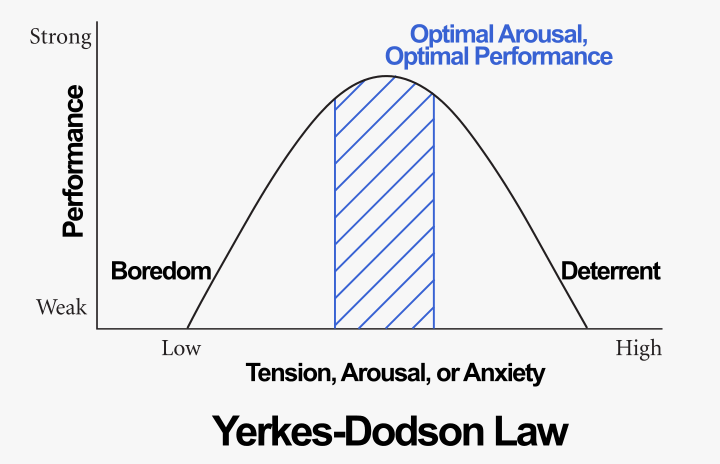
In 1908, Harvard psychologists Robert Yerkes and John Dodson first described the beneficial and harmful effects of stress (“psychological arousal”) on performance in a graph the shape of an upside-down U. According to the Yerkes-Dodson Law, the ascendant curve reflects the energizing effect of arousal. The descendant curve reflects the negative effects of stress on thinking and learning, or performance in general.

Too Much Anxiety and Stress Impairs Performance, but so Does Too Little: The Yerkes-Dodson Law

Many physiological studies have demonstrated that stress enhances your performance by causing your brain to use more of its capabilities, improve memory and intelligence, and increase productivity. Without stress, athletes, performers, executives, and students are likely to underachieve.

There is an optimum level of arousal for every kind of task. So how do you find the right balance? How do you get yourself into the performance zone where stress is most helpful? How much stress is good? The answers depend on individual disposition, the types of stressors, the nature of the task itself, and perceptions of what is stressful to you.

When Stress is Good: The Yerkes-Dodson Law

Idea for Impact: Stress at Work May Be Inevitable but it Doesn’t Have to Be Detrimental

Stress can be a motivator. But don’t seek out stress—less of it is better. Make the stress you do have work for you. Becoming conscious of stress as a potential positive can reduce the harm it causes.

  • Develop an awareness of when you hit the limits beyond which working longer or harder is counter-productive (sportsmen tend to choke under intense pressure.) When you feel overwhelmed, look for ways to reduce or eliminate the stressors so you can become more productive again. Ask for help.
  • Performance deteriorates when your stress level is either too high or too low for a given task. Seek the optimal level of anxiety that can impel you forward without causing you to fight back or give up.

Idea for Impact: The Right Level of Anxiety Can Be a Positive Force for Driving Employees Forward

Anxiety and optimal performance is an individual affair. The Yerkes-Dodson Curve shifts as the performers become established and experienced with the undertaking.

Astute managers repeatedly assess and re-assess where their team members land on the Yerkes-Dodson Curve. Managers can identify over-stressed or under-motivated circumstances with employees and intervene quickly to tailor the level of stress.

Wondering what to read next?

  1. Get Everything Out of Your Head
  2. Some Worry is Useful
  3. “Fly the Aircraft First”
  4. What Airline Disasters Teach About Cognitive Impairment and Decision-Making Under Stress
  5. Ask This One Question Every Morning to Find Your Focus

Filed Under: Managing People, Sharpening Your Skills Tagged With: Anxiety, Decision-Making, Introspection, Mindfulness, Motivation, Procrastination, Stress, Targets, Worry

Admit When You Don’t Have All the Answers

March 27, 2018 By Nagesh Belludi Leave a Comment

As a leader or as a salesperson, your employees or customers expect you to have the answers. However, there’ll times when you may not know the answer to difficult questions right away. To avoid losing credibility and causing others to question your knowledge, it’s important to know how to handle the situation properly.

Folks Don’t Want to Confess to Not Knowing Enough

Having quick, confident answers is often seen as a mark of proficiency and leadership. For that reason, you may be conditioned to believe that “not knowing” makes you look exposed. You may assume that any gaps in knowledge should be veiled at all costs.

Rather than admitting that you don’t have an answer to a tough question, you may tend to make something up on the fly, fast-talk, or stumble your way with a dubious response. Rookie salespeople are particularly prone to this—they tend to give answers they believe their prospective customers want to hear.

Consequently, in trying to look strong, you’ll end up looking weak.

The Power of Saying “I Don’t Know”

The ability to recognize one’s limitations is an underappreciated intellectual skill. A humble individual is all too aware of the confines of his/her corpus of knowledge.

Intellectual growth can come about only when the humble person can admit to not knowing enough and opening up to the possibilities of learning.

In an interview at the Wharton school, Carol Bartz (the no-nonsense, swearword-spewing former executive at Yahoo, Autodesk, and Sun Microsystems) commented about this false bravado and misplaced poise:

The phrase, “I don’t know” is in fact a strength. I have a [nonsense] detector that is really good, really good. And I love playing with people who rubbish me. I would much prefer if someone told me, “Not only do I not know the answer, but I wouldn’t even know how to get it. Could we talk about how, and I can get back to you?” That is so, so powerful. I don’t care how old or seasoned or how high you are in an organization. Saying “I don’t know” can give you the vulnerability you need to lead better.

Idea for Impact: Don’t Be Afraid to Admit What You Don’t Know

Great leaders know when to admit “I don’t know” and how to follow up appropriately. When you’re tempted to misrepresent your understanding, try to declare,

  • “I don’t know the answer at this time, but I will get back to you.”
  • “Good point. I don’t know, but I’m interested in what you think.”
  • “I don’t know, but let’s consult someone who knows more about this.”
  • “I don’t know, but I can do more research and incorporate those risk factors in our contingency plans.”

To be appreciated as a reliable, confident, and ethical person, be willing to admit that you don’t have all the answers. This act of humility and the readiness to seek the help of others can inspire greater trust within your team and encourage others to follow suit.

Be honest and direct when dealing with people, and they’ll respect you even if you aren’t able to answer all their questions.

Wondering what to read next?

  1. Question Success More Than Failure
  2. Why Others’ Pride Annoys You
  3. Could Limiting Social Media Reduce Your Anxiety About Work?
  4. Power Inspires Hypocrisy
  5. The More You Can Manage Your Emotions, the More Effective You’ll Be

Filed Under: Mental Models, Sharpening Your Skills Tagged With: Attitudes, Ethics, Getting Along, Humility, Introspection, Mindfulness, Virtues, Wisdom

Expressive Writing Can Help You Heal

November 8, 2017 By Nagesh Belludi Leave a Comment

Give sorrow words;
the grief that does not speak;
whispers the o’er-fraught heart
and bids it break.
—William Shakespeare, Macbeth (Act 4, Scene 3)

Confronting Upsetting Experiences: Expressive Writing for Healing

People often block out thoughts that provoke negative emotions as a way of reducing their stress and regulating their moods. However, intentional suppression of deep-seated emotions not only increases susceptibility to illness, but also amplifies the emotionality and associated psychological effects of the suppressed thoughts.

Discussing, venting, clarifying, or expressing a trauma is a natural human response. When this necessity is inhibited, emotional stress and physical illness ensue.

Facing up to deeply personal issues can promote physical health, well-being, and beneficial behaviors.

The scientific research on the benefits of putting negative experiences into words is extensive. Studies have shown that expressive writing about oneself and one’s traumatic or stressful experiences does produce significant health benefits. Expressive writing helps ameliorate mood disorders, reduces symptoms among patients with serious illness, improve a person’s physical condition after a heart attack, and even enhance memory.

Writing about Emotional Topics Brings About Improved Physical and Emotional Wellbeing

'Opening Up' by James Pennebaker (ISBN 1572302380) James Pennebaker, a psychology professor at the University of Texas at Austin, first investigated expressive writing as a healing process in the 1980s. Since then, research that spawned from Pennebaker’s pioneering studies, has revealed benefits could accrue to those who were dealing with divorces, lost love, death of loved ones, job rejections, terminal illness, even college students struggling with first-year transitions.

Here are the main points about the expressive writing method:

  • Choose the part of the day when you are most contemplative (that’s the morning for most people.) Sit down at a place where you are not likely to be disturbed.
  • Reflect about a very personal and important event. Consider a significant emotional upheaval that influences your life the most or has in the past. Your topic can be about a distress or failure, lost love, health-, school- or career-related anxiety, relationships, inner conflicts, death of a loved one, or just about any topic that you would like to express.
  • If you’re writing about an experience or an event that involves another person, it can help to organize your writing as a letter to that person, whether alive or dead.
  • Write your deepest thoughts about your chosen event or experience continuously for 20 minutes. If you run out of things to write or reach a mental block, just repeat or recap what you have previously written.
  • In your writing, deeply explore your thoughts about the event and describe its effect on you. In other words, write both about what happened and how you feel about it. Think about how you can handle these events and their consequences now—what you can do specifically.
  • Connect your personal experiences to other parts of your life. How do they relate to your childhood, your parents, people you love, who you are, or who you want to be?
  • Write for yourself as your thoughts arise. Be as direct, intense, and serious as possible. Do not worry about grammar, spelling, comprehensiveness, legibility, or structure. On the opening day of writing, your stories are not very structured, but over the three or four days, you will develop a more structured narrative.
  • After writing for 20 minutes, do not look back over. Simply fold the papers you used, seal them, and put them away (read more about the “worry box technique.”) Unlike psychotherapy, the expressive writing technique does not employ feedback to the participant.
  • 'Writing as a Way of Healing' by Louise Desalvo (ISBN 0807072435) Make a mental note of how you feel. It is not unusual to feel sad or disheartened after writing—these feelings usually fade away in an hour or so. In research experiments, many participants have reported crying or getting upset by the experience of writing about emotional upheavals, but most participants testify that the writing experience was meaningful in helping them organize their experiences.
  • Repeat this exercise for four consecutive days. You can write about the same experience on all four days or about different experiences each day. If you choose to write about the same topic on all the four days, try to wrap everything up by the fourth day.

Note that expressive writing is distinct from keeping a daily journal in that it allows people to step back for a moment and evaluate their lives. Pennebaker once said, “I’m not even convinced that people should write about a horrible event for more than a couple of weeks. You risk getting into a sort of navel gazing or cycle of self-pity. … But standing back every now and then and evaluating where you are in life is really important.”

Translating an Emotional Experience Into Language Makes the Experience Graspable: it Can Help You Find New Meaning in Life’s Ordeals

New research has shown that expressive writing—followed by expressive rewriting—can improve happiness and lead to behavioral changes. Narrative storytelling of an unpleasant and chaotic experience may make the experience and its effects more controllable. For instance, according this New York Times article,

At the Johnson & Johnson Human Performance Institute, life coaches ask clients to identify their goals, then to write about why they haven’t achieved those goals. Once the clients have written their old stories, they are asked to reflect on them and edit the narratives to come up with a new, more honest assessment. While the institute doesn’t have long-term data, the intervention has produced strong anecdotal results.

Idea for Impact: Expressive Writing Can Help Change the Way You Feel About Traumatic Events and About Yourself

Expressive writing is a method of self-help that supplements the value of therapeutic talking to someone accepting and non-judgmental.

By exploring your deepest thoughts and feelings with a reflective, inquiring, honest attitude, you can shift perspective. Standing back and reflecting on your suffering from different points of view can bring about an improved emotional state. You can create your greatest opportunities for change by confronting the realities, reframing your experiences in terms of your values and priorities, and identifying impediments that stand in the way of purpose, joy, and contentment.

For more on the means and methods of expressive writing, as well its many confirmed physiological and behavioral benefits, read James Pennebaker’s Opening Up: the Healing Power of Expressing Emotion (1997) and Louise DeSalvo’s Writing as a Way of Healing (1999)

Wondering what to read next?

  1. Cope with Anxiety and Stop Obsessive Worrying by Creating a Worry Box
  2. The Power of Negative Thinking
  3. Get Everything Out of Your Head
  4. This May Be the Most Potent Cure for Melancholy
  5. Therapeutic Overreach: Diagnosing Ordinary Struggles as Disorders

Filed Under: Living the Good Life, Sharpening Your Skills Tagged With: Adversity, Anxiety, Conversations, Emotions, Introspection, Mindfulness, Resilience, Stress, Suffering, Therapy, Wisdom, Worry

Cope with Anxiety and Stop Obsessive Worrying by Creating a Worry Box

November 8, 2016 By Nagesh Belludi Leave a Comment

Most worry is ultimately fruitless

Worries and concerns trouble us all. We waste valuable time worrying about things. As the American motivational author Leo Buscaglia once wrote, “Worry never robs tomorrow of its sorrow, it only saps today of its joy.”

In a previous article, I suggested a mindfulness exercise to help you realize the temporal nature of worry. I also emphasized that most of your anticipated adversities will never occur.

Despite the transitional nature of anxiety and worry, mental anguishes can overwhelm your mind. Sometimes these negative emotions can spill over and seep into the fabric of your day.

Obsessive anxiety and worry can wreak havoc on your body. Stress from worrying about life’s many “what ifs” can actually manifest in physical and medical problems, if you let them. For instance, say you are troubled about an upcoming exam in your least favorite course at college. Your worrying could become so compulsive that your apprehensions about the exam could interfere with whatever else is going on in your life. If unchecked, your worry could manifest in higher acid levels in your stomach. Then, you may start worrying about developing stomach problems if you don’t stop worrying. Your worries thus snowball and consume even more of your time.

Writing about your anxieties and worries can help you cope with current concerns

An effective way to stop agonizing and let go of troubling thoughts is to keep a “worry box.”

  1. Find a box and designate it as your worry box. Keep it in a handy location. (A “worry journal” may be just as effective.)
  2. Whenever you feel drowned in worries or have anxious thoughts circulating ceaselessly in your mind, take a piece of paper and jot down each worry as it arises. Write down as much about your worries as you feel like writing.
  3. Drop your note into the worry box. Try to imagine mentally letting go of your concerns. Turn your attention to other matters.
  4. Every so often, empty your worry box and throw away your worry notes without looking at them. If you want, you could read them—you will be surprised to see how many of your worries feel unfounded in hindsight, but were in fact seriously troubling in the immediate storms of distress.

Idea for Impact: Maintaining a “worry box” to deposit your anxieties and worries can help you break free from them and prevent them from disrupting your life.

Wondering what to read next?

  1. Expressive Writing Can Help You Heal
  2. The Power of Negative Thinking
  3. Get Everything Out of Your Head
  4. This May Be the Most Potent Cure for Melancholy
  5. Don’t Be So Hard on Yourself

Filed Under: Living the Good Life, Sharpening Your Skills Tagged With: Adversity, Anxiety, Conversations, Emotions, Introspection, Mindfulness, Resilience, Stress, Suffering, Wisdom, Worry

The Duplicity of Corporate Diversity Initiatives

February 5, 2013 By Nagesh Belludi Leave a Comment

Corporate Diversity Initiatives Even after years of diversity initiatives in corporate America, “inclusion” is more about meeting the numbers on gender, race, and other obvious differences, and less about pursuing intellectual, ideological, pedagogical, and stylistic diversity within teams and organizations.

Overall, the workforce diversity initiatives have succeeded in deterring explicit discriminatory behavior and preventing employee lawsuits. However, to make the representation numbers look good, corporate diversity initiatives have largely resulted in exclusionary practices for the preferential hiring and promoting of underrepresented demographic groups, much to the chagrin of those who are more competent, yet arbitrarily overlooked because the latter belong to groups that are numerically “overrepresented”—reverse discrimination, indeed. For fear of reprisal, the shortchanged majority is reluctant to speak out against this veiled unfairness or to call attention to the dichotomy between the ideals and the practice of affirmative action in the workplace.

Even if nearly all corporate mission statements extol the virtues of “valuing differences,” managers stifle individuality down in the trenches. They are less willing to be receptive of distinctive viewpoints and seek to mold their employees to conform to the existing culture of the workplace and to comply with the existing ways of doing things. Compliant, acquiescent employees who look the part are promoted in preference to exceptional, questioning employees who bring truly different perspectives to the table. The nail that sticks its head up indeed gets hammered down.

Wondering what to read next?

  1. The Unlikely Barrier to True Diversity
  2. Why You May Be Overlooking Your Best Talent
  3. The Double-Edged Sword of a Strong Organizational Culture
  4. Tokenism Isn’t Inclusion
  5. Don’t Manage with Fear

Filed Under: Leadership, Leading Teams Tagged With: Diversity, Group Dynamics, Hiring & Firing, Introspection, Persuasion, Questioning, Relationships, Workplace

« Previous Page

Primary Sidebar

Popular Now

Anxiety Assertiveness Attitudes Balance Biases Coaching Conflict Conversations Creativity Critical Thinking Decision-Making Discipline Emotions Entrepreneurs Etiquette Feedback Getting Along Getting Things Done Goals Great Manager Innovation Leadership Leadership Lessons Likeability Mental Models Mentoring Mindfulness Motivation Networking Parables Performance Management Persuasion Philosophy Problem Solving Procrastination Relationships Simple Living Social Skills Stress Suffering Thinking Tools Thought Process Time Management Winning on the Job Wisdom

About: Nagesh Belludi [hire] is a St. Petersburg, Florida-based freethinker, investor, and leadership coach. He specializes in helping executives and companies ensure that the overall quality of their decision-making benefits isn’t compromised by a lack of a big-picture understanding.

Get Updates

Signup for emails

Subscribe via RSS

Contact Nagesh Belludi

RECOMMENDED BOOK:
Confessions of a Public Speaker

Confessions of a Public Speaker: Scott Berkun

Communication consultant Scott Berkun's guidelines on how to reduce anxiety and how to speak in public with greater effectiveness.

Explore

  • Announcements
  • Belief and Spirituality
  • Business Stories
  • Career Development
  • Effective Communication
  • Great Personalities
  • Health and Well-being
  • Ideas and Insights
  • Inspirational Quotations
  • Leadership
  • Leadership Reading
  • Leading Teams
  • Living the Good Life
  • Managing Business Functions
  • Managing People
  • MBA in a Nutshell
  • Mental Models
  • News Analysis
  • Personal Finance
  • Podcasts
  • Project Management
  • Proverbs & Maxims
  • Sharpening Your Skills
  • The Great Innovators

Recently,

  • Hustle Culture is Losing Its Shine
  • This Ancient Japanese Concept Can Help You Embrace Imperfection
  • Inspirational Quotations #1129
  • Don’t Abruptly Walk Away from an Emotionally Charged Conflict
  • What It Means to Lead a Philosophical Life
  • The High Cost of Too Much Job Rotation: A Case Study in Ford’s Failure in Teamwork and Vision
  • Inspirational Quotations #1128

Unless otherwise stated in the individual document, the works above are © Nagesh Belludi under a Creative Commons BY-NC-ND license. You may quote, copy and share them freely, as long as you link back to RightAttitudes.com, don't make money with them, and don't modify the content. Enjoy!