• Skip to content
  • Skip to primary sidebar

Right Attitudes

Ideas for Impact

Search Results for: How Much Would Sam Walton be worth today

How Jeff Bezos is Like Sam Walton

November 1, 2021 By Nagesh Belludi Leave a Comment

Walmart founder Sam Walton’s brilliant autobiography, Made in America (my summary,) was published a few weeks before his death in 1992. The penultimate page reads,

Could a Wal-Mart-type story still occur in this day and age? My answer is of course it could happen again. Somewhere out there right now there’s someone—probably hundreds of thousands of someones—with good enough ideas to go all the way. It will be done again—over and over, providing that someone wants it badly enough to do what it takes to get there. It’s all a matter of attitude and the capacity to constantly study and question the management of the business.

Jeff Bezos started Amazon just two years later. After eight years on Wall Street, Bezos dreamt up Amazon during a drive from New York to Seattle in 1994. His wife (now ex-wife) MacKenzie drove, and Jeff “tapped out a business plan on his computer along the way.”

'Sam Walton: Made In America' by Sam Walton (ISBN 0553562835) Amazon began as a loss-making book e-tailer at the dawn of the commercial Internet and as the dot-com poster child in the late ’90s. It has since evolved into one of the world’s most valuable companies. Amazon has come a long way from its genesis as the curse of bricks-and-mortar booksellers and has diversified broadly into just about every adjacent business it could get its hands on.

Bezos’s and Amazon’s dominant leadership values echo those of Sam Walton and Wal-Mart: frugality, a bias for action, long-term focus, motivating staff to think like owners, and customer obsession.

The Everything Store (2013,) Brad Stone’s excellent chronicle of the rise of Amazon notes, “In his autobiography, Walmart’s founder expounds on the principles of discount retailing and discusses his core values of frugality and a bias for action—a willingness to try a lot of things and make many mistakes. Bezos included both in Amazon’s corporate values.” On an earnings call, Bezos famously declared, “there are two kinds of retailers: there are those folks who work to figure how to charge more, and there are companies that work to figure how to charge less, and we are going to be in the second, full-stop.”

All along, Bezos has made big bet-decisions that hurt it in the short term but created value in the long term. Amazon’s market capitalization has rocketed up from $4.55 billion in 2001 to $1.08 trillion before the Coronavirus/COVID-19 infected the stock markets. Amazon’s secret, in Bezos’s words, is,

We are genuinely customer-centric, we are genuinely long-term oriented and we genuinely like to invent. Most companies are not those things. They are focused on the competitor, rather than the customer. They want to work on things that will pay dividends in two or three years, and if they don’t work in two or three years they will move on to something else. And they prefer to be close-followers rather than inventors, because it’s safer. So if you want to capture the truth about Amazon, that is why we are different.

Amazon has not been consistently profitable over the years, and that is a deliberate upshot of how Bezos approaches business. Amazon cycles through periods of substantial investments that beget future revenue growth (with low profits) and periods of increasing profits as its investments ebb.

'The Everything Store' by Brad Stone (ISBN 0316219266) Bezos has maneuvered Wall Street into believing that he is just getting started—his “Day 1” philosophy has become something of a legend. “A big piece of the story we tell ourselves about who we are is that we are willing to invent … and very importantly, we are willing to be misunderstood for long periods of time,” Bezos asserted at Amazon’s 2011 annual shareholders meeting.

Not all of Bezos’s bets have succeeded. However, investors have come to acknowledge that his long-term initiatives will produce rich results several years down the road. Little wonder, then, that Amazon’s stock has defied short-termism by continually progressing upward even during quarters of little or no earnings.

Postscript: Bezos has been, until recently, the world’s wealthiest person since about 2018. Walton was the richest man from 1985 until his death in 1992. His inheritors, the Walton family, are collectively more affluent than Bezos!

Filed Under: Leadership, The Great Innovators Tagged With: Amazon, Entrepreneurs, Jeff Bezos, Leadership Lessons, Management, Strategy

Our 10 Most Popular Articles of 2017

January 3, 2018 By Nagesh Belludi Leave a Comment

Top Blog Articles of 2017 Here are our most popular exclusive features of 2017.
Pass this on to your friends; if they like these, they can sign up to receive our RSS feeds or email updates.

  1. Zeigarnik Effect: How Incomplete Tasks Trigger Stress. Unresolved and interrupted tasks thieve the attention of your brain until you have a clear—if subconscious—proposal of what you’re going to deal with them. Just the simple act of capturing a task that reaches your head can achieve that sense of completion.
  2. Lessons on Adversity from Charlie Munger: Be a Survivor, Not a Victim. Berkshire Hathaway’s Vice-Chairman overcame “horrible blows, unfair blows” on the road to success. Munger counsels, “Feeling like a victim is a perfectly disastrous way to go through life.” Don’t operate life on the assumption that the world ought to be fair, just, and objective. You are neither entitled nor unentitled to good treatment.
  3. How to Guard Against Anger Erupting. The most effective way to deal with anger in yourself is by not disregarding or repressing it. When anger rises past a threshold, it requires a reasonable and pleasing expression—an outlet—to be diffused. The key to expelling anger in a way that must feel good and fair is to invoke your calm, wise self and put out some of the fire of the emotion before moving forward.
  4. Why People to Act Immorally and Justify Their Unprincipled Behavior. People can rationalize behavior that is at odds with their own moral principles. When people feel angry, pressured, or depressed, their mental footing tends to ebb away. They are more likely to engage in self-absorbed behaviors that they would otherwise spurn, especially if the payoff for such behavior is high and the odds of getting caught and punished are low.
  5. Rewards and Incentives Can Backfire. Offering rewards for motivating people to do unlikable tasks could sometimes become counterproductive. In what psychologists call “the overjustification effect,” a reward, instead of motivating, could fortify a person’s revulsion for the task. In other words, the reward could reinforce the belief that the task can’t be worth doing for itself.
  6. Choose Your Role Models Carefully. The modern world has a dangerous problem with hero-worship—pop artists, rappers, film stars, sportspersons, capitalists, and so on command attention and affection as never before. While admiring, and drawing wisdom, meaning, and inspiration from heroes can be constructive, you must take “hero narratives” with a grain of salt. Don’t blindly place much faith in today’s experts and celebrities.
  7. Expressive Writing Can Help You Heal. People often block out thoughts that provoke negative emotions as a way of reducing their stress and regulating their moods. By exploring your deepest thoughts and feelings with a reflective, inquiring, honest attitude, you can shift perspective. Standing back and reflecting on your suffering from different points of view can bring about an improved emotional state.
  8. Twenty Reasons People Don’t Change. If you have trouble getting people to change, perhaps one—or more—of these twenty reasons are to blame. Be realistic about changing others’ hearts and minds. If you can learn to accept them for who they are and let go of your conceptions of their perfection, your relationships become richer.
  9. The More You Can Manage Your Emotions, the More Effective You’ll Be. People who lack the capacity to withstand psychological distresses such as anger, fear, frustration, and sadness are at a marked disadvantage in life. When faced with life’s unceasing challenges, they engage in destructive behaviors, often with verbal and physical aggression toward themselves and others.
  10. Six Powerful Reasons to Eat Slowly and Mindfully. Cultivate a healthy relationship with food. Dedicating time to eat slowly, mindfully, and intentionally—and enjoying the pleasure of food—can make an enormous difference in your diet and health.

And here are articles of yesteryear that continue to be popular:

  1. How smart companies get smarter
  2. Make decisions using Bill Hewlett’s “Hat-wearing Process”
  3. Temper your expectations, avoid disappointments in life
  4. Stop asking, “What do you do for a living?”
  5. Ten rules of management success from Sam Walton

See our top 10 lists for 2016 and 2015.

Filed Under: Announcements

The Halo and Horns Effects [Rating Errors]

April 30, 2010 By Nagesh Belludi 1 Comment

Preamble: We are often unaware of the many biases and prejudices that influence our social judgments. Psychologists call these “bias blind spots.” We can overcome many of these subliminal biases by teaching ourselves to be aware of them. This is the second in a series of articles on the common rating errors. See my earlier article on the recency bias.

Unconscious Judgments of an Investment Broker

A 2007 study highlights two of the most common unconscious social judgment biases. Prof. Emily Pronin of Princeton University showed study participants one of two pictures of the same man whom she introduced as an investment broker. One picture showed a suited man with a highly regarded Cornell degree and the other showed the man in casual clothing with a degree from a nondescript college. The professor asked her participants how much of a theoretical $1,000 they would invest in each. The participants rated the suited man as more competent: on average, he got $535 on without having his background checked. In contrast, the causal dresser received just $352. Not only were the participants more likely to have the second broker’s credentials verified —but also they did not consider him as trustworthy.

The Halo Effect

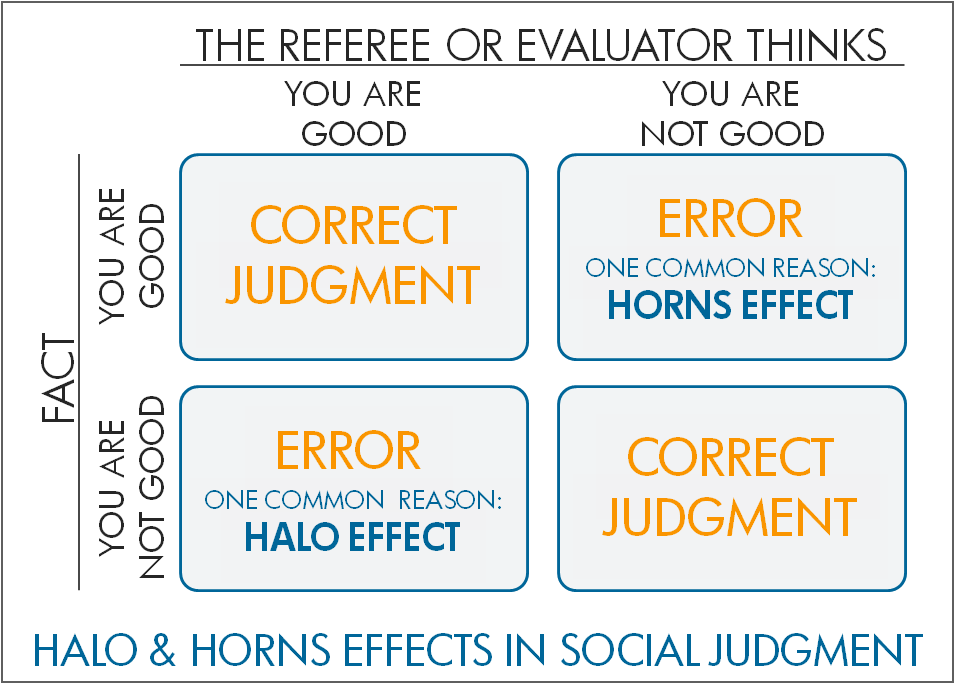
The “halo effect” captures what happens when a person who is judged positively based on one aspect is automatically judged positively on several others without much evidence. For instance, as a result of the halo effect,

  • attractive people are often judged as competent and sociable. Film stars and other celebrities are assumed pleasant and sharp-witted,
  • inexperienced interviewers tend to pay less attention to a candidate’s negative traits after discerning one or two positive traits in the first few minutes of a job interview,
  • charismatic professionals tend to get noticed and move up the corporate ladder faster, irrespective of their technical and leadership skills,
  • articulate speakers are likely to influence their audiences more even if their messages are poor in form and content.

Politicians, film and TV stars, sportspersons, celebrities and brand managers have learned to construct a halo effect and capitalize on their reputations. Apple’s iPod spawned positive impressions of other Apple products—the company took advantage of this halo effect and delivered excellent products in the iPhone and iPad. In another example, renowned fashion designers can set high prices for perfectly ordinary clothes.

Halo and Horns Effects in Social Judgment

The Horns Effect

The “horns” or “devil effect” is the concept by which a person who is judged negatively on one aspect is automatically judged negatively on several other aspects without much evidence. Clearly, this is the opposite of the halo effect.

For years, American car manufacturers have battled the mistaken public perception that cars made by Japanese companies are of significantly better quality. This misperception remains even when American car manufacturers use identical components from the same suppliers and assemble their cars using identical manufacturing processes. Even today, Japanese-brand cars resell for much higher prices than American-brand cars.

Call for Action

  • Reflect on your decision-making process to steer clear of biases. As human beings, we incessantly form opinions of people, objects, and events, both consciously and subconsciously. However, our judgment is rarely free of biases and our measures are not always comprehensive enough. Before reaching any important decision, be sure to collect all the relevant facts and reflect on whether your thought processes are free of the common biases.
  • Understand that perception is reality and be conscious of the image you are projecting. People judge the proverbial book by its cover. Your friends and family, workplace and society at large have a certain perception of who you are and what you can do, irrespective of the reality. As much as you would prefer to be evaluated based on who you actually are and what you can actually do, understand that your identity and prospects are based on others’ image of you. Do everything you can to connect people’s perception to the reality. Look and play your role. Begin by reading the seminal article on the topic of personal branding, “The Brand Called You,” written by renowned management author, Tom Peters.

Filed Under: Leading Teams, Sharpening Your Skills Tagged With: Biases, Mental Models

Primary Sidebar

Popular Now

Anxiety Assertiveness Attitudes Balance Biases Coaching Conflict Conversations Creativity Critical Thinking Decision-Making Discipline Emotions Entrepreneurs Etiquette Feedback Getting Along Getting Things Done Goals Great Manager Innovation Leadership Leadership Lessons Likeability Mental Models Mentoring Mindfulness Motivation Networking Parables Performance Management Persuasion Philosophy Problem Solving Procrastination Relationships Simple Living Social Skills Stress Suffering Thinking Tools Thought Process Time Management Winning on the Job Wisdom

About: Nagesh Belludi [hire] is a St. Petersburg, Florida-based freethinker, investor, and leadership coach. He specializes in helping executives and companies ensure that the overall quality of their decision-making benefits isn’t compromised by a lack of a big-picture understanding.

Get Updates

Signup for emails

Subscribe via RSS

Contact Nagesh Belludi

RECOMMENDED BOOK:
Les Misérables

Les Misérables: Victor Hugo

Victor Hugo's profound tale of Jean Valjean's redemption and the saga of the endless battle between good and evil is considered one of the greatest novels of the 19th century.

Explore

  • Announcements
  • Belief and Spirituality
  • Business Stories
  • Career Development
  • Effective Communication
  • Great Personalities
  • Health and Well-being
  • Ideas and Insights
  • Inspirational Quotations
  • Leadership
  • Leadership Reading
  • Leading Teams
  • Living the Good Life
  • Managing Business Functions
  • Managing People
  • MBA in a Nutshell
  • Mental Models
  • News Analysis
  • Personal Finance
  • Podcasts
  • Project Management
  • Proverbs & Maxims
  • Sharpening Your Skills
  • The Great Innovators

Recently,

  • Inspirational Quotations #1131
  • Boundaries Define What You are—and What You’re Not
  • The Case Against Team Work
  • Teams That Thrive make it Safe to Speak & Safe to Fail
  • Inspirational Quotations #1130
  • ‘Mrs Brown’s Boys’ Teaches That the Most Sincere Moment is the Unplanned One
  • Hustle Culture is Losing Its Shine

Unless otherwise stated in the individual document, the works above are © Nagesh Belludi under a Creative Commons BY-NC-ND license. You may quote, copy and share them freely, as long as you link back to RightAttitudes.com, don't make money with them, and don't modify the content. Enjoy!