• Skip to content
  • Skip to primary sidebar

Right Attitudes

Ideas for Impact

Worry

A Quick Way to De-stress: The “Four Corners Breathing” Exercise

April 9, 2020 By Nagesh Belludi 1 Comment

Whenever you feel frenzied, i.e., your mind is restless and disturbed, a centering meditation can help you focus inward, pull together your scattered energies, and allow your mind to become calm.

Here’s a quick-and-easy deep breathing exercise called “Four Corners Breathing” suggested by psychologist Lucy Jo Palladino in Find Your Focus Zone (2007):

  1. Find an object nearby that has four corners—a box, your monitor, or even this page.
  2. Start at the upper-left-hand corner and inhale for four counts. Breathe in, filling your lungs with air.
  3. Turn your gaze to the upper-right-hand corner and hold your breath for four counts.
  4. Move to the lower-right-hand corner. Exhale for four counts.
  5. Now shift your attention to the lower-left-hand corner. Tell yourself to relax and smile.

Repeat these steps 3 to 5 times, or as often as you like.

You can do this centering exercise practically anywhere without drawing attention to yourself. It can initiate an immediate shift in consciousness, enabling you to bring greater awareness into the world around you and maintain your calm.

According to ancient meditation practices, the breath can link the mind and the body. When the breathing is calm, the mind is calm, and the body is calm.

Deep breathing is an effective way to moderate the activation of your sympathetic nervous system, which controls the body’s response to a perceived threat.

Idea for Impact: Breathing exercises need not take much time out of your day. Set aside some time to pay attention to your breathing. Even a few minutes of slow, deep breathing can help you get a grip on your mind, manage your emotions, short-circuit the stress response, and keep your mind focused.

Wondering what to read next?

  1. Learn to Cope When You’re Stressed
  2. Niksen: The Dutch Art of Embracing Stillness, Doing Nothing
  3. Understand What’s Stressing You Out
  4. If Meditation Isn’t Working For You, Try Intermittent Silence
  5. Is Your Harried Mind Causing You to Underachieve?

Filed Under: Health and Well-being, Living the Good Life Tagged With: Anxiety, Balance, Mindfulness, Stress, Time Management, Worry

Understand What’s Stressing You Out

March 2, 2020 By Nagesh Belludi Leave a Comment

Mindfulness comes from paying attention to what you’re feeling right now and then taking the first steps to let go of your regrets, worries, and fears.

To gain an insight into why you’re feeling stressed out, first get into a relaxed frame of mind. Take a deep breath. Hold it for a moment, and then exhale.

Mentally ask yourself, “Why am I so tense right now?” Then, listen to whatever feelings pop into your mind or notice any images of distress or anxiety that emerge.

If you can’t get an evocative response to your question, imagine that you’re confiding in a best friend or chatting to a counselor.

Your spontaneous reflections can give you valuable insights into your inner feelings and concerns. Become acquainted with your inner experience and embrace what you see with a kind heart.

Try a relaxation technique—play with a pet, soak in a warm bath, listen to soothing music, practice yoga or meditation, do physical activity, write a journal entry (try expressive writing,) or get a massage. When you perform a relaxation technique, you’re stimulating activity in the parasympathetic nervous system, which can offset the effects of your body’s overly activated stress response.

While relaxation techniques may calm you down and relieve the immediate symptoms of stress, they’ll not help alleviate the underlying triggers of stress.

If you resort to relaxation merely to suppress or bury your emotions, the tension will find its way to pop up somewhere else.

For a more in-depth, enduring solution to your stress, you must learn how to unshackle yourself from this source of stress through alternative actions. Ask your inner self, “What do I need to do to stay calm?” Be receptive to what your mind tells you.

Don’t overanalyze the past, get upset, and increase your stress. Stay in the moment.

Look forward. Ask yourself, “What is the first baby step I can take toward mitigating my stress?” Or, “What is a stumbling block that I can overcome now?”

Idea for Impact: By practicing positive modes of reflection and taking small corrective actions now, you can bring balance to your inner life and deny those negative emotional patterns their power to affect your sense of self-control.

Wondering what to read next?

  1. Is Your Harried Mind Causing You to Underachieve?
  2. Learn to Cope When You’re Stressed
  3. A Quick Way to De-stress: The “Four Corners Breathing” Exercise
  4. Hustle Culture is Losing Its Shine
  5. Anger is the Hardest of the Negative Emotions to Subdue

Filed Under: Health and Well-being, Living the Good Life Tagged With: Balance, Getting Along, Mindfulness, Stress, Suffering, Time Management, Worry

Lessons from the World’s Worst Aviation Disaster // Book Summary of ‘The Collision on Tenerife’

November 5, 2019 By Nagesh Belludi 1 Comment

Jon Ziomek’s nonfiction history book Collision on Tenerife (2018) is the result of years of analysis into the world’s worst aviation disaster on Tenerife Island in the Canary Islands of Spain.

Distinct Small Errors Can Become Linked and Amplified into a Big Tragedy

On 27-March-1977, two fully loaded Boeing 747 passenger jets operated by Pan American World Airways (Pan Am) and KLM Royal Dutch Airlines collided on the runway, killing 583 passengers and crew on the two airplanes. Only 61 survived—all from the Pan Am jet, including its pilot.

These two flights, and a few others, were diverted to Tenerife after a bomb went off at the Gran Canaria Airport in Las Palmas, their original destination. Tenerife was not a major airport—it had a single runway, and taxi and parking space were limited. After the Las Palmas airport reopened, flights were cleared for takeoff from Tenerife, but the fog rolled in over Tenerife reducing visibility to less than 300 feet. Several airplanes that had been diverted to Tenerife had blocked the taxiway and the parking ramp. Therefore, the KLM and Pan Am jets taxied down the single runway in preparation for takeoff, the Pan Am behind the KLM.

At one end of the runway, the KLM jet turned 180 degrees into position for takeoff. In the meantime, the Pan Am jet was still taxiing on the runway, having missed its taxiway turnoff in the fog. The KLM pilot jumped the gun and started his take-off roll before he got clearance from traffic control.

When the pilots of the two jets caught sight of each other’s airplanes through the fog, it was too late for the Pan Am jet to clear out of the runway into the grass and for KLM jet to abort the takeoff. The KLM pilot lifted his airplane off the runway prematurely, but could not avoid barreling into the Pan Am’s fuselage at 240 kmph. Both the jets exploded into flames.

The accident was blamed on miscommunication—breakdown of coordinated action, vague language from the control tower, the KLM pilot’s impatience to takeoff without clearance, and the distorted cross-talk of the KLM and Pan Am pilots and the controllers on a common radio channel.

Breakdown of Coordination Under Stress

Sweeping changes were made to international airline regulations following the accident: cockpit procedures were changed, standard phrases were introduced, and English was emphasized as a common working language.

'Collision on Tenerife' by Jon Ziomek (ISBN 1682617734) In Collision on Tenerife, Jon Ziomek, a journalism professor at Northwestern University, gives a well-written, detailed account of all the mistakes leading up to the crash and its aftermath.

The surviving passengers’ first- and second-hand accounts recall the horror of those passengers on the right side of the Pan Am jet who saw the lights of the speeding KLM 747, just as the Pan Am pilot was hastily turning his airplane onto the grass to avoid the collision.

Ziomek describes how passengers escaped. Some had to make the difficult choice of leaving loved ones or friends and strangers behind.

Dorothy Kelly … then spotted Captain Grubbs lying near the fuselage. Badly burned and shaken by his jump from the plane, he could not move. “What have I done to these people?” he yelled, pounding the ground in anguish. Kelly grabbed him under his shoulders and urged “Crawl, Captain, crawl!”

Recommendation: Read Jon Ziomek’s Collision on Tenerife

Some of the bewildering details make for difficult reading—especially the psychological effects (post-traumatic stress syndrome) on the surviving passengers. But Jon Ziomek’s Collision on Tenerife is important reading, providing a comprehensive picture of the extensive coordination required in aviation, the importance of safety and protocols, and how some humans can freeze in shock while others spring into action.

The key takeaway is the recognition of how small errors and problems (an “error chain”) can quickly become linked and amplified into disastrous outcomes.

Wondering what to read next?

  1. “Fly the Aircraft First”
  2. Under Pressure, The Narrowing Cognitive Map: Lessons from the Tragedy of Singapore Airlines Flight 6
  3. How Contributing Factors Stack Up and Accidents Unfold: A Case Study of the 2024 Delta A350 & CRJ-900 Collision
  4. What Airline Disasters Teach About Cognitive Impairment and Decision-Making Under Stress
  5. How Stress Impairs Your Problem-Solving Capabilities: Case Study of TransAsia Flight 235

Filed Under: Business Stories, Effective Communication, Sharpening Your Skills Tagged With: Anxiety, Assertiveness, Aviation, Biases, Books for Impact, Conflict, Decision-Making, Mindfulness, Problem Solving, Stress, Thinking Tools, Worry

How Stress Impairs Your Problem-Solving Capabilities: Case Study of TransAsia Flight 235

October 1, 2019 By Nagesh Belludi Leave a Comment

As I’ve examined previously, airline disasters are particularly instructive on the subjects of cognitive impairment and decision-making under stress.

Consider the case of TransAsia Airways Flight 235 that crashed in 2015 soon after takeoff from an airport in Taipei, Taiwan. Accident investigations revealed that the pilots of the ATR 72-600 turboprop erroneously switched off the plane’s working engine after the other lost power. Here’s a rundown of what happened:

  1. About one minute after takeoff, at 1,300 feet, engine #2 had an uncommanded autofeather failure. This is a routine engine failure—the aircraft is designed to be able to be flown on one engine.
  2. The Pilot Flying misdiagnosed the problem, and assumed that the still-functional engine #1 had failed. He retarded power on engine #1 and it promptly shut down.
  3. With power lost on both the engines, the pilots did not react to the stall warnings in a timely and effective manner. The Pilot Flying acknowledged his error, “wow, pulled back the wrong side throttle.”
  4. The aircraft continued its descent. The pilots rushed to restart engine #1, but the remaining altitude was not adequate enough to recover the aircraft.
  5. In a state of panic, the Pilot Flying clasped the flight controls and steered (see this video) the aircraft perilously to avoid apartment blocks and commercial buildings before clipping a bridge and crashing into a river.

A High Level of Stress Can Diminish Your Problem-solving Capabilities

Thrown into disarray after a routine engine failure, the pilots of TransAsia flight 235 did not perform their airline’s abnormal and emergency procedures to identify the failure and implement the required corrective actions. Their ineffective coordination, communication, and error management compromised the safety of the flight.

The combination of sudden threat and extreme time pressure to avert a danger fosters a state of panic, in which decision-makers are inclined to commit themselves impulsively to courses of action that they will soon come to regret.

Idea for Impact: To combat cognitive impairment under stress, use checklists and standard operating procedures, as well as increased training on situational awareness, crisis communication, and emergency management.

Wondering what to read next?

  1. What Airline Disasters Teach About Cognitive Impairment and Decision-Making Under Stress
  2. Lessons from the World’s Worst Aviation Disaster // Book Summary of ‘The Collision on Tenerife’
  3. Under Pressure, The Narrowing Cognitive Map: Lessons from the Tragedy of Singapore Airlines Flight 6
  4. “Fly the Aircraft First”
  5. The “Ashtray in the Sky” Mental Model: Idiot-Proofing by Design

Filed Under: Business Stories, Leadership, Sharpening Your Skills Tagged With: Anxiety, Aviation, Biases, Decision-Making, Emotions, Mental Models, Mindfulness, Problem Solving, Risk, Stress, Thought Process, Worry

This May Be the Most Potent Cure for Melancholy

August 13, 2019 By Nagesh Belludi 1 Comment


Never Feel Sorry for Yourself or Engage in Self-pity

The American writer and Nobel Laureate Toni Morrison, who poignantly explored the African-American experience, passed away last week. Her best-known novel, the Pulitzer Prize-winning Beloved (1987) is one of the few works of non-fiction that I’ve read. This captivating novel is much-admired for calling to mind of the inhumane violence of the institution of slavery. It’s a true story of a post-Civil War escapee-slave who, after she is recaptured, kills her infant daughter to liberate her from slavery and oppression. Read it (or watch its 1998 film adaption starring Oprah Winfrey.)

Morrison’s celebrated essay in the 150th-anniversary issue of The Nation suggested a potent antidote to suffering and loss. Here’s a précis:

On the day after Christmas 2004, I was in an extremely dark mood, feeling helpless. When a friend, a fellow artist, called to wish happy holidays, I told him, “I’m not well. Not only am I depressed, I can’t seem to work, to write; it’s as though I am paralyzed, unable to write anything more in the novel I’ve begun. I’ve never felt this way before, but the recent reelection of George W. Bush …” My friend interrupted me and challenged, “No! No, no, no! This is precisely the time when artists go to work—not when everything is fine, but in times of dread. That’s our job!” I felt foolish the rest of the morning.

[All the trouble in the world makes it difficult to stay grounded and productive.] Still, I remember the shout of my friend that day after Christmas. This is precisely the time when artists go to work. [While being aware of the world’s plights and the struggles of people,] there is no time for despair, no place for self-pity, no need for silence, no room for fear. We speak, we write, we do language. That is how civilizations heal.

I know the world is bruised and bleeding, and though it is important not to ignore its pain, it is also critical to refuse to succumb to its malevolence. Like failure, chaos contains information that can lead to knowledge—even wisdom.

Acceptance Can Set You Free

Sorrowing Old Man (At Eternity's Gate) by Vincent van Gogh When events have a downer-depressive effect, they can leave you in the throes of helplessness and depression. As Morrison suggests, acceptance and looking-forward is a compelling remedy to life’s many tribulations.

As I’ve stated in previous articles, even in the face of some of the worst misfortunes that could strike you, attempting to endure pain is a far superior choice than getting absorbed in feeling victimized and powerless.

After a reasonable period of grief, confronting your fears and facing up to the worst possible scenarios can bring about some tranquility.

You can deal with your troubles by diverting your mind with escapisms or cheering yourself up with distractive remedies, but these things can relieve suffering only for a short time. They do not alleviate grief but hinder it. You would rather end it than distract it.

In other words, it’s better to conquer your sorrow than to deceive it. If simply masked under self-gratifying pleasures and diversions, your haunted mind eventually comes back at you stronger than ever.

Idea for Impact: In facing life’s many troubles, acceptance can set you free. Perhaps the most potent cure for melancholy is to ask yourself, “What’s the one positive step I can take now?”

Wondering what to read next?

  1. Cope with Anxiety and Stop Obsessive Worrying by Creating a Worry Box
  2. Expressive Writing Can Help You Heal
  3. The Power of Negative Thinking
  4. Get Everything Out of Your Head
  5. The More You Can Manage Your Emotions, the More Effective You’ll Be

Filed Under: Living the Good Life, Sharpening Your Skills Tagged With: Adversity, Anxiety, Attitudes, Emotions, Mindfulness, Resilience, Stress, Suffering, Wisdom, Worry

Could Limiting Social Media Reduce Your Anxiety About Work?

July 15, 2019 By Nagesh Belludi Leave a Comment

In a recent article on “Facebook envy,” I wrote about how looking at the carefully curated lives of others on social media can provoke insecurities about one’s own accomplishments—or lack thereof.

In response, a blog reader directed me to journalist Keith Breene’s writeup about a study on why millennials aren’t happy at work. Here’s a précis:

Much of the stress and anxiety reported by twenty-somethings is caused by ruthless comparison with peers. Emerson Csorba, director of the consultancy Gen Y, reported one millennial describing the challenge like this: “If we are not doing something exceptional or don’t feel important and fulfilled for what we are doing, we have a hard time.”

Where is the pressure coming from? With millennials more connected than any previous generation, opportunities to compare levels of success are ubiquitous, creating anxiety and insecurity. The accomplishments of peers, shown on social media, are a constant prompt to examine millennials’ own successes or failures. The problem is made much worse by the fact that only positive achievements are posted—you only ever see the good stuff.

Even though everyone knows that social media is a kind of PR feed of people’s lives, when you spend so much time online, these messages can easily become overpowering.

Idea for Impact: Resist the Envious Consequence of Social Media

Everyone’s lives are far from perfect, notwithstanding the dreamy pictures they’re posting on social media.

Protect yourself and your own internal goodness from self-sabotage. Rejoice in your real accomplishments without needing to show off to anyone else or seek external validation. Care less for what other people think.

Life isn’t a competition. There isn’t a race to the finish lines.

Furthermore, making others envious should never be a motivation for curating your social media posts. Nothing good comes from trying to be the envy of others.

Wondering what to read next?

  1. How to … Care Less About What Other People Think
  2. Entitlement and Anger Go Together
  3. Group Polarization: Like-Mindedness is Dangerous, Especially with Social Media
  4. The More You Can Manage Your Emotions, the More Effective You’ll Be
  5. Is It Worth It to Quit Social Media?

Filed Under: Career Development, Managing People, Mental Models, Sharpening Your Skills Tagged With: Attitudes, Confidence, Conflict, Conversations, Conviction, Getting Along, Mindfulness, Networking, Relationships, Social Dynamics, Social Life, Social Media, Stress, Wisdom, Worry

When Stress is Good

November 5, 2018 By Nagesh Belludi Leave a Comment

Stress and Anxiety Can Lead to Improved Performance

Why Some Stress Is Good for You Many people claim that they work best under pressure. There’s some truth to that. Stress is a natural response in highly competitive environments. Before an exam, important meeting, or contest, your heart rate rises and so does your blood pressure. You become more absorbed, alert, and efficient.

However, this favorable relationship applies only up to a certain level of stress. Past this level, stress impairs your performance—and eventually your heart.

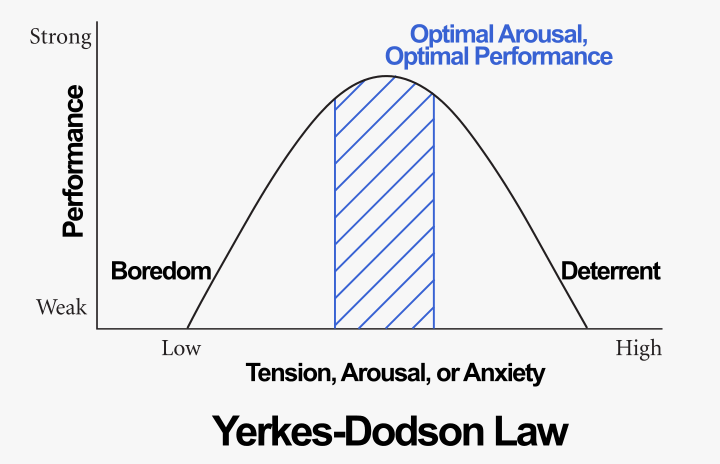
In 1908, Harvard psychologists Robert Yerkes and John Dodson first described the beneficial and harmful effects of stress (“psychological arousal”) on performance in a graph the shape of an upside-down U. According to the Yerkes-Dodson Law, the ascendant curve reflects the energizing effect of arousal. The descendant curve reflects the negative effects of stress on thinking and learning, or performance in general.

Too Much Anxiety and Stress Impairs Performance, but so Does Too Little: The Yerkes-Dodson Law

Many physiological studies have demonstrated that stress enhances your performance by causing your brain to use more of its capabilities, improve memory and intelligence, and increase productivity. Without stress, athletes, performers, executives, and students are likely to underachieve.

There is an optimum level of arousal for every kind of task. So how do you find the right balance? How do you get yourself into the performance zone where stress is most helpful? How much stress is good? The answers depend on individual disposition, the types of stressors, the nature of the task itself, and perceptions of what is stressful to you.

When Stress is Good: The Yerkes-Dodson Law

Idea for Impact: Stress at Work May Be Inevitable but it Doesn’t Have to Be Detrimental

Stress can be a motivator. But don’t seek out stress—less of it is better. Make the stress you do have work for you. Becoming conscious of stress as a potential positive can reduce the harm it causes.

  • Develop an awareness of when you hit the limits beyond which working longer or harder is counter-productive (sportsmen tend to choke under intense pressure.) When you feel overwhelmed, look for ways to reduce or eliminate the stressors so you can become more productive again. Ask for help.
  • Performance deteriorates when your stress level is either too high or too low for a given task. Seek the optimal level of anxiety that can impel you forward without causing you to fight back or give up.

Idea for Impact: The Right Level of Anxiety Can Be a Positive Force for Driving Employees Forward

Anxiety and optimal performance is an individual affair. The Yerkes-Dodson Curve shifts as the performers become established and experienced with the undertaking.

Astute managers repeatedly assess and re-assess where their team members land on the Yerkes-Dodson Curve. Managers can identify over-stressed or under-motivated circumstances with employees and intervene quickly to tailor the level of stress.

Wondering what to read next?

  1. Reality is Messy—and Denial is Deadly
  2. Lessons from the World’s Worst Aviation Disaster // Book Summary of ‘The Collision on Tenerife’
  3. Beware the Opportunity Cost of Meditating
  4. Zeigarnik Effect: How Incomplete Tasks Trigger Stress
  5. How Stress Impairs Your Problem-Solving Capabilities: Case Study of TransAsia Flight 235

Filed Under: Managing People, Sharpening Your Skills Tagged With: Anxiety, Decision-Making, Introspection, Mindfulness, Motivation, Procrastination, Stress, Targets, Worry

Summary of Richard Carlson’s ‘Don’t Sweat The Small Stuff’

September 4, 2018 By Nagesh Belludi 1 Comment

Stress follows a peculiar principle: when life hits us with big crises—the death of a loved one or a job loss—we somehow find the inner strength to endure these upheavals in due course. It’s the little things that drive us insane day after day—traffic congestion, awful service at a restaurant, an overbearing coworker taking credit for your work, meddling in-laws, for example.

It’s all too easy to get caught up in the many irritations of life. We overdramatize and overreact to life’s myriad tribulations. Under the direct influence of anguish, our minds are bewildered and we feel disoriented. This creates stress, which makes the problems more difficult to deal with.

'Don't Sweat The Small Stuff' by Richard Carlson (ISBN 0786881852) The central thesis of psychotherapist Richard Carlson’s bestselling Don’t Sweat The Small Stuff… And It’s All Small Stuff (1997) is this: to deal with angst or anger, what we need is not some upbeat self-help prescriptions for changing ourselves, but simply a measure of perspective.

Perspective helps us understand that there’s an art to understand what we should let go and what we should concern ourselves with. As I mentioned in my article on the concept of opportunity cost, it is important to focus our efforts on the important stuff, and not waste time on the insignificant and incidental things.

I’ve previously written about my favorite 5-5-5 technique for gaining perspective and guarding myself against anger erupting: I remove myself from the offending environment and contemplate if whatever I’m getting worked up over is of importance. I ask myself, “Will this matter in 5 days? Will this matter in 5 months? Will this matter in 5 years?”

Carlson stresses that there’s always a vantage point from which even the biggest stressor can be effectively dealt with. The challenge is to keep making that shift in perspective. When we achieve that “wise-person-in-me” perspective, our problems seem more controllable and our lives more peaceful.

Carlson’s prescriptions aren’t uncommon—we can learn to be more patient, compassionate, generous, grateful, and kind, all of which will improve the way we feel about ourselves and the way that other people feel when they are around us.

Some of Carlson’s 100 recommendations are trite and banal—for example, “make peace with imperfection,” “think of your problems as potential teachers,” “remember that when you die, your ‘in-basket’ won’t be empty,” and “do one thing at a time.” Others are more edifying:

  • Let others have the glory
  • Let others be “right” most of the time
  • Become aware of your moods and don’t allow yourself to be fooled by the low ones
  • Look beyond behavior
  • Every day, tell at least one person something you like, admire, or appreciate about them
  • Argue for your limitations, and they’re yours
  • Resist the urge to criticize
  • Read articles and books with entirely different points of view from your own and try to learn something

Carlson’s succinct insights have hit home with legions of the hurried and the harried. He became a bestselling author and a sought-after motivational speaker. Before his tragic death in 2006 at age 45, Carson followed up “Don’t Sweat The Small Stuff…” with some 20 tacky spinoffs intended particularly for spouses, parents, teenagers, new-weds, employees, and lovers.

Wondering what to read next?

  1. Learn to Manage Your Negative Emotions and Yourself
  2. The More You Can Manage Your Emotions, the More Effective You’ll Be
  3. Anger is the Hardest of the Negative Emotions to Subdue
  4. This Trick Can Relieve Your Anxiety: “What’s the worst that can happen?”
  5. Expressive Writing Can Help You Heal

Filed Under: Living the Good Life, Sharpening Your Skills Tagged With: Anger, Anxiety, Books, Conflict, Emotions, Getting Along, Mindfulness, Stress, Suffering, Thinking Tools, Thought Process, Wisdom, Worry

Writing To-Do Lists Can Help You Sleep

June 4, 2018 By Nagesh Belludi 1 Comment


Sleeplessness Can Both Cause Anxiety and Be Caused by Anxiety

If you have recurrent difficulty with falling asleep or staying asleep, making a to-do list may help.

The authors of a Baylor University study suggest that not only can anxiety about unfinished tasks affect your sleep, but improving your sleep problem can also help symptoms of anxiety.

The authors’ experiment asked 57 students to spend a night in a sleep lab with no gadgets or distractions. Five minutes prior to an enforced sleep time, one half of the volunteers created a list of things they wanted to do over the upcoming days and the other half recorded tasks that they had completed during the previous few days. The researchers examined the participants’ brain activity during the night and established that those who wrote their to-do lists fell asleep nine minutes sooner on average.

How Ruminating about Unfinished Tasks Can Keep You Awake

The beneficial effects of a humble to-do list on your sleeplessness can be explained by the Zeigarnik Effect, the tendency for interrupted tasks and thoughts to be evoked better than completed tasks.

As I’ve written previously, Psychologist Bluma Zeigarnik, who studied this phenomenon, theorized that incomplete tasks can incite “psychic tension” and can inundate you with a constant stream of reminders. Just the modest act of capturing how you’re going to deal with the unresolved tasks in a to-do list can achieve a sense of completion and respite.

According to Michael Scullin, the lead researcher of the aforementioned Baylor study, “there’s something about the act of writing, physically writing something on paper, that helps us hit the Pause button.”

When you have a task that’s unfinished, it’s on your mind more than any task you have completed. If you test people’s memory for things that were unfinished versus things that were completed, people remember the things that were unfinished a lot better. It seems that unfinished tasks rest at what we call a heightened level of cognitive activation. We think that’s the key ingredient. With our day-to-day lives and work schedule, unfinished tasks pile on one another and create this cognitive activation that’s difficult to set aside—unless, of course, you write about it.

Idea for Impact: Write a To-Do List Before Hitting the Sack Every Night

Some folks I know create a ‘brain dump’ just before bedtime—they not only jot down any worries or unfinished tasks from the day, but also create a plan for resolving their worries and stressors.

Wondering what to read next?

  1. Stressed, Lonely, or Depressed? Could a Pet Help?
  2. Beware the Opportunity Cost of Meditating
  3. The Law of Petty Irritations
  4. Reality is Messy—and Denial is Deadly
  5. How to Encourage Yourself During Tough Times

Filed Under: Health and Well-being, Sharpening Your Skills Tagged With: Emotions, Procrastination, Stress, Worry

What Airline Disasters Teach About Cognitive Impairment and Decision-Making Under Stress

February 27, 2018 By Nagesh Belludi Leave a Comment

Airline disasters often make great case studies on how a series of insignificant errors can build up into catastrophes.

As the following two case studies will illuminate, unanticipated pressures can force your mind to quickly shift to a panic-like state. As it searches frenetically for a way out of a problem, your mind can disrupt your ability to take account of all accessible evidence and attend rationally to the situation in its entirety.

Stress Can Blind You and Limit Your Ability to See the Bigger Picture: A Case Study on Eastern Airlines Flight 401

Eastern Airlines Flight 401 crashed on December 29, 1972, killing 101 people.

As Flight 401 began its approach into the Miami International Airport, first officer Albert Stockstill lowered the landing gear. But the landing gear indicator, a green light to verify that the nose gear was correctly locked in the “down” position, did not switch on. (This was later verified to be caused by a burned-out light bulb. Regardless of the indicator, the landing gear could have been manually lowered and verified.)

The flight deck got thrown into a disarray. The flight’s captain, Bob Loft, sent flight engineer Don Repo to the avionics bay underneath the flight deck to verify through a small porthole if the landing gear was actually down. Loft simultaneously directed Stockstill to put the aircraft on autopilot. Then, when Loft unintentionally leaned against the aircraft’s yoke to speak to Repo, the autopilot mistakably switched to a wrong setting that did not hold the aircraft’s altitude.

The aircraft began to descend so gradually that it could not be perceived by the crew. With the flight engineer down in the avionics bay, the captain and the first officer were so preoccupied with the malfunction of the landing gear indicator that they failed to pay attention to the altitude-warning signal from the engineer’s instrument panel.

Additionally, given that the aircraft was flying over the dark terrain of the Everglades in nighttime, no ground lights or other visual cues signaled that the aircraft was gradually descending. When Stockstill eventually became aware of the aircraft’s altitude, it was too late to recover the aircraft from crashing.

In summary, the cause of the Flight 401’s crash was not the nose landing gear, but the crew’s negligence and inattention to a bigger problem triggered by a false alarm.

Stress Can Blind You into Focusing Just on What You Think is Happening: A Case Study on United Airlines Flight 173

United Airlines Flight 173 crashed on December 28, 1978, in comparable circumstances.

When Flight 173’s pilots lowered the landing gear upon approach to the Portland International Airport, the aircraft experienced an abnormal vibration and yaw motion. In addition, the pilots observed that an indicator light did not show that the landing gear was lowered successfully. In reality, the landing gear was down and locked in position.

With the intention of troubleshooting the landing gear problem, the pilots entered a holding pattern. For the next hour, they tried to diagnose the landing gear glitch and prepare for a probable emergency landing. During this time, however, none of the pilots monitored the fuel levels.

When the landing gear problem was first suspected, the aircraft had abundant reserve fuel—even for a diversion or other contingencies. But, all through the hour-long holding procedure, the landing gear was down and the flaps were set to 15 degrees in anticipation of a landing. This significantly increased the aircraft’s fuel burn rate. With fuel exhaustion to all four engines, the aircraft crashed.

To sum up, Flight 173’s crew got preoccupied with the landing gear’s malfunction and harried preparations for an emergency landing. As a result of their inattention, the pilots failed to keep tabs on the fuel state and crashed the aircraft.

Stress Can Derail Your Train of Thought

Under pressure, your mind will digress from its rational model of thinking.

The emotional excitement from fear, anxiety, time-pressure, and stress can lead to a phenomenon known as “narrowing of the cognitive map.” This tunnel vision can restrict your field of mindful attention and impair your ability for adequate discernment.

Situational close-mindedness can constrict your across-the-board awareness of the situation and force you overlook alternative lines of thought.

Idea for Impact: To combat cognitive impairment under stress, use checklists and standard operating procedures, as well as increased training on situational awareness, crisis communication, and emergency management, as the aviation industry did in response to the aforementioned incidents.

Wondering what to read next?

  1. How Stress Impairs Your Problem-Solving Capabilities: Case Study of TransAsia Flight 235
  2. Lessons from the World’s Worst Aviation Disaster // Book Summary of ‘The Collision on Tenerife’
  3. Lessons from the Princeton Seminary Experiment: People in a Rush are Less Likely to Help Others (and Themselves)
  4. “Fly the Aircraft First”
  5. Under Pressure, The Narrowing Cognitive Map: Lessons from the Tragedy of Singapore Airlines Flight 6

Filed Under: Business Stories, Mental Models, Sharpening Your Skills Tagged With: Anxiety, Aviation, Decision-Making, Emotions, Mindfulness, Problem Solving, Risk, Stress, Thinking Tools, Thought Process, Worry

« Previous Page
Next Page »

Primary Sidebar

Popular Now

Anxiety Assertiveness Attitudes Balance Biases Coaching Conflict Conversations Creativity Critical Thinking Decision-Making Discipline Emotions Entrepreneurs Ethics Etiquette Feedback Getting Along Getting Things Done Goals Great Manager Innovation Leadership Lessons Likeability Mental Models Mindfulness Motivation Parables Performance Management Personal Growth Persuasion Philosophy Problem Solving Procrastination Psychology Relationships Resilience Simple Living Social Skills Stress Thinking Tools Thought Process Time Management Winning on the Job Wisdom

About: Nagesh Belludi [hire] is a St. Petersburg, Florida-based freethinker, investor, and leadership coach. He specializes in helping executives and companies ensure that the overall quality of their decision-making benefits isn’t compromised by a lack of a big-picture understanding.

Get Updates

Signup for emails

Subscribe via RSS

Contact Nagesh Belludi

RECOMMENDED BOOK:
Liminal Thinking

Liminal Thinking: Dave Gray

Strategic design consultant Dave Gray manual on addressing complex challenges by recognizing ignorance, seeking understanding, and creating positive change.

Explore

  • Announcements
  • Belief and Spirituality
  • Business Stories
  • Career Development
  • Effective Communication
  • Great Personalities
  • Health and Well-being
  • Ideas and Insights
  • Inspirational Quotations
  • Leadership
  • Leadership Reading
  • Leading Teams
  • Living the Good Life
  • Managing Business Functions
  • Managing People
  • MBA in a Nutshell
  • Mental Models
  • News Analysis
  • Personal Finance
  • Podcasts
  • Project Management
  • Proverbs & Maxims
  • Sharpening Your Skills
  • The Great Innovators

Recently,

  • The Commercialization of Yoga: Downward Dog, Upward Profit
  • Write Your Constitution, Then Cut What Doesn’t Fit
  • Inspirational Quotations #1175
  • How to Interview for Grit
  • Everything’s a Remix: Originality is Overrated
  • In Japan, Shame is Not a Private Torment but a Civic Virtue
  • Inspirational Quotations #1174

Unless otherwise stated in the individual document, the works above are © Nagesh Belludi under a Creative Commons BY-NC-ND license. You may quote, copy and share them freely, as long as you link back to RightAttitudes.com, don't make money with them, and don't modify the content. Enjoy!