• Skip to content
  • Skip to primary sidebar

Right Attitudes

Ideas for Impact

Winning on the Job

Eight Ways to Keep Your Star Employees Around

July 5, 2016 By Nagesh Belludi Leave a Comment

Every manager should make employee retention a priority and regularly inquire, “How many of my star employees would leave my organization if they could?”

Employee turnover can be expensive. Managers must find and hire replacements, invest in training the new employees, and wait for them to get to up to speed—all while suffering productivity shortfalls during the transition. The more talented an employee, the higher the cost of replacing him/her.

Here’s what you need to do to keep your star employees around.

  1. Identify them. Find key attributes that distinguish top performers from average performers. Then rank your team against these attributes and identify those employees who are critical to your organization’s short- and long-term success.
  2. Perform salary and compensation research within your industry and offer an attractive-enough benefits package. Beyond a particular point, compensation loses much of its motivating power. Consider flexible work arrangements.
  3. Understand what your star employees value and help them realize their values and regard their work as meaningful, purposeful, and important. Often, the risk of losing employees because their personal values don’t correspond with the team’s values is far greater than the risk of losing them because of compensation.
  4. Get regular feedback from your star employees. Ask, “What can I do as your manager to make our organization a great place for you to work?” Let them tell you what they need and what they like and don’t like about their jobs. Adjust their assignments and their work conditions accordingly.
  5. Invest in training and development. Give star employees opportunities to develop their skills and increase their engagement and job security. Hold frequent and formal career discussions to determine employees’ goals and aspirations and coach them.
  6. Give your star employees the autonomy, authority, and resources to use their skills and do their jobs in their own way.
  7. Keep them challenged and engaged. Make work more exciting. Set aggressive, but realizable goals. Move your star employees around into positions in the company where they will face new challenges and develop critical skills. Employees would like to be challenged, appreciated, trusted, and see a path for career advancement.
  8. Appreciate and give honest feedback regularly. Make timely and informal feedback a habit. Don’t disregard employee performance until the annual review. Help employees feel confident about your organization’s future. Earn their trust.

Wondering what to read next?

  1. General Electric’s Jack Welch Identifies Four Types of Managers
  2. Don’t Push Employees to Change
  3. Four Telltale Signs of an Unhappy Employee
  4. Seven Real Reasons Employees Disengage and Leave
  5. To Inspire, Pay Attention to People: The Hawthorne Effect

Filed Under: Career Development, Managing People, Sharpening Your Skills Tagged With: Coaching, Feedback, Goals, Great Manager, Human Resources, Mentoring, Motivation, Performance Management, Winning on the Job

How to Prepare an Action Plan at a New Job [Two-Minute Mentor #6]

July 1, 2016 By Nagesh Belludi Leave a Comment

Meet with all the people your new role interacts with—bosses, peers, suppliers, internal and external customers, and your employees.

Inquire what they expect to see you accomplish in five weeks, five months, and five years. Ask,

  • “What should we continue to do?”
  • “What should we change?”
  • “What should we do?”
  • “What shouldn’t we do?”
  • “What are the two or three levers that, if pulled correctly, can enable us to make the biggest impact?”

Synthesize their responses and prepare a one-page “plan for action.” Keep it as simple as possible for all your constituencies to understand and buy-in.

Communicate your proposals across your organization: “Here’s what I heard from you. Here’s what I think about it. Here’s our list of priorities and an action plan.”

For more guidelines on preparing an action plan, see my article on doing a job analysis; it’s part of my three-part (parts 1, 2, 3) series of articles on how to write a job description for your present position.

Wondering what to read next?

  1. Howard Gardner’s Five Minds for the Future // Books in Brief
  2. This is Yoga for the Brain: Multidisciplinary Learning
  3. What Happens When You Talk About Too Many Goals
  4. How to Stimulate Group Creativity // Book Summary of Edward de Bono’s ‘Six Thinking Hats’
  5. Creativity by Imitation: How to Steal Others’ Ideas and Innovate

Filed Under: Career Development, Mental Models, Sharpening Your Skills Tagged With: Creativity, Goals, Thought Process, Winning on the Job

Five Principles of Career Success from Intel’s Andy Grove

June 28, 2016 By Nagesh Belludi Leave a Comment

Andy Grove (1936–2016,) the illustrious cofounder and CEO of Intel, passed away earlier this year. Grove was arguably the most influential tech executive the Silicon Valley has ever seen. He achieved fame and success in his adopted country and provides an outstanding modern-day immigrant success story.

Modern-Day Immigrant Success Story

Born András István Gróf to a middle-class Jewish family in Hungary, he survived the Nazi occupation by taking a false name, hiding with Christian families, and escaping the heartbreaking fate of half a million Hungarian Jewish people. After the war, when the Russians occupied Hungary and installed a repressive Communist government, Grove’s father was forced to take up menial work despite having been emaciated from torture at a Nazi labor camp.

During the brutal response to the anti-Soviet 1956 Hungarian Revolution following Stalin’s death, Grove’s family hid themselves in a coal cellar whilst Soviet artillery shells destroyed their neighborhood. Grove joined a flood of people who took advantage of the pandemonium to walk across the border into Austria. He fled to the United States in 1957, arrived in New York with less than $20 in his pocket, and settled in with relatives.

As a child, Grove was afflicted with scarlet fever and an ear infection that left him nearly deaf. In spite of his hearing impairment and an inadequate knowledge of English, he studied chemical engineering at the City College of New York and graduated at the top of his class. Grove learned to lip read and then deciphered his notes after class. He recalled to The New York Times in 1960, “I had to go over each day’s work again at night with a dictionary at my side.” He then earned a Ph.D. in chemical engineering at Berkeley and joined Fairchild Semiconductor. When his managers Gordon Moore and Robert Noyce left Fairchild to start Intel, Grove went with them as director of engineering.

High Performance Management and Paranoia

'Only the Paranoid Survive' by Andrew S. Grove (ISBN 0385483821) Intel evolved swiftly. As President and later CEO, Grove brilliantly led Intel’s strategy and operations, established a near-monopoly on CPUs, and played a central role in the PC revolution. During this tenure as CEO from 1987–98, Intel’s stock price rose 32% a year. After relinquishing his role as Intel’s CEO in 1998 and as Chairman of the Board in 2005, he mentored prominent Silicon Valley entrepreneurs.

Grove was famous for his rigorous, no-nonsense, confrontational, non-hierarchical management style; his approach still dominates the Silicon Valley culture. He zealously demanded high performance. In 2004, the Wharton School him the most influential business leader of the past quarter-century, over Microsoft’s Bill Gates, General Electric’s Jack Welch, and Walmart’s Sam Walton.

Grove was a conspicuous voice for reason in the immigration, offshoring, and jobs-creation debates. He was also a prolific author and public speaker. His autobiography Swimming Across (2001) recounts the first 20 years of his life—from childhood in Hungary up until his move to California. His other autobiography, Only the Paranoid Survive (1996,) describes how companies should deal with emergent competitors, transform themselves, and perhaps change the nature of the industry itself. Forbes magazine calls it “probably the best book on business written by a business person since Alfred Sloan’s My Years with General Motors.” High Output Management (1995) explained how to maximize productivity and has become a cult classic in Silicon Valley. One on One with Andy Grove (1988) compiles his “Dear Abby”-style newspaper Q&A column on work- and career-advice.

Five Principles of Career Success

'One-on-One With Andy Grove' by Andy Grove (ISBN 0140109358) Wrapping up One on One, Grove summarized his advice on career, management, and leadership with five suggestions:

  • FIRST—and this is very important—enjoy your work. It’s impossible to like all of it. Sometimes you’ll chafe under its unrelenting nature, other times you’ll be bored, but overall you must enjoy it. I am convinced that most people will like their work if they can see that what they do makes a difference and if they approach their work with a bit of zest, maybe even playfulness. Doing so introduces a bit of levity when it’s most needed and leads to camaraderie.
  • SECOND, be totally dedicated to the substance of your work, to the end result, the output; not how you got to it or whose idea it was or whether you look good or not.
  • THIRD, respect the work of all those who respect their own work, from vice presidents to sales clerks, from maintenance technicians to security officers. Nobody is unimportant: It takes all levels and all jobs to run a functioning organization.
  • FOURTH, be straight with everyone. I hate it when people are not honest with me, and I would hate myself if I weren’t straight with them. This isn’t an easy principle to stick to. There are always many reasons (better to call them excuses) to compromise a little here or there. We may reason that people are not ready to hear the truth or the bad news, that the time isn’t right, or whatever. Giving in to those tempting rationalizations usually leads to conduct that can be ethically wrong and will backfire every time.
  • And, ALWAYS, when stumped, stop and think your way through to your own answers!

Wondering what to read next?

  1. Get Started, Passion Comes Later: A Case Study of Chipotle’s Founder, Steve Ells
  2. How to Write a Job Description for Your Present Position — Part 1: Why
  3. Learn from a Mentor Who is Two Steps Ahead of You
  4. Invite Employees to Contribute Their Wildest Ideas
  5. New Job Anxiety is Normal

Filed Under: Career Development, Great Personalities Tagged With: Winning on the Job

Finding Potential Problems & Risk Analysis: A Case Study on ‘The Three Faces of Eve’

June 24, 2016 By Nagesh Belludi Leave a Comment

The Three Faces of Eve (1957)

Risk Analysis is a Forerunner to Risk Reduction

My previous article stressed the importance of problem finding as an intellectual skill and as a definitive forerunner to any creative process. In this article, I will draw attention to another facet of problem finding: thinking through potential problems.

Sometimes people are unaware of the harmful, unintended side effects of their actions. They fail to realize that a current state of affairs may lead to problems later on. Their actions and decisions could result in outcomes that are different from those planned. Risk analysis reduces the chance of non-optimal results.

The Three Contracts of Eve

'The 3 Faces of Eve' by Corbett H. Thigpen and Hervey M. Cleckley (ISBN 0445081376) A particularly instructive example of finding potential problems and mitigating risk concerns the Hollywood classic The Three Faces of Eve (1957). This psychological drama features the true story of Chris Sizemore who suffered from dissociative identity disorder (also called multiple personality disorder.) Based on The Three Faces of Eve by her psychiatrists Corbett Thigpen and Hervey Cleckley, the movie portrays Sizemore’s three personalities, which manifest in three characters: Eve White, Eve Black, and Jane.

Before filming started on The Three Faces of Eve, the legal department of the 20th Century Fox studio insisted that Sizemore sign three separate contracts—one for each of her personalities—to cover the studio from any possible legal action. For that reason, Sizemore was asked to evoke “Eve White,” “Eve Black,” and “Jane,” and then sign an agreement while manifesting each of these respective personalities. According to Aubrey Solomon’s The Films of 20th Century-Fox and her commentary on the movie’s DVD, the three signatures on the three contracts were all different because they were a product of three distinct personalities that Sizemore had invoked because of her multiple personality disorder.

Idea for Impact: Risk analysis and risk reduction should be one of the primary goals of any intellectual process.

Postscript Notes

  • I recommend the movie The Three Faces of Eve for its captivating glimpse into the mind of a person afflicted with dissociative identity disorder. Actress Joanne Woodward won the 1958 Academy Award (Oscar) for best actress for her portrayal of the three Eves.
  • The automotive, aerospace, and other engineering disciplines use a formal risk analysis procedure called “failure mode and effects analysis” (FEMA.) FEMA examines the key risk factors that may fail a project, system, design, or process, the potential effects of those failures, and the seriousness of these effects.

Wondering what to read next?

  1. Overcoming Personal Constraints is a Key to Success
  2. Defect Seeding: Strengthen Systems, Boost Confidence
  3. How to Stimulate Group Creativity // Book Summary of Edward de Bono’s ‘Six Thinking Hats’
  4. Turning a Minus Into a Plus … Constraints are Catalysts for Innovation
  5. Creativity by Imitation: How to Steal Others’ Ideas and Innovate

Filed Under: Mental Models, Sharpening Your Skills Tagged With: Creativity, Critical Thinking, Innovation, Mental Models, Personality, Risk, Thinking Tools, Thought Process, Winning on the Job

You Can’t Develop Solutions Unless You Realize You Got Problems: Problem Finding is an Undervalued Skill

June 21, 2016 By Nagesh Belludi Leave a Comment

Problem finding plays an important role in creative thinking

Problem finding is one of the most significant parts of problem solving. However, it tends to be an underappreciated skill. Many managers naively consider it strange to encourage employees to look for problems at work: “Why look for new problems when we’ve got no resources to work on ones we’ve already identified?”

Many courses and books on problem solving and creativity overlook problem finding. Many educational resources tend to assume that problem solving really begins only after problems have been identified.

Problem-identification lead to the invention of the ballpoint pen

The story of the invention of the ballpoint pen demonstrates the importance of problem finding. Had the inventors not recognized a problem with the existing writing instruments of their day, they would not have developed their invention.

In the 1920s, Hungarian journalist Laszlo Biro spent much time proofreading and checking for errors in others’ writings. To communicate these errors to the authors, Laszlo could not use pencils because their impressions fade quickly. He tried using a fountain pen, but the ink from the fountain pen dried slowly and often left smudges on paper.

Laszlo observed that the ink used in newspaper printing dried quickly and left the paper smudge-free. When he tried using that ink in his fountain pen, however, the ink was too viscous to flow into the tip of the fountain pen.

Laszlo then collaborated with his chemist-brother Gyorgy Biro to invent a new pen tip consisting of a ball that was enclosed within a socket. As the ball rolled inside the socket, the ball could pick up ink from a reservoir or cartridge and then continue to roll to deposit the ink on the paper. The Biro brothers thus invented the ballpoint pen. The company they created is now part of the BIC Company. The ballpoint pen continues to be called a ‘Biro’ in some countries.

Often, creativity is the outcome of discovered problem solving

Greek Philosopher Plato famously wrote in The Republic, “Let us begin and create in idea a State; and yet a true creator is necessity, which is the mother of our invention.”

One reason we fail to identify problems is that we do not stop to think about improving various situations that we encounter. Very often, these problems are directly in front of us; we need to consciously identify them and convert them into opportunities for problem solving. Instead, we tend to take inconveniences and unpleasant situations for granted and assume they are merely “facts of life.”

  • The grain mill was not invented until somebody in antiquity identified the ineffectiveness of two hours of pounding grain to make a cup of flour.
  • The world’s first traffic lights were installed around the British Houses of Parliament in London only after somebody thought of the problem of traffic congestion. In other words, up until the problems from congestion were identified in the 1860s, no one attempted to systematically consider how the problem might be solved.
  • James Watt invented his seminal separate-condenser steam engine after discovering an interesting problem with the Newcomen steam engine. In 1763, when Watt was working as an instrument maker at the University of Glasgow, he was assigned to repair a model of a Newcomen engine for a lecture-demonstration. Watt initially had difficulty getting the Newcomen engine to work because its parts were poorly constructed. When he finally had it running, he was surprised at its efficiency. Watt observed that the engine was constantly running out of coal because the constant heating and cooling of the cylinder resulted in a large waste of energy. Watt then devised a system whereby the cylinder and the condenser were separate. This led to his invention of the “steam engine” (or, more precisely, the separate-condenser steam engine.)
  • As I mentioned in a previous article on the opportunities in customers’ pain points, crispy potato chips were invented only when Chef George Crum of New York’s Saratoga Springs attempted to appease a cranky customer who frequently sent Crum’s fried potatoes back to the kitchen complaining that they were mushy and not crunchy enough. Decades later, Laura Scudder invented airtight packaging for potato chips only after becoming conscious of customers’ complaints that chips packaged in metal containers quickly go stale and crumble during handling.

If problems are not identified, solutions are unlikely to be proposed

It pays to keep your eyes open and look at inconveniences, difficulties, and troubles as creative problems to be solved. Don’t ignore these merely as facts of life.

Curiosity, intrigue, and motivation influence problem finding (and problem solving.) One of the easiest ways to develop your skills in problem finding is to ponder at anything around you and wonder why those gadgets and contraptions were ever invented. Analyze carefully and you’ll learn that the first step taken by the inventors of these objects was the identification of the problems the objects were designed to solve.

When you look around various objects in your life, think about what life was before these objects were invented. What problems could these inventions have solved? Why was the zipper invented? What problems motivated Bjarne Stroustrup to create C++? What was internet search like before Google? How did commerce transpire before the advent of coins and bills and money?

Some people make a career out of problem finding. Managers who want to know if their organizations are running efficiently frequently hire consultants to look for problems that managers do not know exist in their businesses.

And finally, if you want to become an inventor or an entrepreneur, try to start with problems you already have in your work or in your life. Ideally, identify problems shared by a large number of people to increase the probability that your inventions will be put in widespread use.

Idea for Impact: A creative solution to a problem often depends on first finding and defining a creative problem. Very often, the solution to a problem becomes obvious when the problem has been properly identified, defined, and represented.

Wondering what to read next?

  1. Four Ideas for Business Improvement Ideas
  2. Overcoming Personal Constraints is a Key to Success
  3. Avoid Defining the Problem Based on a Proposed Solution
  4. Finding Potential Problems & Risk Analysis: A Case Study on ‘The Three Faces of Eve’
  5. Creativity by Imitation: How to Steal Others’ Ideas and Innovate

Filed Under: Mental Models, Sharpening Your Skills Tagged With: Artists, Creativity, Critical Thinking, Luck, Mental Models, Problem Solving, Scientists, Thinking Tools, Thought Process, Winning on the Job

To Inspire, Pay Attention to People: The Hawthorne Effect

May 27, 2016 By Nagesh Belludi

The Hawthorne Experiments

Sociologist Elton Mayo’s Hawthorne Experiments marked a sea change in industrial and organizational psychology. In the late 1920s and early 1930s, Mayo led this famous series of experiments on workers’ productivity at a Western Electric factory in the Chicago suburb of Hawthorne.

The experiments’ initial purpose was to study the effects of workers’ physical conditions on their productivity. The lighting in the work area for one group of workers was dramatically improved while another group’s lighting remained unchanged. The productivity of the workers with the better lighting increased.

The experimenters found similar productivity improvements when they improved other working conditions, viz., work hours, meal and rest breaks, etc. Surprisingly, the workers’ productivity increased even when the lights were dimmed again. In fact, even when everything about the workplace was restored to the way it was before the experiments had begun, the factory’s productivity was at its highest level.

Recognition and even simple acknowledgment can give people a boost

When Elton Mayo discussed his findings with the workers, he learned that the interest Mayo and his experimenters had shown in the workers made them feel more valued. They were accustomed to being ignored by management.

Mayo concluded that the workers’ productivity and morale had not improved because of the changes in physical conditions, but rather from a motivational effect—the workers felt encouraged when someone was actually concerned about their workplace conditions.

'The Social Problems of an Industrial Civilisation' by Elton Mayo (ISBN 0415436842) The Hawthorne Experiments understood the individual worker in a social context. The resulting insight was that employees’ performance was influenced not only by their own innate abilities but also by their work environment and the people they work with. Mayo wrote in The Social Problems of an Industrial Civilisation, “The desire to stand well with one’s fellows, the so-called human instinct of association, easily outweighs the merely individual interest and the logic of reasoning upon which so many spurious principles of management are based.”

Over the decades, the methodology and conclusions of the Hawthorne experiments have been widely debated. Yet the key takeaway is profound: when managers pay attention to people, better morale and productivity ensue.

Idea for Impact: Employee engagement is the very heart of effective management

Inspire your employees by asking them how they are doing. Let them in on the plans for your organization, seek their opinions, recognize them, appreciate their work, and coach and give them feedback.

Even a little appreciation and praise can go a long way to boost employee morale. The desire for recognition is a basic human need; and managers can easily fulfill this need with the aim of bringing out the best in people.

Wondering what to read next?

  1. Don’t Push Employees to Change
  2. General Electric’s Jack Welch Identifies Four Types of Managers
  3. Eight Ways to Keep Your Star Employees Around
  4. Seven Real Reasons Employees Disengage and Leave
  5. Seven Easy Ways to Motivate Employees and Increase Productivity

Filed Under: Leading Teams, Managing People, Sharpening Your Skills Tagged With: Coaching, Employee Development, Great Manager, Management, Mentoring, Motivation, Performance Management, Winning on the Job

A Guaranteed Formula for Success: Identify Your #1 Priority and Finish It First

May 24, 2016 By Nagesh Belludi 1 Comment

Identify Your #1 Priority and Finish It First

“He who every morning plans the transactions of the day and follows out that plan carries a thread that will guide him through the labyrinth of the most busy life. The orderly arrangement of his time is a like a ray of life which darts itself through all his occupations. But where no plan is laid, where the disposal of time is surrendered merely to the chance of incident, chaos will soon reign.”
—Victor Hugo

“A Guaranteed Formula for Success”

A popular legend recalls a time management trick that efficiency expert Ivy Lee showed to Charles Michael Schwab (1862—1939,) the American steel magnate and President of Bethlehem Steel, then the second largest steel manufacturer in the United States.

Lee famously advised Charles Schwab and his managers to list and rank their top priorities every day, and work on tasks in the order of their importance as time allows, not proceeding until a task was completed. After implementing the suggestion, Charles Schwab famously said that Lee’s method for managing priorities had been the most profitable advice he had ever received and paid him $25,000.

When Charles Schwab was president of Bethlehem Steel, he confronted Ivy Lee, a management consultant, with an unusual challenge. “Show me a way to get more things done,” he demanded. “If it works, I will pay you anything within reason.”

Lee handed Schwab a piece of paper. “Write down the things you have to do tomorrow.”

When Schwab had completed the list, Lee said, “Now number these items in the order of their real importance.”

Schwab did, and Lee said, “The first thing tomorrow morning, start working on number one and stay with it until it’s completed. Then take number two, and don’t go any further until it’s finished or until you’ve done as much with it as you can. Then proceed to number three and so on. If you can’t complete everything on schedule, don’t worry. At least you will have taken care of the most important things before getting distracted by items of less importance.

“The secret is to do this daily. Evaluate the relative importance of the things you have to get done, establish priorities, record your plan of action, and stick to it. Do this every working day. After you have convinced yourself that this system has value, have your people try it. Test it as long as you like, and then send me a check for whatever you think the idea is worth.”

Mary Kay Ash Helped Her Beauty Consultants Juggle Spouse, Children, and Career

'You Can Have It All' by Mary Kay Ash (ISBN 0761501622) Mary Kay Ash, American beauty products entrepreneur and founder of Mary Kay Cosmetics, had a variation to this technique. In You Can Have It All, she writes:

Each night, I put together my list for the following day. If I don’t get something on my list accomplished, it goes on the next day’s list. I put the hardest or most unappealing task at the top of the list. This way, I tackle the most difficult item first, and once it’s out of the way, I feel my day is off to a good start.

Mary Kay Ash taught her cosmetics sales consultants this technique of prioritizing their work and thus avoid being stretched too thin. Most of Mary Kay’s cosmetics sales consultants were women filling multiple roles as mother, wife, and businesswoman.

We try very hard to get our consultants to organize themselves. The best way I have found is a little pad of paper we issue called “The Six Most Important Things.” I teach consultants to write down the six most important things they have to do the next day every night before they go to bed. I suggest that people organize things by priority. First, put the thing they most don’t want to do at the top. Then write down the six most important things—not sixteen, because this is frustrating, but six.

Idea for Impact: Squeeze the Most out of Your Day

The best way to start your day is by accomplishing something instead of fiddling around with email or contemplating the day’s priorities. So, every evening, before you leave the office, write down the most important tasks you’ve got to get done the next day. Leave it on your desk along with any support material you need to work on it. This will help you get rolling first thing in the morning.

Wondering what to read next?

  1. Get Unstuck and Take Action Now
  2. Keep Your Eyes on the Prize [Two-Minute Mentor #9]
  3. Ask This One Question Every Morning to Find Your Focus
  4. How to … Make a Dreaded Chore More Fun
  5. Don’t Do the Easiest Jobs First

Filed Under: Living the Good Life, Sharpening Your Skills Tagged With: Discipline, Getting Things Done, Motivation, Parables, Procrastination, Simple Living, Task Management, Time Management, Winning on the Job

How to Stimulate Group Creativity // Book Summary of Edward de Bono’s ‘Six Thinking Hats’

May 13, 2016 By Nagesh Belludi

Stimulate Group Creativity Using Edward de Bono's 'Six Thinking Hats'

In his bestselling book Six Thinking Hats, Edward de Bono describes a powerful problem-solving approach that enriches mental flexibility by encouraging individuals and groups to attack an issue from six independent but complementary perspectives.

Edward de Bono is a leading authority in creative thinking. He is widely regarded as the father of lateral thinking. De Bono has written over 70 books on thinking and creativity.

Using the ‘Six Thinking Hats’ for Structured Brainstorming

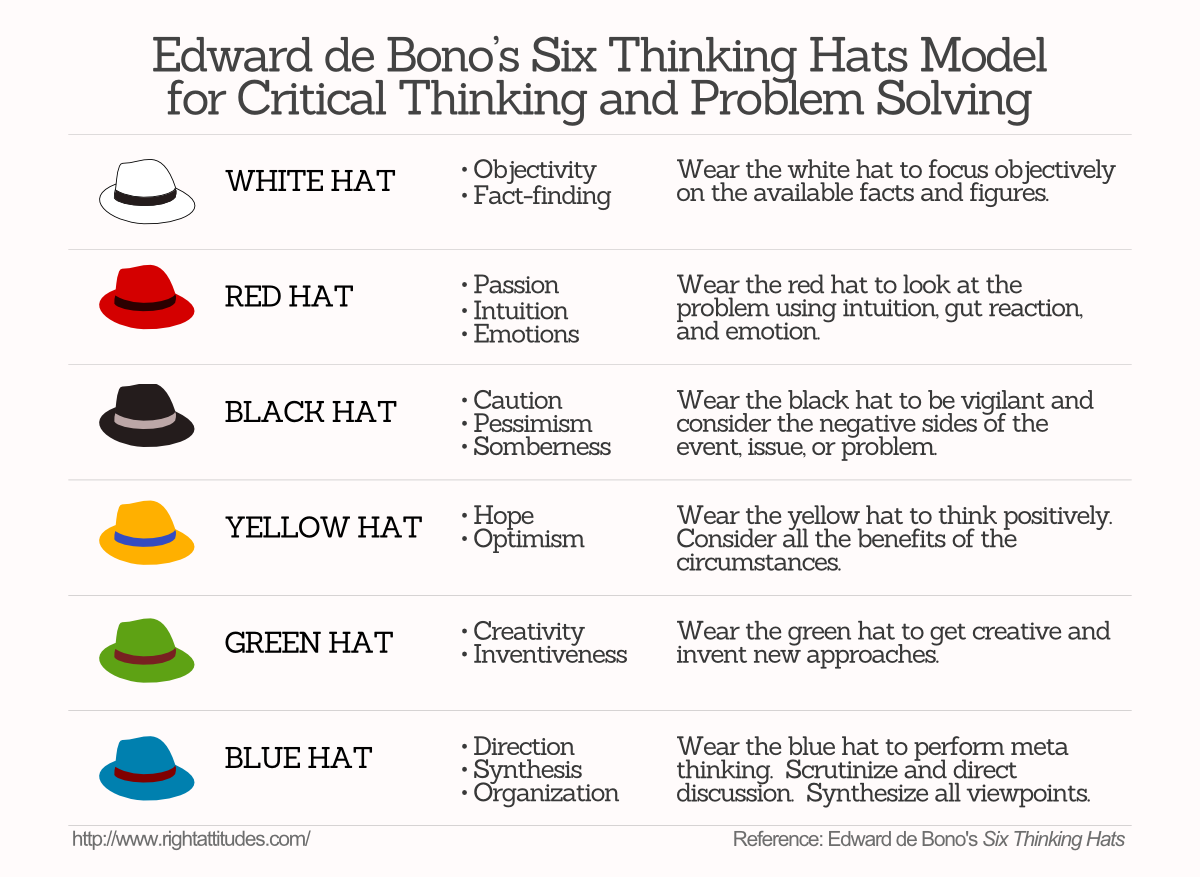
De Bono created the ‘six thinking hats’ method after identifying six distinct lines of human thought in problem solving. De Bono calls each approach a “hat” and assigns them different colors.

At the heart of the ‘six thinking hats’ method are six different colored hats that participants put on—literally or metaphorically—to represent the type of thinking they should concentrate on while wearing each.

  1. White is neutral, objective, and fact-based. A white hat is concerned with objective data: “What information do we have? What information do we need? What information are we missing? How can get the information we need? What objective questions should be asked?”
  2. Red denotes passion, anger, intuition, and emotions. A red hat considers the emotional side of problem solving, which is often neglected or masked in meetings: “What are our gut reactions to the matter at hand?”
  3. Black is somber, serious, and cautious. A black hat is vigilant, plays devil’s advocate, and encourages derogatory and judgmental behavior: “what are the weaknesses of these ideas? What are the risks? What could go wrong?”
  4. Yellow represents positive thinking, hope, and optimism to counteract the black hat’s power. A yellow hat plays “the angel’s advocate” and is cheerful and confident: “What are the best-case scenarios? What are the best aspects of this? What are the advantages? Who can benefit from this?”
  5. Green signifies abundance, growth, richness, and fertility. A green hat is the hat of creativity; it rejects established rules and norms, and invents new approaches: “What are some new ideas on this subject? What is interesting about this idea? What are the variances in these ideas?”
  6. Blue represents the sky and therefore provides the overarching perspective. A blue hat performs “meta thinking” and is concerned with the organization of the thinking process and the use of other hats. The blue hat synthesizes and reconciles different viewpoints. At the start of a brainstorming session, the blue hat sets the stage for where the discussion may go. The blue hat guides and sustains the discussion, often restating its purposes: “What are we thinking about? What is the goal? What should we do next? What have we achieved so far? What should we do to achieve more?” At the conclusion of the brainstorming session, the blue hat appraises the discussion, and proposes a plan of action.

Use De Bono’s Six Thinking Hats Model for Critical Thinking and Problem Solving

'Six Thinking Hats' by Edward de Bono (ISBN 0316178314) An individual working alone may use the approach to consider broader, distinct lines of thought. By changing hats, the individual can switch viewpoints and ensure that he/she is not stuck in specific thinking patterns.

However, the approach is best suited to group discussions (when chaired by a skilled facilitator) in which conflicting ideas may never otherwise be fully synthesized into plans of action. By persuading each participant to think constructively alongside other participants, the ‘six thinking hats’ method taps into group members’diverse perspectives and uses their collective knowledge without destructive conflict.

Using these hats nurtures creativity by letting participants step beyond their typical roles and contribute to developing, organizing, and progressing ideas. Participants can also identify how their cognitive state at any one time shapes how they approach problems.

Recommendation: Read. Edward de Bono’s Six Thinking Hats presents a very effective technique for stimulating group creativity. The method can remove mental blocks, organize ideas and information, foster cross-fertilization, and help conduct thinking sessions more productively than do other brainstorming methods.

Complement with Dan Ciampa’s Taking Advice for an excellent framework on the kind of advice network you need on strategic, operational, political, and personal elements of your work and life. Read my summary in this article.

Wondering what to read next?

  1. Finding Potential Problems & Risk Analysis: A Case Study on ‘The Three Faces of Eve’
  2. The Curse of Teamwork: Groupthink
  3. This is Yoga for the Brain: Multidisciplinary Learning
  4. Creativity by Imitation: How to Steal Others’ Ideas and Innovate
  5. Four Ideas for Business Improvement Ideas

Filed Under: Mental Models, Sharpening Your Skills Tagged With: Conversations, Creativity, Critical Thinking, Mental Models, Networking, Social Dynamics, Teams, Thinking Tools, Thought Process, Winning on the Job

Stuck on a Problem? Shift Your Perspective!

March 11, 2016 By Nagesh Belludi 1 Comment

The World’s Second Funniest Joke

In 2001, Richard Wiseman led an international humor experiment to find the world’s funniest joke. He had internet users submit and rate 40,000 jokes. Of these, the second-funniest joke was the following (the world’s funniest joke is here.)

Sherlock Holmes and Dr. Watson are camping. They pitch their tent under the stars and go to sleep. Sometime in the middle of the night, Holmes wakes Watson up.

Holmes: “Watson, look up at the stars, and tell me what you deduce.”

Watson: “I see millions of stars and even if a few of those have planets, it’s quite likely there are some planets like earth, and if there are a few planets like earth out there, there might also be life. What does it tell you, Holmes?”

Holmes: “Watson, you idiot, somebody has stolen our tent!”

Fixation: an Impediment to Successful Problem Solving

The joke suggests the psychological concept of fixation. Fixation occurs when you view a problem from only one perspective preventing you from seeing the obvious or breaking from a routine way of thinking.

To change an entrenched pattern of thinking, try to shift your perspective—literally or metaphorically. A shift in perspective can change your physical position and thus alter your point of view in a literal and sensory way, or it may change the way you think about or define the problem at hand.

The fields of arts and the sciences are replete with examples of how a different frame of mind can offer creative insight. As I cited in my article on the start of Picasso’s Blue Period, many artistic styles develop when artists feel the need to change the way their art represents the world. The new style therefore presents an alternative perspective.

Idea for Impact: Get Creative by Shifting Your Perspective

Shifts in perspective are fundamental to many facets of the creative process. As I stated in my previous article on reframing, the solution to many difficult problems can be found merely by defining or formulating them in a new, more productive way.

If you’re stuck on a problem, stand back and apply a different lens to break away from your current perspective.

Alternatively, simply take time away from your problem. A relaxation of effort may help you see something that is obvious after the break, but was previously overlooked or taken for granted.

Wondering what to read next?

  1. Reframe Your Thinking, Get Better Answers: What the Stoics Taught
  2. Howard Gardner’s Five Minds for the Future // Books in Brief
  3. You Can’t Develop Solutions Unless You Realize You Got Problems: Problem Finding is an Undervalued Skill
  4. Finding Potential Problems & Risk Analysis: A Case Study on ‘The Three Faces of Eve’
  5. Good Questions Encourage Creative Thinking

Filed Under: Mental Models, Sharpening Your Skills Tagged With: Creativity, Humor, Philosophy, Thinking Tools, Thought Process, Winning on the Job

How to Become a Broad-thinker: Principles and Methods

December 18, 2015 By Nagesh Belludi Leave a Comment

Success depends on understanding basic principles as well as on developing and practicing workable methods.

  • Elon Musk, CEO of SpaceX and Tesla, recently advised in his Reddit AMA, “It is important to view knowledge as sort of a semantic tree—make sure you understand the fundamental principles, i.e. the trunk and big branches, before you get into the leaves/details or there is nothing for them to hang on to.”
  • Harrington Emerson, a prominent management consultant and efficiency expert during the early 1900s, is understood to have said that the key to becoming a broad-thinker is to focus on the principles: “As to methods, there may be a million and then some, but principles are few. The man who grasps principles can successfully select his own methods. The man who tries methods, ignoring principles, is sure to have trouble.” (This quote is often incorrectly attributed to American essayist Ralph Waldo Emerson.)

Principles are the fundamental set of philosophies, propositions, assumptions, laws, and rules concerning a topic, problem, or circumstances. The principles can teach you why something works the way it does.

Methods, on the other hand, are merely devices to apply those principles in a particular circumstance.

While principles are immutable, Emerson reminds us that there can be many methods to interpret and apply those principles.

Principles and Methods

Given the time-pressure induced by the hurried world of work, we are often so tempted to implement ready-made or handed-down methods that we forgo the necessary examination of underpinning principles.

By delving directly into methods, we can find some reliable direction and save a great deal of time, but we may be neglecting many factors that can affect the outcomes of our methods. These circumferential issues, second- and higher-order effects, and peripheral relationships may not be readily apparent at the outset. They will emanate only from a knowledge of the underlying principles.

Idea for Impact: To be an effective thinker, develop a broad understanding and appreciation of the principles before you develop or deploy methods.

Wondering what to read next?

  1. Reframe Your Thinking, Get Better Answers: What the Stoics Taught
  2. Finding Potential Problems & Risk Analysis: A Case Study on ‘The Three Faces of Eve’
  3. Good Questions Encourage Creative Thinking
  4. Creativity by Imitation: How to Steal Others’ Ideas and Innovate
  5. Four Ideas for Business Improvement Ideas

Filed Under: Mental Models, Sharpening Your Skills Tagged With: Creativity, Elon Musk, Thinking Tools, Thought Process, Winning on the Job

« Previous Page
Next Page »

Primary Sidebar

Popular Now

Anxiety Assertiveness Attitudes Balance Biases Coaching Conflict Conversations Creativity Critical Thinking Decision-Making Discipline Emotions Entrepreneurs Etiquette Feedback Getting Along Getting Things Done Goals Great Manager Innovation Leadership Leadership Lessons Likeability Mental Models Mindfulness Motivation Networking Parables Performance Management Persuasion Philosophy Problem Solving Procrastination Psychology Relationships Simple Living Social Skills Stress Suffering Thinking Tools Thought Process Time Management Winning on the Job Wisdom

About: Nagesh Belludi [hire] is a St. Petersburg, Florida-based freethinker, investor, and leadership coach. He specializes in helping executives and companies ensure that the overall quality of their decision-making benefits isn’t compromised by a lack of a big-picture understanding.

Get Updates

Signup for emails

Subscribe via RSS

Contact Nagesh Belludi

RECOMMENDED BOOK:
The Art of Stillness

The Art of Stillness: Pico Iyer

Travel writer Pico Iyer’s argues the importance of taking a timeout from busyness. Examples of a privileged few who have found peace through stillness in practice.

Explore

  • Announcements
  • Belief and Spirituality
  • Business Stories
  • Career Development
  • Effective Communication
  • Great Personalities
  • Health and Well-being
  • Ideas and Insights
  • Inspirational Quotations
  • Leadership
  • Leadership Reading
  • Leading Teams
  • Living the Good Life
  • Managing Business Functions
  • Managing People
  • MBA in a Nutshell
  • Mental Models
  • News Analysis
  • Personal Finance
  • Podcasts
  • Project Management
  • Proverbs & Maxims
  • Sharpening Your Skills
  • The Great Innovators

Recently,

  • Book Summary: Hadley Freeman’s ‘Life Moves Pretty Fast’—How ’80s Movies Wrote America’s Story
  • Inspirational Quotations #1150
  • Corporate Boardrooms: The Governance Problem Everyone Knows and Nobody Fixes
  • Every Agreement Has a Loophole: What Puma’s Pele Gambit Teaches About Lateral Thinking
  • Five Simple Changes That Can Save You the Most Time
  • Inspirational Quotations #1149
  • Sadness Isn’t a Diagnosis

Unless otherwise stated in the individual document, the works above are © Nagesh Belludi under a Creative Commons BY-NC-ND license. You may quote, copy and share them freely, as long as you link back to RightAttitudes.com, don't make money with them, and don't modify the content. Enjoy!