• Skip to content
  • Skip to primary sidebar

Right Attitudes

Ideas for Impact

Thought Process

You Can’t Develop Solutions Unless You Realize You Got Problems: Problem Finding is an Undervalued Skill

June 21, 2016 By Nagesh Belludi Leave a Comment

Problem finding plays an important role in creative thinking

Problem finding is one of the most significant parts of problem solving. However, it tends to be an underappreciated skill. Many managers naively consider it strange to encourage employees to look for problems at work: “Why look for new problems when we’ve got no resources to work on ones we’ve already identified?”

Many courses and books on problem solving and creativity overlook problem finding. Many educational resources tend to assume that problem solving really begins only after problems have been identified.

Problem-identification lead to the invention of the ballpoint pen

The story of the invention of the ballpoint pen demonstrates the importance of problem finding. Had the inventors not recognized a problem with the existing writing instruments of their day, they would not have developed their invention.

In the 1920s, Hungarian journalist Laszlo Biro spent much time proofreading and checking for errors in others’ writings. To communicate these errors to the authors, Laszlo could not use pencils because their impressions fade quickly. He tried using a fountain pen, but the ink from the fountain pen dried slowly and often left smudges on paper.

Laszlo observed that the ink used in newspaper printing dried quickly and left the paper smudge-free. When he tried using that ink in his fountain pen, however, the ink was too viscous to flow into the tip of the fountain pen.

Laszlo then collaborated with his chemist-brother Gyorgy Biro to invent a new pen tip consisting of a ball that was enclosed within a socket. As the ball rolled inside the socket, the ball could pick up ink from a reservoir or cartridge and then continue to roll to deposit the ink on the paper. The Biro brothers thus invented the ballpoint pen. The company they created is now part of the BIC Company. The ballpoint pen continues to be called a ‘Biro’ in some countries.

Often, creativity is the outcome of discovered problem solving

Greek Philosopher Plato famously wrote in The Republic, “Let us begin and create in idea a State; and yet a true creator is necessity, which is the mother of our invention.”

One reason we fail to identify problems is that we do not stop to think about improving various situations that we encounter. Very often, these problems are directly in front of us; we need to consciously identify them and convert them into opportunities for problem solving. Instead, we tend to take inconveniences and unpleasant situations for granted and assume they are merely “facts of life.”

  • The grain mill was not invented until somebody in antiquity identified the ineffectiveness of two hours of pounding grain to make a cup of flour.
  • The world’s first traffic lights were installed around the British Houses of Parliament in London only after somebody thought of the problem of traffic congestion. In other words, up until the problems from congestion were identified in the 1860s, no one attempted to systematically consider how the problem might be solved.
  • James Watt invented his seminal separate-condenser steam engine after discovering an interesting problem with the Newcomen steam engine. In 1763, when Watt was working as an instrument maker at the University of Glasgow, he was assigned to repair a model of a Newcomen engine for a lecture-demonstration. Watt initially had difficulty getting the Newcomen engine to work because its parts were poorly constructed. When he finally had it running, he was surprised at its efficiency. Watt observed that the engine was constantly running out of coal because the constant heating and cooling of the cylinder resulted in a large waste of energy. Watt then devised a system whereby the cylinder and the condenser were separate. This led to his invention of the “steam engine” (or, more precisely, the separate-condenser steam engine.)
  • As I mentioned in a previous article on the opportunities in customers’ pain points, crispy potato chips were invented only when Chef George Crum of New York’s Saratoga Springs attempted to appease a cranky customer who frequently sent Crum’s fried potatoes back to the kitchen complaining that they were mushy and not crunchy enough. Decades later, Laura Scudder invented airtight packaging for potato chips only after becoming conscious of customers’ complaints that chips packaged in metal containers quickly go stale and crumble during handling.

If problems are not identified, solutions are unlikely to be proposed

It pays to keep your eyes open and look at inconveniences, difficulties, and troubles as creative problems to be solved. Don’t ignore these merely as facts of life.

Curiosity, intrigue, and motivation influence problem finding (and problem solving.) One of the easiest ways to develop your skills in problem finding is to ponder at anything around you and wonder why those gadgets and contraptions were ever invented. Analyze carefully and you’ll learn that the first step taken by the inventors of these objects was the identification of the problems the objects were designed to solve.

When you look around various objects in your life, think about what life was before these objects were invented. What problems could these inventions have solved? Why was the zipper invented? What problems motivated Bjarne Stroustrup to create C++? What was internet search like before Google? How did commerce transpire before the advent of coins and bills and money?

Some people make a career out of problem finding. Managers who want to know if their organizations are running efficiently frequently hire consultants to look for problems that managers do not know exist in their businesses.

And finally, if you want to become an inventor or an entrepreneur, try to start with problems you already have in your work or in your life. Ideally, identify problems shared by a large number of people to increase the probability that your inventions will be put in widespread use.

Idea for Impact: A creative solution to a problem often depends on first finding and defining a creative problem. Very often, the solution to a problem becomes obvious when the problem has been properly identified, defined, and represented.

Wondering what to read next?

  1. Four Ideas for Business Improvement Ideas
  2. Howard Gardner’s Five Minds for the Future // Books in Brief
  3. Finding Potential Problems & Risk Analysis: A Case Study on ‘The Three Faces of Eve’
  4. Van Gogh Didn’t Just Copy—He Reinvented
  5. Creativity by Imitation: How to Steal Others’ Ideas and Innovate

Filed Under: Mental Models, Sharpening Your Skills Tagged With: Artists, Creativity, Critical Thinking, Luck, Mental Models, Problem Solving, Scientists, Thinking Tools, Thought Process, Winning on the Job

How to Stimulate Group Creativity // Book Summary of Edward de Bono’s ‘Six Thinking Hats’

May 13, 2016 By Nagesh Belludi

Stimulate Group Creativity Using Edward de Bono's 'Six Thinking Hats'

In his bestselling book Six Thinking Hats, Edward de Bono describes a powerful problem-solving approach that enriches mental flexibility by encouraging individuals and groups to attack an issue from six independent but complementary perspectives.

Edward de Bono is a leading authority in creative thinking. He is widely regarded as the father of lateral thinking. De Bono has written over 70 books on thinking and creativity.

Using the ‘Six Thinking Hats’ for Structured Brainstorming

De Bono created the ‘six thinking hats’ method after identifying six distinct lines of human thought in problem solving. De Bono calls each approach a “hat” and assigns them different colors.

At the heart of the ‘six thinking hats’ method are six different colored hats that participants put on—literally or metaphorically—to represent the type of thinking they should concentrate on while wearing each.

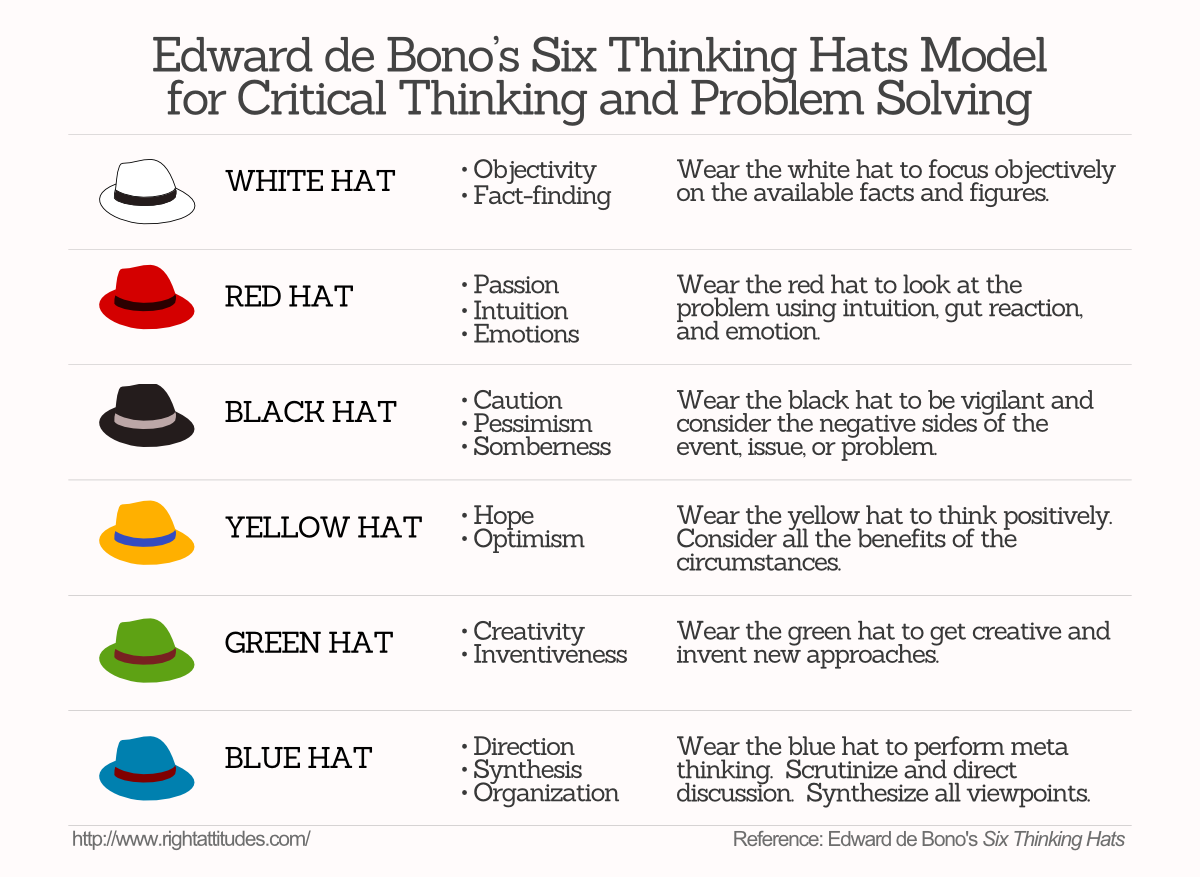
  1. White is neutral, objective, and fact-based. A white hat is concerned with objective data: “What information do we have? What information do we need? What information are we missing? How can get the information we need? What objective questions should be asked?”
  2. Red denotes passion, anger, intuition, and emotions. A red hat considers the emotional side of problem solving, which is often neglected or masked in meetings: “What are our gut reactions to the matter at hand?”
  3. Black is somber, serious, and cautious. A black hat is vigilant, plays devil’s advocate, and encourages derogatory and judgmental behavior: “what are the weaknesses of these ideas? What are the risks? What could go wrong?”
  4. Yellow represents positive thinking, hope, and optimism to counteract the black hat’s power. A yellow hat plays “the angel’s advocate” and is cheerful and confident: “What are the best-case scenarios? What are the best aspects of this? What are the advantages? Who can benefit from this?”
  5. Green signifies abundance, growth, richness, and fertility. A green hat is the hat of creativity; it rejects established rules and norms, and invents new approaches: “What are some new ideas on this subject? What is interesting about this idea? What are the variances in these ideas?”
  6. Blue represents the sky and therefore provides the overarching perspective. A blue hat performs “meta thinking” and is concerned with the organization of the thinking process and the use of other hats. The blue hat synthesizes and reconciles different viewpoints. At the start of a brainstorming session, the blue hat sets the stage for where the discussion may go. The blue hat guides and sustains the discussion, often restating its purposes: “What are we thinking about? What is the goal? What should we do next? What have we achieved so far? What should we do to achieve more?” At the conclusion of the brainstorming session, the blue hat appraises the discussion, and proposes a plan of action.

Use De Bono’s Six Thinking Hats Model for Critical Thinking and Problem Solving

'Six Thinking Hats' by Edward de Bono (ISBN 0316178314) An individual working alone may use the approach to consider broader, distinct lines of thought. By changing hats, the individual can switch viewpoints and ensure that he/she is not stuck in specific thinking patterns.

However, the approach is best suited to group discussions (when chaired by a skilled facilitator) in which conflicting ideas may never otherwise be fully synthesized into plans of action. By persuading each participant to think constructively alongside other participants, the ‘six thinking hats’ method taps into group members’diverse perspectives and uses their collective knowledge without destructive conflict.

Using these hats nurtures creativity by letting participants step beyond their typical roles and contribute to developing, organizing, and progressing ideas. Participants can also identify how their cognitive state at any one time shapes how they approach problems.

Recommendation: Read. Edward de Bono’s Six Thinking Hats presents a very effective technique for stimulating group creativity. The method can remove mental blocks, organize ideas and information, foster cross-fertilization, and help conduct thinking sessions more productively than do other brainstorming methods.

Complement with Dan Ciampa’s Taking Advice for an excellent framework on the kind of advice network you need on strategic, operational, political, and personal elements of your work and life. Read my summary in this article.

Wondering what to read next?

  1. Finding Potential Problems & Risk Analysis: A Case Study on ‘The Three Faces of Eve’
  2. The Curse of Teamwork: Groupthink
  3. This is Yoga for the Brain: Multidisciplinary Learning
  4. Creativity by Imitation: How to Steal Others’ Ideas and Innovate
  5. Charlie Munger’s Iron Prescription

Filed Under: Mental Models, Sharpening Your Skills Tagged With: Conversations, Creativity, Critical Thinking, Mental Models, Networking, Social Dynamics, Teams, Thinking Tools, Thought Process, Winning on the Job

Find out What Your Customers Want and Give it to Them

April 22, 2016 By Nagesh Belludi 1 Comment

“Nobody asked the dogs what they wanted”

Once upon a time, a pet-foods company struggled to sell a new dog food product they’d recently introduced to the market.

The company’s CEO called the department heads together to discuss why the new product wouldn’t sell.

The head of production said he’d done everything right; it wasn’t his department’s fault.

The heads of the sales, advertising, finance, packaging, shipping, and distribution departments had done everything right. None of them were to blame.

The CEO demanded, “Darn! What happened? Why won’t our new product sell?”

A junior staffer shouted from the back of the room, “Sir, it’s just that the dogs simply won’t eat our doggone food. You see, nobody asked the dogs what they wanted.”

Idea for Impact: Customer Focus Drives Company Success

Your research and development efforts will be successful only if they’re driven by a thorough understanding of what your customers want. Engage your customers. Pay close attention to their needs in every phase of product/service design including idea generation, product design, prototyping, production, distribution, and service. Remember Peter Drucker’s dictum that “the purpose of a business is to create and keep a customer.”

Wondering what to read next?

  1. Your Product May Be Excellent, But Is There A Market For It?
  2. How to … Get into a Creative Mindset
  3. Airline Safety Videos: From Dull Briefings to Dynamic Ad Platforms
  4. The Singapore Girl: Myth, Marketing, and Manufactured Grace
  5. Invention is Refined Theft

Filed Under: Business Stories, Leadership, Managing Business Functions, The Great Innovators Tagged With: Creativity, Customer Service, Innovation, Parables, Peter Drucker, Thought Process

Stuck on a Problem? Shift Your Perspective!

March 11, 2016 By Nagesh Belludi 1 Comment

The World’s Second Funniest Joke

In 2001, Richard Wiseman led an international humor experiment to find the world’s funniest joke. He had internet users submit and rate 40,000 jokes. Of these, the second-funniest joke was the following (the world’s funniest joke is here.)

Sherlock Holmes and Dr. Watson are camping. They pitch their tent under the stars and go to sleep. Sometime in the middle of the night, Holmes wakes Watson up.

Holmes: “Watson, look up at the stars, and tell me what you deduce.”

Watson: “I see millions of stars and even if a few of those have planets, it’s quite likely there are some planets like earth, and if there are a few planets like earth out there, there might also be life. What does it tell you, Holmes?”

Holmes: “Watson, you idiot, somebody has stolen our tent!”

Fixation: an Impediment to Successful Problem Solving

The joke suggests the psychological concept of fixation. Fixation occurs when you view a problem from only one perspective preventing you from seeing the obvious or breaking from a routine way of thinking.

To change an entrenched pattern of thinking, try to shift your perspective—literally or metaphorically. A shift in perspective can change your physical position and thus alter your point of view in a literal and sensory way, or it may change the way you think about or define the problem at hand.

The fields of arts and the sciences are replete with examples of how a different frame of mind can offer creative insight. As I cited in my article on the start of Picasso’s Blue Period, many artistic styles develop when artists feel the need to change the way their art represents the world. The new style therefore presents an alternative perspective.

Idea for Impact: Get Creative by Shifting Your Perspective

Shifts in perspective are fundamental to many facets of the creative process. As I stated in my previous article on reframing, the solution to many difficult problems can be found merely by defining or formulating them in a new, more productive way.

If you’re stuck on a problem, stand back and apply a different lens to break away from your current perspective.

Alternatively, simply take time away from your problem. A relaxation of effort may help you see something that is obvious after the break, but was previously overlooked or taken for granted.

Wondering what to read next?

  1. Reframe Your Thinking, Get Better Answers: What the Stoics Taught
  2. Many Businesses Get Started from an Unmet Personal Need
  3. What Isn’t Matters Too
  4. How to Become a Broad-thinker: Principles and Methods
  5. How to Stimulate Group Creativity // Book Summary of Edward de Bono’s ‘Six Thinking Hats’

Filed Under: Mental Models, Sharpening Your Skills Tagged With: Creativity, Humor, Philosophy, Thinking Tools, Thought Process, Winning on the Job

The Drunkard’s Search or the Streetlight Effect [Cognitive Bias]

February 26, 2016 By Nagesh Belludi Leave a Comment

An old parable (sometimes ascribed to Mulla Nasreddin, the 13th Century witty philosopher from today’s Turkey) tells of a drunkard searching under a street lamp for keys he has lost because the light there is better than where he thinks he lost them.

A police officer sees a drunken man intently searching the ground near a lamppost and asks him the goal of his quest. The inebriate replies that he is looking for his car keys, and the officer helps for a few minutes without success. Then he asks whether the man is certain that he dropped the keys near the lamppost.

“No,” is the reply, “I lost the keys somewhere across the street.”

“Why look here?” asks the surprised and irritated officer.

“The light is much better here,” the intoxicated man responds with aplomb.

The “drunkard’s search” or the “streetlight effect” refers to the propensity for people to look for whatever they’re searching in the easier places instead of in the places that are most likely to yield the results they’re seeking. This is a widespread observational bias that manifests itself frequently in research and investigative methods.

For instance, many Americans who lost their jobs during the two recessions of the ‘lost decade’ of the 2000s sought jobs in the same communities where their factories had closed. They were less inclined to seek long-term solutions to their joblessness and relocate to parts of America where jobs were not as scarce. They had kids in local schools, owned homes that had significantly devalued during the recession, and felt rooted in their communities. They found it more convenient to hope for a revival in their local economies and endure the recession.

Idea for Impact: Look out for observational biases. Don’t seek answers where the looking is good; rather seek answers where they’re likely to be found.

Wondering what to read next?

  1. The “Ashtray in the Sky” Mental Model: Idiot-Proofing by Design
  2. Accidents Can Happen When You Least Expect Them: The Overconfidence Effect
  3. Increase Paranoia When Things Are Going Well
  4. The Upsides of Slowing Down
  5. The Wisdom of the Well-Timed Imperfection: The ‘Pratfall Effect’ and Authenticity

Filed Under: Mental Models, Sharpening Your Skills Tagged With: Biases, Critical Thinking, Parables, Thought Process

How to Become a Broad-thinker: Principles and Methods

December 18, 2015 By Nagesh Belludi Leave a Comment

Success depends on understanding basic principles as well as on developing and practicing workable methods.

  • Elon Musk, CEO of SpaceX and Tesla, recently advised in his Reddit AMA, “It is important to view knowledge as sort of a semantic tree—make sure you understand the fundamental principles, i.e. the trunk and big branches, before you get into the leaves/details or there is nothing for them to hang on to.”
  • Harrington Emerson, a prominent management consultant and efficiency expert during the early 1900s, is understood to have said that the key to becoming a broad-thinker is to focus on the principles: “As to methods, there may be a million and then some, but principles are few. The man who grasps principles can successfully select his own methods. The man who tries methods, ignoring principles, is sure to have trouble.” (This quote is often incorrectly attributed to American essayist Ralph Waldo Emerson.)

Principles are the fundamental set of philosophies, propositions, assumptions, laws, and rules concerning a topic, problem, or circumstances. The principles can teach you why something works the way it does.

Methods, on the other hand, are merely devices to apply those principles in a particular circumstance.

While principles are immutable, Emerson reminds us that there can be many methods to interpret and apply those principles.

Principles and Methods

Given the time-pressure induced by the hurried world of work, we are often so tempted to implement ready-made or handed-down methods that we forgo the necessary examination of underpinning principles.

By delving directly into methods, we can find some reliable direction and save a great deal of time, but we may be neglecting many factors that can affect the outcomes of our methods. These circumferential issues, second- and higher-order effects, and peripheral relationships may not be readily apparent at the outset. They will emanate only from a knowledge of the underlying principles.

Idea for Impact: To be an effective thinker, develop a broad understanding and appreciation of the principles before you develop or deploy methods.

Wondering what to read next?

  1. Many Businesses Get Started from an Unmet Personal Need
  2. Stuck on a Problem? Shift Your Perspective!
  3. How to Stimulate Group Creativity // Book Summary of Edward de Bono’s ‘Six Thinking Hats’
  4. You Can’t Develop Solutions Unless You Realize You Got Problems: Problem Finding is an Undervalued Skill
  5. This is Yoga for the Brain: Multidisciplinary Learning

Filed Under: Mental Models, Sharpening Your Skills Tagged With: Creativity, Elon Musk, Thinking Tools, Thought Process, Winning on the Job

The Trickery of Leading Questions

December 1, 2015 By Nagesh Belludi 1 Comment

Leading questions are questions that are purposely phrased and presented in such a way that they prompt the respondent to think and answer them in a particular way. Leading questions have the potential to subtly change respondents’ opinions about a topic and to shape their responses to the questions that follow.

Example of Leading Questions and Suggestive Interrogation

Consider the following interchange from the popular 1980s British political satire (and one of my all-time favorite shows) Yes, Prime Minister. In The Ministerial Broadcast episode, Sir Humphrey Appleby and Bernard Woolley discuss how leading questions can be used to influence the results of opinion polls—in their case regarding the reintroduction of National Service, military conscription in the UK.

In Yes, Prime Minister, Sir Appleby (played by Nigel Hawthorne) is the Cabinet Secretary, UK’s principal bureaucrat and a scheming master of manipulation and obfuscation. Woolley (played by Derek Fowlds) is the Prime Minister’s Principal Private Secretary.

In the following clip, Sir Appleby presents a set of leading questions designed to elicit opinion survey responses in support of National Service. He then presents another set of leading questions poised to produce responses opposing National Service.

The Effect of the Leading Questions

First, Sir Appleby demonstrates that asking the following leading questions can sway a respondent to support the reintroduction of National Service:

  • Are you worried about the number of young people without jobs?
  • Are you worried about the rise in crime among teenagers?
  • Do you think there is lack of discipline in our comprehensive schools?
  • Do you think young people welcome some authority and leadership in their lives?
  • Do you think they’ll respond to a challenge?
  • Would you be in favour of reintroducing National Service?”

This set of six questions brilliantly exemplifies the use of leading questions. They are designed and presented in such a way that they trigger agreement—‘yes’ seems an obvious answer to each. After all, everybody is inclined to be worried about teenage crime and youth unemployment. After this pattern of concordance, Sir Appleby throws in the well-worded crucial question about National Service. In fact, this last question is worded in such a way that it offers National Service as a supposed solution to all the aforementioned problems. Once more, the answer is agreement.

In the second half of his interchange with Woolley, Sir Appleby demonstrates that another set of deliberate leading questions can make the respondent oppose the reintroduction of National Service:

  • Are you worried about the danger of war?
  • Are you worried about the growth of armaments?
  • Do you think there’s a danger in giving young people guns and teaching them how to kill?
  • Do you think it’s wrong to force people to take up arms against their will?
  • Would you oppose the reintroduction of National Service?

Sir Humphrey’s first four questions are deliberately designed to produce agreement. In keeping with the survey’s design, the fifth question does too: a person who is concerned about arms and opposed to forcing the youth to take up arms against their will is bound to oppose reintroduction of National Service.

Idea for Impact: Sensitize Yourself to Leading Questions; Use Them if Necessary

Firstly, trust surveys, statistics, and anecdotes at your own discretion. Question everything.

Secondly, sensitize yourself to leading questions. Be alert and aware of all the negative ploys, manipulations, and other persuasive devices that others can shrewdly use to influence your thinking.

Thirdly, and more consequentially, use leading questions when you hold a strong personal opinion on a topic of discussion and must engage others in your favor. If necessary, use leading questions to change their opinion or even to gather some slanted information. While I am not one to condone deception, I do recommend such manipulative techniques as long as you use them for positive ends—sometimes certain ends do justify certain means.

Wondering what to read next?

  1. The Power of Asking Open-Ended Questions
  2. Cultural Differences and Detecting Deception
  3. What the Rise of AI Demands: Teaching the Thinking That Thinks About Thinking
  4. Situational Blindness, Fatal Consequences: Lessons from American Airlines 5342
  5. Let’s Hope She Gets Thrown in the Pokey

Filed Under: Effective Communication, Mental Models Tagged With: Asking Questions, Biases, Humor, Manipulation, Questioning, Thought Process

When Getting a Great Deal Might Not Be Worth Your Time

November 20, 2015 By Nagesh Belludi 1 Comment

Most consumers love a deal. However, some of us spend untold time searching for the best possible bargains.

If you’re one of these obsessive bargain-hunters, unless you derive some hedonistic pleasure in snatching deals, you may not have considered the possibility that you’re putting too low a value on your time.

Perhaps you could benefit from some perspective: the time you spend hunting for deals and trying to save that last penny may not be worth it. While you can quantify how much money you save by shopping around, you may not realize the opportunity costs of deal-hunting: it often comes at the cost of your time.

You may have a vague sense of the fact that “time is money,” but this might not be telling enough. You can find the approximate value of an hour of your time by dividing your annual income by 2,000 (or, more easily, by disregarding the last three digits of your annual income and dividing the result by 2.)

Obsessive Bargain-Hunters, Coupon Craziness Set a cost threshold based on the value of your time, say $15 per hour, for deal-hunting. If you’re not saving at least this amount, deal-hunting might just waste your time and money. So, refrain from scouring the internet for a better deal on a weeklong vacation or bidding on eBay if you’re not saving $15 per hour. Likewise, don’t drive across town to Costco just to save a dime per gallon on 20 gallons of gas.

I’ve written previously that life is all about values and the priorities you assign to those values. Therefore, decide which choices in your life really matter and focus your time and energy there. Let numerous other opportunities pass you by.

Another part of leading a wise and meaningful life is not always seeking the best but instead making good-enough choices about the things that matter and not concerning yourself too much about the things that don’t.

Idea for Impact: Don’t spend more time on a task unless it really warrants this in terms of “time-is-money.” As the American Philosopher Henry David Thoreau said, “The price of anything is the amount of life you exchange for it.”

Wondering what to read next?

  1. Don’t Ruminate Endlessly
  2. Everything in Life Has an Opportunity Cost
  3. The Simple Life, The Good Life // Book Summary of Greg McKeown’s ‘Essentialism’
  4. Let Go of Sunk Costs
  5. Stop Searching for the Best Productivity System

Filed Under: Mental Models, Sharpening Your Skills Tagged With: Decision-Making, Materialism, Perfectionism, Personal Finance, Thought Process, Time Management

Clever Marketing Exploits the Anchoring Bias

November 17, 2015 By Nagesh Belludi Leave a Comment

In the ’70s, psychologists Amos Tversky and Daniel Kahneman were the first to study a cognitive phenomenon called “anchoring” and its influence on decision-making. Over the decades, extensive research on anchoring has explained that the way and context in which we receive information profoundly influence how we synthesize it.

The effects of anchoring are very visible in marketing, sales, merchandising, and product pricing as it profoundly influences consumer behavior. By offering clever price contrasts, marketers can shape customers’ purchasing decisions. For example,

  • By offering lower prices and promotional sales, department stores induce customers to compare the sale price against the original price—the “anchor”—and think they’re getting a bargain.
  • By displaying shiny, expensive new cars in the showroom, car dealerships encourage customers to accept the prices displayed on their used cars or less flashy models.
  • Patrons at restaurants tend to order the second least-expensive bottle of wine in an attempt to avoid looking cheap. Therefore, restaurants tend to put the highest markup on that very bottle.

The Case of the $429 Breadmaker

Anchoring Bias: Williams-Sonoma $429 Breadmaker Customers are usually more likely to purchase a product when competing alternatives are included, as opposed to having only one product option.

Consider a classic example of this “single-option aversion” phenomenon. A few years ago, Williams-Sonoma couldn’t get customers to buy their $279 breadmaker. They cleverly added a spiffier-and-slicker deluxe breadmaker model to their product line for $429. While Williams-Sonoma didn’t sell many of the new and expensive breadmaker, they doubled sales of the original and less-expensive model.

When the $279 breadmaker was the only model available for sale, customers couldn’t tell whether the price was competitive because there was nothing to compare it to. By introducing a better product for a higher price, Williams-Sonoma provided an anchor upon which its customers could compare the two models; they naturally sided with the $279 model as an attractive alternative.

The Case of the $69 Hot Dog and the $1000 Chocolate Sundae

Usually, absurdly expensive premium goods are less of publicity stunts and more of strategic marketing tactics.

Consider the case of Serendipity 3’s menu anchors. In 2010, the popular New York eatery introduced a $69 hot dog called “Foot-Long Haute Dog” with dressings as exotic as medallions of duck liver, ketchup made from heirloom tomatoes, Dijon mustard with truffle shavings, and caramelized Vidalia onions to justify the high price. Of course, Serendipity 3 gained plenty of publicity when The Guinness Book of World Records certified this hot dog as the most expensive wiener of all time.

The true purpose of these ridiculously priced premium items is to make the next most expensive item seem cheaper. Customers who were drawn by the Haute Dog’s publicity gladly ordered the menu’s $17.95 cheeseburger. Even if $17.95 was too pricey elsewhere, Serendipity 3 customers deemed it reasonable in comparison to the $69 hot dog.

A few years previous, Serendipity 3 similarly offered a $1000 “Golden Opulence Sundae” that was only available with a 48 hour-notice. They sold only one Sundae per month. Nevertheless, this was just a shrewd marketing ploy to convince customers to spend more on high-profit margin desserts such as the $15.50 “fruit and fudge” confection or the $22.50 “Cheese Cake Vesuvius.”

Unsuspecting customers ended up paying too much for other meals at Serendipity 3 while believing they were getting a great deal.

Idea for Impact: Be Sensitive of Anchoring Bias

In both the above case studies, even if the companies sold almost none of their highest-priced models despite the publicity they generated, the companies reaped enormous benefits by exploiting the anchoring bias to induce customers to buy cheaper-than-most-expensive high-profit products.

In summary, anchoring exploits our tendency to seek out comparison and our reliance on context. The anchoring bias describes our subconscious tendency to make decisions by relying heavily on a single piece of information.

Call to Action: Sensitize yourself to how anchoring and anchoring bias may subconsciously affect your decision-making. If you’re in marketing or sales, investigate how you could use anchoring bias to influence your customers.

For more on cognitive biases and behavioral economics, read 2002 Nobel Laureate Daniel Kahneman’s bestselling Thinking, Fast and Slow. Also read Nir Eyal’s Hooked: How to Build Habit-Forming Products on how to influence customer behaviors and build products and offer services that people love.

Wondering what to read next?

  1. Decoy Effect: The Sneaky Sales Trick That Turns Shoppers into Spenders
  2. The Wisdom of the Well-Timed Imperfection: The ‘Pratfall Effect’ and Authenticity
  3. The Mere Exposure Effect: Why We Fall for the Most Persistent
  4. Elon Musk Insults, Michael O’Leary Sells: Ryanair Knows Cheap-Fare Psychology
  5. Your Product May Be Excellent, But Is There A Market For It?

Filed Under: Business Stories, MBA in a Nutshell, Mental Models, Sharpening Your Skills Tagged With: Biases, Creativity, Marketing, Materialism, Personal Finance, Thought Process

How to Make Tough Choices // Book Summary of Suzy Welch’s 10-10-10 Rule

November 13, 2015 By Nagesh Belludi 1 Comment

'10-10-10: A Life-Transforming Idea' by Suzy Welch (ISBN 1416591826) In “10-10-10”, Suzy Welch offers a simple, straightforward thought process for decision-making.

The fundamental premise of Welch’s “10-10-10 Rule” is that our decisions define us. Each of our choices has consequences, both now and in the future.

Welch advocates making decisions thoughtfully by considering the potential positive and negative consequences in the immediate present, the near term, and the distant future: or in 10 minutes, 10 months, and 10 years.

… there is nothing literal about each ten in 10-10-10. The first 10 basically stands for “right now” as in, one minute, one hour, or one week. The second 10 represents that point in the foreseeable future when the initial reaction to your decision has passed but its consequences continue to play out in ways you can reasonably predict. And the third 10 stands for a time in a future that is so far off that its particulars are entirely vague. So, really, 10-10-10 could just as well be referring to nine days, fifteen months, and twenty years, or two hours, six months, and eight years. The name of the process is just a totem meant to directionally suggest time frames along the lines of: in the heat of the moment, somewhat later, and when all is said and done.

Welch reiterates that decision-making should involve a clear understanding of all the attributes and the long-term implications of your dilemma, crisis, problem, or question.

10-10-10 does have a way of galvanizing people into forward-thinking action and out of a fixation on the present. … The third 10 in 10-10-10 has a powerful way of mitigating that tendency. It helps us decide whether (or not) it’s worth it to endure short-term flame-outs in the service of our larger, more deeply held goals in life.

The bulk of the book offers trite, protracted, and tiresome examples of people using 10-10-10 to make decisions related to friendships, dating, marriage, children, work, and career and life planning.

Welch explains that the perspective that accompanies considering our decisions’ immediate and long-term consequences can be very helpful.

  • “By having us methodically sort through our options in various time frames, the process … forces us to dissect and analyze what we’re deciding and why, and it pushes us to empathize with who we might become.”
  • “The process invariably led me to faster, cleaner, and sounder decisions.”
  • “The process also gave me a way to explain myself to all the relevant “constituents”—my kids or parents or boss with clarity and confidence.”

Recommendation: Skim. If you must, read the first two chapters for a long-form description of what I’ve summarized. You’ll find little of value in the rest of the chapters. Alternatively, read The Oprah Magazine article in which Welch first introduced her 10-10-10 idea.

Postscript: In 2002, Suzy Welch was launched into spotlight after getting fired as an editor of the Harvard Business Review following a scandalous affair with former General Electric CEO Jack Welch, who was still married to his second wife. Subsequently, Jack’s enraged wife revealed embarrassing details of his post-retirement compensation from General Electric, claimed a significant share of his wealth, and divorced him. Suzy and Jack got married in 2004 and have since authored two best-selling books, “Winning” and “The Real-Life MBA”.

Wondering what to read next?

  1. The Best Leaders Make the Complex Simple
  2. How to Boost Your Willpower // Book Summary of Baumeister & Tierney’s ‘Willpower’
  3. Make a Difficult Decision Like Benjamin Franklin
  4. How to Solve a Problem By Standing It on Its Head
  5. This is Yoga for the Brain: Multidisciplinary Learning

Filed Under: Mental Models, Sharpening Your Skills Tagged With: Books, Decision-Making, Jack Welch, Thought Process

« Previous Page
Next Page »

Primary Sidebar

Popular Now

Anxiety Assertiveness Attitudes Balance Biases Coaching Conflict Conversations Creativity Critical Thinking Decision-Making Discipline Emotions Entrepreneurs Ethics Etiquette Feedback Getting Along Getting Things Done Goals Great Manager Innovation Leadership Leadership Lessons Likeability Mental Models Mindfulness Motivation Parables Performance Management Persuasion Philosophy Problem Solving Procrastination Psychology Relationships Simple Living Social Skills Stress Suffering Thinking Tools Thought Process Time Management Winning on the Job Wisdom

About: Nagesh Belludi [hire] is a St. Petersburg, Florida-based freethinker, investor, and leadership coach. He specializes in helping executives and companies ensure that the overall quality of their decision-making benefits isn’t compromised by a lack of a big-picture understanding.

Get Updates

Signup for emails

Subscribe via RSS

Contact Nagesh Belludi

RECOMMENDED BOOK:
How to Talk to Anyone

How to Talk to Anyone: Leil Lowndes

Communication consultant Leil Lowndes discusses 92 tricks to become a better conversationalist and improve social relationships---body language, words to say, telephone techniques, social tactics.

Explore

  • Announcements
  • Belief and Spirituality
  • Business Stories
  • Career Development
  • Effective Communication
  • Great Personalities
  • Health and Well-being
  • Ideas and Insights
  • Inspirational Quotations
  • Leadership
  • Leadership Reading
  • Leading Teams
  • Living the Good Life
  • Managing Business Functions
  • Managing People
  • MBA in a Nutshell
  • Mental Models
  • News Analysis
  • Personal Finance
  • Podcasts
  • Project Management
  • Proverbs & Maxims
  • Sharpening Your Skills
  • The Great Innovators

Recently,

  • The Quiet Rebellion
  • The ‘Near Enemy’: The Subtle Corruption That Makes Good Acts Fail
  • Inspirational Quotations #1162
  • The “Empty Vessel” Effect: Why Insecurity Speaks the Loudest
  • Persuasion’s Oldest Trick Isn’t the Promise of More—It’s the Threat of Loss
  • Efficiency vs. Effectiveness: Activity Without Outcome as Self-Indulgent Futility
  • Inspirational Quotations #1161

Unless otherwise stated in the individual document, the works above are © Nagesh Belludi under a Creative Commons BY-NC-ND license. You may quote, copy and share them freely, as long as you link back to RightAttitudes.com, don't make money with them, and don't modify the content. Enjoy!