• Skip to content
  • Skip to primary sidebar

Right Attitudes

Ideas for Impact

Attitudes

Don’t Aim at Success

September 4, 2015 By Nagesh Belludi 1 Comment

To complement my recent articles on the futility of attachment to results and the need to focus on effort not on outcomes, here’s practical instruction from the highly-recommended “Man’s Search for Meaning”, the memoir of Austrian psychiatrist and Holocaust survivor Viktor Frankl:

'Man's Search For Meaning' by Viktor Frankl (ISBN 0671023373) Again and again I therefore admonish my students in Europe and America: Don’t aim at success—the more you aim at it and make it a target, the more you are going to miss it. For success, like happiness, cannot be pursued; it must ensue, and it only does so as the unintended side effect of one’s personal dedication to a cause greater than oneself or as the by-product of one’s surrender to a person other than oneself. Happiness must happen, and the same holds for success: you have to let it happen by not caring about it. I want you to listen to what your conscience commands you to do and go on to carry it out to the best of your knowledge. Then you will live to see that in the long-run—in the long-run, I say!—success will follow you precisely because you had forgotten to think about it.

Wondering what to read next?

  1. How to … Change Your Life When Nothing Seems to be Going Your Way
  2. Choose Pronoia, Not Paranoia
  3. Success Conceals Wickedness
  4. Lessons on Adversity from Charlie Munger: Be a Survivor, Not a Victim
  5. Power Corrupts, and Power Attracts the Corruptible

Filed Under: Living the Good Life, Sharpening Your Skills Tagged With: Attitudes, Success

The Futility of Attachment to Expected Results

August 4, 2015 By Nagesh Belludi 1 Comment

The Futility of Attachment to Expected Results

Attachments Can Cause Suffering

Hindu and Buddhist philosophies posit that focusing on the rewards or outcomes of one’s actions is a prominent cause of emotional bondage in our material existence.

Buddhism holds that, above all, desire (selfish craving or tanha) and ignorance (unawareness or avidya) lie at the root of suffering (unsatisfactoriness or dukkha.) Desire is the yearning for hedonistic pleasure, affection, possessions, relationships, power, and even immortality.

The Bhagavad Gita on Detachment from Fruits of Labor

कर्मण्ये वाधिकारस्ते म फलेषु कदाचना।
कर्मफलेह्तुर भुरमा ते संगोस्त्वकर्मानी॥
—श्रीमद्भगवद्गीता 2:47

karmaṇy evādhikāras te mā phaleṣu kadācana
mā karma-phala-hetur bhūr mā te sańgo ‘stv akarmaṇi
—Bhagavad Gita 2:47

Translation: “To action alone hast thou a right and never at all to its fruits; let not the fruits of action be thy motive; neither let there be in thee any attachment to inaction.” [Source: “Bhagavadgita” by Sarvepalli Radhakrishnan]

“The wise are not bound by desire for rewards”

This verse suggests that the anticipated results of actions should not be the motivation for the performance of those actions.

Expounding this verse, the Hindu philosopher Madhvacharya (1238–1317) advocated godliness through right actions:

All rewards are factually independently ordained by the Supreme Lord … therefore, it is not correct to imagine that any reward which one receives is due only to one’s own efforts. … So one who is spiritually situated performs actions unattached to reward. Verily such is the way of action. … Actions performed without desire as a matter of duty are full of wisdom. … One should understand that it is fallacious to believe that one is the ultimate controller of their own destiny because the Supreme Lord ultimately ordains all results.

Hinduism (and Buddhism) actively advocates right conduct to attain definitive rewards: liberation (moksha, mukti, or nirvana) and salvation. Another Hindu philosopher Adi Shankaracharya explained that hankering for the fruits of labor results in entrapment in the cycle of birth and death, thus inhibiting liberation from the cycle of rebirth.

Buddhism encourages virtuous actions (in addition to the eschewal of bad actions) to beget positive karma for favorable rebirth and perhaps nirvana. While the abovementioned verse discourages attachment to outcomes, it does not imply that a person who performs actions without attachment to the rewards will not receive its rewards.

The Bhagavad Gita on Letting Go: The Power of Detachment

श्रेयो हि ज्ञानमभ्यासाज्ज्ञानाद्ध्यानं विशिष्यते।
ध्यानात्कर्मफलत्यागस्त्यागाच्छान्तिरनन्तरम्॥
—श्रीमद्भगवद्गीता 12:12

śreyo hi jñānam abhyāsāj jñānād dhyānaḿ viśiṣyate
dhyānāt karma-phala-tyāgas tyāgāc chāntir anantaram
—Bhagavad Gita 12:12

Translation: “Better indeed is knowledge than the practice of concentration; better than knowledge is meditation; better than meditation is the renunciation of the fruit of action; on renunciation follows immediately peace.” [Source: “Bhagavadgita” (1948) by Sarvepalli Radhakrishnan]

Describing the psychological and spiritual benefits of renunciation of the rewards of actions (“karma-phala-tyagas,”) the Hindu Philosopher Madhvacharya explains this verse:

Superior to meditation with knowledge is non-attachment to performing actions for rewards and the renunciation of the rewards of actions coupled with bhakti or exclusive devotion to the Supreme Lord. … All one’s activities should be intended as an offering to the Supreme Lord because from such activities realization dawns and renunciation of the rewards of action arises and liberation from material existence manifests and the Supreme peace is attained.

Let Go of Attachments to Results

Idea for Impact: Let Go of Attachments to Results

Having no expectations of actions and lowering your expectations of people is liberating and can lead you to a happier life, not to mention of better relationships.

In terms of pursuing goals, freeing yourself from attachments to a particular outcome has to do with comprehending that there are certain things you cannot control. The attachment to a result takes hold when you believe that in order to be happy, you “must have it,” or you “should reach a goal.” Equally this attachment also arises from the anxious anticipation of a strong negative feeling if you do not reach your goal.

Alas, this attitude of letting go of attachment to results is not easy to implement. Psychologically, human beings are habitually driven by our hopes for the future, by desires from our relationships, and by a variety of other optimistic constructs like knowledge, power, status, and glory.

You can start by letting go of your attachments by redefining the form you think the results should come in. That way, should you not achieve the goal as you wish, you will remain content. Though it is an intimidating thought, remembering that many things are outside your span of control can help you let go of steep expectations.

Rather than limit the focus of your goal, a healthy approach is to consider instead your anticipated results as preferred results. By deliberating, “I prefer to have this outcome,” you can be open to anything that happens—good or bad. When good stuff happens, you can count your blessings. When bad stuff happens, you can just change direction without whining and self-pitying about how bad stuff was not supposed to happen you. Lowering expectations and detaching yourself from specific outcomes can reduce disappointment when things don’t go just as you desired.

Complement this philosophy of actions (karma or work) and results from the Bhagavad Gita with,

  1. Artist Vincent van Gogh’s Calvinistic belief that work, like religion, was a way to communion with God.
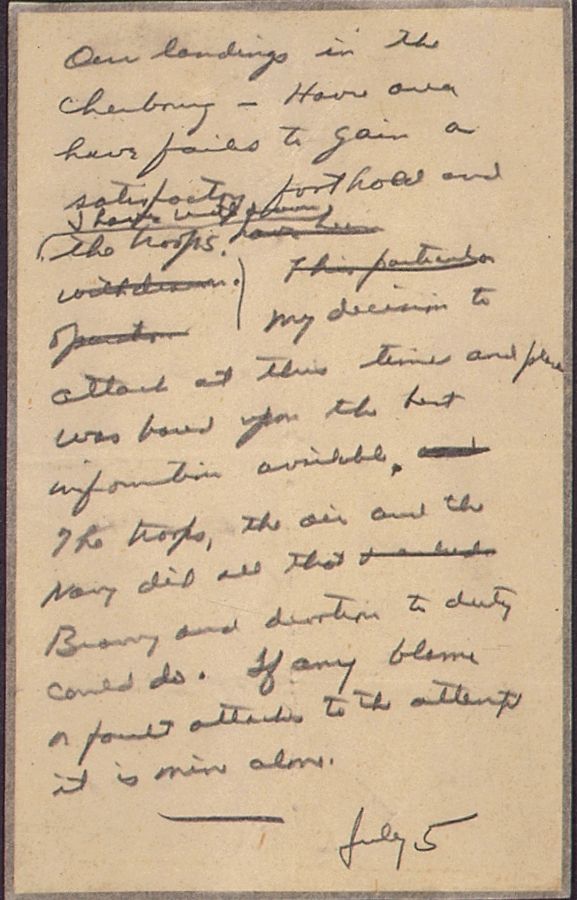
  2. General Dwight Eisenhower’s awareness that, after ordering his troops across the English Channel during World War II, the success of the invasion of Normandy was no longer in his own hands—that one could control efforts but not outcomes.

Acknowledgements: Thanks to my friend Venkatasubramanian, founder of the Bangalore-based Vyoma Linguistic Labs for help with this article. Vyoma is a non-profit organization devoted to the translation, preservation, and dissemination of rare classic Indian texts. It also produces Sanskrit learning products.

Wondering what to read next?

  1. The More You Can Manage Your Emotions, the More Effective You’ll Be
  2. The Secret to Happiness in Relationships is Lowering Your Expectations
  3. Control Your Efforts, Not the Outcomes
  4. The Surprising Power of Low Expectations: The Secret Weapon to Happiness?
  5. Live as If You Are Already Looking Back on This Moment with Longing

Filed Under: Living the Good Life, Sharpening Your Skills Tagged With: Attitudes, Mindfulness, Philosophy, Relationships, Suffering

These Celebrities and Hollywood Actors Didn’t Just Wait Around for Dream Jobs to Turn up

July 21, 2015 By Nagesh Belludi 1 Comment

“He who lives uprightly and experiences true difficulty and disappointment and is nonetheless undefeated by it is worth more than someone who prospers and knows nothing but relative good fortune.”
—Vincent van Gogh

Stories of superstars who struggled in their early careers are very inspiring

Some superstars had it made. They came from privileged backgrounds and had spectacular starts to their careers. They were lucky enough to attend the best schools, get the right pedigree, make the right connections, get an early break, or join the fast track to the top.

Other superstars were not so lucky in their early careers. Most of these men and women—particularly the archetypical self-made person—came from humble backgrounds and struggled to establish themselves. They found productive jobs to eke out a living, all the while never losing sight of their ambitions. They took every opportunity to learn and prove themselves. They worked hard to get a foot in the door, toiled in the trenches, learned everything about their trades, and painstakingly built their spectacular careers from the ground up. In sum, they didn’t just while their time away waiting for their desired jobs and dream gigs to show up.

Jack Nicholson, Robin Williams, Brad Pitt

Consider three Hollywood superstars who struggled during their early careers and worked modest jobs to earn their living but never abandoned their ambitions.

  • Hollywood legend Jack Nicholson (b. 1937) ran errands and worked as a messenger at Hollywood’s MGM animation studios before being “discovered.” He had moved from New Jersey to pursue his dream of becoming an actor and lived with his wannabe-actress mother (whom he thought was his sister until he was 36, a full ten years after her death.)
  • Comedian and Hollywood actor Robin Williams (1951–2014) gained precious experience in his twenties working as a mime artist in front of New York’s Museum of Modern Art while trying to find acting gigs. As a child, Williams hardly fit the stereotype of someone who would later pursue comedy. Born to a successful Ford executive, Williams grew up a shy, lonely child playing by himself in an empty room of his family’s mansion. He overcame his shyness only after taking drama classes in high school.
  • Celebrated actor and producer Brad Pitt (b. 1963) worked a variety of odd jobs while struggling to establish himself in Hollywood. To pursue his passion for the big screen, he moved to Los Angeles from Missouri two weeks before he was about to earn his degree in Journalism. He took acting lessons and made contacts. Within months, Pitt got uncredited roles in three films. For the next seven years, he gained increasing recognition in supporting roles on television and in films before securing leading roles that catapulted him to worldwide fame.

Examine the purpose of these examples viz. to emphasize that successful people find something productive to do while improving themselves and waiting for their big break. Take note of a crucial nuance: we are not discussing humble part-time or casual summer jobs that later-superstars held in their youth—e.g., Pope Francis worked as a bouncer in Buenos Aires, German Chancellor Angela Merkel as a barmaid in Leipzig, Bill Gates as a page in the United States Congress, Warren Buffett as a newspaper delivery boy in Washington, D.C.

Albert Einstein, Soichiro Honda, Stephen King

Other disciplines also present plenty of superstars who pursued their ambitions while holding humble first-jobs.

  • Physicist and philosopher Albert Einstein (1879–1955) spent two frustrating post-college years searching for a teaching job before becoming a clerk at the Swiss Patent Office in Bern. In between examining patent applications and during his spare time, he worked on physics problems. In his third year at the job, he wrote four groundbreaking papers that transformed physics.
  • When Japanese engineer and industrialist Soichiro Honda (1906–1991) moved to Tokyo at age 15 to find work as an auto mechanic, a repair shop owner hired him as a nanny to his infant. With a child in tow, Honda often meandered about the garage, observing and learning from the mechanics. When the child was asleep, Honda tinkered with engines and started giving suggestions to the mechanics. He strengthened his passion for automotive engines just as the nascent industrial base of Japan was finding a new enthusiasm for machines.
  • 'Carrie' by Stephen King (ISBN 0307743667) Best-selling author Stephen King (b. 1947) struggled for years after graduating from college. He and his writer-wife grappled financially and lived in a trailer home. He worked hard at building a career as a writer and developed ideas for many novels. King sold short stories to men’s magazines and worked small jobs to make a living. When working as a janitor in a school locker room, he was inspired to write a novel titled “Carrie”. Set in a girls’ locker room, Carrie features a schoolgirl who exercises her newly-discovered telekinetic powers to exact revenge on her bullies. Carrie turned into King’s first published novel and lent him his big break.

Idea for Impact: Self-disciplined people don’t wait for the right answer or the golden path to present themselves. They understand that the best way to get unstuck is to start somewhere, focus on action, keep themselves productive, amend their course if necessary, and do all this without losing sight of their goals and ambitions.

A note of caution: Stories of superstars’ successes are but cherry-picked examples

“Welcome to Hollywood. What’s your dream?
Everybody comes here. This is Hollywood, the land of dreams.
Some dreams come true, some don’t. But keep on dreamin’.
This is Hollywood. Always time to dream, so keep on dreamin’.”
—From “Pretty Woman” (1990)

More than we possibly realize, so much of life’s success in life has to do with luck (or fate or destiny.) As I’ve written previously, success is often more about being at the right place, at the right time, and with the right person than about possessing the right skills and working hard.

The above are merely examples of a few lucky superstars who made it big in Hollywood or in their chosen disciplines and followed their passions as careers.

For every Stephen Hawking or J. K. Rowling, there are thousands of wannabe writers whose creative writing doesn’t even pay enough to buy the notebooks they use.

For every Jack Nicholson, Robin Williams, or Brad Pitt, there are countless Hollywood wannabes struggling in the “Land of a Million Dreams.” What’s more, among actors who manage to find work, an even smaller fraction of them actually make a living doing it. Part-timers are paid so little that they must work at stores, restaurants, or bars at night and on weekends. The cost of living in Southern California has hit the roof; even professionally-done headshots cost hundreds of dollars. The celebrity impersonators and street performers on Hollywood’s Walk of Fame have even started aggressively pestering tourists and photographers for bigger tips.

Celebrity impersonators and street artists on Hollywood's Walk of Fame pestering tourists for bigger tips

In the la-la land of Los Angeles, chances are that any random person you meet is an aspiring actor, model, designer, musician, songwriter, screenplay writer, director, stunt-double, makeup artist, or is trying to get some gig in the entertainment industry. Each aspirant is taking classes, trying to make contacts, looking for auditions, hoping to land jobs, wishing to be “discovered” by an actor or noticed by a talent agent at a restaurant, club, or elsewhere.

Competition is brutal and the market for fame is saturated

In Hollywood, anything is possible and yes, “some dreams come true.” However, in reality, there’s an infinitesimal chance that any aspirant will ever get a break. Even still, thousands of hopefuls flock to Hollywood every year (and thousands of rejects move out.) After endless auditions, rejections, or false starts, they wake up to the harsh realities of competition and get jobs that are more gratifying than chasing a near-impossible dream.

“He that lives upon hope will die fasting.”
—Benjamin Franklin

If you have a passion for something that will not pay adequately, pursue it on the side. Here’s some sage advice from my mentor Marty Nemko:

Do what you love, but don’t expect to get paid for it. Want to be on stage? Act in community theater. Want to be an artist? Convince a restaurant to let you decorate its walls with your creations. To make money, pick a field that pays decently and has few liabilities. Chances are, that will lead to more career contentment than pursuing a long-shot dream as your career. Treating a long-shot dream as an avocation gives you most of its pleasure without forcing you to endure a life of poverty.

Wondering what to read next?

  1. Leo Burnett on Meaning and Purpose
  2. Success Conceals Wickedness
  3. Lessons on Adversity from Charlie Munger: Be a Survivor, Not a Victim
  4. Lessons from Sam Walton: Learning from Failure
  5. Silicon Valley’s Founding Fathers // Book Summary of David Packard’s “HP Way”

Filed Under: Career Development, Great Personalities, Sharpening Your Skills Tagged With: Attitudes, Celebrities, Entrepreneurs, Scientists, Writers

Control Your Efforts, Not the Outcomes

June 30, 2015 By Nagesh Belludi Leave a Comment

During World War II, President Dwight Eisenhower (1890–1969) was the Supreme Commander of the Allied Forces. On 2-June-1944, he issued a memo to his troops just before the Allied invasion of Normandy:

You are about to embark upon the Great Crusade, toward which we have striven these many months. The eyes of the world are upon you. The hopes and prayers of liberty-loving people everywhere march with you. In company with our brave Allies and brothers-in-arms on other Fronts, you will bring about the destruction of the German war machine, the elimination of Nazi tyranny over the oppressed peoples of Europe, and security for ourselves in a free world.

Your task will not be an easy one. Your enemy is well trained, well equipped and battle hardened. He will fight savagely. … The free men of the world are marching together to Victory!

I have full confidence in your courage and devotion to duty and skill in battle.

We will accept nothing less than full Victory! Good luck! And let us beseech the blessing of Almighty God upon this great and noble undertaking.

Under Eisenhower’s leadership, the Allied forces had meticulously planned Operation Overlord for over a year. For months, Eisenhower’s troops not only rehearsed their D-Day roles and routines, but also went to exceptional lengths to uphold the secrecy of their plans and deceive the German forces about troop movement. The Allied forces even plotted to cut off all roads and rail lines leading to the coast of Normandy and thus block reinforcements for the German troops.

Some things are simply beyond your control—you can only do your best

Despite all the strategizing and training, the success of the Allied invasion depended on the weather across the English Channel—their success essentially rested on something beyond their control.

The Allied aircrafts sought air superiority and would be unable to locate targets if low clouds covered Normandy. In addition, if the tides were high or the seas heavy, the troops would be unable to launch their landing crafts. The success or failure of their landings hinged entirely on suitable weather.

Eisenhower tentatively planned to send his troops across the English Channel on 5-June. The day before, however, the troops predicted cloudy skies, rain, and heavy seas that were inappropriate for the invasion. Eisenhower decided to postpone the invasion by a day, when the forecasted weather was to be more suitable than on 5-June, but not necessarily perfect for his plans. If he did not invade on 6-June, the tides would not favor an invasion for another two weeks, which would possibly give the Germans enough time to get wind of the Allies’ plan.

Eisenhower gave the marching orders for 6-June. It was then that he realized that the success of the invasion was no longer in his hands. Its outcome depended on 160,000 allied troops, thousands of commanders, and hundreds of lieutenants. Eisenhower had done everything in his power to coordinate their efforts and create conditions conducive to the mission’s success. After issuing his orders, all he could do was let those conditions come to fruition on their own terms. After all his efforts, he could not control the outcomes—he let go of the outcomes.

In time, the hard-fought cross-channel invasion was successful—Eisenhower won his wager with the weather. The invasion of Normandy proved to be a turning point in World War II. Despite formidable obstacles and thousands of casualties, the Allied troops prevailed over the German forces in landing at the coast of Normandy. Within days, Allied forces quickly consolidated at the beachheads and built up troops. Within two months, they broke out from their beachheads in Normandy and advanced on the Axis powers. The Allies liberated Europe when German troops surrendered unconditionally on 8-May-1945.

Control Your Efforts---Not the Outcomes

Idea for Impact: Focus on effort and lower your expectations of the outcomes

The wise among us understand what’s within their control and what’s not. They recognize that “you win some, you lose some.”

Success and results are not often within your span of control. However, you can control your effort and ability to create the conditions for success. Focus on your efforts, then let those conditions unfold.

In the Bhagavad Gita, Lord Krishna instructed Arjuna, “set thy heart upon thy work but never its reward” (verse 2:47.) And the Buddha counseled his followers to lower their expectations in order to achieve happiness, a belief that is not without proof in the hurly-burly world we live in.

Moreover, even if you can, don’t go overboard with your efforts. Push yourself to the max only when the stakes are big enough. As I mentioned in a previous article, a 110% effort may not fetch more rewards than an 80% or a 90% effort.

Be committed to your job, but don’t overly invest in it.

Wondering what to read next?

  1. The Futility of Attachment to Expected Results
  2. The More You Can Manage Your Emotions, the More Effective You’ll Be
  3. The Surprising Power of Low Expectations: The Secret Weapon to Happiness?
  4. The Secret to Happiness in Relationships is Lowering Your Expectations
  5. Live as If You Are Already Looking Back on This Moment with Longing

Filed Under: Great Personalities, Ideas and Insights, Sharpening Your Skills Tagged With: Attitudes, Mindfulness, Philosophy, Relationships, Suffering

Lessons from the Princeton Seminary Experiment: People in a Rush are Less Likely to Help Others (and Themselves)

June 16, 2015 By Nagesh Belludi 3 Comments

Vincent van Gogh's The Good Samaritan (after Delacroix)

In the parable of the Good Samaritan (Luke 10:29–37 in the New Testament,) a Samaritan helps a traveler assaulted by robbers and left half dead by the side of the road. Prior to the Samaritan, a priest and a Levite pass the injured traveler and fail to notice him. Conceivably, the priest and Levite’s contempt was because they didn’t sincerely follow those same virtues they espoused as religious functionaries. Possibly, they were in a hurry or were occupied with busy, important—even religious—thoughts. Perhaps the Samaritan was in less of a hurry since he wasn’t as socially important as the priest or Levite and was therefore not expected to be somewhere.

The Princeton Seminary Experiment

Inspired by the parable of the Good Samaritan, Princeton social psychologists John Darley and Dan Batson conducted a remarkable experiment in the 1970s on time pressure and helpful behavior. They studied how students of the Princeton Theological Seminary conducted themselves when asked to deliver a sermon on the parable of the Good Samaritan.

The students were to give the sermon in a studio a building across campus and would be evaluated by their supervisors. The researchers were curious about whether time pressure would affect the seminary students’ helpful nature. After all, the students were being trained to become ordained priests; they are presumably inclined to help others.

As each student finalized his preparation in a classroom, the researchers inflicted an element of time constraint upon them by giving them one of three instructions:

  1. “You’re late. They were expecting you a few minutes ago…You’d better hurry. It shouldn’t take but just a minute.” This was the high-hurry condition.
  2. “The (studio) assistant is ready for you, so please go right over.” This was the intermediate-hurry condition.
  3. “It’ll be a few minutes before they’re ready for you, but you might as well head on over. If you have to wait over there, it shouldn’t be long.” This was the low-hurry condition.

As each student walked by himself from the preparation classroom to the studio, he encountered a ‘victim’ in a deserted alleyway just like the wounded traveler in the parable of the Good Samaritan. This victim (actually an associate of the experimenters) appeared destitute, was slouched and coughing and clearly in need of assistance. The seminarians were thus offered a chance to apply what they were about to preach.

“Conflict, rather than callousness, can explain their failure to stop.”

Researchers were interested in determining if their imposed time pressure affected the seminarians’ response to a distressed stranger. Remarkably, only 10% of the students in the high-hurry situation stopped to help the victim. 45% of the students in the intermediate-hurry and 63% of the students in the low-hurry situations helped the victim.

The researchers concluded, “A person not in a hurry may stop and offer help to a person in distress. A person in a hurry is likely to keep going. Ironically, he is likely to keep going even if he is hurrying to speak on the parable of the Good Samaritan, thus inadvertently confirming the point of the parable… Thinking about the Good Samaritan did not increase helping behavior, but being in a hurry decreased it.”

In light of their training and calling, the seminarians’ failure of bystander intervention is probably not due to indifference, self-centeredness, or contempt. (Compare with the plot of the series finale of American sitcom Seinfeld, where Jerry and friends are prosecuted for failure of duty to rescue.) The dominant cause is time pressure. Most of the students who believed they had enough time to stop did so. In contrast, the vast majority of those who thought they were late did not stop to help. In other words, the perception of time pressure or “having limited time” resulted in behaviors incongruent to their education and career: the devotion to help others. Time pressure triggered these well-intentioned students to behave in ways that, upon reflection, they would find disgraceful. The weight of a time constraint caused the students to put their immediate concern of being on time before the wellbeing of someone in need.

We’re in such hurry that we don’t stop to help ourselves

“I’m Late, I’m Late for a very important date,
No time to say hello. Goodbye.
I’m late, I’m late, I’m late, and when I wave,
I lose the time I save.”
—White Rabbit in the Disney musical “Alice in Wonderland” (1951)

The Princeton Seminary Experiment offers an even more personal lesson. As the researchers in this experiment expound, when we speed up and feel rushed, we experience a phenomenon known as “narrowing of the cognitive map.” That is, we miss details, we are not present enough in the moment to notice what is really important and we do not make the most beneficial choices for ourselves.

As we make our way through life, not only do we not stop to help others—we also do not stop to help ourselves. We neglect our own needs. We fail to nurture ourselves. We surrender, we settle, we lose hope. We compromise ourselves and become what we often settle for.

Our noisy world and busy lives constantly make us hurry as somebody always depends on us being somewhere. We constantly rush from place to place as if our lives depended upon it. We rush while doing just about everything. We are at the mercy of commitments often imposed by others.

Life moves quickly. And we’ll have missed it.

We fail to nurture ourselves We’re too busy, we’re too hurried and we’re too rushed. When people place demands on our time, our first resort is to cut out that which is most valuable. We are so busy meeting deadlines that we cannot make time for our loved ones. We abandon physical exercise to get to meetings on time. We avoid medical checkups critical to our well-being. We engage in behaviors that can put ourselves at risk for negative consequences in the future.

As our world continues to accelerate and our pace of life picks up speed, the clock’s finger turns inescapably. Life moves on by quickly, and soon enough we’ll have missed it entirely.

Idea for Impact: Be ever-conscious of the fact that time is the currency of your life

The German theologian and anti-Nazi descendent Dietrich Bonhoeffer (1906–1945) wrote in his “Letters and Papers from Prison”, “As time is the most valuable thing that we have, because it is the most irrevocable, the thought of any lost time troubles us whenever we look back. Time lost is time in which we have failed to live a full human life, gain experience, learn, create, enjoy, and suffer; it is time that has not been filled up, but left empty.”

Make the best use of your time. Interrupt your busy life to help yourself by living more fully in the present. Nurture yourself. Your needs belong to the top.

Wondering what to read next?

  1. What Airline Disasters Teach About Cognitive Impairment and Decision-Making Under Stress
  2. Summary of Richard Carlson’s ‘Don’t Sweat The Small Stuff’
  3. How Stress Impairs Your Problem-Solving Capabilities: Case Study of TransAsia Flight 235
  4. Learn to Manage Your Negative Emotions and Yourself
  5. The More You Can Manage Your Emotions, the More Effective You’ll Be

Filed Under: Living the Good Life, Sharpening Your Skills Tagged With: Anxiety, Attitudes, Decision-Making, Emotions, Mindfulness, Stress, Thinking Tools, Thought Process, Worry

With Needs, Without Wants

December 2, 2014 By Nagesh Belludi Leave a Comment

Contentment is worth more than riches. Having few desires and feeling satisfied with what you have is vital for happiness.

Be Happy with What You Have

In a This I Believe essay, Marianne Bachleder of San Francisco reminisces about consumerism and about being conscious of how much she already has:

We forget to be happy with what we have and in our forgetfulness we spread the infection of discontent. It’s a mistake easily made in a world where everyone is expected to pursue every want—the newest gadget, the latest update.

…

I may want shiny things, but I don’t need them. What I do desperately need is the peace of mind found in moments of contentment and gratitude. I need to identify each of my wildcat urges to purchase or possess as either “want” or “need.” My needs are basic, predictable, manageable. My wants are chaotic changelings, disturbers of the peace that can never be satisfied.

I will tend my needs, I will whittle my wants, and I will say often, “I’m happy with what I have.”

Thrift to Wealth

'The Little Book of Main Street Money' by Jonathan Clements (ISBN 0470473231) Jonathan Clements, personal finance columnist at Wall Street Journal and author of ‘The Little Book of Main Street Money’ and the forthcoming ‘Money Guide 2015’, spoke of thrift and the wealthy in an interview with Vanguard:

Over the years, I have met thousands of everyday Americans who have amassed seven-figure portfolios—and the one attribute shared by almost all of them is that they’re extremely frugal. When I was at Citi, I used to joke to the bankers that they would know a couple was wealthy if they pulled up to the branch in a second-hand Civic, wore clothes from J.C. Penney, and asked to have their parking ticket validated.

Shop at Amazon & Support a Noble Cause

Gyaana Prawas : Science/field trip for tribal kids in South India / Aapatsahaaya Foundation Dear readers, during this holiday season, if you succumb to the urge for the latest and the greatest or if you are shopping for gifts for friends and family, please consider shopping at Amazon.com using this link or clicking on a recommended book on the right sidebar of this website.

With no additional cost to you, 100% of the referral fees earned by this blog from the international Amazon Associates program support the education of underprivileged kids in South India. Our philanthropy partner is Aapatsahaaya Foundation, Bangalore. In 2013, your purchases funded part of a science/field trip for tribal kids.

Wondering what to read next?

  1. Why I’m Frugal
  2. Yes, Money Can Buy Happiness
  3. Here’s the #1 Lesson from Secret Millionaires
  4. On Black Friday, Buy for Good—Not to Waste
  5. How Ads Turn Us into Dreamers

Filed Under: Living the Good Life, Personal Finance Tagged With: Attitudes, Giving, Materialism, Personal Finance, Simple Living

Viktor Frankl on The Meaning of Suffering

November 13, 2014 By Nagesh Belludi Leave a Comment

The Austrian existential psychiatrist Viktor Frankl suggested that, generally, the need for meaning is a crucial force in people, from the time we’re born until our last breath. He continued to feel this way when his family was murdered by the Nazis and he himself was sent to Auschwitz. Frankl frequently quoted Friedrich Nietzsche’s remark that “he who has a why to live for can bear with almost any how.”

In “Mans’ Search for Meaning”, Frankl describes suffering as a potential springboard both for having a need for meaning and for finding it:

We must never forget that we may also find meaning in life even when confronted with a hopeless situation, when facing a fate that cannot be changed. For what then matters is to bear witness to the uniquely human potential at its best, which is to transform a personal tragedy into a triumph, to turn one’s predicament into a human achievement. When we are no longer able to change a situation—just think of an incurable disease such as inoperable cancer—we are challenged to change ourselves.

'Man's Search For Meaning' by Viktor Frankl (ISBN 0671023373) Frankl also suggests that the one freedom allowed in us, irrespective of our circumstances, including his horrid subjugation at a Nazi concentration camp, is the freedom to pick our way of thinking in accepting our suffering. This might mean that meaning can be found in becoming a role model for others dealing with similar problems, or utilizing our suffering as a channel for changing for the better in particular aspects of our lives:

It is one of the basic tenets of logotherapy that man’s main concern is not to gain pleasure or to avoid pain but rather to see a meaning in his life. That is why man is even ready to suffer, on the condition, to be sure, that his suffering has a meaning.

Frankl’s story is worth the read: (1) as a reminder of the depths and heights of human nature, and the nature of hopes and despairs that rule our existence, (2) for the idea that life is primarily about the search for meaning and the kinds of choices we can make to establish significance in our lives (logotherapy technique.)

Wondering what to read next?

  1. Blame Your Parents for Your Current Problems?
  2. What Are You So Afraid Of? // Summary of Susan Jeffers’s ‘Feel the Fear and Do It Anyway’
  3. How to … Change Your Life When Nothing Seems to be Going Your Way
  4. If You Want to Be Loved, Love
  5. When Optimism Feels Hollow

Filed Under: Sharpening Your Skills Tagged With: Attitudes, Books for Impact, Emotions, Therapy

Don’t be Rude to Receptionists and Support Staff

December 17, 2012 By Nagesh Belludi Leave a Comment

One of the quickest ways to fail in an interview is to ignore, be discourteous, or be disrespectful to receptionists and support staff.

Some job candidates believe that they do not need to be at their best behavior in front of support staff, and then “turn it on” for the professionals who will actually interview them.

It is a common fallacy to assume that the relative position of a person on the corporate ladder is predicative of how much influence that person has in the organization. Rank, experience, and influence do not always correspond. People with influence are those whose opinions are important—not necessarily because they rank high on the org chart, but because they have acknowledged expertise, experience, or because of their association with people of authority.

Job candidates: a condescending attitude could cost you a job offer. Be courteous around everyone you meet and watch what you say. Assume that every person—the receptionists, assistants, and support staff—may have an input into the hiring decision. They will convey their negative perceptions to the hiring managers.

Wondering what to read next?

  1. The Waiter Rule: A Window to Personality
  2. Avoid Control Talk
  3. “But, Excuse Me, I’m Type A”: The Ultimate Humblebrag?
  4. The Trouble with Accusing Someone of Virtue Signaling
  5. How to Increase Your Likeability: The 10/5 Rule

Filed Under: Career Development, Managing People, Sharpening Your Skills Tagged With: Attitudes, Courtesy, Likeability, Personality, Workplace

When in Doubt, Do

February 20, 2012 By Nagesh Belludi 1 Comment

One of the most insidious obstacles to achievement is our tendency to give in to the pessimistic voices in our heads that advocate caution and forethought before making decisions. Instead of accepting failure as an inherent possibility in any undertaking, we tend to espouse inaction in order to weigh every fact against possible outcomes. We are thus predisposed to devising excuses for our indolence.

Admittedly, further deliberation is justified in some cases, but with a vast majority of our decisions, we tend to overestimate the stress we might experience after making a difficult choice. The longer we spend on making a decision, the less productive we are. Beyond a reasonable amount, obsessing over choices causes analysis paralysis, as in the fable of the fox and the cat.

Idea for Impact: No good comes from hesitation and inaction. The only things you will regret in the future are the things you don’t do today. So, instead of dragging it out, act decidedly on an opportunity before it ceases to be one. Take a few low-risk steps and watch your confidence grow. The consequences are likely to be far less extreme than the cost of comfortable inaction.

Follow the “10-Minute Dash” technique to get a task going and overcome procrastination.

Wondering what to read next?

  1. Chances Fade, Regrets Linger
  2. That Burning “What If” Question
  3. The Truth Can Be Bitterer than a Sweet Illusion
  4. Feeling Is the Enemy of Thinking—Sometimes
  5. Lessons from the Princeton Seminary Experiment: People in a Rush are Less Likely to Help Others (and Themselves)

Filed Under: Sharpening Your Skills Tagged With: Attitudes, Decision-Making, Procrastination

Sucking up Isn’t a Requirement for Success

March 8, 2010 By Nagesh Belludi Leave a Comment

Consider the all-too-familiar boss’s pet employee at an office. He uses flattery, goes out of his way to help the boss, curries personal favors, and constantly tows the boss’s line no matter how unreasonable it is. He never corrects the boss when necessary. He either sugarcoats or withholds information that the boss would rather not hear. Over time, he has perfected the art of stroking his boss’s exaggerated sense of self-worth.

How about leaders who go overboard on their intention to exceed customer expectations and turn out to be “customer compelled?” They bend over backward to fulfill every whim and fancy of their customers to the likely peril of their own organization’s values and priorities.

Sucking up or brown-nosing is widespread approach to win a boss’s approval solely with one’s own self-interest in mind. Consider the consequences of sucking up:

  • An employee that sucks up to his boss loses the respect of his peers and employees. They assume positive discrimination and favoritism because of his ingratiatory behavior. The suck-up recursively promotes sucking up in his organization—he encourages others to establish themselves in his good graces.
  • Suck-ups quickly get into a pattern of slavishly reacting to every impulse of the boss. Without realizing, they become vulnerable to obligations to support their boss. Neither can they set limits on favors, nor do they stand up for themselves or their employees.

Be Resourceful, Don’t Suck Up

“One does not make the strengths of the boss productive by toadying to him. One does it by starting out with what is right and presenting it in a form which is accessible to the superior.”
* Peter Drucker, in The Effective Executive

Contrary to popular opinion, a vast majority of promotions are not handed out to employees who are most willing to suck up. Research and empirical evidence proves that employees who are honest, sincere, open, straightforward, and helpful earn management’s respect and attention over time. They move up fast because of their demonstrated ability to make the right choices. In addition, most people can innately distinguish the brown-nosers and differentiate genuine compliments from insincere flattery.

Do not get me wrong. There is enormous value in being helpful to the boss. After all, making yourself resourceful can go a long way in staying in the boss’s good graces. It can open professional opportunities and increase your access to new ideas, initiatives, and restricted information. However, there is an obvious boundary between doing favors and sucking up. Running an urgent errand when the boss is busy preparing for an important meeting or watching over his pet when he is travelling are well within reason. Compromising your values and priorities just to get on the boss’s side will not get you anywhere in the long term. Try these suggestions:

  • Be sincere and timely in your compliments. Refrain from making flattering remarks.
  • Use facts and logic to support or challenge the boss’s ideas. Never praise, or comment on your boss or his plans in front of others.
  • Ask your boss how you could help him achieve his goals and follow-up earnestly.

Wondering what to read next?

  1. Going Over Your Boss’s Head After She Rejects Your Idea?
  2. What’s Next When You Get Snubbed for a Promotion
  3. The Good of Working for a Micromanager
  4. Five Questions to Spark Your Career Move
  5. How Can You Contribute?

Filed Under: Career Development, Managing People Tagged With: Attitudes, Managing the Boss, Peter Drucker

« Previous Page
Next Page »

Primary Sidebar

Popular Now

Anxiety Assertiveness Attitudes Balance Biases Coaching Conflict Conversations Creativity Critical Thinking Decision-Making Discipline Emotions Entrepreneurs Ethics Etiquette Feedback Getting Along Getting Things Done Goals Great Manager Innovation Leadership Leadership Lessons Likeability Mental Models Mindfulness Motivation Parables Performance Management Persuasion Philosophy Problem Solving Procrastination Psychology Relationships Simple Living Social Skills Stress Suffering Thinking Tools Thought Process Time Management Winning on the Job Wisdom

About: Nagesh Belludi [hire] is a St. Petersburg, Florida-based freethinker, investor, and leadership coach. He specializes in helping executives and companies ensure that the overall quality of their decision-making benefits isn’t compromised by a lack of a big-picture understanding.

Get Updates

Signup for emails

Subscribe via RSS

Contact Nagesh Belludi

RECOMMENDED BOOK:
Les Misérables

Les Misérables: Victor Hugo

Victor Hugo's profound tale of Jean Valjean's redemption and the saga of the endless battle between good and evil is considered one of the greatest novels of the 19th century.

Explore

  • Announcements
  • Belief and Spirituality
  • Business Stories
  • Career Development
  • Effective Communication
  • Great Personalities
  • Health and Well-being
  • Ideas and Insights
  • Inspirational Quotations
  • Leadership
  • Leadership Reading
  • Leading Teams
  • Living the Good Life
  • Managing Business Functions
  • Managing People
  • MBA in a Nutshell
  • Mental Models
  • News Analysis
  • Personal Finance
  • Podcasts
  • Project Management
  • Proverbs & Maxims
  • Sharpening Your Skills
  • The Great Innovators

Recently,

  • To Be Lost is Simply to Be Becoming
  • Task-Driven Living Is a Form of Self-Deception
  • The Akbar-Birbal Parable of the Pulling of the Emperor’s Beard Is a Master Class in Critical Thinking
  • Inspirational Quotations #1159
  • Shed Your Past
  • Your Brain Is Lying to You. Here’s How to Catch It.
  • How to Ask for a Raise—and Negotiate in a Way That Commands Respect

Unless otherwise stated in the individual document, the works above are © Nagesh Belludi under a Creative Commons BY-NC-ND license. You may quote, copy and share them freely, as long as you link back to RightAttitudes.com, don't make money with them, and don't modify the content. Enjoy!