• Skip to content
  • Skip to primary sidebar

Right Attitudes

Ideas for Impact

Attitudes

Don’t Be Too Helpful at Work

August 12, 2016 By Nagesh Belludi Leave a Comment

Agreeableness Can Go Too Far

Consider the case of Sherry, a discontented claims adjustor at an insurance firm. She is a star employee and an excellent team player. In a bid to be seen as obliging, Sherry always agrees to do everything she is asked to do by her supervisors and her colleagues. She ends up taking on a lot of extra work.

Sherry gets much praise for helping out as much as she can. However, she feels constantly overworked. This excessive dedication has left her with neither the time nor the energy for leisure or family. Her discontent materializes from the fact that her inability to say “no” is actually holding her back from some of her primary priorities.

Too Much Congeniality Can Be Counterproductive

We live in an era in which self-interest is contemptible. People who aren’t generous and altruistic are branded as uncaring and greedy—even evil. At work, one mark of a high-performing employee is the ability to bring discretionary effort at work. This implies willingly dedicating energy and attention beyond the basic requirements of the role. Employees who are agreeable and helpful are much favored to those who are not so obliging.

Nonetheless, as a whole, there are dangers of being too helpful in a workplace. Employees like Sherry frequently find themselves overloaded with tasks that aren’t really part of their responsibility, tasks that are difficult to execute well, and tasks that that others don’t want to undertake because they are uninteresting or low-status in the organization. These supplementary tasks may stop obliging employees from doing their own work to the expected standard. Eventually, they get branded with humdrum work and may even be overlooked for higher-status work assignments or for promotion to senior roles.

If you’re one of those employees who is accommodating or strives to be seen as such, curtail your impulse to say “yes” to whatever people ask you to do. Don’t change abruptly from being a friendly, accommodating employee into an obstinate, unhelpful person.

Be judicious in undertaking extra work if it is only desirable in light of your priorities and the personal image you want to sustain. If the prospective task conflicts with your priorities, you are within your rights to say “no” (see my previous article on nice ways to do so.)

Idea for Impact: There is a Limit to the Results Being Nice Will Get You

While it is virtuous to think of others first at both work and home, devoting all of your time for others can stand in the way of caring for yourself. Your work-life balance can suffer.

Addressing your own needs first is not only incredibly beneficial for your well-being, but also vital to your ability to care for others. Be prudent. Stand up for yourself. Be mindful of your priorities. Be attentive to your own needs. Practice saying “no.” Learn to be assertive.

Wondering what to read next?

  1. Weak Kindness & The Doormat Phenomenon: Balance Kindness with Strength
  2. What Most People Get Wrong About Focus
  3. Don’t Say “Yes” When You Really Want to Say “No”
  4. Nice Ways to Say ‘No’
  5. Everything in Life Has an Opportunity Cost

Filed Under: Career Development, Living the Good Life Tagged With: Assertiveness, Attitudes, Balance, Kindness, Negotiation, Persuasion

Silicon Valley’s Founding Fathers // Book Summary of David Packard’s “HP Way”

August 9, 2016 By Nagesh Belludi Leave a Comment

'The HP Way' by David Packard (ISBN 0060845791) David Packard’s The HP Way recalls how he and Bill Hewlett started one of the world’s most successful corporations in 1937 with just $538 (today’s $8,850 when adjusted for inflation) and a rented one-car garage in Palo Alto, California. That garage is recognized today as the birthplace not only of Silicon Valley, but also of a new management approach.

Bill and David first met as electrical engineering students at Stanford University. Despite their different dispositions, they shared a passion for the outdoors and, with a professor’s encouragement, started Hewlett-Packard (HP) to commercialize the latest “radio engineering” theories. Over the decades, HP invented many groundbreaking electrical gadgets that were crucial to the development of radars, instrumentation devices, computers, and other technological revolutions.

In addition to their technical innovations, Bill and David established many progressive management practices that prevail even today. Starting in the initial days at the garage, the culture that Bill and David engendered at HP was unlike the hierarchical and egalitarian management practices that existed at other corporations of their day.

The essence of the “HP Way” was openness and respect for the individual. (Bill Hewlett once sawed a lock off a tool-room cabinet and left a note, “HP trusts its employees.”)

Management by objectives, managing by wandering about, nursing-mother facilities, flextime, decentralization, intrapreneurship, catastrophic medical insurance, profit sharing, employee stock ownership, tuition assistance, and many other management principles that dominate human resources practices today were all pioneered—if not invented—at HP.

Recommendation: Read. The HP Way tells the story how Bill and David built a company based on a framework of principles and the simplicity of their management methods. Good to Great author Jim Collins once wrote in commending David Packard’s The HP Way, “The greatest lesson to be divined from this book isn’t so much how to create a similar company but how creating a company based on a strong and clear set of values can lead to outstanding success.”

Postscript: Notes from ‘The HP Way’

  • Like Sam Walton, the other illustrious entrepreneur of their generation, Bill and David grew up witnessing Americans’ hardships during the Great Depression. This made them risk-averse; they vowed never to incur long-term debt to expand their fledgling company.
  • On the day Hewlett-Packard went public in 1961, David Packard took a subway instead of a taxi to Wall Street, lost his way, and reached the New York Stock Exchange late.
  • The foundations that Bill Hewlett and David Packard established individually with 95% of their stakes in HP are today two of the most prominent philanthropies in America.

Wondering what to read next?

  1. Ten Rules of Management Success from Sam Walton
  2. Lessons from Airline Entrepreneur David Neeleman: Staff Your Weaknesses
  3. Book Summary of Nicholas Carlson’s ‘Marissa Mayer and the Fight to Save Yahoo!’
  4. How to Manage Smart, Powerful Leaders // Book Summary of Jeswald Salacuse’s ‘Leading Leaders’
  5. Beware of Key-Person Dependency Risk

Filed Under: Leadership Reading, Managing People, Mental Models, The Great Innovators Tagged With: Attitudes, Books, Entrepreneurs, Mental Models, Mentoring

Anger Is Often Pointless

May 31, 2016 By Nagesh Belludi 1 Comment

Anger is often nothing more than an intense emotion caused by an apparent injustice. The destructive outcomes of anger are well known. When even a slight annoyance arises, it is capable of growing quickly and overwhelming your state of mind.

Anger results in (1) a loss of perspective and judgement, (2) impulsive and irrational behavior that is destructive to both yourself and others, and (3) loss of face, compassion, and social credibility.

Anger is often pointless, as the following Buddhist parable will illustrate.

Often, there’s no one to blame

Once upon a time, a farmer was paddling his boat upstream to deliver his produce to a distant village. It was a sultry day, so he was covered in sweat. He was in a great hurry to reach the village market.

Further on upstream, the farmer spotted another boat rapidly moving downstream toward his vessel. It looked as though this boat was going to hit him. In response, he paddled feverishly to move out of the way, but it didn’t seem to help. He yelled, “Hey, watch out!” The other boat seemed to approach him swiftly. The farmer shouted, “Hey, you’re going to hit me! Adjust your direction.” He got no response and continued to yell in vain.

As a last resort, the farmer stood up angrily waving his arms and shaking his fist. The other boat smashed right into him. He was hopping mad and cried out, “You imbecile! How could you hit my boat in the middle of this wide river? Couldn’t you hear me asking you to get out of my way? What is wrong with you?”

Then, all of a sudden, the farmer realized that the boat was empty; it had perhaps cut loose of its moorings and floated downstream with the current. He calmed down and realized that there was no one to blame but an empty boat and the river. His anger was purposeless.

Anger depletes energy and leads to loss of perspective and judgement

When you lose your inner peace, you expect that your anger can help you get even with the offending person or amend the vexing circumstances. However, responding with anger is illogical. The offending deed has already occurred, a fact your anger fails to negate. Also, your anger cannot thwart or diminish the perceived wrong.

In the New Testament, Ephesians 4:26–27 advise, “In your anger do not sin. Do not let the sun go down while you are still angry, and do not give the devil a foothold.”

Free yourself from anger

There is no benefit to anger at all. All anger can beget is negative energy, which can aggravate an already volatile situation. Anger can also impede sound judgement and inhibit your ability to consider the negative consequences of your abrupt reactions.

The next time you’re angry, consider the following response:

  • Stop. Don’t respond immediately. Walk away from the situation that has instigated your anger.
  • Breathe deeply. Become fully aware of your state of mind. Assess what’s going on.
  • Calm down and compose yourself. Invoke mindfulness to appeal to your wisdom. Anger and other emotional arousals often stem from a lack of self-awareness or mindlessness, and can simmer down if you just wait long enough.
  • Consider the matter from other points of view. Ask if there could be other possible explanations for what happened.
  • Identify the reasons for your anger by asking three questions: (1) “Is this matter serious enough to get worked up about?” (2) “Is my anger necessary and warranted?” (3) “Will getting angry make a difference?”
  • Reflect about what response will be most effective. Try to develop a wise and measured course of action.

Idea for Impact: A low-anger life is a happier life

Patience is the definitive antidote to anger and aggression. With patience, you may not always be able to eliminate anger, but you can usually control it. Patience can build and fortify your intellectual and psychological resources.

As Proverbs 19:11 tells in the Hebrew Bible, “A person’s wisdom yields patience; it is to one’s glory to overlook an offense.” Ultimately, developing greater patience enhances your romantic, personal, professional, and casual relationships—as well as that all-important relationship: the one you have with yourself.

Wondering what to read next?

  1. Change Your Perspective, Change Your Reactions
  2. Heaven and Hell: A Zen Parable on Self-Awareness
  3. Live as If You Are Already Looking Back on This Moment with Longing
  4. Learn to Manage Your Negative Emotions and Yourself
  5. Anger is the Hardest of the Negative Emotions to Subdue

Filed Under: Health and Well-being, Living the Good Life, Sharpening Your Skills Tagged With: Anger, Attitudes, Buddhism, Emotions, Mindfulness, Parables, Philosophy, Wisdom

Life Is to You as to Everyone Else: What the Stoics Taught

April 8, 2016 By Nagesh Belludi Leave a Comment

Mosaic of Alexander the Great, who Sucked at Geometry

Life is as hard for one as for another

Roman Stoic philosopher Seneca’s Moral Letters to Lucilius (Latin orig. Epistulae morales ad Lucilium) tells a story of Alexander the Great’s schooling.

Even at a young age, the hugely ambitious Alexander dreamt of conquering empires. He had no patience for formal learning. When faced with the difficulty of understanding geometry, he whined to his tutor, “Teach me something easy.” His tutor replied, “These things are the same for all, as hard for one as for another.”

'Letters from a Stoic' by Lucius Annaeus Seneca (ISBN 0140442103) Alexander, king of Macedon, began to study geometry; unhappy man, because he would thereby learn how puny was that earth of which he had seized but a fraction!

Unhappy man, I repeat, because he was bound to understand that he was bearing a false title. For who can be “great” in that which is puny?

The lessons which were being taught him were intricate and could be learned only by assiduous application; they were not the kind to be comprehended by a madman, who let his thoughts range beyond the ocean.

“Teach me something easy!” he cries; but his teacher answers: “These things are the same for all, as hard for one as for another.”

Imagine that nature is saying to us: “Those things of which you complain are the same for all. I cannot give anything easier to any man, but whoever wishes will make things easier for himself.” In what way? By equanimity.

You must suffer pain, and thirst, and hunger, and old age too, if a longer stay among men shall be granted you; you must be sick, and you must suffer loss and death.

On a related note, the great Roman Emperor and Stoic Philosopher Marcus Aurelius wrote in Meditations (trans. Gregory Hays,) “Alexander the Great and his mule driver both died and the same thing happened to both. They were absorbed alike into the life force of the world, or dissolved alike into atoms.”

Idea for Impact: Put your problems and worries in perspective

Beyond the randomness (or providence for those of you with a religious bent) of where we’re born and whom we’re born to, life is generally fair to all and cannot be easier for anyone. The trials and tribulations of life are equally difficult for everyone. Complaining about others having it easier is futile.

Learn to play the hand you’ve been dealt. If you’re fraught with pain and suffering now, don’t ask, “Why is my life so difficult? Why can’t it be easier?” Take solace in the realization that even the greatest and the mightiest had their share of life’s struggles. Make it easier by viewing life with calmness, composure, and evenness of temper.

Wondering what to read next?

  1. A Prayer to Help You Deal with Annoying People: What the Stoics Taught
  2. Choose Not to Be Offended, and You Will Not Be: What the Stoics Taught
  3. Why Others’ Pride Annoys You
  4. The More You Can Manage Your Emotions, the More Effective You’ll Be
  5. How to Handle Conflict: Disagree and Commit [Lessons from Amazon & ‘The Bezos Way’]

Filed Under: Mental Models, Sharpening Your Skills Tagged With: Anger, Attitudes, Getting Along, Philosophy, Stoicism

When Should a Leader Pass Blame?

April 1, 2016 By Nagesh Belludi Leave a Comment

A leader is the “captain of the ship.” He is responsible for his organization’s every outcome—good or bad. He is wholly accountable for everything that happens under his authority.

If there is a problem caused by his mistakes or errors within his organization, a leader should not shirk responsibility. He should not abandon his team if things go wrong, nor should he pass the blame or use an employee as a scapegoat.

However, a leader cannot see and touch all his people, especially if his organization is large. He cannot be personally responsible for a rogue employee who steals information, misuses funds, or engages in unethical behavior. In such circumstances, the leader may pass blame.

Although a leader cannot police every action taken by every employee, the leader should be held accountable for not instituting and overseeing a rigorous control system to prevent problems, deter unethical actions, and to identify employees that engage in such behavior.

A leader also sets the tone for all his employees—not only in terms of goals and priorities but also in terms of proper organizational behavior. A legendary case in point are the ethical rules that investor Warren Buffett set in his company after the 1991 bond-rigging scandal at Salomon Brothers: “I want employees to ask themselves whether they are willing to have any contemplated act appear the next day on the front page of their local paper, to be read by their spouses, children, and friends, with the reporting done by an informed and critical reporter. If they follow this test, they need not fear my other message to them: Lose money for the firm, and I will be understanding; lose a shred of reputation for the firm, and I will be ruthless.” Even now, Buffett includes this statement in his biannual letters to his managers and displays a video of this speech at every Berkshire Hathaway annual meeting.

Wondering what to read next?

  1. Power Inspires Hypocrisy
  2. The Poolguard Effect: A Little Power, A Big Ego!
  3. Power Corrupts, and Power Attracts the Corruptible
  4. Shrewd Leaders Sometimes Take Liberties with the Truth to Reach Righteous Goals
  5. Look, Here’s the Deal: Your Insecurity is Masquerading as Authority

Filed Under: Leadership, Leading Teams Tagged With: Attitudes, Ethics, Integrity, Leadership

Lessons from Sam Walton: Learning from Failure

March 29, 2016 By Nagesh Belludi Leave a Comment

Sam Walton (1918–1992) experienced failures and setbacks. And, like all successful people, the iconic founder of Walmart and Sam’s Club prided himself on learning from those experiences.

Walton’s Initial Success … and Then, in a Heartbeat, Failure

By 1950, a 32-year-old Sam Walton had established himself as a successful retailer in Newport, Arkansas. In 1945, Walton had purchased a Ben Franklin variety store and set up a five-year personal goal to make it the most profitable variety store in the region. By 1950, Walton had a record $250,000 in sales and $30,000 to $40,000 in profit (some $2.5 million in sales and $300,000 to $400,000 in profits in today’s dollars.) His success had attracted a lot of attention.

Not only that, the young Walton family—Sam, his wife Helen, and four young children—had firmly established itself in Newport. Sam and Helen were very active in the community and had taken up prominent civic and church duties.

An innocuous legal oversight cost him this success. When he had signed the lease on the property rental for his Ben Franklin variety store in 1945, thanks to inexperience and excitement at becoming a merchant, Walton had agreed to give back the landlord 5% of sales. He later discovered this was the highest any retailer had paid for rental.

More significantly, Walton had also neglected to add a clause in his lease that would give him the option to renew the lease after five years. Therefore, in 1950, when the lease on Walton’s Ben Franklin store expired, his sneaky landlord knew there was nowhere else in town for Walton to relocate his store. The landlord refused to renew Walton’s lease at any price! The landlord bought Walton’s well-established store along with its fixtures and inventory and transferred the store to his son. Walton was devastated; he had no choice but to give up his successful store. In his best-selling autobiography Made in America, Walton recalled this as the lowest point of his business life:

I felt sick to my stomach. I couldn’t believe it was happening to me. It really was like a nightmare. I had built the best variety store in the whole region and worked hard in the community, done everything right, and now I was being kicked out of town. It didn’t seem fair. I blamed myself for ever getting suckered into such an awful lease, and I was furious at the landlord. Helen, just settling in with a brand-new family of four, was heartsick at the prospect of leaving Newport. But that’s what we were going to do.

Sam Walton Was Not One to Dwell on Disasters

All the hard work he had put in to build a successful store and the earning power he had established over five years had become worthless because of an innocuous mistake. Nevertheless, Walton didn’t let this disaster get him down.

I’ve never been one to dwell on reverses, and I didn’t do so then. It’s just a corny saying that you can make a positive out of most any negative if you work at it hard enough. I’ve always thought of problems as challenges, and this one wasn’t any different. I don’t know if that experience changed me or not. I know I read my leases a lot more carefully after that, and may be I because a little wary of just how tough the world can be. Also, it may have been about then that I began encouraging our eldest boy—six-year-old Bob—to become a lawyer. But I didn’t dwell on my disappointment. The challenge at hand was simple enough to figure out. I had to pick myself up and get on with it, do it all over again, only even better this time.

This Newport experience turned out to be a blessing in disguise for Walton. His family relocated to the relatively obscure Bentonville, Arkansas, for a brand-new start. Walton started over and established himself as a retailer again—only in even bigger and better ways. In 1962, Walton decided that the future of retailing lay in discounting. His strategy of buying low, selling at a discount, and making up for low margins by moving vast amounts of inventory, made Walmart the most successful retailer ever. From 1985 until his death in 1992, he was the richest man in the world.

Successful People Learn from Failure and Get On

'Sam Walton: Made In America' by Sam Walton (ISBN 0553562835) Walton’s was a typical entrepreneurial response to failure—successful people take risks, fail sometimes, but pick themselves up, ask what they can learn from the experience, and try again, even harder the next time.

On a related note, Bill Gates, the most successful entrepreneur of his generation, once said, “Success is a lousy teacher. It seduces smart people into thinking they can’t lose.”

Complement this lesson on failure with J.K. Rowling’s reflections on the benefits of failure in her famous 2008 commencement address at Harvard: “Failure meant a stripping away of the inessential. I stopped pretending to myself that I was anything other than what I was, and began to direct all my energy into finishing the only work that mattered to me…The knowledge that you have emerged wiser and stronger from setbacks means that you are, ever after, secure in your ability to survive.”

Wondering what to read next?

  1. How to Face Your Fear and Move Forward
  2. Fear of Failure is an Obstacle to Growth
  3. Success Conceals Wickedness
  4. Some Lessons Can Only Be Learned in the School of Life
  5. Resilience Through Rejection

Filed Under: Leadership Reading, Sharpening Your Skills Tagged With: Attitudes, Discipline, Entrepreneurs, Learning, Persistence, Personal Growth, Success

Ever Wonder If The Other Side May Be Right?

March 22, 2016 By Nagesh Belludi Leave a Comment

The French essayist and novelist Andre Gide once wrote, “Believe those who are seeking the truth; doubt those who find it.”

Scratch the surface of any thinking ideologue and you’ll find not certainties but contradictions and doubts.

Darwin’s doubts about natural selection and evolution

Even after the publication of his seminal Origin of Species and The Descent of Man, Charles Darwin had crippling doubts about some aspects of natural selection. Specifically, if natural selection was to have lasting effects, evolutionary advances had to be conserved and passed on from one generation to the next. Darwin agreed with scientists who argued that his evolutionary theory failed to explain how variations are transmitted from parents to their offspring.

It was not until the 1930s that biologists started to study Gregor Mendel’s work on genetic inheritance and heredity in conjunction with Darwin’s theory of natural selection. Only then did biologists come to understand how variation of characteristics is passed on to new generations and how evolution is a process of descent with modification.

Seek to have an idea tomorrow that contradicts your idea today

At a Q&A at American web application company Basecamp, Amazon founder Jeff Bezos opined that people who are “right a lot” are those who had a flexible mindset and often changed their minds. Summarizing the conversation, Basecamp co-founder Jason Fried wrote,

[Bezos] observed that the smartest people are constantly revising their understanding, reconsidering a problem they thought they’d already solved. They’re open to new points of view, new information, new ideas, contradictions, and challenges to their own way of thinking.

He doesn’t think consistency of thought is a particularly positive trait. It’s perfectly healthy—encouraged, even—to have an idea tomorrow that contradicted your idea today.

This doesn’t mean you shouldn’t have a well formed point of view, but it means you should consider your point of view as temporary.

What trait signified someone who was wrong a lot of the time? Someone obsessed with details that only support one point of view. If someone can’t climb out of the details, and see the bigger picture from multiple angles, they’re often wrong most of the time.

Idea for Impact: Wisdom comes from seeking wisdom

Want to learn, expand your worldview, and broaden your mindset? Start by seeking out the right people—mix with people other than those from your own background (professional, cultural, social, academic, racial, ethnic, etc.) Remember that birds of a feather do flock together. Instead of preferring the company of other people from similar backgrounds, try investing some time with people who have viewpoints that contrast your own.

French entomologist Jean-Henri Fabre once wrote, “Seek those who find your road agreeable, your personality and mind stimulating, your philosophy acceptable, and your experiences helpful. Let those who do not, seek their own kind.” Look for those who respect your worldview—even if drastically different from theirs—but can present alternative perspectives and push you into considering different viewpoints on any issue of mutual interest.

Wondering what to read next?

  1. It’s Probably Not as Bad as You Think
  2. No One Has a Monopoly on Truth
  3. Does the Consensus Speak For You?
  4. Nothing Deserves Certainty
  5. Care Less for What Other People Think

Filed Under: Mental Models, Sharpening Your Skills Tagged With: Attitudes, Confidence, Conviction, Jeff Bezos, Philosophy, Wisdom

Nothing Deserves Certainty

March 1, 2016 By Nagesh Belludi Leave a Comment

In a 1960 TV interview, celebrated British mathematician and philosopher Bertrand Russell said,

I think nobody should be certain of anything. If you’re certain, you’re certainly wrong because nothing deserves certainty. So one ought to hold all one’s beliefs with a certain element of doubt, and one ought to be able to act vigorously in spite of the doubt. … One has in practical life to act upon probabilities, and what I should look to philosophy to do is to encourage people to act with vigor without complete certainty.

Intellectual Censorship

It’s regrettable that many ideas imprinted into the soft putty of an unformed mind sometimes remain there forever. Many people seem to believe the very first thing they’re told and stick with it for the rest of their life. What’s worse, they are often willing to defend that position to their death. They engage in intellectual censorship: not only do their core beliefs remain unexamined, but also any attempt to challenge their beliefs is taken as a grievous insult. They don’t realize that the suppression of opposing viewpoints doesn’t add credibility to an argument.

One reason could be laziness. In On Being Certain, Robert Burton highlights the neuroscience behind the discrepancies between genuine certainty and the feeling of certainty. Arguing that certainty is an emotion just like anger, passion, or sorrow, Burton provides summaries of many studies that show that people’s certainty about their beliefs is an emotional response that is distinct from how they process those beliefs. Consequently, once they develop a “that’s right” disposition about a subject matter, their brain subconsciously protects them from wasting its processing effort on problems for which they have already found a solution that they believe is good enough. In other words, their cerebral laziness subconsciously leads them to “do less” by simply embracing certainty rather than reexamining their assumptions.

Intellectual Arrogance and Philosophical Idolatry

One outcome of feeling certain is intellectual arrogance. People who live by the illusion of their own self-sufficiency will shut their arrogant minds to alternative perspectives and even turn hostile towards those who possess or produce new ideas, since they regard their own truths as absolute without the need for alternative viewpoints or even amplification of their own convictions. On the other hand, people who recognize their limitations will necessarily feel modest about themselves and be enthusiastic to broaden their points of view. They actively seek differing viewpoints with compassion and gratitude and seek to cross-examine their convictions, strengthen them, explore alternative viewpoints, and perhaps discover new truths.

The 16th century English philosopher Francis Bacon wrote (per The New Organon and Related Writings,)

The human understanding when it has once adopted an opinion draws all things else to support and agree with it. And though there be a greater number and weight of instances to be found on the other side, yet these it either neglects and despises, or else by some distinction sets aside and rejects, in order that by this great and pernicious predetermination the authority of its former conclusion may remain inviolate.

The 19th Century British political philosopher John Stuart Mill actively advocated understanding every side of an argument because he wanted to “see that no scattered particles of important truth are buried and lost in the ruins of exploded error.” Mill explained in Early Essays:

Every prejudice, which has long and extensively prevailed among the educated and intelligent, must certainly be borne out by some strong appearance of evidence; and when it is found that the evidence does not prove the received conclusion, it is of the highest importance to see what it does prove. If this be thought not worth inquiring into, an error conformable to appearances is often merely exchanged for an error contrary to appearances; while, even if the result be truth, it is paradoxical truth, and will have difficulty in obtaining credence while the false appearances remain.

Uncertainty is a Fundamental Tenet of Thinking, Discovery, and Invention

Speaking of the virtues of uncertainty and doubt in the scientific and unscientific methods of questioning, experimenting, and understanding, the celebrated physicist Richard Feynman said in The Meaning of It All,

This experience with doubt and uncertainty is important. I believe that it is of very great value, and one that extends beyond the sciences. I believe that to solve any problem that has never been solved before, you have to leave the door to the unknown ajar. You have to permit the possibility that you do not have it exactly right. Otherwise, if you have made up your mind already, you might not solve it.

When the scientist tells you he does not know the answer, he is an ignorant man. When he tells you he has a hunch about how it is going to work, he is uncertain about it. When he is pretty sure of how it is going to work, and he tells you, “This is the way it’s going to work, I’ll bet,” he still is in some doubt. And it is of paramount importance, in order to make progress, that we recognize this ignorance and this doubt. Because we have the doubt, we then propose looking in new directions for new ideas. The rate of the development of science is not the rate at which you make observations alone but, much more important, the rate at which you create new things to test.

If we were not able or did not desire to look in any new direction, if we did not have a doubt or recognize ignorance, we would not get any new ideas. There would be nothing worth checking, because we would know what is true. So what we call scientific knowledge today is a body of statements of varying degrees of certainty. Some of them are most unsure; some of them are nearly sure; but none is absolutely certain. Scientists are used to this.

Reiterating the virtues of uncertainty in a discussion of the thought process of the French Renaissance philosopher Michel de Montaigne, author Nassim Nicholas Taleb writes in Fooled by Randomness (see my summary of this book):

It certainly takes bravery to remain skeptical; it takes inordinate courage to introspect, to confront oneself, to accept one’s limitations— scientists are seeing more and more evidence that we are specifically designed by mother nature to fool ourselves.

And British naturalist Charles Darwin wrote in his Autobiography,

As far as I can judge, I am not apt to follow blindly the lead of other men. I have steadily endeavoured to keep my mind free so as to give up any hypothesis, however much beloved (and I cannot resist forming one on every subject), as soon as facts are shown to be opposed to it.

It’s a Narrow Mind that Stays Rooted in One Spot

The American jurist Oliver Wendell Holmes, Jr. wrote in Ideals and Doubts, “To have doubted one’s own first principles is the mark of a civilized man.”

An important characteristic of an educated person is an inquiring mind and the pursuit of intellectual growth. People of sound conviction have nothing to fear from civil debates and are willing to throw a wide net in exploring their own beliefs. They are ready to give up the refuge of a false dogma. They have no fear of meeting minds that may be sharply different from their own. Seek alternative—even opposing—perspectives to broaden your perspectives and persistently examine your biases and prejudices.

Charlie Munger, the widely respected vice-chairman of Berkshire Hathaway, constantly reminds us that one of our utmost intellectual duties is to scrutinize our most cherished ideas as ruthlessly and as intellectually as we can—something that’s hard to do.

Idea for Impact: Expose Yourself to Alternate Viewpoints and Grow Intellectually

If you earnestly survey an opposing viewpoint and find it is still erroneous, you have the satisfaction of knowing that your views withstood intellectual scrutiny. Alternatively, if you determine that another viewpoint is partly or wholly right, you have the equal satisfaction of softening your rigid position, setting your opinions right, and feeling smarter for not succumbing to your ego’s demand to cling to a sense of certainty. The German writer and philosopher Johann Wolfgang von Goethe once wrote, “Let no one be ashamed to say yes today if yesterday he said no. Alternatively, to say no today if yesterday he said yes. For that is life. Never to have changed—what a pitiable thing of which to boast.”

By all means, dismiss ideas if you find that they lack coherence, evidence, or argumentative power—but don’t dismiss ideas merely because they disagree with your existing viewpoints. As the French writer and philosopher Voltaire said, “Doubt is not a pleasant condition, but certainty is absurd.”

Wondering what to read next?

  1. It’s Probably Not as Bad as You Think
  2. No One Has a Monopoly on Truth
  3. Does the Consensus Speak For You?
  4. Ever Wonder If The Other Side May Be Right?
  5. Care Less for What Other People Think

Filed Under: Mental Models, Sharpening Your Skills Tagged With: Attitudes, Bertrand Russell, Confidence, Conviction, Philosophy, Wisdom

Lessons from Dwight Eisenhower: Authentic Leaders Demonstrate Accountability

February 9, 2016 By Nagesh Belludi Leave a Comment

In a previous article about how you can control just your efforts and not the outcomes of those efforts, I detailed Dwight Eisenhower’s weather-induced dilemma on the eve of the Allied invasion of Normandy in June 1944.

The Success of the Normandy Invasion Was Not Entirely in Eisenhower’s Control

Despite a year of intense planning and preparation under Eisenhower’s leadership, the Allied invasion’s success ultimately depended on the weather across the English Channel. Their landings hinged on suitable weather—something entirely beyond their control.

Eisenhower tentatively planned to send his troops across the English Channel on 5-June. On 4-June, however, the troops predicted cloudy skies, rain, and heavy seas that threatened the invasion. Although the following day’s weather was not necessarily ideal, it was comparatively more suitable than the 5-June, so Eisenhower postponed the invasion by a day. If he did not invade on 6-June, the tides would not favor an invasion for another two weeks, which would possibly give the Germans enough time to get wind of the Allies’ plan.

Early in the morning of 5-June, Eisenhower gathered his advisers’ and military officers’ opinions on whether to launch the attack despite the less-than-suitable weather. He sat quietly in deep contemplation. One of his advisers later recalled, “I never realized before, the loneliness and isolation of a commander at a time when such a momentous decision has to be taken, with full knowledge that failure or success rests on his judgment alone.”

After five minutes, Eisenhower gazed at his advisers and said, “Well, we’ll go!”

With those words, Eisenhower launched the D-Day invasion of Europe on 6-June. After issuing those marching orders, events passed from Eisenhower’s control. He then realized that the invasion’s success was no longer in his hands. Its outcome depended on 160,000 allied troops, thousands of commanders, and hundreds of lieutenants. Eisenhower had done everything in his power to coordinate their efforts and create conditions conducive to the mission’s success. After issuing his orders, all he could do was let those conditions come to fruition on their own terms. After all his efforts, he could not control the outcomes—he let go of the outcomes.

An Authentic Leader in Action: Eisenhower’s Character, Responsibility, & Accountability

That evening, on his way to visit American and British paratroopers (pictured above) who were headed into battle that night, Eisenhower told his driver, “I hope to God I’m right.”

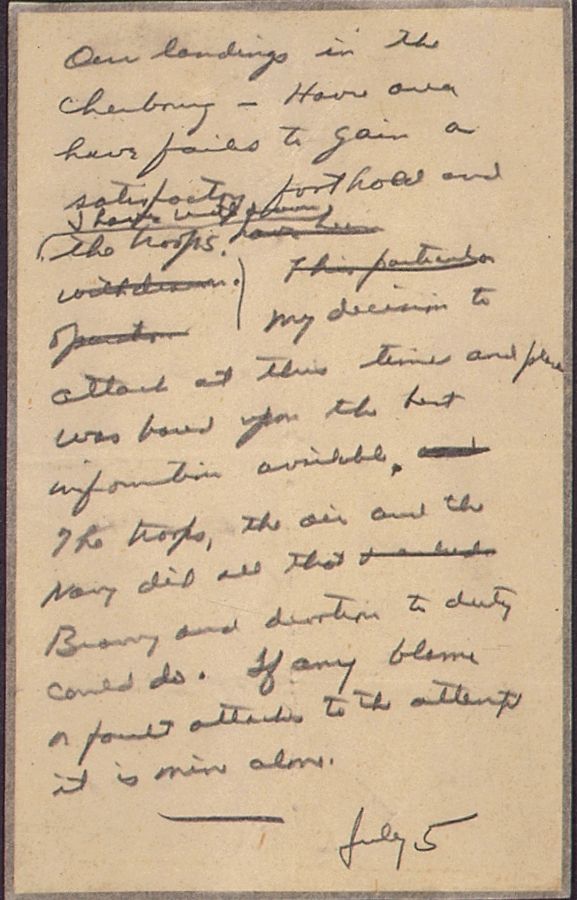
Just before he went to bed at night, Eisenhower scribbled a note and tucked it into his wallet. He thought he would use this letter if the invasion went wrong. (Eisenhower mistakenly dated the note July 5 instead of June 5.)

Our landings in the Cherbourg-Havre area have failed to gain a satisfactory foothold and I have withdrawn the troops. My decision to attack at this time and place was based upon the best information available. The troops, the air and the Navy did all that bravery and devotion to duty could do. If any blame or fault attaches to the attempt it is mine alone.

Dwight Eisenhower's note to use if the Normandy Invasion went wrong, 5-June-1945

Observe that Eisenhower crossed out “This particular operation” and wrote “My decision to attack.” This demonstrates Eisenhower’s assertive and responsible leadership in action. He wrote, “any blame or fault … is mine alone” and underscored the phrase “mine alone.” He did not use passive language or try to camouflage failure with phrases like, “as fate would have had it,” “unaccommodating weather,” “forecast not met,” “mistakes were made,” or “we tried really hard, but ….”

Eisenhower was an authentic leader in action—a leader who was ready and willing to accept unshrinking responsibility for his actions and their results.

Eisenhower won his wager with the weather. The invasion of Normandy was successful and proved to be a turning point in World War II. Eisenhower never used the note he had prepared on the eve of the attack. It is now on display at Dwight D. Eisenhower Library and Museum in Abilene, Kansas.

Authentic Leaders Demonstrate Accountability

As exemplified by Dwight Eisenhower’s leadership as the Supreme Allied Commander during World War II, authentic leaders recognize the accountability that comes with their roles. They accept absolute responsibility for the expected outcomes—both good and bad—no matter what the situation is. They don’t blame unfavorable circumstances, the external environment, employees, superiors, customers, or anybody else.

Wondering what to read next?

  1. Moral Self-Licensing: Do Good Deeds Make People Act Bad?
  2. The Poolguard Effect: A Little Power, A Big Ego!
  3. Virtue Deferred: Marcial Maciel, The Catholic Church, and How Institutions Learn to Look Away
  4. One of the Tests of Leadership is the Ability to Sniff out a Fire Quickly
  5. Power Corrupts, and Power Attracts the Corruptible

Filed Under: Leadership, Sharpening Your Skills Tagged With: Attitudes, Authenticity, Character

Success Conceals Wickedness

January 29, 2016 By Nagesh Belludi Leave a Comment

Biographies of Steve Jobs (by Walter Isaacson,) Jeff Bezos (by Brad Stone,) and Elon Musk (by Ashlee Vance)

Two common themes in the biographies of Steve Jobs (by Walter Isaacson,) Jeff Bezos (by Brad Stone,) and Elon Musk (by Ashley Vance) are these entrepreneurs’ extreme personalities and the costs of their extraordinary successes.

The world mostly regards Musk, Jobs, and Bezos as passionate, inspiring, visionary, and charismatic leaders who’ve transformed their industries. Yet their biographies paint a vivid picture of how ill-mannered these innovators are (or were, in the case of Jobs). They exercise ruthless control over every aspect of their companies’ products but have little tolerance for underperformers. They are extremely demanding of employees and unnecessarily demeaning to people who help them succeed.

  • Steve Jobs was renowned for his cranky, rude, spiteful, and controlling outlook. Biographer Isaacson recalls, “Nasty was not necessary. It hindered him more than it helped him.” Jobs famously drove his Mercedes around without a license and frequently parked in handicapped spots. For years, he denied paternity of his first daughter Lisa and forced her and her mother to live on welfare. He often threw tantrums when he didn’t get his way and publicly humiliated employees.
  • In a 2010 commencement address at Princeton, Jeff Bezos recalled his grandfather counseling, “Jeff, one day you’ll understand that it’s harder to be kind than clever.” Still, according to Brad Stone’s biography, Bezos often imparts insulting rebukes and criticisms to employees: “I’m sorry, did I take my stupid pills today?” “Are you lazy or just incompetent?” “Why are you wasting my life?” and “Do I need to go down and get the certificate that says I’m CEO of the company to get you to stop challenging me on this?”
  • According to Ashlee Vance’s biography, when an executive assistant asked for a raise, Elon Musk asked her to take a two-week vacation while he contemplated her request. When the assistant returned from vacation, Musk fired her.

“Success covers a multitude of blunders”

The great Irish playwright Oscar Wilde once remarked, “No object is so beautiful that, under certain conditions, it will not look ugly.”

The other great Irish playwright George Bernard Shaw wrote, “Success covers a multitude of blunders.”

British politician and historian Lord John Dalberg-Acton famously said, “Power tends to corrupt and absolute power corrupts absolutely. Great men are almost always bad men, even when they exercise influence and not authority: still more when you superadd the tendency or the certainty of corruption by authority. There is no worse heresy than that the office sanctifies the holder of it. That is the point at which … the end learns to justify the means.”

Ethics Violations by NBC News Anchor Brian Williams

In 2015, NBC suspended prominent news anchor Brian Williams after internal investigations revealed no less than 11 instances where he either embellished facts or bent the truth. Members of his team and NBC staffers who knew about these ethics violations chose to overlook because he was powerful. According to The New York Times,

Mr. Williams has been drawing 9.3 million viewers a night, and his position seemed unassailable. Even as the stature of the nightly newscast faded in the face of real-time digital news, Mr. Williams was one of the most trusted names in America … He was powerful. Williams had the ear of NBC boss Steve Burke. He was a ratings powerhouse. And he spent years overseeing TV’s most watched newscast. He was a winner, for himself, those around him and those above him—until it became clear the man who is supposed be among the most trusted in America had issues with telling the truth.

Power Corrupts the Mind

Brilliant men and women engage in morally wrong conduct simply because they can. They can get away with extreme pride, temper, abuse, and other disruptive behaviors because their spectacular success can and does cover many of their sins, even in the eyes of those at the receiving end of their crudeness.

Our high-achieving culture adores the successful, the powerful, and the rich. And part of this adoration is the exemption we grant these celebrities from the ordinary rules of professional civility.

Idea for Impact: The more people possess power and the more successful they get, the more they focus on their own egocentric perspectives and ignore others’ interests.

Wondering what to read next?

  1. The Poolguard Effect: A Little Power, A Big Ego!
  2. Power Corrupts, and Power Attracts the Corruptible
  3. Power Inspires Hypocrisy
  4. Look, Here’s the Deal: Your Insecurity is Masquerading as Authority
  5. Is Showing up Late to a Meeting a Sign of Power?

Filed Under: Business Stories, Great Personalities, Leadership Reading, Sharpening Your Skills Tagged With: Attitudes, Elon Musk, Entrepreneurs, Ethics, Etiquette, Humility, Jeff Bezos, Leadership, Psychology, Steve Jobs, Success

« Previous Page
Next Page »

Primary Sidebar

Popular Now

Anxiety Assertiveness Attitudes Balance Biases Coaching Conflict Conversations Creativity Critical Thinking Decision-Making Discipline Emotions Entrepreneurs Etiquette Feedback Getting Along Getting Things Done Goals Great Manager Innovation Leadership Leadership Lessons Likeability Mental Models Mentoring Mindfulness Motivation Networking Parables Performance Management Persuasion Philosophy Problem Solving Procrastination Relationships Simple Living Social Skills Stress Suffering Thinking Tools Thought Process Time Management Winning on the Job Wisdom

About: Nagesh Belludi [hire] is a St. Petersburg, Florida-based freethinker, investor, and leadership coach. He specializes in helping executives and companies ensure that the overall quality of their decision-making benefits isn’t compromised by a lack of a big-picture understanding.

Get Updates

Signup for emails

Subscribe via RSS

Contact Nagesh Belludi

RECOMMENDED BOOK:
The Story of My Experiments with Truth

The Story of My Experiments with Truth: Mahatma Gandhi

Gandhi's transparent glimpse into the mind of a truly great soul who demonstrated that an individual dedicated to conscious living, honesty, and love can overcome any violence or hatred.

Explore

  • Announcements
  • Belief and Spirituality
  • Business Stories
  • Career Development
  • Effective Communication
  • Great Personalities
  • Health and Well-being
  • Ideas and Insights
  • Inspirational Quotations
  • Leadership
  • Leadership Reading
  • Leading Teams
  • Living the Good Life
  • Managing Business Functions
  • Managing People
  • MBA in a Nutshell
  • Mental Models
  • News Analysis
  • Personal Finance
  • Podcasts
  • Project Management
  • Proverbs & Maxims
  • Sharpening Your Skills
  • The Great Innovators

Recently,

  • Design for the 80% Experience
  • Inspirational Quotations #1143
  • The Hot-Desking Lie: How It Killed Focus and Gutted Collaboration
  • Unreliable Narrators Make a Story Sounds Too Neat
  • Bertrand Russell on The Value of Philosophy: Doubt in an Age of Dogma
  • Inspirational Quotations #1142
  • The Law of Petty Irritations

Unless otherwise stated in the individual document, the works above are © Nagesh Belludi under a Creative Commons BY-NC-ND license. You may quote, copy and share them freely, as long as you link back to RightAttitudes.com, don't make money with them, and don't modify the content. Enjoy!