• Skip to content
  • Skip to primary sidebar

Right Attitudes

Ideas for Impact

Search Results for: people skills

10 Smart Things You Can Do in 10 Minutes

July 8, 2010 By Nagesh Belludi 1 Comment


1. Clear the clutter

Disorder and clutter are the primary sources of the feeling of not being on “top of things.” Messy workspaces can quickly get out of hand and drag you down. Conquer clutter by processing each paper or object at your desk by asking, “Why is this here?” Consider throwing things away; ask, “What is the worst that could happen if I dispose of this?” Organize, simplify, and setup an environment that works for you.

2. Stretch at your desk or brisk walk

Interrupt your deskbound lifestyle by practicing a few exercises right at your desk, walking up a few flights by stairs, or brisk walking around your office block. Simple workouts can revive your energy, prevent afternoon slumps, help you think more clearly, and help control anxiety.

3. Get caught-up on your email and remain caught-up

Given the pervasiveness of email in our lives, regulating email, remaining responsive and productive about email are critical soft-skills for any knowledge worker. Empty your inbox everyday by using following productivity guru Merlin Mann’s ‘Process to Zero’ and ‘Inbox Zero’ techniques. Systematize your email habits by deleting, archiving, responding or delegating every email in your inbox.

4. Embark on a “10-Minute Dash” to conquer procrastination

Not finishing what you have started can be a source of stress and anxiety. Pick a task that you have been putting off, turn on your favorite music, sip your favorite beverage, and work on that task for just ten minutes without any interruption. You will probably find that the seemingly difficult task gets easier once you start working on it. This “10-minute dash” technique can build momentum, get you into the “flow,” and motivate you to work and complete the task.

5. Write a “thank-you” note

In today’s fast-paced world, it is easy to forget to repay kindness with gratitude. Thank-you notes not only help people feel appreciated for things they do to for you, but can also motivate them to do more for you in the future (this secondary reason should not be the key motivation for your attitude of gratitude.) When writing a thank-you note, mention what the other person did for you, how it was relevant, and how much you appreciate their help.

6. Tend to your network

Tending to your professional and social network is not as time-consuming as you might expect. Invest ten minutes each day to email or ring a friend or two, perhaps even to say a quick hello. Cultivate and maintain a strong network. Remember people’s birthdays and anniversaries and reach out to them on their special days. Avoid contacting people only when you need something from them.

7. Update your résumé or your list of achievements

Most professionals tend to procrastinate on keeping their résumés updated. Do not expect to pull your résumé together when you need one and expect it to work efficiently. Spend ten minutes updating your résumé by adding details from your latest projects and assignments. Try to review each section and question yourself, “Is this section relevant? Is there anything more worthwhile that I could replace this section with?” Keeping your résumé updated can reduce the anxiety of preparing an impressive résumé at short notice.

8. Walk the floor, talk to your customers, and seek their ideas

Companies and leaders who excel at customer service talk to customers on a regular basis and follow-up scrupulously. Simply walk the floor for ten minutes or pick-up the phone and talk to a customer or two. Ask customers how your product or service has been of value to them, seek to understand their needs, run your ideas past them, and incorporate their views to design/improve your product or service. Going the extra mile to reach out to a customer can have a big impact on customer loyalty.

9. Look for easy ways to simplify your life

Differentiate between activity and achievement. Rather than finding ways to squeeze more activities into your life, find ways to leave out some things. Focus on things that actually need to be done and eliminate anything that does not fit your immediate priorities. Ask for help, delegate, and lower your standards. Plan for the next day or the week ahead and prepare to-do lists to get things off your mind.

10. Take a break and chill out

When you feel overwhelmed, take ten minutes to rest, relax, and clear your mind. Meditate, listen to music, catch up on news or sports, play with your pet, take a short map, look out of the window, or do something else that can benefit you the most. Stepping out of the moment of busyness can lower your blood pressure, slow down your breathing and heart rate, and bring about psychological changes that can reduce the harmful effects of stress and worry.

Bonus: Put your own needs first

When you are overwhelmed with the demands on your time at work and at home, try to examine if you tend to succumb instinctively to the pressure and put others needs ahead of your own. While it is virtuous to be selfless and attend to the needs of others, devoting too much of your own time to others can become an impediment to your own happiness. Consider constructing boundaries on your time and try to think of at least one activity you can stop, or one task that you cancel at once. Do not become a victim of your own generosity. Taking care of your own needs first is not about being selfish; it is rather about being fair to yourself. Exercise your right to protect your own time and interests.
Filed Under: Health and Well-being, Living the Good Life Tagged With: Time Management

The Halo and Horns Effects [Rating Errors]

April 30, 2010 By Nagesh Belludi 1 Comment

Preamble: We are often unaware of the many biases and prejudices that influence our social judgments. Psychologists call these “bias blind spots.” We can overcome many of these subliminal biases by teaching ourselves to be aware of them. This is the second in a series of articles on the common rating errors. See my earlier article on the recency bias.

Unconscious Judgments of an Investment Broker

A 2007 study highlights two of the most common unconscious social judgment biases. Prof. Emily Pronin of Princeton University showed study participants one of two pictures of the same man whom she introduced as an investment broker. One picture showed a suited man with a highly regarded Cornell degree and the other showed the man in casual clothing with a degree from a nondescript college. The professor asked her participants how much of a theoretical $1,000 they would invest in each. The participants rated the suited man as more competent: on average, he got $535 on without having his background checked. In contrast, the causal dresser received just $352. Not only were the participants more likely to have the second broker’s credentials verified —but also they did not consider him as trustworthy.

The Halo Effect

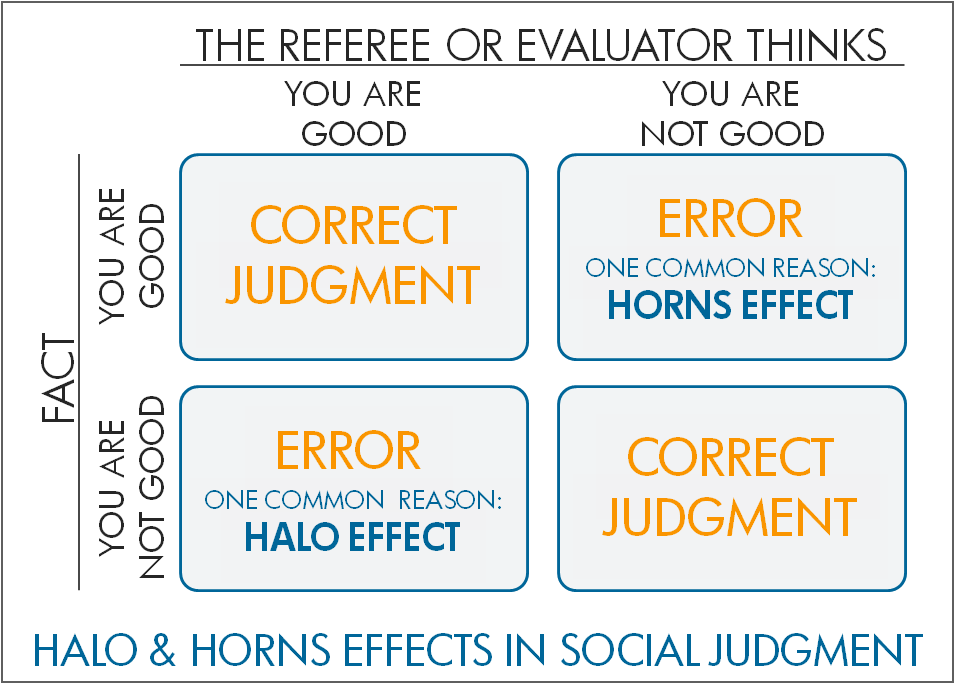
The “halo effect” captures what happens when a person who is judged positively based on one aspect is automatically judged positively on several others without much evidence. For instance, as a result of the halo effect,

  • attractive people are often judged as competent and sociable. Film stars and other celebrities are assumed pleasant and sharp-witted,
  • inexperienced interviewers tend to pay less attention to a candidate’s negative traits after discerning one or two positive traits in the first few minutes of a job interview,
  • charismatic professionals tend to get noticed and move up the corporate ladder faster, irrespective of their technical and leadership skills,
  • articulate speakers are likely to influence their audiences more even if their messages are poor in form and content.

Politicians, film and TV stars, sportspersons, celebrities and brand managers have learned to construct a halo effect and capitalize on their reputations. Apple’s iPod spawned positive impressions of other Apple products—the company took advantage of this halo effect and delivered excellent products in the iPhone and iPad. In another example, renowned fashion designers can set high prices for perfectly ordinary clothes.

Halo and Horns Effects in Social Judgment

The Horns Effect

The “horns” or “devil effect” is the concept by which a person who is judged negatively on one aspect is automatically judged negatively on several other aspects without much evidence. Clearly, this is the opposite of the halo effect.

For years, American car manufacturers have battled the mistaken public perception that cars made by Japanese companies are of significantly better quality. This misperception remains even when American car manufacturers use identical components from the same suppliers and assemble their cars using identical manufacturing processes. Even today, Japanese-brand cars resell for much higher prices than American-brand cars.

Call for Action

  • Reflect on your decision-making process to steer clear of biases. As human beings, we incessantly form opinions of people, objects, and events, both consciously and subconsciously. However, our judgment is rarely free of biases and our measures are not always comprehensive enough. Before reaching any important decision, be sure to collect all the relevant facts and reflect on whether your thought processes are free of the common biases.
  • Understand that perception is reality and be conscious of the image you are projecting. People judge the proverbial book by its cover. Your friends and family, workplace and society at large have a certain perception of who you are and what you can do, irrespective of the reality. As much as you would prefer to be evaluated based on who you actually are and what you can actually do, understand that your identity and prospects are based on others’ image of you. Do everything you can to connect people’s perception to the reality. Look and play your role. Begin by reading the seminal article on the topic of personal branding, “The Brand Called You,” written by renowned management author, Tom Peters.

Filed Under: Leading Teams, Sharpening Your Skills Tagged With: Biases, Mental Models

Hiring: If You Pay Peanuts, You Get Monkeys

April 20, 2010 By Nagesh Belludi Leave a Comment

If You Pay Peanuts, You Get Monkeys During the economic slowdown last year, a manager had a choice between two consultants for a critical project to turnaround the prospects of his division. The first candidate was five years out of business school; his billing rate was $370 an hour. The second, more experienced candidate’s was $510 an hour. Without much deliberation, the manager hired the first candidate because he would fit in the manager’s budget. Things did not work out as well as the manager had expected. Three months later, after considerable delays and missed opportunities, the manager fired his consultant and recruited the second candidate anyway. This consultant had an earlier experience similar to the situation at hand and succeeded in his mission in due course.

The best don’t come cheap

Recruiting is the toughest responsibility of a manager. Prudent hiring processes start with a realization that talented professionals are the heart of successful organizational endeavors. Many managers simply do not take in this fact and signup those who cost the least instead.

Economic downturn or lower project budgets are no reasons for careless hiring decisions. It is exactly during though times that managers should recruit the best people. And, the best don’t come cheap.

Now, I am not saying that high-priced consultants and employees are necessarily good. The converse is not automatically true either. Market demand for talent often dictates billing rates and compensation of skilled professionals. There is often a strong reason for them being in demand and commanding premium fees. No manager dare overlook such considerations.

Filed Under: Managing People Tagged With: Great Manager, Hiring & Firing

Learn from the Top Performers in Every Field

April 13, 2010 By Nagesh Belludi Leave a Comment

Learn from the Top Performers in Every Field

During Q & A at a career-planning workshop that I led recently, a member of the audience asked me, “Where could I get the best education in life?” This article elaborates my response.

You learn best from imitating the techniques of the successful

“What the outstanding person does, others will try to do. The standards such people create will be followed by the whole world.”
* The Bhagavad Gita

The best way to educate yourself is by observing the top performers in every field and by identifying and applying their effectiveness techniques to your circumstances. Your inspiration may be somebody you interact with, somebody you can hear about in the media or a fictional character from a novel or movie.

Try to imitate the best performers in a discipline to be successful in that discipline. Study their educational and professional backgrounds, their work style, successes, and failures. Identify how they go about conducting their everyday affairs. Try to copy the stock picking and capital allocation skills of Warren Buffett to become a successful investor. Piggyback on the thinking of the best mutual fund managers; replicate their portfolios to benefit from their stock selection process.

Read about the techniques of Sherlock Holmes to improve your reasoning and problem-solving skills. Impersonate your favorite stand-up comedian ahead of a presentation or public speech to improve your delivery. Study the footprints of the leaders in your organization if you want to follow their lead.

Imitate different attributes of people you encounter every day: the cheerfulness of an administrative assistant, the persuasion skills of a seasoned negotiator, the resourcefulness of a car mechanic, and the dexterity of a customer service agent.

Role models are inspirational

Looking up to others is rather instinctive. As kids, you looked up to your siblings, parents, or family members. At work, you learn from observing your colleagues and bosses.

When we learn of role models, read their stories or watch of them on TV or in the movies, we identify in them a part of ourselves; we associate with their struggles and victories, their hopes and despairs.

When we identify with a role model who has accomplished what we seek yourselves, we not only learn from them but also become more confident in our abilities.

This technique has its limitations

Naturally, the influence of role models is neither always practical nor necessarily productive. Your perception of popular role models (sportsmen, artists, businesspeople and other celebrities) is often incomplete and based on cursory assessments of them. Media accounts of their trappings of wealth, fame, and success or their unseemly lifestyles can just as easily turn them into negative role models. Excesses and faults are as common in everyday life as they are in the news. Exercise judgment in what you identify and implement. Hence the corollary: Learn from the shortcomings of the unsuccessful.

Call for action

  • When people make a positive impression on you, reflect on what they did and how they did to impress you. Explore what you can learn from them.
  • Identify the top performers in your field. Seek to understand and adopt their techniques. Improve or tailor them to your personal circumstances and improve yourselves.
  • Study the biographies and memoirs of your favorite historical leaders. Read news stories and case studies of people you admire. Learn their techniques.
  • Think of personal and professional skills that you would like to improve upon. Identify one or two people in your organization who are especially skilled in these areas. Observe them or ask them for advice.

Learn everything you can from others, implement what appeals to you, and discard the rest.

Filed Under: Career Development, Great Personalities, Sharpening Your Skills Tagged With: Getting Ahead, Role Models

Not Everybody Wishes to Climb the Corporate Ladder

March 30, 2010 By Nagesh Belludi Leave a Comment

You have probably met corporate people who are five to ten years from retirement and have remained in their bottom-of-the-ladder “contributor” roles (as engineers, programmers, accountants, salespersons, etc.) for decades. Don’t they typically report to managers 10 to 15 years their juniors? Ever wonder why they never assumed managerial or leadership roles? Are they simply incompetent or unenthusiastic? Enquire around and you may be surprised to learn that they may have perhaps never desired to climb the corporate ladder. You will possibly learn that,

  • They are not aimless. In reality, at some point in their careers, they made a conscious choice to not pursue the traditional career advancement paths and stay in their roles as “senior contributors.” Their dominant priorities lie elsewhere: usually with family, community, faith, and creative interests. They view their careers as means to other ends. They set goals for what they seek to achieve, create a plan, and relate to their values in the right way, everyday.
  • They are quite influential in their organizations. They gain credibility not by virtue of positions or titles, but from years of experience, awareness of processes and historical perspectives. They seek to mentor young engineers and offer their opinions and judgments when consulted by management. They gain an immense sense of satisfaction by helping their organizations grow. They are widely respected.
  • Their salaries are quite comparable to people who have identical spans of service in their organizations and have assumed leadership roles. They are highly valuable contributors.

The “senior contributors” are not the only ones who have shunned the corporate ladder. Many women choose to work three days a week once they have kids. Husbands of career-minded moms have relinquished their rewarding careers to become stay-at-home dads and support their wives’ careers. Frequently, executives decline international assignments that could keep them away from family. All these people tend to feel in command of their life and career—they are more contented in their careers and have a stronger sense of work-life balance. For sure, they can teach the rest of us a thing or two about setting the course of our lives.

The long-hours culture is not for everybody

You probably recollect the days when corporate people had reasonably secure jobs, showed up at work every workday, clocked in, worked eight hours, clocked out, stopped thinking about work until the next workday, and enjoyed four weeks of vacation a year. They could maintain a healthy separation between work and personal time. Alas, those days are long over.

In today’s workplace, the demands on our energy, time, and creativity constantly overwhelm us, despite access to technology, computers, and other productivity tools. We have so much on our plates that we only rarely complete things WHEN and AS we would wish to. The workday is longer, the pace of work is faster, and most projects tend to be open-ended. The pressure to learn new skills is prominent. A successful corporate career demands a high-level of performance for sustained periods. At what cost, though? Unsurprisingly, the pressure to work harder and longer results in poor physical health, stress, anxiety, lesser time with family and friends, fewer opportunities to pursue hobbies and creative interests, and insufficient rest and relaxation.

Work or life or both—its your choice

“The price of anything is the amount of life you exchange for it.”
* Henry David Thoreau

There is no magic potion or canned method for balancing your work and life. Finding balance is rather an exercise in finding a healthy perspective that works for you. Nobody but you can make the right choices and work out what is best for you to bring about a sense of satisfaction of physical, mental, financial, intellectual, professional, and social well-being.

Everyone has to find his or her own individual balance

The quest for work-life balance begins with defining what balance means to you. Reflect on what you value most in life and prioritize them. Include your family in your contemplations of choices and consequences. Establish a set of boundaries between an adequate amount of effort and return. Consider your personal and professional aspirations, the family and social life you desire, your hobbies and interests and your goals and dreams.

Ask yourself, “How much is adequate?” and, “How much success and money is good enough?” Set boundaries and limits between what you must do and what you want to achieve in the short term and in the long term. The choices you make and your ability to respect the limits your set for yourself should shape your work and career, not the other way around.

Explore alternate arrangements at work

After you reflect on what could constitute a sense of individual balance for you, examine your career objectives. Once you are clear about what you want, consider the potential consequences to your employer. Discuss your options and proposals with a trusted advisor, the human resources / personnel department, and your boss. Most companies care for their employees enough to offer options for part-time or flexible schedules, working from home or sabbaticals.

Lead a life to your own script, not to others’

The world will shape your life, if you let it. Establish what you want to achieve in your life; do not let others impose their proposals for you. Make the right choices and live true to your values. This is, in essence, the key to finding the illusive work-life balance.

Filed Under: Career Development, Living the Good Life Tagged With: Balance, Career Planning, Work-Life

Humility is a Mark of the Great

March 24, 2010 By Nagesh Belludi Leave a Comment


Humility is a Life-long Pursuit

“Before destruction the heart of man is haughty, and before honor is humility.”
* The Holy Bible (Proverbs 18:12)

We live in a world that misconstrues the virtue of humility as a sign of meekness, timidity, lack of resolve, and, in general, a personal and leadership inadequacy. Could anything be more imprudent?

As the following narratives of great people will illustrate, humility is the bona fide characteristic of the truly accomplished and well-adjusted people. These great men and women live the life of modesty, unpretentiousness, and supreme confidence. They do not bear a sense of self-superiority and pride.

The Humility of Dr. Albert Einstein

“Einstein taught the greatest humility of all: that we are but a speck in an unfathomable large universe.”
* Time magazine, recognizing Albert Einstein as the Person of the Century

Sometime in the ’50s, Don Merwin, a producer of the ‘This I Believe’ radio program, visited Albert Einstein’s home in Princeton, New Jersey. He was to record Einstein speak his essay, “An Ideal of Service to Our Fellow Man” for the program. Don Merwin later recalled his experience: “I started setting up [the bulky tape recorder], and Dr. Einstein, who was a very amiable man, was chatting with me and expressed curiosity about tape-recording, which was fairly new in those days. He said, ‘How does it work?’ I started explaining the electronics of it, the way that the recording heads imprinted a signal on the moving tape. All of a sudden, I froze up. I said, ‘I am lecturing to Albert Einstein on physics!'” [Source: Allison, Jay, et al. (editors) “This I Believe: the Personal Philosophies of Remarkable Men and Women.”]

The Humility of Dr. M. Balamuralikrishna

Look at this 2007 picture from Deccan Herald, via Churumuri. Dr. M. Balamuralikrishna, the 79-year old celebrated Indian Classical vocalist, expresses deep reverence and seeks the blessings of the 96-year old Dr. Gangubai Hangal, another legendary vocalist.

The Humility of Sri Veerendra Heggade

How about this 2009 picture from Karnataka News (via Churumuri?) Sri Veerendra Heggade, the widely respected guardian of a prominent temple in South India, holds an umbrella to shield from sun blaze the chairman of a culture convention at a parade in the latter’s honor.

The Humility of Peter Drucker

I have read of many an instance of the humility of Peter Drucker, the most influential management philosopher of the modern era. Here are two anecdotes:

  • Executive-education student Cathy Taylor remembers Peter Drucker conscientiously writing down autograph seekers’ names on a napkin to get the spelling correct before he made the formal inscription.
  • Forbes magazine publisher Rich Karlgaard remembers Peter Drucker “apologizing for taking so long to answer the doorbell at his modest home in Claremont, California. He said he was still adapting to his new artificial knees.”

Call for Action: Try to Practice Humility

Humility is simply the absence of pride. Humility and modesty are the marks of a genuine individual. However, practicing humility is often easier said than done. Deplorably, our society and world of work characterizes humility as significantly antithetical to the impression of the intelligent professional and competent leader. It is rather easy to succumb to the temptation to enhance our ego.

Hard as it may be, try to practice humility whenever an opportunity arises. Here are few remainders to bear in mind.

  • Stop interpreting humility and unpretentiousness as signs of submissiveness, timidity, lack of confidence, insecurity, and diffidence
  • Practice assertiveness, not aggressiveness
  • Never confuse humility with false modesty
  • Compliment others sincerely, avoid flattery
  • Give credit where it’s due and describe achievements in terms of “what we did”
  • Acknowledge the role of people and circumstances in your successes
  • Tone down your authority and look to promote others
  • Smile more. Say, “thank you,” “please” and “sorry” often.
  • Try not to yield to the temptation to one-up people and gain an advantage over them
  • Demonstrate curiosity and a genuine interest in the fellow being
  • Avoid swagger, do not feign to be a “know-it-all” or “holier than thou”
  • Respect others for who they are and show consideration for everybody
  • Acknowledge what you do not know and be open to learning
  • Own up to your mistakes and acknowledge your personal shortcomings
  • Invite criticism and tend to feedback you receive
  • Value others’ opinions and be open to change
  • Avoid pretentiousness and conduct yourself in a manner that befits your true talents and shortcomings.

Filed Under: Great Personalities, Living the Good Life Tagged With: Humility, India, Peter Drucker, Virtues

Want to be more likeable? Improve your customer service? Adopt Sam Walton’s “Ten-Foot Rule”

January 7, 2010 By Nagesh Belludi 2 Comments


Walton Ten-Foot Rule

Sam Walton, Walmart’s iconic founder and perhaps the most successful entrepreneur of his generation, demonstrated considerable charisma, ambition, and drive from a very young age.

Sam was a committed student leader when he attended the University of Missouri, Columbia. One of the secrets to his reputation in college was that he would greet and speak to everybody he came across on campus. If he knew them, he was sure to address them by their name. In a short time, he had made many friends and was well-liked. Small wonder, then, that Sam triumphed in nearly all the student elections he entered.

From his bestselling autobiography, “Made in America”:

'Sam Walton: Made In America' by Sam Walton (ISBN 0553562835) I had decided I wanted to be president of the university student body. I learned early on that one of the secrets to campus leadership was the simplest thing of all: speak to people coming down the sidewalk before they speak to you. I did that in college. I did it when I carried my papers. I would always look ahead and speak to the person coming toward me. If I knew them, I would call them by name, but even if I didn’t I would still speak to them. Before long, I probably knew more students than anybody in the university, and they recognized me and considered me their friend. I ran for every office that came along. l was elected president of the senior men’s honor society, QEBH, an officer in my fraternity, and president of the senior class. I was captain and president of Scabbard and Blade, the elite military organization of ROTC.

When Walmart became sizeable enough, Sam realized that it could not offer prices lower than those of other retail giants—yet. As part of his customer service strategy, he institutionalized the very trait that had made him popular when he was a student. He insisted on the “Walton Ten-Foot Rule.” According to the rule, when Walmart associates (as Walmart calls its employees) came within ten feet of customers, they were to smile, make eye contact, greet the customer, and offer assistance. As Walmart grew, Sam added greeters who would greet customers at the door (and control “shrinkage” / shoplifting.) Even today, the Ten-Foot Rule is a part of the Walmart culture.

Likeability: A Predictor of Success

Likeability is an important predictor to success in life. Some people seem naturally endowed with appealing personalities. They tend to complement their talents by being personable and graceful, presenting themselves well, and by possessing the appropriate social skills for every occasion. They often win others over effortlessly. At school and in college, they are their teachers’ favorites and are chosen by their peers to represent their classes. They are invited to the right kind of parties and gatherings, and infuse them with life. At work, they are persuasive; they get noticed and quickly climb the corporate ladder.

From my observations of the traits of the talented and successful, I offer you a few reminders to help you become more personable, develop rapport, and thus maximize your chance of success:

  • Look people in their eyes. Smile. Greet them by their names.
  • Listen. Speak with a pleasant tone of voice and in a positive manner. Show respect. Indeed, even your adversaries have some admirable characteristics.
  • Show genuine interest in others. Try to build a rapport by sharing something about yourself with them.
  • Say “Please,” “Sorry,” and “Thank you.” Offer a kind word. Compliment them. Do not superficially flatter.
  • Consider the other’s perspectives and his/her circumstances before disagreeing.
  • Practice compassion. Make a sincere effort to help others.
  • Do not overdo any of the above. Try your best. Do not please others at the expense of your own sanity—stay true to your values, principles, and happiness.

Filed Under: Great Personalities, Sharpening Your Skills Tagged With: Body Language, Courtesy, Entrepreneurs, Etiquette, Likeability, Personality

Compilation of Job Interview Questions

April 4, 2009 By Nagesh Belludi 1 Comment

A couple of years ago, I compiled a list of job interview questions and loosely categorized this list by personal attributes, career performance, communication skills, team skills, managerial skills, and leadership skills.

I have since shared this list with recruiting managers (interviewers) and job candidates (interviewees) who I have coached. I suggest that recruiting managers choose eight questions on varied topics for a thirty-minute interview. Job candidates can select twenty-five questions and practice answering these questions by recording and reviewing their answers.

Job Interview Questions on Personal Attributes

  • Why do you think you are successful at what you do?
  • What you consider your biggest fault at work? Why do you think you have it and what are you doing about it?
  • What defines a challenge to you?
  • Describe the situation when your expectations were not met.
  • What is a misconception people have about you when they first meet you?
  • How do you maintain your passion in a place that lacks accountability?
  • Tell me about a time when you felt culturally ill-at-ease and how do you cope with it?
  • What is the single best quality that you have seen in people—a quality that you do not possess?
  • Tell me about yourself.
  • What are your strengths and weaknesses?
  • What was a constructive criticism you received and how did you respond to it?
  • Tell me about a failure. How would you know you failed in something?
  • Tell me about a time when your belief was challenged.
  • Give me an instance when your ethics have been challenged.
  • Give me an example when you were criticised for your personality.
  • If you had a month without any commitments, what would you do?
  • What are people most surprised to learn about you?
  • What do you consider to be your key values? Name a time when these values were challenged.
  • What is something from your past that you wish you would have done differently and why?
  • List three things that motivate you at work.
  • What is your one personal trait you most admire and why?
  • What motivates you to succeed?
  • How do you measure success?
  • What are you passionate about?
  • Which business leader do you admire? Why?
  • Describe a typical day at work.
  • Tell me about the current (non-professional) book you are reading? What did you learn from it?
  • Who is a prominent figure that you admire? Why?
  • What is your biggest regret and thus far?
  • What do you enjoy most about your job?
  • What is the one impression you want me to leave this interview with?
  • What do you look for in a job?
  • What were the high and low points in your life over the past few years?
  • What was the toughest integrity violation you have ever encountered, and how did you handle it?
  • Have you ever had to define yourself in the midst of criticism, and did you succeed?
  • When have you been blindsided in life, and why did it happen?

Job Interview Questions on Career Performance

  • What class did you like the most while you were at school? Why? How have you pursued that topic since you graduated?
  • When was the last time you were forced to step out of your comfort zone? What is the situation and how did you deal with it?
  • Suppose you discover that you missed a significant detail six hours before a project deadline. What would you do?
  • What you think about your current or former boss?
  • Was there a time where you had to choose between good opportunities? Which one did you choose?
  • Career-wise, was there anything in the last five years that you would have done differently?
  • How does your current or last job relate to the overall goals of your department or organisation?
  • What are you most proud of?
  • Tell me about a time when you personally failed. How did you handle it?
  • How do you feel about your career progress to date?
  • What would your peers at this organisation say on your second year anniversary?
  • When did you realise you needed a change in your career path?
  • What was your best mistake?
  • What about our position do you find most attractive? Least attractive?
  • Tell me about time when you overcame a problem and took initiative.
  • What was your most challenging work situation?
  • What has been your most creative solution to a problem?
  • What has been the highlight of your career?
  • What is the best idea you have ever had and why?
  • What is the one thing you would change about how you performed in your job in the last few years?
  • How have you changed the nature of your job?
  • Tell me about a time at work when things did not go well.
  • Describe the key characteristics of the business you are in.
  • Describe your organisation.
  • Describe your job. Being effective in this job means?
  • What are the key things that have happened since you took this job? What did you do? Why? What effect did you have? What problems developed? How did you handle these problems?
  • How effective do you think you have been in this job? Specifically, why do you say this? What are the performance measures? What is it about you, the job, or its context that has contributed to this level of effectiveness? What could you have done better?
  • What are you trying to achieve in your career? In your life?

Job Interview Questions on Communication, Conflicts

  • Tell me about a time when you worked with someone and had a difficult interaction or disagreement. How did you resolve it?
  • Describe a time when you had a conflict with a co-worker. How did you resolve it?
  • Tell me about a time when your powers of persuasion failed.
  • Give me an example of a time when you made a mistake because you did not listen well to what someone had to say.
  • Describe the most challenging negotiation in which you were involved. What did you do? What were the results for you? What were the results for the other party?
  • When a number of different people come to you with ideas about solving a problem, how do you go about using their information? Please give an example.
  • Tell me about a time when you have had to stand or defend a position that was not popular or easily accepted?
  • What was the hardest thing you had to say no to in the last two years?
  • Have you ever disagreed with your manager?
  • How do you approach resolving a conflict within a group?

Job Interview Questions on Team Skills

  • How would you pick a team?
  • What is your role on a team?
  • Tell me about a time when you had to deliver bad news to your team.
  • Tell me about a time when you let your team down.
  • How do you create accountability and create a strong team?
  • Describe a time when you were working in a team and you failed. How did you resolve the situation?
  • What characteristics do you look for in your team members?
  • Describe a situation when your team fell apart.
  • How would you describe your best friend?
  • What weaknesses do you have or experience when you are working in a team environment?
  • In the teams that you work with, how do you deal with disagreements between the team members?
  • Who was the toughest person you have worked with?
  • Discuss your worst team work experience.
  • Describe five qualities that you would want your team members to have for you to work effectively with them.
  • Tell me about a time when you lead a team and failed.

Job Interview Questions on Managerial Skills

  • What was the biggest mistake you have had when delegating work?
  • What is your biggest weakness as a manager?
  • How do you know when the project is working well? If it is not, how do you address the problem?
  • Describe a time when you had to be assertive in giving directions to others.
  • Tell me how you go about delegating work? How did you keep track of delegated assignments?
  • Describe characteristics of a bad team member or supervisor you have worked with.
  • What would you do if your boss in the job came to you requesting you to do something that you know is definitely dead wrong?
  • What is your management style?
  • Tell me about a time when your relationship with a colleague broke down. What did you learn from that?
  • Tell me about a time when you helped someone else succeed without doing the job for them.
  • Describe the situation when you had to micromanage. How did you go about it? What were the results?
  • What is the most difficult aspect of being a manager?
  • Tell me about an instance when you had to work with a difficult person? What did you learn?
  • Give me an instance where you handled a difficult subordinate at work.
  • Consider me to be your employee. I am not performing well. How would you fire me? Please play it out.
  • Describe an experience where you motivated your followers. Why you think you were able to do it?
  • Tell me about when you had to work with someone you did not get along with, or someone whose personality was different from yours.
  • What would your subordinates say about you and your leadership style?
  • How do you deal with difficult personalities?
  • If you were the CEO of a company and had to do downsizing, what people would you layoff, and, how would you implement this?
  • How do you handle working with people who are not good at their jobs?
  • How do you evaluate the productivity / effectiveness of your subordinates? How do you get data for performance reviews?
  • How would you describe your managerial style? How has changed over the past five or ten years?
  • Give me examples of your hiring successes and disasters? Explain what you got right—and what you missed.
  • Can you point to any of your people who grew up with your guidance and have gone on to succeed in your own company or beyond?

Job Interview Questions on Leadership Skills

  • Describe the qualities of a good manager or a leader you have worked with. Why are these important?
  • How has your leadership style evolved from ten years ago?
  • Define leadership. How does a good manager differ from a good leader?
  • Tell me about a time when you challenged somebody else’s idea and generated a new business initiative or project.
  • What kinds of decisions are most difficult for you? Describe an example.
  • Tell me about a time when you influenced others who were not your subordinates.
  • Tell me about a time when you saw poor leadership at work.
  • When you start your own company, what qualities will you look for in people you choose to partner with?
  • What is the most competitive situation you have experienced? How did you handle it? What was the result?
  • Tell me about a time when you developed a new business opportunity. What was the impact?
  • Describe a failure at work, how did you deal with it, and what did you learn from it?
  • What will be happening in our industry five years from now?
  • Have you ever been caught unaware by a problem or obstacle that you had not foreseen? What happened?
  • Tell me about a time when you overcame a problem or took initiative to solve something.
  • Describe a project where you preferred a common sense approach to an analytical approach to solve a problem.
  • What is your leadership style? How do you build consensus without using authority?
  • Some people consider themselves to be ‘big picture people’ and others are ‘detail oriented.’ Which are you? Give an example of a time when you displayed this.
  • What do you think is the most important thing a business needs to develop?
  • What is the riskiest decision you have made? What was the situation? What happened?
  • What you think are the three qualities of a leader? Give me an example of a situation in which you exhibited each of these.
  • If you had to assemble a team to work on a project, which three celebrities would you choose and why?
  • Describe a situation when something went totally awry.
  • In your present position, what problems did you identify that had previously been overlooked?
  • How do you get new ideas?
  • Tell me about a time when you saw a solution before everybody else.
  • Tell me about the most impactful failure in your life? What did you learn from it?
  • Tell me a situation where you took risks.
  • What innovative procedures have you developed? How did you develop them? Who was involved? Where did the ideas come from?
  • What is the role of management in today’s global economy?
  • What are the toughest decisions you have had to make in the last few years?
  • What was your biggest management challenge, and how did you handle it?
  • In your career, what is the best example of you anticipating market changes that your competitors did not?
  • When did your curiosity lead you to probe deeply and uncover a competitive trend or marketplace dynamic that others did not see, or, did not want to see?
  • People frequently borrow ideas they have seen elsewhere and then apply them in a new setting. How have you done this?

Filed Under: Career Development, Managing People Tagged With: Interviewing

Inspirational Quotations #246

November 9, 2008 By Nagesh Belludi Leave a Comment

Hard work performed in a disciplined manner will in most cases keep the worker fit and also prolong his life.
—Mokshagundam Visvesvaraya (Indian Engineer)

To avoid criticism, do nothing, say nothing, be nothing.
—Elbert Hubbard (American Writer)

Love is life. And if you miss love, you miss life.
—Leo Buscaglia (American Motivational Speaker)

‘If something’s free, I’ll take two,’ a mentor of mine once said. His point was that people don’t value things they don’t pay for.
—Edwin Feulner (American Economist)

A great mentor is one who aims for others’ abilities to surpass his own.
—Unknown

We reap what we sow. We are the makers of our own fate. None else has the blame, none has the praise.
—Swami Vivekananda (Indian Hindu Mystic)

A journey of a thousand miles starts with a single step.
—Laozi (Chinese Philosopher)

Leadership is the art of getting someone else to do something you want done because he wants to do it.
—Dwight D. Eisenhower (American Head of State)

Throughout his life, a wise man engages in practice of all his useful, rarely used skills, many of them outside his discipline, as a sort of duty to his better self. If he reduces the number of skills he practices and, therefore, the number of skills he retains, he will naturally drift into error from man with a hammer tendency. … Skills of a very high order can be maintained only with daily practice.
—Charlie Munger

A cheerful thought in you produces cheerful thoughts in others. You are filled with joy and intense delight when you see a batch of hilarious children playing mirthfully and dancing in joy.
—Sivananda Saraswati

Be prepared to take some shit in life; just do not take more than a mouthful at a time.
—Movie: Forrest Gump

Filed Under: Inspirational Quotations

What the Deaf Can Teach Us About Listening

June 13, 2008 By Nagesh Belludi 2 Comments

Lessons of Silence

Bruno Kahne, a corporate consultant for the aeronautical industry, shares how deaf people helped his corporate clients be effective communicators. His article appears on the website of the strategy+business magazine, published by management consulting firm Booz & Company. See full article or PDF file. Below is a summary of the article.

Through their “handicap,” deaf people develop certain communication skills more thoroughly than most hearing people, which make them uncommonly effective at getting their point across. When they interact with one another, deaf people act in ways that let them communicate more rapidly and accurately than hearing people.

To improve your “hearing,” consider some of these lessons from our experiences and training sessions.

  1. Do not take notes. You will be more present in the interaction and you can concentrate more. And the more you do it, the better you remember.
  2. Don’t interrupt. A deaf person ensures that he or she first understands the other speaker before trying to be understood. Try this the next time you’re in a business discussion, ideally one in which there’s some tension—let the other person finish what he or she has to say, then silently count to three before responding.
  3. Say what you mean, as simply as possible. Deaf people are direct. They reveal not only their thoughts, but also their feelings, both positive and negative, more clearly than hearing people do, as they express them with their whole bodies. Similarly, the deaf are often far better than hearing people at finding the most economical way to convey their message.
  4. When you don’t understand something, ask. Deaf people feel completely at ease saying “I don’t know” or “I don’t understand.” Those of us with hearing aren’t nearly as willing to admit confusion or lack of comprehension. We often sit silently in meetings while our colleagues use acronyms or technical jargon we don’t grasp because we think asking for clarification is a sign of weakness.
  5. Stay focused. The deaf cut themselves off from any distractions, they don’t multitask, and they focus their attention entirely on the conversation.

Overall, the most inspiring thing about communication with deaf people—and the behavior most worth emulating—is their incredibly strong desire to exchange information efficiently and without adornment.

Call for Action

All of the suggestions in the article are trite and obvious. When I discuss such desired behaviors in my seminars or during one-on-one coaching sessions, I can sense my audience negligently declaring, “I know that.” My response is usually along the lines of “Sure, you know that. And, tell me how and where do you apply these ideas in your everyday interactions?”

Most of the articles I write on this blog are about simple ideas. I hope my articles serve as a reminder of key principles and help you tune-up your communications and behaviors. As you read through my articles, instead of declaring, “I know that,” ask, “How do/can I apply these principles in my everyday interactions?” Take responsibility for the effectiveness of your communications and your ability to influence and get the results you desire.

***Via ‘I can see what they’re saying,’ Doc Searls at Harvard

Filed Under: Effective Communication Tagged With: Getting Along, Listening, Mentoring, Networking, Social Life

« Previous Page
Next Page »

Primary Sidebar

Popular Now

Anxiety Assertiveness Attitudes Balance Biases Coaching Conflict Conversations Creativity Critical Thinking Decision-Making Discipline Emotions Entrepreneurs Ethics Etiquette Feedback Getting Along Getting Things Done Goals Great Manager Innovation Leadership Lessons Likeability Mental Models Mindfulness Motivation Parables Performance Management Persuasion Philosophy Problem Solving Procrastination Psychology Relationships Resilience Simple Living Social Skills Stress Suffering Thinking Tools Thought Process Time Management Winning on the Job Wisdom

About: Nagesh Belludi [hire] is a St. Petersburg, Florida-based freethinker, investor, and leadership coach. He specializes in helping executives and companies ensure that the overall quality of their decision-making benefits isn’t compromised by a lack of a big-picture understanding.

Get Updates

Signup for emails

Subscribe via RSS

Contact Nagesh Belludi

RECOMMENDED BOOK:
The Power of a Positive No

The Power of a Positive No: William Ury

Harvard's negotiation professor William Ury details a simple, yet effective three-step technique for saying 'No' decisively and successfully, without destroying relationships.

Explore

  • Announcements
  • Belief and Spirituality
  • Business Stories
  • Career Development
  • Effective Communication
  • Great Personalities
  • Health and Well-being
  • Ideas and Insights
  • Inspirational Quotations
  • Leadership
  • Leadership Reading
  • Leading Teams
  • Living the Good Life
  • Managing Business Functions
  • Managing People
  • MBA in a Nutshell
  • Mental Models
  • News Analysis
  • Personal Finance
  • Podcasts
  • Project Management
  • Proverbs & Maxims
  • Sharpening Your Skills
  • The Great Innovators

Recently,

  • The Safest Choice Is Rarely the Smartest, Yet Always the One That Shields You From Blame
  • Inspirational Quotations #1168
  • Delegate Up: Credibility Climbs Hierarchies Faster Than Ideas Do
  • Your Brain is Much Better at Generating Thoughts Than Suppressing Them
  • The Commitment Device That Costs Nothing
  • Inspirational Quotations #1167
  • The Adjacent Move: How Johnny Andrean Built Three Consumer Brands From One Playbook

Unless otherwise stated in the individual document, the works above are © Nagesh Belludi under a Creative Commons BY-NC-ND license. You may quote, copy and share them freely, as long as you link back to RightAttitudes.com, don't make money with them, and don't modify the content. Enjoy!