• Skip to content
  • Skip to primary sidebar

Right Attitudes

Ideas for Impact

Search Results for: people skills

When Delegating, Acknowledge Possible Errors

September 25, 2015 By Nagesh Belludi Leave a Comment

Earlier this year, the ever-brilliant Ben Casnocha wrote an interesting essay reflecting upon his “10,000 Hours with Reid Hoffman,” the co-founder of LinkedIn and a prominent Silicon Valley investor. As Hoffman’s chief of staff for two years, Casnocha worked on strategic aspects of Hoffman’s many personal and professional projects. The two also authored “Start-up of You” (on career management) and “The Alliance” (on talent management).

Casnocha’s “What I Learned” essay is full of helpful management and leadership insights. Here’s one on delegation:

If you’re a manager and care seriously about speed, you’ll need to tell your people you’re willing to accept the tradeoffs [of delegation]. Reid did this with me. We agreed I was going to make judgment calls on a range of issues on his behalf without checking with him. He told me, “In order to move fast, I expect you’ll make some foot faults. I’m okay with an error rate of 10-20%—times when I would have made a different decision in a given situation—if it means you can move fast.” I felt empowered to make decisions with this ratio in mind—and it was incredibly liberating.

Idea for Impact: When Delegating, Acknowledge Possible Error

Managers can’t do everything. They must accept that they’ll need to delegate tasks often, knowing full well—often with good reason—that employees may not do those tasks as well or as fast as they managers would themselves.

To build confidence in employees’ skills in handling delegated tasks, managers can give employees a few initial low-risk tasks. As the manager gets more confident with the employee, the scope of delegated authority can expand.

Nobody makes optimal decisions every time. Demanding perfection from employees is unrealistic. Clarifying expectations, negotiating limits, expecting mistakes, and establishing confidence can be incredibly relieving and empowering to both managers and employees.

Filed Under: Leading Teams, Managing People Tagged With: Delegation

What Everybody Ought to Know about Writing Better Emails

August 18, 2015 By Nagesh Belludi Leave a Comment

Over the last decade and a half, email has evolved into the modern organization’s primary medium of communication. One survey estimated that professionals tend to spend one to three hours per day reading and writing emails, and waste half of this time reading trying to interpret ineffectively written emails. Poorly written emails are a result of weaknesses in style and structure.

Poor style is characterized by improper spelling and grammar, meandering and complex sentences and abstract, technical or indirect language. Style is a function of formal education, developed primarily through practice.

In contrast, poor structure refers to disparity between logical sentence order and the reader’s comprehension of those sentences. Often, the central argument does not develop over the course of the email. Consequently, the email’s goal is unclear. Though poor structure is more pervasive, it is also easier to correct.

In this take-away from my “Write Right Emails” workshop, I provide a few guidelines to improve your the style and structure of your emails.

Write for Impact

  • Before you compose an email, address two key questions: (1) “Why am I writing this email?” and (2) “What do I expect the reader to do and when?”
  • Compose your email from the reader’s point of view. Make it easy for him/her to understand immediately why you have sent that message what response or action you expect.
  • Be brief. It saves everyone time and drives action. Summarize information such that your readers are more likely to read the email and actually respond. Attach all supporting material or offer to provide details if the reader is interested.
  • Make each paragraph’s first sentence as clear and persuasive as possible. Assume that the reader will read only the first sentence before deciding if he/she is interested in the second sentence and beyond.
  • In each paragraph, make your most important point first before providing details. The reader will better understand the major (abstract/summary) ideas first before he/she is presented with the minor (constituent) details.
  • Make your emails count the first time. Anticipate any missing details that could cause an extended back-and-forth. Anticipate any supplementary information the reader may need.
  • Do not rush to send emails. Dedicate time to proofread each message. You can usually improve the wording, make a point more concisely, or generally improve. Do not give your readers an excuse to misread you.

Use Great Subject Lines

  • State your email’s objective in a meaningful subject line. Give readers a clue as to what your email is about and, more importantly, your expected response.
  • Include two components in each subject line: [Context/Project] + [Message summary/Action required] E.g., “Need MATLAB help: how can I calculate variance,” “Competitive pricing problem: recommended solution.”
  • Avoid indistinct and elusive subject lines: “Hi,” “One more thing …,” “FYI,” “Can you do this,” or, “Help, please???”
  • Prefix the subject with ‘URGENT’ if the matter is pressing.
  • Try composing all-in-the-subject-line emails. E.g., “Friday’s lunch: rescheduled to 1:00 PM [eom]” or “Reminder: budget reports due today at noon [eom].” Within your team, adopt a few standard practices and abbreviations (e.g., EOM for end of message) in your team.
  • When replying to emails, change the subject if the thread’s topic has changed or if the original subject was too vague.
  • Do not discuss multiple subjects in a single message. Send multiple emails, each with its own meaningful subject line.

Improve your Writing Style

  • Keep sentences short. Use fifteen or fewer words per sentence. Use simple vocabulary. Avoid jargon and buzz words.
  • Limit paragraphs to four sentences. Each paragraph should not be more than one inch tall on a computer screen’s display.
  • Limit your entire email to one screen size; the reader should not have to scroll vertically or horizontally to read your entire email.
  • Break longer messages into bulleted or numbered form.
  • Use the active voice (e.g., “I appreciate your thoughtfulness and assistance”) and avoid passive voice (“Your thoughtfulness and assistance are greatly appreciated”). Active voice is direct, simple, and more concise.
  • Personalize your emails: Use “I,” “you,” “we,” or “Mike from Quality Assurance” as subjects of sentences instead of “our company,” or “the Quality Assurance team.”
  • Compose emails in Microsoft Word while writing, editing and proofing text. Then copy your messages to your email software.
  • In Microsoft Word’s “Options” dialog box, activate all the “Spelling & Grammar” settings. Enable the ‘Check grammar as you type’ and ‘Check grammar with spelling’ options. Select ‘Grammar & Style’ from the ‘Writing style’ drop down and click on the ‘Settings’ button. When proofing text, use “Tools”-“Spelling and Grammar” or the keyboard shortcut F7 to check spelling and grammar.
  • In Microsoft Word, turn on “Readability Statistics” in the “Spelling and Grammar” options dialog box. After the spelling and grammar check (see above tip), Word displays the Readability Statistics dialog box. For better readability in technical writing, target a Flesch Reading Ease score of 60 to 70 and a Flesch—Kincaid Grade Level of 8 to 9.
  • Do not write in ALL CAPS. This is the digital equivalent of shouting. In addition, ALL CAPS are harder to read.
  • Avoid SMS/texting language and acronyms such as ‘u,’ ‘afk,’ ‘ty,’ ‘jk,’ etc. Use normal capitalization. Use correct spelling, grammar, and punctuation. Avoid unnecessary exclamation points.

Observe Proper Email Etiquette

  • Keep language professional and courteous. Email tends to be a relaxed medium. Still, avoid humor, criticism, sarcasm and informal language. Be mindful of your tone. Email tends to transmit anger more easily than other emotions. Do not reply in anger.
  • Avoid emails that simply say “thanks,” “got it,” “see you at the meeting,” “you’re welcome,” “glad you got it,” or “Great, I’ll see you too.”
  • Be selective in your choice of recipients. Have a purpose for every addressee. Use “TO” and “CC” to differentiate between readers who have action items in the email and readers for whom the email is merely informative. Never use the “BCC” field. Do not overuse “reply to all” – include just the appropriate readers.
  • When forwarding or replying to a thread, trim everything irrelevant to keep the conversation going.
  • Keep attachments small. Use alternative means of exchanging large files.
  • Avoid prolonged conversations over email. Problems are often easier to defuse using a more personal means of interaction. If you have difficulty saying something via email, pick up the phone or if possible, talk to your recipient in person.
  • Have a face-to-face meeting or telephone call if a topic (discovery and problem solving, especially) involves a lot of discussion, debate, or data exchange.
  • When requesting a routine action from an employee, copy his/her boss as a courtesy. When requesting a special (time-consuming) action from an employee, first write to his/her boss and request for the employee’s time. It is not wise to circumvent the boss.
  • Do not “copy up” (copy someone’s boss) as a means of coercion. If you have not gotten a response to an earlier email, call the person.
  • Email is a public and permanent record and could be used in legal proceedings against people and organizations. Do not state anything that may be potentially hurtful or damaging.
  • Do not use your company’s email account to send private messages. Your company owns the content of your company email account.

Filed Under: Effective Communication Tagged With: Email

Inspirational Quotations #592

August 9, 2015 By Nagesh Belludi Leave a Comment

The lowest ebb is the turn of the tide.
—Henry Wadsworth Longfellow (American Poet)

I suppose leadership at one time meant muscles; but today it means getting along with people.
—Indira Gandhi (Indian Head of State)

Anger, which, far sweeter than trickling drops of honey, rises in the bosom of a man like smoke.
—Homer (Ancient Greek Poet)

This life is worth living, we can say, since it is what we make it.
—William James (American Philosopher)

One discipline always leads to another discipline.
—Jim Rohn (American Entrepreneur)

Man… cannot learn to forget, but hangs on the past: however far or fast he runs, that chain runs with him.
—Friedrich Nietzsche (German Philosopher, Scholar)

The aim of education should be to teach us rather how to think, than what to think—rather to improve our minds, so as to enable us to think for ourselves, than to load the memory with the thoughts of other men.
—James Beattie

We are always acting on what has just finished happening. It happened at least 1/30th of a second ago. We think we’re in the present, but we aren’t. The present we know is only a movie of the past.
—Thomas Wolfe

Developing expertise or assets that are not easily copied is essential; otherwise you’re just a middleman.
—Seth Godin (American Entrepreneur)

Don’t ever slam a door, you might want to go back.
—Don Herold (American Humorist)

If you spend more time asking appropriate questions rather than giving answers or opinions, your listening skills will increase.
—Brian Koslow

Books are masters who instruct us without rods or ferules, without words or anger, without bread or money. If you approach them, they are not asleep; if you seek them, they do not hide; if you blunder, they do not scold; if you are ignorant, they do not laugh at you.
—Richard de Bury

Love never reasons but profusely gives; gives, like a thoughtless prodigal, its all, and trembles lest it has done too little.
—Hannah More

To know is to know that you know nothing. That is the meaning of true knowledge.
—Confucius (Chinese Philosopher)

Filed Under: Inspirational Quotations

These Celebrities and Hollywood Actors Didn’t Just Wait Around for Dream Jobs to Turn up

July 21, 2015 By Nagesh Belludi 1 Comment

“He who lives uprightly and experiences true difficulty and disappointment and is nonetheless undefeated by it is worth more than someone who prospers and knows nothing but relative good fortune.”
—Vincent van Gogh

Stories of superstars who struggled in their early careers are very inspiring

Some superstars had it made. They came from privileged backgrounds and had spectacular starts to their careers. They were lucky enough to attend the best schools, get the right pedigree, make the right connections, get an early break, or join the fast track to the top.

Other superstars were not so lucky in their early careers. Most of these men and women—particularly the archetypical self-made person—came from humble backgrounds and struggled to establish themselves. They found productive jobs to eke out a living, all the while never losing sight of their ambitions. They took every opportunity to learn and prove themselves. They worked hard to get a foot in the door, toiled in the trenches, learned everything about their trades, and painstakingly built their spectacular careers from the ground up. In sum, they didn’t just while their time away waiting for their desired jobs and dream gigs to show up.

Jack Nicholson, Robin Williams, Brad Pitt

Consider three Hollywood superstars who struggled during their early careers and worked modest jobs to earn their living but never abandoned their ambitions.

  • Hollywood legend Jack Nicholson (b. 1937) ran errands and worked as a messenger at Hollywood’s MGM animation studios before being “discovered.” He had moved from New Jersey to pursue his dream of becoming an actor and lived with his wannabe-actress mother (whom he thought was his sister until he was 36, a full ten years after her death.)
  • Comedian and Hollywood actor Robin Williams (1951–2014) gained precious experience in his twenties working as a mime artist in front of New York’s Museum of Modern Art while trying to find acting gigs. As a child, Williams hardly fit the stereotype of someone who would later pursue comedy. Born to a successful Ford executive, Williams grew up a shy, lonely child playing by himself in an empty room of his family’s mansion. He overcame his shyness only after taking drama classes in high school.
  • Celebrated actor and producer Brad Pitt (b. 1963) worked a variety of odd jobs while struggling to establish himself in Hollywood. To pursue his passion for the big screen, he moved to Los Angeles from Missouri two weeks before he was about to earn his degree in Journalism. He took acting lessons and made contacts. Within months, Pitt got uncredited roles in three films. For the next seven years, he gained increasing recognition in supporting roles on television and in films before securing leading roles that catapulted him to worldwide fame.

Examine the purpose of these examples viz. to emphasize that successful people find something productive to do while improving themselves and waiting for their big break. Take note of a crucial nuance: we are not discussing humble part-time or casual summer jobs that later-superstars held in their youth—e.g., Pope Francis worked as a bouncer in Buenos Aires, German Chancellor Angela Merkel as a barmaid in Leipzig, Bill Gates as a page in the United States Congress, Warren Buffett as a newspaper delivery boy in Washington, D.C.

Albert Einstein, Soichiro Honda, Stephen King

Other disciplines also present plenty of superstars who pursued their ambitions while holding humble first-jobs.

  • Physicist and philosopher Albert Einstein (1879–1955) spent two frustrating post-college years searching for a teaching job before becoming a clerk at the Swiss Patent Office in Bern. In between examining patent applications and during his spare time, he worked on physics problems. In his third year at the job, he wrote four groundbreaking papers that transformed physics.
  • When Japanese engineer and industrialist Soichiro Honda (1906–1991) moved to Tokyo at age 15 to find work as an auto mechanic, a repair shop owner hired him as a nanny to his infant. With a child in tow, Honda often meandered about the garage, observing and learning from the mechanics. When the child was asleep, Honda tinkered with engines and started giving suggestions to the mechanics. He strengthened his passion for automotive engines just as the nascent industrial base of Japan was finding a new enthusiasm for machines.
  • 'Carrie' by Stephen King (ISBN 0307743667) Best-selling author Stephen King (b. 1947) struggled for years after graduating from college. He and his writer-wife grappled financially and lived in a trailer home. He worked hard at building a career as a writer and developed ideas for many novels. King sold short stories to men’s magazines and worked small jobs to make a living. When working as a janitor in a school locker room, he was inspired to write a novel titled “Carrie”. Set in a girls’ locker room, Carrie features a schoolgirl who exercises her newly-discovered telekinetic powers to exact revenge on her bullies. Carrie turned into King’s first published novel and lent him his big break.

Idea for Impact: Self-disciplined people don’t wait for the right answer or the golden path to present themselves. They understand that the best way to get unstuck is to start somewhere, focus on action, keep themselves productive, amend their course if necessary, and do all this without losing sight of their goals and ambitions.

A note of caution: Stories of superstars’ successes are but cherry-picked examples

“Welcome to Hollywood. What’s your dream?
Everybody comes here. This is Hollywood, the land of dreams.
Some dreams come true, some don’t. But keep on dreamin’.
This is Hollywood. Always time to dream, so keep on dreamin’.”
—From “Pretty Woman” (1990)

More than we possibly realize, so much of life’s success in life has to do with luck (or fate or destiny.) As I’ve written previously, success is often more about being at the right place, at the right time, and with the right person than about possessing the right skills and working hard.

The above are merely examples of a few lucky superstars who made it big in Hollywood or in their chosen disciplines and followed their passions as careers.

For every Stephen Hawking or J. K. Rowling, there are thousands of wannabe writers whose creative writing doesn’t even pay enough to buy the notebooks they use.

For every Jack Nicholson, Robin Williams, or Brad Pitt, there are countless Hollywood wannabes struggling in the “Land of a Million Dreams.” What’s more, among actors who manage to find work, an even smaller fraction of them actually make a living doing it. Part-timers are paid so little that they must work at stores, restaurants, or bars at night and on weekends. The cost of living in Southern California has hit the roof; even professionally-done headshots cost hundreds of dollars. The celebrity impersonators and street performers on Hollywood’s Walk of Fame have even started aggressively pestering tourists and photographers for bigger tips.

Celebrity impersonators and street artists on Hollywood's Walk of Fame pestering tourists for bigger tips

In the la-la land of Los Angeles, chances are that any random person you meet is an aspiring actor, model, designer, musician, songwriter, screenplay writer, director, stunt-double, makeup artist, or is trying to get some gig in the entertainment industry. Each aspirant is taking classes, trying to make contacts, looking for auditions, hoping to land jobs, wishing to be “discovered” by an actor or noticed by a talent agent at a restaurant, club, or elsewhere.

Competition is brutal and the market for fame is saturated

In Hollywood, anything is possible and yes, “some dreams come true.” However, in reality, there’s an infinitesimal chance that any aspirant will ever get a break. Even still, thousands of hopefuls flock to Hollywood every year (and thousands of rejects move out.) After endless auditions, rejections, or false starts, they wake up to the harsh realities of competition and get jobs that are more gratifying than chasing a near-impossible dream.

“He that lives upon hope will die fasting.”
—Benjamin Franklin

If you have a passion for something that will not pay adequately, pursue it on the side. Here’s some sage advice from my mentor Marty Nemko:

Do what you love, but don’t expect to get paid for it. Want to be on stage? Act in community theater. Want to be an artist? Convince a restaurant to let you decorate its walls with your creations. To make money, pick a field that pays decently and has few liabilities. Chances are, that will lead to more career contentment than pursuing a long-shot dream as your career. Treating a long-shot dream as an avocation gives you most of its pleasure without forcing you to endure a life of poverty.

Filed Under: Career Development, Great Personalities, Sharpening Your Skills Tagged With: Attitudes, Celebrities, Entrepreneurs, Scientists, Writers

Goals Gone Wild: The Use and Abuse of Goals

July 7, 2015 By Nagesh Belludi 2 Comments

An article in The Economist (7-March-2015 Issue) discussed the side effects of goal setting, more specifically the perils of overprescribing goals. This article echoes my earlier commentary on “The Trouble with Targets and Goals.”

The Economist article mentioned a Harvard Business School paper titled “Goals Gone Wild” by Lisa D. Ordonez, et al. This engaging literature review discusses many of the predictable side effects of goal setting on individual and organizational performance:

  • When goals are too specific, they can narrow people’s focus. People tend to fixate on a goal so intensely that they overlook aspects of a task that are unrelated to the goal. Even if unrelated, these overlooked details may be significant enough to warrant attention.
  • When people are assigned too many goals, this can encourage them to concentrate on tasks that are comparatively easier to achieve.
  • When goals aren’t afforded an appropriate time-horizon, they can distort long-and short-term priorities. Short-term goals can steer people toward myopic behavior that harms their organization in the long term. Conversely, long-term goals can be vague about the immediate course of action and obscure what’s required in the short term.
  • When goals are too challenging, they can discourage risk-taking. As a result, people may use deceitful methods to reach their goals or even misrepresent their performance levels—they may exaggerate their feats, conceal underperformance, or claim unmerited credit. The authors acknowledge the complexity of setting goals “at the most challenging level possible to inspire effort, commitment, and performance—but not so challenging that employees see no point in trying.”
  • When goals are complex, specific, and challenging, they can push people to focus narrowly on performance and neglect opportunities for experiential learning.
  • When goals are comparative, i.e., when goals pit employees against their peers, goals can hinder cooperation between people and even create a culture of unhealthy competition within a team.
  • When goals, by definition, try to increase extrinsic motivation, they can subdue people’s intrinsic motivation. Goals can challenge some people far more or far less than necessary if the intrinsic value of the job itself is already deeply motivating.
  • When goals fail to consider individuals’ skills or prior achievements or when they are not tailored enough, they can be too easy for some and too difficult for others. On the other hand, customizing goals can lead to feeling of discrimination or favoritism.

A Warning Label for Setting Goals

The authors propose a clever cautionary graphic sign and conclude,

For decades, scholars have prescribed goal setting as an all-purpose remedy for employee motivation. Rather than dispensing goal setting as a benign, over-the-counter treatment motivation, managers and scholars need to conceptualize goal setting as a prescription-strength medication that requires careful dosing, consideration of harmful side effects, and close supervision.

Idea for Impact: Set objectives that are not only well designed, but also challenging and attainable.

Filed Under: Managing People, Sharpening Your Skills Tagged With: Goals, Motivation, Performance Management

Creativity by Blending Ideas to Form New Ones: A Case Study of Gutenberg and the Printing Press

February 24, 2015 By Nagesh Belludi Leave a Comment


Ideas Evolve over Time by Blending with Other Ideas

One of the fascinating aspects of invention is tracking the continuity of ideas across an arc of time. Through education, exposure, and experimentation, people’s creative thoughts can stretch both temporally and across various disciplines of knowledge.

When people develop a new idea, they often share it with others, who may then use this idea to expand their own understanding of concepts, invent even fresher ideas, and spread them. Ideas thus evolve over time.

Building on Antecedent Inventions

Considering the collaborative nature of idea formation, every new idea is arguably a conceptual sum of its predecessors. The power of blending ideas to form new ones is shown in that most seminal inventions are based on antecedents—inventions that came before them. For instance,

  • James Watt’s “invention” of the steam engine (or, more precisely, his invention of the separate-condenser steam engine) was in fact an attempt to modify Thomas Newcomen’s steam engine. Newcomen’s work was itself based on Thomas Savery’s invention of a steam-powered pump to extract water from mine-shifts. Later, James Watt adapted his separate-condenser to produce continuous rotary motion and expanded its use far beyond pumping water. Continuous rotary motion sparked the transition from hand-production methods to machine-power and became the driving force of the Industrial Revolution.
  • The Wright brothers’ first heavier-than-air powered flight was the culmination of their experience with bicycles. This first flight demonstrated their ability to improve prior inventions by applying previously-reached solutions to controlled flight issues. [See my previous article on how the Wright brothers argued and developed their ideas.] Within fifty years of the Wright brothers’ first successful airplane, humankind’s concept of distance had changed dramatically: aircrafts could fly across continents in hours—sometimes faster than sound. Just a short time later, aircrafts were traveling into space.
  • British Mathematician Andrew Wiles’ much-celebrated proof of Pierre de Fermat’s Last Theorem was based on the work of some of the greatest mathematical minds who, over three centuries, had also puzzled over Fermat’s Last Theorem. Contemporaries Gerhard Frey, Jean-Pierre Serre, and Ken Ribet also influenced Wiles’ work. Until Wiles’ success in the mid-nineties, the theorem remained inaccessible to proof for 358 years. In the 1840s, German mathematician Richard Dedekind attempted to solve the theorem and in so doing, laid the foundations of algebraic number theory.

Idea for Impact: Creativity is accessible through the often-subconscious process of blending what you already know to form new ideas.

Gutenberg's Invention of Mechanized Printing: Blend of coin punch and mechanized wine press

Case Study: Gutenberg’s Invention of Mechanized Printing

In the 15th century, Johannes Gutenberg invented mechanized movable-type printing. His invention revolutionized the dissemination of knowledge throughout the Western World and played a pivotal role in the development of the Renaissance, the Protestant Reformation, the Age of Enlightenment, and the Scientific Revolution.

The earliest forms of printing evolved from letter and coin punches, which were in vogue even in the Neolithic era. Woodblock printing was fashionable in East Asia since the second century. At least two centuries prior to Gutenberg’s invention, manual block printing with movable type had existed. However, this technique was hardly known in Europe, where all manuscripts were laboriously copied out by hand or stamped out with woodblocks before Gutenberg’s invention.

Gutenberg blended the flexibility of a coin punch with the power of a mechanized wine press to invent mechanized printing. For each character to be printed, Gutenberg used his skills as a goldsmith to cast individual pieces of metal type. These pieces could be quickly assembled into blocks depending on the composition of characters on a page.

Gutenberg’s mechanized press was an adaptation of the wine press, a historical contraption used to crush grapes and extract their juice for winemaking. Gutenberg’s press consisted of a fixed lower bed and movable upper platen containing composed type blocks. The platen was inked, covered with a sheet of paper, and pressed by a small bar on a worm screw. Pressing the upper and lower surfaces together formed a vise and left a sharp impression of inked characters on the paper.

The hand-operated Gutenberg press was further mechanized in the 19th century. Engineers introduced James Watt’s invention of the double-acting rotary steam engine to create steam-powered rotary presses, altogether creating industrialized bulk printing.

Filed Under: Mental Models, Sharpening Your Skills Tagged With: Creativity, Thought Process

Books I Read in 2014 & Recommend

January 12, 2015 By Nagesh Belludi Leave a Comment

Other than a number of Rick Steves’ books for my summer-long travels in Europe, here are a few books that I read in 2014 and recommend.

Even though I read few works of fiction, I read a number of Agatha Christie’s “Poirot” books, including the enthralling “Death on the Nile”. Christie describes her characters brilliantly with superb detail.

Books on Business, Operations, & Finance

  • Atul Gawande’s ‘The Checklist Manifesto’ on eliminating errors, improving safety, and increasing efficiency by adapting checklists, standard operating practices, and work instructions.
  • Steven Johnson’s 'How We Got to Now Six Innovations That Made the Modern World' by Steven Johnson (ISBN 1594632960) ‘How We Got to Now: Six Innovations That Made the Modern World’ explores how seemingly simple inventions cause huge societal shifts through the unintended consequences of collaboration and context. For example, the chapter on “Glass” narrates how the Gutenberg printing press led to lens-making, which in turn led to eyeglasses, telescopes and space exploration, microscopes and biology, fiberglass and fiber-optic cables, mirrors, cameras and the present-day selfie obsession.
  • Eric Schmidt and Jonathan Rosenberg’s ‘How Google Works’ is a firsthand account of the distinctive ecosystem, culture, people, and decision-making inside one of the world’s most admired companies.
  • John Mihaljevic’s ‘The Manual of Ideas: The Proven Framework for Finding the Best Value Investments’ describes nine template-themes of value investing strategies along with case studies, checklists, and screening tools.
  • Cristiane Correa’s ‘DREAM BIG: How Jorge Paulo Lemann, Marcel Telles and Beto Sicupira Acquired Anheuser-Busch, Burger King and Heinz and Revolutionized Brazilian Capital’ discusses 3G Capital’s approach to buying companies (including Tim Hortons in 2014; Coca-Cola, Campbell Soup, or PepsiCo are rumored to be next) and then implementing an aggressive management template that’s obsessive about slashing operating costs and expanding organizational efficiency.

Books on Skills for Success

  • Susan Cain’s ‘Quiet: The Power of Introverts in a World That Can’t Stop Talking’ on how the world excessively and misguidedly admires extroverts, but should also encourage and celebrate the particular talents, abilities, and dispositions of introverts.
  • Jocelyn K. Glei’s ‘Manage Your Day-to-Day: Build Your Routine, Find Your Focus, and Sharpen Your Creative Mind’ is a compilation of essays on time management, organizing routines, and work-life balance from various authors.
  • Russ Roberts’s 'How Adam Smith Can Change Your Life' by Russ Roberts (ISBN 1591846846) ‘How Adam Smith Can Change Your Life: An Unexpected Guide to Human Nature and Happiness’ is an interpretation of Adam Smith’s less known book, “Theory of Moral Sentiments”
  • B. H. Liddell Hart’s ‘Why Don’t We Learn from History?’ on the didactic value of history and on the significance of acting on principles deduced from learning from other people’s experience.
  • Gerd Gigerenzer’s ‘Risk Savvy: How to Make Good Decisions’ describes the many ways we characteristically misjudge risk and how we make bad decisions because we misunderstand risk.
  • Garth Sundem’s ‘Beyond IQ: Scientific Tools for Training Problem Solving, Intuition, Emotional Intelligence, Creativity, and More’ on how to develop brain power in competencies such as creativity, willpower emotional intelligence and intuition—skills that are not measured by standardized intelligence (e.g. IQ) tests.

Four Timeless Books I Re-Read Every Year

'Common Stocks and Uncommon Profits' by Philip A. Fisher (ISBN 0471445509) Benjamin Graham’s “Security Analysis”, Benjamin Graham’s “The Intelligent Investor”, and Phil Fisher’s “Common Stocks and Uncommon Profits” discuss two complementary schools of investment analysis. Graham’s quantitative approach to value investing comprises of buying stocks below what they are worth and then selling them once they are fully priced. In contrast, Fisher’s qualitative approach to growth investing considers the intangibles (products and services, management, competition, growth prospects, etc.) and paying a premium for growth. Graham’s and Fisher’s viewpoints are a significant part of Warren Buffett’s approach to investments. He’s described himself as “85% Graham, 15% Fisher” (I think Buffett is more “15% Graham, 85% Fisher.”)

Dale Carnegie’s “How to Win Friends and Influence People” is the granddaddy of all self-help books that spawned the self-improvement industry. I discovered that the 2011 update, “How to Win Friends and Influence People Digital Age”, references my blog article on the art of remembering names.

Filed Under: Leadership Reading, Sharpening Your Skills Tagged With: Books for Impact, Skills for Success

Don’t be Rude to Receptionists and Support Staff

December 17, 2012 By Nagesh Belludi Leave a Comment

One of the quickest ways to fail in an interview is to ignore, be discourteous, or be disrespectful to receptionists and support staff.

Some job candidates believe that they do not need to be at their best behavior in front of support staff, and then “turn it on” for the professionals who will actually interview them.

It is a common fallacy to assume that the relative position of a person on the corporate ladder is predicative of how much influence that person has in the organization. Rank, experience, and influence do not always correspond. People with influence are those whose opinions are important—not necessarily because they rank high on the org chart, but because they have acknowledged expertise, experience, or because of their association with people of authority.

Job candidates: a condescending attitude could cost you a job offer. Be courteous around everyone you meet and watch what you say. Assume that every person—the receptionists, assistants, and support staff—may have an input into the hiring decision. They will convey their negative perceptions to the hiring managers.

Filed Under: Career Development, Managing People, Sharpening Your Skills Tagged With: Attitudes, Courtesy, Likeability, Personality, Workplace

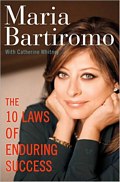
Book Summary of Maria Bartiromo’s ‘The 10 Laws of Enduring Success’

November 28, 2010 By Nagesh Belludi Leave a Comment

The 10 Laws of Enduring Success » Maria Bartiromo Success consists of recognizing opportunity, being optimistic, following our passions, keeping good relations, and making the best of circumstances that life presents us. The elements of accomplishment have been widely written about since the dawn of publishing. Each year, several authors attempt to repackage the familiar skills for success in new contexts. Such is the effort of CNBC anchor and journalist Maria Bartiromo (with Catherine Whitney) in “The 10 Laws of Enduring Success.” Maria presents the longstanding blueprint of success as ten attitudes: self-awareness, foresight, ingenuity, audacity, integrity, flexibility, modesty, fortitude, tenacity of purpose, and resilience.

“The 10 Laws of Enduring Success” falls short on one key characteristic. Advice on success can inspire only when the narrator connects his/her advice to personal anecdotes of hopes and despairs, achievements and disappointments, and meaningfully reflects on how certain attitudes contributed to his/her eventual success. Remember my recent article about commencement addresses by Steve Jobs, Bill Gates, and J K Rowling? These speakers are stimulating for the very reason that their timeless advices consist of thought-provoking personal contemplations.

“The 10 Laws of Enduring Success” is lacking in deep reflections of what contributed to the author’s success. As the host of one of the most popular shows in business TV, Maria Bartiromo has an extensive access to distinguished people. She does include insights from many successful people from the world of politics, business, sports, and entertainment. However, these narratives are typically short, often wander off the point, and do not necessarily connect to individual themes in a memorable way.

The conversational writing style is unassuming and quite engaging, and thus makes the book a quick read.

Leadership Reader’s Bottom-line

  • “The 10 Laws of Enduring Success” by Maria Bartiromo with Catherine Whitney
  • Subject: Skills for success
  • Suggested reading for fans of CNBC and the financial news media. Optional reading for others.
  • Read this book as a reiteration of the first principles of success. Be not amazed if this book does not prompt new thoughts.
  • 3 out of 5 Stars

Filed Under: Career Development, Leadership Reading, Sharpening Your Skills Tagged With: Books for Impact, Wisdom

25 Ways to Instantly Become a Better Boss

August 2, 2010 By Nagesh Belludi 2 Comments

Bad management is not usually a result of bosses not knowing what to do to manage better. Rather, it stems largely from bosses not putting conventional managerial skills into practice. Little wonder, then, that despite the billions that organizations pour into managerial training, instances of shoddy management abound.

Here are a few simple and specific actions you can take now to become an effective boss.

  1. Smile more
  2. Appreciate more, judge less
  3. Compliment openly; critique and correct in private
  4. Don’t worry about who gets credit; give credit where due
  5. Give feedback now; don’t wait until the next performance review
  6. Reiterate employees’ strengths and make them feel smarter
  7. Get rid of busy work
  8. Simplify work and encourage expediency
  9. Establish deadlines and stick with them
  10. Organize employees’ time and priorities
  11. Explain what needs to be done and get out of the way
  12. Avoid giving conflicting orders
  13. Find the time to listen to your employees and follow-up
  14. Recognize the small picture
  15. Seek to understand what inhibits employee effectiveness
  16. Give employees adequate latitude
  17. Fix problems, not blames
  18. Encourage mistakes; own up to your mistakes
  19. Standup for your employees
  20. Encourage participation in decision-making
  21. Be tough-minded, not mean
  22. Do not play favorites; discourage sucking up
  23. Be accessible and friendly, yet consistent and objective
  24. Earn respect; don’t demand deference
  25. Attempt to influence by persuasion, not by wielding authority

Filed Under: Leading Teams Tagged With: Great Manager

« Previous Page
Next Page »

Primary Sidebar

Popular Now

Anxiety Assertiveness Attitudes Balance Biases Coaching Conflict Conversations Creativity Critical Thinking Decision-Making Discipline Emotions Entrepreneurs Ethics Etiquette Feedback Getting Along Getting Things Done Goals Great Manager Innovation Leadership Lessons Likeability Mental Models Mindfulness Motivation Parables Performance Management Persuasion Philosophy Problem Solving Procrastination Psychology Relationships Resilience Simple Living Social Skills Stress Suffering Thinking Tools Thought Process Time Management Winning on the Job Wisdom

About: Nagesh Belludi [hire] is a St. Petersburg, Florida-based freethinker, investor, and leadership coach. He specializes in helping executives and companies ensure that the overall quality of their decision-making benefits isn’t compromised by a lack of a big-picture understanding.

Get Updates

Signup for emails

Subscribe via RSS

Contact Nagesh Belludi

RECOMMENDED BOOK:
India After Gandhi

India After Gandhi: Ramachandra Guha

Historian Ramachandra Guha's chronicle of the political and socio-economic endeavors of post-independence India, and its burgeoning prosperity despite cultural heterogeneity.

Explore

  • Announcements
  • Belief and Spirituality
  • Business Stories
  • Career Development
  • Effective Communication
  • Great Personalities
  • Health and Well-being
  • Ideas and Insights
  • Inspirational Quotations
  • Leadership
  • Leadership Reading
  • Leading Teams
  • Living the Good Life
  • Managing Business Functions
  • Managing People
  • MBA in a Nutshell
  • Mental Models
  • News Analysis
  • Personal Finance
  • Podcasts
  • Project Management
  • Proverbs & Maxims
  • Sharpening Your Skills
  • The Great Innovators

Recently,

  • The Safest Choice Is Rarely the Smartest, Yet Always the One That Shields You From Blame
  • Inspirational Quotations #1168
  • Delegate Up: Credibility Climbs Hierarchies Faster Than Ideas Do
  • Your Brain is Much Better at Generating Thoughts Than Suppressing Them
  • The Commitment Device That Costs Nothing
  • Inspirational Quotations #1167
  • The Adjacent Move: How Johnny Andrean Built Three Consumer Brands From One Playbook

Unless otherwise stated in the individual document, the works above are © Nagesh Belludi under a Creative Commons BY-NC-ND license. You may quote, copy and share them freely, as long as you link back to RightAttitudes.com, don't make money with them, and don't modify the content. Enjoy!