• Skip to content
  • Skip to primary sidebar

Right Attitudes

Ideas for Impact

Search Results for: leadership skills

Why Are There No ‘How to Be a Great Follower’ Classes?

February 24, 2025 By Nagesh Belludi Leave a Comment

Why Are There No 'How to Be a Great Follower' Classes? It struck me recently: while we obsess over leadership—how to be a good leader, how to measure it, and so on—there’s barely a peep about being a good follower.

No one seems particularly interested in becoming a good follower. Step into a business school, and the hustle to prove leadership skills is as intense as caffeine consumption!

Think about it: leaders wouldn’t exist without followers. Both roles are vital for any group’s success.

Yet, leadership gets all the glory, while followership is often overlooked. Society praises leaders with power and prestige, while followers are seen as mere support staff. It’s as if followership is considered a less glamorous, passive role.

'The Art of Followership' by Ronald E. Riggio (ISBN 0787996653) So why the lack of buzz about following? Maybe there’s no market for it. But effective followership is just as vital. A bit more focus on it could lead to smoother, more balanced teams. After all, if everyone’s busy leading, who’s left to follow? Good leaders aren’t always out front.

Filed Under: Leadership, Leading Teams, Managing People Tagged With: Assertiveness, Getting Along, Leadership, Personality, Persuasion

How to … Change Your Life When Nothing Seems to be Going Your Way

May 4, 2023 By Nagesh Belludi Leave a Comment

Recollect what it means to be human: we go through ups, downs, shortcomings, triumphs, losses, confidence, and apprehensions are all just a part of life. While unpleasant, failure is also a common and essential element of life. Bearing failure with equanimity is more likely to help you find success and get what you want.

Next, think about something that’s challenged you in the past and consider how you’re better off for having been through that experience. When you acknowledge you’ve overcome setbacks before, you can recognize that you can—and will—weather this one, too.

Ponder about whatever challenges you presently and see if you can reframe it. Try to perceive it as an opportunity for growth and consider what gifts could come from this experience. Visualizing successful outcomes is the best way to reset or repurpose your goals.

Idea for Impact: Developing resiliency isn’t easy, but excessive rumination and dwelling on past failures for longer than necessary will keep you stuck. When things aren’t going your way, challenge yourself to find any upsides, no matter how small. Find the good in the less-than-ideal. You’re more likely to get unstuck by trying a low-risk baby step forward.

Filed Under: Living the Good Life, Mental Models, Sharpening Your Skills Tagged With: Adversity, Attitudes, Discipline, Emotions, Mental Models, Motivation, Resilience, Success, Wisdom

Don’t Get Stuck in Middle Management

September 21, 2021 By Nagesh Belludi Leave a Comment

This survey by the Association of Asian Americans in Investment Management reports (via The New York Times DealBook column) the nature of discrimination and bias faced by Asian Americans:

Asian Americans and Pacific Islanders are often stereotyped as lacking leadership skills. At investment firms, they “fill middle management ranks, but their percentages plummet in senior management and C-suites.” Respondents said they were often tapped as technical experts and benefited from the perception that they are good workers. But their advancement stalled as they sought more senior roles that emphasize networking and communication skills.

Most professionals fail to realize that the competencies that made them successful in their early corporate roles are not necessarily the attributes that will allow them to outshine in roles higher up on the ladder. These desirable qualities would include forming coalitions, managing relationships and alliances, determining where and when to shift one’s focus, and learning to appreciate different perspectives.

Work out what you need to get to the top and fight the perceptions

  • Evaluate where your development priorities should be. Find out how you can acquire the necessary skills and competencies. Go get them. Become more visible to management and situate yourself for a promotion.
  • Network wisely. Understanding who must be won over to your point of view is vital for training for your promotion. Spend time cultivating meaningful relationships.
  • Ask for honest feedback—not just from your boss but also from well-respected peers, customers, mentors, and others. Confront problems quickly lest they metastasize.

Idea for Impact: In today’s world, your skills and promotability are your responsibility.

Filed Under: Career Development, Sharpening Your Skills Tagged With: Biases, Career Planning, Interpersonal, Leadership, Personal Growth, Skills for Success

General Electric Blame Must Be Shared: Summary of Ex-CEO Jeff Immelt’s ‘Hot Seat’

March 4, 2021 By Nagesh Belludi Leave a Comment

Leadership is tough. Some things work out, and some don’t. Other things end up epic failures. But no company gets anywhere without trying.

In the fullness of time, when the company does well, as suggested by its stock price, such leadership attributes as optimism and foresight are heralded as brilliant. But when things go wrong, these very attributes are the first to get the blame.

“More complete telling of the truth”

Hot Seat: What I Learned Leading a Great American Company (2021) is former General Electric CEO Jeff Immelt’s response to the allegations that his ineffectiveness led to the collapse of the once-mighty company. It’s an engaging book that must be studied after Wall Street Journal reporters Thomas Gryta and Ted Mann’s worthwhile postmortem, Lights Out: Pride, Delusion, and the Fall of General Electric (2020; my summary.)

My legacy was, at best, controversial. GE won in the marketplace but not in the stock market. I made thousands of decisions impacting millions of people, often in the midst of blinding uncertainty and second-guessed by countless critics. I was proud of my team and what we’d accomplished, but as CEO, I’d been about as brilliant as I was lucky, by which I mean: too often I was neither.

Confluence of bad luck, bad timing, leadership mistakes

I’ve previously written a dissertation on what happened at General Electric (GE.) Immelt had a tough act to follow. Under the previous CEO, the exceptional Jack Welch, GE got spoiled by greed and got away with a lack of transparency.

Over the years Jack Welch had collected a group of idol worshippers and sycophants around and outside the company who fostered an unrealistic view of GE and of Jack himself.

Immelt was saddled with Welch’s doomed legacy, but Immelt failed to right-track it in his 16 years at the helm.

Early in his tenure as CEO, Immelt realized the scope of a potential disaster in GE Capital but couldn’t break its bad habits swiftly. In fact, Immelt went about pivoting the company around slow-growth industrial products. Still, as he did so, his strategy entailed relying on GE Capital to deliver easy profits. It was a hard addiction to break, and Immelt couldn’t discard GE Capital easily.

In the short term, GE Capital was our strategy. We had no other engines of growth. We had to keep our heads down and weather the scrutiny. … We would let the rest of GE Capital grow so that we could keep earnings on a steady path, while the industrial businesses could catch up.

On top, Immelt overpaid for acquisitions, most prominently for the French power generating equipment company Alstom. At the same time, his bet on fossil-fuel-based power equipment was spectacularly mistimed because market conditions deteriorated quickly.

In the final years, Immelt’s misfortunes, even in such previously thriving businesses as healthcare and transportation, piled on. When Immelt called Jack Welch after stepping down, Welch told him supportively, “We both know you never caught a break.”

Jeff Immelt Admits He Let Everybody Down.

Immelt’s Hot Seat is a fascinating account of what it takes to lead a significant global business in times of rapid change.

Immelt owns up his many mistakes with a certain self-awareness. He rebukes a few people while acknowledging he should have been more accountable for everything that happened under his watch. But Hot Seat is primarily a then-in-time rationale of his significant decisions.

Interestingly enough, Immelt doesn’t offer insightful misgivings for the lack of transparency in GE’s financial statements, his outsized compensation, and the mischaracterization of insurance charges and pension liabilities.

Be advised, though, there’re so many details in Hot Seat that are unknowable without a first-rate knowledge of GE’s people and business model, starting with the Welch era.

“Every job looks easy (until you’re the one doing it)”

Read Hot Seat: What I Learned Leading a Great American Company (2021.) General Electric’s fall is a complicated story. It deserves to be heard from insiders such as Immelt as it does from journalists and stockholders.

Hot Seat should leave you with a fair-minded assessment of General Electric, Jack Welch, Jeff Immelt, financial engineering, the conglomerate business model, and Wall Street-oriented capitalism itself. These, sadly, many people don’t understand or know completely.

Filed Under: Business Stories, Leadership Reading, The Great Innovators Tagged With: General Electric, Jack Welch, Leadership Lessons, Leadership Reading

Leo Burnett on Meaning and Purpose

June 15, 2020 By Nagesh Belludi Leave a Comment

Adman Leo Burnett (1892–1971) founded a global advertising agency that ranks among the titans of the trade. Burnett and the company that bears his name produced such famous brand icons as the Marlboro Man, Tony the Tiger, Jolly Green Giant, Maytag Repairman, and Pillsbury Doughboy.

Burnett pioneered the ‘Chicago School’ of advertising, wherein product campaigns centered on the inherent appeal of products themselves. Burnett’s advertisements used meaningful visuals to evoke emotions and experiences. This approach contrasted the time-honored use of catchy catchphrases and clever copy describing the products’ features. The models in Burnett’s campaigns resembled ordinary people rather than celebrities.

“When to Take My Name Off the Door”

After 33 years at the helm of his company, Burnett officially retired at age 76. He delivered a remarkable valedictory (film clip,) reminding his colleagues of his advertising agency’s core values and its high creative standards.

Let me tell you when I might demand that you take my name off the door.

When you lose your itch to do the job well for its own sake—regardless of the client, or the money, or the effort it takes.

When you lose your passion for thoroughness…your hatred of loose ends.

When you stop reaching for the manner, the overtones, the marriage of words and pictures that produces the fresh, the memorable, and the believable effect.

When you stop rededicating yourselves every day to the idea that better advertising is what the Leo Burnett Company is all about.

When you begin to compromise your integrity—which has always been the heart’s blood—the very guts of this agency.

When you stoop to convenient expediency and rationalize yourselves into acts of opportunism—for the sake of a fast buck.

When your main interest becomes a matter of size just to be big—rather than good, hard, wonderful work.

When you lose your humility and become big-shot weisenheimers … a little too big for your boots.

When you start giving lip service to this being a “creative agency” and stop really being one.

Finally, when you lose your respect for the lonely man—the man at his typewriter or his drawing board or behind his camera or just scribbling notes with one of our big black pencils—or working all night on a media plan. When you forget that the lonely man—and thank God for him—has made the agency we now have—possible. When you forget he’s the man who, because he is reaching harder, sometimes actually gets hold of—for a moment—one of those hot, unreachable stars.

THAT, boys and girls, is when I shall insist you take my name off the door.

Idea for Impact: Leaders are Meaning-Makers

Burnett’s valedictory is a potent reminder of the power of meaningful organizational values and a leader’s role in upholding his company’s principles-based DNA.

Organizational values are at the heart of the long-term success of a company. When these values grow fainter, the company may no longer reflect the intended culture. The organizational values will no longer clarify, inspire, and bind the company’s customers, employees, partners, investors, and other stakeholders.

As the steward of a company’s culture, a leader is responsible for institutionalizing—not merely individualizing—a sense and meaning in the workplace. And, as Burnett demonstrates, an effective leader passionately expresses what the company stands for and shares personal lessons learned in that process.

Burnett’s name is still on the door.

Filed Under: Career Development, Sharpening Your Skills, The Great Innovators Tagged With: Attitudes, Creativity, Entrepreneurs, Likeability, Marketing, Winning on the Job

Enabling the Highest Degrees of Understanding // Book Summary of Howard Gardner’s ‘The Unschooled Mind’

June 27, 2017 By Nagesh Belludi Leave a Comment

Traditional Schooling Fails to Teach Kids to Ask the Right Questions

'The Unschooled Mind' by Howard Gardner (ISBN 0465024386) In The Unschooled Mind (1991,) Harvard developmental psychologist Howard Gardner makes a persuasive case for why even the brightest students often lack a deep understanding of what traditional schooling purports to teach them.

According to Gardner, students (in elementary schools to graduate colleges) may take exams and earn degrees, but their supposed knowledge turns out deficient in situations that are at variance from the “text-to-test” framework in which they learnt it. To some extent, this disconnect is an outcome of teachers’ settling for “correct-answer compromises” whereby students take the rote repetition of facts, formulas, concepts, and theories for a real understanding of fundamental concepts.

Robust Forms of Intuitive Knowledge

Overall, Gardner argues that children tend to acquire well-established models for perceptive learning and intuitive thinking by the time they are five years old. They develop wide-ranging beliefs about the physical world and distinctive models of events and people.

Subsequently, when children begin their schooling, they are launched into pedagogic methods that often sidestep—even interfere with—the children’s entrenched patterns of learning and understanding. That is to say, children have to put up with a disagreeable dichotomy between their intuitive learning patterns and the academic learning:

In its theoretical resourcefulness and intuitions, [a 5-year old’s mind] is powerful; in its artistic endeavors, it can be creative and imaginative; in its adventurousness, it is exemplary. … Education that takes seriously the ideas and intuitions of the young child is far more likely to achieve success than education that ignores these views, either considering them to be unimportant or assuming that they will disappear on their own.

Experiential Learning, Supplanted by Critical Analysis and Synthesis, Can Enhance Students’ Points of View

The Unschooled Mind contends that far-reaching knowledge and appreciation of education can occur only when students are allowed to integrate their “prescholastic” learning modes with the scholastic and the disciplinary ways of traditional school education. “The problem is less a difficulty in school learning per se and more a problem in integrating the notational and conceptual knowledge featured in school with the robust forms of intuitive knowledge that have evolved spontaneously during the opening years of life.”

Gardner’s solution to this problem is to situate students in educational environments that pique their curiosity about the subject matter and, at the higher levels of education, challenge their preexisting assumptions. Educating children for the utmost degrees of understanding involves designing educational systems that help students synthesize these several patterns of learning.

Real Education Opens the Way to Thinking, Knowing, and Deeper Understanding

For real learning to occur, Gardner argues, students must have an opportunity to realize their own ignorance, and then ask and explore their own questions. Teachers must regularly expose students to “Christopherian encounters”—compelling personal discoveries of the inconsistencies between their various frames of reference—by approaching any subject matter through at least five instructive channels:

  • through narratives and stories,
  • through logical and quantitative lines of attack,
  • through “foundational” or philosophical inquiries,
  • through aesthetic approaches (exploring the creative and artistic elements) and
  • through creating and drawing upon the students’ life-experiences.

Gardner claims that traditional schooling should incorporate more apprenticing—apprenticeship programs build most effectively on the ways children learn—and schools should become more like children’s museums.

Recommendation: Read The Unschooled Mind by Howard Gardner, especially if you have a child in school. The key takeaway: to enable the highest degrees of understanding, any skills instruction must be systematically reinforced by instruction in which the deployment of the skills makes holistic sense.

Filed Under: Leadership Reading, Sharpening Your Skills Tagged With: Creativity, Development, Learning, Philosophy, Thinking Tools, Thought Process, Training

Books I Read in 2016 & Recommend

December 27, 2016 By Nagesh Belludi Leave a Comment

Personal Finance: Thomas Stanley and William Danko’s The Millionaire Next Door summarizes anthropological research from the ’90s on the attributes of unassuming wealthy Americans. The authors discuss the fancy trappings of affluence and the high cost of maintaining social status. They explain that prosperous individuals prioritize financial independence over a high social status. Key takeaway: It’s easy to get rich by living below your means, efficiently allocating funds in ways that build wealth, and ignoring conspicuous consumption. {Read my synopsis in this article.}

'Taking Advice' by Dan Ciampa (ISBN 1591396689) Decision-Making / Problem-Solving: Dan Ciampa’s Taking Advice offers an excellent framework on the kind of advice network you need on strategic, operational, political, and personal elements of your work and your life. Taking Advice offers important insights into a seemingly obvious dimension of success, but one that’s often neglected, poorly understood, or taken for granted. {Read my synopsis in this article.}

Creativity / Decision-Making / Teamwork: Edward de Bono’s Six Thinking Hats describes a powerful problem-solving approach that enriches mental flexibility by encouraging individuals and groups to attack an issue from six independent but complementary perspectives. Key takeaway: The ‘Six Thinking Hats’ method can remove mental blocks, organize ideas and information, foster cross-fertilization, and help conduct thinking sessions more productively than do other brainstorming methods. {Read my synopsis in this article.}

Presentation / Communication: Edward Tufte’s The Cognitive Style of PowerPoint argues that presentations reduce the analytical timbre of communication. In other words, presentation slides lack the resolution to effectively convey context, “weaken verbal and spatial reasoning, and almost always corrupt statistical analysis.” Tufte contends that, by forcibly condensing our ideas into bullet point-statements, phrases, and slides, we break up narrative flow and flatten the information we’re trying to convey. Key takeaway: Well-structured and succinct memos can convey ideas comprehensively, clearly, and meaningfully. {Read my synopsis in this article. Also, learn about Amazon’s ‘Mock Press Release’ discipline and Procter & Gamble’s ‘One-Page Memo’ practice to communicate ideas.}

Happiness / Relationships: Janice Kaplan’s The Gratitude Diaries. For one year, Kaplan maintained a gratitude journal and wrote down three things that she was thankful for each day. She also decided to “find one area to focus on each month—whether husband, family, friends, or work—and … see what happened when I developed an attitude of gratitude.” Key takeaway: A grateful heart is a happy heart. Stop whatever you’re doing, take stock of your blessings, and be grateful for everything you have in life. {Read my synopsis in this article.}

'Man's Search for Meaning' by Victor Frankl (ISBN 1846042844) Psychology: Viktor Frankl’s Man’s Search for Meaning. When subject to brutal treatment at Nazi concentration camps in Germany, Frankl changed his initial reaction from ‘Why me?’ and ‘Why is this happening?’ to ‘What is life asking of me?’ Such profound shifts in thinking, Frankl argues, could help you find meaning in life, regardless of what is happening on the outside. Key takeaway: The one power you have at all times is the freedom to choose your response to any given set of circumstances. Uncover a sense of purpose in life and you can survive nearly anything. {Read my synopsis in this article.}

Psychology: John Tierney and Roy Baumeister’s Willpower: Rediscovering the Greatest Human Strength. The book’s central theorem is the much-debated “muscle metaphor” of self-control, which states that willpower is like a muscle that tires out—or runs out of energy—as you use it, but can be replenished and purposely fortified through practice. Key takeaway: Budget your willpower and spend it where and when you need it the most. Eliminate distractions, temptations, and unnecessary choices. {Read my synopsis in this article.}

'Sam Walton: Made In America' by Sam Walton (ISBN 0553562835) Biography / Leadership: Sam Walton’s Made in America is the Walmart founder’s very educational, insightful, and stimulating autobiography. It’s teeming with Walton’s relentless search for better ideas learning from competitors, managing costs and prices to gain competitive advantage, asking incessant questions of day-to-day operations, listening to employees at all levels of Walmart, and inventing creative ways to foster an idea-driven culture. Takeaways: ten rules of management success, learning from failure, cost and price as a competitive advantage, and Walton’s ‘Ten-Foot Rule’ to become more likeable.

Biography / Leadership: Deborrah Himsel’s Beauty Queen: Inside the Reign of Avon’s Andrea Jung offers an insightful tale of the spectacular rise to the top and the tumultuous fall from grace of the former Avon CEO. Jung initially led six consecutive years of double-digit growth and then presided over a series of operational missteps that led to her resignation. “Her story is a cautionary tale, one that suggests the critical importance of being aware of your weaknesses and how they can sabotage you.” Key takeaway: Spectacular success, especially those attributable to external circumstances, can often conceal on organization’s or an individual’s flaws. When the tide turns, the deficiencies are exposed for all to see. {Read my synopsis in this article.}

'The HP Way' by David Packard (ISBN 0060845791) Biography / Leadership: David Packard’s The HP Way recalls how Bill Hewlett and David Packard built a company based on a framework of principles and the simplicity of management methods. In addition to their technical innovations, Bill and David established many progressive management practices that prevail even today. Starting in the initial days, the HP culture that Bill and David engendered was unlike the hierarchical and egalitarian management practices that existed at other corporations of their day. Key takeaway: The essence of the “HP Way” was a strong and clear set of values, and a culture of openness and respect for the individual. {Read my synopsis in this article. Also learn about management by walking around and Bill Hewlett’s ‘Hat-Wearing Process’ for decision-making.}

Leadership: Warren Bennis and Robert Thomas’s Geeks and Geezers. The authors posit that all potential leaders must pass through a “leadership crucible” that provides an intense, transformative experience. Only after they “organize the meaning” and draw significant lessons from their “crucible experiences” can they become leaders. Key takeaway: Find your “leadership voice” by reflecting on transformative experiences in your life and examining what you’ve learned from them. {Read my synopsis in this article.}

Look at my articles on how to process a pile of books that you can’t seem to finish, and on how self-help books bring hope that change is possible.

Also, see a list of books I read in 2015 and 2014 and recommend.

Filed Under: Belief and Spirituality, Leadership Reading Tagged With: Books

The Halo and Horns Effects [Rating Errors]

April 30, 2010 By Nagesh Belludi 1 Comment

Preamble: We are often unaware of the many biases and prejudices that influence our social judgments. Psychologists call these “bias blind spots.” We can overcome many of these subliminal biases by teaching ourselves to be aware of them. This is the second in a series of articles on the common rating errors. See my earlier article on the recency bias.

Unconscious Judgments of an Investment Broker

A 2007 study highlights two of the most common unconscious social judgment biases. Prof. Emily Pronin of Princeton University showed study participants one of two pictures of the same man whom she introduced as an investment broker. One picture showed a suited man with a highly regarded Cornell degree and the other showed the man in casual clothing with a degree from a nondescript college. The professor asked her participants how much of a theoretical $1,000 they would invest in each. The participants rated the suited man as more competent: on average, he got $535 on without having his background checked. In contrast, the causal dresser received just $352. Not only were the participants more likely to have the second broker’s credentials verified —but also they did not consider him as trustworthy.

The Halo Effect

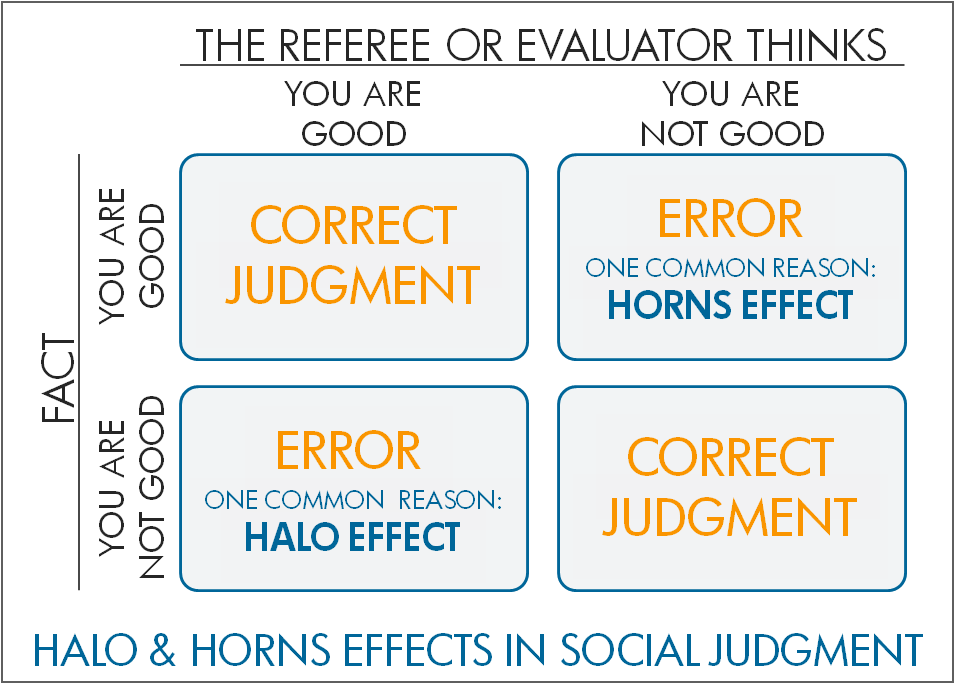
The “halo effect” captures what happens when a person who is judged positively based on one aspect is automatically judged positively on several others without much evidence. For instance, as a result of the halo effect,

  • attractive people are often judged as competent and sociable. Film stars and other celebrities are assumed pleasant and sharp-witted,
  • inexperienced interviewers tend to pay less attention to a candidate’s negative traits after discerning one or two positive traits in the first few minutes of a job interview,
  • charismatic professionals tend to get noticed and move up the corporate ladder faster, irrespective of their technical and leadership skills,
  • articulate speakers are likely to influence their audiences more even if their messages are poor in form and content.

Politicians, film and TV stars, sportspersons, celebrities and brand managers have learned to construct a halo effect and capitalize on their reputations. Apple’s iPod spawned positive impressions of other Apple products—the company took advantage of this halo effect and delivered excellent products in the iPhone and iPad. In another example, renowned fashion designers can set high prices for perfectly ordinary clothes.

Halo and Horns Effects in Social Judgment

The Horns Effect

The “horns” or “devil effect” is the concept by which a person who is judged negatively on one aspect is automatically judged negatively on several other aspects without much evidence. Clearly, this is the opposite of the halo effect.

For years, American car manufacturers have battled the mistaken public perception that cars made by Japanese companies are of significantly better quality. This misperception remains even when American car manufacturers use identical components from the same suppliers and assemble their cars using identical manufacturing processes. Even today, Japanese-brand cars resell for much higher prices than American-brand cars.

Call for Action

  • Reflect on your decision-making process to steer clear of biases. As human beings, we incessantly form opinions of people, objects, and events, both consciously and subconsciously. However, our judgment is rarely free of biases and our measures are not always comprehensive enough. Before reaching any important decision, be sure to collect all the relevant facts and reflect on whether your thought processes are free of the common biases.
  • Understand that perception is reality and be conscious of the image you are projecting. People judge the proverbial book by its cover. Your friends and family, workplace and society at large have a certain perception of who you are and what you can do, irrespective of the reality. As much as you would prefer to be evaluated based on who you actually are and what you can actually do, understand that your identity and prospects are based on others’ image of you. Do everything you can to connect people’s perception to the reality. Look and play your role. Begin by reading the seminal article on the topic of personal branding, “The Brand Called You,” written by renowned management author, Tom Peters.

Filed Under: Leading Teams, Sharpening Your Skills Tagged With: Biases, Mental Models

Compilation of Job Interview Questions

April 4, 2009 By Nagesh Belludi 1 Comment

A couple of years ago, I compiled a list of job interview questions and loosely categorized this list by personal attributes, career performance, communication skills, team skills, managerial skills, and leadership skills.

I have since shared this list with recruiting managers (interviewers) and job candidates (interviewees) who I have coached. I suggest that recruiting managers choose eight questions on varied topics for a thirty-minute interview. Job candidates can select twenty-five questions and practice answering these questions by recording and reviewing their answers.

Job Interview Questions on Personal Attributes

  • Why do you think you are successful at what you do?
  • What you consider your biggest fault at work? Why do you think you have it and what are you doing about it?
  • What defines a challenge to you?
  • Describe the situation when your expectations were not met.
  • What is a misconception people have about you when they first meet you?
  • How do you maintain your passion in a place that lacks accountability?
  • Tell me about a time when you felt culturally ill-at-ease and how do you cope with it?
  • What is the single best quality that you have seen in people—a quality that you do not possess?
  • Tell me about yourself.
  • What are your strengths and weaknesses?
  • What was a constructive criticism you received and how did you respond to it?
  • Tell me about a failure. How would you know you failed in something?
  • Tell me about a time when your belief was challenged.
  • Give me an instance when your ethics have been challenged.
  • Give me an example when you were criticised for your personality.
  • If you had a month without any commitments, what would you do?
  • What are people most surprised to learn about you?
  • What do you consider to be your key values? Name a time when these values were challenged.
  • What is something from your past that you wish you would have done differently and why?
  • List three things that motivate you at work.
  • What is your one personal trait you most admire and why?
  • What motivates you to succeed?
  • How do you measure success?
  • What are you passionate about?
  • Which business leader do you admire? Why?
  • Describe a typical day at work.
  • Tell me about the current (non-professional) book you are reading? What did you learn from it?
  • Who is a prominent figure that you admire? Why?
  • What is your biggest regret and thus far?
  • What do you enjoy most about your job?
  • What is the one impression you want me to leave this interview with?
  • What do you look for in a job?
  • What were the high and low points in your life over the past few years?
  • What was the toughest integrity violation you have ever encountered, and how did you handle it?
  • Have you ever had to define yourself in the midst of criticism, and did you succeed?
  • When have you been blindsided in life, and why did it happen?

Job Interview Questions on Career Performance

  • What class did you like the most while you were at school? Why? How have you pursued that topic since you graduated?
  • When was the last time you were forced to step out of your comfort zone? What is the situation and how did you deal with it?
  • Suppose you discover that you missed a significant detail six hours before a project deadline. What would you do?
  • What you think about your current or former boss?
  • Was there a time where you had to choose between good opportunities? Which one did you choose?
  • Career-wise, was there anything in the last five years that you would have done differently?
  • How does your current or last job relate to the overall goals of your department or organisation?
  • What are you most proud of?
  • Tell me about a time when you personally failed. How did you handle it?
  • How do you feel about your career progress to date?
  • What would your peers at this organisation say on your second year anniversary?
  • When did you realise you needed a change in your career path?
  • What was your best mistake?
  • What about our position do you find most attractive? Least attractive?
  • Tell me about time when you overcame a problem and took initiative.
  • What was your most challenging work situation?
  • What has been your most creative solution to a problem?
  • What has been the highlight of your career?
  • What is the best idea you have ever had and why?
  • What is the one thing you would change about how you performed in your job in the last few years?
  • How have you changed the nature of your job?
  • Tell me about a time at work when things did not go well.
  • Describe the key characteristics of the business you are in.
  • Describe your organisation.
  • Describe your job. Being effective in this job means?
  • What are the key things that have happened since you took this job? What did you do? Why? What effect did you have? What problems developed? How did you handle these problems?
  • How effective do you think you have been in this job? Specifically, why do you say this? What are the performance measures? What is it about you, the job, or its context that has contributed to this level of effectiveness? What could you have done better?
  • What are you trying to achieve in your career? In your life?

Job Interview Questions on Communication, Conflicts

  • Tell me about a time when you worked with someone and had a difficult interaction or disagreement. How did you resolve it?
  • Describe a time when you had a conflict with a co-worker. How did you resolve it?
  • Tell me about a time when your powers of persuasion failed.
  • Give me an example of a time when you made a mistake because you did not listen well to what someone had to say.
  • Describe the most challenging negotiation in which you were involved. What did you do? What were the results for you? What were the results for the other party?
  • When a number of different people come to you with ideas about solving a problem, how do you go about using their information? Please give an example.
  • Tell me about a time when you have had to stand or defend a position that was not popular or easily accepted?
  • What was the hardest thing you had to say no to in the last two years?
  • Have you ever disagreed with your manager?
  • How do you approach resolving a conflict within a group?

Job Interview Questions on Team Skills

  • How would you pick a team?
  • What is your role on a team?
  • Tell me about a time when you had to deliver bad news to your team.
  • Tell me about a time when you let your team down.
  • How do you create accountability and create a strong team?
  • Describe a time when you were working in a team and you failed. How did you resolve the situation?
  • What characteristics do you look for in your team members?
  • Describe a situation when your team fell apart.
  • How would you describe your best friend?
  • What weaknesses do you have or experience when you are working in a team environment?
  • In the teams that you work with, how do you deal with disagreements between the team members?
  • Who was the toughest person you have worked with?
  • Discuss your worst team work experience.
  • Describe five qualities that you would want your team members to have for you to work effectively with them.
  • Tell me about a time when you lead a team and failed.

Job Interview Questions on Managerial Skills

  • What was the biggest mistake you have had when delegating work?
  • What is your biggest weakness as a manager?
  • How do you know when the project is working well? If it is not, how do you address the problem?
  • Describe a time when you had to be assertive in giving directions to others.
  • Tell me how you go about delegating work? How did you keep track of delegated assignments?
  • Describe characteristics of a bad team member or supervisor you have worked with.
  • What would you do if your boss in the job came to you requesting you to do something that you know is definitely dead wrong?
  • What is your management style?
  • Tell me about a time when your relationship with a colleague broke down. What did you learn from that?
  • Tell me about a time when you helped someone else succeed without doing the job for them.
  • Describe the situation when you had to micromanage. How did you go about it? What were the results?
  • What is the most difficult aspect of being a manager?
  • Tell me about an instance when you had to work with a difficult person? What did you learn?
  • Give me an instance where you handled a difficult subordinate at work.
  • Consider me to be your employee. I am not performing well. How would you fire me? Please play it out.
  • Describe an experience where you motivated your followers. Why you think you were able to do it?
  • Tell me about when you had to work with someone you did not get along with, or someone whose personality was different from yours.
  • What would your subordinates say about you and your leadership style?
  • How do you deal with difficult personalities?
  • If you were the CEO of a company and had to do downsizing, what people would you layoff, and, how would you implement this?
  • How do you handle working with people who are not good at their jobs?
  • How do you evaluate the productivity / effectiveness of your subordinates? How do you get data for performance reviews?
  • How would you describe your managerial style? How has changed over the past five or ten years?
  • Give me examples of your hiring successes and disasters? Explain what you got right—and what you missed.
  • Can you point to any of your people who grew up with your guidance and have gone on to succeed in your own company or beyond?

Job Interview Questions on Leadership Skills

  • Describe the qualities of a good manager or a leader you have worked with. Why are these important?
  • How has your leadership style evolved from ten years ago?
  • Define leadership. How does a good manager differ from a good leader?
  • Tell me about a time when you challenged somebody else’s idea and generated a new business initiative or project.
  • What kinds of decisions are most difficult for you? Describe an example.
  • Tell me about a time when you influenced others who were not your subordinates.
  • Tell me about a time when you saw poor leadership at work.
  • When you start your own company, what qualities will you look for in people you choose to partner with?
  • What is the most competitive situation you have experienced? How did you handle it? What was the result?
  • Tell me about a time when you developed a new business opportunity. What was the impact?
  • Describe a failure at work, how did you deal with it, and what did you learn from it?
  • What will be happening in our industry five years from now?
  • Have you ever been caught unaware by a problem or obstacle that you had not foreseen? What happened?
  • Tell me about a time when you overcame a problem or took initiative to solve something.
  • Describe a project where you preferred a common sense approach to an analytical approach to solve a problem.
  • What is your leadership style? How do you build consensus without using authority?
  • Some people consider themselves to be ‘big picture people’ and others are ‘detail oriented.’ Which are you? Give an example of a time when you displayed this.
  • What do you think is the most important thing a business needs to develop?
  • What is the riskiest decision you have made? What was the situation? What happened?
  • What you think are the three qualities of a leader? Give me an example of a situation in which you exhibited each of these.
  • If you had to assemble a team to work on a project, which three celebrities would you choose and why?
  • Describe a situation when something went totally awry.
  • In your present position, what problems did you identify that had previously been overlooked?
  • How do you get new ideas?
  • Tell me about a time when you saw a solution before everybody else.
  • Tell me about the most impactful failure in your life? What did you learn from it?
  • Tell me a situation where you took risks.
  • What innovative procedures have you developed? How did you develop them? Who was involved? Where did the ideas come from?
  • What is the role of management in today’s global economy?
  • What are the toughest decisions you have had to make in the last few years?
  • What was your biggest management challenge, and how did you handle it?
  • In your career, what is the best example of you anticipating market changes that your competitors did not?
  • When did your curiosity lead you to probe deeply and uncover a competitive trend or marketplace dynamic that others did not see, or, did not want to see?
  • People frequently borrow ideas they have seen elsewhere and then apply them in a new setting. How have you done this?

Filed Under: Career Development, Managing People Tagged With: Interviewing

Use The STAR Technique to Ace Your Behavioral Interview

July 15, 2008 By Nagesh Belludi 36 Comments

Introduction

Behavioral interviewing is a popular approach to assess a candidate’s past experiences and judge his/her response to similar situations on a future job. This variety of interviewing is based on the premise that past performance in comparable circumstances is the best predictor of future performance.

Rather than ask hypothetical questions (E.g., “How will you handle…,”) interviewers ask more specific, focused questions (E.g., “Describe a time when you had to…”) to elicit concrete examples of desired behaviors from the past. For example, instead of asking an interviewee, “How will you deal with a team member who is not pulling his weight on a project?” as in a traditional interview, an interviewer using the behavioral technique may ask, “Describe a project where one of your teammates was not pulling his weight. What did you do?” For further details and sample questions, see my earlier article on behavioral interviewing.

Prior to the interview, an interviewer identifies a set of behavioral traits he/she believes is essential for professional success on a particular job assignment. He/she then selects a series of questions:

  • “Describe a time when you had to …. What did you do?”
  • “Give me an example of a time when you had to …”
  • “Tell me about a situation in the past …”

Next, the interviewer may question the interviewee further:

  • “What was the outcome?”
  • “Did you consider …?”
  • “How did the other person react?”

Instead of allowing the interviewee to theorize or generalize about events, the interviewer expects the interviewee to narrate four details for each experience: (1) what the situation was, (2) what the challenges were, (3) how the interviewee dealt with the situation, and (3) what the outcome was.

6 Steps to Answer Behavioral Interview Questions

  1. Listen to the question carefully. Commonly, behavioral interview questions tend be long-winded and may sound vague (blame an overuse of adjectives, adverbs and trendy language.) Here is an example: “Good problem-solving often includes a careful review of the substantial facts and weighing of options before making a decision. Give me an instance when you reached a practical business decision by assessing the facts and weighing the options.”
  2. Make sure you understand the question before you start to answer. You may paraphrase the question and ask the interviewer if you understand it correctly. If necessary, ask the interviewer to repeat the question. Do not, however, ask the interviewer to repeat every question—the interviewer may doubt your ability to listen.
  3. Organize your answer. Allow yourself five to eight seconds to collect your thoughts and structure your response. Interviewers appreciate this break and could use the time to drink some water, review their notes, or rest their hands from note taking.
  4. State your answer. Try to limit your answer to about three minutes. Three minutes is long enough to relate a story completely and short enough to hold the interviewer’s attention.
  5. Do not digress from your plan. Resist the temptation to think of new details as you state the answer. By sticking to your planned details and structure, you can provide a consistent, concise, and well-reasoned answer.
  6. Answer follow-up questions. In response to your three-minute answer, the interviewer may pose additional questions. These questions may require simple ‘yes’ or ‘no’ answers or brief elaboration.

The 'STAR' Technique to Answer Behavioral Interview Questions

Answering a Question: Use the STAR Technique to Narrate an Experience

In behavioral interviewing, every answer should specifically address the skill in question. Your response should relate an experience from a previous job assignment, project, academic study, or community work.

Present a diverse set of experiences. Suppose you are asked six behavioral questions during a thirty-minute interview. Supplementing each question with a distinct experience will help you portray a wide range of skills and interests.

First, examine the question: what is its purpose; what specific skill is the question addressing? Next, choose an applicable experience. In your mind, recollect and reflect on specifics of that experience. You can structure your answer a using the four steps of the ‘STAR’ technique:

  • ‘S’ for Situation: Start your answer by providing the background of your experience. Describe the circumstances of your involvement. Provide enough detail to preface the rest of your narration.
  • ‘T’ for Task: Describe the challenge at hand and what needed to be done. Give the expected outcome and any conditions that needed to be satisfied.
  • ‘A’ for Action: Elaborate your specific action in response to the challenge. Specify analytical work, team effort or project coordination. Use ‘I’ and ‘we’ statements as appropriate.
  • ‘R’ for Results: Explain the results of your efforts: what you accomplished, what you learned, how your managers and team responded, and how your organization recognized you. Wherever possible, quantify your achievements and improvements—e. g., “20% improvement in …” or “reduced manufacturing costs by 1.5 million dollars per year …”

The 'STAR' Technique to Answer Behavioral Interview Questions

An Example: Using the STAR Technique to Narrate an Experience

Consider a question posed by authors Jack and Suzy Welch in a 2008 BusinessWeek article on recruiting for leadership positions: “Have you ever had to define yourself in the midst of criticism, and did you succeed?”

Below is a ‘STAR’ answer to this interview question. The interviewee’s response illustrates their ability to listen to feedback, adapt as a manager, and lead teams well.

  • ‘S’ for Situation: “My first job after business school was to lead a product development team at Acme Corporation. One of my responsibilities involved weekly product planning meetings that chose product features. After the meeting, I would meet with my staff and delegate programming tasks. Since I am an experienced programmer, I would explain the approach to each feature to be programmed. I expected my staff to write the programs in C++, then test and debug them. We seemed to work very well as a team.”
  • ‘T’ for Task: “Three months later, my manager collected feedback from my staff. In my performance review, my manager noted that I could improve my delegation skills. His comment surprised me. I thought I was good at delegating, as I would explain my expectations and all necessary steps to each staff member. I felt my staff was productive and consistently benefitted from my coaching. I thanked my manager for the feedback and promised to reflect on my delegating style and consider a change.”
  • ‘A’ for Action: “Upon reflection, I noticed two issues with my delegation approach. Firstly, in assigning tasks to my staff I only described the steps they needed to take. I had habitually failed to describe the background of product features we wanted to develop and explain how their work would contribute to and improve the overall product. My staff would just do what I had asked of them without understanding the context of their efforts. Secondly, while explaining how to complete each assignment, I was micromanaging. This may have limited my staff’s initiative and reduced opportunities to advance their programming skills. During the next staff meeting, I thanked them for the feedback and acknowledged I would change. from that point forward, Then, each week, I explained each product feature’s unique context, described the task in terms of outcomes and asked my staff how we could approach each task.”
  • ‘R’ for Results: “My staff was very excited by the opportunity to propose ideas, brainstorm, and choose their own preferred method of going about their work. They were no longer working on my idea alone: they shared in its conception and approached it their own way. They were more enthusiastic about their work and realized they were an integral part of something bigger than they were. During the next quarterly meeting, my manager praised me for empowering my team.”

The Significant Accomplishment Question

The single most important question that you will answer in every interview is the significant accomplishment question: “Tell me about the most significant accomplishment in your life. What challenges did you face? What did you do? How did it impact your organization?” An interviewer may pose this question as one of these variations: “Tell me something you are most proud of,” “Share the one thing you want me to know,” or, “Tell me something from your past that you are really excited about.”

If there’s one question that you should prepare for, it’s this significant accomplishment question. Here is a sample answer:

“The accomplishment that I am most proud of was being named ‘Consultant of the Year’ by Acme Medical Systems in 2002. When I worked as a product development consultant at Indigo, a team of Acme Medical Systems designers hired me to develop the plastic prototype of a new Computed Tomography (CT) scanner. Acme wanted to display their new cardiac scanner to their vice president who was visiting the following week. In preparation, I was asked to help develop the prototype of the CT-scanner’s new keyboard.

“The keyboard is a large, intricate device with plenty of keys, knobs, and styluses. One of the primary challenges with prototyping this keyboard was that it was too large to fit into any standard manufacturing machine. In addition, based on the design’s complexity, I originally estimated that developing the prototype would take at least two weeks. We had just eight days, including the weekend. For the next week, I worked from 10:00 AM until midnight every day and over the weekend. On the first day, after studying the design, I proposed a modified, simpler version, which my clients accepted. The next day, I used my advanced CAD skills to digitally split the complex design into smaller components that could be manufactured individually and then assembled. The new modular design, in fact, facilitated the assembly plan.

“Initially, my clients were concerned about the assembly process. I used a finite element model to reassure them and confirm that the assembly would be sufficiently robust. Since my clients were busy working on the rest of the CT-scanner, I offered to work with the suppliers. I visited five suppliers and prepared a manufacturing budget. After my budget was approved, I chose two suppliers and spent three days supervising the manufacturing process. Then, I worked with a third supplier to have the prototype carefully assembled, painted, and delivered the day before the vice president’s visit.

“The end-result was that the prototype was prepared in half the lead-time and 40% under budget, even after paying the suppliers overtime. In addition, my modular design lowered manufacturing costs by 20% when the CT-scanner went into production. In recognition of my hard work and cost savings, Acme honored me among sixteen contenders with the ‘Consultant of the Year’ award.

Behavioral Interview Questions for Practice

Consider the following questions. Practice your answers using the four-step ‘STAR’ technique. For more questions to practice with, see my compilation of job interview questions categorized by personal attributes, career performance, communication skills, team skills, managerial skills, and leadership skills.

  • Question on team work: “Describe a situation when your team members disagreed with your ideas or proposal on a project. What did you do?”
  • Question on analytical problem-solving: “Tell me about a time when you discovered a problem before anybody else on your team. What was the nature of the problem? How did you handle it? Did you ask for help?”
  • Question on assertiveness: “Give me an example of when you had difficulty getting along with a team member. What made this person difficult to work with? How did you handle the situation?”
  • Question on customer orientation and commitment to task: “Tell me about a time when you had to reject a customer’s request. What reasons did you give? How did you communicate?”
  • Question on creativity: “What is your most creative solution to a problem?”
  • Question on working effectively with others: “What was a constructive criticism you received recently? How did you respond to it? Did your relationship with this person change?”

Concluding Thoughts

In answering interview questions, the best way to impress an interviewer is to discuss your credentials and accomplishments in terms of personal success stories. The ‘STAR’ technique is probably the best method to structure answers to interview questions. By following this simple technique, you can narrate direct, meaningful, personalized experiences that best demonstrate your qualifications.

Filed Under: Career Development, Effective Communication Tagged With: Career Planning, Getting Ahead, Interviewing, Job Search

« Previous Page
Next Page »

Primary Sidebar

Popular Now

Anxiety Assertiveness Attitudes Balance Biases Coaching Conflict Conversations Creativity Critical Thinking Decision-Making Discipline Emotions Entrepreneurs Ethics Etiquette Feedback Getting Along Getting Things Done Goals Great Manager Innovation Leadership Lessons Likeability Mental Models Mindfulness Motivation Parables Performance Management Persuasion Philosophy Problem Solving Procrastination Psychology Relationships Resilience Simple Living Social Skills Stress Suffering Thinking Tools Thought Process Time Management Winning on the Job Wisdom

About: Nagesh Belludi [hire] is a St. Petersburg, Florida-based freethinker, investor, and leadership coach. He specializes in helping executives and companies ensure that the overall quality of their decision-making benefits isn’t compromised by a lack of a big-picture understanding.

Get Updates

Signup for emails

Subscribe via RSS

Contact Nagesh Belludi

RECOMMENDED BOOK:
How to Talk to Anyone

How to Talk to Anyone: Leil Lowndes

Communication consultant Leil Lowndes discusses 92 tricks to become a better conversationalist and improve social relationships---body language, words to say, telephone techniques, social tactics.

Explore

  • Announcements
  • Belief and Spirituality
  • Business Stories
  • Career Development
  • Effective Communication
  • Great Personalities
  • Health and Well-being
  • Ideas and Insights
  • Inspirational Quotations
  • Leadership
  • Leadership Reading
  • Leading Teams
  • Living the Good Life
  • Managing Business Functions
  • Managing People
  • MBA in a Nutshell
  • Mental Models
  • News Analysis
  • Personal Finance
  • Podcasts
  • Project Management
  • Proverbs & Maxims
  • Sharpening Your Skills
  • The Great Innovators

Recently,

  • The “Shadow Job Description”: The One Question That Changes the Interview Dynamic
  • Inspirational Quotations #1171
  • Enterprise Begins in Annoyance: How One Miserable Vacation Sparked a Global Hotel Chain
  • Wishful Thinking Is Free. Movement Pays.
  • Rumination Can Turn the Mind Into a Prison of Repetition
  • Inspirational Quotations #1170
  • Conversational Narcissism: When You Make It About You

Unless otherwise stated in the individual document, the works above are © Nagesh Belludi under a Creative Commons BY-NC-ND license. You may quote, copy and share them freely, as long as you link back to RightAttitudes.com, don't make money with them, and don't modify the content. Enjoy!