• Skip to content
  • Skip to primary sidebar

Right Attitudes

Ideas for Impact

Search Results for: Amazon Principle

Ever Wonder If The Other Side May Be Right?

March 22, 2016 By Nagesh Belludi Leave a Comment

The French essayist and novelist Andre Gide once wrote, “Believe those who are seeking the truth; doubt those who find it.”

Scratch the surface of any thinking ideologue and you’ll find not certainties but contradictions and doubts.

Darwin’s doubts about natural selection and evolution

Even after the publication of his seminal Origin of Species and The Descent of Man, Charles Darwin had crippling doubts about some aspects of natural selection. Specifically, if natural selection was to have lasting effects, evolutionary advances had to be conserved and passed on from one generation to the next. Darwin agreed with scientists who argued that his evolutionary theory failed to explain how variations are transmitted from parents to their offspring.

It was not until the 1930s that biologists started to study Gregor Mendel’s work on genetic inheritance and heredity in conjunction with Darwin’s theory of natural selection. Only then did biologists come to understand how variation of characteristics is passed on to new generations and how evolution is a process of descent with modification.

Seek to have an idea tomorrow that contradicts your idea today

At a Q&A at American web application company Basecamp, Amazon founder Jeff Bezos opined that people who are “right a lot” are those who had a flexible mindset and often changed their minds. Summarizing the conversation, Basecamp co-founder Jason Fried wrote,

[Bezos] observed that the smartest people are constantly revising their understanding, reconsidering a problem they thought they’d already solved. They’re open to new points of view, new information, new ideas, contradictions, and challenges to their own way of thinking.

He doesn’t think consistency of thought is a particularly positive trait. It’s perfectly healthy—encouraged, even—to have an idea tomorrow that contradicted your idea today.

This doesn’t mean you shouldn’t have a well formed point of view, but it means you should consider your point of view as temporary.

What trait signified someone who was wrong a lot of the time? Someone obsessed with details that only support one point of view. If someone can’t climb out of the details, and see the bigger picture from multiple angles, they’re often wrong most of the time.

Idea for Impact: Wisdom comes from seeking wisdom

Want to learn, expand your worldview, and broaden your mindset? Start by seeking out the right people—mix with people other than those from your own background (professional, cultural, social, academic, racial, ethnic, etc.) Remember that birds of a feather do flock together. Instead of preferring the company of other people from similar backgrounds, try investing some time with people who have viewpoints that contrast your own.

French entomologist Jean-Henri Fabre once wrote, “Seek those who find your road agreeable, your personality and mind stimulating, your philosophy acceptable, and your experiences helpful. Let those who do not, seek their own kind.” Look for those who respect your worldview—even if drastically different from theirs—but can present alternative perspectives and push you into considering different viewpoints on any issue of mutual interest.

Filed Under: Mental Models, Sharpening Your Skills Tagged With: Attitudes, Confidence, Conviction, Jeff Bezos, Philosophy, Wisdom

Nothing Deserves Certainty

March 1, 2016 By Nagesh Belludi Leave a Comment

In a 1960 TV interview, celebrated British mathematician and philosopher Bertrand Russell said,

I think nobody should be certain of anything. If you’re certain, you’re certainly wrong because nothing deserves certainty. So one ought to hold all one’s beliefs with a certain element of doubt, and one ought to be able to act vigorously in spite of the doubt. … One has in practical life to act upon probabilities, and what I should look to philosophy to do is to encourage people to act with vigor without complete certainty.

Intellectual Censorship

It’s regrettable that many ideas imprinted into the soft putty of an unformed mind sometimes remain there forever. Many people seem to believe the very first thing they’re told and stick with it for the rest of their life. What’s worse, they are often willing to defend that position to their death. They engage in intellectual censorship: not only do their core beliefs remain unexamined, but also any attempt to challenge their beliefs is taken as a grievous insult. They don’t realize that the suppression of opposing viewpoints doesn’t add credibility to an argument.

One reason could be laziness. In On Being Certain, Robert Burton highlights the neuroscience behind the discrepancies between genuine certainty and the feeling of certainty. Arguing that certainty is an emotion just like anger, passion, or sorrow, Burton provides summaries of many studies that show that people’s certainty about their beliefs is an emotional response that is distinct from how they process those beliefs. Consequently, once they develop a “that’s right” disposition about a subject matter, their brain subconsciously protects them from wasting its processing effort on problems for which they have already found a solution that they believe is good enough. In other words, their cerebral laziness subconsciously leads them to “do less” by simply embracing certainty rather than reexamining their assumptions.

Intellectual Arrogance and Philosophical Idolatry

One outcome of feeling certain is intellectual arrogance. People who live by the illusion of their own self-sufficiency will shut their arrogant minds to alternative perspectives and even turn hostile towards those who possess or produce new ideas, since they regard their own truths as absolute without the need for alternative viewpoints or even amplification of their own convictions. On the other hand, people who recognize their limitations will necessarily feel modest about themselves and be enthusiastic to broaden their points of view. They actively seek differing viewpoints with compassion and gratitude and seek to cross-examine their convictions, strengthen them, explore alternative viewpoints, and perhaps discover new truths.

The 16th century English philosopher Francis Bacon wrote (per The New Organon and Related Writings,)

The human understanding when it has once adopted an opinion draws all things else to support and agree with it. And though there be a greater number and weight of instances to be found on the other side, yet these it either neglects and despises, or else by some distinction sets aside and rejects, in order that by this great and pernicious predetermination the authority of its former conclusion may remain inviolate.

The 19th Century British political philosopher John Stuart Mill actively advocated understanding every side of an argument because he wanted to “see that no scattered particles of important truth are buried and lost in the ruins of exploded error.” Mill explained in Early Essays:

Every prejudice, which has long and extensively prevailed among the educated and intelligent, must certainly be borne out by some strong appearance of evidence; and when it is found that the evidence does not prove the received conclusion, it is of the highest importance to see what it does prove. If this be thought not worth inquiring into, an error conformable to appearances is often merely exchanged for an error contrary to appearances; while, even if the result be truth, it is paradoxical truth, and will have difficulty in obtaining credence while the false appearances remain.

Uncertainty is a Fundamental Tenet of Thinking, Discovery, and Invention

Speaking of the virtues of uncertainty and doubt in the scientific and unscientific methods of questioning, experimenting, and understanding, the celebrated physicist Richard Feynman said in The Meaning of It All,

This experience with doubt and uncertainty is important. I believe that it is of very great value, and one that extends beyond the sciences. I believe that to solve any problem that has never been solved before, you have to leave the door to the unknown ajar. You have to permit the possibility that you do not have it exactly right. Otherwise, if you have made up your mind already, you might not solve it.

When the scientist tells you he does not know the answer, he is an ignorant man. When he tells you he has a hunch about how it is going to work, he is uncertain about it. When he is pretty sure of how it is going to work, and he tells you, “This is the way it’s going to work, I’ll bet,” he still is in some doubt. And it is of paramount importance, in order to make progress, that we recognize this ignorance and this doubt. Because we have the doubt, we then propose looking in new directions for new ideas. The rate of the development of science is not the rate at which you make observations alone but, much more important, the rate at which you create new things to test.

If we were not able or did not desire to look in any new direction, if we did not have a doubt or recognize ignorance, we would not get any new ideas. There would be nothing worth checking, because we would know what is true. So what we call scientific knowledge today is a body of statements of varying degrees of certainty. Some of them are most unsure; some of them are nearly sure; but none is absolutely certain. Scientists are used to this.

Reiterating the virtues of uncertainty in a discussion of the thought process of the French Renaissance philosopher Michel de Montaigne, author Nassim Nicholas Taleb writes in Fooled by Randomness (see my summary of this book):

It certainly takes bravery to remain skeptical; it takes inordinate courage to introspect, to confront oneself, to accept one’s limitations— scientists are seeing more and more evidence that we are specifically designed by mother nature to fool ourselves.

And British naturalist Charles Darwin wrote in his Autobiography,

As far as I can judge, I am not apt to follow blindly the lead of other men. I have steadily endeavoured to keep my mind free so as to give up any hypothesis, however much beloved (and I cannot resist forming one on every subject), as soon as facts are shown to be opposed to it.

It’s a Narrow Mind that Stays Rooted in One Spot

The American jurist Oliver Wendell Holmes, Jr. wrote in Ideals and Doubts, “To have doubted one’s own first principles is the mark of a civilized man.”

An important characteristic of an educated person is an inquiring mind and the pursuit of intellectual growth. People of sound conviction have nothing to fear from civil debates and are willing to throw a wide net in exploring their own beliefs. They are ready to give up the refuge of a false dogma. They have no fear of meeting minds that may be sharply different from their own. Seek alternative—even opposing—perspectives to broaden your perspectives and persistently examine your biases and prejudices.

Charlie Munger, the widely respected vice-chairman of Berkshire Hathaway, constantly reminds us that one of our utmost intellectual duties is to scrutinize our most cherished ideas as ruthlessly and as intellectually as we can—something that’s hard to do.

Idea for Impact: Expose Yourself to Alternate Viewpoints and Grow Intellectually

If you earnestly survey an opposing viewpoint and find it is still erroneous, you have the satisfaction of knowing that your views withstood intellectual scrutiny. Alternatively, if you determine that another viewpoint is partly or wholly right, you have the equal satisfaction of softening your rigid position, setting your opinions right, and feeling smarter for not succumbing to your ego’s demand to cling to a sense of certainty. The German writer and philosopher Johann Wolfgang von Goethe once wrote, “Let no one be ashamed to say yes today if yesterday he said no. Alternatively, to say no today if yesterday he said yes. For that is life. Never to have changed—what a pitiable thing of which to boast.”

By all means, dismiss ideas if you find that they lack coherence, evidence, or argumentative power—but don’t dismiss ideas merely because they disagree with your existing viewpoints. As the French writer and philosopher Voltaire said, “Doubt is not a pleasant condition, but certainty is absurd.”

Filed Under: Mental Models, Sharpening Your Skills Tagged With: Attitudes, Bertrand Russell, Confidence, Conviction, Philosophy, Wisdom

Success Conceals Wickedness

January 29, 2016 By Nagesh Belludi Leave a Comment

Biographies of Steve Jobs (by Walter Isaacson,) Jeff Bezos (by Brad Stone,) and Elon Musk (by Ashlee Vance)

Two common themes in the biographies of Steve Jobs (by Walter Isaacson,) Jeff Bezos (by Brad Stone,) and Elon Musk (by Ashley Vance) are these entrepreneurs’ extreme personalities and the costs of their extraordinary successes.

The world mostly regards Musk, Jobs, and Bezos as passionate, inspiring, visionary, and charismatic leaders who’ve transformed their industries. Yet their biographies paint a vivid picture of how ill-mannered these innovators are (or were, in the case of Jobs). They exercise ruthless control over every aspect of their companies’ products but have little tolerance for underperformers. They are extremely demanding of employees and unnecessarily demeaning to people who help them succeed.

  • Steve Jobs was renowned for his cranky, rude, spiteful, and controlling outlook. Biographer Isaacson recalls, “Nasty was not necessary. It hindered him more than it helped him.” Jobs famously drove his Mercedes around without a license and frequently parked in handicapped spots. For years, he denied paternity of his first daughter Lisa and forced her and her mother to live on welfare. He often threw tantrums when he didn’t get his way and publicly humiliated employees.
  • In a 2010 commencement address at Princeton, Jeff Bezos recalled his grandfather counseling, “Jeff, one day you’ll understand that it’s harder to be kind than clever.” Still, according to Brad Stone’s biography, Bezos often imparts insulting rebukes and criticisms to employees: “I’m sorry, did I take my stupid pills today?” “Are you lazy or just incompetent?” “Why are you wasting my life?” and “Do I need to go down and get the certificate that says I’m CEO of the company to get you to stop challenging me on this?”
  • According to Ashlee Vance’s biography, when an executive assistant asked for a raise, Elon Musk asked her to take a two-week vacation while he contemplated her request. When the assistant returned from vacation, Musk fired her.

“Success covers a multitude of blunders”

The great Irish playwright Oscar Wilde once remarked, “No object is so beautiful that, under certain conditions, it will not look ugly.”

The other great Irish playwright George Bernard Shaw wrote, “Success covers a multitude of blunders.”

British politician and historian Lord John Dalberg-Acton famously said, “Power tends to corrupt and absolute power corrupts absolutely. Great men are almost always bad men, even when they exercise influence and not authority: still more when you superadd the tendency or the certainty of corruption by authority. There is no worse heresy than that the office sanctifies the holder of it. That is the point at which … the end learns to justify the means.”

Ethics Violations by NBC News Anchor Brian Williams

In 2015, NBC suspended prominent news anchor Brian Williams after internal investigations revealed no less than 11 instances where he either embellished facts or bent the truth. Members of his team and NBC staffers who knew about these ethics violations chose to overlook because he was powerful. According to The New York Times,

Mr. Williams has been drawing 9.3 million viewers a night, and his position seemed unassailable. Even as the stature of the nightly newscast faded in the face of real-time digital news, Mr. Williams was one of the most trusted names in America … He was powerful. Williams had the ear of NBC boss Steve Burke. He was a ratings powerhouse. And he spent years overseeing TV’s most watched newscast. He was a winner, for himself, those around him and those above him—until it became clear the man who is supposed be among the most trusted in America had issues with telling the truth.

Power Corrupts the Mind

Brilliant men and women engage in morally wrong conduct simply because they can. They can get away with extreme pride, temper, abuse, and other disruptive behaviors because their spectacular success can and does cover many of their sins, even in the eyes of those at the receiving end of their crudeness.

Our high-achieving culture adores the successful, the powerful, and the rich. And part of this adoration is the exemption we grant these celebrities from the ordinary rules of professional civility.

Idea for Impact: The more people possess power and the more successful they get, the more they focus on their own egocentric perspectives and ignore others’ interests.

Filed Under: Business Stories, Great Personalities, Leadership Reading, Sharpening Your Skills Tagged With: Attitudes, Elon Musk, Entrepreneurs, Ethics, Etiquette, Humility, Jeff Bezos, Leadership, Psychology, Steve Jobs, Success

Persuade Others to See Things Your Way: Use Aristotle’s Ethos, Logos, Pathos, and Timing

January 19, 2016 By Nagesh Belludi 1 Comment

During argumentation—i.e. when putting forward a point of view—your goal is to persuade your audience that your thesis is valid, engage them in your favor, change their opinion, and influence them to act as you’d like them to act.

The American literary theorist Kenneth Burke wrote in his Rhetoric of Motives, “Wherever there is persuasion, there is rhetoric. And wherever there is meaning, there is persuasion.” Learning to make effective arguments is helpful in every facet of decision-making and sharing ideas with others—not only in verbal and written discourses, but also in marketing, sales promotion, crisis-management, storytelling, courtship, social etiquette, and education.

Some 2400 years ago, the Greek philosopher Aristotle wrote one of the most important works on argumentation. In his treatise Rhetorica, he explained that arguments are more persuasive when applied in three distinct but inseparable dimensions: ethos (credibility,) logos (reason,) and pathos (emotion.) He wrote,

Of the modes of persuasion furnished by the spoken word there are three kinds. The first kind depends on the personal character of the speaker; the second on putting the audience into a certain frame of mind; the third the proof, or apparent proof, provided by the words of the speech itself … The modes of persuasion are the only true constituents of the art: everything else is merely accessory.

There are, then, these three means of effecting persuasion. The man who is to be in command of them must, it is clear, be able (1) to reason logically, (2) to understand human character and goodness in their various forms, and (3) to understand the emotions—that is, to name them and describe them, to know their causes and the way in which they are excited.

Element #1 of Persuasion: Ethos (‘Character’ in Greek)

Aristotle contended that audiences are more likely to be convinced when an argument comes from someone of standing, repute, authority, and legitimacy:

We believe good men more fully and more readily than others: this is generally true whatever the question is, and absolutely true where exact certainty is impossible and opinions are divided … It is not true, as some writers assume in their treatise on rhetoric, that the personal goodness revealed by the speaker contributes nothing to his power of persuasions; on the contrary, his character may almost be called the most effective means of persuasion he possesses.

Your ability to persuade depends on demonstrating that you are a credible authority on a subject. Credibility comes from your academic and professional credentials, social standing, integrity of character, and trustworthiness.

Ethos is also about how you express your expertise. Enhance your ethos by projecting confidence and paying attention to your mannerisms, dress, demeanor, tone, style, posture, body language, and crispness of your message. Appeal to ethos because your audience is likely to be persuaded if they believe you’re likeable and worthy of their respect. If you lack credibility, you must determine how to produce credibility, address your lack of it, or involve somebody credible who can vouch for your ideas.

Element #2 of Persuasion: Pathos (‘Suffering’ or ‘Experience’ in Greek)

As the saying goes, when the heart pulls, the head tends to follow.

Aristotle contended that persuasion also depends on making an emotional and imaginative impact on the audience by “putting the hearer into a certain frame of mind” (“ton akroaten diatheinai poos”):

Secondly, persuasion may come through the power of the hearers, when the speech stirs their emotions. Our judgments when we are pleased and friendly are not the same as when we are pained and hostile.

To appeal to emotion, you must understand and relate to the needs, values, and desires of your audience. Identify and appeal to what motivates the audience to anger and happiness, what irritates them and leads them to fear, what animates them and arouses their empathy. Defense attorneys often use this technique: they try to appeal to a jury or judge’s emotions by invoking sympathy for the accused and swaying them into thinking that the accused has done little or no wrong.

Element #3 of Persuasion: Logos (‘Word’ in Greek)

Logos refers to the argument’s clarity and integrity. Aristotle stressed logic and the appeal to reason:

Thirdly, persuasion is effected by the speech itself when we have proved a truth or an apparent truth by means of the persuasive arguments suitable to the case in question.

Appeal to your audience using logical consistency, analytical reasoning, rationale, and supporting evidence. Don’t just persuade your audience from your vantage point. Instead, construct a viewpoint that can assert your audience’s own objectives and goals.

Element #4 of Persuasion: Timing

Aristotle mentioned that timing of delivery is a fourth dimension of successful argumentation. Therefore, even if ethos, pathos, and logos are in place, efforts to persuade may fail if they are deployed at the wrong time.

These three kinds of rhetoric refer to three different kinds of time. The political orator is concerned with the future: it is about things to be done hereafter that he advises, for or against. The party in a case at law is concerned with the past; one man accuses the other, and the other defends himself, with reference to things already done. The ceremonial orator is, properly speaking, concerned with the present, since all men praise or blame in view of the state of things existing at the time, though they often find it useful also to recall the past and to make guesses at the future.

To persuade your audience, know where to focus the conversation—the past, present, or future. As the Greek didactic poet Hesiod emphasized in Works and Days, “observe due measure, for right timing is in all things the most important factor.”

Use Four Vantage Points to Improve Your Abilities in Argumentation and Negotiation

You can be more persuasive if you understand what truly moves your audience. Some people are swayed by logic, others by appeals to emotion, and still others quickly defer to those who seem to possess authority and expertise.

Aristotle’s ethos, pathos, and logos provide a clear, understandable, and easy-to-apply framework for developing argumentation. Although these three elements can be analyzed separately, they often overlap and work together. Often it may not be possible or useful to completely distinguish them.

Recommended Resources

Round up your persuasive skills by combining Aristotle’s technique with these recommended approaches.

  • Robert Cialdini’s best-selling books, Influence The Psychology of Persuasion and Science and Practice, identify six ways to persuade another person. Watch this and this YouTube videos for excellent summaries of these six principles.
    1. reciprocity, when the other acts in expectation that his/her favors will be returned
    2. commitment and consistency, when the other takes actions consistent with his/her self-image
    3. social proof, when the other replicates the actions of others
    4. authority, when the other acquiesces to authority even if the request is questionable
    5. liking, when the other is persuaded by those whom they know, like, respect, and admire
    6. scarcity, when an object becomes more desirable because it is in short supply
  • Simon Sinek’s Start with Why advocates that when pitching a product, service, idea, or proposal to an audience, you must start with answering why they should they care. “People don’t buy what you do, they buy why you do it.” Sinek’s TED talk (this YouTube video) describes his concept of “The Golden Circle”—with the ‘why’ at the core, surrounded by ‘how,’ and the finally the ‘what.’
  • Richard Shell and Mario Moussa’s The Art of Woo recommends that people use relationship-based, emotionally intelligent approaches to persuade others of the value of their ideas to “win them over” rather than to “defeat” them.
  • William Ury’s The Power of a Positive No offers a “yes-no-yes” framework to (1) connect a situation, circumstance or dilemma to your core set of interests and values, (2) communicate your decision assertively and respectfully and yet obtain the most positive outcome for you and for others.
  • Roger Fisher, William Ury, and Bruce Patton’s popular book Getting to Yes offers an step-by-step plan of action for coming to mutually satisfactory agreements to conflict.

Filed Under: Effective Communication, Sharpening Your Skills Tagged With: Communication, Critical Thinking, Leadership, Negotiation, Persuasion, Presentations, Writing

Does the Consensus Speak For You?

October 9, 2015 By Nagesh Belludi 2 Comments


Charles Darwin Skirted the Danger That Is Public Scorn

Charles Darwin’s fear of disapproval almost pushed him into oblivion. Fear of others’ judgments just about forced Darwin to miss the title of the father of evolution.

For over a decade, while Darwin (1809–1882) compiled a vast body of evidence in support of evolution, he suffered crippling anxiety whenever he considered publishing his theories. His principles of evolution by natural selection directly contrasted with the dominant views on the origin of life per Christian theology.

Darwin feared that publishing his views on evolution would affect his standing among his Victorian peers and with his outstandingly pious wife, Emma Darwin. To his botanist friend Joseph D. Hooker, Charles Darwin wrote, “it is like confessing a murder.”

Only before fellow British naturalist and anthropologist Alfred Russel Wallace (1823–1913) published his independent conclusions about evolution through natural selection did Darwin give up his fear of non-conformity. In 1889, he published his seminal “On the Origin of Species”. Darwin thus secured his place as one of most influential persons in human history by a slender lead.

To Conform Is to Be Treated as “One Of”

Our social and professional lives are brimming with rituals, customs, norms, rubrics, rules, procedures, and guidelines that we are expected to observe. There is a clear benefit to be gained from this conformity: when we follow the structures imposed on us, we fit in.

While conformity is often important to group cohesiveness and social acceptance, when conformity becomes unquestioning, we are vulnerable to groupthink. Groupthink creates a powerful pattern of conceptualizing, thinking, and living that disregards alternative rubrics and ignores alternate attitudes and behaviors.

Don’t Passively Absorb Other’s Ideals

Nonconformance to social and organizational norms (engaging in deviant attitudes and behavior) can be problematic. As individuals, we risk being shut out, excluded, and disregarded. Possessing a life-philosophy and mindset that run counter to our peers and wider community can indeed be troubling. Therefore, the pressure to conform dominates our everyday lives. Too often, we silently bear the inconveniences of adherence and sacrificing our individuality.

In a 2001 interview with Charlie Rose discussing “Letters to a Young Contrarian”, author Christopher Hitchens, the outspoken critic of theocracy and religion and arguably the most masterful rhetorician of our times, said the following about being a contrarian:

'Letters to a Young Contrarian' by Christopher Hitchens (ISBN 0465030335) It’s not for everybody. Not everyone wants to always be an outcast or out of step or against the stream. But if you do feel that the consensus doesn’t speak for you, if there’s something about you that makes you feel that it would be worth being unpopular or marginal for the chance to lead your own life and have a life instead of a career or a job, then I can promise you it is worthwhile, yes.

In the same vein, Apple’s Steve Jobs said in his famous 2005 commencement address at Stanford,

Don’t be trapped by dogma which is living with the results of other people’s thinking. Don’t let the noise of others’ opinions drown out your own inner voice. And most important, have the courage to follow your heart and intuition.

Idea for Impact: Shun Synthetic Conformity

Where practically possible, shun synthetic conformity. Question the authorities. Never feel content with the limits of your mind. Think independently. Form your own opinions. Engage your knowledge and your wisdom to discover your uniqueness. Exercise your freedom to determine your own experience in life instead of having it imposed by someone else. As Eleanor Roosevelt said in “You Learn by Living”, “When you adopt the standards and the values of someone else or a community or a pressure group, you surrender your own integrity. You become, to the extent of your surrender, less of a human being.”

Filed Under: Belief and Spirituality, Great Personalities, Mental Models, Sharpening Your Skills Tagged With: Attitudes, Confidence, Conviction, Parables, Philosophy, Religiosity, Wisdom

Creativity by Synthesis (Combining Ideas): A Case Study on the Darwin & Mendel Theorems in Biology

April 14, 2015 By Nagesh Belludi Leave a Comment

One of the fascinating aspects of invention is tracking the continuity of ideas across an arc of time and tracing the progression of ideas over time. My previous article examined how blending antecedent ideas to form new ones led to the invention of the Gutenberg’s press, the rotary steam engine, and the Wright Brothers‘ first powered flight. In this article, we will explore a related mental model for creativity.

A fundamental component of creative thinking is combining whole ideas (or just certain elements of ideas) to create a new concept. When we synthesize—i.e. fuse ideas to forge new ones—we mirror the footsteps of some of humankind’s most imaginative breakthroughs.

James Maxwell’s work on electromagnetic radiation developed from the synthesis of seemingly unrelated concepts such as electricity, magnetism, light, and motion. His theory of electromagnetism was one of the most significant discoveries of the nineteenth century. Albert Einstein described Maxwell’s work on electromagnetism as “the most profound and the most fruitful that physics has experienced since the time of Newton.”

Even more profoundly, Darwin and Mendel’s work exemplifies the most groundbreaking synthesis of ideas. Combined more than four decades after their deaths, their ideas shaped the foundation of life sciences, as we know it. Allow me to elaborate.

Theory of the Descent of Man - Darwin's Theories of Evolution

Charles Darwin’s Theory of Evolution

The word “evolution” was first used in English as early as 1647. Long before that, pre-Socratic Greek philosopher Anaximander (611–546 B.C.E) speculated that humans must have evolved from an animal and that this evolution must have sprung from the sea. By the end of the 18th century, naturalists conjectured that different life forms develop progressively from more primitive forms. They also hypothesized that all life forms were interrelated. Erasmus Darwin (1731–1802,) Charles Darwin’s grandfather and a natural philosopher and physiologist, as well as the French naturalist Jean-Baptiste Lamarck (1744–1829) argued along those lines. However, most of their thoughts on evolution and the relatedness of all life forms were purely speculative.

'The Origin of Species' by Charles Darwin (ISBN 0451529065) Darwin’s most notable scientific contribution was his vast body of evidence supporting the aforementioned hypotheses. Even more significantly, Darwin identified natural selection as the mechanism that determines evolutionary change. In his seminal treatise, “Origin of Species” (1859,) Darwin distilled the theory of evolution through two foundational concepts:

  1. In any ecosystem, individuals of the same species are likely to differ in their measurable characteristics. Such variations tend to be inherited.
  2. Living beings—plants and animals—reproduce more quickly than nature can impart the resources for their survival. Individuals of a species must therefore compete in order to live and reproduce in a competitive ecosystem.

Charles Darwin’s work on evolution was really a synthesis of concepts from comparative anatomy, paleontology, geology, geography, and animal breeding.

Advancing his theories further, in “The Descent of Man” (1871,) Darwin described humans as an outcome of evolution. Humans have the same general anatomical and physiological principles as animals and are in fact an advanced animal form whose superior traits are a consequence of evolutionary progression. Darwin hypothesized that humans share a common ancestry with animals, more specifically evolving from primates.

The Big Gap in Darwin’s Theory: Lack of an Explanation for Heredity

'The Descent Of Man' by Charles Darwin (ISBN 1463645961) In the introduction to The Descent of Man, Darwin wrote, “It has often and confidently been asserted, that man’s origin can never be known: but ignorance more frequently begets confidence than does knowledge: it is those who know little, and not those who know much, who so positively assert that this or that problem will never be solved by science.”

Darwin’s theories about the evolution of humankind created an instant uproar among advocates of Christian theology and its concept of a wise, benevolent, and omnipotent Creator as laid out in the Book of Genesis. Since then, few scientific theories have been as hotly debated among nonscientists as evolution and its opponent, creationism (and recently, intelligent design.)

After The Descent of Man, it was more than a decade before Darwin’s work came to be scientifically established. Darwin’s work remained deficient—if natural selection was to have lasting effects, these advances had to be conserved and passed on from one generation to the next. He agreed with scientists who argued that his evolutionary theory failed to explain how variations are transmitted from parents to their offspring.

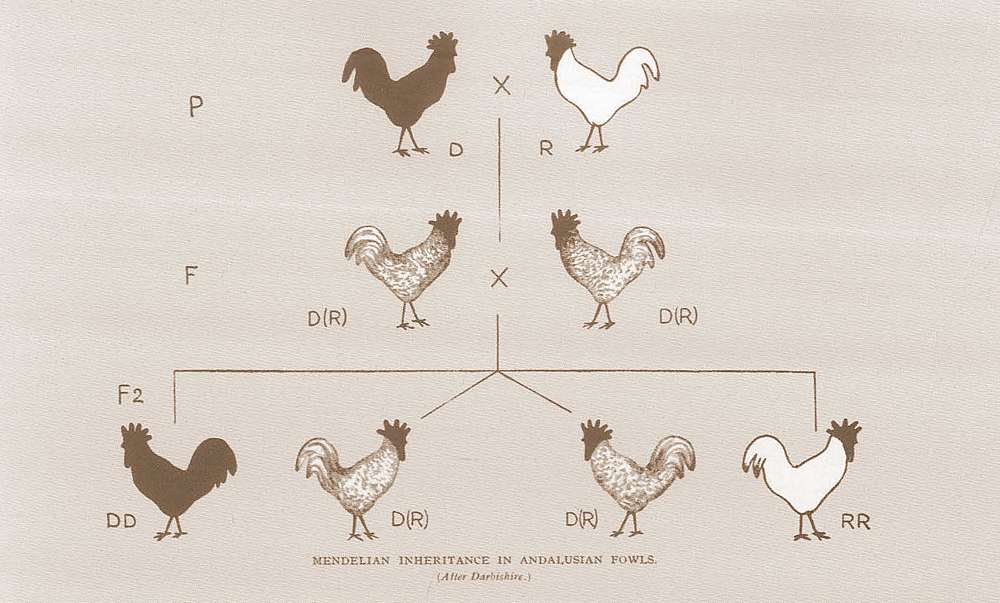
Mendelian Inheritance in Andalusian Fowls - Cross-breeding Experiments by Gregor Mendel

Cross-breeding Experiments by Gregor Mendel: Evidence of Heredity

Between 1856 and 1863, independent of Charles Darwin (1809–1882,) Moravian monk Gregor Mendel (1822–1884) conducted extensive pea plant breeding experiments in his monastery’s garden. He systematically studied what farmers had known for centuries: that crossbreeding animals and plants creates “hybrid” offspring with desirable traits. Based on his pea plant experiments, Mendel laid the foundational rules of genetic inheritance and heredity.

Synthesis of Darwin and Mendel’s Work as the Foundation of Life Sciences

It was not until the 1930s, long after both Darwin and Mendel’s deaths, that biologists started to study Mendel’s work on heredity in conjunction with Darwin’s theory of natural selection. Scientists were then able to understand how variation of characteristics is passed on to new generations and how evolution is a process of descent with modification. Mendel’s laws provided justification of inheritance, thereby completing Darwin’s theory of natural selection. Subsequently, Darwin’s theory became the basic mechanism of evolution—evolutionary genetics was established as biology’s central theorem and the bedrock concept of all life sciences. From that point on, Darwin became one of the most influential persons in human history.

Scientists continue to fine-tune humankind’s understanding of evolutionary biology as new evidence and fresh insights pour in from biochemistry, genetics, archaeology, neuroscience, and various other disciplines.

Filed Under: Mental Models, Sharpening Your Skills Tagged With: Creativity, Scientists, Thought Process

Vincent van Gogh on Living Life with Zeal and Engaging Oneself in Work

April 1, 2015 By Nagesh Belludi Leave a Comment

Self-Portrait with Bandaged Ear - Vincent van Gogh

My article earlier this week presented a brief life story of the renowned Dutch painter Vincent van Gogh followed by inspirational quotations chosen from his letters to his brother Theo.

This article will explore his philosophy of work and his sense of devotion, as evidenced by extracts mainly from Vincent’s letters to Theo. I have interspersed fascinating bits of Vincent’s life in hopes that the story of this extraordinary man who achieved so much in the face of adversity may inspire you and, perhaps, elicit further admiration (recommended biography) and even sympathy.

The Letters of Vincent van Gogh

During most of his adult years, Vincent van Gogh wrote copious letters primarily to his brother Theo. Vincent wrote less frequently to his mother, one of his sisters, friends, and collaborators. The Van Gogh Museum in Amsterdam maintains a comprehensive compilation of his letters. I also recommend “Ever Yours: The Essential Letters”, a fascinating anthology of Vincent’s letters to Theo.

'Ever Yours: The Essential Letters' by Vincent van Gogh (ISBN 0300209479) The accessible correspondence between Vincent and Theo is mostly one-way communication. This is because Theo retained the great majority of Vincent’s letters; but Vincent, owing to neglect, retained just a few of Theo’s replies.

Vincent’s letters offer a profound, soul-searching description of the jagged life of a genius who achieved much in the face of adversity. His letters make a splendid record of his life, work, and philosophy. They have provided the primary source and substance of numerous scholarly studies, particularly by art historians and psychiatrists.

Vincent’s letters reveal the inner workings of his mind and heart like few others have done. His letters were extemporaneous ‘thinking aloud’ journals: he took paper everywhere and scribbled his thoughts spontaneously while he was thinking or creating art. For this reason, Vincent’s letters aren’t easy reads—his thoughts often appear unstructured and abstruse.

Vincent van Gogh on Finding Meaningful Work

Portrait of the Postman Joseph Roulin by Vincent van Gogh Vincent embarked upon his artistic career at the somewhat advanced age of 27. According to biographers, he showed no signs that he was precocious during his childhood. All through youth, Vincent struggled to find his place in the world and held various occupations where he proved deficient. Before resolving to devote his life to art, Vincent wrote,

We’ve talked quite a lot about what we feel to be our duty and how we should arrive at something good, and we rightly came to the conclusion that first of all our goal must be to find a certain position and a profession to which we can devote ourselves entirely.

And I think that we also agreed on this point, namely that one must pay special attention to the end, and that a victory achieved after lifelong work and effort is better than one achieved more quickly.

He who lives uprightly and experiences true difficulty and disappointment and is nonetheless undefeated by it is worth more than someone who prospers and knows nothing but relative good fortune. …

… Do let us go on quietly, examining all things and holding fast to that which is good, and trying always to learn more that is useful, and gaining more experience.

If we but try to live uprightly, then we shall be all right, even though we shall inevitably experience true sorrow and genuine disappointments, and also probably make real mistakes and do wrong things, but it’s certainly true that it is better to be fervent in spirit, even if one accordingly makes more mistakes, than narrow-minded and overly cautious. [Letter to Theo, April 1878]

Vincent van Gogh’s Concept of Work and Idea of Art

Core to Vincent’s philosophy was his belief that the concept for a work must precede the execution of the work. At the beginning of his tenure as an artist, Vincent outlined his idea of art,

Art is man added to nature … nature, reality, truth, but with a significance, a conception, a character, which the artist brings out in it, and to which he gives expression … which he disentangles, sets free and interprets. [Letter to Theo, June 1879]

Vincent van Gogh on the Primacy of Work

The tragic circumstances of Vincent’s life allowed him to pursue his calling for just 11 years, the time required by most artists to master their technique fully. During those 11 years, Vincent experimented and practiced art with a steady sense of purpose. He continued to paint right up until his fateful suicide. On deeming one’s work as one’s salvation, Vincent wrote,

How much sadness there is in life! Nevertheless one must not become melancholy. One must seek distraction in other things, and the right thing is to work. [Letter to Theo, September 1883]

Echoing Martin Luther and John Calvin’s emphasis on conscientiousness and hard work (now labeled ‘Protestant work ethic‘,) Vincent believed that work is life’s highest reward and worthy of submission:

I believe more and more that to work for the sake of the work is the principle of all great artists: not to be discouraged even though almost starving, and though one feels one has to say farewell to all material comfort. [Letter to Theo, February 1886]

He firmly believed that art—or more generally, work—like religion, was a way to communion with God.

To try to understand the real significance of what the great artists, the serious masters, tell us in their masterpieces, that leads to God; one man wrote or told it in a book; another, in a picture. [Letter to Theo, July 1880]

Vincent’s letters provide a profile of the shifting quality of his moods. Later, as a mature artist, he regarded his ability to create more sacrosanct than his godliness,

I can very well do without God both in my life and in my painting, but I cannot, ill as I am, do without something which is greater than I, which is my life—the power to create. [Letter to Theo, September 1888]

Starry Night Over the Rhone by Vincent van Gogh

Vincent van Gogh on the Sense of Achievement and Identity that it Brings

Throughout his life, Vincent struggled to find meaning and establish some kind of harmonious relationship with the outer world. He seemed governed entirely by emotions (“the little emotions are the great captains of our lives and we obey them without realizing it,” he once wrote to Theo.) People found him awkward and unreasonable; he even didn’t tend to his physical appearance. He acknowledged,

It is possible that these great geniuses (Rembrandt, Delacroix, Zola, Balzac, Millet) are only madmen, and that one must be mad oneself to have boundless faith in them and a boundless admiration for them. If this is true I should prefer my insanity to the sanity of others. [Letter to Emile Bernard, July 1888]

He caused anger, strife, or embarrassment wherever he went. He struggled in his professional and romantic relationships. However, he was determined to seek his sense of social identity through work. He wrote,

What am I in the eyes of most people? A good-for-nothing, an eccentric and disagreeable man, somebody who has no position in society and never will have. Very well, even if that were true, I should want to show by my work what there is in the heart of such an eccentric man, of such a nobody. … Everyone who works with love and with intelligence finds in the very sincerity of his love for nature and art a kind of armor against the opinions of other people. [Letter to Theo, July 1882]

Vincent van Gogh on “the Secret of Beautiful Work”: Utmost Sincerity

Do you know that it is very, very necessary for honest people to remain in art? … To a great extent the cause of the evil lies in the fact that the intentions of the great landscape painters have been misconstrued. Hardly anyone knows that the secret of beautiful work lies mainly in truth and sincere sentiment. [Letter to Theo, December 1882]

One of the keys to Vincent’s greatness is his incredible sincerity to his work. He exhibited his sense of extreme sincerity in two vocations he held before he decided to devote his life to being an artist. In both these instances, he proved deficient by giving too much of what the circumstances demanded of him.

  • At age 13, Vincent apprenticed with a leading art dealer in Paris where he assisted in the sale of paintings, photographs, and lithographs. This was his first experience with art. Within months, he began discussing unreservedly his opinions about the qualities of artwork with potential customers and frequently talked them out of sales. Within a year, his employer fired Vincent for conducting himself in a manner antithetical to the interests of the art dealership.
  • At age 26, Vincent started work as a lay preacher in a mining community in southern Belgium. Vincent was seized with compassion for the miners who toiled in darkness and exposed themselves to filthy dust. Having fully committed himself to this job and wanting to be like the poor miners, he even smeared his hands and face with soot and dirt. He gave away his belongings, lived on bread and water, and slept on a sack spread out on the floor of his miserable shed. The church’s committee of elders reprimanded Vincent for carelessness in dress and lack of dignity in the conduct of his office. They chastised him for his excessive zeal and dismissed him. His mother complained of his uncompromising stubbornness: “He will never comply with the wishes of the committee, and nothing will change him.”

Portrait of Dr. Gachet by Vincent van Gogh

Vincent van Gogh on Giving Everything One’s Got to One’s Work

After nine years of meticulous experimentation and assiduous practice, Vincent developed his artistic expertise to a level where he could execute art swiftly. For the next two years, he focused on his artwork and produced masterpieces notwithstanding debilitating bouts of mental illness.

On investing in learning technique and mulling over ideas, Vincent said,

I consider making studies like sowing, and making pictures like reaping. [Letter to Theo, September 1882]

Successful people have the ability to concentrate on a single problem for extended periods of time. Vincent wrote,

The sooner one seeks to become competent in a certain position and in a certain profession, and adopts a fairly independent way of thinking and acting, and the more one observes fixed rules, the stronger one’s character becomes, and yet that doesn’t mean that one has to become narrow-minded.

It is wise to do that, for life is but short and time passes quickly. If one is competent in one thing and understands one thing well, one gains at the same time insight into and knowledge of many other things into the bargain.

It’s sometimes good to go about much in the world and to be among people, and at times one is actually obliged and called upon to do so, or it can be one way of ‘throwing oneself into one’s work unreservedly and with all one’s might’, but he who actually goes quietly about his work, alone, preferring to have but very few friends, goes the most safely among people and in the world. One should never trust it when one is without difficulties or some worry or obstacle, and one shouldn’t make things too easy for oneself. …

… Launching out into the deep is what we too must do if we want to catch anything, and if it sometimes happens that we have to work the whole night and catch nothing, then it is good not to give up after all but to let down the nets again at dawn.

And not troubling ourselves too much if we have shortcomings, for he who has none has a shortcoming nonetheless, namely that he has none, and he who thinks he is perfectly wise would do well to start over from the beginning and become a fool. [Letter to Theo, April 1878]

Vincent van Gogh Found Solace and Meaning in Painting

When he lived in the town of Arles in Southern France, he suffered his first attack of mental disturbance and cut off his own ear after a dispute with another artist during Christmas 1888. By May of 1889, he had already suffered two horrifying episodes of psychotic illness. Following a complaint about his conduct by the townspeople of Arles, he was terrified of the possibility of compulsory incarceration. He voluntarily joined the Saint-Paul Asylum in Saint-Remy-de-Provence.

Vincent could not paint during periods of mental illness while at the asylum. On the road to recovery, Vincent sought peace in nature. He found solace and meaning in painting. He drew inspiration from nature and painted some of his well-known works here, including The Starry Night, and Wheat Field series. To Vincent, budding flowers symbolized the cycle of life and butterflies represented hope. Even the metamorphosis of a caterpillar into a butterfly symbolized the ability of humans to transform,

… since nothing confutes the assumption that lines and forms and colours exist on innumerable other planets and suns as well, we are at liberty to feel fairly serene about the possibilities of painting in a better and different existence, an existence altered by a phenomenon that is perhaps no more ingenious and no more surprising than the transformation of a caterpillar into a butterfly or of a grub into a maybug. [Letter to Emile Bernard, July 1888]

Vincent van Gogh on the Frustration of Inactivity and Incoherence

One of the most impressive features of Vincent’s letters is the depth of his self-analysis, even about his debilitating illness and his helplessness with social wellbeing. Even when growing up, he possessed a difficult temper and lacked self-confidence. He wrote,

Do not imagine that I think myself perfect or that I think that many people taking me for a disagreeable character is no fault of mine. I am often terribly melancholy, irritable, hungering and thirsting, as it were, for sympathy; and when I do not get it, I try to act indifferently, speak sharply, and often even pour oil on the fire. I do not like to be in company, and often find it painful and difficult to mingle with people, to speak to them. But do you know what the cause is —if not at all, of a great deal of this? Simply nervousness; I am terribly sensitive, physically as well as morally, the nervousness having developed during those miserable years which drained my health. [Letter to Theo, July 1882]

Vincent’s lifestyle exacerbated his mental condition and compounded his problems. Towards the end of his life, he was deeply upset by the inability to paint and the incoherence in his creative process during periods of illness. After taking to work again during his stay at the Saint-Paul asylum in Saint-Remy-de-Provence, he wrote,

Life passes in this way, time does not return, but I am working furiously for the very reason that I know that opportunities for work do not recur. Especially in my case, where a more violent attack could destroy my ability to paint for good. … I am trying to recover, like someone who has meant to commit suicide, but then makes for the bank because he finds the water too cold.[Letter to Theo, September 1889]

Conceivably, at the brink of death, Vincent was conscious about his mortality.

Theo van Gogh and Johanna van Gogh-Bonger

No discussion of Vincent van Gogh (1853–90) would be complete without mention of the extraordinary devotion of his brother Theo van Gogh (1857–91) and the zeal of Theo’s wife Johanna van Gogh-Bonger (1862–1925.)

Portraits of Vincent van Gogh and Theo van Gogh

Theo van Gogh, the Devoted Brother

Vincent wouldn’t have been an artist had it not been for a squabble he had with his brother Theo who was visiting Vincent after he’d been fired from his job as a lay preacher in 1880. Until then, he held a variety of occupations—art dealer, schoolteacher, book seller, priest—where he proved deficient. Theo declared that the van Gogh family was worried about Vincent’s lack of direction in life, especially after several false starts in various vocations. Vincent once wrote,

Either inside or outside the family, they will always judge me or talk about me from different points of view, and you will always hear the most divergent opinions about me. And I blame no one for it, because relatively few people know why an artist acts as he does. [Letter to Theo, April 1881]

The ensuing dispute between Theo and Vincent marked a serious turning point in Vincent’s life: he resolved to become an artist. He would build on what was once a mere pastime. He would finally find his place in the world.

For the next eleven years, until Vincent’s tragic suicide from a self-inflicted gunshot, Theo supported Vincent not only emotionally, but also provided him a monthly stipend in exchange for his artworks.

The tragedy of Vincent’s life overwhelmed Theo. After losing his adored brother for whom he’d dedicated his life, Theo seemed no more himself. He suffered a stroke that led to paralysis. His health deteriorated rapidly and he died at the age of 33, just six months after Vincent’s death.

Johanna van Gogh-Bonger, the Determined Sister-in-Law

Vincent van Gogh signed only a few of his pieces “Vincent” but did not sign his name in full. He said,

Van Gogh is such an impossible name for many foreigners to pronounce; if it should happen that my pictures found their way to France or England, then the name would certainly be murdered, whereas the whole world can pronounce the name Vincent correctly. … they will surely recognize my work later on, and write about me when I’m dead and gone. I shall take care of that, if I can keep alive for some little time. [Quoted by Anton Kerssemakers, April 1912]

Johanna van Gogh-Bonger, Vincent van Gogh’s sister-in-law and Theo van Gogh’s wife, played a pivotal role in initiating the legacy and renown of Vincent. Johanna inherited all of Vincent’s artwork from Theo. Theo hadn’t been able to save much money because Vincent had been a perpetual drain on Theo’s earnings as an art dealer. Even though Johanna needed money to live on, she did not sell Vincent’s art.

Johanna came from a wealthy family with connections to artists throughout Europe. In the few years after Vincent’s death, Johanna contributed his art pieces to many exhibitions. She compiled 650 of his letters to Theo and published them in three volumes in 1914. She even wrote the first memoir of Vincent. She shared Theo’s conviction that, one day, Vincent’s artistic genius would be widely acknowledged. She lived to see that day.

Filed Under: Great Personalities, Inspirational Quotations, The Great Innovators Tagged With: Artists, Christianity, Creativity, Philosophy

Books I Read in 2014 & Recommend

January 12, 2015 By Nagesh Belludi Leave a Comment

Other than a number of Rick Steves’ books for my summer-long travels in Europe, here are a few books that I read in 2014 and recommend.

Even though I read few works of fiction, I read a number of Agatha Christie’s “Poirot” books, including the enthralling “Death on the Nile”. Christie describes her characters brilliantly with superb detail.

Books on Business, Operations, & Finance

  • Atul Gawande’s ‘The Checklist Manifesto’ on eliminating errors, improving safety, and increasing efficiency by adapting checklists, standard operating practices, and work instructions.
  • Steven Johnson’s 'How We Got to Now Six Innovations That Made the Modern World' by Steven Johnson (ISBN 1594632960) ‘How We Got to Now: Six Innovations That Made the Modern World’ explores how seemingly simple inventions cause huge societal shifts through the unintended consequences of collaboration and context. For example, the chapter on “Glass” narrates how the Gutenberg printing press led to lens-making, which in turn led to eyeglasses, telescopes and space exploration, microscopes and biology, fiberglass and fiber-optic cables, mirrors, cameras and the present-day selfie obsession.
  • Eric Schmidt and Jonathan Rosenberg’s ‘How Google Works’ is a firsthand account of the distinctive ecosystem, culture, people, and decision-making inside one of the world’s most admired companies.
  • John Mihaljevic’s ‘The Manual of Ideas: The Proven Framework for Finding the Best Value Investments’ describes nine template-themes of value investing strategies along with case studies, checklists, and screening tools.
  • Cristiane Correa’s ‘DREAM BIG: How Jorge Paulo Lemann, Marcel Telles and Beto Sicupira Acquired Anheuser-Busch, Burger King and Heinz and Revolutionized Brazilian Capital’ discusses 3G Capital’s approach to buying companies (including Tim Hortons in 2014; Coca-Cola, Campbell Soup, or PepsiCo are rumored to be next) and then implementing an aggressive management template that’s obsessive about slashing operating costs and expanding organizational efficiency.

Books on Skills for Success

  • Susan Cain’s ‘Quiet: The Power of Introverts in a World That Can’t Stop Talking’ on how the world excessively and misguidedly admires extroverts, but should also encourage and celebrate the particular talents, abilities, and dispositions of introverts.
  • Jocelyn K. Glei’s ‘Manage Your Day-to-Day: Build Your Routine, Find Your Focus, and Sharpen Your Creative Mind’ is a compilation of essays on time management, organizing routines, and work-life balance from various authors.
  • Russ Roberts’s 'How Adam Smith Can Change Your Life' by Russ Roberts (ISBN 1591846846) ‘How Adam Smith Can Change Your Life: An Unexpected Guide to Human Nature and Happiness’ is an interpretation of Adam Smith’s less known book, “Theory of Moral Sentiments”
  • B. H. Liddell Hart’s ‘Why Don’t We Learn from History?’ on the didactic value of history and on the significance of acting on principles deduced from learning from other people’s experience.
  • Gerd Gigerenzer’s ‘Risk Savvy: How to Make Good Decisions’ describes the many ways we characteristically misjudge risk and how we make bad decisions because we misunderstand risk.
  • Garth Sundem’s ‘Beyond IQ: Scientific Tools for Training Problem Solving, Intuition, Emotional Intelligence, Creativity, and More’ on how to develop brain power in competencies such as creativity, willpower emotional intelligence and intuition—skills that are not measured by standardized intelligence (e.g. IQ) tests.

Four Timeless Books I Re-Read Every Year

'Common Stocks and Uncommon Profits' by Philip A. Fisher (ISBN 0471445509) Benjamin Graham’s “Security Analysis”, Benjamin Graham’s “The Intelligent Investor”, and Phil Fisher’s “Common Stocks and Uncommon Profits” discuss two complementary schools of investment analysis. Graham’s quantitative approach to value investing comprises of buying stocks below what they are worth and then selling them once they are fully priced. In contrast, Fisher’s qualitative approach to growth investing considers the intangibles (products and services, management, competition, growth prospects, etc.) and paying a premium for growth. Graham’s and Fisher’s viewpoints are a significant part of Warren Buffett’s approach to investments. He’s described himself as “85% Graham, 15% Fisher” (I think Buffett is more “15% Graham, 85% Fisher.”)

Dale Carnegie’s “How to Win Friends and Influence People” is the granddaddy of all self-help books that spawned the self-improvement industry. I discovered that the 2011 update, “How to Win Friends and Influence People Digital Age”, references my blog article on the art of remembering names.

Filed Under: Leadership Reading, Sharpening Your Skills Tagged With: Books for Impact, Skills for Success

Book Summary of Viktor Frankl’s ‘Man’s Search for Meaning’

May 31, 2013 By Nagesh Belludi Leave a Comment

Man's Search for Meaning » Austrian psychiatrist Viktor Frankl In “Man’s Search for Meaning,” Austrian psychiatrist Viktor Frankl makes the case that the primary motivation in one’s life is neither pleasure (as proposed by Sigmund Freud) nor power (as proposed by Alfred Adler), but meaning and purpose.

Viktor Frankl is the pioneer of “logotherapy,” a psychotherapy system that carries out an existential examination of a person and consequently helps him/her discover purpose and meaning in his/her life.

Principal ideas from “Man’s Search for Meaning”:

  • Based on his experience as an inmate at many Nazi concentration camps during the Second World War, Viktor Frankl observed that those who survived the longest in the Nazi concentration camps were not those who were physically strong, but were those who maintained a sense of control over their environment by finding meaning in their existence and their torments.
  • Even in the toughest of circumstances, life can be given a meaning, and so too can suffering. A person can learn how to cope with suffering and move ahead with a renewed sense of purpose and meaning.
  • Meaning in life can be discovered by taking responsibility and through “right conduct” by,
    • Contributing meaningfully to the world through self-expression and resourcefulness,
    • Experiencing the world by connecting meaningfully with others and with our environment, and
    • Probing our attitudes and changing our approach meaningfully when we face situations that we have little control over.

Filed Under: Leadership Reading, Sharpening Your Skills Tagged With: Books for Impact, Motivation

David Ogilvy on Why It Pays to Advertise

April 29, 2013 By Nagesh Belludi Leave a Comment

I’ve been reading Ogilvy on Advertising, written by David Ogilvy (1911–1999,) the founder of Ogilvy & Mather.

Ogilvy on Advertising, David Ogilvy (1911--1999) Ogilvy is one of the founding fathers of modern advertising and spent his life preaching the benefits of research in salesmanship, long informative copy, creative brilliance, and results for clients. Ogilvy famously said, “It is useless to be a creative original thinker unless you can also sell what you create.”

Ogilvy on Advertising provides excellent sage advice into the art of selling smart. Many of the principles in this book are dated, but the ideology and creative thought processes discussed are timeless.

Ogilvy cites this anonymous poem on why it pays to advertise.

The codfish lays ten thousand eggs,
The homely hen lays one.
The codfish never cackles
To tell you what she’s done—
And so we scorn the codfish
While the humble hen we prize.
It only goes to show you
That it pays to advertise!

Filed Under: Sharpening Your Skills, The Great Innovators Tagged With: Books for Impact, Parables, Persuasion

« Previous Page
Next Page »

Primary Sidebar

Popular Now

Anxiety Assertiveness Attitudes Balance Biases Coaching Conflict Conversations Creativity Critical Thinking Decision-Making Discipline Emotions Entrepreneurs Etiquette Feedback Getting Along Getting Things Done Goals Great Manager Innovation Leadership Leadership Lessons Likeability Mental Models Mentoring Mindfulness Motivation Networking Parables Performance Management Persuasion Philosophy Problem Solving Procrastination Relationships Simple Living Social Skills Stress Suffering Thinking Tools Thought Process Time Management Winning on the Job Wisdom

About: Nagesh Belludi [hire] is a St. Petersburg, Florida-based freethinker, investor, and leadership coach. He specializes in helping executives and companies ensure that the overall quality of their decision-making benefits isn’t compromised by a lack of a big-picture understanding.

Get Updates

Signup for emails

Subscribe via RSS

Contact Nagesh Belludi

RECOMMENDED BOOK:
Tap Dancing to Work

Tap Dancing to Work: Warren Buffett

Insights into Warren Buffett's investment strategies and his philosophies on management, philanthropy, public policy, and even parenting. Articles by Carol Loomis, Bill Gates, and others.

Explore

  • Announcements
  • Belief and Spirituality
  • Business Stories
  • Career Development
  • Effective Communication
  • Great Personalities
  • Health and Well-being
  • Ideas and Insights
  • Inspirational Quotations
  • Leadership
  • Leadership Reading
  • Leading Teams
  • Living the Good Life
  • Managing Business Functions
  • Managing People
  • MBA in a Nutshell
  • Mental Models
  • News Analysis
  • Personal Finance
  • Podcasts
  • Project Management
  • Proverbs & Maxims
  • Sharpening Your Skills
  • The Great Innovators

Recently,

  • It’s Never About You
  • Inspirational Quotations #1132
  • What You’re Saying When You Say ‘Yes’
  • To-Do or Not To-Do?
  • Nice Ways to Say ‘No’
  • Inspirational Quotations #1131
  • Boundaries Define What You are—and What You’re Not

Unless otherwise stated in the individual document, the works above are © Nagesh Belludi under a Creative Commons BY-NC-ND license. You may quote, copy and share them freely, as long as you link back to RightAttitudes.com, don't make money with them, and don't modify the content. Enjoy!