No man is ever old enough to know better.
—Holbrook Jackson (British Journalist, Writer)
Real happiness is cheap enough, yet how dearly we pay for its counterfeit.
—Hosea Ballou (American Theologian)
The traditional disputes of philosophers are, for the most part, as unwarranted as they are unfruitful.
—A. J. Ayer (English Philosopher)
Half of the secular unrest and dismal, profane sadness of modern society comes from the vain ideas that every man is bound to be a critic for life.
—Henry van Dyke Jr. (American Author, Educator, Clergyman)
Where there are friends there is wealth.
—Plautus (Titus Maccius Plautus) (Roman Comic Playwright)
Sometimes when we are generous in small, barely detectable ways it can change someone else’s life forever.
—Margaret Cho (American Stand-Up Comedian)
Fears are nothing more than states of mind.
—Napoleon Hill (American Author)
Take not from the mouth of labor the bread it has earned.
—Thomas Jefferson (American Head of State)
One way of getting an idea of our fellow-countrymen’s miseries is to go and look at their pleasures.
—George Eliot (Mary Anne Evans) (English Novelist)
True glory consists in doing what deserves to be written; in writing what deserves to be read; and in so living as to make the world happier and better for our living in it.
—Pliny the Elder (Roman Scholar)
The lucky man is the one who arrives at everything. The unlucky is the one to whom everything happens.
—Eugene Labiche (French Dramatist)
Learning how to learn is life’s most important skill.
—Tony Buzan (British Writer, Educational Consultant)
A committee is an animal with four back legs.
—John le Carre (English Novelist)
Man’s unique agony as a species consists in his perpetual conflict between the desire to stand out and the need to blend in.
—Sydney J. Harris (American Essayist, Drama Critic)
Prudence is the virtue by which we discern what is proper to do under various circumstances in time and place.
—John Milton (English Poet)
.jpg "'Microjoys' by Cyndie Spiegel (ISBN 593492226)")


 There’s no shortage of brilliant ideas. What’s scarce is the discipline to
 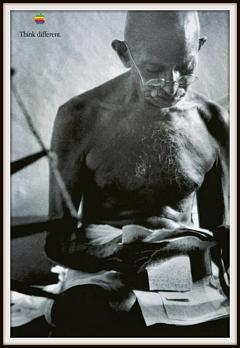 Apple’s “Think Different” campaign in 1998 placed Gandhi among its
 .jpg "'Life Moves Pretty Fast' by Hadley Freeman (ISBN 1501130455)")
 The concentration of power in corporate boardrooms is one of those problems that everybody in business acknowledges and almost nobody does anything about.