• Skip to content
  • Skip to primary sidebar

Right Attitudes

Ideas for Impact

Mental Models

Finding Potential Problems & Risk Analysis: A Case Study on ‘The Three Faces of Eve’

June 24, 2016 By Nagesh Belludi Leave a Comment

The Three Faces of Eve (1957)

Risk Analysis is a Forerunner to Risk Reduction

My previous article stressed the importance of problem finding as an intellectual skill and as a definitive forerunner to any creative process. In this article, I will draw attention to another facet of problem finding: thinking through potential problems.

Sometimes people are unaware of the harmful, unintended side effects of their actions. They fail to realize that a current state of affairs may lead to problems later on. Their actions and decisions could result in outcomes that are different from those planned. Risk analysis reduces the chance of non-optimal results.

The Three Contracts of Eve

'The 3 Faces of Eve' by Corbett H. Thigpen and Hervey M. Cleckley (ISBN 0445081376) A particularly instructive example of finding potential problems and mitigating risk concerns the Hollywood classic The Three Faces of Eve (1957). This psychological drama features the true story of Chris Sizemore who suffered from dissociative identity disorder (also called multiple personality disorder.) Based on The Three Faces of Eve by her psychiatrists Corbett Thigpen and Hervey Cleckley, the movie portrays Sizemore’s three personalities, which manifest in three characters: Eve White, Eve Black, and Jane.

Before filming started on The Three Faces of Eve, the legal department of the 20th Century Fox studio insisted that Sizemore sign three separate contracts—one for each of her personalities—to cover the studio from any possible legal action. For that reason, Sizemore was asked to evoke “Eve White,” “Eve Black,” and “Jane,” and then sign an agreement while manifesting each of these respective personalities. According to Aubrey Solomon’s The Films of 20th Century-Fox and her commentary on the movie’s DVD, the three signatures on the three contracts were all different because they were a product of three distinct personalities that Sizemore had invoked because of her multiple personality disorder.

Idea for Impact: Risk analysis and risk reduction should be one of the primary goals of any intellectual process.

Postscript Notes

  • I recommend the movie The Three Faces of Eve for its captivating glimpse into the mind of a person afflicted with dissociative identity disorder. Actress Joanne Woodward won the 1958 Academy Award (Oscar) for best actress for her portrayal of the three Eves.
  • The automotive, aerospace, and other engineering disciplines use a formal risk analysis procedure called “failure mode and effects analysis” (FEMA.) FEMA examines the key risk factors that may fail a project, system, design, or process, the potential effects of those failures, and the seriousness of these effects.

Wondering what to read next?

  1. Overcoming Personal Constraints is a Key to Success
  2. You Can’t Develop Solutions Unless You Realize You Got Problems: Problem Finding is an Undervalued Skill
  3. Turning a Minus Into a Plus … Constraints are Catalysts for Innovation
  4. Creativity by Imitation: How to Steal Others’ Ideas and Innovate
  5. Four Ideas for Business Improvement Ideas

Filed Under: Mental Models, Sharpening Your Skills Tagged With: Creativity, Critical Thinking, Innovation, Mental Models, Personality, Risk, Thinking Tools, Thought Process, Winning on the Job

You Can’t Develop Solutions Unless You Realize You Got Problems: Problem Finding is an Undervalued Skill

June 21, 2016 By Nagesh Belludi Leave a Comment

Problem finding plays an important role in creative thinking

Problem finding is one of the most significant parts of problem solving. However, it tends to be an underappreciated skill. Many managers naively consider it strange to encourage employees to look for problems at work: “Why look for new problems when we’ve got no resources to work on ones we’ve already identified?”

Many courses and books on problem solving and creativity overlook problem finding. Many educational resources tend to assume that problem solving really begins only after problems have been identified.

Problem-identification lead to the invention of the ballpoint pen

The story of the invention of the ballpoint pen demonstrates the importance of problem finding. Had the inventors not recognized a problem with the existing writing instruments of their day, they would not have developed their invention.

In the 1920s, Hungarian journalist Laszlo Biro spent much time proofreading and checking for errors in others’ writings. To communicate these errors to the authors, Laszlo could not use pencils because their impressions fade quickly. He tried using a fountain pen, but the ink from the fountain pen dried slowly and often left smudges on paper.

Laszlo observed that the ink used in newspaper printing dried quickly and left the paper smudge-free. When he tried using that ink in his fountain pen, however, the ink was too viscous to flow into the tip of the fountain pen.

Laszlo then collaborated with his chemist-brother Gyorgy Biro to invent a new pen tip consisting of a ball that was enclosed within a socket. As the ball rolled inside the socket, the ball could pick up ink from a reservoir or cartridge and then continue to roll to deposit the ink on the paper. The Biro brothers thus invented the ballpoint pen. The company they created is now part of the BIC Company. The ballpoint pen continues to be called a ‘Biro’ in some countries.

Often, creativity is the outcome of discovered problem solving

Greek Philosopher Plato famously wrote in The Republic, “Let us begin and create in idea a State; and yet a true creator is necessity, which is the mother of our invention.”

One reason we fail to identify problems is that we do not stop to think about improving various situations that we encounter. Very often, these problems are directly in front of us; we need to consciously identify them and convert them into opportunities for problem solving. Instead, we tend to take inconveniences and unpleasant situations for granted and assume they are merely “facts of life.”

  • The grain mill was not invented until somebody in antiquity identified the ineffectiveness of two hours of pounding grain to make a cup of flour.
  • The world’s first traffic lights were installed around the British Houses of Parliament in London only after somebody thought of the problem of traffic congestion. In other words, up until the problems from congestion were identified in the 1860s, no one attempted to systematically consider how the problem might be solved.
  • James Watt invented his seminal separate-condenser steam engine after discovering an interesting problem with the Newcomen steam engine. In 1763, when Watt was working as an instrument maker at the University of Glasgow, he was assigned to repair a model of a Newcomen engine for a lecture-demonstration. Watt initially had difficulty getting the Newcomen engine to work because its parts were poorly constructed. When he finally had it running, he was surprised at its efficiency. Watt observed that the engine was constantly running out of coal because the constant heating and cooling of the cylinder resulted in a large waste of energy. Watt then devised a system whereby the cylinder and the condenser were separate. This led to his invention of the “steam engine” (or, more precisely, the separate-condenser steam engine.)
  • As I mentioned in a previous article on the opportunities in customers’ pain points, crispy potato chips were invented only when Chef George Crum of New York’s Saratoga Springs attempted to appease a cranky customer who frequently sent Crum’s fried potatoes back to the kitchen complaining that they were mushy and not crunchy enough. Decades later, Laura Scudder invented airtight packaging for potato chips only after becoming conscious of customers’ complaints that chips packaged in metal containers quickly go stale and crumble during handling.

If problems are not identified, solutions are unlikely to be proposed

It pays to keep your eyes open and look at inconveniences, difficulties, and troubles as creative problems to be solved. Don’t ignore these merely as facts of life.

Curiosity, intrigue, and motivation influence problem finding (and problem solving.) One of the easiest ways to develop your skills in problem finding is to ponder at anything around you and wonder why those gadgets and contraptions were ever invented. Analyze carefully and you’ll learn that the first step taken by the inventors of these objects was the identification of the problems the objects were designed to solve.

When you look around various objects in your life, think about what life was before these objects were invented. What problems could these inventions have solved? Why was the zipper invented? What problems motivated Bjarne Stroustrup to create C++? What was internet search like before Google? How did commerce transpire before the advent of coins and bills and money?

Some people make a career out of problem finding. Managers who want to know if their organizations are running efficiently frequently hire consultants to look for problems that managers do not know exist in their businesses.

And finally, if you want to become an inventor or an entrepreneur, try to start with problems you already have in your work or in your life. Ideally, identify problems shared by a large number of people to increase the probability that your inventions will be put in widespread use.

Idea for Impact: A creative solution to a problem often depends on first finding and defining a creative problem. Very often, the solution to a problem becomes obvious when the problem has been properly identified, defined, and represented.

Wondering what to read next?

  1. Four Ideas for Business Improvement Ideas
  2. Howard Gardner’s Five Minds for the Future // Books in Brief
  3. How to Stimulate Group Creativity // Book Summary of Edward de Bono’s ‘Six Thinking Hats’
  4. How to Solve a Problem By Standing It on Its Head
  5. This is Yoga for the Brain: Multidisciplinary Learning

Filed Under: Mental Models, Sharpening Your Skills Tagged With: Artists, Creativity, Critical Thinking, Luck, Mental Models, Problem Solving, Scientists, Thinking Tools, Thought Process, Winning on the Job

How to Stimulate Group Creativity // Book Summary of Edward de Bono’s ‘Six Thinking Hats’

May 13, 2016 By Nagesh Belludi

Stimulate Group Creativity Using Edward de Bono's 'Six Thinking Hats'

In his bestselling book Six Thinking Hats, Edward de Bono describes a powerful problem-solving approach that enriches mental flexibility by encouraging individuals and groups to attack an issue from six independent but complementary perspectives.

Edward de Bono is a leading authority in creative thinking. He is widely regarded as the father of lateral thinking. De Bono has written over 70 books on thinking and creativity.

Using the ‘Six Thinking Hats’ for Structured Brainstorming

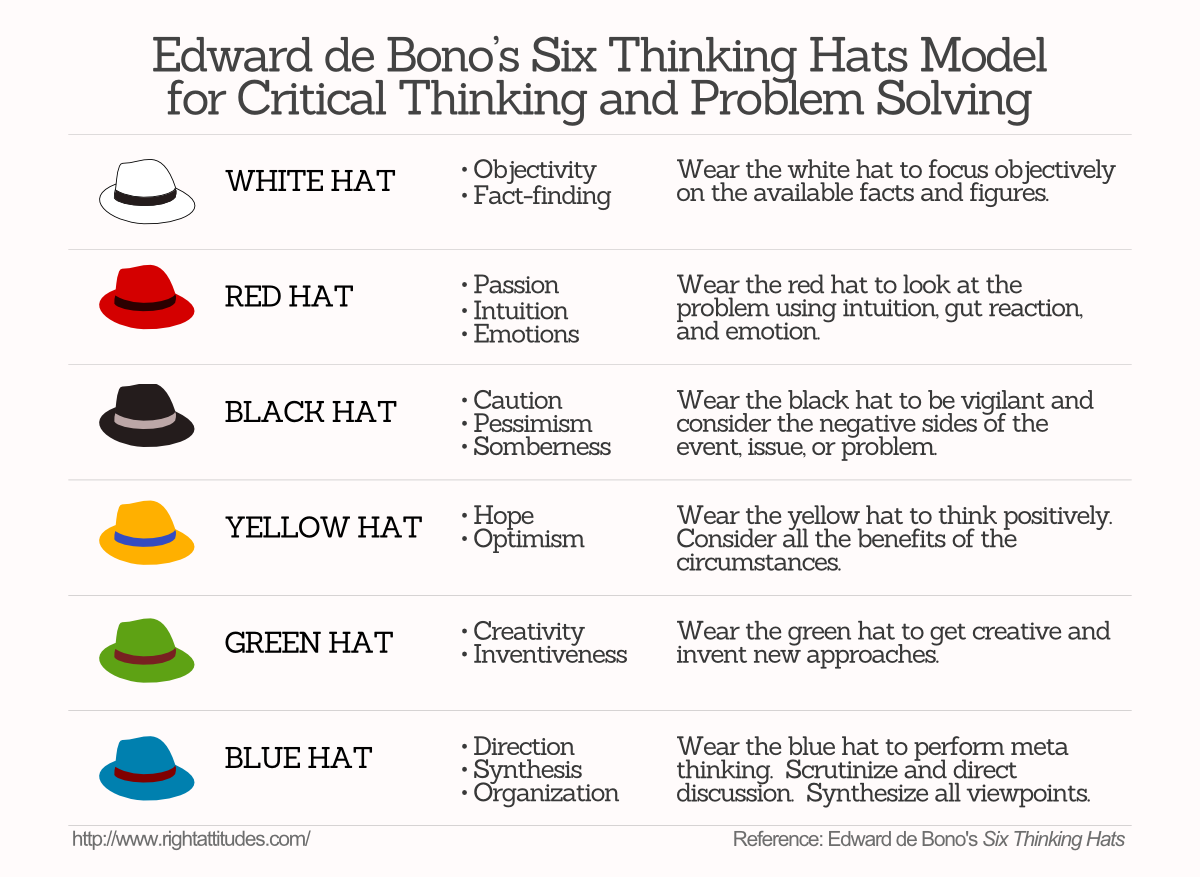
De Bono created the ‘six thinking hats’ method after identifying six distinct lines of human thought in problem solving. De Bono calls each approach a “hat” and assigns them different colors.

At the heart of the ‘six thinking hats’ method are six different colored hats that participants put on—literally or metaphorically—to represent the type of thinking they should concentrate on while wearing each.

  1. White is neutral, objective, and fact-based. A white hat is concerned with objective data: “What information do we have? What information do we need? What information are we missing? How can get the information we need? What objective questions should be asked?”
  2. Red denotes passion, anger, intuition, and emotions. A red hat considers the emotional side of problem solving, which is often neglected or masked in meetings: “What are our gut reactions to the matter at hand?”
  3. Black is somber, serious, and cautious. A black hat is vigilant, plays devil’s advocate, and encourages derogatory and judgmental behavior: “what are the weaknesses of these ideas? What are the risks? What could go wrong?”
  4. Yellow represents positive thinking, hope, and optimism to counteract the black hat’s power. A yellow hat plays “the angel’s advocate” and is cheerful and confident: “What are the best-case scenarios? What are the best aspects of this? What are the advantages? Who can benefit from this?”
  5. Green signifies abundance, growth, richness, and fertility. A green hat is the hat of creativity; it rejects established rules and norms, and invents new approaches: “What are some new ideas on this subject? What is interesting about this idea? What are the variances in these ideas?”
  6. Blue represents the sky and therefore provides the overarching perspective. A blue hat performs “meta thinking” and is concerned with the organization of the thinking process and the use of other hats. The blue hat synthesizes and reconciles different viewpoints. At the start of a brainstorming session, the blue hat sets the stage for where the discussion may go. The blue hat guides and sustains the discussion, often restating its purposes: “What are we thinking about? What is the goal? What should we do next? What have we achieved so far? What should we do to achieve more?” At the conclusion of the brainstorming session, the blue hat appraises the discussion, and proposes a plan of action.

Use De Bono’s Six Thinking Hats Model for Critical Thinking and Problem Solving

'Six Thinking Hats' by Edward de Bono (ISBN 0316178314) An individual working alone may use the approach to consider broader, distinct lines of thought. By changing hats, the individual can switch viewpoints and ensure that he/she is not stuck in specific thinking patterns.

However, the approach is best suited to group discussions (when chaired by a skilled facilitator) in which conflicting ideas may never otherwise be fully synthesized into plans of action. By persuading each participant to think constructively alongside other participants, the ‘six thinking hats’ method taps into group members’diverse perspectives and uses their collective knowledge without destructive conflict.

Using these hats nurtures creativity by letting participants step beyond their typical roles and contribute to developing, organizing, and progressing ideas. Participants can also identify how their cognitive state at any one time shapes how they approach problems.

Recommendation: Read. Edward de Bono’s Six Thinking Hats presents a very effective technique for stimulating group creativity. The method can remove mental blocks, organize ideas and information, foster cross-fertilization, and help conduct thinking sessions more productively than do other brainstorming methods.

Complement with Dan Ciampa’s Taking Advice for an excellent framework on the kind of advice network you need on strategic, operational, political, and personal elements of your work and life. Read my summary in this article.

Wondering what to read next?

  1. Finding Potential Problems & Risk Analysis: A Case Study on ‘The Three Faces of Eve’
  2. The Curse of Teamwork: Groupthink
  3. This is Yoga for the Brain: Multidisciplinary Learning
  4. Creativity by Imitation: How to Steal Others’ Ideas and Innovate
  5. Four Ideas for Business Improvement Ideas

Filed Under: Mental Models, Sharpening Your Skills Tagged With: Conversations, Creativity, Critical Thinking, Mental Models, Networking, Social Dynamics, Teams, Thinking Tools, Thought Process, Winning on the Job

Why Doing Good Is Selfish

April 19, 2016 By Nagesh Belludi Leave a Comment

Consider the following legend about Abraham Lincoln (1809–1865) from J. E. Gallaher’s Best Lincoln Stories (1898.)

The Fable of Abraham Lincoln and the Pigs

Once Lincoln was traveling in a mud-wagon coach along a swampy, rural area. His fellow passenger was his good friend and US Senator Edward Dickinson Baker, who later lost his life in the Battle of Ball’s Bluff at the onset of the American Civil War.

While they were conversing in the mud-wagon coach, Lincoln remarked to Baker that in doing good and evil, all people are motivated by selfishness. Just as Baker challenged Lincoln’s assertion, their coach crossed a rickety bridge over a slough (a large swampy marsh.)

Abruptly, Lincoln and Baker glimpsed a mother pig making a terrible squeal because her piglets were stuck in the swamp, couldn’t get out, and were in danger of drowning.

Abraham Lincoln As their coach started to head away, Lincoln yelled, “Driver, can’t you stop just a moment?” The driver replied, “If the other fellow don’t object.”

With Baker’s approval, Lincoln jumped out of the wagon, ran to the slough, lifted the piglets one by one out of the swamp, and carried them to the dry bank of the swamp.

When Lincoln returned to the coach, Baker remarked, “Now, Abe, where does selfishness come in this little episode?”

Lincoln replied, “Why, bless your soul, Ed, that was the very essence of selfishness. I would have had no peace of mind all day had I gone on and left that suffering old sow worrying over those pigs. I did it to get peace of mind, don’t you see?”

Psychological Egoism

Being moved by the plight of others—even the suffering of animals (or sentient beings to use Buddhist terminology) as in the aforementioned legend of Lincoln and the piglets—is considered a selfish deed per modern philosophy’s theory of ‘psychological egoism’.

Egoism has its roots in the philosophy of the Greek philosopher Epicurus (341–270 BCE,) who argued that the human mind is driven by the need to maximize pleasure and minimize pain. Egoism contends that deep down all our actions are motivated by what we perceive to be in our own self-interest. For example, if Tom saves Mark from drowning in a river, egoism contends that Tom’s seemingly altruistic behavior is actually motivated by his own self-interest to avoid potential social censure for not helping Mark or to be regarded a hero within his social circle.

Idea for Impact: Be Selfish, Be Generous

Mahatma Gandhi said, “The best way to find yourself is to lose yourself in the service of others.”

The great Indian philosopher Aurobindo wrote in Towards the Light, “The secret of joy is self-giving. If any part in you is without joy, it means that it has not given itself, it wants to keep itself for itself.”

The Dalai Lama once advised, “If you want others to be happy, practice compassion. If you want to be happy, practice compassion.” Per the Buddhist concept of interconnectedness, altruistic generosity encourages us to perceive others more positively. When we discover the suffering of others, we realize that those individuals could just as easily have been us. Intuitively, we contemplate “I feel their pain; I can’t let that happen” and are driven to helping others.

When we do something for others and lose ourselves in the service of others, not only do we feel closer to them, but also they feel closer to us. By focusing on giving rather than receiving and on contributing rather than consuming, our generosity can engender an outward orientation toward the world, shifting our focus away from ourselves.

As our whole perception broadens, we realize that the biggest beneficiary of our generosity is often ourselves: at the outset, we are filled with joy with the recognition that someone else is happier because of us.

Idea for Impact: If you want to feel good, help someone else.

Wondering what to read next?

  1. Treating Triumph and Disaster Just the Same // Book Summary of Pema Chödrön’s ‘The Wisdom of No Escape’
  2. The Source of All Happiness: A Spirit of Generosity
  3. Boost Your Confidence Quickly: Lift Others
  4. Weak Kindness & The Doormat Phenomenon: Balance Kindness with Strength
  5. Change Your Perspective, Change Your Reactions

Filed Under: Great Personalities, Living the Good Life, Mental Models Tagged With: Abraham Lincoln, Altruism, Buddhism, Kindness, Mindfulness

Self-Assessment Quiz: Are You A Difficult Boss?

April 12, 2016 By Nagesh Belludi Leave a Comment

If you answered “yes” to any of the following questions, you need to reflect on and adjust your management style.

  • Do you give employees more critical feedback than appreciation, compliments, and positive feedback?
  • Do you undercut praise with criticism? In other words, do you deliver criticism with praise in the form of a “feedback sandwich,” undermine the positive impact of praise, and weaken the significance of the corrective feedback?
  • Do you give unfeasible or contradictory orders? For example, do you fail to give employees enough resources, time, and direction to get a job done?
  • Do you play favorites?
  • Do you reward “yes” people?
  • Do you avoid taking responsibility for your mistakes?
  • Do you focus on assigning blame and finding fault instead of fixing a problem?
  • Do you set deadlines and forget to follow up?
  • Do you micromanage too often?
  • Do you regularly coach your employees?
  • Do you invent busy work?
  • Do you stand up for your employees?
  • Are you sometimes self-absorbed and manipulative? Are you sometimes cold or abrupt?
  • Do you fail to give productive people encouragement, autonomy, and latitude?
  • Do you expect that there’s only one way to do a job, and that’s your way?
  • Do you raise your voice unnecessarily?
  • Do your employees avoid eye contact or dread meeting with you?
  • Do you act as if your team or organization would fall apart if you were to go on a vacation for a week? Do you expect regular updates from your team even while you’re on vacation?
  • Do you withhold information from your staff because it takes too much time to fill them in?
  • Do you ignore workplace concerns (inappropriate dressing, for example) until they evolve into problems? In other words, do you let concerns fester and let problematic situations get worse?

Wondering what to read next?

  1. Five Pitfalls of Coaching Success
  2. General Electric’s Jack Welch Identifies Four Types of Managers
  3. How to Lead Sustainable Change: Vision v Results
  4. Eight Ways to Keep Your Star Employees Around
  5. Don’t Push Employees to Change

Filed Under: Leading Teams, Mental Models Tagged With: Coaching, Feedback, Motivation, Performance Management

Life Is to You as to Everyone Else: What the Stoics Taught

April 8, 2016 By Nagesh Belludi Leave a Comment

Mosaic of Alexander the Great, who Sucked at Geometry

Life is as hard for one as for another

Roman Stoic philosopher Seneca’s Moral Letters to Lucilius (Latin orig. Epistulae morales ad Lucilium) tells a story of Alexander the Great’s schooling.

Even at a young age, the hugely ambitious Alexander dreamt of conquering empires. He had no patience for formal learning. When faced with the difficulty of understanding geometry, he whined to his tutor, “Teach me something easy.” His tutor replied, “These things are the same for all, as hard for one as for another.”

'Letters from a Stoic' by Lucius Annaeus Seneca (ISBN 0140442103) Alexander, king of Macedon, began to study geometry; unhappy man, because he would thereby learn how puny was that earth of which he had seized but a fraction!

Unhappy man, I repeat, because he was bound to understand that he was bearing a false title. For who can be “great” in that which is puny?

The lessons which were being taught him were intricate and could be learned only by assiduous application; they were not the kind to be comprehended by a madman, who let his thoughts range beyond the ocean.

“Teach me something easy!” he cries; but his teacher answers: “These things are the same for all, as hard for one as for another.”

Imagine that nature is saying to us: “Those things of which you complain are the same for all. I cannot give anything easier to any man, but whoever wishes will make things easier for himself.” In what way? By equanimity.

You must suffer pain, and thirst, and hunger, and old age too, if a longer stay among men shall be granted you; you must be sick, and you must suffer loss and death.

On a related note, the great Roman Emperor and Stoic Philosopher Marcus Aurelius wrote in Meditations (trans. Gregory Hays,) “Alexander the Great and his mule driver both died and the same thing happened to both. They were absorbed alike into the life force of the world, or dissolved alike into atoms.”

Idea for Impact: Put your problems and worries in perspective

Beyond the randomness (or providence for those of you with a religious bent) of where we’re born and whom we’re born to, life is generally fair to all and cannot be easier for anyone. The trials and tribulations of life are equally difficult for everyone. Complaining about others having it easier is futile.

Learn to play the hand you’ve been dealt. If you’re fraught with pain and suffering now, don’t ask, “Why is my life so difficult? Why can’t it be easier?” Take solace in the realization that even the greatest and the mightiest had their share of life’s struggles. Make it easier by viewing life with calmness, composure, and evenness of temper.

Wondering what to read next?

  1. A Prayer to Help You Deal with Annoying People: What the Stoics Taught
  2. Choose Not to Be Offended, and You Will Not Be: What the Stoics Taught
  3. Why Others’ Pride Annoys You
  4. The More You Can Manage Your Emotions, the More Effective You’ll Be
  5. It’s Probably Not as Bad as You Think

Filed Under: Mental Models, Sharpening Your Skills Tagged With: Anger, Attitudes, Getting Along, Philosophy, Stoicism

Ever Wonder If The Other Side May Be Right?

March 22, 2016 By Nagesh Belludi Leave a Comment

The French essayist and novelist Andre Gide once wrote, “Believe those who are seeking the truth; doubt those who find it.”

Scratch the surface of any thinking ideologue and you’ll find not certainties but contradictions and doubts.

Darwin’s doubts about natural selection and evolution

Even after the publication of his seminal Origin of Species and The Descent of Man, Charles Darwin had crippling doubts about some aspects of natural selection. Specifically, if natural selection was to have lasting effects, evolutionary advances had to be conserved and passed on from one generation to the next. Darwin agreed with scientists who argued that his evolutionary theory failed to explain how variations are transmitted from parents to their offspring.

It was not until the 1930s that biologists started to study Gregor Mendel’s work on genetic inheritance and heredity in conjunction with Darwin’s theory of natural selection. Only then did biologists come to understand how variation of characteristics is passed on to new generations and how evolution is a process of descent with modification.

Seek to have an idea tomorrow that contradicts your idea today

At a Q&A at American web application company Basecamp, Amazon founder Jeff Bezos opined that people who are “right a lot” are those who had a flexible mindset and often changed their minds. Summarizing the conversation, Basecamp co-founder Jason Fried wrote,

[Bezos] observed that the smartest people are constantly revising their understanding, reconsidering a problem they thought they’d already solved. They’re open to new points of view, new information, new ideas, contradictions, and challenges to their own way of thinking.

He doesn’t think consistency of thought is a particularly positive trait. It’s perfectly healthy—encouraged, even—to have an idea tomorrow that contradicted your idea today.

This doesn’t mean you shouldn’t have a well formed point of view, but it means you should consider your point of view as temporary.

What trait signified someone who was wrong a lot of the time? Someone obsessed with details that only support one point of view. If someone can’t climb out of the details, and see the bigger picture from multiple angles, they’re often wrong most of the time.

Idea for Impact: Wisdom comes from seeking wisdom

Want to learn, expand your worldview, and broaden your mindset? Start by seeking out the right people—mix with people other than those from your own background (professional, cultural, social, academic, racial, ethnic, etc.) Remember that birds of a feather do flock together. Instead of preferring the company of other people from similar backgrounds, try investing some time with people who have viewpoints that contrast your own.

French entomologist Jean-Henri Fabre once wrote, “Seek those who find your road agreeable, your personality and mind stimulating, your philosophy acceptable, and your experiences helpful. Let those who do not, seek their own kind.” Look for those who respect your worldview—even if drastically different from theirs—but can present alternative perspectives and push you into considering different viewpoints on any issue of mutual interest.

Wondering what to read next?

  1. It’s Probably Not as Bad as You Think
  2. No One Has a Monopoly on Truth
  3. Does the Consensus Speak For You?
  4. Nothing Deserves Certainty
  5. Care Less for What Other People Think

Filed Under: Mental Models, Sharpening Your Skills Tagged With: Attitudes, Confidence, Conviction, Jeff Bezos, Philosophy, Wisdom

How to Get Good Advice and Use It Effectively

March 15, 2016 By Nagesh Belludi Leave a Comment

Learning How to Take Advice Is Critical

To be effective in your job and personal life, you must be willing to identify your blind spots and recognize when and how to ask for advice. You must seek and implement useful insights from the right people and overcome any immediate defensiveness about your attitudes and behaviors.

Proverbs 15:22 suggests, “Plans fail for lack of counsel, but with many advisers they succeed.” Effective advisers can bridge the gap between your vision of what you want to achieve and implementation of that vision.

'Taking Advice' by Dan Ciampa (ISBN 1591396689) There is extensive literature which offers guidance on giving advice (I particularly recommend Gerald M. Weinberg’s The Secrets of Consulting) and being an effective mentor. However, few resources address the equally important topic of using advisers wisely—particularly about when to solicit advice, how to seek trusted advisers, and how to best act upon their advice. Dan Ciampa’s excellent book Taking Advice fills this void.

“How Leaders Get Good Counsel and Use It Wisely”

Drawing from his vast experience as a leadership consultant, Ciampa provides a comprehensive framework for getting and using advice in Taking Advice. He identifies four elements of work and life where you’ll need advice:

  • strategic aspects
  • operational aspects
  • political aspects
  • personal aspects

Taking Advice’s most instructive element is the framework it provides for thinking through the kind of advice network you may need. Ciampa suggests that you deliberately build a “balanced advice network” which includes a mix of advisers from whom to seek the most effective advice. He identifies four types of advisers and details their specific roles and purposes:

  • the subject-matter experts who can offer you deep specialized/circumstantial knowledge
  • the experienced advisers who’ve previously faced similar circumstances or have been in similar positions
  • the partners who could engage in working relationships and operate up close or hash out ideas in greater detail for a longer duration
  • the sounding boards who proffer a ‘safe harbor’ where you can freely express your mind, discuss your insecurities, seek advice on personal challenges—all while feeling assured that they’ll honor confidentiality and ensure that your discussions remain private.

Providing practical examples, Ciampa describes three considerations for selecting the right advisers and forming strong relationships with them:

  • content: the adviser must possess the kind of expertise you’re looking for
  • competence: the adviser must have direct experience in your context
  • chemistry: the adviser must be compatible or sympathetic with the style and substance of your goals, targets, and mindsets

To derive the most help from advisers, Ciampa recommends techniques for productive advise-seeking:

  • Listen, understand, and accept feedback without becoming defensive
  • Seek advice as quickly as possible when facing challenges
  • Anticipate roadblocks and involve advisers in planning for contingencies
  • Avoid “yes-men” for advisers; do not bar opinions which may clash with or defy your own

Idea for Impact: Become a Good Advice-Seeker

Ciampa draws heavily from his leadership consulting experience and provides case studies of a few large companies’ senior leaders who, by virtue of their position, often feel insulated and isolated at the top. Nevertheless, his examples will benefit anyone seeking advice.

Recommendation: Read. Taking Advice offers important insights into a seemingly obvious dimension of leadership success, but one that’s often neglected, poorly understood, or taken for granted.

The comprehensive and practical framework discussed in Taking Advice will help you find the right kind of help from within and beyond your organization, get the most from your advisers, and deal effectively with emergent situations in your life and at work.

Wondering what to read next?

  1. Don’t Underestimate Others’ Willingness to Help
  2. How to Improve Your Career Prospects During the COVID-19 Crisis
  3. You Need a Personal Cheerleader
  4. An Underappreciated Way to Improve Team Dynamic
  5. Eight Ways to Keep Your Star Employees Around

Filed Under: Career Development, Leadership, Mental Models, Sharpening Your Skills Tagged With: Feedback, Mentoring, Networking

Stuck on a Problem? Shift Your Perspective!

March 11, 2016 By Nagesh Belludi 1 Comment

The World’s Second Funniest Joke

In 2001, Richard Wiseman led an international humor experiment to find the world’s funniest joke. He had internet users submit and rate 40,000 jokes. Of these, the second-funniest joke was the following (the world’s funniest joke is here.)

Sherlock Holmes and Dr. Watson are camping. They pitch their tent under the stars and go to sleep. Sometime in the middle of the night, Holmes wakes Watson up.

Holmes: “Watson, look up at the stars, and tell me what you deduce.”

Watson: “I see millions of stars and even if a few of those have planets, it’s quite likely there are some planets like earth, and if there are a few planets like earth out there, there might also be life. What does it tell you, Holmes?”

Holmes: “Watson, you idiot, somebody has stolen our tent!”

Fixation: an Impediment to Successful Problem Solving

The joke suggests the psychological concept of fixation. Fixation occurs when you view a problem from only one perspective preventing you from seeing the obvious or breaking from a routine way of thinking.

To change an entrenched pattern of thinking, try to shift your perspective—literally or metaphorically. A shift in perspective can change your physical position and thus alter your point of view in a literal and sensory way, or it may change the way you think about or define the problem at hand.

The fields of arts and the sciences are replete with examples of how a different frame of mind can offer creative insight. As I cited in my article on the start of Picasso’s Blue Period, many artistic styles develop when artists feel the need to change the way their art represents the world. The new style therefore presents an alternative perspective.

Idea for Impact: Get Creative by Shifting Your Perspective

Shifts in perspective are fundamental to many facets of the creative process. As I stated in my previous article on reframing, the solution to many difficult problems can be found merely by defining or formulating them in a new, more productive way.

If you’re stuck on a problem, stand back and apply a different lens to break away from your current perspective.

Alternatively, simply take time away from your problem. A relaxation of effort may help you see something that is obvious after the break, but was previously overlooked or taken for granted.

Wondering what to read next?

  1. Reframe Your Thinking, Get Better Answers: What the Stoics Taught
  2. Many Businesses Get Started from an Unmet Personal Need
  3. What Isn’t Matters Too
  4. How to Stimulate Group Creativity // Book Summary of Edward de Bono’s ‘Six Thinking Hats’
  5. Creativity by Imitation: How to Steal Others’ Ideas and Innovate

Filed Under: Mental Models, Sharpening Your Skills Tagged With: Creativity, Humor, Philosophy, Thinking Tools, Thought Process, Winning on the Job

Nothing Deserves Certainty

March 1, 2016 By Nagesh Belludi Leave a Comment

In a 1960 TV interview, celebrated British mathematician and philosopher Bertrand Russell said,

I think nobody should be certain of anything. If you’re certain, you’re certainly wrong because nothing deserves certainty. So one ought to hold all one’s beliefs with a certain element of doubt, and one ought to be able to act vigorously in spite of the doubt. … One has in practical life to act upon probabilities, and what I should look to philosophy to do is to encourage people to act with vigor without complete certainty.

Intellectual Censorship

It’s regrettable that many ideas imprinted into the soft putty of an unformed mind sometimes remain there forever. Many people seem to believe the very first thing they’re told and stick with it for the rest of their life. What’s worse, they are often willing to defend that position to their death. They engage in intellectual censorship: not only do their core beliefs remain unexamined, but also any attempt to challenge their beliefs is taken as a grievous insult. They don’t realize that the suppression of opposing viewpoints doesn’t add credibility to an argument.

One reason could be laziness. In On Being Certain, Robert Burton highlights the neuroscience behind the discrepancies between genuine certainty and the feeling of certainty. Arguing that certainty is an emotion just like anger, passion, or sorrow, Burton provides summaries of many studies that show that people’s certainty about their beliefs is an emotional response that is distinct from how they process those beliefs. Consequently, once they develop a “that’s right” disposition about a subject matter, their brain subconsciously protects them from wasting its processing effort on problems for which they have already found a solution that they believe is good enough. In other words, their cerebral laziness subconsciously leads them to “do less” by simply embracing certainty rather than reexamining their assumptions.

Intellectual Arrogance and Philosophical Idolatry

One outcome of feeling certain is intellectual arrogance. People who live by the illusion of their own self-sufficiency will shut their arrogant minds to alternative perspectives and even turn hostile towards those who possess or produce new ideas, since they regard their own truths as absolute without the need for alternative viewpoints or even amplification of their own convictions. On the other hand, people who recognize their limitations will necessarily feel modest about themselves and be enthusiastic to broaden their points of view. They actively seek differing viewpoints with compassion and gratitude and seek to cross-examine their convictions, strengthen them, explore alternative viewpoints, and perhaps discover new truths.

The 16th century English philosopher Francis Bacon wrote (per The New Organon and Related Writings,)

The human understanding when it has once adopted an opinion draws all things else to support and agree with it. And though there be a greater number and weight of instances to be found on the other side, yet these it either neglects and despises, or else by some distinction sets aside and rejects, in order that by this great and pernicious predetermination the authority of its former conclusion may remain inviolate.

The 19th Century British political philosopher John Stuart Mill actively advocated understanding every side of an argument because he wanted to “see that no scattered particles of important truth are buried and lost in the ruins of exploded error.” Mill explained in Early Essays:

Every prejudice, which has long and extensively prevailed among the educated and intelligent, must certainly be borne out by some strong appearance of evidence; and when it is found that the evidence does not prove the received conclusion, it is of the highest importance to see what it does prove. If this be thought not worth inquiring into, an error conformable to appearances is often merely exchanged for an error contrary to appearances; while, even if the result be truth, it is paradoxical truth, and will have difficulty in obtaining credence while the false appearances remain.

Uncertainty is a Fundamental Tenet of Thinking, Discovery, and Invention

Speaking of the virtues of uncertainty and doubt in the scientific and unscientific methods of questioning, experimenting, and understanding, the celebrated physicist Richard Feynman said in The Meaning of It All,

This experience with doubt and uncertainty is important. I believe that it is of very great value, and one that extends beyond the sciences. I believe that to solve any problem that has never been solved before, you have to leave the door to the unknown ajar. You have to permit the possibility that you do not have it exactly right. Otherwise, if you have made up your mind already, you might not solve it.

When the scientist tells you he does not know the answer, he is an ignorant man. When he tells you he has a hunch about how it is going to work, he is uncertain about it. When he is pretty sure of how it is going to work, and he tells you, “This is the way it’s going to work, I’ll bet,” he still is in some doubt. And it is of paramount importance, in order to make progress, that we recognize this ignorance and this doubt. Because we have the doubt, we then propose looking in new directions for new ideas. The rate of the development of science is not the rate at which you make observations alone but, much more important, the rate at which you create new things to test.

If we were not able or did not desire to look in any new direction, if we did not have a doubt or recognize ignorance, we would not get any new ideas. There would be nothing worth checking, because we would know what is true. So what we call scientific knowledge today is a body of statements of varying degrees of certainty. Some of them are most unsure; some of them are nearly sure; but none is absolutely certain. Scientists are used to this.

Reiterating the virtues of uncertainty in a discussion of the thought process of the French Renaissance philosopher Michel de Montaigne, author Nassim Nicholas Taleb writes in Fooled by Randomness (see my summary of this book):

It certainly takes bravery to remain skeptical; it takes inordinate courage to introspect, to confront oneself, to accept one’s limitations— scientists are seeing more and more evidence that we are specifically designed by mother nature to fool ourselves.

And British naturalist Charles Darwin wrote in his Autobiography,

As far as I can judge, I am not apt to follow blindly the lead of other men. I have steadily endeavoured to keep my mind free so as to give up any hypothesis, however much beloved (and I cannot resist forming one on every subject), as soon as facts are shown to be opposed to it.

It’s a Narrow Mind that Stays Rooted in One Spot

The American jurist Oliver Wendell Holmes, Jr. wrote in Ideals and Doubts, “To have doubted one’s own first principles is the mark of a civilized man.”

An important characteristic of an educated person is an inquiring mind and the pursuit of intellectual growth. People of sound conviction have nothing to fear from civil debates and are willing to throw a wide net in exploring their own beliefs. They are ready to give up the refuge of a false dogma. They have no fear of meeting minds that may be sharply different from their own. Seek alternative—even opposing—perspectives to broaden your perspectives and persistently examine your biases and prejudices.

Charlie Munger, the widely respected vice-chairman of Berkshire Hathaway, constantly reminds us that one of our utmost intellectual duties is to scrutinize our most cherished ideas as ruthlessly and as intellectually as we can—something that’s hard to do.

Idea for Impact: Expose Yourself to Alternate Viewpoints and Grow Intellectually

If you earnestly survey an opposing viewpoint and find it is still erroneous, you have the satisfaction of knowing that your views withstood intellectual scrutiny. Alternatively, if you determine that another viewpoint is partly or wholly right, you have the equal satisfaction of softening your rigid position, setting your opinions right, and feeling smarter for not succumbing to your ego’s demand to cling to a sense of certainty. The German writer and philosopher Johann Wolfgang von Goethe once wrote, “Let no one be ashamed to say yes today if yesterday he said no. Alternatively, to say no today if yesterday he said yes. For that is life. Never to have changed—what a pitiable thing of which to boast.”

By all means, dismiss ideas if you find that they lack coherence, evidence, or argumentative power—but don’t dismiss ideas merely because they disagree with your existing viewpoints. As the French writer and philosopher Voltaire said, “Doubt is not a pleasant condition, but certainty is absurd.”

Wondering what to read next?

  1. It’s Probably Not as Bad as You Think
  2. No One Has a Monopoly on Truth
  3. Does the Consensus Speak For You?
  4. Ever Wonder If The Other Side May Be Right?
  5. Care Less for What Other People Think

Filed Under: Mental Models, Sharpening Your Skills Tagged With: Attitudes, Bertrand Russell, Confidence, Conviction, Philosophy, Wisdom

« Previous Page
Next Page »

Primary Sidebar

Popular Now

Anxiety Assertiveness Attitudes Balance Biases Coaching Conflict Conversations Creativity Critical Thinking Decision-Making Discipline Emotions Entrepreneurs Ethics Etiquette Feedback Getting Along Getting Things Done Goals Great Manager Innovation Leadership Leadership Lessons Likeability Mental Models Mindfulness Motivation Parables Performance Management Persuasion Philosophy Problem Solving Procrastination Psychology Relationships Simple Living Social Skills Stress Suffering Thinking Tools Thought Process Time Management Winning on the Job Wisdom

About: Nagesh Belludi [hire] is a St. Petersburg, Florida-based freethinker, investor, and leadership coach. He specializes in helping executives and companies ensure that the overall quality of their decision-making benefits isn’t compromised by a lack of a big-picture understanding.

Get Updates

Signup for emails

Subscribe via RSS

Contact Nagesh Belludi

RECOMMENDED BOOK:
Poirot: Murder on the Orient Express

Poirot: Murder on the Orient Express: Agatha Christie

Agatha Christie has her brilliant detective Hercule Poirot hunt for a killer aboard one of the world’s most famous passenger trains.

Explore

  • Announcements
  • Belief and Spirituality
  • Business Stories
  • Career Development
  • Effective Communication
  • Great Personalities
  • Health and Well-being
  • Ideas and Insights
  • Inspirational Quotations
  • Leadership
  • Leadership Reading
  • Leading Teams
  • Living the Good Life
  • Managing Business Functions
  • Managing People
  • MBA in a Nutshell
  • Mental Models
  • News Analysis
  • Personal Finance
  • Podcasts
  • Project Management
  • Proverbs & Maxims
  • Sharpening Your Skills
  • The Great Innovators

Recently,

  • The Fallacy of Outsourced Sin: The Cow Paradox in India
  • Inspirational Quotations #1151
  • Don’t Ruin Your Brilliant Idea by Talking About It
  • Gandhi’s Wheel, Apple’s Spin: The Paradox of Apple’s ‘Think Different’ Campaign
  • Book Summary: Hadley Freeman’s ‘Life Moves Pretty Fast’—How ’80s Movies Wrote America’s Story
  • Inspirational Quotations #1150
  • Corporate Boardrooms: The Governance Problem Everyone Knows and Nobody Fixes

Unless otherwise stated in the individual document, the works above are © Nagesh Belludi under a Creative Commons BY-NC-ND license. You may quote, copy and share them freely, as long as you link back to RightAttitudes.com, don't make money with them, and don't modify the content. Enjoy!