
• Skip to content
  • Skip to primary sidebar

Right Attitudes

Ideas for Impact

Mental Models

When Optimism Feels Hollow

December 24, 2025 By Nagesh Belludi Leave a Comment

When Optimism Masks Reality: The Emotional Toll of False Positivity in Challenging Times Optimism’s useful—good for your mind, body, and well-being. But it’s not a cure-all.

Rather than advocating for outright cynicism, I encourage a realistic and grounded approach. The current obsession with “positivity” has spun out of control. The self-help world hijacked optimism and inflated it into a cartoon. Wellness sites now peddle “Vibrational Soaks” and “Celestial Cymbals” for your “chakra meltdowns.” Thank you, Gwyneth, for enlightening us with the revelation that a good soak with some overpriced bath salts fixes everything.

Optimism, for all its perks, can backfire.

  • Unrealistic Expectations: Too much optimism breeds disappointment. Managing expectations and prepping for setbacks matter. But the “Don’t stress—focus on the bright side and everything will align” crowd acts like ignoring problems makes them disappear. It won’t. Sometimes you need to face the mess.
  • Ignoring Problems: Blind positivity can downplay real issues and block real action. “Feeling good is all that matters” sounds lovely until life punches you in the face. Feeling good doesn’t fix everything. And calling cancer “a gift”? That’s not spiritual. It’s insulting. Hardship is hardship. Denial helps no one.
  • Naïveté: Extreme optimism can turn you naïve. Risks exist. Pretending they don’t is reckless. “Believe you’re great and you are” is pure fantasy. Confidence should be real, not make-believe. Ignoring others with “only your opinion matters” leads straight to delusion. Wishing on stars doesn’t change facts. Neither does grinning through disaster.

Idea for Impact: Hope isn’t the enemy. But blind optimism is. Wellness isn’t about floating on affirmations. It’s about clear eyes, grounded hope, and real action. A little pessimism won’t kill you. Blind optimism just might.

Wondering what to read next?

  1. Sometimes You Should Stop Believing // The Case Against Hope
  2. Embracing the Inner Demons Without Attachment: The Parable of Milarepa
  3. Don’t Fight the Wave
  4. This May Be the Most Potent Cure for Melancholy
  5. How to … Change Your Life When Nothing Seems to be Going Your Way

Filed Under: Living the Good Life, Mental Models, Sharpening Your Skills Tagged With: Assertiveness, Attitudes, Emotions, Mindfulness, Personality, Resilience, Wisdom

Founders Struggle to Lead Growing Companies

December 22, 2025 By Nagesh Belludi Leave a Comment

Tony's Chocolonely Case Study on Scaling Up: Founders Struggle to Lead Growing Companies

In 2003, Dutch investigative journalist Teun van de Keuken took an extreme approach to expose child labor in the cocoa industry. On his TV show Keuringsdienst van Waarde, he ate 12 chocolate bars that were likely made with cocoa harvested through child labor and demanded to be prosecuted under a Dutch law, which he believed held consumers accountable for knowingly purchasing illegally produced goods. Although authorities dismissed the case because it was impossible to definitively prove that the chocolate was unethically sourced, his stunt sparked widespread awareness about the dark practices behind chocolate production.

Determined to make the problem more tangible, van de Keuken arranged for a child exploited on a West African cocoa plantation to travel to the Netherlands. This move humanized the issue and forced global attention on the realities of the chocolate supply chain. Frustrated with the industry’s lack of progress, he founded Tony’s Chocolonely in 2005 to prove that chocolate could be made without slavery. Despite facing legal scrutiny in 2007, the brand eventually secured recognition for its commitment to ethical sourcing. By 2011, van de Keuken sold most of his stake, and entrepreneur Henk Jan Beltman became the majority shareholder, setting the stage for Tony’s international expansion.

Today, Tony’s Chocolonely has grown into a prominent brand, now widely available in America at retailers like Target, Whole Foods, and Walmart. The brand is instantly recognizable by its bold, blocky lettering and its uniquely irregularly shaped chocolate pieces—designed to serve as a constant reminder that inequality is built into the cocoa industry. While worldwide sales skyrocketed from 1 million euros at the time of van de Keuken’s exit to about 225 million euros today, details about his remaining stake remain private, though it’s likely that he has benefited financially.

Idea for Impact: Know when to step aside. Scaling a venture requires more than just passion—it demands operational efficiency, sound financial strategy, and strong leadership teams. Many founders flourish during the startup phase, yet recognizing when to adapt or step aside often makes the difference between a fleeting idea and lasting success.

Wondering what to read next?

  1. FedEx’s ZapMail: A Bold Bet on the Future That Changed Too Fast
  2. Learning from Amazon: Getting Your House in Order
  3. Starbucks’ Oily Brew: Lessons on Innovation Missing the Mark
  4. Lessons from Peter Drucker: Quit What You Suck At
  5. Your Product May Be Excellent, But Is There A Market For It?

Filed Under: Business Stories, Leadership, Mental Models, The Great Innovators Tagged With: Delegation, Discipline, Entrepreneurs, Leadership, Leadership Lessons, Parables, Personal Growth, Strategy

It’s Never About You

December 15, 2025 By Nagesh Belludi Leave a Comment

Don't Take It Personally: Others' Actions Reflect Them, Not Your Worth. Disappointed? Hurt? Offended?

Let’s get real: most slights aren’t about you.

Someone trashed your Instagram post, shot down your opinion, or picked a petty fight? Not about you. They’re venting or projecting. You’re just collateral damage.

Your friend forgot your birthday, your coworker swiped your idea, or a relative threw a harsh critique? It stings. Still not about you. Their actions come from their own mess.

Customer service left you hanging, or some frustrating process ate hours of your life? Annoying, yes—personal, no. These systems aren’t made for you.

Lost money or a bad investment? Blame timing, luck, or the universe’s indifference. Not about you.

Someone dropped a cruel comment? Still not about you. Their bias says everything about them, not you.

Here’s the truth: people are self-absorbed. We live in our own bubbles, always chasing our own needs and fears. We rarely see others as full people. They’re props in our drama. And who loses sleep over props?

Idea for Impact: When someone disappoints you, remember: it’s not about you. Odds are, you didn’t even cross their mind.

Stop asking, “What does this say about me?” The answer is, “Nothing.” Flip the script. Focus on what their behavior says about them. Dropping the “me lens” reduces stress, lowers anxiety, and builds empathy. Life’s randomness isn’t yours to control. But resilience? That’s your superpower. Not every bump needs a deep dive.

Wondering what to read next?

  1. Affection Is No Defense: Good Intentions Make Excellent Alibis
  2. You’re Worthy of Respect
  3. How to … Care Less About What Other People Think
  4. Could Limiting Social Media Reduce Your Anxiety About Work?
  5. Who Told You That Everybody Was Going to Like You?

Filed Under: Managing People, Mental Models, Sharpening Your Skills Tagged With: Assertiveness, Attitudes, Confidence, Conflict, Emotions, Getting Along, Likeability, Relationships, Resilience

What You’re Saying When You Say ‘Yes’

December 12, 2025 By Nagesh Belludi Leave a Comment

Every 'Yes' Demands a Mindful 'No': Choose Wisely for Lasting Impact Life’s a series of trade-offs; each choice has an opportunity cost—what we must abandon. Time’s finite; each yes to one thing’s a silent no to another. Whether we work, spend time with family, learn, or rest, we’re always exchanging pursuits.

Recognizing these trade-offs is key to better decisions. Instead of blindly agreeing, consider your sacrifice. Are the alternatives you forgo more aligned with your long-term goals? Will this choice serve your well-being and priorities? Thinking about opportunity cost moves decisions from impulse to intention, making sure each commitment reflects what truly matters.

Every intentional yes requires a thoughtful no. Choose consciously. Let opportunity cost sharpen your decision-making, helping you use time wisely and live in greater alignment with your values.

Wondering what to read next?

  1. Everything in Life Has an Opportunity Cost
  2. Books in Brief: “Hell Yeah or No” Mental Model
  3. Never Take the First Offer
  4. What Most People Get Wrong About Focus
  5. Honest Commitments: Saying ‘No’ is Kindness

Filed Under: Mental Models, Sharpening Your Skills Tagged With: Assertiveness, Conflict, Conversations, Decision-Making, Discipline, Negotiation, Persuasion, Time Management

To-Do or Not To-Do?

December 10, 2025 By Nagesh Belludi Leave a Comment

Knowing What to Ignore is Just as Important as Knowing What to Pursue We rely on to-do lists to organize our tasks, yet they often spiral beyond what’s manageable, overwhelming us with more than we can realistically accomplish.

What we choose not to do is just as defining as what we pursue. That is where a “don’t-do” list really comes in handy—it serves as a filter for distractions, those pointless tasks, and commitments that consume your time without yielding much in return. At work, this might mean forgoing duties that do not add significant value. In life, it could entail letting go of habits or projects that simply crowd out what actually matters.

Saying no today does not mean no forever. Some tasks can be revisited later; however, actively clearing space ensures that priorities remain front and center.

Idea for Impact: A to-do list drives action, while a not-to-do list sharpens focus. Figuring out what not to do often gets you further.

Wondering what to read next?

  1. Don’t Ruminate Endlessly
  2. Hofstadter’s Law: Why Everything Takes Longer Than Anticipated
  3. Everything in Life Has an Opportunity Cost
  4. Do Things Fast
  5. Zeigarnik Effect: How Incomplete Tasks Trigger Stress

Filed Under: Living the Good Life, Mental Models, Sharpening Your Skills Tagged With: Assertiveness, Decision-Making, Discipline, Goals, Procrastination, Thought Process, Time Management

This Ancient Japanese Concept Can Help You Embrace Imperfection

November 24, 2025 By Nagesh Belludi Leave a Comment

Wabi-Sabi: Ancient Japanese Concept Can Help You Embrace Imperfection The Japanese aesthetic of wabi-sabi reveals beauty in imperfection, transience, and incompletion. It reflects a deep appreciation for the real and the natural, fostering humility and connection to the world around them.

Centuries of tradition and Zen Buddhism root wabi-sabi, honoring life’s cycles of growth and decay. While society often obsesses over flawless ideals, this philosophy offers a different view: finding allure in what’s irregular and fleeting.

Consider kintsugi, or “golden joinery.” This Japanese art form involves mending broken pottery with gold. Rather than concealing the damage, they deliberately highlight the cracks with precious metal, transforming the object into a potent symbol of resilience and renewal. This appreciation for imperfection extends to their valuing of aged wood, antiques, and handcrafted items, where the wear and tear tell unique stories.

Wabi-sabi encourages acceptance of life’s inherent nature. Each flaw enriches one’s journey and deepens the broader human experience. This perspective frees individuals from chasing impossible perfection, celebrating life as it truly is.

Idea for Impact: Accept your natural flaws and challenge those unrealistic expectations. Embrace the beauty in repair and how things evolve.

Wondering what to read next?

  1. Mottainai: The Japanese Idea That’s Bringing More Balance to Busy Lives Everywhere
  2. Marie Kondo is No Cure for Our Wasteful and Over-consuming Culture
  3. Finding Peace in Everyday Tasks: Book Summary of ‘A Monk’s Guide to Cleaning’
  4. The Simple Life, The Good Life // Book Summary of Greg McKeown’s ‘Essentialism’
  5. Lilies and Leeches

Filed Under: Living the Good Life, Mental Models Tagged With: Clutter, Discipline, Happiness, Introspection, Japan, Materialism, Mindfulness, Parables, Perfectionism, Philosophy, Simple Living, Virtues

What It Means to Lead a Philosophical Life

November 19, 2025 By Nagesh Belludi Leave a Comment

What It Means to Lead a Philosophical Life November 20 is World Philosophy Day. It’s as fitting a moment as any to remember that introspection nurtures personal growth and cultivates a more thoughtful society.

Anything you do becomes richer when you understand not only what you’re doing but why you’re doing it. Too often, your motives dwell in the shadows, steering choices you barely notice. A philosophical life begins the moment you shine a light on those hidden reasons and ask “why?” with genuine curiosity.

Philosophy is not a quest for final answers but an invitation to explore questions without urgency. True growth emerges in the tension of uncertainty—when you sit with doubt, challenge your assumptions, and push your questions deeper rather than settle for neat solutions. Each inquiry expands your perspective, revealing layers of complexity you never imagined.

Living philosophically means weaving questions into every aspect of your being. It transforms routine into ritual and doubt into strength, guiding you through continual self-discovery. In this practice, no answer is ever final; each insight simply opens the door to further wonder.

Idea for Impact: To live philosophically is not to arrive, but to wander—with wonder—knowing that the questions matter more than the answers.

Wondering what to read next?

  1. Why Philosophy Matters
  2. What a Daily Stoic Practice Actually Looks Like
  3. Why Others’ Pride Annoys You
  4. Admit When You Don’t Have All the Answers
  5. Bertrand Russell on The Value of Philosophy: Doubt in an Age of Dogma

Filed Under: Living the Good Life, Mental Models, Sharpening Your Skills Tagged With: Attitudes, Discipline, Ethics, Mindfulness, Philosophy, Questioning, Virtues, Wisdom

The Rebellion of Restraint: Dogma 25 and the Call to Reinvent Cinema with Less

November 14, 2025 By Nagesh Belludi Leave a Comment

Constraints and Creativity - The Rebellion of Restraint: Dogma 25 and the Call to Reinvent Cinema with Less At this year’s Cannes Film Festival, a group of Danish filmmakers unveiled a manifesto for a cinema movement called Dogma 25. Building on the radical spirit of Dogme 95—a cinematic rebellion launched in 1995 against Hollywood’s excesses—it rekindles artistic constraint for the digital age. Where Dogme 95 rejected artificial lighting, canned music, and special effects to prioritize raw storytelling, Dogma 25 asks a hauntingly relevant question: Can limitation still liberate? Might less still be more?

In an era flooded with tools and visual spectacle, Dogma 25 embraces subtraction as revolution. It challenges filmmakers to distill, not indulge—to confront material with honesty, stripped of digital distraction. Rule #1 declares: “All films must be made using consumer-grade materials, tech, or smartphones.” This isn’t nostalgia. It’s defiance.

Constraint, far from stifling creativity, sculpts it. Boundaries compel precision, guide direction, and fuel innovation. A haiku doesn’t suffer from brevity—it glows because of it. Like water diverting around stone, creative force adapts and deepens. The greatest artists don’t evade limitations. They lean into them—discovering rhythm in friction, meaning in resistance. Constraint doesn’t just make art possible. It makes art vital.

Freedom isn’t the absence of rules—it’s fluency in them. Obstacles do not cloud the path. They etch it.

Idea for Impact: Constraints are the launchpad of creativity. If you’re seeking creative breakthrough, don’t chase abundance. Flip the paradigm. Let constraint be your compass. It might just point to something more daring, vibrant, and truthful than anything born in excess.

Wondering what to read next?

  1. Constraints Inspire Creativity: How IKEA Started the “Flatpack Revolution”
  2. Question the Now, Imagine the Next
  3. Learning from Amazon: Getting Your House in Order
  4. Restless Dissatisfaction = Purposeful Innovation
  5. Unlocking Your Creative Potential: The Power of a Quiet Mind and Wandering Thoughts

Filed Under: Business Stories, Mental Models, The Great Innovators Tagged With: Creativity, Critical Thinking, Discipline, Innovation, Materialism, Parables, Problem Solving, Resilience, Simple Living, Thinking Tools

The “Ashtray in the Sky” Mental Model: Idiot-Proofing by Design

November 10, 2025 By Nagesh Belludi Leave a Comment

Planes Still Have Ashtrays Even Though Smoking Is Banned: Idiot-Proofing by Design It’s a curious feature of our age that we still require, by law, ashtrays in the lavatories of commercial aircraft. Not because we’re nostalgic for the days when the skies were thick with the fug of unfiltered Marlboros, but because—despite decades of prohibition—someone, somewhere, will inevitably decide the rules don’t apply to them. The ashtray is not a relic. It’s a rebuke to the illusion that clear signage and the threat of punishment are enough to deter the determined cretin.
At first glance, an ashtray on a no-smoking flight may seem absurd. But anyone who has worked in safety design, risk engineering, security, or customer service knows the truth: whether out of ignorance, arrogance, or sheer defiance, some people will always push boundaries. And when they do, the consequences can be catastrophic unless the system is built to withstand them. On airplanes, the real danger isn’t the smoking, it’s what happens after. A smoldering cigarette flicked into a trash bin full of paper towels is no minor infraction; it’s a spark away from turning the plane into a firetrap.

Smart safety design doesn’t rely on perfect behavior. It plans for failure The ashtray in the airplane lavatory is a fireproof failsafe, a small admission that while we may outlaw idiocy, we can’t eliminate it. So we contain it. The ashtray doesn’t say, “Go ahead.” It says, “If you must, don’t kill us all.”

Redundancy isn’t wasteful—it’s wise. The same logic gives us fire exits, seatbelts, and those little hammers on buses meant only for when things go very wrong. These features reflect a mature understanding of risk. True safety doesn’t rely on perfect compliance, but on resilient design—built to anticipate that someone, somewhere, will act recklessly, and to shield the rest of us from the consequences.

Idea for Impact: The ashtray isn’t there for the smoker. It’s there for everyone else. A quiet reminder that rules will be broken, and survival depends on being ready.

Wondering what to read next?

  1. Be Smart by Not Being Stupid
  2. Accidents Can Happen When You Least Expect Them: The Overconfidence Effect
  3. Availability Heuristic: Our Preference for the Familiar
  4. How to Solve a Problem By Standing It on Its Head
  5. How Stress Impairs Your Problem-Solving Capabilities: Case Study of TransAsia Flight 235

Filed Under: Business Stories, MBA in a Nutshell, Mental Models, Sharpening Your Skills Tagged With: Assertiveness, Aviation, Biases, Critical Thinking, Decision-Making, Mental Models, Parables, Problem Solving, Risk, Thinking Tools, Thought Process, Wisdom

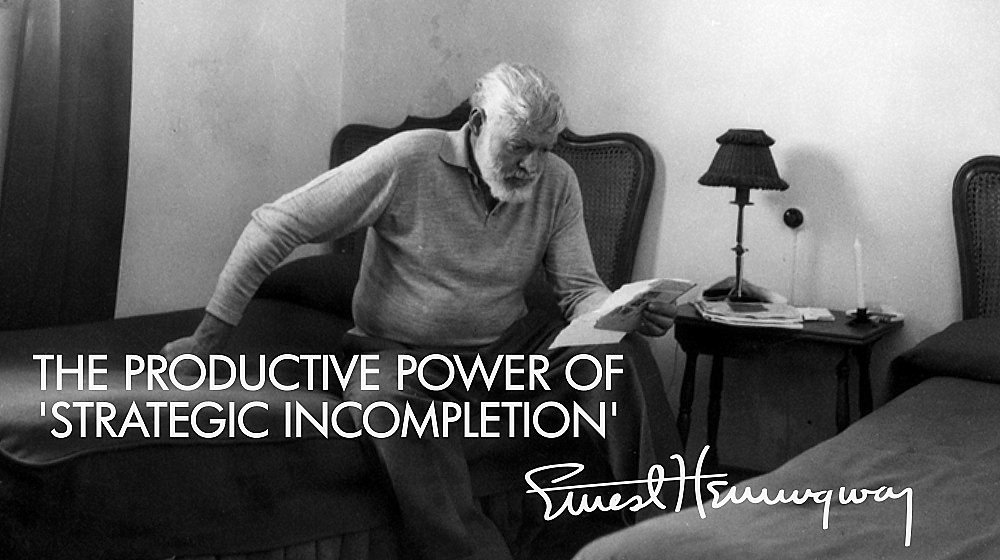
“Leave Something in the Well”: Hemingway on The Productive Power of Strategic Incompletion

November 7, 2025 By Nagesh Belludi Leave a Comment

'Leave Something in the Well': Hemingway on The Productive Power of Strategic Incompletion

Ernest Hemingway claimed to have a disciplined writing routine. He wrote early each morning and always stopped while he still knew what came next—leaving something in the “well” for the following day. He shared this advice in various contexts, notably in a 1935 Esquire article, framing it as an antidote to creative block.

When the goal is sustained momentum in any creative or cognitive endeavor, one principle stands out: stop while the work is still alive. Hemingway wasn’t just advising writers when he said, “The best way is always to stop when you are going good and when you know what will happen next.” He was articulating a broader truth about motivation: friction.

The method is deceptively simple: pause while momentum remains. Finishing everything may feel productive, but it often kills clarity. Push past peak energy, and you return to dread. Pause midstream, and you resume with direction.

The Hemingway Principle of Continuity

This defies cultural instinct. We’re conditioned to chase closure—to exhaust ourselves chasing completion. But exhaustion isn’t discipline. The better move is knowing when to stop: at the crest of effort, when the next step is obvious—but untaken.

Hemingway distilled this perfectly: “I had learned already never to empty the well of my writing, but always to stop when there was still something there in the deep part of the well, and let it refill at night from the springs that fed it.”

He wasn’t preserving mystery—he was preserving momentum.

Applied broadly, the technique dulls resistance. Reentry becomes ritual—driven by anticipation, not obligation. You don’t resume reluctantly. You resume with hunger.

Idea for Impact: Leave your work unfinished on purpose. Not because you failed, but because the unfinished work remains fertile. Discipline isn’t about what you finish. It’s about the ability to return—again and again.

Wondering what to read next?

  1. Why Doing a Terrible Job First Actually Works
  2. How to Banish Your Inner Perfectionist
  3. Five Ways … You Could Stop Procrastinating
  4. Did School Turn You Into a Procrastinator?
  5. Separate the Job of Creating and Improving

Filed Under: Mental Models, Sharpening Your Skills Tagged With: Discipline, Lifehacks, Motivation, Perfectionism, Procrastination, Task Management

« Previous Page
Next Page »

Primary Sidebar

Popular Now

Anxiety Assertiveness Attitudes Balance Biases Coaching Conflict Conversations Creativity Critical Thinking Decision-Making Discipline Emotions Entrepreneurs Etiquette Feedback Getting Along Getting Things Done Goals Great Manager Innovation Leadership Leadership Lessons Likeability Mental Models Mentoring Mindfulness Motivation Networking Parables Performance Management Persuasion Philosophy Problem Solving Procrastination Relationships Simple Living Social Skills Stress Suffering Thinking Tools Thought Process Time Management Winning on the Job Wisdom

About: Nagesh Belludi [hire] is a St. Petersburg, Florida-based freethinker, investor, and leadership coach. He specializes in helping executives and companies ensure that the overall quality of their decision-making benefits isn’t compromised by a lack of a big-picture understanding.

Get Updates

Signup for emails

Subscribe via RSS

Contact Nagesh Belludi

RECOMMENDED BOOK:
The Art of War

The Art of War: Sun Tzu

The ancient Chinese master Sun Tzu reveals the essence of conflict and how to win by knowing yourself, knowing your enemy, and fighting only when you can win.

Explore

  • Announcements
  • Belief and Spirituality
  • Business Stories
  • Career Development
  • Effective Communication
  • Great Personalities
  • Health and Well-being
  • Ideas and Insights
  • Inspirational Quotations
  • Leadership
  • Leadership Reading
  • Leading Teams
  • Living the Good Life
  • Managing Business Functions
  • Managing People
  • MBA in a Nutshell
  • Mental Models
  • News Analysis
  • Personal Finance
  • Podcasts
  • Project Management
  • Proverbs & Maxims
  • Sharpening Your Skills
  • The Great Innovators

Recently,

  • The Small Detail That Keeps a Conversation From Running Dry
  • Design for the 80% Experience
  • Inspirational Quotations #1143
  • The Hot-Desking Lie: How It Killed Focus and Gutted Collaboration
  • Unreliable Narrators Make a Story Sounds Too Neat
  • Bertrand Russell on The Value of Philosophy: Doubt in an Age of Dogma
  • Inspirational Quotations #1142

Unless otherwise stated in the individual document, the works above are © Nagesh Belludi under a Creative Commons BY-NC-ND license. You may quote, copy and share them freely, as long as you link back to RightAttitudes.com, don't make money with them, and don't modify the content. Enjoy!