 A comfortable but unfulfilling job reads, to some, as surrender. Standard career advice doesn’t do nuance: comfort breeds complacency, perpetual discomfort is the price of growth, and if you’re not advancing, you’re falling behind.
That framing ignores a lot. There’s genuine dignity in choosing stability, and for many people, it’s a rational, considered choice. Some prioritize financial, emotional, and temporal security over artificial passion repackaged as purpose. They work sane hours, pay their bills, sleep well, and take their vacations. Others use a steady job to support demanding work outside it: a creative practice, a side business, a family that needs them present. What one person calls stagnation, another calls structure. The day job isn’t a cage. It’s infrastructure.
Career fulfillment doesn’t follow a single pattern. It shifts with circumstance, obligation, health, and personal values. Assuming it should look the same for everyone replaces analysis with projection. Meaning is plural: for some, it’s advancement; for others, it’s balance.
The fetishization of ambition is its own ideology, one that mistakes motion for meaning. Ambition without reflection is vanity with momentum. That narrative is compelling, but it consistently erases quieter stories: people who choose stability to care for families, communities, or themselves. Before diagnosing someone else’s apparent lack of drive, consider that you know nothing of their calculus.
Idea for Impact: Success isn’t a template. If a person’s career sustains their life on their own terms, there’s no useful critique to offer. Only bias, and perhaps the good sense to stay quiet.
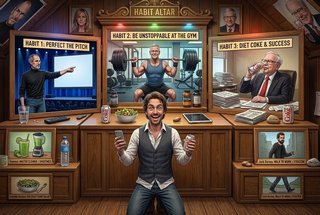 It’s oddly compelling to learn that Jennifer Aniston ate the
  That instinct has a name. Hanlon’s Razor, coined by Robert J. Hanlon in a collection of
  Everyone carries an inner critic. It fills quiet moments with familiar doubts: I have to do this perfectly. If I try, I might fail. I’m not good enough. I’ll never catch up.
 Think about the last time you said ‘no’ to something.
.jpg "'Microjoys' by Cyndie Spiegel (ISBN 593492226)")

 There’s no shortage of brilliant ideas. What’s scarce is the discipline to
 .jpg "'Life Moves Pretty Fast' by Hadley Freeman (ISBN 1501130455)")
 The night before, spend ten minutes writing down your priorities for the next day. Block time for