• Skip to content
  • Skip to primary sidebar

Right Attitudes

Ideas for Impact

Thought Process

Make a Difficult Decision Like Benjamin Franklin

October 30, 2015 By Nagesh Belludi Leave a Comment

Benjamin Franklin, American inventor, journalist, printer, diplomat, author, and founding father Benjamin Franklin (1706–1790) was renowned for his lifelong quest for self-improvement, as he thoroughly documented in his “Autobiography” (1791.)

In my previous article on Benjamin Franklin’s “Plan for Conduct,” I noted that Franklin had a methodical mindset.

As a young adult, Franklin developed a method for making complex decisions. At age 66, in a letter to his close friend Joseph Priestley (a London chemist who, in 1774, isolated the element oxygen,) Franklin described this method.

In this letter written on September 19, 1772, Franklin mentions one of the key challenges of fact-collecting and decision-making:

In the affair of so much importance to you, wherein you ask my advice, I cannot for want of sufficient premises, advise you what to determine, but if you please I will tell you how. When these difficult cases occur, they are difficult chiefly because while we have them under consideration all the reasons pro and con are not present to the mind at the same time; but sometimes one set present themselves, and at other times another, the first being out of sight. Hence the various purposes or inclinations that alternately prevail, and the uncertainty that perplexes us.

Make a Difficult Decision Like Benjamin Franklin - T-charts

Then, Franklin describes how to weigh the “pro et contra” (Latin for “for and against”) in any situation:

To get over this, my way is, to divide, half a sheet of paper by a line into two columns, writing over the one pro, and over the other con. Then during three or four day’s consideration I put down under the different heads short hints of the different motives that at different times occur to me for or against the measure. When I have thus got them all together in one view, I endeavor to estimate their respective weights; and where I find two, one on each side, that seem equal, I strike them both out: if I find a reason pro equal to some two reasons con, I strike out the three. If l judge some two reasons con equal to some three reasons pro, I strike out the five; and thus proceeding I find at length where the balance lies; and if after a day or two of farther consideration nothing new that is of importance occurs on either side, I come to a determination accordingly. And though the weight of reasons cannot be taken with the precision of algebraic quantities, yet when each is thus considered separately and comparatively, and the whole lies before me, I think I can judge better, and am less likely to make a rash step; and in fact I have found great advantage from this kind of equation, in what may be called moral or prudential algebra.

'The Benjamin Franklin Reader' by Walter Isaacson (ISBN 743273982) Ben Franklin’s humble tool for decision-making is now known as the T-Chart. It is widely used to examine two opposing facets of a topic, object, situation, circumstance, or event under consideration. T-Charts are particularly helpful for analyzing advantages and disadvantages, as well as strengths and weaknesses.

Recommended Reading: For a great collection of the writings of Benjamin Franklin, including his “Autobiography”, see Walter Isaacson’s “A Benjamin Franklin Reader”.

Wondering what to read next?

  1. Make Decisions Using Bill Hewlett’s “Hat-Wearing Process”
  2. Question the Now, Imagine the Next
  3. Disproven Hypotheses Are Useful Too
  4. How to Solve a Problem By Standing It on Its Head
  5. This is Yoga for the Brain: Multidisciplinary Learning

Filed Under: Great Personalities, Mental Models, Sharpening Your Skills Tagged With: Creativity, Decision-Making, Discipline, Thinking Tools, Thought Process

Reframe Your Thinking, Get Better Answers: What the Stoics Taught

September 29, 2015 By Nagesh Belludi Leave a Comment

The solution to many a difficult problem can be found merely by reframing the problem, thereby changing or adjusting your perception of the issue.

Reframing is a very effective technique to shift your view of a specific problem, event, or person. When you approach a situation from another perspective, you are likely to reevaluate your intentions and find alternative, acceptable solutions to your situations.

Reframing helps in two ways:

  • Reframing allows you to consider a problem within a positive—rather than a negative—context. For example, if you’re trying out a diet, you can reframe it by asking yourself “What are some foods I like that I should eat more of? What new foods can I experiment with?” rather than wondering, “What foods must I give up?” Reframing can help turn a problem into an opportunity, a weakness into a strength, an impossibility into a work-around, and a conflict into a mere lack of understanding.
  • Reframing can also broaden a problem’s context, thus helping you recognize its systemic contributors. In other words, by reframing, you look at a problem within its larger context. For example, you could reframe an individual issue, “Why won’t Tom gel with our team?” to a systemic problem, “What are the attributes of our team that make Tom feel excluded?”

“Redirect your prayers … and watch what happens”

The great Roman Emperor and Stoic Philosopher Marcus Aurelius wrote in “Meditations” (trans. Gregory Hays,)

'Meditations: A New Translation' by Marcus Aurelius (ISBN 0812968255)Either the gods have power or they don’t. If they don’t, why pray? If they do, then why not pray for something else instead of for things to happen or not to happen? Pray not to feel fear. Or desire, or grief. If the gods can do anything, they can surely do that for us.

But those are things the gods left up to me.

Then isn’t it better to do what’s up to you—like a free man—than to be passively controlled by what isn’t, like a slave or beggar? And what makes you think the gods don’t care about what’s up to us?

Start praying like this and you’ll see.

Not “some way to sleep with her”—but a way to stop wanting to.

Not “some way to get rid of him”—but a way to stop trying.

Not “some way to save my child”—but a way to lose your fear.

Redirect your prayers like that, and watch what happens.

Idea for Impact: Reframe, Always Reframe

If you find yourself stuck with a problem or difficult situation, try reframing your view of that problem. Consider alternate perspectives, revise your goals, and reconsider how you see the way forward.

To reframe, simply step back from your present viewpoint and alter the “lens” through which you perceive the reality. Discover your unspoken assumptions, challenge your beliefs, change the attributes of your perception of the problem, and downplay or emphasize various elements of the situation. By “looking at it another way” you can derive new meanings and define different courses of action.

Wondering what to read next?

  1. Stuck on a Problem? Shift Your Perspective!
  2. Howard Gardner’s Five Minds for the Future // Books in Brief
  3. You Can’t Develop Solutions Unless You Realize You Got Problems: Problem Finding is an Undervalued Skill
  4. Good Questions Encourage Creative Thinking
  5. Four Ideas for Business Improvement Ideas

Filed Under: Mental Models, Sharpening Your Skills Tagged With: Creativity, Philosophy, Stoicism, Thinking Tools, Thought Process, Winning on the Job

Lessons from the Princeton Seminary Experiment: People in a Rush are Less Likely to Help Others (and Themselves)

June 16, 2015 By Nagesh Belludi 3 Comments

Vincent van Gogh's The Good Samaritan (after Delacroix)

In the parable of the Good Samaritan (Luke 10:29–37 in the New Testament,) a Samaritan helps a traveler assaulted by robbers and left half dead by the side of the road. Prior to the Samaritan, a priest and a Levite pass the injured traveler and fail to notice him. Conceivably, the priest and Levite’s contempt was because they didn’t sincerely follow those same virtues they espoused as religious functionaries. Possibly, they were in a hurry or were occupied with busy, important—even religious—thoughts. Perhaps the Samaritan was in less of a hurry since he wasn’t as socially important as the priest or Levite and was therefore not expected to be somewhere.

The Princeton Seminary Experiment

Inspired by the parable of the Good Samaritan, Princeton social psychologists John Darley and Dan Batson conducted a remarkable experiment in the 1970s on time pressure and helpful behavior. They studied how students of the Princeton Theological Seminary conducted themselves when asked to deliver a sermon on the parable of the Good Samaritan.

The students were to give the sermon in a studio a building across campus and would be evaluated by their supervisors. The researchers were curious about whether time pressure would affect the seminary students’ helpful nature. After all, the students were being trained to become ordained priests; they are presumably inclined to help others.

As each student finalized his preparation in a classroom, the researchers inflicted an element of time constraint upon them by giving them one of three instructions:

  1. “You’re late. They were expecting you a few minutes ago…You’d better hurry. It shouldn’t take but just a minute.” This was the high-hurry condition.
  2. “The (studio) assistant is ready for you, so please go right over.” This was the intermediate-hurry condition.
  3. “It’ll be a few minutes before they’re ready for you, but you might as well head on over. If you have to wait over there, it shouldn’t be long.” This was the low-hurry condition.

As each student walked by himself from the preparation classroom to the studio, he encountered a ‘victim’ in a deserted alleyway just like the wounded traveler in the parable of the Good Samaritan. This victim (actually an associate of the experimenters) appeared destitute, was slouched and coughing and clearly in need of assistance. The seminarians were thus offered a chance to apply what they were about to preach.

“Conflict, rather than callousness, can explain their failure to stop.”

Researchers were interested in determining if their imposed time pressure affected the seminarians’ response to a distressed stranger. Remarkably, only 10% of the students in the high-hurry situation stopped to help the victim. 45% of the students in the intermediate-hurry and 63% of the students in the low-hurry situations helped the victim.

The researchers concluded, “A person not in a hurry may stop and offer help to a person in distress. A person in a hurry is likely to keep going. Ironically, he is likely to keep going even if he is hurrying to speak on the parable of the Good Samaritan, thus inadvertently confirming the point of the parable… Thinking about the Good Samaritan did not increase helping behavior, but being in a hurry decreased it.”

In light of their training and calling, the seminarians’ failure of bystander intervention is probably not due to indifference, self-centeredness, or contempt. (Compare with the plot of the series finale of American sitcom Seinfeld, where Jerry and friends are prosecuted for failure of duty to rescue.) The dominant cause is time pressure. Most of the students who believed they had enough time to stop did so. In contrast, the vast majority of those who thought they were late did not stop to help. In other words, the perception of time pressure or “having limited time” resulted in behaviors incongruent to their education and career: the devotion to help others. Time pressure triggered these well-intentioned students to behave in ways that, upon reflection, they would find disgraceful. The weight of a time constraint caused the students to put their immediate concern of being on time before the wellbeing of someone in need.

We’re in such hurry that we don’t stop to help ourselves

“I’m Late, I’m Late for a very important date,
No time to say hello. Goodbye.
I’m late, I’m late, I’m late, and when I wave,
I lose the time I save.”
—White Rabbit in the Disney musical “Alice in Wonderland” (1951)

The Princeton Seminary Experiment offers an even more personal lesson. As the researchers in this experiment expound, when we speed up and feel rushed, we experience a phenomenon known as “narrowing of the cognitive map.” That is, we miss details, we are not present enough in the moment to notice what is really important and we do not make the most beneficial choices for ourselves.

As we make our way through life, not only do we not stop to help others—we also do not stop to help ourselves. We neglect our own needs. We fail to nurture ourselves. We surrender, we settle, we lose hope. We compromise ourselves and become what we often settle for.

Our noisy world and busy lives constantly make us hurry as somebody always depends on us being somewhere. We constantly rush from place to place as if our lives depended upon it. We rush while doing just about everything. We are at the mercy of commitments often imposed by others.

Life moves quickly. And we’ll have missed it.

We fail to nurture ourselves We’re too busy, we’re too hurried and we’re too rushed. When people place demands on our time, our first resort is to cut out that which is most valuable. We are so busy meeting deadlines that we cannot make time for our loved ones. We abandon physical exercise to get to meetings on time. We avoid medical checkups critical to our well-being. We engage in behaviors that can put ourselves at risk for negative consequences in the future.

As our world continues to accelerate and our pace of life picks up speed, the clock’s finger turns inescapably. Life moves on by quickly, and soon enough we’ll have missed it entirely.

Idea for Impact: Be ever-conscious of the fact that time is the currency of your life

The German theologian and anti-Nazi descendent Dietrich Bonhoeffer (1906–1945) wrote in his “Letters and Papers from Prison”, “As time is the most valuable thing that we have, because it is the most irrevocable, the thought of any lost time troubles us whenever we look back. Time lost is time in which we have failed to live a full human life, gain experience, learn, create, enjoy, and suffer; it is time that has not been filled up, but left empty.”

Make the best use of your time. Interrupt your busy life to help yourself by living more fully in the present. Nurture yourself. Your needs belong to the top.

Wondering what to read next?

  1. What Airline Disasters Teach About Cognitive Impairment and Decision-Making Under Stress
  2. Summary of Richard Carlson’s ‘Don’t Sweat The Small Stuff’
  3. How Stress Impairs Your Problem-Solving Capabilities: Case Study of TransAsia Flight 235
  4. This Trick Can Relieve Your Anxiety: “What’s the worst that can happen?”
  5. This May Be the Most Potent Cure for Melancholy

Filed Under: Living the Good Life, Sharpening Your Skills Tagged With: Anxiety, Attitudes, Decision-Making, Emotions, Mindfulness, Stress, Thinking Tools, Thought Process, Worry

Creativity by Synthesis (Combining Ideas): A Case Study on the Darwin & Mendel Theorems in Biology

April 14, 2015 By Nagesh Belludi Leave a Comment

One of the fascinating aspects of invention is tracking the continuity of ideas across an arc of time and tracing the progression of ideas over time. My previous article examined how blending antecedent ideas to form new ones led to the invention of the Gutenberg’s press, the rotary steam engine, and the Wright Brothers‘ first powered flight. In this article, we will explore a related mental model for creativity.

A fundamental component of creative thinking is combining whole ideas (or just certain elements of ideas) to create a new concept. When we synthesize—i.e. fuse ideas to forge new ones—we mirror the footsteps of some of humankind’s most imaginative breakthroughs.

James Maxwell’s work on electromagnetic radiation developed from the synthesis of seemingly unrelated concepts such as electricity, magnetism, light, and motion. His theory of electromagnetism was one of the most significant discoveries of the nineteenth century. Albert Einstein described Maxwell’s work on electromagnetism as “the most profound and the most fruitful that physics has experienced since the time of Newton.”

Even more profoundly, Darwin and Mendel’s work exemplifies the most groundbreaking synthesis of ideas. Combined more than four decades after their deaths, their ideas shaped the foundation of life sciences, as we know it. Allow me to elaborate.

Theory of the Descent of Man - Darwin's Theories of Evolution

Charles Darwin’s Theory of Evolution

The word “evolution” was first used in English as early as 1647. Long before that, pre-Socratic Greek philosopher Anaximander (611–546 B.C.E) speculated that humans must have evolved from an animal and that this evolution must have sprung from the sea. By the end of the 18th century, naturalists conjectured that different life forms develop progressively from more primitive forms. They also hypothesized that all life forms were interrelated. Erasmus Darwin (1731–1802,) Charles Darwin’s grandfather and a natural philosopher and physiologist, as well as the French naturalist Jean-Baptiste Lamarck (1744–1829) argued along those lines. However, most of their thoughts on evolution and the relatedness of all life forms were purely speculative.

'The Origin of Species' by Charles Darwin (ISBN 0451529065) Darwin’s most notable scientific contribution was his vast body of evidence supporting the aforementioned hypotheses. Even more significantly, Darwin identified natural selection as the mechanism that determines evolutionary change. In his seminal treatise, “Origin of Species” (1859,) Darwin distilled the theory of evolution through two foundational concepts:

  1. In any ecosystem, individuals of the same species are likely to differ in their measurable characteristics. Such variations tend to be inherited.
  2. Living beings—plants and animals—reproduce more quickly than nature can impart the resources for their survival. Individuals of a species must therefore compete in order to live and reproduce in a competitive ecosystem.

Charles Darwin’s work on evolution was really a synthesis of concepts from comparative anatomy, paleontology, geology, geography, and animal breeding.

Advancing his theories further, in “The Descent of Man” (1871,) Darwin described humans as an outcome of evolution. Humans have the same general anatomical and physiological principles as animals and are in fact an advanced animal form whose superior traits are a consequence of evolutionary progression. Darwin hypothesized that humans share a common ancestry with animals, more specifically evolving from primates.

The Big Gap in Darwin’s Theory: Lack of an Explanation for Heredity

'The Descent Of Man' by Charles Darwin (ISBN 1463645961) In the introduction to The Descent of Man, Darwin wrote, “It has often and confidently been asserted, that man’s origin can never be known: but ignorance more frequently begets confidence than does knowledge: it is those who know little, and not those who know much, who so positively assert that this or that problem will never be solved by science.”

Darwin’s theories about the evolution of humankind created an instant uproar among advocates of Christian theology and its concept of a wise, benevolent, and omnipotent Creator as laid out in the Book of Genesis. Since then, few scientific theories have been as hotly debated among nonscientists as evolution and its opponent, creationism (and recently, intelligent design.)

After The Descent of Man, it was more than a decade before Darwin’s work came to be scientifically established. Darwin’s work remained deficient—if natural selection was to have lasting effects, these advances had to be conserved and passed on from one generation to the next. He agreed with scientists who argued that his evolutionary theory failed to explain how variations are transmitted from parents to their offspring.

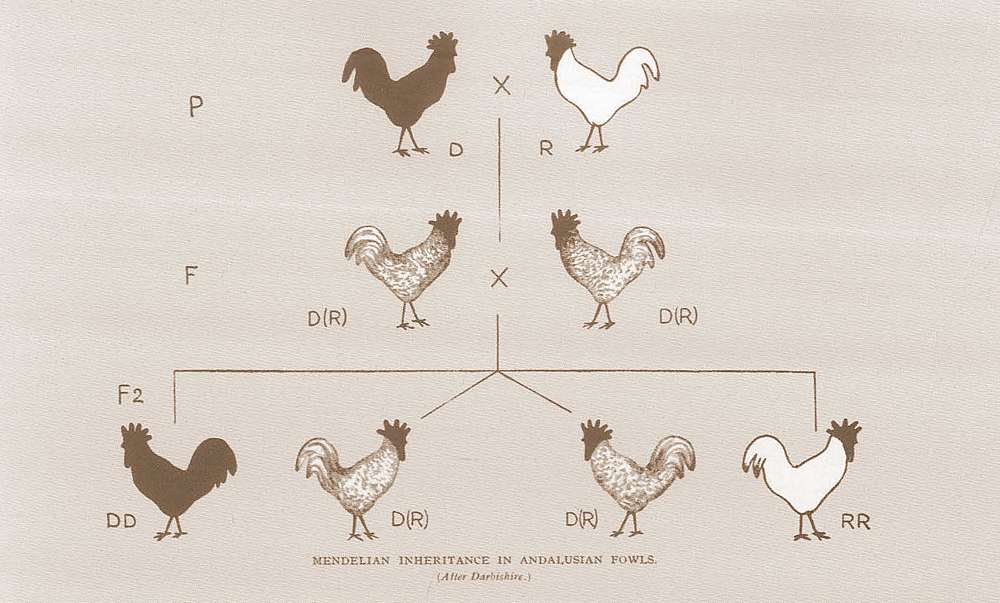
Mendelian Inheritance in Andalusian Fowls - Cross-breeding Experiments by Gregor Mendel

Cross-breeding Experiments by Gregor Mendel: Evidence of Heredity

Between 1856 and 1863, independent of Charles Darwin (1809–1882,) Moravian monk Gregor Mendel (1822–1884) conducted extensive pea plant breeding experiments in his monastery’s garden. He systematically studied what farmers had known for centuries: that crossbreeding animals and plants creates “hybrid” offspring with desirable traits. Based on his pea plant experiments, Mendel laid the foundational rules of genetic inheritance and heredity.

Synthesis of Darwin and Mendel’s Work as the Foundation of Life Sciences

It was not until the 1930s, long after both Darwin and Mendel’s deaths, that biologists started to study Mendel’s work on heredity in conjunction with Darwin’s theory of natural selection. Scientists were then able to understand how variation of characteristics is passed on to new generations and how evolution is a process of descent with modification. Mendel’s laws provided justification of inheritance, thereby completing Darwin’s theory of natural selection. Subsequently, Darwin’s theory became the basic mechanism of evolution—evolutionary genetics was established as biology’s central theorem and the bedrock concept of all life sciences. From that point on, Darwin became one of the most influential persons in human history.

Scientists continue to fine-tune humankind’s understanding of evolutionary biology as new evidence and fresh insights pour in from biochemistry, genetics, archaeology, neuroscience, and various other disciplines.

Wondering what to read next?

  1. What James Watt and the Steam Engine Teach You about Creativity and Invention
  2. You Can’t Develop Solutions Unless You Realize You Got Problems: Problem Finding is an Undervalued Skill
  3. Question the Now, Imagine the Next
  4. Finding Potential Problems & Risk Analysis: A Case Study on ‘The Three Faces of Eve’
  5. Invention is Refined Theft

Filed Under: Mental Models, Sharpening Your Skills Tagged With: Creativity, Scientists, Thought Process

Creativity by Blending Ideas to Form New Ones: A Case Study of Gutenberg and the Printing Press

February 24, 2015 By Nagesh Belludi Leave a Comment


Ideas Evolve over Time by Blending with Other Ideas

One of the fascinating aspects of invention is tracking the continuity of ideas across an arc of time. Through education, exposure, and experimentation, people’s creative thoughts can stretch both temporally and across various disciplines of knowledge.

When people develop a new idea, they often share it with others, who may then use this idea to expand their own understanding of concepts, invent even fresher ideas, and spread them. Ideas thus evolve over time.

Building on Antecedent Inventions

Considering the collaborative nature of idea formation, every new idea is arguably a conceptual sum of its predecessors. The power of blending ideas to form new ones is shown in that most seminal inventions are based on antecedents—inventions that came before them. For instance,

  • James Watt’s “invention” of the steam engine (or, more precisely, his invention of the separate-condenser steam engine) was in fact an attempt to modify Thomas Newcomen’s steam engine. Newcomen’s work was itself based on Thomas Savery’s invention of a steam-powered pump to extract water from mine-shifts. Later, James Watt adapted his separate-condenser to produce continuous rotary motion and expanded its use far beyond pumping water. Continuous rotary motion sparked the transition from hand-production methods to machine-power and became the driving force of the Industrial Revolution.
  • The Wright brothers’ first heavier-than-air powered flight was the culmination of their experience with bicycles. This first flight demonstrated their ability to improve prior inventions by applying previously-reached solutions to controlled flight issues. [See my previous article on how the Wright brothers argued and developed their ideas.] Within fifty years of the Wright brothers’ first successful airplane, humankind’s concept of distance had changed dramatically: aircrafts could fly across continents in hours—sometimes faster than sound. Just a short time later, aircrafts were traveling into space.
  • British Mathematician Andrew Wiles’ much-celebrated proof of Pierre de Fermat’s Last Theorem was based on the work of some of the greatest mathematical minds who, over three centuries, had also puzzled over Fermat’s Last Theorem. Contemporaries Gerhard Frey, Jean-Pierre Serre, and Ken Ribet also influenced Wiles’ work. Until Wiles’ success in the mid-nineties, the theorem remained inaccessible to proof for 358 years. In the 1840s, German mathematician Richard Dedekind attempted to solve the theorem and in so doing, laid the foundations of algebraic number theory.

Idea for Impact: Creativity is accessible through the often-subconscious process of blending what you already know to form new ideas.

Gutenberg's Invention of Mechanized Printing: Blend of coin punch and mechanized wine press

Case Study: Gutenberg’s Invention of Mechanized Printing

In the 15th century, Johannes Gutenberg invented mechanized movable-type printing. His invention revolutionized the dissemination of knowledge throughout the Western World and played a pivotal role in the development of the Renaissance, the Protestant Reformation, the Age of Enlightenment, and the Scientific Revolution.

The earliest forms of printing evolved from letter and coin punches, which were in vogue even in the Neolithic era. Woodblock printing was fashionable in East Asia since the second century. At least two centuries prior to Gutenberg’s invention, manual block printing with movable type had existed. However, this technique was hardly known in Europe, where all manuscripts were laboriously copied out by hand or stamped out with woodblocks before Gutenberg’s invention.

Gutenberg blended the flexibility of a coin punch with the power of a mechanized wine press to invent mechanized printing. For each character to be printed, Gutenberg used his skills as a goldsmith to cast individual pieces of metal type. These pieces could be quickly assembled into blocks depending on the composition of characters on a page.

Gutenberg’s mechanized press was an adaptation of the wine press, a historical contraption used to crush grapes and extract their juice for winemaking. Gutenberg’s press consisted of a fixed lower bed and movable upper platen containing composed type blocks. The platen was inked, covered with a sheet of paper, and pressed by a small bar on a worm screw. Pressing the upper and lower surfaces together formed a vise and left a sharp impression of inked characters on the paper.

The hand-operated Gutenberg press was further mechanized in the 19th century. Engineers introduced James Watt’s invention of the double-acting rotary steam engine to create steam-powered rotary presses, altogether creating industrialized bulk printing.

Wondering what to read next?

  1. Question the Now, Imagine the Next
  2. Decoy Effect: The Sneaky Sales Trick That Turns Shoppers into Spenders
  3. What Isn’t Matters Too
  4. Finding Potential Problems & Risk Analysis: A Case Study on ‘The Three Faces of Eve’
  5. Invention is Refined Theft

Filed Under: Mental Models, Sharpening Your Skills Tagged With: Creativity, Thought Process

How to Argue like the Wright Brothers

February 15, 2012 By Nagesh Belludi 2 Comments

The Wright brothers, most notable for inventing powered flight, also enjoyed developing their critical thinking by fiercely debating with each other.

Wilbur and Orville found debating and challenging each other’s viewpoints was a constructive way to identify solutions to a myriad of problems or resolve their interpersonal conflicts.

The Wright brothers often took two different sides of an argument, debated the subject, then switched sides and debated the opposing argument. Orville Wright once narrated, “Often, after an hour or so of heated argument, we would discover that we were as far from agreement as when we started, but that each had changed to the other’s original position.”

Idea for Impact: Only when you contrast your point of view with an opponent’s does your own make sense. Use the Wright Brothers’ technique of double-sided debate to question your own preconceptions about an issue and appreciate alternative perspectives.

Wondering what to read next?

  1. To Make an Effective Argument, Explain Your Opponent’s Perspective
  2. How to Gain Empathic Insight during a Conflict
  3. Rapoport’s Rules to Criticize Someone Constructively
  4. Presenting Facts Can Sometimes Backfire
  5. Don’t Ignore the Counterevidence

Filed Under: Effective Communication, Sharpening Your Skills Tagged With: Conflict, Conversations, Critical Thinking, Getting Along, Persuasion, Thinking Tools, Thought Process

Systems-Thinking as a Trait for Career Success

February 12, 2009 By Nagesh Belludi Leave a Comment

In this Fast Company article, Gary Flake, Director of Live Labs at Microsoft identifies Systems Thinking as an important trait for career success.

There are three traits that will serve anyone wanting any role at any company, not just ours: systems thinking, passion, and clear communication. Systems thinking is a way of looking at the world that allows you to see how many small pieces come together to make a more complex whole. System thinkers see the hidden interconnections that bind together the parts and know how to make the best use of ambiguity and uncertainty as a result.

Gary’s reflection reiterates the importance of understanding context and perspective in our jobs. A previous blog article and a podcast discussed this indispensable trait for success.

Systems Thinking for a Big Picture Approach

From an early age, we’re taught to break apart problems in order to make complex tasks and subjects easier to deal with. But this creates a bigger problem . . . we lose the ability to see the consequences of our actions, and we lose a sense of connection to a larger whole.
* Peter Senge

Traditional methods of problem analysis concentrate on dividing problems into smaller, more comprehensible components. The drawback of understanding isolated or unrelated elements, functions, and events is that the effects of changes to one element on other elements of the whole are rarely considered.

In contrast, the discipline of Systems Thinking emphasizes analyzing the whole in terms of interrelationships of its elements. Examining structures, relationships, and outcomes facilitates taking into account any secondary consequences of decisions and actions pertaining individual elements.

We work in increasingly connected organizations where an event that affects one part of an organization is likely to have a meaningful effect–in the short-term or the long-term–on another part of the organization. The discipline of Systems Thinking enables us to develop a broader, holistic perspective of problems and opportunities in businesses and make effective decisions.

Resources, References

Over the last couple of decades, System Thinking has evolved into a formal discipline and has incorporated several rigorous analysis techniques. Here are two excellent resources to help you gain more knowledge of these methods.

  • The ‘Thinking’ in Systems Thinking: Seven Essential Skills, Barry Richmond
  • The Fifth Discipline: The Art and Practice of the Learning Organization, Peter Senge

Wondering what to read next?

  1. Howard Gardner’s Five Minds for the Future // Books in Brief
  2. This is Yoga for the Brain: Multidisciplinary Learning
  3. You Can’t Develop Solutions Unless You Realize You Got Problems: Problem Finding is an Undervalued Skill
  4. Finding Potential Problems & Risk Analysis: A Case Study on ‘The Three Faces of Eve’
  5. Four Ideas for Business Improvement Ideas

Filed Under: Career Development, Sharpening Your Skills Tagged With: Creativity, Critical Thinking, Mental Models, Thinking Tools, Thought Process, Winning on the Job

To Make an Effective Argument, Explain Your Opponent’s Perspective

December 12, 2008 By Nagesh Belludi Leave a Comment

“The man who can hold forth on every matter under debate in two contradictory ways of pleading, or can argue for and against every proposition that can be laid down – such a man is the true, the complete, and the only orator.”
– Cicero

“If you can’t imagine how anyone could hold the view you are attacking, you just don’t understand it yet.”
– Anthony Weston, ‘Rulebook for Arguments’

Explaining the Other Side of the Argument

Entrepreneur and blogger Ben Casnocha presents an effective discussion / debating / interviewing technique:

Here is one of the simplest ways to test someone’s knowledge of an issue: ask them to explain the other side of the argument. Ask the person who’s in favor of spending more money on marketing project X to explain the thinking process behind those who oppose the budgetary move.

I have yet to find a more efficient and reliable way to probe the depths of a person’s knowledge and seriousness about an issue than asking them to explain the other side’s perspective.

How can you effectively argue for your side if you don’t understand the arguments of the other?

Never Limit Your Ability to Learn From Opposite Perspectives

Never Limit Your Ability to Learn From Opposite Perspectives Habitually, we discard contrasting opinions without making an effort to explore their significance. We shape our attitudes and seek facts to support our own beliefs without contemplating the merits of opposite perspectives. We fail to realize that, when we do not understand opposite perspectives enough to justify their merits, we almost certainly do not understand them enough to dismiss them either.

Develop the curiosity to see the world from new perspectives and discover opposite circumstances, whether you believe in them or not. If you follow faith X, attend services of faith Y; if you are conservative, explain the liberal outlook; if you hold the western philosophy on a particular subject, reason the eastern viewpoint; if you oppose a particular legislation, argue the merits of legislation. Instead of asking ‘ why ,’ ask ‘why not .’

When you pause arguing with an opposite perspective and try arguing for it, when you switch your point of view briefly, you will witness a profound shift in your thinking.

  • Your own attitudes may look different when seen from the opposite perspective. It can help you reinforce your own beliefs and attitudes. This approach may open your mind to discover the merits, similarities, and weaknesses of your arguments that may not be obvious from your own side of the board.
  • People are often glad to work with anyone who is accommodating and tries to understand their perspectives. Therefore, your ability to persuade others improves.

Wondering what to read next?

  1. How to Gain Empathic Insight during a Conflict
  2. How to Argue like the Wright Brothers
  3. Rapoport’s Rules to Criticize Someone Constructively
  4. Presenting Facts Can Sometimes Backfire
  5. Don’t Ignore the Counterevidence

Filed Under: Effective Communication, Mental Models, Sharpening Your Skills Tagged With: Conflict, Conversations, Critical Thinking, Getting Along, Persuasion, Thinking Tools, Thought Process

How to Examine a Process and Ask the Right Questions

September 29, 2007 By Nagesh Belludi 2 Comments

Method Study and Critical Examination

Method study is a practice of examining methods of doing work: work-flows, processes, etc. The key component of method study is ‘critical examination.’ Author Michael Armstrong describes critical examination in his ‘Handbook of Management Techniques.’

Critical examination uses the questioning approach to find out what, how, when, where and, most importantly, why and activity is carried out, and who does it. From this analysis, two fundamental questions are posed: (1) Does the activity need to be done at all? If so, (2) Are there any better ways of doing it?

The questioning approach for critical examination is described in the following chart. This chart is also available as a hand-out (PDF download) for quick reference.

Questioning Approach Critical Examination

Call for Action

A great degree of professional work–in engineering, management, finances, and other functions of the modern corporation–involves analysis of products, procedures and systems. Here, thought-processes involve asking, and seeking answers to, a series of questions.

In my role as an engineer and manager, I carry the above chart of questions to meetings and brainstorming sessions. The chart helps me ask the right questions on the intent of a process or system and gain a big-picture perspective for my work or task at hand.

Download the critical examination handout, post it at your cubicle and refer to the chart for help on asking the right questions.

Wondering what to read next?

  1. The Solution to a Problem Often Depends on How You State It
  2. What the Rise of AI Demands: Teaching the Thinking That Thinks About Thinking
  3. Good Questions Encourage Creative Thinking
  4. Finding Potential Problems & Risk Analysis: A Case Study on ‘The Three Faces of Eve’
  5. Invention is Refined Theft

Filed Under: Mental Models, Sharpening Your Skills Tagged With: Creativity, Questioning, Thought Process

« Previous Page

Primary Sidebar

Popular Now

Anxiety Assertiveness Attitudes Balance Biases Coaching Conflict Conversations Creativity Critical Thinking Decision-Making Discipline Emotions Entrepreneurs Ethics Etiquette Feedback Getting Along Getting Things Done Goals Great Manager Innovation Leadership Leadership Lessons Likeability Mental Models Mindfulness Motivation Parables Performance Management Persuasion Philosophy Problem Solving Procrastination Psychology Relationships Simple Living Social Skills Stress Suffering Thinking Tools Thought Process Time Management Winning on the Job Wisdom

About: Nagesh Belludi [hire] is a St. Petersburg, Florida-based freethinker, investor, and leadership coach. He specializes in helping executives and companies ensure that the overall quality of their decision-making benefits isn’t compromised by a lack of a big-picture understanding.

Get Updates

Signup for emails

Subscribe via RSS

Contact Nagesh Belludi

RECOMMENDED BOOK:
Doing Business In China

Doing Business In China: Ted Plafker

The Economist's Beijing-correspondent Ted Plafker on the challenges of entering the Chinese market, conducting business in China, and not falling flat on your face.

Explore

  • Announcements
  • Belief and Spirituality
  • Business Stories
  • Career Development
  • Effective Communication
  • Great Personalities
  • Health and Well-being
  • Ideas and Insights
  • Inspirational Quotations
  • Leadership
  • Leadership Reading
  • Leading Teams
  • Living the Good Life
  • Managing Business Functions
  • Managing People
  • MBA in a Nutshell
  • Mental Models
  • News Analysis
  • Personal Finance
  • Podcasts
  • Project Management
  • Proverbs & Maxims
  • Sharpening Your Skills
  • The Great Innovators

Recently,

  • We Don’t Buy Products, We Buy Narratives of Ourselves
  • Inspirational Quotations #1163
  • You Need Your Enemy to Be Worth It
  • The Quiet Rebellion
  • The ‘Near Enemy’: The Subtle Corruption That Makes Good Acts Fail
  • Inspirational Quotations #1162
  • The “Empty Vessel” Effect: Why Insecurity Speaks the Loudest

Unless otherwise stated in the individual document, the works above are © Nagesh Belludi under a Creative Commons BY-NC-ND license. You may quote, copy and share them freely, as long as you link back to RightAttitudes.com, don't make money with them, and don't modify the content. Enjoy!