• Skip to content
  • Skip to primary sidebar

Right Attitudes

Ideas for Impact

Thinking Tools

Make Decisions Using Bill Hewlett’s “Hat-Wearing Process”

September 6, 2016 By Nagesh Belludi Leave a Comment

“Reasons pro and con are not present at the same time”

My previous article about Ben Franklin’s T-Chart method in making difficult decisions quoted him mentioning this as a key challenge of fact-collecting and decision-making:

When difficult cases occur, they are difficult chiefly because while we have them under consideration all the reasons pro and con are not present to the mind at the same time; but sometimes one set present themselves, and at other times another, the first being out of sight. Hence the various purposes or inclinations that alternately prevail, and the uncertainty that perplexes us.

Bill Hewlett’s “Hat-Wearing Process”

Bill Hewlett, co-founder of Hewlett-Packard (HP,) developed an effective “hat-wearing process” in his decision-making. When confronted with a challenge, Hewlett used a three-pronged approach to take the time to reflect, collect input from others, and develop a sound judgment about the matter at hand.

  1. Whenever an HP employee approached Hewlett with an innovative idea, he put on his “enthusiasm” hat. He listened, expressed enthusiasm, appreciated the creative process, and asked wide-ranging but not-too-pointed questions about the idea.
  2. A few days later, Hewlett wore his “inquisition” hat and met the inventor. Hewlett asked many pointed questions and meticulously examined the facts and the virtues. He critically examined the idea, but adjourned without a final decision.
  3. A few days later, Hewlett wore his “decision” hat and met with the inventor. Hewlett discussed his opinions and conveyed his decision with logic and sensitivity.

In a discussion about the corporate culture of enthusiasm and creativity that the founders engendered at Hewlett-Packard, cofounder David Packard recalls in The HP Way (see my review / summary) that even if the decision went against the inventor, Bill Hewlett’s “Hat-Wearing Process” provided the inventor with a sense of satisfaction that Hewlett had carefully considered the ideas.

Idea for Impact: Make Considered Decisions

Use the “hat-wearing process” to listen to and mull over facts about a decision to be made, collect input from others, develop perspective that comes only with time, and make sound, thoughtful decisions.

Compliment with Edward de Bono’s ‘Six Thinking Hats’ thought process to stimulate creativity.

Wondering what to read next?

  1. Make a Difficult Decision Like Benjamin Franklin
  2. Question the Now, Imagine the Next
  3. Disproven Hypotheses Are Useful Too
  4. Don’t Ruminate Endlessly
  5. Creativity by Imitation: How to Steal Others’ Ideas and Innovate

Filed Under: Great Personalities, Leading Teams, Mental Models, Sharpening Your Skills Tagged With: Creativity, Decision-Making, Discipline, Thinking Tools, Thought Process

How to Solve a Problem By Standing It on Its Head

July 19, 2016 By Nagesh Belludi 1 Comment

Fixed Mental Set or Fixation

Psychologists use the terms ‘fixation’ and ‘fixed mental set’ to describe a person’s inability to see his/her problem from a fresh perspective. Fixation impedes problem-solvers from approaching problems from a different angle and from finding novel solutions.

Fixation is a persistent impasse in problem-solving in which predispositions towards a previously-reliable process, unwarranted postulations, unjustifiable assumptions, conventional thinking in identifiable contexts (called Einstellung Effect,) or recent experiences block awareness of possible solutions that may exist within other contexts. A period of rest, entertainment, or exposure to an alternative environment frequently can dissipate fixation.

Problem Reversal in Problem-Solving

If you’re stuck on a problem and can’t solve it because you’re fixated on a reliable process, try reversing the problem to reframe your thinking and consider alternate perspectives.

As the following three case studies illustrate, reversing a problem simply involves taking a problem and turning it on its head.

  • A top-level executive at a large American corporation loved his job, his company, his employees, and his salary. However, he despised his boss. The executive and his boss were both long tenured; neither was likely to move out of their jobs anytime soon. The executive decided to find a new job at a different company. A headhunter assured the executive that a new job could be easily arranged. While speaking to his wife in the evening, the executive realized that he could easily reverse the problem. So he returned to the headhunter the next day and provided the boss’s name. Within days, the headhunter found an appealing new job for the unwary boss, who accepted. The executive then got his boss’s job and was even more content with his career.
  • A herd of sheep was moving slowly along a narrow country lane that was surrounded by high banks. An ambulance in a great hurry came up behind the herd and requested the shepherd to move his sheep to the side so that the ambulance could drive through. The shepherd declined because getting the ambulance past the sheep would be slow and he wasn’t sure of keeping all his sheep out of the way of the ambulance on a narrow lane. Instead, he reversed the problem: he got the sheep past the ambulance. He asked the ambulance to halt and then gently turned the herd round and guided it back past the stationary ambulance.
  • An ethical used-car salesman loathed his job because he felt compelled to sell cars with problematic features to unsuspecting buyers. He was eager for a career change, but the only thing he knew was cars. Therefore, he reversed his problem: he started a new business of locating, inspecting, and recommending used cars to prospective buyers. For a reasonable fee, he helped car buyers by scrutinizing used cars, listing current and prospective problems, and offering an estimate for repairs. His business boomed and he was much happier than he was as a used-car salesman.

Idea for Impact: Solve Problems by Reversing Them

When you’re stuck and can’t see how to solve the problem at hand, try reversing it or “standing the problem on its head.” Reversal as a problem-solving technique can free you from old ways of looking at problems.

Wondering what to read next?

  1. The “Ashtray in the Sky” Mental Model: Idiot-Proofing by Design
  2. Howard Gardner’s Five Minds for the Future // Books in Brief
  3. Question the Now, Imagine the Next
  4. Intellectual Inspiration Often Lies in the Overlap of Disparate Ideas
  5. You Can’t Develop Solutions Unless You Realize You Got Problems: Problem Finding is an Undervalued Skill

Filed Under: Mental Models, Sharpening Your Skills Tagged With: Creativity, Critical Thinking, Decision-Making, Mental Models, Problem Solving, Thinking Tools, Thought Process, Wisdom

Finding Potential Problems & Risk Analysis: A Case Study on ‘The Three Faces of Eve’

June 24, 2016 By Nagesh Belludi Leave a Comment

The Three Faces of Eve (1957)

Risk Analysis is a Forerunner to Risk Reduction

My previous article stressed the importance of problem finding as an intellectual skill and as a definitive forerunner to any creative process. In this article, I will draw attention to another facet of problem finding: thinking through potential problems.

Sometimes people are unaware of the harmful, unintended side effects of their actions. They fail to realize that a current state of affairs may lead to problems later on. Their actions and decisions could result in outcomes that are different from those planned. Risk analysis reduces the chance of non-optimal results.

The Three Contracts of Eve

'The 3 Faces of Eve' by Corbett H. Thigpen and Hervey M. Cleckley (ISBN 0445081376) A particularly instructive example of finding potential problems and mitigating risk concerns the Hollywood classic The Three Faces of Eve (1957). This psychological drama features the true story of Chris Sizemore who suffered from dissociative identity disorder (also called multiple personality disorder.) Based on The Three Faces of Eve by her psychiatrists Corbett Thigpen and Hervey Cleckley, the movie portrays Sizemore’s three personalities, which manifest in three characters: Eve White, Eve Black, and Jane.

Before filming started on The Three Faces of Eve, the legal department of the 20th Century Fox studio insisted that Sizemore sign three separate contracts—one for each of her personalities—to cover the studio from any possible legal action. For that reason, Sizemore was asked to evoke “Eve White,” “Eve Black,” and “Jane,” and then sign an agreement while manifesting each of these respective personalities. According to Aubrey Solomon’s The Films of 20th Century-Fox and her commentary on the movie’s DVD, the three signatures on the three contracts were all different because they were a product of three distinct personalities that Sizemore had invoked because of her multiple personality disorder.

Idea for Impact: Risk analysis and risk reduction should be one of the primary goals of any intellectual process.

Postscript Notes

  • I recommend the movie The Three Faces of Eve for its captivating glimpse into the mind of a person afflicted with dissociative identity disorder. Actress Joanne Woodward won the 1958 Academy Award (Oscar) for best actress for her portrayal of the three Eves.
  • The automotive, aerospace, and other engineering disciplines use a formal risk analysis procedure called “failure mode and effects analysis” (FEMA.) FEMA examines the key risk factors that may fail a project, system, design, or process, the potential effects of those failures, and the seriousness of these effects.

Wondering what to read next?

  1. Overcoming Personal Constraints is a Key to Success
  2. Defect Seeding: Strengthen Systems, Boost Confidence
  3. How to Stimulate Group Creativity // Book Summary of Edward de Bono’s ‘Six Thinking Hats’
  4. Turning a Minus Into a Plus … Constraints are Catalysts for Innovation
  5. Creativity by Imitation: How to Steal Others’ Ideas and Innovate

Filed Under: Mental Models, Sharpening Your Skills Tagged With: Creativity, Critical Thinking, Innovation, Mental Models, Personality, Risk, Thinking Tools, Thought Process, Winning on the Job

You Can’t Develop Solutions Unless You Realize You Got Problems: Problem Finding is an Undervalued Skill

June 21, 2016 By Nagesh Belludi Leave a Comment

Problem finding plays an important role in creative thinking

Problem finding is one of the most significant parts of problem solving. However, it tends to be an underappreciated skill. Many managers naively consider it strange to encourage employees to look for problems at work: “Why look for new problems when we’ve got no resources to work on ones we’ve already identified?”

Many courses and books on problem solving and creativity overlook problem finding. Many educational resources tend to assume that problem solving really begins only after problems have been identified.

Problem-identification lead to the invention of the ballpoint pen

The story of the invention of the ballpoint pen demonstrates the importance of problem finding. Had the inventors not recognized a problem with the existing writing instruments of their day, they would not have developed their invention.

In the 1920s, Hungarian journalist Laszlo Biro spent much time proofreading and checking for errors in others’ writings. To communicate these errors to the authors, Laszlo could not use pencils because their impressions fade quickly. He tried using a fountain pen, but the ink from the fountain pen dried slowly and often left smudges on paper.

Laszlo observed that the ink used in newspaper printing dried quickly and left the paper smudge-free. When he tried using that ink in his fountain pen, however, the ink was too viscous to flow into the tip of the fountain pen.

Laszlo then collaborated with his chemist-brother Gyorgy Biro to invent a new pen tip consisting of a ball that was enclosed within a socket. As the ball rolled inside the socket, the ball could pick up ink from a reservoir or cartridge and then continue to roll to deposit the ink on the paper. The Biro brothers thus invented the ballpoint pen. The company they created is now part of the BIC Company. The ballpoint pen continues to be called a ‘Biro’ in some countries.

Often, creativity is the outcome of discovered problem solving

Greek Philosopher Plato famously wrote in The Republic, “Let us begin and create in idea a State; and yet a true creator is necessity, which is the mother of our invention.”

One reason we fail to identify problems is that we do not stop to think about improving various situations that we encounter. Very often, these problems are directly in front of us; we need to consciously identify them and convert them into opportunities for problem solving. Instead, we tend to take inconveniences and unpleasant situations for granted and assume they are merely “facts of life.”

  • The grain mill was not invented until somebody in antiquity identified the ineffectiveness of two hours of pounding grain to make a cup of flour.
  • The world’s first traffic lights were installed around the British Houses of Parliament in London only after somebody thought of the problem of traffic congestion. In other words, up until the problems from congestion were identified in the 1860s, no one attempted to systematically consider how the problem might be solved.
  • James Watt invented his seminal separate-condenser steam engine after discovering an interesting problem with the Newcomen steam engine. In 1763, when Watt was working as an instrument maker at the University of Glasgow, he was assigned to repair a model of a Newcomen engine for a lecture-demonstration. Watt initially had difficulty getting the Newcomen engine to work because its parts were poorly constructed. When he finally had it running, he was surprised at its efficiency. Watt observed that the engine was constantly running out of coal because the constant heating and cooling of the cylinder resulted in a large waste of energy. Watt then devised a system whereby the cylinder and the condenser were separate. This led to his invention of the “steam engine” (or, more precisely, the separate-condenser steam engine.)
  • As I mentioned in a previous article on the opportunities in customers’ pain points, crispy potato chips were invented only when Chef George Crum of New York’s Saratoga Springs attempted to appease a cranky customer who frequently sent Crum’s fried potatoes back to the kitchen complaining that they were mushy and not crunchy enough. Decades later, Laura Scudder invented airtight packaging for potato chips only after becoming conscious of customers’ complaints that chips packaged in metal containers quickly go stale and crumble during handling.

If problems are not identified, solutions are unlikely to be proposed

It pays to keep your eyes open and look at inconveniences, difficulties, and troubles as creative problems to be solved. Don’t ignore these merely as facts of life.

Curiosity, intrigue, and motivation influence problem finding (and problem solving.) One of the easiest ways to develop your skills in problem finding is to ponder at anything around you and wonder why those gadgets and contraptions were ever invented. Analyze carefully and you’ll learn that the first step taken by the inventors of these objects was the identification of the problems the objects were designed to solve.

When you look around various objects in your life, think about what life was before these objects were invented. What problems could these inventions have solved? Why was the zipper invented? What problems motivated Bjarne Stroustrup to create C++? What was internet search like before Google? How did commerce transpire before the advent of coins and bills and money?

Some people make a career out of problem finding. Managers who want to know if their organizations are running efficiently frequently hire consultants to look for problems that managers do not know exist in their businesses.

And finally, if you want to become an inventor or an entrepreneur, try to start with problems you already have in your work or in your life. Ideally, identify problems shared by a large number of people to increase the probability that your inventions will be put in widespread use.

Idea for Impact: A creative solution to a problem often depends on first finding and defining a creative problem. Very often, the solution to a problem becomes obvious when the problem has been properly identified, defined, and represented.

Wondering what to read next?

  1. Four Ideas for Business Improvement Ideas
  2. Overcoming Personal Constraints is a Key to Success
  3. Avoid Defining the Problem Based on a Proposed Solution
  4. Finding Potential Problems & Risk Analysis: A Case Study on ‘The Three Faces of Eve’
  5. Creativity by Imitation: How to Steal Others’ Ideas and Innovate

Filed Under: Mental Models, Sharpening Your Skills Tagged With: Artists, Creativity, Critical Thinking, Luck, Mental Models, Problem Solving, Scientists, Thinking Tools, Thought Process, Winning on the Job

How to Stimulate Group Creativity // Book Summary of Edward de Bono’s ‘Six Thinking Hats’

May 13, 2016 By Nagesh Belludi

Stimulate Group Creativity Using Edward de Bono's 'Six Thinking Hats'

In his bestselling book Six Thinking Hats, Edward de Bono describes a powerful problem-solving approach that enriches mental flexibility by encouraging individuals and groups to attack an issue from six independent but complementary perspectives.

Edward de Bono is a leading authority in creative thinking. He is widely regarded as the father of lateral thinking. De Bono has written over 70 books on thinking and creativity.

Using the ‘Six Thinking Hats’ for Structured Brainstorming

De Bono created the ‘six thinking hats’ method after identifying six distinct lines of human thought in problem solving. De Bono calls each approach a “hat” and assigns them different colors.

At the heart of the ‘six thinking hats’ method are six different colored hats that participants put on—literally or metaphorically—to represent the type of thinking they should concentrate on while wearing each.

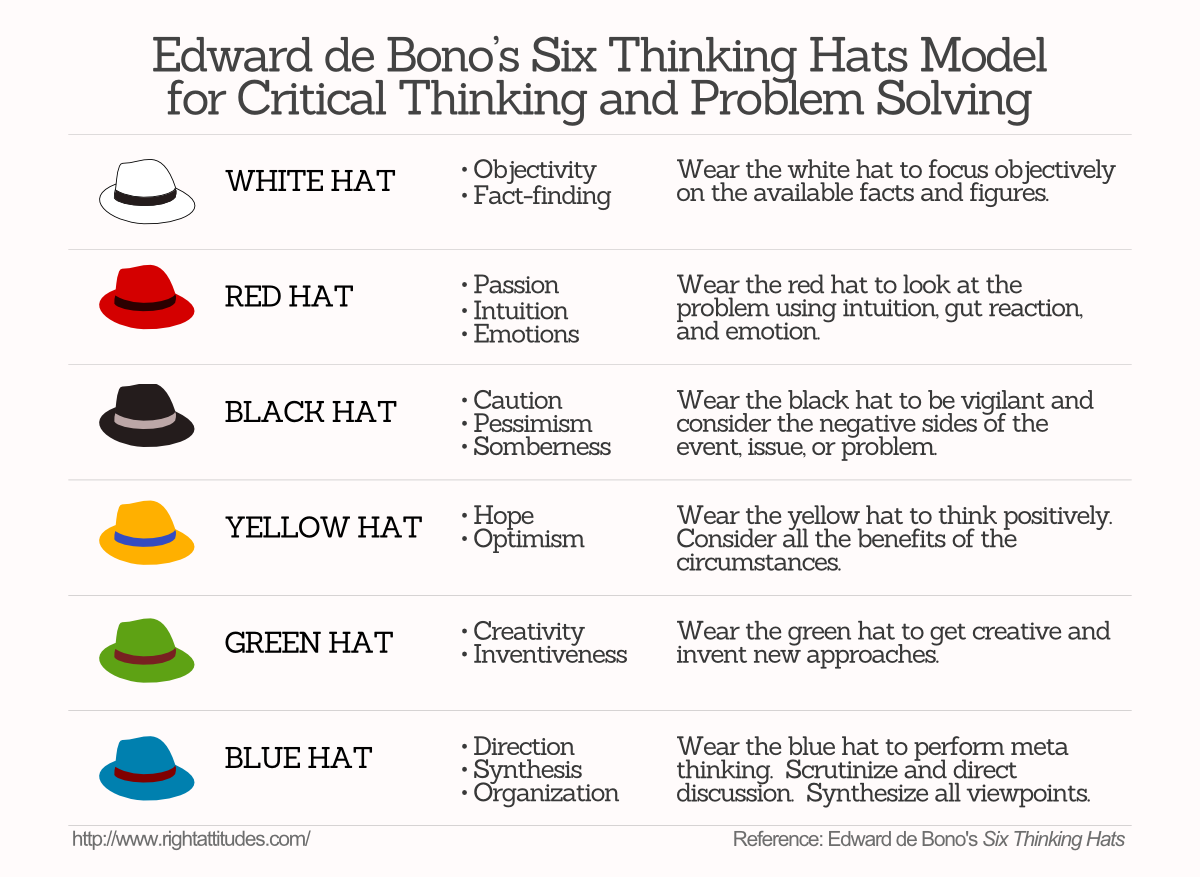
  1. White is neutral, objective, and fact-based. A white hat is concerned with objective data: “What information do we have? What information do we need? What information are we missing? How can get the information we need? What objective questions should be asked?”
  2. Red denotes passion, anger, intuition, and emotions. A red hat considers the emotional side of problem solving, which is often neglected or masked in meetings: “What are our gut reactions to the matter at hand?”
  3. Black is somber, serious, and cautious. A black hat is vigilant, plays devil’s advocate, and encourages derogatory and judgmental behavior: “what are the weaknesses of these ideas? What are the risks? What could go wrong?”
  4. Yellow represents positive thinking, hope, and optimism to counteract the black hat’s power. A yellow hat plays “the angel’s advocate” and is cheerful and confident: “What are the best-case scenarios? What are the best aspects of this? What are the advantages? Who can benefit from this?”
  5. Green signifies abundance, growth, richness, and fertility. A green hat is the hat of creativity; it rejects established rules and norms, and invents new approaches: “What are some new ideas on this subject? What is interesting about this idea? What are the variances in these ideas?”
  6. Blue represents the sky and therefore provides the overarching perspective. A blue hat performs “meta thinking” and is concerned with the organization of the thinking process and the use of other hats. The blue hat synthesizes and reconciles different viewpoints. At the start of a brainstorming session, the blue hat sets the stage for where the discussion may go. The blue hat guides and sustains the discussion, often restating its purposes: “What are we thinking about? What is the goal? What should we do next? What have we achieved so far? What should we do to achieve more?” At the conclusion of the brainstorming session, the blue hat appraises the discussion, and proposes a plan of action.

Use De Bono’s Six Thinking Hats Model for Critical Thinking and Problem Solving

'Six Thinking Hats' by Edward de Bono (ISBN 0316178314) An individual working alone may use the approach to consider broader, distinct lines of thought. By changing hats, the individual can switch viewpoints and ensure that he/she is not stuck in specific thinking patterns.

However, the approach is best suited to group discussions (when chaired by a skilled facilitator) in which conflicting ideas may never otherwise be fully synthesized into plans of action. By persuading each participant to think constructively alongside other participants, the ‘six thinking hats’ method taps into group members’diverse perspectives and uses their collective knowledge without destructive conflict.

Using these hats nurtures creativity by letting participants step beyond their typical roles and contribute to developing, organizing, and progressing ideas. Participants can also identify how their cognitive state at any one time shapes how they approach problems.

Recommendation: Read. Edward de Bono’s Six Thinking Hats presents a very effective technique for stimulating group creativity. The method can remove mental blocks, organize ideas and information, foster cross-fertilization, and help conduct thinking sessions more productively than do other brainstorming methods.

Complement with Dan Ciampa’s Taking Advice for an excellent framework on the kind of advice network you need on strategic, operational, political, and personal elements of your work and life. Read my summary in this article.

Wondering what to read next?

  1. Finding Potential Problems & Risk Analysis: A Case Study on ‘The Three Faces of Eve’
  2. The Curse of Teamwork: Groupthink
  3. This is Yoga for the Brain: Multidisciplinary Learning
  4. Creativity by Imitation: How to Steal Others’ Ideas and Innovate
  5. Four Ideas for Business Improvement Ideas

Filed Under: Mental Models, Sharpening Your Skills Tagged With: Conversations, Creativity, Critical Thinking, Mental Models, Networking, Social Dynamics, Teams, Thinking Tools, Thought Process, Winning on the Job

Stuck on a Problem? Shift Your Perspective!

March 11, 2016 By Nagesh Belludi 1 Comment

The World’s Second Funniest Joke

In 2001, Richard Wiseman led an international humor experiment to find the world’s funniest joke. He had internet users submit and rate 40,000 jokes. Of these, the second-funniest joke was the following (the world’s funniest joke is here.)

Sherlock Holmes and Dr. Watson are camping. They pitch their tent under the stars and go to sleep. Sometime in the middle of the night, Holmes wakes Watson up.

Holmes: “Watson, look up at the stars, and tell me what you deduce.”

Watson: “I see millions of stars and even if a few of those have planets, it’s quite likely there are some planets like earth, and if there are a few planets like earth out there, there might also be life. What does it tell you, Holmes?”

Holmes: “Watson, you idiot, somebody has stolen our tent!”

Fixation: an Impediment to Successful Problem Solving

The joke suggests the psychological concept of fixation. Fixation occurs when you view a problem from only one perspective preventing you from seeing the obvious or breaking from a routine way of thinking.

To change an entrenched pattern of thinking, try to shift your perspective—literally or metaphorically. A shift in perspective can change your physical position and thus alter your point of view in a literal and sensory way, or it may change the way you think about or define the problem at hand.

The fields of arts and the sciences are replete with examples of how a different frame of mind can offer creative insight. As I cited in my article on the start of Picasso’s Blue Period, many artistic styles develop when artists feel the need to change the way their art represents the world. The new style therefore presents an alternative perspective.

Idea for Impact: Get Creative by Shifting Your Perspective

Shifts in perspective are fundamental to many facets of the creative process. As I stated in my previous article on reframing, the solution to many difficult problems can be found merely by defining or formulating them in a new, more productive way.

If you’re stuck on a problem, stand back and apply a different lens to break away from your current perspective.

Alternatively, simply take time away from your problem. A relaxation of effort may help you see something that is obvious after the break, but was previously overlooked or taken for granted.

Wondering what to read next?

  1. Reframe Your Thinking, Get Better Answers: What the Stoics Taught
  2. Howard Gardner’s Five Minds for the Future // Books in Brief
  3. You Can’t Develop Solutions Unless You Realize You Got Problems: Problem Finding is an Undervalued Skill
  4. Finding Potential Problems & Risk Analysis: A Case Study on ‘The Three Faces of Eve’
  5. Good Questions Encourage Creative Thinking

Filed Under: Mental Models, Sharpening Your Skills Tagged With: Creativity, Humor, Philosophy, Thinking Tools, Thought Process, Winning on the Job

How to Become a Broad-thinker: Principles and Methods

December 18, 2015 By Nagesh Belludi Leave a Comment

Success depends on understanding basic principles as well as on developing and practicing workable methods.

  • Elon Musk, CEO of SpaceX and Tesla, recently advised in his Reddit AMA, “It is important to view knowledge as sort of a semantic tree—make sure you understand the fundamental principles, i.e. the trunk and big branches, before you get into the leaves/details or there is nothing for them to hang on to.”
  • Harrington Emerson, a prominent management consultant and efficiency expert during the early 1900s, is understood to have said that the key to becoming a broad-thinker is to focus on the principles: “As to methods, there may be a million and then some, but principles are few. The man who grasps principles can successfully select his own methods. The man who tries methods, ignoring principles, is sure to have trouble.” (This quote is often incorrectly attributed to American essayist Ralph Waldo Emerson.)

Principles are the fundamental set of philosophies, propositions, assumptions, laws, and rules concerning a topic, problem, or circumstances. The principles can teach you why something works the way it does.

Methods, on the other hand, are merely devices to apply those principles in a particular circumstance.

While principles are immutable, Emerson reminds us that there can be many methods to interpret and apply those principles.

Principles and Methods

Given the time-pressure induced by the hurried world of work, we are often so tempted to implement ready-made or handed-down methods that we forgo the necessary examination of underpinning principles.

By delving directly into methods, we can find some reliable direction and save a great deal of time, but we may be neglecting many factors that can affect the outcomes of our methods. These circumferential issues, second- and higher-order effects, and peripheral relationships may not be readily apparent at the outset. They will emanate only from a knowledge of the underlying principles.

Idea for Impact: To be an effective thinker, develop a broad understanding and appreciation of the principles before you develop or deploy methods.

Wondering what to read next?

  1. Reframe Your Thinking, Get Better Answers: What the Stoics Taught
  2. Finding Potential Problems & Risk Analysis: A Case Study on ‘The Three Faces of Eve’
  3. Good Questions Encourage Creative Thinking
  4. Creativity by Imitation: How to Steal Others’ Ideas and Innovate
  5. Four Ideas for Business Improvement Ideas

Filed Under: Mental Models, Sharpening Your Skills Tagged With: Creativity, Elon Musk, Thinking Tools, Thought Process, Winning on the Job

Make a Difficult Decision Like Benjamin Franklin

October 30, 2015 By Nagesh Belludi Leave a Comment

Benjamin Franklin, American inventor, journalist, printer, diplomat, author, and founding father Benjamin Franklin (1706–1790) was renowned for his lifelong quest for self-improvement, as he thoroughly documented in his “Autobiography” (1791.)

In my previous article on Benjamin Franklin’s “Plan for Conduct,” I noted that Franklin had a methodical mindset.

As a young adult, Franklin developed a method for making complex decisions. At age 66, in a letter to his close friend Joseph Priestley (a London chemist who, in 1774, isolated the element oxygen,) Franklin described this method.

In this letter written on September 19, 1772, Franklin mentions one of the key challenges of fact-collecting and decision-making:

In the affair of so much importance to you, wherein you ask my advice, I cannot for want of sufficient premises, advise you what to determine, but if you please I will tell you how. When these difficult cases occur, they are difficult chiefly because while we have them under consideration all the reasons pro and con are not present to the mind at the same time; but sometimes one set present themselves, and at other times another, the first being out of sight. Hence the various purposes or inclinations that alternately prevail, and the uncertainty that perplexes us.

Make a Difficult Decision Like Benjamin Franklin - T-charts

Then, Franklin describes how to weigh the “pro et contra” (Latin for “for and against”) in any situation:

To get over this, my way is, to divide, half a sheet of paper by a line into two columns, writing over the one pro, and over the other con. Then during three or four day’s consideration I put down under the different heads short hints of the different motives that at different times occur to me for or against the measure. When I have thus got them all together in one view, I endeavor to estimate their respective weights; and where I find two, one on each side, that seem equal, I strike them both out: if I find a reason pro equal to some two reasons con, I strike out the three. If l judge some two reasons con equal to some three reasons pro, I strike out the five; and thus proceeding I find at length where the balance lies; and if after a day or two of farther consideration nothing new that is of importance occurs on either side, I come to a determination accordingly. And though the weight of reasons cannot be taken with the precision of algebraic quantities, yet when each is thus considered separately and comparatively, and the whole lies before me, I think I can judge better, and am less likely to make a rash step; and in fact I have found great advantage from this kind of equation, in what may be called moral or prudential algebra.

'The Benjamin Franklin Reader' by Walter Isaacson (ISBN 743273982) Ben Franklin’s humble tool for decision-making is now known as the T-Chart. It is widely used to examine two opposing facets of a topic, object, situation, circumstance, or event under consideration. T-Charts are particularly helpful for analyzing advantages and disadvantages, as well as strengths and weaknesses.

Recommended Reading: For a great collection of the writings of Benjamin Franklin, including his “Autobiography”, see Walter Isaacson’s “A Benjamin Franklin Reader”.

Wondering what to read next?

  1. Make Decisions Using Bill Hewlett’s “Hat-Wearing Process”
  2. Question the Now, Imagine the Next
  3. Disproven Hypotheses Are Useful Too
  4. The Solution to a Problem Often Depends on How You State It
  5. How to Solve a Problem By Standing It on Its Head

Filed Under: Great Personalities, Mental Models, Sharpening Your Skills Tagged With: Creativity, Decision-Making, Discipline, Thinking Tools, Thought Process

Reframe Your Thinking, Get Better Answers: What the Stoics Taught

September 29, 2015 By Nagesh Belludi Leave a Comment

The solution to many a difficult problem can be found merely by reframing the problem, thereby changing or adjusting your perception of the issue.

Reframing is a very effective technique to shift your view of a specific problem, event, or person. When you approach a situation from another perspective, you are likely to reevaluate your intentions and find alternative, acceptable solutions to your situations.

Reframing helps in two ways:

  • Reframing allows you to consider a problem within a positive—rather than a negative—context. For example, if you’re trying out a diet, you can reframe it by asking yourself “What are some foods I like that I should eat more of? What new foods can I experiment with?” rather than wondering, “What foods must I give up?” Reframing can help turn a problem into an opportunity, a weakness into a strength, an impossibility into a work-around, and a conflict into a mere lack of understanding.
  • Reframing can also broaden a problem’s context, thus helping you recognize its systemic contributors. In other words, by reframing, you look at a problem within its larger context. For example, you could reframe an individual issue, “Why won’t Tom gel with our team?” to a systemic problem, “What are the attributes of our team that make Tom feel excluded?”

“Redirect your prayers … and watch what happens”

The great Roman Emperor and Stoic Philosopher Marcus Aurelius wrote in “Meditations” (trans. Gregory Hays,)

'Meditations: A New Translation' by Marcus Aurelius (ISBN 0812968255)Either the gods have power or they don’t. If they don’t, why pray? If they do, then why not pray for something else instead of for things to happen or not to happen? Pray not to feel fear. Or desire, or grief. If the gods can do anything, they can surely do that for us.

But those are things the gods left up to me.

Then isn’t it better to do what’s up to you—like a free man—than to be passively controlled by what isn’t, like a slave or beggar? And what makes you think the gods don’t care about what’s up to us?

Start praying like this and you’ll see.

Not “some way to sleep with her”—but a way to stop wanting to.

Not “some way to get rid of him”—but a way to stop trying.

Not “some way to save my child”—but a way to lose your fear.

Redirect your prayers like that, and watch what happens.

Idea for Impact: Reframe, Always Reframe

If you find yourself stuck with a problem or difficult situation, try reframing your view of that problem. Consider alternate perspectives, revise your goals, and reconsider how you see the way forward.

To reframe, simply step back from your present viewpoint and alter the “lens” through which you perceive the reality. Discover your unspoken assumptions, challenge your beliefs, change the attributes of your perception of the problem, and downplay or emphasize various elements of the situation. By “looking at it another way” you can derive new meanings and define different courses of action.

Wondering what to read next?

  1. Stuck on a Problem? Shift Your Perspective!
  2. Howard Gardner’s Five Minds for the Future // Books in Brief
  3. You Can’t Develop Solutions Unless You Realize You Got Problems: Problem Finding is an Undervalued Skill
  4. Finding Potential Problems & Risk Analysis: A Case Study on ‘The Three Faces of Eve’
  5. Good Questions Encourage Creative Thinking

Filed Under: Mental Models, Sharpening Your Skills Tagged With: Creativity, Philosophy, Stoicism, Thinking Tools, Thought Process, Winning on the Job

Creativity & Innovation: The Opportunities in Customer Pain Points

September 15, 2015 By Nagesh Belludi Leave a Comment

The Opportunities in Customer's Pain Points

Ellis Paul Torrance, the American psychologist who devoted his career to researching and teaching creativity, observed that “the process of sensing gaps or disturbing missing elements and formulating hypotheses” is pivotal to the creative process.

This is especially true of solving customer’s problems. Many innovative ideas are born of a reliable formula: prudent attention to and empathy with customers’ experiences, as well as applying resourceful imagination to solve customers’ pain points.

Many an innovator—either as a provider or as a consumer—develops deep empathy for customers’ pain points and sees an underexploited customer-need for convenience. The innovator contemplates, “This customer’s experience does not have to be expensive, protracted, hard, or inferior, as it is with the incumbent provider.” The innovator then uses his/her imagination to convert that understanding into a business idea with broad potential.

Consider the following cases of innovation that could be traced back to customer pain points:

  • Crispy Potato Chips. Legend has it that in the 1850s, Chef George Crum of New York’s Saratoga Springs created potato chips. A cranky customer at Moon’s Lake House frequently sent Crum’s fried potatoes back to the kitchen complaining that they were mushy and not crunchy enough. To appease the customer, Crum sliced the potatoes as thin as possible and deep-fried them. The customer loved them. Before long, “Saratoga Chips” became popular throughout New England.
  • Airtight Packaging for Potato Chips. When potato chips were first mass-produced for home consumption, they were packaged and distributed in metal containers, in which the chips would quickly go stale. During the 1920s in Monterey Park, California, Laura Scudder conceived of packaging potato chips in sealed bags. Scudder’s employees ironed wax paper into the form of bags and fill them up with potato chips. This airtight packaging not only kept the chips fresh and crisp longer, but also reduced crumbling. After the invention of the moisture-proof cellophane wrap by DuPont a few years later, chips were packaged in polymer bags. Then, nitrogen gas was blown in to prevent oxidation, extend shelf life, and prevent chips from being crushed as they were handled and distributed.
  • Netflix. At the video rental chain Blockbuster, customers who were paying the most in late fees were also the company’s most prolific renters. Even as they continued to patronize Blockbuster, these customers vented their frustration to Blockbuster’s employees, as well as to other existing and potential customers. In fact, in the ’90s, almost $300 million or 20% of Blockbuster’s pretax profit came from late fees. In 1997, Reed Hastings, one devoted Blockbuster customer, was charged $40 in late fees on a VHS tape of the movie Apollo 13. Frustrated by his fees, Hastings started Netflix, a mail-distribution movie-rental service. As soon as the business caught on, Hastings eliminated late fees. Netflix grew quickly, drove Blockbuster into bankruptcy in 2010, and is now valued at $50 billion.
  • Google News. After 9/11, Google engineer Krishna Bharat and his teammates repeatedly visited ten to 15 news sites looking for a wide range of news reports. Using Google’s legendary “20% Time” policy that allows employees to spend one day a week on side projects and collaborate beyond their immediate teams, Bharat wrote an artificial intelligence software to crawl thousands of news websites, cluster news articles based on topics and keywords, and aggregate a summary. Other engineers at Google loved Bharat’s prototype software and joined the effort to build Google News.
  • Corning’s Gorilla Glass for Smartphones. By 2007, cell phone makers and consumers were frustrated with the screens on their cell phones. The plastic screens broke too easily when the handsets were dropped, and keys and other objects left deep scratches. Sensing a business opportunity, some engineers at Corning dug into their corporate archives. They dredged up the formulation of a super-strong, flexible glass, Chemcor, which was unsuccessfully prototyped for automobile windshields during the 1960s. The engineers spent $300,000 to produce a trial run of Chemcor and discussed the results with cell phone manufacturers. The resulting cell phone glass was called Gorilla Glass and was widely adopted by Samsung, LG, Motorola, and other cell phone manufacturers. Gorilla’s thinness, strength, and resistance to scratches became the defining feature of touch-screen operation. Later Gorilla Glass became a core component on the iPhone, smartphones, tablets, and other portable devices. For Corning, Gorilla Glass has become a significant revenue stream.
  • Uber. In 2008, during a snowy night on a trip to attend a tech conference in Paris, American entrepreneurs Garrett Camp and Travis Kalanick had trouble getting a cab. Garrett purportedly said in frustration, “Why can’t we just tap a button and get a ride?” Before long, during a brainstorming session on ideas for new startups, Camp and Kalanick thought of starting a taxi company with a smartphone app to summon taxis. Instead, they built an app to hail taxi-rides on-demand and opened their app for use by established taxi companies as well as by casual autonomous drivers. In 2010, they launched UberCab in San Francisco. Uber is now worth $50 billion and operates in over 300 cities around the world.

Idea for Impact: Transform Customer Pain Points into Customer Delight

Customer pain points are a consistent pointer to potential opportunities not least because customers are usually willing to pay a premium to have their frustrations with a product or a service resolved.

Discover what opportunities may exist in your customers’ pain points. Examine product- and service-features that your customers find inadequate, more urgent, unpleasant, frustrating, or otherwise troubling. Consider how you could transform those product- and service-deficiencies into innovative features.

Don’t just satisfy customers; delight them by becoming more sensitive to their problems and reducing or eliminating their pain points.

Wondering what to read next?

  1. Make ‘Em Thirsty
  2. Restless Dissatisfaction = Purposeful Innovation
  3. What Taco Bell Can Teach You About Staying Relevant
  4. Constraints Inspire Creativity: How IKEA Started the “Flatpack Revolution”
  5. The #1 Clue to Disruptive Business Opportunity

Filed Under: Mental Models, Sharpening Your Skills Tagged With: Creativity, Customer Service, Innovation, Parables, Persuasion, Problem Solving, Skills for Success, Thinking Tools, Winning on the Job

« Previous Page
Next Page »

Primary Sidebar

Popular Now

Anxiety Assertiveness Attitudes Balance Biases Coaching Conflict Conversations Creativity Critical Thinking Decision-Making Discipline Emotions Entrepreneurs Etiquette Feedback Getting Along Getting Things Done Goals Great Manager Innovation Leadership Leadership Lessons Likeability Mental Models Mindfulness Motivation Networking Parables Performance Management Persuasion Philosophy Problem Solving Procrastination Psychology Relationships Simple Living Social Skills Stress Suffering Thinking Tools Thought Process Time Management Winning on the Job Wisdom

About: Nagesh Belludi [hire] is a St. Petersburg, Florida-based freethinker, investor, and leadership coach. He specializes in helping executives and companies ensure that the overall quality of their decision-making benefits isn’t compromised by a lack of a big-picture understanding.

Get Updates

Signup for emails

Subscribe via RSS

Contact Nagesh Belludi

RECOMMENDED BOOK:
When Things Fall Apart

When Things Fall Apart: Pema Chödrön

Buddhist nun Pema Chodron's treasury of wisdom for overcoming life's pain and difficulties, and ways for creating effective social action.

Explore

  • Announcements
  • Belief and Spirituality
  • Business Stories
  • Career Development
  • Effective Communication
  • Great Personalities
  • Health and Well-being
  • Ideas and Insights
  • Inspirational Quotations
  • Leadership
  • Leadership Reading
  • Leading Teams
  • Living the Good Life
  • Managing Business Functions
  • Managing People
  • MBA in a Nutshell
  • Mental Models
  • News Analysis
  • Personal Finance
  • Podcasts
  • Project Management
  • Proverbs & Maxims
  • Sharpening Your Skills
  • The Great Innovators

Recently,

  • Book Summary: Hadley Freeman’s ‘Life Moves Pretty Fast’—How ’80s Movies Wrote America’s Story
  • Inspirational Quotations #1150
  • Corporate Boardrooms: The Governance Problem Everyone Knows and Nobody Fixes
  • Every Agreement Has a Loophole: What Puma’s Pele Gambit Teaches About Lateral Thinking
  • Five Simple Changes That Can Save You the Most Time
  • Inspirational Quotations #1149
  • Sadness Isn’t a Diagnosis

Unless otherwise stated in the individual document, the works above are © Nagesh Belludi under a Creative Commons BY-NC-ND license. You may quote, copy and share them freely, as long as you link back to RightAttitudes.com, don't make money with them, and don't modify the content. Enjoy!