• Skip to content
  • Skip to primary sidebar

Right Attitudes

Ideas for Impact

Persuasion

The Duplicity of Corporate Diversity Initiatives

February 5, 2013 By Nagesh Belludi Leave a Comment

Corporate Diversity Initiatives Even after years of diversity initiatives in corporate America, “inclusion” is more about meeting the numbers on gender, race, and other obvious differences, and less about pursuing intellectual, ideological, pedagogical, and stylistic diversity within teams and organizations.

Overall, the workforce diversity initiatives have succeeded in deterring explicit discriminatory behavior and preventing employee lawsuits. However, to make the representation numbers look good, corporate diversity initiatives have largely resulted in exclusionary practices for the preferential hiring and promoting of underrepresented demographic groups, much to the chagrin of those who are more competent, yet arbitrarily overlooked because the latter belong to groups that are numerically “overrepresented”—reverse discrimination, indeed. For fear of reprisal, the shortchanged majority is reluctant to speak out against this veiled unfairness or to call attention to the dichotomy between the ideals and the practice of affirmative action in the workplace.

Even if nearly all corporate mission statements extol the virtues of “valuing differences,” managers stifle individuality down in the trenches. They are less willing to be receptive of distinctive viewpoints and seek to mold their employees to conform to the existing culture of the workplace and to comply with the existing ways of doing things. Compliant, acquiescent employees who look the part are promoted in preference to exceptional, questioning employees who bring truly different perspectives to the table. The nail that sticks its head up indeed gets hammered down.

Wondering what to read next?

  1. The Unlikely Barrier to True Diversity
  2. Why You May Be Overlooking Your Best Talent
  3. The Double-Edged Sword of a Strong Organizational Culture
  4. Don’t Manage with Fear
  5. The Business of Popular Causes

Filed Under: Leadership, Leading Teams Tagged With: Diversity, Group Dynamics, Hiring & Firing, Introspection, Persuasion, Questioning, Relationships, Workplace

How to Argue like the Wright Brothers

February 15, 2012 By Nagesh Belludi 2 Comments

The Wright brothers, most notable for inventing powered flight, also enjoyed developing their critical thinking by fiercely debating with each other.

Wilbur and Orville found debating and challenging each other’s viewpoints was a constructive way to identify solutions to a myriad of problems or resolve their interpersonal conflicts.

The Wright brothers often took two different sides of an argument, debated the subject, then switched sides and debated the opposing argument. Orville Wright once narrated, “Often, after an hour or so of heated argument, we would discover that we were as far from agreement as when we started, but that each had changed to the other’s original position.”

Idea for Impact: Only when you contrast your point of view with an opponent’s does your own make sense. Use the Wright Brothers’ technique of double-sided debate to question your own preconceptions about an issue and appreciate alternative perspectives.

Wondering what to read next?

  1. To Make an Effective Argument, Explain Your Opponent’s Perspective
  2. How to Gain Empathic Insight during a Conflict
  3. Rapoport’s Rules to Criticize Someone Constructively
  4. Presenting Facts Can Sometimes Backfire
  5. Don’t Ignore the Counterevidence

Filed Under: Effective Communication, Sharpening Your Skills Tagged With: Conflict, Conversations, Critical Thinking, Getting Along, Persuasion, Thinking Tools, Thought Process

To Make an Effective Argument, Explain Your Opponent’s Perspective

December 12, 2008 By Nagesh Belludi Leave a Comment

“The man who can hold forth on every matter under debate in two contradictory ways of pleading, or can argue for and against every proposition that can be laid down – such a man is the true, the complete, and the only orator.”
– Cicero

“If you can’t imagine how anyone could hold the view you are attacking, you just don’t understand it yet.”
– Anthony Weston, ‘Rulebook for Arguments’

Explaining the Other Side of the Argument

Entrepreneur and blogger Ben Casnocha presents an effective discussion / debating / interviewing technique:

Here is one of the simplest ways to test someone’s knowledge of an issue: ask them to explain the other side of the argument. Ask the person who’s in favor of spending more money on marketing project X to explain the thinking process behind those who oppose the budgetary move.

I have yet to find a more efficient and reliable way to probe the depths of a person’s knowledge and seriousness about an issue than asking them to explain the other side’s perspective.

How can you effectively argue for your side if you don’t understand the arguments of the other?

Never Limit Your Ability to Learn From Opposite Perspectives

Never Limit Your Ability to Learn From Opposite Perspectives Habitually, we discard contrasting opinions without making an effort to explore their significance. We shape our attitudes and seek facts to support our own beliefs without contemplating the merits of opposite perspectives. We fail to realize that, when we do not understand opposite perspectives enough to justify their merits, we almost certainly do not understand them enough to dismiss them either.
Develop the curiosity to see the world from new perspectives and discover opposite circumstances, whether you believe in them or not. If you follow faith X, attend services of faith Y; if you are conservative, explain the liberal outlook; if you hold the western philosophy on a particular subject, reason the eastern viewpoint; if you oppose a particular legislation, argue the merits of legislation. Instead of asking ‘ why ,’ ask ‘why not .’

When you pause arguing with an opposite perspective and try arguing for it, when you switch your point of view briefly, you will witness a profound shift in your thinking.

  • Your own attitudes may look different when seen from the opposite perspective. It can help you reinforce your own beliefs and attitudes. This approach may open your mind to discover the merits, similarities, and weaknesses of your arguments that may not be obvious from your own side of the board.
  • People are often glad to work with anyone who is accommodating and tries to understand their perspectives. Therefore, your ability to persuade others improves.

Wondering what to read next?

  1. How to Gain Empathic Insight during a Conflict
  2. How to Argue like the Wright Brothers
  3. Rapoport’s Rules to Criticize Someone Constructively
  4. Presenting Facts Can Sometimes Backfire
  5. Don’t Ignore the Counterevidence

Filed Under: Effective Communication, Mental Models, Sharpening Your Skills Tagged With: Conflict, Conversations, Critical Thinking, Getting Along, Persuasion, Thinking Tools, Thought Process

Use Active Voice for Persuasive Communication

January 21, 2008 By Nagesh Belludi 1 Comment

Passive Voice Tends to be Indirect and Difficult

Consider the following messages.

  • In an email to a supplier, my engineer declared, “It was determined to use cast-iron instead of aluminum for this component.”
  • In a thank-you card, my colleague acknowledged, “Your thoughtfulness and assistance are greatly appreciated.”
  • In a facsimile cover letter, my attorney confirmed, “A copy of this letter will be sent to you by post.”

These sentences are in passive voice. Each sentence, although grammatically correct, seems impersonal and is rather obscure about responsibility of the respective actions or feelings conveyed.

In general, sentences in passive voice tend to be long-winded and indirect in expression.

Structures of Active and Passive Sentences

Sentences in active voice have the owner-verb-recipient structure. Here is an example: “Our assistant lost your project report.”

Sentences in the passive voice have the recipient-verb-owner structure. Sometimes, the owner is absent, leading to recipient-verb structures. Here are examples: “Your project report was lost by our assistant,” or just, “your project report was lost.”

‘Grammar Girl’ Promotes Active Voice

Grammar Girl, a popular blog for better written-communication skills, advocates active voice over passive voice.

Passive sentences aren’t incorrect; it’s just that they often aren’t the best way to phrase your thoughts. Sometimes passive voice is awkward and other times it’s vague.

When you put sentences in passive voice, it’s easy to leave out the agent doing the action. For example, “Amy is loved” is passive. The problem with that sentence is that you don’t know who loves Amy. In fact, politicians often use passive voice to intentionally obscure the idea of who is taking the action.

So, these are some of the reasons to avoid passive voice: the form can lead to awkward sentences and obscured meaning. Also, passive voice is wordy. You can tighten up your writing a lot if you use active voice more often than passive.

Active Voice is Ideal

Active voice is direct, simple and shorter in structure. Therefore, communications in active voice convey clarity of thought and hence are easier to understand.

Here are enhancements to the three examples in the first section of this article.

  • In his email to a supplier, the engineer could declare, “We determined to use cast iron instead of aluminum for this component.”
  • In her thank-you card, the colleague could acknowledge, “I appreciate your thoughtfulness and assistance.”
  • In her facsimile cover sheet, the attorney could confirm, “I will send you a copy of this letter by post.”

Concluding Thoughts

In our professional and personal lives, how we convey a message is just as important as the message itself. Communication is effective only when a speaker or writer and his/her audience can connect and understand the message alike. Consequently, clarity and ease-of-comprehension are two of the most important requisites to effective communication. Active voice can facilitate effective communication.

Wondering what to read next?

  1. How to Speak Persuasively and Influence Others
  2. Benefits, Not Boasts
  3. Why Good Founding Stories Sell: Stories That Appeal, Stories That Relate
  4. Nice Ways to Say ‘No’
  5. Say It Straight: Why Clarity Beats Precision in Everyday Conversation

Filed Under: Effective Communication Tagged With: Communication, Confidence, Negotiation, Persuasion

Establish Credibility for Persuasion

November 18, 2007 By Nagesh Belludi Leave a Comment

‘Facts bridge the credibility gap.’

In “The McKinsey Way,” author Ethan M. Rasiel presents numerous insights to problem solving, analytical reasoning and effective communication practiced by consultants from McKinsey & Company, one of the foremost management-consulting firms.

When a typical associate joins McKinsey & Company, she “will have graduated near the top of her college class, spent two or three years working for a large company, then received her MBA from a top business school. She will be in her mid- to late-twenties. On her first engagement, she may have to present her analysis to the CEO of a Fortune 50 company, who will not give much credence to what some newly minted, 27-year-old MBA has to say—unless she has an overwhelming weight of facts to back her up. This is just as true for a junior executive presenting a proposal to his boss.

Call for Action

One of the primary facets of our work is to sell ideas—to lead and persuade an audience to appreciate our arguments or our perceptions on a certain topic or problem.

Credibility is the cornerstone of persuasive communication. Many of us mistakenly presume that credibility is an entitlement—a function of our positions or affiliations. We fail to realise that credibility is a virtue we earn and preserve over time.

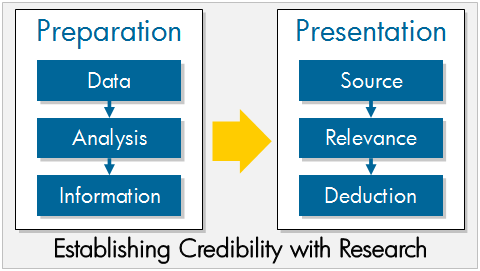
Establishing Credibility with Research

The single most effective approach to establishing credibility is to demonstrate concrete foundations to our proposed thoughts—to draw on meaningful information and deduce concrete inferences in support of our positions.

  • Collect facts and data from reliable sources. Interpret data and demonstrate its relevance. Deduce and structure your arguments in a logical manner to lead people to draw conclusions you would like them to.
  • Include particulars (data, analyses, information) of your background work in an appendix to your presentation or report.
  • Consider your position from every angle and prepare to answer questions. Address counter-arguments in your communication: “Some of you may argue that… Let me assess the risk and suggest a contingency plan.”

Bear in mind that people trust a person’s thoughts so long as they trust the underlying research.

Wondering what to read next?

  1. Use Active Voice for Persuasive Communication
  2. How to Mediate in a Dispute
  3. The Problem with Hiring Smart People
  4. Become a Smart, Restrained Communicator Like Benjamin Franklin
  5. Benefits, Not Boasts

Filed Under: Effective Communication Tagged With: Communication, Negotiation, Persuasion

« Previous Page

Primary Sidebar

Popular Now

Anxiety Assertiveness Attitudes Balance Biases Coaching Conflict Conversations Creativity Critical Thinking Decision-Making Discipline Emotions Entrepreneurs Ethics Etiquette Feedback Getting Along Getting Things Done Goals Great Manager Innovation Leadership Lessons Likeability Mental Models Mindfulness Motivation Parables Performance Management Persuasion Philosophy Problem Solving Procrastination Psychology Relationships Resilience Simple Living Social Skills Stress Suffering Thinking Tools Thought Process Time Management Winning on the Job Wisdom

About: Nagesh Belludi [hire] is a St. Petersburg, Florida-based freethinker, investor, and leadership coach. He specializes in helping executives and companies ensure that the overall quality of their decision-making benefits isn’t compromised by a lack of a big-picture understanding.

Get Updates

Signup for emails

Subscribe via RSS

Contact Nagesh Belludi

RECOMMENDED BOOK:
The Guide

The Guide: R. K. Narayan

R.K. Narayan's story of the transformation of Raju is a profound, yet dryly humorous assessment of the frailty of the human condition and the meaning and consequences of our actions

Explore

  • Announcements
  • Belief and Spirituality
  • Business Stories
  • Career Development
  • Effective Communication
  • Great Personalities
  • Health and Well-being
  • Ideas and Insights
  • Inspirational Quotations
  • Leadership
  • Leadership Reading
  • Leading Teams
  • Living the Good Life
  • Managing Business Functions
  • Managing People
  • MBA in a Nutshell
  • Mental Models
  • News Analysis
  • Personal Finance
  • Podcasts
  • Project Management
  • Proverbs & Maxims
  • Sharpening Your Skills
  • The Great Innovators

Recently,

  • Workaholism and Choice—The Real Problem Isn’t How Much You Work. It’s Whether You Chose It.
  • The Dividend of Waiting: Patience May Be the Best Bargain in Tech
  • The “Shadow Job Description”: The One Question That Changes the Interview Dynamic
  • Inspirational Quotations #1171
  • Enterprise Begins in Annoyance: How One Miserable Vacation Sparked a Global Hotel Chain
  • Wishful Thinking Is Free. Movement Pays.
  • Rumination Can Turn the Mind Into a Prison of Repetition

Unless otherwise stated in the individual document, the works above are © Nagesh Belludi under a Creative Commons BY-NC-ND license. You may quote, copy and share them freely, as long as you link back to RightAttitudes.com, don't make money with them, and don't modify the content. Enjoy!