• Skip to content
  • Skip to primary sidebar

Right Attitudes

Ideas for Impact

Negotiation

Facts Alone Can’t Sell: Lessons from the Intel Pentium Integer Bug Disaster

January 26, 2016 By Nagesh Belludi Leave a Comment

Facts Alone Can’t Change Minds

In my previous article, I discussed Aristotle’s framework for persuasion and argumentation: to persuade people on a particular point of view, it is necessary to appeal to ethos (credibility,) pathos (emotion,) and logos (logic and reason.) Some people are swayed by logic, others by appeals to emotion, and yet others defer to those who seem to possess authority, expertise, and credibility.

In this article, I give a case study of the “Intel Pentium Integer Bug Disaster” to illustrate that facts (logos) alone sometimes don’t have the power to change minds. Many people are adept at those elements of persuasion that Aristotle characterized as logos: i.e., they are proficient at making their case logically and rationally to their audience. But they may not recognize the need for the pathos aspects of persuasion and may struggle to emotionally connect with their audiences.

Mathematical Errors by the Pentium chip

Intel endured one of the most painful episodes in its history soon after it launched the Pentium processor. It was ridiculed by customers and the media for a flaw in the Pentium chip. Intel’s handling of the crisis was even worse than the bug itself. The Pentium flaw and its aftermath eventually led Intel to undertake large-scale product replacements that resulted in a $475 million write-off on its balance sheet.

In June 1994, about a year after Intel launched the Pentium microprocessor with much fanfare and a massive advertising campaign, some Internet newsgroups started discussing a flaw in the Pentium’s floating point unit. This error caused occasional mathematical errors in the chip’s advanced number-crunching component.

Intel knew about the problem. Internal investigators had established that the error “caused a rounding error in division once every nine billion times … an average spreadsheet user would run into the problem only once every 27,000 years of spreadsheet use.” Consequently, Intel’s executives concluded that the error was insignificant and didn’t pay much attention.

Much to Intel’s astonishment, some trade publications caught wind of the online discussions. In November 1994, CNN aired a nasty report about the Pentium flaw. Other media outlets pounced on Intel; The New York Times published an article titled “Flaw Undermines Accuracy of Pentium Chips.” As a direct result of all the negative publicity, Intel’s customers were up in arms and flooded Intel’s customer service lines with customer complaints. By then, Intel (through IBM, Compaq, HP, Dell, Gateway, and other computer OEMs) had shipped two million Pentium chips.

Intel Decided Stuck to Its Guns and Refused to Replace All Pentium Chips

Throughout this crisis, Intel’s leadership underestimated the scale of customer reaction because they believed that facts were in their favor. Intel’s illustrious CEO Andy Grove decided to set the record straight and issued a memo in which he acknowledged the Pentium fault, but declared that it affected only “users of the Pentium processor who are engaged in heavy-duty scientific/floating-point calculations.”

Back then, microprocessors were not yet a commodity product and consumers had paid a premium to buy computers with Pentium chips instead of those with the discounted previous-generation 486 processors. Justifiably, Intel’s customers were enraged and started demanding that Intel send them replacement chips.

In response, Intel decided to stick to its guns, because management believed in the persuasive ability of their facts. Intel’s leadership declared that they would not replace the chips unless consumers would individually call and establish that their chips would be used for advanced math calculations. At the company’s toll-free customer service line, customers had to endure a protracted interview process for Intel to deem them worthy of receiving a corrected chip. Customers who couldn’t convince Intel that they may encounter the bug in their daily computer-use didn’t make the cut.

In December 1994, all hell broke loose for Intel when IBM stopped shipments of all Pentium-based computers. Grove later recalled, “The phones started ringing furiously from all quarters. The call volume to our hotline skyrocketed. Our other customers wanted to know what was going on. And their tone, which had been quite constructive the week before, became confused and anxious. We were back on the defensive again in a major way.”

Ignoring Customer Sentiment (Pathos) Aggravated the Intel Pentium Crisis

Eventually, Intel caved in. Grove reflected, “After a number of days of struggling against the tide of public opinion, of dealing with the phone calls and the abusive editorials, it became clear that we had to make a major change.” Intel reversed its policy, established a huge customer service operation, and announced that it would replace the Pentium chip for any customer who wanted it replaced. The crisis came to pass only after Intel replaced hundreds of thousands of Pentium chips at a cost of $475 million.

The Intel Pentium Bug is a textbook example of how not to handle a delicate situation and hurt a product’s image. A good deal of this mismanagement could be attributed to an engineering-driven corporate culture within Intel, shaped in part by Grove’s attitude that facts alone could—and should—sell. He believed in the no-nonsense way of doing business: all through the crisis, Intel stuck with the facts, refused to bow before pressure, and told customers to get on with the flawed Pentium processor.

Amazingly, the Pentium Crisis Did Not Affect Intel’s Brand

Fortunately, Intel not only survived the Pentium crisis, but its brand recognition increased and Intel even appeared on Fortune magazine’s list of most admired companies. In the two years prior to the Pentium launch, Intel had embarked on an aggressive marketing campaign to build up the Intel brand. The “Intel Inside” slogan was plastered on billboards in all major markets and TV commercials repeatedly blared the renowned “Intel Inside” jingle.

Another upshot of this crisis was that the attention Intel and Pentium received brought microprocessor chips bang into the public consciousness. With the August 1995-release of Microsoft’s Windows 95, the “Wintel” partnership between Microsoft and Intel ushered a wave of consumer demand that brought inexpensive personal computing to the masses around the world.

Lessons from the Intel Pentium Disaster: Just Being a Truth Teller May Not Be Enough

'Only the Paranoid Survive' by Andrew S. Grove (ISBN 0385483821) It is fallacious to assume that logic, reason, and facts are all potent and that rationality will triumph over irrationality. During the Pentium crisis, Intel had assumed that an honest appraisal of facts of the Pentium bug would have the strength to change customer’s minds. However, sticking to facts alone backfired.

Following Aristotle’s ethos-pathos-logos framework, Intel had logos right: Intel’s assessment that the Pentium errors would not affect most people’s use of their computers was accurate. As the CEO of Intel, Grove had ethos right: his engineers were the prevalent authorities on microprocessor technology and Intel was the dominant producer of computer chips. But Intel got pathos wrong: by just presenting facts (logos) with authority (ethos) and ignoring customer sentiment (pathos), Intel’s arrogant stance was not only ineffective but also aggravated the whole Pentium crisis.

Idea for Impact: During Argumentation, Ignore Pathos At Your Own Peril

When persuading others of your ideas, don’t assume that logos alone has the power to change their minds. Don’t arm yourself with just bulletproof facts, scientific evidence, logic, and rationality and expect logos to sway others to your point of view. Recent research suggests that emotion plays a significant role even in situations where logic seems to be the dominant driver of decision-making.

Decision-making isn’t just logical, it’s emotional too. Remember, “When the heart pulls, the head tends to follow.”

Wondering what to read next?

  1. Persuade Others to See Things Your Way: Use Aristotle’s Ethos, Logos, Pathos, and Timing
  2. How to … Prepare to Be Interviewed by The Media
  3. How to … Make a Memorable Elevator Speech
  4. Deliver The Punchline First
  5. Why Good Founding Stories Sell: Stories That Appeal, Stories That Relate

Filed Under: Effective Communication, Sharpening Your Skills Tagged With: Communication, Crisis Management, Critical Thinking, Leadership, Negotiation, Persuasion, Presentations

This Manager’s Change Initiatives Lacked Ethos, Pathos, Logos: Case Study on Aristotle’s Persuasion Framework

January 22, 2016 By Nagesh Belludi Leave a Comment

In my previous article, I reviewed Aristotle’s framework for persuasion and argumentation: to win over others to a particular point of view, it’s necessary to appeal through ethos (credibility,) pathos (emotion,) and logos (reason.) In this article, I give a case study of organizational initiative that lacked ethos, pathos, and logos.

Consider the case of a young mid-level manager I coached last year. Helen (name changed for anonymity) recently joined the finance department of a capital-goods company. Two months into her job, she was bothered by her lack of initial success in bringing about change at her workplace.

Helen was smart, driven, and had a great professional track record. During her interviews, she had impressed her supervisors by her hard work, drive, and creative ideas. They recruited her to implement rigorous audit processes.

Just a few weeks after joining, Helen drew from her previous experience and generated many new and creative ideas to overhaul the financial audit processes. Her supervisors had given her all the responsibility and authority to bring about the necessary changes. However, she quickly encountered a problem: her peers and team members would not buy into her ideas.

In meetings where Helen spoke of her vision for change, her peers and team members would politely pay lip service to her ideas, but when it came to actually implementing her suggestions, nothing seemed to happen. Helen received a 360-degree feedback exercise about how her peers and team members perceived her and her ideas.

Helen was startled by the feedback she received. In response, she decided to improve her approach to selling her ideas by working on all three dimensions of Aristotle’s persuasion framework.

  • Ethos: Helen lacked ethos among her peers and her team members. She possessed ethos in the eyes of her superiors who’d recruited her and granted her authority to bring about the necessary change, but not with her peers and team members. She realized that she needed to prove herself and her ideas’ credibility.
  • Pathos: Helen had failed to elicit pathos and never took the time and effort to involve her peers and team members in the decision-making and convince them of the need for change.
  • Logos: Helen assumed that the problems she had faced at her previous employer were the same problems her new employer faced. Without learning about the corporate culture and the existing audit processes by interviewing her peers and team members, Helen had made all her recommendations for change based on things she had seen work in other settings. Her suggestions found no resonance for her new colleagues—to them she seemed to be trying to fix problems that did not exist.

Idea for Impact: To persuade others to your point of view, you must understand what truly moves your audience and then appeal through all the elements of Aristotle’s ethos-pathos-logos framework.

Wondering what to read next?

  1. Here’s a Tactic to Sell Change: As a Natural Progression
  2. Don’t Say “Yes” When You Really Want to Say “No”
  3. What Most People Get Wrong About Focus
  4. Why Good Founding Stories Sell: Stories That Appeal, Stories That Relate
  5. Honest Commitments: Saying ‘No’ is Kindness

Filed Under: Effective Communication, Sharpening Your Skills Tagged With: Assertiveness, Character, Communication, Likeability, Negotiation, Persuasion, Presentations, Relationships

Persuade Others to See Things Your Way: Use Aristotle’s Ethos, Logos, Pathos, and Timing

January 19, 2016 By Nagesh Belludi 1 Comment

During argumentation—i.e. when putting forward a point of view—your goal is to persuade your audience that your thesis is valid, engage them in your favor, change their opinion, and influence them to act as you’d like them to act.

The American literary theorist Kenneth Burke wrote in his Rhetoric of Motives, “Wherever there is persuasion, there is rhetoric. And wherever there is meaning, there is persuasion.” Learning to make effective arguments is helpful in every facet of decision-making and sharing ideas with others—not only in verbal and written discourses, but also in marketing, sales promotion, crisis-management, storytelling, courtship, social etiquette, and education.

Some 2400 years ago, the Greek philosopher Aristotle wrote one of the most important works on argumentation. In his treatise Rhetorica, he explained that arguments are more persuasive when applied in three distinct but inseparable dimensions: ethos (credibility,) logos (reason,) and pathos (emotion.) He wrote,

Of the modes of persuasion furnished by the spoken word there are three kinds. The first kind depends on the personal character of the speaker; the second on putting the audience into a certain frame of mind; the third the proof, or apparent proof, provided by the words of the speech itself … The modes of persuasion are the only true constituents of the art: everything else is merely accessory.

There are, then, these three means of effecting persuasion. The man who is to be in command of them must, it is clear, be able (1) to reason logically, (2) to understand human character and goodness in their various forms, and (3) to understand the emotions—that is, to name them and describe them, to know their causes and the way in which they are excited.

Element #1 of Persuasion: Ethos (‘Character’ in Greek)

Aristotle contended that audiences are more likely to be convinced when an argument comes from someone of standing, repute, authority, and legitimacy:

We believe good men more fully and more readily than others: this is generally true whatever the question is, and absolutely true where exact certainty is impossible and opinions are divided … It is not true, as some writers assume in their treatise on rhetoric, that the personal goodness revealed by the speaker contributes nothing to his power of persuasions; on the contrary, his character may almost be called the most effective means of persuasion he possesses.

Your ability to persuade depends on demonstrating that you are a credible authority on a subject. Credibility comes from your academic and professional credentials, social standing, integrity of character, and trustworthiness.

Ethos is also about how you express your expertise. Enhance your ethos by projecting confidence and paying attention to your mannerisms, dress, demeanor, tone, style, posture, body language, and crispness of your message. Appeal to ethos because your audience is likely to be persuaded if they believe you’re likeable and worthy of their respect. If you lack credibility, you must determine how to produce credibility, address your lack of it, or involve somebody credible who can vouch for your ideas.

Element #2 of Persuasion: Pathos (‘Suffering’ or ‘Experience’ in Greek)

As the saying goes, when the heart pulls, the head tends to follow.

Aristotle contended that persuasion also depends on making an emotional and imaginative impact on the audience by “putting the hearer into a certain frame of mind” (“ton akroaten diatheinai poos”):

Secondly, persuasion may come through the power of the hearers, when the speech stirs their emotions. Our judgments when we are pleased and friendly are not the same as when we are pained and hostile.

To appeal to emotion, you must understand and relate to the needs, values, and desires of your audience. Identify and appeal to what motivates the audience to anger and happiness, what irritates them and leads them to fear, what animates them and arouses their empathy. Defense attorneys often use this technique: they try to appeal to a jury or judge’s emotions by invoking sympathy for the accused and swaying them into thinking that the accused has done little or no wrong.

Element #3 of Persuasion: Logos (‘Word’ in Greek)

Logos refers to the argument’s clarity and integrity. Aristotle stressed logic and the appeal to reason:

Thirdly, persuasion is effected by the speech itself when we have proved a truth or an apparent truth by means of the persuasive arguments suitable to the case in question.

Appeal to your audience using logical consistency, analytical reasoning, rationale, and supporting evidence. Don’t just persuade your audience from your vantage point. Instead, construct a viewpoint that can assert your audience’s own objectives and goals.

Element #4 of Persuasion: Timing

Aristotle mentioned that timing of delivery is a fourth dimension of successful argumentation. Therefore, even if ethos, pathos, and logos are in place, efforts to persuade may fail if they are deployed at the wrong time.

These three kinds of rhetoric refer to three different kinds of time. The political orator is concerned with the future: it is about things to be done hereafter that he advises, for or against. The party in a case at law is concerned with the past; one man accuses the other, and the other defends himself, with reference to things already done. The ceremonial orator is, properly speaking, concerned with the present, since all men praise or blame in view of the state of things existing at the time, though they often find it useful also to recall the past and to make guesses at the future.

To persuade your audience, know where to focus the conversation—the past, present, or future. As the Greek didactic poet Hesiod emphasized in Works and Days, “observe due measure, for right timing is in all things the most important factor.”

Use Four Vantage Points to Improve Your Abilities in Argumentation and Negotiation

You can be more persuasive if you understand what truly moves your audience. Some people are swayed by logic, others by appeals to emotion, and still others quickly defer to those who seem to possess authority and expertise.

Aristotle’s ethos, pathos, and logos provide a clear, understandable, and easy-to-apply framework for developing argumentation. Although these three elements can be analyzed separately, they often overlap and work together. Often it may not be possible or useful to completely distinguish them.

Recommended Resources

Round up your persuasive skills by combining Aristotle’s technique with these recommended approaches.

  • Robert Cialdini’s best-selling books, Influence The Psychology of Persuasion and Science and Practice, identify six ways to persuade another person. Watch this and this YouTube videos for excellent summaries of these six principles.
    1. reciprocity, when the other acts in expectation that his/her favors will be returned
    2. commitment and consistency, when the other takes actions consistent with his/her self-image
    3. social proof, when the other replicates the actions of others
    4. authority, when the other acquiesces to authority even if the request is questionable
    5. liking, when the other is persuaded by those whom they know, like, respect, and admire
    6. scarcity, when an object becomes more desirable because it is in short supply
  • Simon Sinek’s Start with Why advocates that when pitching a product, service, idea, or proposal to an audience, you must start with answering why they should they care. “People don’t buy what you do, they buy why you do it.” Sinek’s TED talk (this YouTube video) describes his concept of “The Golden Circle”—with the ‘why’ at the core, surrounded by ‘how,’ and the finally the ‘what.’
  • Richard Shell and Mario Moussa’s The Art of Woo recommends that people use relationship-based, emotionally intelligent approaches to persuade others of the value of their ideas to “win them over” rather than to “defeat” them.
  • William Ury’s The Power of a Positive No offers a “yes-no-yes” framework to (1) connect a situation, circumstance or dilemma to your core set of interests and values, (2) communicate your decision assertively and respectfully and yet obtain the most positive outcome for you and for others.
  • Roger Fisher, William Ury, and Bruce Patton’s popular book Getting to Yes offers an step-by-step plan of action for coming to mutually satisfactory agreements to conflict.

Wondering what to read next?

  1. Facts Alone Can’t Sell: Lessons from the Intel Pentium Integer Bug Disaster
  2. How to … Make a Memorable Elevator Speech
  3. Deliver The Punchline First
  4. Why Good Founding Stories Sell: Stories That Appeal, Stories That Relate
  5. This Manager’s Change Initiatives Lacked Ethos, Pathos, Logos: Case Study on Aristotle’s Persuasion Framework

Filed Under: Effective Communication, Sharpening Your Skills Tagged With: Communication, Critical Thinking, Leadership, Negotiation, Persuasion, Presentations, Writing

Use Active Voice for Persuasive Communication

January 21, 2008 By Nagesh Belludi 1 Comment

Passive Voice Tends to be Indirect and Difficult

Consider the following messages.

  • In an email to a supplier, my engineer declared, “It was determined to use cast-iron instead of aluminum for this component.”
  • In a thank-you card, my colleague acknowledged, “Your thoughtfulness and assistance are greatly appreciated.”
  • In a facsimile cover letter, my attorney confirmed, “A copy of this letter will be sent to you by post.”

These sentences are in passive voice. Each sentence, although grammatically correct, seems impersonal and is rather obscure about responsibility of the respective actions or feelings conveyed.

In general, sentences in passive voice tend to be long-winded and indirect in expression.

Structures of Active and Passive Sentences

Sentences in active voice have the owner-verb-recipient structure. Here is an example: “Our assistant lost your project report.”

Sentences in the passive voice have the recipient-verb-owner structure. Sometimes, the owner is absent, leading to recipient-verb structures. Here are examples: “Your project report was lost by our assistant,” or just, “your project report was lost.”

‘Grammar Girl’ Promotes Active Voice

Grammar Girl, a popular blog for better written-communication skills, advocates active voice over passive voice.

Passive sentences aren’t incorrect; it’s just that they often aren’t the best way to phrase your thoughts. Sometimes passive voice is awkward and other times it’s vague.

When you put sentences in passive voice, it’s easy to leave out the agent doing the action. For example, “Amy is loved” is passive. The problem with that sentence is that you don’t know who loves Amy. In fact, politicians often use passive voice to intentionally obscure the idea of who is taking the action.

So, these are some of the reasons to avoid passive voice: the form can lead to awkward sentences and obscured meaning. Also, passive voice is wordy. You can tighten up your writing a lot if you use active voice more often than passive.

Active Voice is Ideal

Active voice is direct, simple and shorter in structure. Therefore, communications in active voice convey clarity of thought and hence are easier to understand.

Here are enhancements to the three examples in the first section of this article.

  • In his email to a supplier, the engineer could declare, “We determined to use cast iron instead of aluminum for this component.”
  • In her thank-you card, the colleague could acknowledge, “I appreciate your thoughtfulness and assistance.”
  • In her facsimile cover sheet, the attorney could confirm, “I will send you a copy of this letter by post.”

Concluding Thoughts

In our professional and personal lives, how we convey a message is just as important as the message itself. Communication is effective only when a speaker or writer and his/her audience can connect and understand the message alike. Consequently, clarity and ease-of-comprehension are two of the most important requisites to effective communication. Active voice can facilitate effective communication.

Wondering what to read next?

  1. How to Speak Persuasively and Influence Others
  2. Benefits, Not Boasts
  3. How to Mediate in a Dispute
  4. The Problem with Hiring Smart People
  5. How to … Make a Memorable Elevator Speech

Filed Under: Effective Communication Tagged With: Communication, Confidence, Negotiation, Persuasion

Establish Credibility for Persuasion

November 18, 2007 By Nagesh Belludi Leave a Comment

‘Facts bridge the credibility gap.’

In “The McKinsey Way,” author Ethan M. Rasiel presents numerous insights to problem solving, analytical reasoning and effective communication practiced by consultants from McKinsey & Company, one of the foremost management-consulting firms.

When a typical associate joins McKinsey & Company, she “will have graduated near the top of her college class, spent two or three years working for a large company, then received her MBA from a top business school. She will be in her mid- to late-twenties. On her first engagement, she may have to present her analysis to the CEO of a Fortune 50 company, who will not give much credence to what some newly minted, 27-year-old MBA has to say—unless she has an overwhelming weight of facts to back her up. This is just as true for a junior executive presenting a proposal to his boss.

Call for Action

One of the primary facets of our work is to sell ideas—to lead and persuade an audience to appreciate our arguments or our perceptions on a certain topic or problem.

Credibility is the cornerstone of persuasive communication. Many of us mistakenly presume that credibility is an entitlement—a function of our positions or affiliations. We fail to realise that credibility is a virtue we earn and preserve over time.

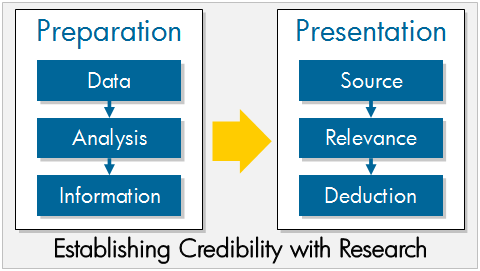
Establishing Credibility with Research

The single most effective approach to establishing credibility is to demonstrate concrete foundations to our proposed thoughts—to draw on meaningful information and deduce concrete inferences in support of our positions.

  • Collect facts and data from reliable sources. Interpret data and demonstrate its relevance. Deduce and structure your arguments in a logical manner to lead people to draw conclusions you would like them to.
  • Include particulars (data, analyses, information) of your background work in an appendix to your presentation or report.
  • Consider your position from every angle and prepare to answer questions. Address counter-arguments in your communication: “Some of you may argue that… Let me assess the risk and suggest a contingency plan.”

Bear in mind that people trust a person’s thoughts so long as they trust the underlying research.

Wondering what to read next?

  1. Here’s a Tactic to Sell Change: As a Natural Progression
  2. Why Good Founding Stories Sell: Stories That Appeal, Stories That Relate
  3. Persuade Others to See Things Your Way: Use Aristotle’s Ethos, Logos, Pathos, and Timing
  4. This Manager’s Change Initiatives Lacked Ethos, Pathos, Logos: Case Study on Aristotle’s Persuasion Framework
  5. Facts Alone Can’t Sell: Lessons from the Intel Pentium Integer Bug Disaster

Filed Under: Effective Communication Tagged With: Communication, Negotiation, Persuasion

« Previous Page

Primary Sidebar

Popular Now

Anxiety Assertiveness Attitudes Balance Biases Coaching Conflict Conversations Creativity Critical Thinking Decision-Making Discipline Emotions Entrepreneurs Etiquette Feedback Getting Along Getting Things Done Goals Great Manager Innovation Leadership Leadership Lessons Likeability Mental Models Mentoring Mindfulness Motivation Networking Parables Performance Management Persuasion Philosophy Problem Solving Procrastination Relationships Simple Living Social Skills Stress Suffering Thinking Tools Thought Process Time Management Winning on the Job Wisdom

About: Nagesh Belludi [hire] is a St. Petersburg, Florida-based freethinker, investor, and leadership coach. He specializes in helping executives and companies ensure that the overall quality of their decision-making benefits isn’t compromised by a lack of a big-picture understanding.

Get Updates

Signup for emails

Subscribe via RSS

Contact Nagesh Belludi

RECOMMENDED BOOK:
How Will You Measure Your Life

How Will You Measure Your Life: Clayton Christensen

Harvard business strategy professor Clayton Christensen's exceptional book of inspiration and wisdom for achieving a purpose-filled, fulfilling life.

Explore

  • Announcements
  • Belief and Spirituality
  • Business Stories
  • Career Development
  • Effective Communication
  • Great Personalities
  • Health and Well-being
  • Ideas and Insights
  • Inspirational Quotations
  • Leadership
  • Leadership Reading
  • Leading Teams
  • Living the Good Life
  • Managing Business Functions
  • Managing People
  • MBA in a Nutshell
  • Mental Models
  • News Analysis
  • Personal Finance
  • Podcasts
  • Project Management
  • Proverbs & Maxims
  • Sharpening Your Skills
  • The Great Innovators

Recently,

  • What Appears Self-Evident to One May Be Entirely Opaque to Another: How the Dalai Lama Apology Highlights Cultural Relativism
  • Inspirational Quotations #1136
  • Ditch Deadlines That Deceive
  • Invention is Refined Theft
  • You Need to Stop Turning Warren Buffett Into a Prophet
  • Inspirational Quotations #1135
  • What the Dry January Trap Shows Us About Extremes

Unless otherwise stated in the individual document, the works above are © Nagesh Belludi under a Creative Commons BY-NC-ND license. You may quote, copy and share them freely, as long as you link back to RightAttitudes.com, don't make money with them, and don't modify the content. Enjoy!