• Skip to content
  • Skip to primary sidebar

Right Attitudes

Ideas for Impact

Mental Models

Ten Rules of Management Success from Sam Walton

February 2, 2016 By Nagesh Belludi 1 Comment

Sam Walton (1918–1992,) the iconic founder of Walmart and Sam’s Club, was arguably the most successful entrepreneur of his generation. He was passionate about retailing, loved his work, and built and ran Walmart with boundless energy.

'Sam Walton: Made In America' by Sam Walton (ISBN 0553562835) “Made in America” is Walton’s very educational, insightful, and stimulating autobiography. It’s teeming with Walton’s relentless search for better ideas, learning from competitors, managing costs and prices to gain competitive advantage, asking incessant questions of day-to-day operations, listening to employees at all levels of Walmart, and inventing creative ways to foster an idea-driven culture. “Made in America” is also filled with anecdotes from Walton’s associates and family members—in fact, some of their opinions are less than flattering.

Former CEO of General Electric Jack Welch once said, “Walton understood people the way Thomas Edison understood innovation and Henry Ford, production. He brought out the very best in his employees, gave his very best to his customers, and taught something of value to everyone he touched.”

Here are ten insightful management ideas from “Made in America” with the relevant anecdotes from Walton or his associates.

  1. When hiring employees, look for passion and desire to grow. Having the right skills and qualifications is no doubt essential in a potential employee, but a better predictor of long-term success and career advancement is his/her passion for learning new things, commitment to a task, and a drive to get things done. A former Walmart executive recalls, “Sam would take people with hardly any retail experience, give them six months with us, and if he thought they showed any real potential to merchandise a store and manage people, he’d give them a chance. He’d make them an assistant manager. They were the ones who would go around and open all the new stores and they would be next in line to manage their own store. In my opinion, most of them weren’t anywhere near ready to run stores, but Sam proved me wrong there. He finally convinced me. If you take someone who lacks the experience and the know-how but has the real desire and the willingness to work his tail off to get the job done, he’ll make up for what he lacks.”
  2. Delegate and follow up. Delegation is indispensable; yet it remains one of the most underutilized and underdeveloped managerial skills. One element of effective delegation is consistent follow-up. Far too often, managers will delegate a task and then fail to follow up to see how things are going. Such failure to follow-up is tantamount to abdication of accountability for results, which still lies with the manager. Former Walmart CEO David Glass recalls, “As famous as Sam is for being a great motivator … he is equally good at checking on the people he has motivated. You might call his style: management by looking over your shoulder.”
  1. Persist and rally people to the cause. Passionate managers demonstrate the energy and drive needed to rally their teams around a shared vision. They engage their employees with the same messages over and over, escalate their sense of urgency, and get their vision implemented quickly. Former Walmart CEO David Glass recalls, “When Sam feels a certain way, he is relentless. He will just wear you out. He will bring up an idea, we’ll all discuss it and then decide maybe that it’s not something we should be doing right now—or ever. Fine. Case closed. But as long as he is convinced that it is the right thing, it just keeps coming up—week after week after week—until finally everybody capitulates and says, well, it’s easier to do it than to keep fighting this fight. I guess it could be called management by wearing you down.”
  2. Mentor, critique, and inspire employees. Mentoring employees is an effective way to improve employee performance and build trust and loyalty. Effective mentoring is not merely telling employees what to do. It is helping them broaden and deepen their thinking by clarifying their goals and asking the right questions. Effective mentoring is also about supporting employees as they learn and practice new skills and habits. Walton writes, “I’ve been asked if I was a hands-on manager or an arm’s-length type. I think really I’m more of a manager by walking and flying around, and in the process I stick my fingers into everything I can to see how it’s coming along. I’ve let our executives make their decisions—and their mistakes—but I’ve critiqued and advised them.”
  3. Invest in frontline employees for better customer relationships. Much of customers’ opinions about a business come from the myriad interactions they have with customer-interfacing frontline employees, who are the face of any business. If a business doesn’t get these customer experiences right, nothing else matters. Walton writes, “The way management treats the associates is exactly how the associates will then treat the customers. And if the associates treat the customers well, the customers will return again and again, and that is where the real profit in this business lies, not in trying to drag strangers into your stores for one-time purchases based on splashy sales or expensive advertising. Satisfied, loyal, repeat customers … are loyal to us because our associates treat them better than salespeople in other stores do. So, in the whole Wal-Mart scheme of things, the most important contact ever made is between the associate in the store and the customer.”
  4. Treat employees like business partners and empower them by sharing information. Effective managers foster open communication by treating employees as co-owners of the business and sharing operational data regularly. Managers empower employees by helping them understand how their contribution makes a difference, discussing opportunities and challenges, and encouraging them to contribute to solutions. Walton writes, “Our very unusual willingness to share most of the numbers of our business with all the associates … It’s the only way they can possibly do their jobs to the best of their abilities—to know what’s going on in their business. … Sharing information and responsibility is a key to any partnership. It makes people feel responsible and involved …. In our individual stores, we show them their store’s profits, their store’s purchases, their store’s sales, and their store’s markdowns.
  5. Never be satisfied. There’s always room for improvement. Effective managers never rest on their laurels and are persistently dissatisfied with the status quo. They possess a pervasive obsession for discovering problems and improving products, services, and people. Home Depot founder Bernard Marcus recalls, “If you ask Sam how’s business, he’s never satisfied. He says, ‘Bernie, things are really lousy. Our lines are too long at the cash registers. Our people aren’t being helpful enough. I don’t know what we’re gonna do to get them motivated.’ Then you ask some of these CEOs from other retail organizations who you know are on the verge of going out of business, and they brag and tell you how great everything is. Really putting on airs. Not Sam. He is down to earth and knows who he is.”
  1. Appreciate employees and give honest feedback. A key determinant of employee engagement is whether employees feel their managers genuinely care. Do the managers provide regular, direct feedback, both appreciative and corrective? Do they coach employees in their learning and career growth? Walton writes, “Keeping so many people motivated to do the best job possible involves … appreciation. All of us like praise. So what we try to practice in our company is to look for things to praise. … We want to let our folks know when they are doing something outstanding, and let them know they are important to us. You can’t praise something that’s not done well. You can’t be insincere. You have to follow up on things that aren’t done well. There is no substitute for being honest with someone and letting them know they didn’t do a good job. All of us profit from being corrected—if we’re corrected in a positive way.”
  2. Listening to employee’s complaints and concerns could be a positive force for change. Effective managers provide their employees the opportunity to not only contribute their ideas, but also air concerns and complaints. By fostering an environment of open communication, managers who handle employee opinions effectively not only boost employee motivation, performance, and morale, but also benefit from learning directly about problems with teams, organizations, and businesses. Walton writes, “Executives who hold themselves aloof from their associates, who won’t listen to their associates when they have a problem, can never be true partners with them. … Folks who stand on their feet all day stocking shelves or pushing carts of merchandise out of the back room get exhausted and frustrated too, and occasionally they dwell on problems that they just can’t let go of until they’ve shared it with somebody who they feel is in a position to find a solution. … We have really tried to maintain an open-door policy at Wal-Mart. … If the associate happens to be right, it’s important to overrule their manager, or whoever they’re having the problem … . The associates would know pretty soon that it was just something we paid lip service to, but didn’t really believe.”
  3. Learn from the competition. Effective managers understand that keeping tabs on competitors, copying their innovations as much as possible, and reaching out to customers the way competitors do is a great strategy for growing business. Sam Walton’s brother Bud recalls, “There may not be anything (Walton) enjoys more than going into a competitor’s store trying to learn something from it.” A former K-Mart board member recalls, “(Walton) had adopted almost all of the original Kmart ideas. I always had great admiration for the way he implemented—and later enlarged those ideas. Much later on, when I was retired still a K-Mart board member, I tried to advise (K-Mart) management of just what a serious threat I thought he was. But it wasn’t until recently that they took him seriously.”

Wondering what to read next?

  1. General Electric’s Jack Welch Identifies Four Types of Managers
  2. How to Manage Overqualified Employees
  3. Why Hiring Self-Leaders is the Best Strategy
  4. Seven Real Reasons Employees Disengage and Leave
  5. Fire Fast—It’s Heartless to Hang on to Bad Employees

Filed Under: Leadership, Leading Teams, Managing People, Sharpening Your Skills Tagged With: Employee Development, Entrepreneurs, Great Manager, Hiring & Firing, Mental Models, Mentoring

Lessons from Sam Walton: Cost and Price as a Competitive Advantage

November 10, 2015 By Nagesh Belludi Leave a Comment

I recently finished reading “Made in America”, the bestseller autobiography of Sam Walton (1918–1992.) The book is very educational, insightful, and stimulating.

Walton, the iconic founder of Walmart and Sam’s Club, was arguably the most successful entrepreneur of his generation. From 1985 until his death, he was the richest man in the world. On the 2015 list of the world’s richest individuals, his descendants ranked at #8, #9, #11, and #12.

Despite his immense fortune, Walton lived a humble life right up until his death. He as an enthusiastic outdoorsman and lived in a modest home in Bentonville, Arkansas, for 33 years. On quail hunting trips, he slept in smelly, old beat-up trailers and ate peanut butter sandwiches for breakfast, lunch, and dinner. He even drove a red 1985 Ford pickup and famously said, “What am I supposed to haul my dogs around in, a Rolls-Royce?”

Sam Walton's Red 1985 Ford Pickup Truck

Cost and Price Control

One of the book’s key takeaways is to “control your expenses better than your competition.” Walton says that this focus on cost-efficiency contributed more to Walmart’s enormous success than did any other aspect of his business model:

This is where you can always find the competitive advantage. For twenty-five years running—long before Wal-Mart was known as the nation’s largest retailer—we’ve ranked No. 1 in our industry for the lowest ratio of expenses to sales. You can make a lot of different mistakes and still recover if you run an efficient operation. Or you can be brilliant and still go out of business if you’re too inefficient.

A Child of the Great Depression Takes to Retail

Walton was a child of the Great Depression. The poverty he experienced while growing up in a rural Missouri farming community taught him the value of money, hard work, and perseverance.

Walton learned the value of a dollar early from his parents, who financially struggled to raise their family. The two squabbled constantly, except on one topic. “One thing my mom and dad shared completely was their approach to money: they just didn’t spend it.”

Walton was just plain cheap. His devotion to bargain became Walmart’s underpinning. He lived by a simple formula: pile it high, sell it cheap. “Say I bought an item for 80 cents. I found that by pricing it at $1.00, I could sell three times more of it than by pricing it at $1.20.” He refused to increase profit margins at the expense of price: “I might make only half the profit per item, but because I was selling three times as many, the overall profit was much greater. Simple enough.”

The Lasting Impact of Sam Walton

'Sam Walton: Made In America' by Sam Walton (ISBN 0553562835) In 1962, Walton decided that the future of retailing lay in discounting. He studied his competitors and borrowed liberally. His strategy was to buy low, sell at a discount, and make up for low margins by moving vast amounts of inventory. Over the decades, Walmart has relentlessly squeezed as much value as possible from its supply chain and passed those savings on to consumers.

Walton’s passion to serve as the “agent” for consumers has changed retailing forever. It’s hard not to overestimate Walmart’s influence on local communities and economics. Walmart’s obsessive focus on low prices changed the way Americans shop. Its bargaining power, superlative size, and logistical efficiency not only dampened inflation, but also brought about productivity gains throughout retailing and manufacturing. Its dominance has attracted backlash from labor unions, anti-sweatshop campaigners, and anti-sprawl activists. Critics also blamed Walmart for contributing to the movement toward overseas production jobs, and for destroying small-town merchants.

However, Walmart’s business model has struggled overseas, especially with profitability in countries where it operates three fourths of its international stores.

Sam Walton’s Influence on Entrepreneurs

Walton inspired legions of other entrepreneurs who thrive on managing costs and prices to gain competitive advantage. Prominently,

  • Dell’s Michael Dell kept costs low by using direct sales as his primary sales channel and orchestrating Dell’s supply chain with that of its suppliers.
  • Ryanair’s Michael O’Leary used absurdly low fares to generate demand from fare-conscious travelers who would have otherwise used alternative means of transportation or would have not traveled at all. O’Leary’s operating costs (aircraft, equipment, personnel, customer service, airport access, and handling) are one of the lowest in the airline industry.
  • Amazon’s Jeff Bezos used innovative sales-discounting methods and a strong emphasis on customer service to grab market share from traditional retailers. Without the burden of operating physical stores, Amazon’s efficiency has played a key role in the structural shift away from brick-and-mortar retail.

The “wheel of retailing” theory in corporate strategy posits that a lower-cost innovator eventually undercuts every dominant merchant. To combat the risk of cost-leadership from Amazon and other online retailers, Walmart has made major investments in e-commerce, even at the risk of cannibalizing its in-store sales.

Wondering what to read next?

  1. What Virgin’s Richard Branson Teaches: The Entrepreneur as Savior, Stuntman, Spectacle
  2. Beware of Key-Person Dependency Risk
  3. Sock Success: How THORLO’s Customer Focus Led to Big Wins
  4. HP’s “Next Bench” Innovation Mindset: Observe, Learn, Solve
  5. Creativity by Imitation: How to Steal Others’ Ideas and Innovate

Filed Under: Business Stories, Great Personalities, MBA in a Nutshell Tagged With: Entrepreneurs, Finance, Materialism, Mental Models

Situational Awareness: Learn to Adapt More Flexibly to Developing Situations

December 15, 2014 By Nagesh Belludi Leave a Comment

As humans, we are each a product of our habits. Much of our behavior is automated. This behavior—often reflexive and natural—is usually shaped by our mental models. These models or “behavioral scripts” that are ingrained in our minds influence how we process stimuli and act. As a result, our mental models influence not only our actions but also how we perceive and interpret various situations.

Mental models are very convenient: they simplify our comprehension of the world around us, streamline decision-making and help us get things done efficiently. At the same time, our reliance on these scripts comes at a cost: we tend to generalize into the future what has worked in the past. This dependence can compel us to overlook important information from the current environment. In addition, our biases often prevent us from considering factors that contradict these models. Mental models sometimes lead us to cling stubbornly to the “this is how I have always done it” mindset, which overlooks the realities of a new situation. We make mistakes when we rely on a model that doesn’t account for real-world situations.

Those mental models and behavioral scripts that we’ve grown so dependent on are the antithesis of adaptability: the characteristic of being adaptable, of being flexible under the influence of rapidly changing external conditions.

Idea for Impact: Learn to sharpen your ‘social antennae.’ Make every effort to read the circumstances and adapt more flexibly to a developing situation.

Parable: “Don’t Become Somebody”

Occasionally, it pays to feign ignorance, as exemplified by the following parable.

Once upon a time, there was a master and his pupil. The master was renowned for his esoteric teaching style. As part of a discussion regarding the self and ego development, the master advised, “Never become somebody.”

The master and pupil set out on a pilgrimage. After an exhausting trek, they stumbled upon a wilderness camp. There were no occupants or attendants around. The master and disciple assumed they could rest there. The master entered one of the cottages and immediately went to sleep. The pupil, emulating his teacher, stepped into an adjacent cottage and fell asleep.

After some time, a royal entourage returned to the camp fatigued from a hunting expedition. The monarch was furious when he glimpsed two strangers sleeping peacefully in his cottages. He dashed to the pupil, roused him and demanded, “Who are you? How dare you rest in my camp?” The pupil rose and noticed the king’s fuming countenance. Bowing respectfully, the pupil exclaimed, “I am a hermetic monk!” Incensed, the monarch ordered that the pupil be beaten up and thrown out.

Next the monarch approached the master, demanding his identity. The master quickly realized he had mistakenly helped himself to the royal cottage. Reading the monarch’s fury, the master did not answer. He feigned cluelessness, babbling, “Hmmmm.” The monarch was livid: “Can’t you understand? I want to know. Who are you?” Yet again, the master did not speak and babbled, “Hmmmm.” The monarch concluded, “He is clearly a dimwit. Take him out of here.”

Soon thereafter, the master and pupil reunited. The pupil was groaning in pain and lamented his stay in the royal camp. The master reiterated, “I told you, don’t become somebody. You ignored my advice, became somebody and suffered for it. You became a monk in that royal lodge and were punished. I did not become anybody and escaped unscathed.”

Recommended Reading

  • ‘Everyday Survival: Why Smart People Do Stupid Things’ by Laurence Gonzales
  • ‘The Power of Habit: Why We Do What We Do in Life and Business’ by Charles Duhigg
  • ‘Thinking, Fast and Slow’ by Daniel Kahneman
  • ‘Seeking Wisdom: From Darwin to Munger’ by Peter Bevelin

Wondering what to read next?

  1. Optimize with Intent
  2. The Mere Exposure Effect: Why We Fall for the Most Persistent
  3. The “Ashtray in the Sky” Mental Model: Idiot-Proofing by Design
  4. The Loss Aversion Mental Model: A Case Study on Why People Think Spirit is a Horrible Airline
  5. Restless Dissatisfaction = Purposeful Innovation

Filed Under: Sharpening Your Skills Tagged With: Biases, Mental Models, Parables

Book Summary of Nassim Taleb’s ‘Fooled by Randomness’

May 6, 2013 By Nagesh Belludi Leave a Comment

'Fooled by Randomness: The Hidden Role of Chance in Life and in the Markets' by Nassim Nicholas Taleb (ISBN 1400067936) In “Fooled by Randomness: The Hidden Role of Chance in Life and in the Markets,” Lebanese American essayist Nassim Nicholas Taleb discusses cognitive biases and irrationalities that drive human behavior and decision-making.

Principal ideas:

  • Luck, chance, and randomness play a larger role in the happenings of the world than most people acknowledge.
  • People tend to justify random outcomes as non-random and rationalize chance outcomes as results of deliberate actions.
  • Correlation does not translate to causation.
  • People tend to assume patterns in their analysis even when such patterns do not exist.
  • Variations in performance and ability can cause disproportionate rewards, difficulties, punishments, or returns.

Wondering what to read next?

  1. Gambler’s Fallacy is the Failure to Realize How Randomness Rules Our World
  2. Maximize Your Chance Possibilities & Get Lucky
  3. Question Success More Than Failure
  4. Availability Heuristic: Our Preference for the Familiar
  5. The Historian’s Fallacy: People of the Past Had No Knowledge of the Future

Filed Under: Leadership Reading, Sharpening Your Skills Tagged With: Biases, Books for Impact, Luck, Mental Models

The Halo and Horns Effects [Rating Errors]

April 30, 2010 By Nagesh Belludi 1 Comment

Preamble: We are often unaware of the many biases and prejudices that influence our social judgments. Psychologists call these “bias blind spots.” We can overcome many of these subliminal biases by teaching ourselves to be aware of them. This is the second in a series of articles on the common rating errors. See my earlier article on the recency bias.

Unconscious Judgments of an Investment Broker

A 2007 study highlights two of the most common unconscious social judgment biases. Prof. Emily Pronin of Princeton University showed study participants one of two pictures of the same man whom she introduced as an investment broker. One picture showed a suited man with a highly regarded Cornell degree and the other showed the man in casual clothing with a degree from a nondescript college. The professor asked her participants how much of a theoretical $1,000 they would invest in each. The participants rated the suited man as more competent: on average, he got $535 on without having his background checked. In contrast, the causal dresser received just $352. Not only were the participants more likely to have the second broker’s credentials verified —but also they did not consider him as trustworthy.

The Halo Effect

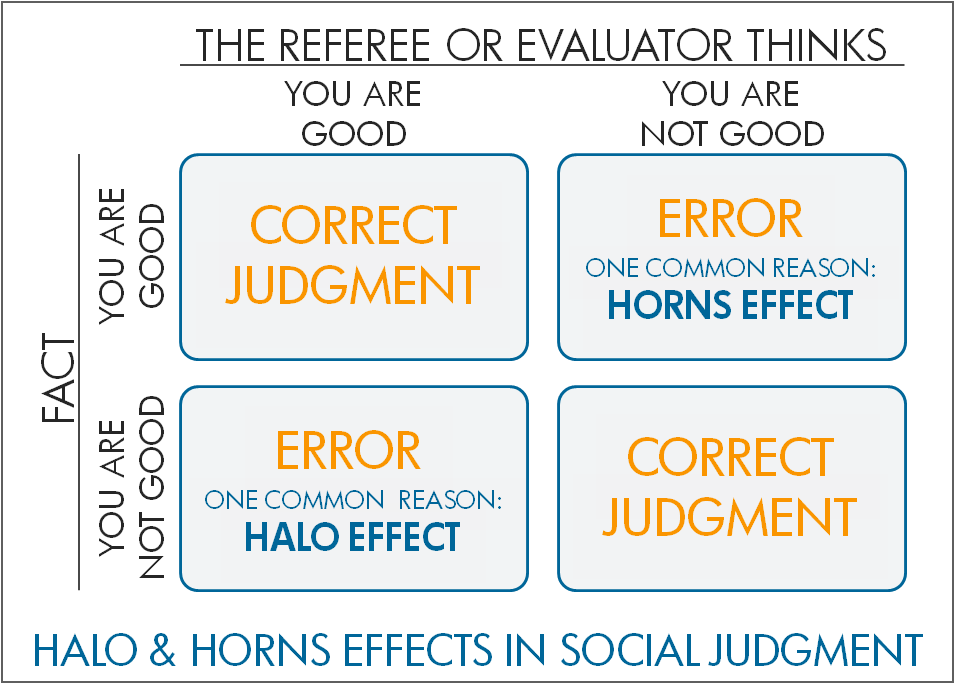
The “halo effect” captures what happens when a person who is judged positively based on one aspect is automatically judged positively on several others without much evidence. For instance, as a result of the halo effect,

  • attractive people are often judged as competent and sociable. Film stars and other celebrities are assumed pleasant and sharp-witted,
  • inexperienced interviewers tend to pay less attention to a candidate’s negative traits after discerning one or two positive traits in the first few minutes of a job interview,
  • charismatic professionals tend to get noticed and move up the corporate ladder faster, irrespective of their technical and leadership skills,
  • articulate speakers are likely to influence their audiences more even if their messages are poor in form and content.

Politicians, film and TV stars, sportspersons, celebrities and brand managers have learned to construct a halo effect and capitalize on their reputations. Apple’s iPod spawned positive impressions of other Apple products—the company took advantage of this halo effect and delivered excellent products in the iPhone and iPad. In another example, renowned fashion designers can set high prices for perfectly ordinary clothes.

Halo and Horns Effects in Social Judgment

The Horns Effect

The “horns” or “devil effect” is the concept by which a person who is judged negatively on one aspect is automatically judged negatively on several other aspects without much evidence. Clearly, this is the opposite of the halo effect.

For years, American car manufacturers have battled the mistaken public perception that cars made by Japanese companies are of significantly better quality. This misperception remains even when American car manufacturers use identical components from the same suppliers and assemble their cars using identical manufacturing processes. Even today, Japanese-brand cars resell for much higher prices than American-brand cars.

Call for Action

  • Reflect on your decision-making process to steer clear of biases. As human beings, we incessantly form opinions of people, objects, and events, both consciously and subconsciously. However, our judgment is rarely free of biases and our measures are not always comprehensive enough. Before reaching any important decision, be sure to collect all the relevant facts and reflect on whether your thought processes are free of the common biases.
  • Understand that perception is reality and be conscious of the image you are projecting. People judge the proverbial book by its cover. Your friends and family, workplace and society at large have a certain perception of who you are and what you can do, irrespective of the reality. As much as you would prefer to be evaluated based on who you actually are and what you can actually do, understand that your identity and prospects are based on others’ image of you. Do everything you can to connect people’s perception to the reality. Look and play your role. Begin by reading the seminal article on the topic of personal branding, “The Brand Called You,” written by renowned management author, Tom Peters.

Wondering what to read next?

  1. Book Summary of Nassim Taleb’s ‘Fooled by Randomness’
  2. Increase Paranoia When Things Are Going Well
  3. Availability Heuristic: Our Preference for the Familiar
  4. The Mere Exposure Effect: Why We Fall for the Most Persistent
  5. Risk Homeostasis and Peltzman Effect: Why Risk Mitigation and Safety Measures Become Ineffective

Filed Under: Leading Teams, Sharpening Your Skills Tagged With: Biases, Mental Models

Systems-Thinking as a Trait for Career Success

February 12, 2009 By Nagesh Belludi Leave a Comment

In this Fast Company article, Gary Flake, Director of Live Labs at Microsoft identifies Systems Thinking as an important trait for career success.

There are three traits that will serve anyone wanting any role at any company, not just ours: systems thinking, passion, and clear communication. Systems thinking is a way of looking at the world that allows you to see how many small pieces come together to make a more complex whole. System thinkers see the hidden interconnections that bind together the parts and know how to make the best use of ambiguity and uncertainty as a result.

Gary’s reflection reiterates the importance of understanding context and perspective in our jobs. A previous blog article and a podcast discussed this indispensable trait for success.

Systems Thinking for a Big Picture Approach

From an early age, we’re taught to break apart problems in order to make complex tasks and subjects easier to deal with. But this creates a bigger problem . . . we lose the ability to see the consequences of our actions, and we lose a sense of connection to a larger whole.
* Peter Senge

Traditional methods of problem analysis concentrate on dividing problems into smaller, more comprehensible components. The drawback of understanding isolated or unrelated elements, functions, and events is that the effects of changes to one element on other elements of the whole are rarely considered.

In contrast, the discipline of Systems Thinking emphasizes analyzing the whole in terms of interrelationships of its elements. Examining structures, relationships, and outcomes facilitates taking into account any secondary consequences of decisions and actions pertaining individual elements.

We work in increasingly connected organizations where an event that affects one part of an organization is likely to have a meaningful effect–in the short-term or the long-term–on another part of the organization. The discipline of Systems Thinking enables us to develop a broader, holistic perspective of problems and opportunities in businesses and make effective decisions.

Resources, References

Over the last couple of decades, System Thinking has evolved into a formal discipline and has incorporated several rigorous analysis techniques. Here are two excellent resources to help you gain more knowledge of these methods.

  • The ‘Thinking’ in Systems Thinking: Seven Essential Skills, Barry Richmond
  • The Fifth Discipline: The Art and Practice of the Learning Organization, Peter Senge

Wondering what to read next?

  1. Howard Gardner’s Five Minds for the Future // Books in Brief
  2. This is Yoga for the Brain: Multidisciplinary Learning
  3. You Can’t Develop Solutions Unless You Realize You Got Problems: Problem Finding is an Undervalued Skill
  4. Finding Potential Problems & Risk Analysis: A Case Study on ‘The Three Faces of Eve’
  5. Creativity by Imitation: How to Steal Others’ Ideas and Innovate

Filed Under: Career Development, Sharpening Your Skills Tagged With: Creativity, Critical Thinking, Mental Models, Thinking Tools, Thought Process, Winning on the Job

« Previous Page

Primary Sidebar

Popular Now

Anxiety Assertiveness Attitudes Balance Biases Coaching Conflict Conversations Creativity Critical Thinking Decision-Making Discipline Emotions Entrepreneurs Etiquette Feedback Getting Along Getting Things Done Goals Great Manager Innovation Leadership Leadership Lessons Likeability Mental Models Mentoring Mindfulness Motivation Networking Parables Performance Management Persuasion Philosophy Problem Solving Procrastination Relationships Simple Living Social Skills Stress Suffering Thinking Tools Thought Process Time Management Winning on the Job Wisdom

About: Nagesh Belludi [hire] is a St. Petersburg, Florida-based freethinker, investor, and leadership coach. He specializes in helping executives and companies ensure that the overall quality of their decision-making benefits isn’t compromised by a lack of a big-picture understanding.

Get Updates

Signup for emails

Subscribe via RSS

Contact Nagesh Belludi

RECOMMENDED BOOK:
Liminal Thinking

Liminal Thinking: Dave Gray

Strategic design consultant Dave Gray manual on addressing complex challenges by recognizing ignorance, seeking understanding, and creating positive change.

Explore

  • Announcements
  • Belief and Spirituality
  • Business Stories
  • Career Development
  • Effective Communication
  • Great Personalities
  • Health and Well-being
  • Ideas and Insights
  • Inspirational Quotations
  • Leadership
  • Leadership Reading
  • Leading Teams
  • Living the Good Life
  • Managing Business Functions
  • Managing People
  • MBA in a Nutshell
  • Mental Models
  • News Analysis
  • Personal Finance
  • Podcasts
  • Project Management
  • Proverbs & Maxims
  • Sharpening Your Skills
  • The Great Innovators

Recently,

  • Design for the 80% Experience
  • Inspirational Quotations #1143
  • The Hot-Desking Lie: How It Killed Focus and Gutted Collaboration
  • Unreliable Narrators Make a Story Sounds Too Neat
  • Bertrand Russell on The Value of Philosophy: Doubt in an Age of Dogma
  • Inspirational Quotations #1142
  • The Law of Petty Irritations

Unless otherwise stated in the individual document, the works above are © Nagesh Belludi under a Creative Commons BY-NC-ND license. You may quote, copy and share them freely, as long as you link back to RightAttitudes.com, don't make money with them, and don't modify the content. Enjoy!