• Skip to content
  • Skip to primary sidebar

Right Attitudes

Ideas for Impact

Decision-Making

How Stress Impairs Your Problem-Solving Capabilities: Case Study of TransAsia Flight 235

October 1, 2019 By Nagesh Belludi Leave a Comment

As I’ve examined previously, airline disasters are particularly instructive on the subjects of cognitive impairment and decision-making under stress.

Consider the case of TransAsia Airways Flight 235 that crashed in 2015 soon after takeoff from an airport in Taipei, Taiwan. Accident investigations revealed that the pilots of the ATR 72-600 turboprop erroneously switched off the plane’s working engine after the other lost power. Here’s a rundown of what happened:

  1. About one minute after takeoff, at 1,300 feet, engine #2 had an uncommanded autofeather failure. This is a routine engine failure—the aircraft is designed to be able to be flown on one engine.
  2. The Pilot Flying misdiagnosed the problem, and assumed that the still-functional engine #1 had failed. He retarded power on engine #1 and it promptly shut down.
  3. With power lost on both the engines, the pilots did not react to the stall warnings in a timely and effective manner. The Pilot Flying acknowledged his error, “wow, pulled back the wrong side throttle.”
  4. The aircraft continued its descent. The pilots rushed to restart engine #1, but the remaining altitude was not adequate enough to recover the aircraft.
  5. In a state of panic, the Pilot Flying clasped the flight controls and steered (see this video) the aircraft perilously to avoid apartment blocks and commercial buildings before clipping a bridge and crashing into a river.

A High Level of Stress Can Diminish Your Problem-solving Capabilities

Thrown into disarray after a routine engine failure, the pilots of TransAsia flight 235 did not perform their airline’s abnormal and emergency procedures to identify the failure and implement the required corrective actions. Their ineffective coordination, communication, and error management compromised the safety of the flight.

The combination of sudden threat and extreme time pressure to avert a danger fosters a state of panic, in which decision-makers are inclined to commit themselves impulsively to courses of action that they will soon come to regret.

Idea for Impact: To combat cognitive impairment under stress, use checklists and standard operating procedures, as well as increased training on situational awareness, crisis communication, and emergency management.

Wondering what to read next?

  1. What Airline Disasters Teach About Cognitive Impairment and Decision-Making Under Stress
  2. Lessons from the World’s Worst Aviation Disaster // Book Summary of ‘The Collision on Tenerife’
  3. Under Pressure, The Narrowing Cognitive Map: Lessons from the Tragedy of Singapore Airlines Flight 6
  4. “Fly the Aircraft First”
  5. The “Ashtray in the Sky” Mental Model: Idiot-Proofing by Design

Filed Under: Business Stories, Leadership, Sharpening Your Skills Tagged With: Anxiety, Aviation, Biases, Decision-Making, Emotions, Mental Models, Mindfulness, Problem Solving, Risk, Stress, Thought Process, Worry

Accidents Can Happen When You Least Expect Them: The Overconfidence Effect

September 3, 2019 By Nagesh Belludi Leave a Comment

In the context of decision-making and risk-taking, the “overconfidence effect” is a judgmental bias that can affect your subjective estimate of the likelihood of future events. This can cause you to misjudge the odds of positive/desirable events as well as negative/undesirable events.

As the following Zen story illustrates, experience breeds complacency. When confidence gives way to overconfidence, it can transform from a strength to a liability.

A master gardener, famous for his skill in climbing and pruning the highest trees, examined his disciple by letting him climb a very high tree. Many people had come to watch. The master gardener stood quietly, carefully following every move but not interfering with one word.

Having pruned the top, the disciple climbed down and was only about ten feet from the ground when the master suddenly yelled: “Take care, take care!”

When the disciple was safely down an old man asked the master gardener: “You did not let out one word when he was aloft in the most dangerous place. Why did you caution him when he was nearly down? Even if he had slipped then, he could not have greatly hurt himself.”

“But isn’t it obvious?” replied the master gardener. “Right up at the top he is conscious of the danger, and of himself takes care. But near the end when one begins to feel safe, this is when accidents occur.”

Reference: Irmgard Schlögl’s The Wisdom of the Zen Masters (1976.) Dr. Schlögl (1921–2007) became Ven. Myokyo-ni in 1984, and served as Rinzai Zen Buddhist nun and headed the Zen Centre in London.

Wondering what to read next?

  1. The “Ashtray in the Sky” Mental Model: Idiot-Proofing by Design
  2. Situational Blindness, Fatal Consequences: Lessons from American Airlines 5342
  3. Be Smart by Not Being Stupid
  4. Smart Folks are Most Susceptible to Overanalyzing and Overthinking
  5. Increase Paranoia When Things Are Going Well

Filed Under: Mental Models, Sharpening Your Skills Tagged With: Biases, Confidence, Critical Thinking, Decision-Making, Mindfulness, Parables, Risk, Thinking Tools, Thought Process, Wisdom

The Simple Life, The Good Life // Book Summary of Greg McKeown’s ‘Essentialism’

August 21, 2019 By Nagesh Belludi Leave a Comment

One of the great struggles of modern life is the intense complexity, chaos, and exhaustion of activity and reactivity. We have a tendency to take on too much, become accountable to too many people, and say ‘yes’ to too many demands on our time and our energy.

As I mentioned in my world’s shortest course on time management, the merits of ignoring the trivial many and focusing on the vital few is often overlooked. The need for essentialism—less responsibility, less fame, less money, fewer possessions, less mess—is something that’s easy to identify with, but requires abundant self-discipline to put into consistent action.

Business consultant Greg McKeown’s Essentialism: The Disciplined Pursuit of Less (2014) is an excellent reminder that a rich, meaningful life entails the elimination of the non-essential:

Essentialism is more than a time-management strategy or a productivity technique. It is a systematic discipline for discerning what is absolutely essential, then eliminating everything that is not, so we can make the highest possible contribution toward the things that really matter.

'Essentialism - The Disciplined Pursuit of Less' by Greg McKeown (ISBN 0753555166) McKeown’s wide-ranging discussion covers insightful get-a-hold-of-your-life principles—frugality, sufficiency, moderation, restraint, minimalism, and mindfulness—reframed in the essential-avoidable dichotomy. Here are prominent insights from Essentialism:

  • Get to grips with selectivity—whenever you can, judiciously select which priorities, tasks, meetings, customers, ideas or steps to undertake and which to let go. “The basic value proposition of Essentialism [is,] only once you give yourself permission to stop trying to do it all, to stop saying yes to everyone, can you make your highest contribution towards the things that really matter.”
  • Most top performers have one thing in common: they accept fewer tasks and then fixate on getting them right. “Essentialism is not about how to get more things done; it’s about how to get the right things done. It doesn’t mean just doing less for the sake of less either. It is about making the wisest possible investment of your time and energy in order to operate at our highest point of contribution by doing only what is essential.”
  • If you don’t arrange your life, someone else will. “When we forget our ability to choose, we learn to be helpless. Drip by drip we allow our power to be taken away until we end up becoming a function of other people’s choices-or even a function of our own past choices. In turn, we surrender our power to choose. That is the path of the Nonessentialist. … The Essentialist doesn’t just recognize the power of choice, he celebrates it. The Essentialist knows that when we surrender our right to choose, we give others not just the power but also the explicit permission to choose for us.”
  • Pop out at least once a year to reflect and ask questions about what you’re doing and why. “The faster and busier things get, the more we need to build thinking time into our schedule. And the noisier things get, the more we need to build quiet reflection spaces in which we can truly focus.”
  • Pursue a well-lived, joyful, meaningful life. “The life of an Essentialist is a life lived without regret. If you have correctly identified what really matters, if you invest your time and energy in it, then it is difficult to regret the choices you make. You become proud of the life you have chosen to live.”

Recommendation: Speedread Greg McKeown’s Essentialism: The Disciplined Pursuit of Less. It will remind you of the wisdom to think through—and act upon—what really matters. Essentialism is chockfull of useful instructions on how to say ‘no’ gracefully, exercise your freedom to set boundaries, discover the power of small wins, and harness the power of routines to evade the pull of nonessential distractions that can subsume you easily.

Wondering what to read next?

  1. I’ll Be Happy When …
  2. Yes, Money Can Buy Happiness
  3. Marie Kondo is No Cure for Our Wasteful and Over-consuming Culture
  4. This Ancient Japanese Concept Can Help You Embrace Imperfection
  5. Everything in Life Has an Opportunity Cost

Filed Under: Living the Good Life, Personal Finance, Sharpening Your Skills Tagged With: Balance, Decision-Making, Discipline, Getting Things Done, Goals, Happiness, Materialism, Mindfulness, Perfectionism, Philosophy, Productivity, Simple Living, Time Management, Wisdom

Ask This One Question Every Morning to Find Your Focus

July 29, 2019 By Nagesh Belludi Leave a Comment

Here’s a précis of psychologist Ron Friedman’s HBR article on how to spend the first ten minutes of your day:

Ask yourself this question the moment you sit at your desk: The day is over and I am leaving the office with a tremendous sense of accomplishment. What have I achieved?

This exercise is usually effective at helping people distinguish between tasks that simply feel urgent from those that are truly important. Use it to determine the activities you want to focus your energy on.

Then—and this is important—create a plan of attack by breaking down complex tasks into specific actions. Studies show that when it comes to goals, the more specific you are about what you’re trying to achieve, the better your chances of success.

Idea for Impact: Organize Yourself Good Concentration

Starting your day by mulling over proactively on “what should I have achieved” is a wonderful aid in keeping the mind headed in the right direction.

Planning is easier when your energy levels are highest, which, for most people, is first thing in the morning.

Knowing what your goals are before you launch your day can help you focus the mind and hold it steadily to one thing at a time and in the right order.

Wondering what to read next?

  1. Don’t Do the Easiest Jobs First
  2. Did School Turn You Into a Procrastinator?
  3. How to … Kickstart Your Day with Focus & Set a Daily Highlight to Stay on Track
  4. Why Doing a Terrible Job First Actually Works
  5. How to … Tame Your Calendar Before It Tames You

Filed Under: Living the Good Life, Mental Models, Sharpening Your Skills Tagged With: Decision-Making, Discipline, Efficiency, Getting Things Done, Mindfulness, Motivation, Procrastination, Questioning, Tardiness, Targets, Task Management, Time Management, Winning on the Job

Stop Searching for the Best Productivity System

May 29, 2019 By Nagesh Belludi 1 Comment

One of the reasons many people are not as productive as they want to be is not because they haven’t found the right ideas that can help them take charge of their lives.

They can’t be productive because they keep looking for “better” ideas instead of settling on a “good enough” idea and then putting it into rigorous practice.

Looking for the Best Can Be Counterproductive

This is comparable to weight-loss programs. People buy more and more books on dieting, but don’t lose weight by merely buying diet books. It’s easier to buy books than it is to go on a diet. Recognizing that most diet plans boil down to basic strategies—eat more fruits and veggies, keep portions under control, and stay physically active—and implementing these simple ideas purposely could be as effective a diet program as any out there.

Look, no productivity tool can fit all your requirements. The inadequacies of any productivity system you try out will drive you towards looking for a different tool. But this quest to define the best never ends.

Idea for Impact: Never underestimate the power of a simple idea that is well executed.

If you can identify a simple system and implement its key principles with discipline, you may not need the “best” system.

As Charlie Munger has stated in describing the simplicity of Warren Buffett’s philosophy at Berkshire Hathaway, “Our ideas are so simple that people keep asking us for mysteries when all we have are the most elementary ideas.”

Wondering what to read next?

  1. The Simple Life, The Good Life // Book Summary of Greg McKeown’s ‘Essentialism’
  2. Did School Turn You Into a Procrastinator?
  3. Don’t Ruminate Endlessly
  4. Do Things Fast
  5. Everything in Life Has an Opportunity Cost

Filed Under: Mental Models, Sharpening Your Skills Tagged With: Decision-Making, Discipline, Perfectionism, Productivity, Time Management

When Stress is Good

November 5, 2018 By Nagesh Belludi Leave a Comment

Stress and Anxiety Can Lead to Improved Performance

Why Some Stress Is Good for You Many people claim that they work best under pressure. There’s some truth to that. Stress is a natural response in highly competitive environments. Before an exam, important meeting, or contest, your heart rate rises and so does your blood pressure. You become more absorbed, alert, and efficient.

However, this favorable relationship applies only up to a certain level of stress. Past this level, stress impairs your performance—and eventually your heart.

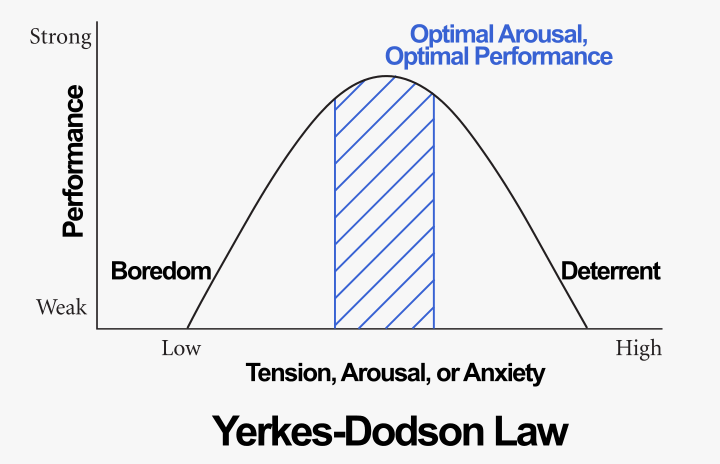
In 1908, Harvard psychologists Robert Yerkes and John Dodson first described the beneficial and harmful effects of stress (“psychological arousal”) on performance in a graph the shape of an upside-down U. According to the Yerkes-Dodson Law, the ascendant curve reflects the energizing effect of arousal. The descendant curve reflects the negative effects of stress on thinking and learning, or performance in general.

Too Much Anxiety and Stress Impairs Performance, but so Does Too Little: The Yerkes-Dodson Law

Many physiological studies have demonstrated that stress enhances your performance by causing your brain to use more of its capabilities, improve memory and intelligence, and increase productivity. Without stress, athletes, performers, executives, and students are likely to underachieve.

There is an optimum level of arousal for every kind of task. So how do you find the right balance? How do you get yourself into the performance zone where stress is most helpful? How much stress is good? The answers depend on individual disposition, the types of stressors, the nature of the task itself, and perceptions of what is stressful to you.

When Stress is Good: The Yerkes-Dodson Law

Idea for Impact: Stress at Work May Be Inevitable but it Doesn’t Have to Be Detrimental

Stress can be a motivator. But don’t seek out stress—less of it is better. Make the stress you do have work for you. Becoming conscious of stress as a potential positive can reduce the harm it causes.

  • Develop an awareness of when you hit the limits beyond which working longer or harder is counter-productive (sportsmen tend to choke under intense pressure.) When you feel overwhelmed, look for ways to reduce or eliminate the stressors so you can become more productive again. Ask for help.
  • Performance deteriorates when your stress level is either too high or too low for a given task. Seek the optimal level of anxiety that can impel you forward without causing you to fight back or give up.

Idea for Impact: The Right Level of Anxiety Can Be a Positive Force for Driving Employees Forward

Anxiety and optimal performance is an individual affair. The Yerkes-Dodson Curve shifts as the performers become established and experienced with the undertaking.

Astute managers repeatedly assess and re-assess where their team members land on the Yerkes-Dodson Curve. Managers can identify over-stressed or under-motivated circumstances with employees and intervene quickly to tailor the level of stress.

Wondering what to read next?

  1. Reality is Messy—and Denial is Deadly
  2. Beware the Opportunity Cost of Meditating
  3. What Airline Disasters Teach About Cognitive Impairment and Decision-Making Under Stress
  4. Ask This One Question Every Morning to Find Your Focus
  5. The Law of Petty Irritations

Filed Under: Managing People, Sharpening Your Skills Tagged With: Anxiety, Decision-Making, Introspection, Mindfulness, Motivation, Procrastination, Stress, Targets, Worry

Creativity by Imitation: How to Steal Others’ Ideas and Innovate

October 22, 2018 By Nagesh Belludi 2 Comments

Emulating others’ ideas is an underappreciated learning tool. Many creative innovators set forth as remarkably astute mimics of others. “Good artists copy, great artists steal,” prods a creator’s maxim often misattributed to Picasso.

Imitation is a leading pathway to business innovation, even if being an imitator is anchored by a sense of derision. Ever more businesses are nicking great ideas wherever they can obtain them—in their own industries or beyond. Hospitals have adapted safety and efficiency procedures from the military and the airline industry. Aircraft manufacturers have adopted the car industry’s lean supply chain management concepts. Ritz-Carlton, the luxury chain of hotels and resorts, runs the Ritz-Carlton Leadership Center that has helped trained its legendary cult of customer service and employee empowerment best practices to managers from companies across industries.

Creativity by Taking Existing Ideas: Applying Them in a New Context

The most prominent example of innovating by imitation is Ford’s development of the automobile assembly line—a system Henry Ford copied (and improved) from the Chicago meat processing business.

Henry Ford’s relentless ambition to build his Model T a high-volume-low-cost automobile, together with his engineering knowledge and manufacturing experience provided the leadership and creative environment that nurtured the development of the moving mechanical assembly line. Today, the moving assembly line is the epitome of manufacturing. Almost everything that is now industrially manufactured—automobiles, aircrafts, toys, furniture, food—passes down assembly lines before landing in our homes and offices.

The genesis of the moving assembly line is in the American agricultural products industry. During the late 18th century, the movement of grains changed from hand labor to belts and later moving hoppers.

Innovation by Imitation: Many Innovations Come from the Outside

By 1873, Chicago’s meat-processing industry adapted belts and hoppers to transform beef and pork production into a standardized, mechanized, and centralized business. After cows and pigs travelled to their fate in train cars from farms throughout the Midwest, they were dropped into hoppers and killed. Conveyor belts then moved carcasses past meat cutters, who progressively removed various sections of the animal, cut them into appropriate sizes, and repackaged and dispatched processed meat across the United States.

The meat processors’ task was disassembly (as opposed to putting together automobile parts in Ford’s plants.) Each worker had a specific, specialized job. Production moved swiftly. The American writer Upton Sinclair famously described this industry’s ghastly working conditions in his acclaimed novel The Jungle and said, “They use everything about the hog except the squeal.”

Chicago Slaughter Houses Were the Pioneers of the Moving Disassembly Line Before Henry Ford Started His Assembly Line

In the early 1900s, when Henry Ford wanted to keep Model T production up with demand and lower the price, Ford’s team explored other industries and found four ideas that could advance their goal: interchangeable parts, continuous flow, division of labor, and cutting wasted effort. Ford’s engineers visited Swift & Company’s Slaughterhouse in Chicago and decided to adopt the “disassembly line” method to build automobiles.

The introduction of the moving assembly line process in 1913 enabled increased production up to 1,000 Model Ts a day and decreased assembly time from 13 hours to 93 minutes. Additional refinement of the process, thanks to reliable precision equipment and standardized shop practices, shortened production time radically: within a few years, a new Model T rolled off the assembly line every 24 seconds. First produced in 1908, the Model T kept the same design until the final one—serial number 15,000,000 rolled off the line in 1927.

Auschwitz-Birkenau and Victims of the Holocaust

Sadly, just as Henry Ford copied the Chicago meat processing and perfected the moving assembly line, the Nazi apparatus copied Ford’s methods of mass production to massacre six million people. While Midwestern butchers processed the livestock carcasses, the Nazis systematically handled corpses of the victims of the Holocaust. Nazi operatives removed victims’ hair, clothing, shoes, gold teeth, hairbrushes, glasses, suitcases, and anything of value to be repurposed for the Reich. The atrocities of this inexpressibly shocking disaster are on display at the train tracks and the museums of Auschwitz-Birkenau, Poland.

Formal Strategic-Benchmarking Programs

Smart businesses have formal strategic-benchmarking programs to achieve significant efficiency improvements: they pinpoint the strategic capabilities that matter most to their businesses, seek out companies or businesses that currently manage those capabilities best, and try to copy and deploy those capabilities as rapidly as possible. But time is of the essence for the success of these undertakings, as the management guru Tom Peters warns,

I hate Benchmarking! Benchmarking is stupid! Why is it stupid? Because we pick the current industry leader and then we launch a five-year program, the goal of which is to be as good as whoever was best five years ago, five years from now. Which to me is not an Olympian aspiration.

Imitation is a Key Characteristic of Highly Creative People: The Case of Steve Jobs Copying from Xerox

One of the key characteristics of highly creative people is their exposure to and experience with working in several related domains. They are very good at crossing domain boundaries, relating their creativeness in new and perhaps unexpected ways, and adapting knowledge into new domains. The following case of one of history’s most famous innovators illustrates this distinguishing characteristic.

Steve Jobs of Apple introduced the revolutionary Lisa computer in 1983. It featured such innovations as the graphical user interface, a mouse, and document-centric computing. Jobs had taken—and refined—all these inventions from Xerox’s PARC research labs and introduced by Xerox on its commercially-unsuccessful Alto and Star computers in 1981. The biographer Walter Isaacson writes in his best-selling Steve Jobs: “The Apple raid on Xerox PARC is sometimes described as one of the biggest heists in the chronicles of industry.” Isaacson cites Jobs: “Picasso had a saying—‘good artists copy, great artists steal’—and we have always been shameless about stealing great ideas… They [Xerox management] were copier-heads who had no clue about what a computer could do… Xerox could have owned the entire computer industry.”

Idea for Impact: Borrow Ideas from Others and Combine Them with Your Own Creativity

Interestingly, many “benchmarking” exercises in the world of business—even academia—do not come “top-down” out of strategy. In other words, innovations by imitation are typically not driven from the top down. Instead, they materialize from everyday operational challenges—those painful experiences that send managers scuttling for solutions in a hurry.

Look outside your industry. To improve your creativity, try spending time researching other smart companies—even those outside of your industry. Learning directly from other companies is a useful, underutilized form of research for finding ways to improve performance.

Attend to developments at your competitors and in other industries. Look for potential opportunities that have been discovered elsewhere. Avoid the “not invented here” syndrome—don’t reject other’s great ideas. Keep an open mind.

Wondering what to read next?

  1. Howard Gardner’s Five Minds for the Future // Books in Brief
  2. This is Yoga for the Brain: Multidisciplinary Learning
  3. Many Businesses Get Started from an Unmet Personal Need
  4. Innovation Without Borders: Shatter the ‘Not Invented Here’ Mindset
  5. You Can’t Develop Solutions Unless You Realize You Got Problems: Problem Finding is an Undervalued Skill

Filed Under: Business Stories, Mental Models, Sharpening Your Skills Tagged With: Creativity, Critical Thinking, Decision-Making, Entrepreneurs, Icons, Leadership Lessons, Mental Models, Thinking Tools, Thought Process, Winning on the Job

Investing is Saying “No” 99% of the Time

September 22, 2018 By Nagesh Belludi Leave a Comment

As an investor in high-quality public companies and startup ventures, I spend very little time each on a lot of investment opportunities and a lot of time each on a very few opportunities. Over seven-tenths of the returns I’ve ever produced have been with just four companies.

I try to learn of as many ideas and opportunities as possible, especially in companies led by first-class entrepreneurs and businesspeople. From time to time, I spend hours at the community library flicking through one-page summaries in the Value Line Investment Survey, arguably the best investment product available on the market.

Exposing myself to many opportunities makes me a better investor. Even if my stock-filtering method quickly guides me to say “no” commonly, my goal is to find a kernel of usable information to add to my “mental attic.” I can’t predict when something might come in handy to help make sound investment choices in the future. As the great investor Charlie Munger said at the 1996 Wesco Financial annual meeting,

Our experience tends to confirm a long-held notion that being prepared, on a few occasions in a lifetime, to act promptly at scale, in doing some simple and logical thing, will often dramatically improve the financial results of that lifetime.

A few major opportunities, clearly recognizable as such, will usually come to one who continuously searches and waits, with a curious mind that loves diagnosis involving multiple variables. And then, all that is required is a willingness to bet heavily when the odds are extremely favorable, using resources available as a result of prudence and patience in the past.

Wondering what to read next?

  1. The Data Never “Says”
  2. Question the Now, Imagine the Next
  3. Making Tough Decisions with Scant Data
  4. Situational Blindness, Fatal Consequences: Lessons from American Airlines 5342
  5. How Stress Impairs Your Problem-Solving Capabilities: Case Study of TransAsia Flight 235

Filed Under: Personal Finance, Sharpening Your Skills Tagged With: Decision-Making, Problem Solving, Thought Process

That Burning “What If” Question

August 8, 2018 By Nagesh Belludi Leave a Comment

The Rightness of Past Choices Become Obvious in the Clarity of Future Hindsight

'The Unbearable Lightness of Being' by Milan Kundera (ISBN 0061148520) In the Czech novelist Milan Kundera’s philosophical novel, The Unbearable Lightness of Being (1984; film adaptation, 1988) the womanizing protagonist Tomáš deliberates if he wants to be single or with his eventual wife Tereza:

We can never know what to want, because, living only one life, we can neither compare it with our previous lives nor perfect it in our lives to come.

…

There is no means of testing which decision is better, because there is no basis for comparison. We live everything as it comes, without warning, like an actor going on cold. And what can life be worth if the first rehearsal for life is life itself? That is why life is always like a sketch. No, “sketch” is not quite the word, because a sketch is an outline of something, the groundwork for a picture, whereas the sketch that is our life is a sketch for nothing, an outline with no picture.

The Mournful “What If” is a Powerful and Emotional Inquiry about Alternative Lives You Could Have Lived

Oftentimes, when dealt with adverse circumstances, life’s self-criticism apparatus kicks in. Plagued with self-doubt, life asks the questions “Why did things turn out this way?” and “Why wasn’t this experience what I expected it to be?” Regrets gnaw in the back of the mind, “How would my life be different?” and “I never shouldn’t have done this.”

And when you cognize life in hindsight, your lived life doesn’t usually compare favorably with your imagined, could-have-been life.

And that’s why you should refrain from ruminating about those non-lived lives—such projections of your mind only instigate sorrow.

Idea for Impact: Sketch the Picture of Our Own Choosing

One of the most effective ways of eliminating regrets is to eliminate the underlying ignorance that is the cause. The wise fancy what the past was once and appreciate how it is molded them. But they no longer desire to live there or evoke the choices of the life that could have been.

As the great Stoics taught, you must reject regret, appreciate that you are now the distillation of all your past choices and experiences, and take the next positive little step. Reflecting on “What do I want to make of all of this?” and “What am I looking forward to?” can clarify your potential.

As Viktor Frankl emphasized in his 1946 masterwork on positive approach to psychological treatment, “Live as if you were living already for the second time, and as if you had acted the first time as wrongly as you are about to act now!”

Who wants to lament the life not lived when you can do dive into the life you’re actually in and do so much good now?

Live this choice. Sketch the picture of our own choosing.

Wondering what to read next?

  1. Chances Fade, Regrets Linger
  2. The Truth Can Be Bitterer than a Sweet Illusion
  3. Lessons from the Princeton Seminary Experiment: People in a Rush are Less Likely to Help Others (and Themselves)
  4. What Will You Regret?
  5. What It Means to Lead a Philosophical Life

Filed Under: Living the Good Life, Sharpening Your Skills Tagged With: Attitudes, Decision-Making, Opportunities, Philosophy, Procrastination, Questioning, Regret, Thought Process

Disproven Hypotheses Are Useful Too

June 21, 2018 By Nagesh Belludi Leave a Comment

Hypotheses are conjectures—often merely proposals or intuitions—about what may constitute facts.

A specific hypothesis can be tested for its adequacy and proved correct or incorrect using the scientific method. Sometimes, a hypothesis is accepted for the time being, until further evidence suggests an amendment.

It does not matter if a certain hypothesis is proven incorrect because, in itself, the falsification of a hypothesis can offer precious insight about the “what is not” to enhance the “what is.”

Hypotheses are the bedrock of scholarship. Scientific understanding accrues when many interrelated and tested hypotheses are used to develop theories, and rethink and restructure our knowledge.

Wondering what to read next?

  1. Question the Now, Imagine the Next
  2. The Data Never “Says”
  3. The Solution to a Problem Often Depends on How You State It
  4. Defect Seeding: Strengthen Systems, Boost Confidence
  5. How to Solve a Problem By Standing It on Its Head

Filed Under: Mental Models Tagged With: Conviction, Creativity, Critical Thinking, Decision-Making, Discipline, Philosophy, Problem Solving, Thinking Tools, Thought Process

« Previous Page
Next Page »

Primary Sidebar

Popular Now

Anxiety Assertiveness Attitudes Balance Biases Coaching Conflict Conversations Creativity Critical Thinking Decision-Making Discipline Emotions Entrepreneurs Ethics Etiquette Feedback Getting Along Getting Things Done Goals Great Manager Innovation Leadership Lessons Likeability Mental Models Mindfulness Motivation Parables Performance Management Personal Growth Persuasion Philosophy Problem Solving Procrastination Psychology Relationships Resilience Simple Living Social Skills Stress Thinking Tools Thought Process Time Management Winning on the Job Wisdom

About: Nagesh Belludi [hire] is a St. Petersburg, Florida-based freethinker, investor, and leadership coach. He specializes in helping executives and companies ensure that the overall quality of their decision-making benefits isn’t compromised by a lack of a big-picture understanding.

Get Updates

Signup for emails

Subscribe via RSS

Contact Nagesh Belludi

RECOMMENDED BOOK:
How Will You Measure Your Life

How Will You Measure Your Life: Clayton Christensen

Harvard business strategy professor Clayton Christensen's exceptional book of inspiration and wisdom for achieving a purpose-filled, fulfilling life.

Explore

  • Announcements
  • Belief and Spirituality
  • Business Stories
  • Career Development
  • Effective Communication
  • Great Personalities
  • Health and Well-being
  • Ideas and Insights
  • Inspirational Quotations
  • Leadership
  • Leadership Reading
  • Leading Teams
  • Living the Good Life
  • Managing Business Functions
  • Managing People
  • MBA in a Nutshell
  • Mental Models
  • News Analysis
  • Personal Finance
  • Podcasts
  • Project Management
  • Proverbs & Maxims
  • Sharpening Your Skills
  • The Great Innovators

Recently,

  • How to Deal with … Overtalkers
  • Stress You Can’t Name Is Stress You Can’t Manage
  • Inspirational Quotations #1176
  • The Leader and the Legend
  • The Commercialization of Yoga: Downward Dog, Upward Profit
  • Write Your Constitution, Then Cut What Doesn’t Fit
  • Inspirational Quotations #1175

Unless otherwise stated in the individual document, the works above are © Nagesh Belludi under a Creative Commons BY-NC-ND license. You may quote, copy and share them freely, as long as you link back to RightAttitudes.com, don't make money with them, and don't modify the content. Enjoy!