• Skip to content
  • Skip to primary sidebar

Right Attitudes

Ideas for Impact

Decision-Making

Better Than Brainstorming

February 8, 2020 By Nagesh Belludi Leave a Comment

Most brainstorming sessions suck. Facilitators aren’t often skilled enough to direct the creative process and overcome interpersonal and intrapersonal barriers to idea-generation. Participants are not as organized as they need to be. One or two “meeting-hogs,” who lack self-awareness and self-control, dominate the conversations with their pet ideas and shut everyone else down. And then there’s groupthink and self-censorship based on responses to earlier suggestions by others. Consequently, bold ideas seldom survive a group discussion.

If you want to buck the odds, try “brainwriting” instead of brainstorming.

In its simplest form, brainwriting has the participants quietly reflect upon an open-ended prompt of appropriate scope, for example, “how could we improve our design process,” and write down their ideas. A group leader can organize the responses by combining identical ideas, grouping thematically-related ideas, and posting them on a wall for the group to appraise them further. Then, the participants vote on their favorites, and the top ‘n’ number of ideas or priorities are identified for future discussion and exploration.

Idea for Impact: Teams Don’t Think—Individuals Do

In essence, brainwriting isolates idea generation from the instantaneous discussion and evaluation that can hamper the creative process.

Brainwriting, when followed by discussion, combines the benefits of both individual and group creativity. Studies have repeatedly shown that people think of more new—and practical—ideas on their own than they do in a group.

In my experience, this creative thinking process is inclusionary, engaging, time-effective, non-judgmental, and mostly free from pressures to conform to others’ ideas. Brainwriting is particularly useful with a group of people who are reserved and would be unlikely to offer many ideas in an open group session.

Wondering what to read next?

  1. Empower Your Problem-Solving with the Initial Hypothesis Method
  2. How to Stimulate Group Creativity // Book Summary of Edward de Bono’s ‘Six Thinking Hats’
  3. Why Group Brainstorming Falls Short on Creativity and How to Improve It
  4. Intellectual Inspiration Often Lies in the Overlap of Disparate Ideas
  5. Creativity by Imitation: How to Steal Others’ Ideas and Innovate

Filed Under: Mental Models, Sharpening Your Skills Tagged With: Creativity, Critical Thinking, Decision-Making, Social Dynamics, Teams, Thinking Tools

Avoid Decision Fatigue: Don’t Let Small Decisions Destroy Your Productivity

January 20, 2020 By Nagesh Belludi Leave a Comment


Making some decisions depletes mental resources for making more important ones

Every decision you make impacts the quality of successive decisions you’ll have to make, even in totally unrelated situations.

That’s because, according to the much-debated “muscle metaphor” of willpower, your mental stamina is limited.

'Willpower: Rediscovering the Greatest Human Strength' by Roy F. Baumeister and John Tierney (ISBN 0143122231) As Roy Baumeister and John Tierney explained in their bestselling book on Willpower: Rediscovering the Greatest Human Strength (2011; my summary,) you have a finite strength of will for making prudent choices. As you go about your day, your willpower is depleted and “decision fatigue” sets in. Consequently, you’re likely to employ one of two cognitive shortcuts in decision-making: you avoid the act of deciding altogether or make an less-thoughtful, sub-optimal decision.

Don’t get overloaded with so many pointless decisions that your cognitive productivity ends up falling off a cliff.

President Barack Obama claimed that he makes deliberate efforts to avoid decision fatigue so that he can devote his mental energies to things that matter. Michael Lewis quotes Obama in the October 2012 issue of Vanity Fair,

You’ll see I wear only gray or blue suits … I’m trying to pare down decisions. I don’t want to make decisions about what I’m eating or wearing. Because I have too many other decisions to make. … You need to focus your decision-making energy. You need to routinize yourself. You can’t be going through the day distracted by trivia.

In the same way, Facebook founder Mark Zuckerberg sports a limited wardrobe. He has previously declared that doesn’t waste time and energy to pick his daily outfits: “I really want to clear my life to make it so that I have to make as few decisions as possible about anything except how to best serve the community.”

Idea for Impact: Establish healthy routines that can eliminate unnecessary deliberation

Life is the sum total of all the mundane and momentous choices you make. Being monotonous in handling the former enables you to excel in the latter. Limit decision fatigue by

  1. putting as much of your life as possible on an autopilot using routines / rituals and checklists,
  2. limiting the choices you have (read Barry Schwartz’s The Paradox of Choice: Why More Is Less,) and
  3. delegating decision-making where possible.

Good routines can provide structure to your day, protect you from your more effective negative impulses, and bring order and predictability to your life. Besides, according to renowned career coach Marty Nemko, “modern life, increasingly defined by unpredictability, can be anxiety-provoking, and routines provide an anchor of predictability.”

Wondering what to read next?

  1. Don’t Ruminate Endlessly
  2. Everything in Life Has an Opportunity Cost
  3. Question the Now, Imagine the Next
  4. Make a Difficult Decision Like Benjamin Franklin
  5. Make Decisions Using Bill Hewlett’s “Hat-Wearing Process”

Filed Under: Mental Models, Sharpening Your Skills Tagged With: Decision-Making, Discipline, Perfectionism, Simple Living, Thinking Tools, Thought Process

The Boeing 737 MAX’s Achilles Heel

January 7, 2020 By Nagesh Belludi Leave a Comment

Two thousand nineteen was one of the most turbulent years in Boeing’s history. Its 737 MACS (pardon the pun) troubles went from bad to worse to staggering when aviation regulators around the world grounded the aircraft and a steady trickle of disclosures increasingly exposed software problems and corners being cut.

The flaw in this aircraft, its anti-stall mechanism that relied on data from a single sensor, offers a particularly instructive case study of the notion of single point of failure.

One Fault Could Cause an Entire System to Stop Operating

A single point of failure of a system is an element whose failure can result in the failure of the entire system. (A system may have multiple single points of failure.)

Single points of failures are eliminated by adding redundancy—by doubling the critical components or simply backing them up, so that failure of any such element does not initiate a failure of the entire system.

Boeing Mischaracterized Its Anti-Stall System as Less-than-Catastrophic in Its Safety Analysis

The two 737 MAX crashes (with Lion Air and Ethiopian Airlines) originate from a late-change that Boeing made in a trim system called the Maneuvering Characteristics Augmentation System (MCAS.)

Without the pilot’s input, the MCAS could automatically nudge the aircraft’s nose downwards if it detects that the aircraft is pointing up at a dangerous angle, for instance, at high thrust during take-off.

Reliance on One Sensor is an Anathema in Aviation

The MCAS was previously “approved” by the Federal Aviation Administration (FAA.) Nevertheless, Boeing made some design changes after the FAA approval without checking with the FAA again. The late-changes were made to improve MCAS’s response during low-speed aerodynamic stalls.

The MCAS system relied on data from just one Angle-of-Attack (AoA) sensor. With no backup, if this single sensor were to malfunction, erroneous input from that sensor would trigger a corrective nosedive just after take-off. This catastrophe is precisely what happened during the two aircraft crashes.

The AoA sensor thus became a single point of failure. Despite the existence of two angle-of-attack sensors on the nose of the aircraft, the MCAS system not only used data from either one of the sensors but also did not expect concurrence between the two sensors to infer that the aircraft was stalling. Further, Lion Air did not pay up to equip its aircraft with a warning light that could have alerted the crew to a disagreement between the AoA sensors.

Boeing Missed Safety Risks in the Design of the MAX’s Flight-Control System

Reliance on one sensor’s data is an egregious violation of a long-standing engineering principle about eliminating single points of failure. Some aircraft use three duplicate systems for flight control: if one of the three malfunctions, if two systems agree, and the third does not, the flight control software ignores the odd one out.

If the dependence on one sensor was not enough, Boeing, blinded by time- and price-pressure to stay competitive with its European rival Airbus, intentionally chose to do away with any reference to MCAS in pilot manuals to spare pilot training for its airline-customers. Indeed, Boeing did not even disclose the existence of the MCAS on the aircraft.

Boeing allows pilots to switch the trim system off to override the automated anti-stall system, but the pilots of the ill-fated Lion Air and Ethiopian Airlines flights failed to do so.

Idea for Impact: Redundancy is the Sine Qua Non of Reliable Systems

In preparation for airworthiness recertification for the 737 MAX, Boeing has corrected the MCAS blunder by having its trim software compare inputs from two AoA sensors, alerting the pilots if the sensors’ readings disagree, and limiting MCAS’s authority.

One key takeaway from the MCAS disaster is this: when you devise a highly reliable system, identify all single points of failure, and investigate how these risks and failure modes can be mitigated. Examine if every component of a product or a service you work on is a single point of failure by asking, “If this component fails, does the rest of the system still work, and, more importantly, does it still do the function it is supposed to do?”

Wondering what to read next?

  1. Availability Heuristic: Our Preference for the Familiar
  2. The “Ashtray in the Sky” Mental Model: Idiot-Proofing by Design
  3. Many Hard Leadership Lessons in the Boeing 737 MAX Debacle
  4. How Contributing Factors Stack Up and Accidents Unfold: A Case Study of the 2024 Delta A350 & CRJ-900 Collision
  5. How to Guard Against Anything You May Inadvertently Overlook

Filed Under: Mental Models, Sharpening Your Skills Tagged With: Aviation, Biases, Decision-Making, Problem Solving, Risk, Thinking Tools

Lessons from the World’s Worst Aviation Disaster // Book Summary of ‘The Collision on Tenerife’

November 5, 2019 By Nagesh Belludi 1 Comment

Jon Ziomek’s nonfiction history book Collision on Tenerife (2018) is the result of years of analysis into the world’s worst aviation disaster on Tenerife Island in the Canary Islands of Spain.

Distinct Small Errors Can Become Linked and Amplified into a Big Tragedy

On 27-March-1977, two fully loaded Boeing 747 passenger jets operated by Pan American World Airways (Pan Am) and KLM Royal Dutch Airlines collided on the runway, killing 583 passengers and crew on the two airplanes. Only 61 survived—all from the Pan Am jet, including its pilot.

These two flights, and a few others, were diverted to Tenerife after a bomb went off at the Gran Canaria Airport in Las Palmas, their original destination. Tenerife was not a major airport—it had a single runway, and taxi and parking space were limited. After the Las Palmas airport reopened, flights were cleared for takeoff from Tenerife, but the fog rolled in over Tenerife reducing visibility to less than 300 feet. Several airplanes that had been diverted to Tenerife had blocked the taxiway and the parking ramp. Therefore, the KLM and Pan Am jets taxied down the single runway in preparation for takeoff, the Pan Am behind the KLM.

At one end of the runway, the KLM jet turned 180 degrees into position for takeoff. In the meantime, the Pan Am jet was still taxiing on the runway, having missed its taxiway turnoff in the fog. The KLM pilot jumped the gun and started his take-off roll before he got clearance from traffic control.

When the pilots of the two jets caught sight of each other’s airplanes through the fog, it was too late for the Pan Am jet to clear out of the runway into the grass and for KLM jet to abort the takeoff. The KLM pilot lifted his airplane off the runway prematurely, but could not avoid barreling into the Pan Am’s fuselage at 240 kmph. Both the jets exploded into flames.

The accident was blamed on miscommunication—breakdown of coordinated action, vague language from the control tower, the KLM pilot’s impatience to takeoff without clearance, and the distorted cross-talk of the KLM and Pan Am pilots and the controllers on a common radio channel.

Breakdown of Coordination Under Stress

Sweeping changes were made to international airline regulations following the accident: cockpit procedures were changed, standard phrases were introduced, and English was emphasized as a common working language.

'Collision on Tenerife' by Jon Ziomek (ISBN 1682617734) In Collision on Tenerife, Jon Ziomek, a journalism professor at Northwestern University, gives a well-written, detailed account of all the mistakes leading up to the crash and its aftermath.

The surviving passengers’ first- and second-hand accounts recall the horror of those passengers on the right side of the Pan Am jet who saw the lights of the speeding KLM 747, just as the Pan Am pilot was hastily turning his airplane onto the grass to avoid the collision.

Ziomek describes how passengers escaped. Some had to make the difficult choice of leaving loved ones or friends and strangers behind.

Dorothy Kelly … then spotted Captain Grubbs lying near the fuselage. Badly burned and shaken by his jump from the plane, he could not move. “What have I done to these people?” he yelled, pounding the ground in anguish. Kelly grabbed him under his shoulders and urged “Crawl, Captain, crawl!”

Recommendation: Read Jon Ziomek’s Collision on Tenerife

Some of the bewildering details make for difficult reading—especially the psychological effects (post-traumatic stress syndrome) on the surviving passengers. But Jon Ziomek’s Collision on Tenerife is important reading, providing a comprehensive picture of the extensive coordination required in aviation, the importance of safety and protocols, and how some humans can freeze in shock while others spring into action.

The key takeaway is the recognition of how small errors and problems (an “error chain”) can quickly become linked and amplified into disastrous outcomes.

Wondering what to read next?

  1. “Fly the Aircraft First”
  2. Under Pressure, The Narrowing Cognitive Map: Lessons from the Tragedy of Singapore Airlines Flight 6
  3. How Contributing Factors Stack Up and Accidents Unfold: A Case Study of the 2024 Delta A350 & CRJ-900 Collision
  4. What Airline Disasters Teach About Cognitive Impairment and Decision-Making Under Stress
  5. How Stress Impairs Your Problem-Solving Capabilities: Case Study of TransAsia Flight 235

Filed Under: Business Stories, Effective Communication, Sharpening Your Skills Tagged With: Anxiety, Assertiveness, Aviation, Biases, Books for Impact, Conflict, Decision-Making, Mindfulness, Problem Solving, Stress, Thinking Tools, Worry

How Stress Impairs Your Problem-Solving Capabilities: Case Study of TransAsia Flight 235

October 1, 2019 By Nagesh Belludi Leave a Comment

As I’ve examined previously, airline disasters are particularly instructive on the subjects of cognitive impairment and decision-making under stress.

Consider the case of TransAsia Airways Flight 235 that crashed in 2015 soon after takeoff from an airport in Taipei, Taiwan. Accident investigations revealed that the pilots of the ATR 72-600 turboprop erroneously switched off the plane’s working engine after the other lost power. Here’s a rundown of what happened:

  1. About one minute after takeoff, at 1,300 feet, engine #2 had an uncommanded autofeather failure. This is a routine engine failure—the aircraft is designed to be able to be flown on one engine.
  2. The Pilot Flying misdiagnosed the problem, and assumed that the still-functional engine #1 had failed. He retarded power on engine #1 and it promptly shut down.
  3. With power lost on both the engines, the pilots did not react to the stall warnings in a timely and effective manner. The Pilot Flying acknowledged his error, “wow, pulled back the wrong side throttle.”
  4. The aircraft continued its descent. The pilots rushed to restart engine #1, but the remaining altitude was not adequate enough to recover the aircraft.
  5. In a state of panic, the Pilot Flying clasped the flight controls and steered (see this video) the aircraft perilously to avoid apartment blocks and commercial buildings before clipping a bridge and crashing into a river.

A High Level of Stress Can Diminish Your Problem-solving Capabilities

Thrown into disarray after a routine engine failure, the pilots of TransAsia flight 235 did not perform their airline’s abnormal and emergency procedures to identify the failure and implement the required corrective actions. Their ineffective coordination, communication, and error management compromised the safety of the flight.

The combination of sudden threat and extreme time pressure to avert a danger fosters a state of panic, in which decision-makers are inclined to commit themselves impulsively to courses of action that they will soon come to regret.

Idea for Impact: To combat cognitive impairment under stress, use checklists and standard operating procedures, as well as increased training on situational awareness, crisis communication, and emergency management.

Wondering what to read next?

  1. What Airline Disasters Teach About Cognitive Impairment and Decision-Making Under Stress
  2. Lessons from the World’s Worst Aviation Disaster // Book Summary of ‘The Collision on Tenerife’
  3. Under Pressure, The Narrowing Cognitive Map: Lessons from the Tragedy of Singapore Airlines Flight 6
  4. “Fly the Aircraft First”
  5. The “Ashtray in the Sky” Mental Model: Idiot-Proofing by Design

Filed Under: Business Stories, Leadership, Sharpening Your Skills Tagged With: Anxiety, Aviation, Biases, Decision-Making, Emotions, Mental Models, Mindfulness, Problem Solving, Risk, Stress, Thought Process, Worry

Accidents Can Happen When You Least Expect Them: The Overconfidence Effect

September 3, 2019 By Nagesh Belludi Leave a Comment

In the context of decision-making and risk-taking, the “overconfidence effect” is a judgmental bias that can affect your subjective estimate of the likelihood of future events. This can cause you to misjudge the odds of positive/desirable events as well as negative/undesirable events.

As the following Zen story illustrates, experience breeds complacency. When confidence gives way to overconfidence, it can transform from a strength to a liability.

A master gardener, famous for his skill in climbing and pruning the highest trees, examined his disciple by letting him climb a very high tree. Many people had come to watch. The master gardener stood quietly, carefully following every move but not interfering with one word.

Having pruned the top, the disciple climbed down and was only about ten feet from the ground when the master suddenly yelled: “Take care, take care!”

When the disciple was safely down an old man asked the master gardener: “You did not let out one word when he was aloft in the most dangerous place. Why did you caution him when he was nearly down? Even if he had slipped then, he could not have greatly hurt himself.”

“But isn’t it obvious?” replied the master gardener. “Right up at the top he is conscious of the danger, and of himself takes care. But near the end when one begins to feel safe, this is when accidents occur.”

Reference: Irmgard Schlögl’s The Wisdom of the Zen Masters (1976.) Dr. Schlögl (1921–2007) became Ven. Myokyo-ni in 1984, and served as Rinzai Zen Buddhist nun and headed the Zen Centre in London.

Wondering what to read next?

  1. The “Ashtray in the Sky” Mental Model: Idiot-Proofing by Design
  2. Situational Blindness, Fatal Consequences: Lessons from American Airlines 5342
  3. Be Smart by Not Being Stupid
  4. Smart Folks are Most Susceptible to Overanalyzing and Overthinking
  5. Increase Paranoia When Things Are Going Well

Filed Under: Mental Models, Sharpening Your Skills Tagged With: Biases, Confidence, Critical Thinking, Decision-Making, Mindfulness, Parables, Risk, Thinking Tools, Thought Process, Wisdom

The Simple Life, The Good Life // Book Summary of Greg McKeown’s ‘Essentialism’

August 21, 2019 By Nagesh Belludi Leave a Comment

One of the great struggles of modern life is the intense complexity, chaos, and exhaustion of activity and reactivity. We have a tendency to take on too much, become accountable to too many people, and say ‘yes’ to too many demands on our time and our energy.

As I mentioned in my world’s shortest course on time management, the merits of ignoring the trivial many and focusing on the vital few is often overlooked. The need for essentialism—less responsibility, less fame, less money, fewer possessions, less mess—is something that’s easy to identify with, but requires abundant self-discipline to put into consistent action.

Business consultant Greg McKeown’s Essentialism: The Disciplined Pursuit of Less (2014) is an excellent reminder that a rich, meaningful life entails the elimination of the non-essential:

Essentialism is more than a time-management strategy or a productivity technique. It is a systematic discipline for discerning what is absolutely essential, then eliminating everything that is not, so we can make the highest possible contribution toward the things that really matter.

'Essentialism - The Disciplined Pursuit of Less' by Greg McKeown (ISBN 0753555166) McKeown’s wide-ranging discussion covers insightful get-a-hold-of-your-life principles—frugality, sufficiency, moderation, restraint, minimalism, and mindfulness—reframed in the essential-avoidable dichotomy. Here are prominent insights from Essentialism:

  • Get to grips with selectivity—whenever you can, judiciously select which priorities, tasks, meetings, customers, ideas or steps to undertake and which to let go. “The basic value proposition of Essentialism [is,] only once you give yourself permission to stop trying to do it all, to stop saying yes to everyone, can you make your highest contribution towards the things that really matter.”
  • Most top performers have one thing in common: they accept fewer tasks and then fixate on getting them right. “Essentialism is not about how to get more things done; it’s about how to get the right things done. It doesn’t mean just doing less for the sake of less either. It is about making the wisest possible investment of your time and energy in order to operate at our highest point of contribution by doing only what is essential.”
  • If you don’t arrange your life, someone else will. “When we forget our ability to choose, we learn to be helpless. Drip by drip we allow our power to be taken away until we end up becoming a function of other people’s choices-or even a function of our own past choices. In turn, we surrender our power to choose. That is the path of the Nonessentialist. … The Essentialist doesn’t just recognize the power of choice, he celebrates it. The Essentialist knows that when we surrender our right to choose, we give others not just the power but also the explicit permission to choose for us.”
  • Pop out at least once a year to reflect and ask questions about what you’re doing and why. “The faster and busier things get, the more we need to build thinking time into our schedule. And the noisier things get, the more we need to build quiet reflection spaces in which we can truly focus.”
  • Pursue a well-lived, joyful, meaningful life. “The life of an Essentialist is a life lived without regret. If you have correctly identified what really matters, if you invest your time and energy in it, then it is difficult to regret the choices you make. You become proud of the life you have chosen to live.”

Recommendation: Speedread Greg McKeown’s Essentialism: The Disciplined Pursuit of Less. It will remind you of the wisdom to think through—and act upon—what really matters. Essentialism is chockfull of useful instructions on how to say ‘no’ gracefully, exercise your freedom to set boundaries, discover the power of small wins, and harness the power of routines to evade the pull of nonessential distractions that can subsume you easily.

Wondering what to read next?

  1. I’ll Be Happy When …
  2. Yes, Money Can Buy Happiness
  3. Marie Kondo is No Cure for Our Wasteful and Over-consuming Culture
  4. This Ancient Japanese Concept Can Help You Embrace Imperfection
  5. Everything in Life Has an Opportunity Cost

Filed Under: Living the Good Life, Personal Finance, Sharpening Your Skills Tagged With: Balance, Decision-Making, Discipline, Getting Things Done, Goals, Happiness, Materialism, Mindfulness, Perfectionism, Philosophy, Productivity, Simple Living, Time Management, Wisdom

Ask This One Question Every Morning to Find Your Focus

July 29, 2019 By Nagesh Belludi Leave a Comment

Here’s a précis of psychologist Ron Friedman’s HBR article on how to spend the first ten minutes of your day:

Ask yourself this question the moment you sit at your desk: The day is over and I am leaving the office with a tremendous sense of accomplishment. What have I achieved?

This exercise is usually effective at helping people distinguish between tasks that simply feel urgent from those that are truly important. Use it to determine the activities you want to focus your energy on.

Then—and this is important—create a plan of attack by breaking down complex tasks into specific actions. Studies show that when it comes to goals, the more specific you are about what you’re trying to achieve, the better your chances of success.

Idea for Impact: Organize Yourself Good Concentration

Starting your day by mulling over proactively on “what should I have achieved” is a wonderful aid in keeping the mind headed in the right direction.

Planning is easier when your energy levels are highest, which, for most people, is first thing in the morning.

Knowing what your goals are before you launch your day can help you focus the mind and hold it steadily to one thing at a time and in the right order.

Wondering what to read next?

  1. Don’t Do the Easiest Jobs First
  2. Did School Turn You Into a Procrastinator?
  3. How to … Kickstart Your Day with Focus & Set a Daily Highlight to Stay on Track
  4. Zeigarnik Effect: How Incomplete Tasks Trigger Stress
  5. Keep Your Eyes on the Prize [Two-Minute Mentor #9]

Filed Under: Living the Good Life, Mental Models, Sharpening Your Skills Tagged With: Decision-Making, Discipline, Efficiency, Getting Things Done, Mindfulness, Motivation, Procrastination, Questioning, Tardiness, Targets, Task Management, Time Management, Winning on the Job

Stop Searching for the Best Productivity System

May 29, 2019 By Nagesh Belludi 1 Comment

One of the reasons many people are not as productive as they want to be is not because they haven’t found the right ideas that can help them take charge of their lives.

They can’t be productive because they keep looking for “better” ideas instead of settling on a “good enough” idea and then putting it into rigorous practice.

Looking for the Best Can Be Counterproductive

This is comparable to weight-loss programs. People buy more and more books on dieting, but don’t lose weight by merely buying diet books. It’s easier to buy books than it is to go on a diet. Recognizing that most diet plans boil down to basic strategies—eat more fruits and veggies, keep portions under control, and stay physically active—and implementing these simple ideas purposely could be as effective a diet program as any out there.

Look, no productivity tool can fit all your requirements. The inadequacies of any productivity system you try out will drive you towards looking for a different tool. But this quest to define the best never ends.

Idea for Impact: Never underestimate the power of a simple idea that is well executed.

If you can identify a simple system and implement its key principles with discipline, you may not need the “best” system.

As Charlie Munger has stated in describing the simplicity of Warren Buffett’s philosophy at Berkshire Hathaway, “Our ideas are so simple that people keep asking us for mysteries when all we have are the most elementary ideas.”

Wondering what to read next?

  1. The Simple Life, The Good Life // Book Summary of Greg McKeown’s ‘Essentialism’
  2. Did School Turn You Into a Procrastinator?
  3. Don’t Ruminate Endlessly
  4. Do Things Fast
  5. Everything in Life Has an Opportunity Cost

Filed Under: Mental Models, Sharpening Your Skills Tagged With: Decision-Making, Discipline, Perfectionism, Productivity, Time Management

When Stress is Good

November 5, 2018 By Nagesh Belludi Leave a Comment

Stress and Anxiety Can Lead to Improved Performance

Why Some Stress Is Good for You Many people claim that they work best under pressure. There’s some truth to that. Stress is a natural response in highly competitive environments. Before an exam, important meeting, or contest, your heart rate rises and so does your blood pressure. You become more absorbed, alert, and efficient.

However, this favorable relationship applies only up to a certain level of stress. Past this level, stress impairs your performance—and eventually your heart.

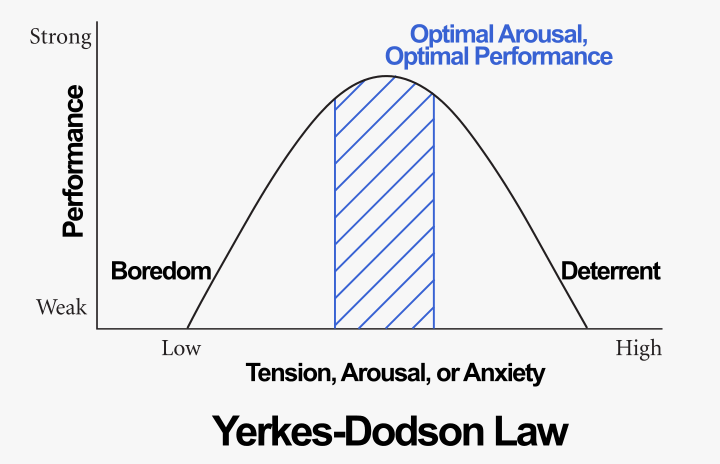
In 1908, Harvard psychologists Robert Yerkes and John Dodson first described the beneficial and harmful effects of stress (“psychological arousal”) on performance in a graph the shape of an upside-down U. According to the Yerkes-Dodson Law, the ascendant curve reflects the energizing effect of arousal. The descendant curve reflects the negative effects of stress on thinking and learning, or performance in general.

Too Much Anxiety and Stress Impairs Performance, but so Does Too Little: The Yerkes-Dodson Law

Many physiological studies have demonstrated that stress enhances your performance by causing your brain to use more of its capabilities, improve memory and intelligence, and increase productivity. Without stress, athletes, performers, executives, and students are likely to underachieve.

There is an optimum level of arousal for every kind of task. So how do you find the right balance? How do you get yourself into the performance zone where stress is most helpful? How much stress is good? The answers depend on individual disposition, the types of stressors, the nature of the task itself, and perceptions of what is stressful to you.

When Stress is Good: The Yerkes-Dodson Law

Idea for Impact: Stress at Work May Be Inevitable but it Doesn’t Have to Be Detrimental

Stress can be a motivator. But don’t seek out stress—less of it is better. Make the stress you do have work for you. Becoming conscious of stress as a potential positive can reduce the harm it causes.

  • Develop an awareness of when you hit the limits beyond which working longer or harder is counter-productive (sportsmen tend to choke under intense pressure.) When you feel overwhelmed, look for ways to reduce or eliminate the stressors so you can become more productive again. Ask for help.
  • Performance deteriorates when your stress level is either too high or too low for a given task. Seek the optimal level of anxiety that can impel you forward without causing you to fight back or give up.

Idea for Impact: The Right Level of Anxiety Can Be a Positive Force for Driving Employees Forward

Anxiety and optimal performance is an individual affair. The Yerkes-Dodson Curve shifts as the performers become established and experienced with the undertaking.

Astute managers repeatedly assess and re-assess where their team members land on the Yerkes-Dodson Curve. Managers can identify over-stressed or under-motivated circumstances with employees and intervene quickly to tailor the level of stress.

Wondering what to read next?

  1. The Power of Negative Thinking
  2. Get Everything Out of Your Head
  3. Some Worry is Useful
  4. “Fly the Aircraft First”
  5. What Airline Disasters Teach About Cognitive Impairment and Decision-Making Under Stress

Filed Under: Managing People, Sharpening Your Skills Tagged With: Anxiety, Decision-Making, Introspection, Mindfulness, Motivation, Procrastination, Stress, Targets, Worry

« Previous Page
Next Page »

Primary Sidebar

Popular Now

Anxiety Assertiveness Attitudes Balance Biases Coaching Conflict Conversations Creativity Critical Thinking Decision-Making Discipline Emotions Entrepreneurs Etiquette Feedback Getting Along Getting Things Done Goals Great Manager Innovation Leadership Leadership Lessons Likeability Mental Models Mentoring Mindfulness Motivation Networking Parables Performance Management Persuasion Philosophy Problem Solving Procrastination Relationships Simple Living Social Skills Stress Suffering Thinking Tools Thought Process Time Management Winning on the Job Wisdom

About: Nagesh Belludi [hire] is a St. Petersburg, Florida-based freethinker, investor, and leadership coach. He specializes in helping executives and companies ensure that the overall quality of their decision-making benefits isn’t compromised by a lack of a big-picture understanding.

Get Updates

Signup for emails

Subscribe via RSS

Contact Nagesh Belludi

RECOMMENDED BOOK:
The Power of a Positive No

The Power of a Positive No: William Ury

Harvard's negotiation professor William Ury details a simple, yet effective three-step technique for saying 'No' decisively and successfully, without destroying relationships.

Explore

  • Announcements
  • Belief and Spirituality
  • Business Stories
  • Career Development
  • Effective Communication
  • Great Personalities
  • Health and Well-being
  • Ideas and Insights
  • Inspirational Quotations
  • Leadership
  • Leadership Reading
  • Leading Teams
  • Living the Good Life
  • Managing Business Functions
  • Managing People
  • MBA in a Nutshell
  • Mental Models
  • News Analysis
  • Personal Finance
  • Podcasts
  • Project Management
  • Proverbs & Maxims
  • Sharpening Your Skills
  • The Great Innovators

Recently,

  • The Spotlight Effect: Why the World Is Less Interested Than You Think
  • The Small Detail That Keeps a Conversation From Running Dry
  • Design for the 80% Experience
  • Inspirational Quotations #1143
  • The Hot-Desking Lie: How It Killed Focus and Gutted Collaboration
  • Unreliable Narrators Make a Story Sounds Too Neat
  • Bertrand Russell on The Value of Philosophy: Doubt in an Age of Dogma

Unless otherwise stated in the individual document, the works above are © Nagesh Belludi under a Creative Commons BY-NC-ND license. You may quote, copy and share them freely, as long as you link back to RightAttitudes.com, don't make money with them, and don't modify the content. Enjoy!