• Skip to content
  • Skip to primary sidebar

Right Attitudes

Ideas for Impact

Critical Thinking

Finding Potential Problems & Risk Analysis: A Case Study on ‘The Three Faces of Eve’

June 24, 2016 By Nagesh Belludi Leave a Comment

The Three Faces of Eve (1957)

Risk Analysis is a Forerunner to Risk Reduction

My previous article stressed the importance of problem finding as an intellectual skill and as a definitive forerunner to any creative process. In this article, I will draw attention to another facet of problem finding: thinking through potential problems.

Sometimes people are unaware of the harmful, unintended side effects of their actions. They fail to realize that a current state of affairs may lead to problems later on. Their actions and decisions could result in outcomes that are different from those planned. Risk analysis reduces the chance of non-optimal results.

The Three Contracts of Eve

'The 3 Faces of Eve' by Corbett H. Thigpen and Hervey M. Cleckley (ISBN 0445081376) A particularly instructive example of finding potential problems and mitigating risk concerns the Hollywood classic The Three Faces of Eve (1957). This psychological drama features the true story of Chris Sizemore who suffered from dissociative identity disorder (also called multiple personality disorder.) Based on The Three Faces of Eve by her psychiatrists Corbett Thigpen and Hervey Cleckley, the movie portrays Sizemore’s three personalities, which manifest in three characters: Eve White, Eve Black, and Jane.

Before filming started on The Three Faces of Eve, the legal department of the 20th Century Fox studio insisted that Sizemore sign three separate contracts—one for each of her personalities—to cover the studio from any possible legal action. For that reason, Sizemore was asked to evoke “Eve White,” “Eve Black,” and “Jane,” and then sign an agreement while manifesting each of these respective personalities. According to Aubrey Solomon’s The Films of 20th Century-Fox and her commentary on the movie’s DVD, the three signatures on the three contracts were all different because they were a product of three distinct personalities that Sizemore had invoked because of her multiple personality disorder.

Idea for Impact: Risk analysis and risk reduction should be one of the primary goals of any intellectual process.

Postscript Notes

  • I recommend the movie The Three Faces of Eve for its captivating glimpse into the mind of a person afflicted with dissociative identity disorder. Actress Joanne Woodward won the 1958 Academy Award (Oscar) for best actress for her portrayal of the three Eves.
  • The automotive, aerospace, and other engineering disciplines use a formal risk analysis procedure called “failure mode and effects analysis” (FEMA.) FEMA examines the key risk factors that may fail a project, system, design, or process, the potential effects of those failures, and the seriousness of these effects.
Wondering what to read next?

  1. Howard Gardner’s Five Minds for the Future // Books in Brief
  2. You Can’t Develop Solutions Unless You Realize You Got Problems: Problem Finding is an Undervalued Skill
  3. This is Yoga for the Brain: Multidisciplinary Learning
  4. Turning a Minus Into a Plus … Constraints are Catalysts for Innovation
  5. Creativity by Imitation: How to Steal Others’ Ideas and Innovate

Filed Under: Mental Models, Sharpening Your Skills Tagged With: Creativity, Critical Thinking, Innovation, Mental Models, Personality, Risk, Thinking Tools, Thought Process, Winning on the Job

You Can’t Develop Solutions Unless You Realize You Got Problems: Problem Finding is an Undervalued Skill

June 21, 2016 By Nagesh Belludi Leave a Comment

Problem finding plays an important role in creative thinking

Problem finding is one of the most significant parts of problem solving. However, it tends to be an underappreciated skill. Many managers naively consider it strange to encourage employees to look for problems at work: “Why look for new problems when we’ve got no resources to work on ones we’ve already identified?”

Many courses and books on problem solving and creativity overlook problem finding. Many educational resources tend to assume that problem solving really begins only after problems have been identified.

Problem-identification lead to the invention of the ballpoint pen

The story of the invention of the ballpoint pen demonstrates the importance of problem finding. Had the inventors not recognized a problem with the existing writing instruments of their day, they would not have developed their invention.

In the 1920s, Hungarian journalist Laszlo Biro spent much time proofreading and checking for errors in others’ writings. To communicate these errors to the authors, Laszlo could not use pencils because their impressions fade quickly. He tried using a fountain pen, but the ink from the fountain pen dried slowly and often left smudges on paper.

Laszlo observed that the ink used in newspaper printing dried quickly and left the paper smudge-free. When he tried using that ink in his fountain pen, however, the ink was too viscous to flow into the tip of the fountain pen.

Laszlo then collaborated with his chemist-brother Gyorgy Biro to invent a new pen tip consisting of a ball that was enclosed within a socket. As the ball rolled inside the socket, the ball could pick up ink from a reservoir or cartridge and then continue to roll to deposit the ink on the paper. The Biro brothers thus invented the ballpoint pen. The company they created is now part of the BIC Company. The ballpoint pen continues to be called a ‘Biro’ in some countries.

Often, creativity is the outcome of discovered problem solving

Greek Philosopher Plato famously wrote in The Republic, “Let us begin and create in idea a State; and yet a true creator is necessity, which is the mother of our invention.”

One reason we fail to identify problems is that we do not stop to think about improving various situations that we encounter. Very often, these problems are directly in front of us; we need to consciously identify them and convert them into opportunities for problem solving. Instead, we tend to take inconveniences and unpleasant situations for granted and assume they are merely “facts of life.”

  • The grain mill was not invented until somebody in antiquity identified the ineffectiveness of two hours of pounding grain to make a cup of flour.
  • The world’s first traffic lights were installed around the British Houses of Parliament in London only after somebody thought of the problem of traffic congestion. In other words, up until the problems from congestion were identified in the 1860s, no one attempted to systematically consider how the problem might be solved.
  • James Watt invented his seminal separate-condenser steam engine after discovering an interesting problem with the Newcomen steam engine. In 1763, when Watt was working as an instrument maker at the University of Glasgow, he was assigned to repair a model of a Newcomen engine for a lecture-demonstration. Watt initially had difficulty getting the Newcomen engine to work because its parts were poorly constructed. When he finally had it running, he was surprised at its efficiency. Watt observed that the engine was constantly running out of coal because the constant heating and cooling of the cylinder resulted in a large waste of energy. Watt then devised a system whereby the cylinder and the condenser were separate. This led to his invention of the “steam engine” (or, more precisely, the separate-condenser steam engine.)
  • As I mentioned in a previous article on the opportunities in customers’ pain points, crispy potato chips were invented only when Chef George Crum of New York’s Saratoga Springs attempted to appease a cranky customer who frequently sent Crum’s fried potatoes back to the kitchen complaining that they were mushy and not crunchy enough. Decades later, Laura Scudder invented airtight packaging for potato chips only after becoming conscious of customers’ complaints that chips packaged in metal containers quickly go stale and crumble during handling.

If problems are not identified, solutions are unlikely to be proposed

It pays to keep your eyes open and look at inconveniences, difficulties, and troubles as creative problems to be solved. Don’t ignore these merely as facts of life.

Curiosity, intrigue, and motivation influence problem finding (and problem solving.) One of the easiest ways to develop your skills in problem finding is to ponder at anything around you and wonder why those gadgets and contraptions were ever invented. Analyze carefully and you’ll learn that the first step taken by the inventors of these objects was the identification of the problems the objects were designed to solve.

When you look around various objects in your life, think about what life was before these objects were invented. What problems could these inventions have solved? Why was the zipper invented? What problems motivated Bjarne Stroustrup to create C++? What was internet search like before Google? How did commerce transpire before the advent of coins and bills and money?

Some people make a career out of problem finding. Managers who want to know if their organizations are running efficiently frequently hire consultants to look for problems that managers do not know exist in their businesses.

And finally, if you want to become an inventor or an entrepreneur, try to start with problems you already have in your work or in your life. Ideally, identify problems shared by a large number of people to increase the probability that your inventions will be put in widespread use.

Idea for Impact: A creative solution to a problem often depends on first finding and defining a creative problem. Very often, the solution to a problem becomes obvious when the problem has been properly identified, defined, and represented.

Wondering what to read next?

  1. Four Ideas for Business Improvement Ideas
  2. Overcoming Personal Constraints is a Key to Success
  3. Avoid Defining the Problem Based on a Proposed Solution
  4. You Never Know What’ll Spark Your Imagination (and When)
  5. Van Gogh Didn’t Just Copy—He Reinvented

Filed Under: Mental Models, Sharpening Your Skills Tagged With: Artists, Creativity, Critical Thinking, Luck, Mental Models, Problem Solving, Scientists, Thinking Tools, Thought Process, Winning on the Job

How to Stimulate Group Creativity // Book Summary of Edward de Bono’s ‘Six Thinking Hats’

May 13, 2016 By Nagesh Belludi

Stimulate Group Creativity Using Edward de Bono's 'Six Thinking Hats'

In his bestselling book Six Thinking Hats, Edward de Bono describes a powerful problem-solving approach that enriches mental flexibility by encouraging individuals and groups to attack an issue from six independent but complementary perspectives.

Edward de Bono is a leading authority in creative thinking. He is widely regarded as the father of lateral thinking. De Bono has written over 70 books on thinking and creativity.

Using the ‘Six Thinking Hats’ for Structured Brainstorming

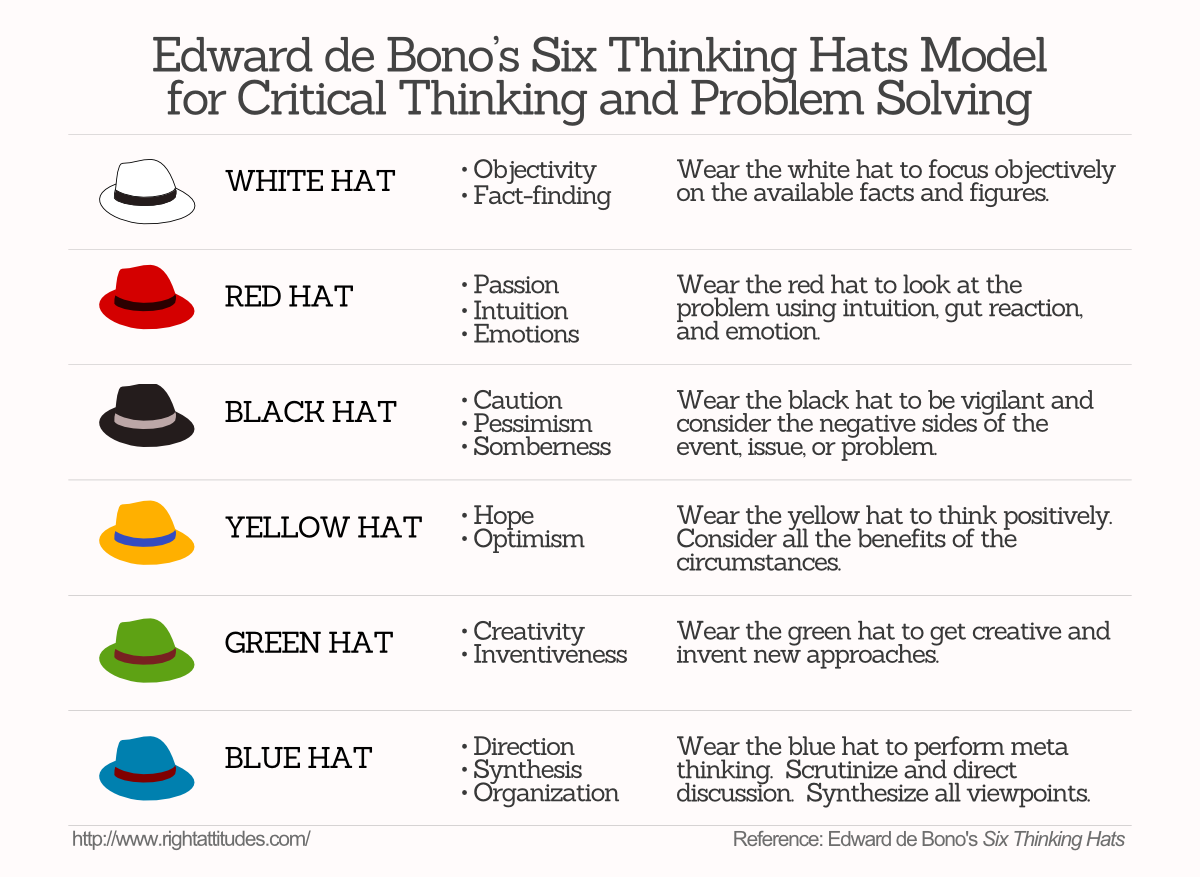
De Bono created the ‘six thinking hats’ method after identifying six distinct lines of human thought in problem solving. De Bono calls each approach a “hat” and assigns them different colors.

At the heart of the ‘six thinking hats’ method are six different colored hats that participants put on—literally or metaphorically—to represent the type of thinking they should concentrate on while wearing each.

  1. White is neutral, objective, and fact-based. A white hat is concerned with objective data: “What information do we have? What information do we need? What information are we missing? How can get the information we need? What objective questions should be asked?”
  2. Red denotes passion, anger, intuition, and emotions. A red hat considers the emotional side of problem solving, which is often neglected or masked in meetings: “What are our gut reactions to the matter at hand?”
  3. Black is somber, serious, and cautious. A black hat is vigilant, plays devil’s advocate, and encourages derogatory and judgmental behavior: “what are the weaknesses of these ideas? What are the risks? What could go wrong?”
  4. Yellow represents positive thinking, hope, and optimism to counteract the black hat’s power. A yellow hat plays “the angel’s advocate” and is cheerful and confident: “What are the best-case scenarios? What are the best aspects of this? What are the advantages? Who can benefit from this?”
  5. Green signifies abundance, growth, richness, and fertility. A green hat is the hat of creativity; it rejects established rules and norms, and invents new approaches: “What are some new ideas on this subject? What is interesting about this idea? What are the variances in these ideas?”
  6. Blue represents the sky and therefore provides the overarching perspective. A blue hat performs “meta thinking” and is concerned with the organization of the thinking process and the use of other hats. The blue hat synthesizes and reconciles different viewpoints. At the start of a brainstorming session, the blue hat sets the stage for where the discussion may go. The blue hat guides and sustains the discussion, often restating its purposes: “What are we thinking about? What is the goal? What should we do next? What have we achieved so far? What should we do to achieve more?” At the conclusion of the brainstorming session, the blue hat appraises the discussion, and proposes a plan of action.

Use De Bono’s Six Thinking Hats Model for Critical Thinking and Problem Solving

'Six Thinking Hats' by Edward de Bono (ISBN 0316178314) An individual working alone may use the approach to consider broader, distinct lines of thought. By changing hats, the individual can switch viewpoints and ensure that he/she is not stuck in specific thinking patterns.

However, the approach is best suited to group discussions (when chaired by a skilled facilitator) in which conflicting ideas may never otherwise be fully synthesized into plans of action. By persuading each participant to think constructively alongside other participants, the ‘six thinking hats’ method taps into group members’diverse perspectives and uses their collective knowledge without destructive conflict.

Using these hats nurtures creativity by letting participants step beyond their typical roles and contribute to developing, organizing, and progressing ideas. Participants can also identify how their cognitive state at any one time shapes how they approach problems.

Recommendation: Read. Edward de Bono’s Six Thinking Hats presents a very effective technique for stimulating group creativity. The method can remove mental blocks, organize ideas and information, foster cross-fertilization, and help conduct thinking sessions more productively than do other brainstorming methods.

Complement with Dan Ciampa’s Taking Advice for an excellent framework on the kind of advice network you need on strategic, operational, political, and personal elements of your work and life. Read my summary in this article.

Wondering what to read next?

  1. Howard Gardner’s Five Minds for the Future // Books in Brief
  2. You Can’t Develop Solutions Unless You Realize You Got Problems: Problem Finding is an Undervalued Skill
  3. Finding Potential Problems & Risk Analysis: A Case Study on ‘The Three Faces of Eve’
  4. This is Yoga for the Brain: Multidisciplinary Learning
  5. Creativity by Imitation: How to Steal Others’ Ideas and Innovate

Filed Under: Mental Models, Sharpening Your Skills Tagged With: Conversations, Creativity, Critical Thinking, Mental Models, Networking, Social Dynamics, Teams, Thinking Tools, Thought Process, Winning on the Job

The Drunkard’s Search or the Streetlight Effect [Cognitive Bias]

February 26, 2016 By Nagesh Belludi Leave a Comment

An old parable (sometimes ascribed to Mulla Nasreddin, the 13th Century witty philosopher from today’s Turkey) tells of a drunkard searching under a street lamp for keys he has lost because the light there is better than where he thinks he lost them.

A police officer sees a drunken man intently searching the ground near a lamppost and asks him the goal of his quest. The inebriate replies that he is looking for his car keys, and the officer helps for a few minutes without success. Then he asks whether the man is certain that he dropped the keys near the lamppost.

“No,” is the reply, “I lost the keys somewhere across the street.”

“Why look here?” asks the surprised and irritated officer.

“The light is much better here,” the intoxicated man responds with aplomb.

The “drunkard’s search” or the “streetlight effect” refers to the propensity for people to look for whatever they’re searching in the easier places instead of in the places that are most likely to yield the results they’re seeking. This is a widespread observational bias that manifests itself frequently in research and investigative methods.

For instance, many Americans who lost their jobs during the two recessions of the ‘lost decade’ of the 2000s sought jobs in the same communities where their factories had closed. They were less inclined to seek long-term solutions to their joblessness and relocate to parts of America where jobs were not as scarce. They had kids in local schools, owned homes that had significantly devalued during the recession, and felt rooted in their communities. They found it more convenient to hope for a revival in their local economies and endure the recession.

Idea for Impact: Look out for observational biases. Don’t seek answers where the looking is good; rather seek answers where they’re likely to be found.

Wondering what to read next?

  1. The “Ashtray in the Sky” Mental Model: Idiot-Proofing by Design
  2. Accidents Can Happen When You Least Expect Them: The Overconfidence Effect
  3. Overcoming Personal Constraints is a Key to Success
  4. The Data Never “Says”
  5. Situational Blindness, Fatal Consequences: Lessons from American Airlines 5342

Filed Under: Mental Models, Sharpening Your Skills Tagged With: Biases, Critical Thinking, Parables, Thought Process

Facts Alone Can’t Sell: Lessons from the Intel Pentium Integer Bug Disaster

January 26, 2016 By Nagesh Belludi Leave a Comment

Facts Alone Can’t Change Minds

In my previous article, I discussed Aristotle’s framework for persuasion and argumentation: to persuade people on a particular point of view, it is necessary to appeal to ethos (credibility,) pathos (emotion,) and logos (logic and reason.) Some people are swayed by logic, others by appeals to emotion, and yet others defer to those who seem to possess authority, expertise, and credibility.

In this article, I give a case study of the “Intel Pentium Integer Bug Disaster” to illustrate that facts (logos) alone sometimes don’t have the power to change minds. Many people are adept at those elements of persuasion that Aristotle characterized as logos: i.e., they are proficient at making their case logically and rationally to their audience. But they may not recognize the need for the pathos aspects of persuasion and may struggle to emotionally connect with their audiences.

Mathematical Errors by the Pentium chip

Intel endured one of the most painful episodes in its history soon after it launched the Pentium processor. It was ridiculed by customers and the media for a flaw in the Pentium chip. Intel’s handling of the crisis was even worse than the bug itself. The Pentium flaw and its aftermath eventually led Intel to undertake large-scale product replacements that resulted in a $475 million write-off on its balance sheet.

In June 1994, about a year after Intel launched the Pentium microprocessor with much fanfare and a massive advertising campaign, some Internet newsgroups started discussing a flaw in the Pentium’s floating point unit. This error caused occasional mathematical errors in the chip’s advanced number-crunching component.

Intel knew about the problem. Internal investigators had established that the error “caused a rounding error in division once every nine billion times … an average spreadsheet user would run into the problem only once every 27,000 years of spreadsheet use.” Consequently, Intel’s executives concluded that the error was insignificant and didn’t pay much attention.

Much to Intel’s astonishment, some trade publications caught wind of the online discussions. In November 1994, CNN aired a nasty report about the Pentium flaw. Other media outlets pounced on Intel; The New York Times published an article titled “Flaw Undermines Accuracy of Pentium Chips.” As a direct result of all the negative publicity, Intel’s customers were up in arms and flooded Intel’s customer service lines with customer complaints. By then, Intel (through IBM, Compaq, HP, Dell, Gateway, and other computer OEMs) had shipped two million Pentium chips.

Intel Decided Stuck to Its Guns and Refused to Replace All Pentium Chips

Throughout this crisis, Intel’s leadership underestimated the scale of customer reaction because they believed that facts were in their favor. Intel’s illustrious CEO Andy Grove decided to set the record straight and issued a memo in which he acknowledged the Pentium fault, but declared that it affected only “users of the Pentium processor who are engaged in heavy-duty scientific/floating-point calculations.”

Back then, microprocessors were not yet a commodity product and consumers had paid a premium to buy computers with Pentium chips instead of those with the discounted previous-generation 486 processors. Justifiably, Intel’s customers were enraged and started demanding that Intel send them replacement chips.

In response, Intel decided to stick to its guns, because management believed in the persuasive ability of their facts. Intel’s leadership declared that they would not replace the chips unless consumers would individually call and establish that their chips would be used for advanced math calculations. At the company’s toll-free customer service line, customers had to endure a protracted interview process for Intel to deem them worthy of receiving a corrected chip. Customers who couldn’t convince Intel that they may encounter the bug in their daily computer-use didn’t make the cut.

In December 1994, all hell broke loose for Intel when IBM stopped shipments of all Pentium-based computers. Grove later recalled, “The phones started ringing furiously from all quarters. The call volume to our hotline skyrocketed. Our other customers wanted to know what was going on. And their tone, which had been quite constructive the week before, became confused and anxious. We were back on the defensive again in a major way.”

Ignoring Customer Sentiment (Pathos) Aggravated the Intel Pentium Crisis

Eventually, Intel caved in. Grove reflected, “After a number of days of struggling against the tide of public opinion, of dealing with the phone calls and the abusive editorials, it became clear that we had to make a major change.” Intel reversed its policy, established a huge customer service operation, and announced that it would replace the Pentium chip for any customer who wanted it replaced. The crisis came to pass only after Intel replaced hundreds of thousands of Pentium chips at a cost of $475 million.

The Intel Pentium Bug is a textbook example of how not to handle a delicate situation and hurt a product’s image. A good deal of this mismanagement could be attributed to an engineering-driven corporate culture within Intel, shaped in part by Grove’s attitude that facts alone could—and should—sell. He believed in the no-nonsense way of doing business: all through the crisis, Intel stuck with the facts, refused to bow before pressure, and told customers to get on with the flawed Pentium processor.

Amazingly, the Pentium Crisis Did Not Affect Intel’s Brand

Fortunately, Intel not only survived the Pentium crisis, but its brand recognition increased and Intel even appeared on Fortune magazine’s list of most admired companies. In the two years prior to the Pentium launch, Intel had embarked on an aggressive marketing campaign to build up the Intel brand. The “Intel Inside” slogan was plastered on billboards in all major markets and TV commercials repeatedly blared the renowned “Intel Inside” jingle.

Another upshot of this crisis was that the attention Intel and Pentium received brought microprocessor chips bang into the public consciousness. With the August 1995-release of Microsoft’s Windows 95, the “Wintel” partnership between Microsoft and Intel ushered a wave of consumer demand that brought inexpensive personal computing to the masses around the world.

Lessons from the Intel Pentium Disaster: Just Being a Truth Teller May Not Be Enough

'Only the Paranoid Survive' by Andrew S. Grove (ISBN 0385483821) It is fallacious to assume that logic, reason, and facts are all potent and that rationality will triumph over irrationality. During the Pentium crisis, Intel had assumed that an honest appraisal of facts of the Pentium bug would have the strength to change customer’s minds. However, sticking to facts alone backfired.

Following Aristotle’s ethos-pathos-logos framework, Intel had logos right: Intel’s assessment that the Pentium errors would not affect most people’s use of their computers was accurate. As the CEO of Intel, Grove had ethos right: his engineers were the prevalent authorities on microprocessor technology and Intel was the dominant producer of computer chips. But Intel got pathos wrong: by just presenting facts (logos) with authority (ethos) and ignoring customer sentiment (pathos), Intel’s arrogant stance was not only ineffective but also aggravated the whole Pentium crisis.

Idea for Impact: During Argumentation, Ignore Pathos At Your Own Peril

When persuading others of your ideas, don’t assume that logos alone has the power to change their minds. Don’t arm yourself with just bulletproof facts, scientific evidence, logic, and rationality and expect logos to sway others to your point of view. Recent research suggests that emotion plays a significant role even in situations where logic seems to be the dominant driver of decision-making.

Decision-making isn’t just logical, it’s emotional too. Remember, “When the heart pulls, the head tends to follow.”

Wondering what to read next?

  1. Persuade Others to See Things Your Way: Use Aristotle’s Ethos, Logos, Pathos, and Timing
  2. How to … Prepare to Be Interviewed by The Media
  3. How to … Make a Memorable Elevator Speech
  4. Deliver The Punchline First
  5. Lessons from JFK’s Inspiration Moon Landing Speeches

Filed Under: Effective Communication, Sharpening Your Skills Tagged With: Communication, Crisis Management, Critical Thinking, Leadership, Negotiation, Persuasion, Presentations

Persuade Others to See Things Your Way: Use Aristotle’s Ethos, Logos, Pathos, and Timing

January 19, 2016 By Nagesh Belludi 1 Comment

During argumentation—i.e. when putting forward a point of view—your goal is to persuade your audience that your thesis is valid, engage them in your favor, change their opinion, and influence them to act as you’d like them to act.

The American literary theorist Kenneth Burke wrote in his Rhetoric of Motives, “Wherever there is persuasion, there is rhetoric. And wherever there is meaning, there is persuasion.” Learning to make effective arguments is helpful in every facet of decision-making and sharing ideas with others—not only in verbal and written discourses, but also in marketing, sales promotion, crisis-management, storytelling, courtship, social etiquette, and education.

Some 2400 years ago, the Greek philosopher Aristotle wrote one of the most important works on argumentation. In his treatise Rhetorica, he explained that arguments are more persuasive when applied in three distinct but inseparable dimensions: ethos (credibility,) logos (reason,) and pathos (emotion.) He wrote,

Of the modes of persuasion furnished by the spoken word there are three kinds. The first kind depends on the personal character of the speaker; the second on putting the audience into a certain frame of mind; the third the proof, or apparent proof, provided by the words of the speech itself … The modes of persuasion are the only true constituents of the art: everything else is merely accessory.

There are, then, these three means of effecting persuasion. The man who is to be in command of them must, it is clear, be able (1) to reason logically, (2) to understand human character and goodness in their various forms, and (3) to understand the emotions—that is, to name them and describe them, to know their causes and the way in which they are excited.

Element #1 of Persuasion: Ethos (‘Character’ in Greek)

Aristotle contended that audiences are more likely to be convinced when an argument comes from someone of standing, repute, authority, and legitimacy:

We believe good men more fully and more readily than others: this is generally true whatever the question is, and absolutely true where exact certainty is impossible and opinions are divided … It is not true, as some writers assume in their treatise on rhetoric, that the personal goodness revealed by the speaker contributes nothing to his power of persuasions; on the contrary, his character may almost be called the most effective means of persuasion he possesses.

Your ability to persuade depends on demonstrating that you are a credible authority on a subject. Credibility comes from your academic and professional credentials, social standing, integrity of character, and trustworthiness.

Ethos is also about how you express your expertise. Enhance your ethos by projecting confidence and paying attention to your mannerisms, dress, demeanor, tone, style, posture, body language, and crispness of your message. Appeal to ethos because your audience is likely to be persuaded if they believe you’re likeable and worthy of their respect. If you lack credibility, you must determine how to produce credibility, address your lack of it, or involve somebody credible who can vouch for your ideas.

Element #2 of Persuasion: Pathos (‘Suffering’ or ‘Experience’ in Greek)

As the saying goes, when the heart pulls, the head tends to follow.

Aristotle contended that persuasion also depends on making an emotional and imaginative impact on the audience by “putting the hearer into a certain frame of mind” (“ton akroaten diatheinai poos”):

Secondly, persuasion may come through the power of the hearers, when the speech stirs their emotions. Our judgments when we are pleased and friendly are not the same as when we are pained and hostile.

To appeal to emotion, you must understand and relate to the needs, values, and desires of your audience. Identify and appeal to what motivates the audience to anger and happiness, what irritates them and leads them to fear, what animates them and arouses their empathy. Defense attorneys often use this technique: they try to appeal to a jury or judge’s emotions by invoking sympathy for the accused and swaying them into thinking that the accused has done little or no wrong.

Element #3 of Persuasion: Logos (‘Word’ in Greek)

Logos refers to the argument’s clarity and integrity. Aristotle stressed logic and the appeal to reason:

Thirdly, persuasion is effected by the speech itself when we have proved a truth or an apparent truth by means of the persuasive arguments suitable to the case in question.

Appeal to your audience using logical consistency, analytical reasoning, rationale, and supporting evidence. Don’t just persuade your audience from your vantage point. Instead, construct a viewpoint that can assert your audience’s own objectives and goals.

Element #4 of Persuasion: Timing

Aristotle mentioned that timing of delivery is a fourth dimension of successful argumentation. Therefore, even if ethos, pathos, and logos are in place, efforts to persuade may fail if they are deployed at the wrong time.

These three kinds of rhetoric refer to three different kinds of time. The political orator is concerned with the future: it is about things to be done hereafter that he advises, for or against. The party in a case at law is concerned with the past; one man accuses the other, and the other defends himself, with reference to things already done. The ceremonial orator is, properly speaking, concerned with the present, since all men praise or blame in view of the state of things existing at the time, though they often find it useful also to recall the past and to make guesses at the future.

To persuade your audience, know where to focus the conversation—the past, present, or future. As the Greek didactic poet Hesiod emphasized in Works and Days, “observe due measure, for right timing is in all things the most important factor.”

Use Four Vantage Points to Improve Your Abilities in Argumentation and Negotiation

You can be more persuasive if you understand what truly moves your audience. Some people are swayed by logic, others by appeals to emotion, and still others quickly defer to those who seem to possess authority and expertise.

Aristotle’s ethos, pathos, and logos provide a clear, understandable, and easy-to-apply framework for developing argumentation. Although these three elements can be analyzed separately, they often overlap and work together. Often it may not be possible or useful to completely distinguish them.

Recommended Resources

Round up your persuasive skills by combining Aristotle’s technique with these recommended approaches.

  • Robert Cialdini’s best-selling books, Influence The Psychology of Persuasion and Science and Practice, identify six ways to persuade another person. Watch this and this YouTube videos for excellent summaries of these six principles.
    1. reciprocity, when the other acts in expectation that his/her favors will be returned
    2. commitment and consistency, when the other takes actions consistent with his/her self-image
    3. social proof, when the other replicates the actions of others
    4. authority, when the other acquiesces to authority even if the request is questionable
    5. liking, when the other is persuaded by those whom they know, like, respect, and admire
    6. scarcity, when an object becomes more desirable because it is in short supply
  • Simon Sinek’s Start with Why advocates that when pitching a product, service, idea, or proposal to an audience, you must start with answering why they should they care. “People don’t buy what you do, they buy why you do it.” Sinek’s TED talk (this YouTube video) describes his concept of “The Golden Circle”—with the ‘why’ at the core, surrounded by ‘how,’ and the finally the ‘what.’
  • Richard Shell and Mario Moussa’s The Art of Woo recommends that people use relationship-based, emotionally intelligent approaches to persuade others of the value of their ideas to “win them over” rather than to “defeat” them.
  • William Ury’s The Power of a Positive No offers a “yes-no-yes” framework to (1) connect a situation, circumstance or dilemma to your core set of interests and values, (2) communicate your decision assertively and respectfully and yet obtain the most positive outcome for you and for others.
  • Roger Fisher, William Ury, and Bruce Patton’s popular book Getting to Yes offers an step-by-step plan of action for coming to mutually satisfactory agreements to conflict.

Wondering what to read next?

  1. Facts Alone Can’t Sell: Lessons from the Intel Pentium Integer Bug Disaster
  2. How to … Make a Memorable Elevator Speech
  3. Deliver The Punchline First
  4. Why Good Founding Stories Sell: Stories That Appeal, Stories That Relate
  5. This Manager’s Change Initiatives Lacked Ethos, Pathos, Logos: Case Study on Aristotle’s Persuasion Framework

Filed Under: Effective Communication, Sharpening Your Skills Tagged With: Communication, Critical Thinking, Leadership, Negotiation, Persuasion, Presentations, Writing

Looking for Important Skills to Develop?

November 26, 2014 By Nagesh Belludi Leave a Comment

Whether you need to take on a new challenge, prepare yourself to become promotable, or enhance your performance at work, undertaking learning and development can help. You must continually be on the lookout for new talents to add to the vast fund of knowledge you’ve accumulated over the years and add to the reservoir of experiences from which to draw.

Some skills are critical to your success throughout your career and life. Chris Anderson recently suggested a set of vital topics that must be taught in school. Anderson is the founder and curator of the Ideas-Worth-Spreading TED conferences.

TED’s Chris Anderson propunds a “Syllabus of the Future”

  • How to nurture your curiosity.
  • How to Google intelligently and skeptically.
  • How to manage your money.
  • How to manage your time.
  • How to present your ideas.
  • How to make a compelling online video.
  • The secret life of a girl.
  • The secret life of a boy.
  • How to build a healthy relationship.
  • How to listen.
  • How to calm an argument.
  • Who do you want to be?
  • How to train your brain to be what you want to be.
  • 100 role models for the career you hadn’t thought of.
  • How to think like a scientist.
  • Why history matters.
  • Books that changed the world.
  • Why personal discipline is key to future success.
  • How your reflective self can manage your instinctual self.
  • How to defend the rights of people you care about.
  • 10 hours with a kid on the other side of the world.
  • The keys to a healthy diet.
  • Why exercise matters.
  • How generosity creates happiness.
  • How immersion in nature eases stress.
  • What are the questions no one knows the answer to?

Use his “Syllabus of the Future” list to evaluate your needs in development and educate yourself in a few selected topics. Design a development plan involving regular discussions, reading articles and books, watching instructional videos, attending courses offered by a professional association, and observing and apprenticing with a mentor proficient in the skill you seek.

Wondering what to read next?

  1. Howard Gardner’s Five Minds for the Future // Books in Brief
  2. This is Yoga for the Brain: Multidisciplinary Learning
  3. Four Ideas for Business Improvement Ideas
  4. Some Lessons Can Only Be Learned in the School of Life
  5. Wide Minds, Bright Ideas: Book Summary of ‘Range: Why Generalists Triumph’ by David Epstein

Filed Under: Career Development, Sharpening Your Skills Tagged With: Creativity, Critical Thinking, Employee Development, Getting Ahead, Skills for Success, Thinking Tools, Winning on the Job

How to Argue like the Wright Brothers

February 15, 2012 By Nagesh Belludi 2 Comments

The Wright brothers, most notable for inventing powered flight, also enjoyed developing their critical thinking by fiercely debating with each other.

Wilbur and Orville found debating and challenging each other’s viewpoints was a constructive way to identify solutions to a myriad of problems or resolve their interpersonal conflicts.

The Wright brothers often took two different sides of an argument, debated the subject, then switched sides and debated the opposing argument. Orville Wright once narrated, “Often, after an hour or so of heated argument, we would discover that we were as far from agreement as when we started, but that each had changed to the other’s original position.”

Idea for Impact: Only when you contrast your point of view with an opponent’s does your own make sense. Use the Wright Brothers’ technique of double-sided debate to question your own preconceptions about an issue and appreciate alternative perspectives.

Wondering what to read next?

  1. To Make an Effective Argument, Explain Your Opponent’s Perspective
  2. How to Gain Empathic Insight during a Conflict
  3. Rapoport’s Rules to Criticize Someone Constructively
  4. Presenting Facts Can Sometimes Backfire
  5. Don’t Ignore the Counterevidence

Filed Under: Effective Communication, Sharpening Your Skills Tagged With: Conflict, Conversations, Critical Thinking, Getting Along, Persuasion, Thinking Tools, Thought Process

Systems-Thinking as a Trait for Career Success

February 12, 2009 By Nagesh Belludi Leave a Comment

In this Fast Company article, Gary Flake, Director of Live Labs at Microsoft identifies Systems Thinking as an important trait for career success.

There are three traits that will serve anyone wanting any role at any company, not just ours: systems thinking, passion, and clear communication. Systems thinking is a way of looking at the world that allows you to see how many small pieces come together to make a more complex whole. System thinkers see the hidden interconnections that bind together the parts and know how to make the best use of ambiguity and uncertainty as a result.

Gary’s reflection reiterates the importance of understanding context and perspective in our jobs. A previous blog article and a podcast discussed this indispensable trait for success.

Systems Thinking for a Big Picture Approach

From an early age, we’re taught to break apart problems in order to make complex tasks and subjects easier to deal with. But this creates a bigger problem . . . we lose the ability to see the consequences of our actions, and we lose a sense of connection to a larger whole.
* Peter Senge

Traditional methods of problem analysis concentrate on dividing problems into smaller, more comprehensible components. The drawback of understanding isolated or unrelated elements, functions, and events is that the effects of changes to one element on other elements of the whole are rarely considered.

In contrast, the discipline of Systems Thinking emphasizes analyzing the whole in terms of interrelationships of its elements. Examining structures, relationships, and outcomes facilitates taking into account any secondary consequences of decisions and actions pertaining individual elements.

We work in increasingly connected organizations where an event that affects one part of an organization is likely to have a meaningful effect–in the short-term or the long-term–on another part of the organization. The discipline of Systems Thinking enables us to develop a broader, holistic perspective of problems and opportunities in businesses and make effective decisions.

Resources, References

Over the last couple of decades, System Thinking has evolved into a formal discipline and has incorporated several rigorous analysis techniques. Here are two excellent resources to help you gain more knowledge of these methods.

  • The ‘Thinking’ in Systems Thinking: Seven Essential Skills, Barry Richmond
  • The Fifth Discipline: The Art and Practice of the Learning Organization, Peter Senge

Wondering what to read next?

  1. Howard Gardner’s Five Minds for the Future // Books in Brief
  2. This is Yoga for the Brain: Multidisciplinary Learning
  3. You Can’t Develop Solutions Unless You Realize You Got Problems: Problem Finding is an Undervalued Skill
  4. Finding Potential Problems & Risk Analysis: A Case Study on ‘The Three Faces of Eve’
  5. Creativity by Imitation: How to Steal Others’ Ideas and Innovate

Filed Under: Career Development, Sharpening Your Skills Tagged With: Creativity, Critical Thinking, Mental Models, Thinking Tools, Thought Process, Winning on the Job

To Make an Effective Argument, Explain Your Opponent’s Perspective

December 12, 2008 By Nagesh Belludi Leave a Comment

“The man who can hold forth on every matter under debate in two contradictory ways of pleading, or can argue for and against every proposition that can be laid down – such a man is the true, the complete, and the only orator.”
– Cicero

“If you can’t imagine how anyone could hold the view you are attacking, you just don’t understand it yet.”
– Anthony Weston, ‘Rulebook for Arguments’

Explaining the Other Side of the Argument

Entrepreneur and blogger Ben Casnocha presents an effective discussion / debating / interviewing technique:

Here is one of the simplest ways to test someone’s knowledge of an issue: ask them to explain the other side of the argument. Ask the person who’s in favor of spending more money on marketing project X to explain the thinking process behind those who oppose the budgetary move.

I have yet to find a more efficient and reliable way to probe the depths of a person’s knowledge and seriousness about an issue than asking them to explain the other side’s perspective.

How can you effectively argue for your side if you don’t understand the arguments of the other?

Never Limit Your Ability to Learn From Opposite Perspectives

Never Limit Your Ability to Learn From Opposite Perspectives Habitually, we discard contrasting opinions without making an effort to explore their significance. We shape our attitudes and seek facts to support our own beliefs without contemplating the merits of opposite perspectives. We fail to realize that, when we do not understand opposite perspectives enough to justify their merits, we almost certainly do not understand them enough to dismiss them either.

Develop the curiosity to see the world from new perspectives and discover opposite circumstances, whether you believe in them or not. If you follow faith X, attend services of faith Y; if you are conservative, explain the liberal outlook; if you hold the western philosophy on a particular subject, reason the eastern viewpoint; if you oppose a particular legislation, argue the merits of legislation. Instead of asking ‘ why ,’ ask ‘why not .’

When you pause arguing with an opposite perspective and try arguing for it, when you switch your point of view briefly, you will witness a profound shift in your thinking.

  • Your own attitudes may look different when seen from the opposite perspective. It can help you reinforce your own beliefs and attitudes. This approach may open your mind to discover the merits, similarities, and weaknesses of your arguments that may not be obvious from your own side of the board.
  • People are often glad to work with anyone who is accommodating and tries to understand their perspectives. Therefore, your ability to persuade others improves.

Wondering what to read next?

  1. How to Gain Empathic Insight during a Conflict
  2. How to Argue like the Wright Brothers
  3. Rapoport’s Rules to Criticize Someone Constructively
  4. Presenting Facts Can Sometimes Backfire
  5. Don’t Ignore the Counterevidence

Filed Under: Effective Communication, Mental Models, Sharpening Your Skills Tagged With: Conflict, Conversations, Critical Thinking, Getting Along, Persuasion, Thinking Tools, Thought Process

« Previous Page

Primary Sidebar

Popular Now

Anxiety Assertiveness Attitudes Balance Biases Coaching Conflict Conversations Creativity Critical Thinking Decision-Making Discipline Emotions Entrepreneurs Etiquette Feedback Getting Along Getting Things Done Goals Great Manager Innovation Leadership Leadership Lessons Likeability Mental Models Mentoring Mindfulness Motivation Networking Parables Performance Management Persuasion Philosophy Problem Solving Procrastination Relationships Simple Living Social Skills Stress Suffering Thinking Tools Thought Process Time Management Winning on the Job Wisdom

About: Nagesh Belludi [hire] is a St. Petersburg, Florida-based freethinker, investor, and leadership coach. He specializes in helping executives and companies ensure that the overall quality of their decision-making benefits isn’t compromised by a lack of a big-picture understanding.

Get Updates

Signup for emails

Subscribe via RSS

Contact Nagesh Belludi

RECOMMENDED BOOK:
The Effective Executive

The Effective Executive: Peter Drucker

Management guru Peter Drucker's insightful perspective and suggestions for making executives more effective managers of both themselves and others.

Explore

  • Announcements
  • Belief and Spirituality
  • Business Stories
  • Career Development
  • Effective Communication
  • Great Personalities
  • Health and Well-being
  • Ideas and Insights
  • Inspirational Quotations
  • Leadership
  • Leadership Reading
  • Leading Teams
  • Living the Good Life
  • Managing Business Functions
  • Managing People
  • MBA in a Nutshell
  • Mental Models
  • News Analysis
  • Personal Finance
  • Podcasts
  • Project Management
  • Proverbs & Maxims
  • Sharpening Your Skills
  • The Great Innovators

Recently,

  • Design for the 80% Experience
  • Inspirational Quotations #1143
  • The Hot-Desking Lie: How It Killed Focus and Gutted Collaboration
  • Unreliable Narrators Make a Story Sounds Too Neat
  • Bertrand Russell on The Value of Philosophy: Doubt in an Age of Dogma
  • Inspirational Quotations #1142
  • The Law of Petty Irritations

Unless otherwise stated in the individual document, the works above are © Nagesh Belludi under a Creative Commons BY-NC-ND license. You may quote, copy and share them freely, as long as you link back to RightAttitudes.com, don't make money with them, and don't modify the content. Enjoy!