• Skip to content
  • Skip to primary sidebar

Right Attitudes

Ideas for Impact

Creativity

Inspirational Quotations by Vincent van Gogh + A Précis of the Troubled Life of an Extraordinary Man

March 30, 2015 By Nagesh Belludi 1 Comment

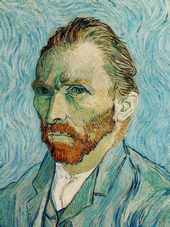
Self-Portrait by Vincent van Gogh

It’s the birthday of Vincent Willem van Gogh (1853–90,) the prominent Dutch painter who is renowned for his characteristic style of undulating lines and bold colors. He produced a great number of masterpiece paintings and sketches in just 11 years dedicated to art. In fact, it was during the last two years of his life that Vincent produced all of his best-known pieces. Though it may surprise us in retrospect, his work was not widely appreciated during his lifetime. Now, of course, he is considered one of the most eminent post-Impressionist painters.

Equally fascinating are the tragic circumstances of Vincent’s short life. His productivity and artistic genius are especially remarkable in the context of his debilitating illness, which caused the self-mutilation of his ear and ultimately his fateful suicide. Even to this day, the trials and tribulations of a man posthumously discovered to be an extraordinary artist elicit haunting curiosity and even sympathy.

Vincent’s letters to his brother Theo and others offer a profound, soul-searching description of the jagged life of a genius who achieved much in the face of adversity. Scholars have even wondered if he was rather a great man who painted great pictures. When understood in a certain light, Vincent’s troubled life, his devotion to art, and his sense of purpose make one of the most inspiring stories in the world.

This article provides a brief story of Vincent’s life followed by inspirational quotations chosen from his letters to Theo. A subsequent article will delve into his philosophy of work and his sense of devotion.

Vincent van Gogh’s Quest for Meaning

Young Vincent van Gogh Vincent was raised in a religious and cultured atmosphere. Growing up, he possessed a difficult temper and lacked self-confidence. All through youth, Vincent struggled to find his place in the world. This was a precursor to his life-long struggle to find meaning and establish some kind of harmonious relationship with the outer world.

Vincent began his artistic career at the relatively advanced age. Until then, he held a variety of occupations where he had proved deficient. At age 26, Vincent started work as a lay preacher in a mining community in southern Belgium. As was his habit, Vincent quickly developed great empathy for the miners and fully committed himself to this job. He wanted to be like the poor miners—he even smeared his hands and face with soot and dirt. He gave away his belongings, lived on bread and water, and slept on a sack spread out on the floor of his miserable shed. The church’s committee of elders chastised him for his excessive zeal and fired him. His mother complained of his uncompromising stubbornness: “He will never comply with the wishes of the committee, and nothing will change him.”

Soon thereafter, Vincent’s younger brother Theo visited to discuss Vincent’s future. Theo declared that the van Gogh family was worried about Vincent’s lack of direction in life, especially after several false starts in various vocations. The ensuing dispute marked a serious turning point in Vincent’s life: he resolved to become an artist. He would build on what was once a mere pastime.

Starry Night by Vincent van Gogh

The Art of a Self-Taught Genius

Vincent van Gogh - Self-Taught Genius For the next nine years, with Theo’s financial and emotional support, Vincent traveled around Europe teaching himself to draw and paint. He struggled financially and even starved sometimes after spending the entire stipend that Theo sent him on art supplies rather than on the necessities of living. After a great deal of meticulous experimentation and assiduous practice, Vincent developed his artistic expertise to a level where he could execute art swiftly.

Vincent was an artist for just 11 years before his death. In those 11 years, he completed more than 2,150 pieces, including 860 oil paintings and more than 1,300 watercolors, drawings, and sketches. Vincent was exceptionally productive towards the end of his life, churning out work with incredible speed—he sometimes executed up to three pieces a day. His most notable paintings are Starry Night, Portrait of Dr. Gachet, Portrait of Joseph Roulin, Bedroom in Arles series, Sunflowers series, Church at Auvers, and several self-portraits including the iconic Self-Portrait with Bandaged Ear.

Following years of depression, frequent bouts of mental illness, struggles with personal relationships, and tumultuous romantic pursuits, Vincent shot himself at age 37, just when his artistic genius was starting to be acknowledged. In an unfinished final letter found on his person when he shot himself, he declared, “Well, the truth is, we can only make our pictures speak.” And speak they did: even today, art lovers marvel at Vincent’s attention to color, his ability to convey emotions, and his unique sense of observation. Although he was poor and practically unknown most of his life, Vincent’s work greatly influenced 20th century art.

The Letters of Vincent van Gogh

'Ever Yours: The Essential Letters' by Vincent van Gogh (ISBN 0300209479) Despite suffering from mental illness, Vincent possessed an extraordinary unity of mind and spirit. This is evident in the 700 letters he wrote over a period of 20 years, primarily to his beloved brother Theo. These letters are a marvelous record of his life, art, and philosophy. They are the primary source and substance for scholarly studies on Vincent’s life and work, particularly by art historians and psychiatrists.

“Ever Yours: The Essential Letters”, an absorbing anthology of correspondence between Vincent and Theo, sheds light on the shifting quality of his moods, his turbulent life, and philosophical evolution as an artist. Few other men and women have written such letters that reveal the inner workings of their minds and hearts.

I also recommend Steven Naifeh and Gregory Smith’s brilliant biography, “Van Gogh: The Life and Anthology”, and Michael Howard’s “Van Gogh: His Life & Works in 500 Images”.

Inspirational Quotations by Vincent van Gogh

If one is master of one thing and understands one thing well, one has at the same time, insight into and understanding of many things.
—Vincent van Gogh (Dutch Painter)

The fishermen know that the sea is dangerous and the storm terrible, but they have never found these dangers sufficient reason for remaining ashore.
—Vincent van Gogh (Dutch Painter)

People are often unable to do anything, imprisoned as they are in I don’t know what kind of terrible, terrible, oh such terrible cage.
—Vincent van Gogh (Dutch Painter)

It is better to be high-spirited, even though one makes more mistakes, than to be narrow-minded and all too prudent. It is good to love many things, for therein lies the true strength, and whosoever loves much performs much, and can accomplish much, and what is done in love, is well done.
—Vincent van Gogh (Dutch Painter)

Love is something eternal; the aspect may change, but not the essence.
—Vincent van Gogh (Dutch Painter)

I dream of painting and then I paint my dream.
—Vincent van Gogh (Dutch Painter)

One must work and dare if one really wants to live.
—Vincent van Gogh (Dutch Painter)

The more I think about it, the more I realize there is nothing more artistic than to love others.
—Vincent van Gogh (Dutch Painter)

For my part I know nothing with any certainty, but the sight of the stars makes me dream.
—Vincent van Gogh (Dutch Painter)

A weaver who has to direct and to interweave a great many little threads has no time to philosophize about it, but rather he is so absorbed in his work that he doesn’t think but acts, and he feels how things must go more than he can explain it.
—Vincent van Gogh (Dutch Painter)

What would life be if we had no courage to attempt anything?
—Vincent van Gogh (Dutch Painter)

The more I think it over, the more I feel that there is nothing more truly artistic than to love people.
—Vincent van Gogh (Dutch Painter)

What has changed is that my life then was less difficult and my future seemingly less gloomy, but as far as my inner self, my way of looking at things and of thinking is concerned, that has not changed. But if there has indeed been a change, then it is that I think, believe and love more seriously now what I thought, believed and loved even then.
—Vincent van Gogh (Dutch Painter)

Even the knowledge of my own fallibility cannot keep me from making mistakes. Only when I fall do I get up again.
—Vincent van Gogh (Dutch Painter)

When we are working at a difficult task and strive after a good thing, we are fighting a righteous battle, the direct reward of which is that we are kept from much evil. As we advance in life it becomes more and more difficult, but in fighting the difficulties the inmost strength of the heart is developed.
—Vincent van Gogh (Dutch Painter)

In spite of everything I shall rise again: I will take up my pencil, which I have forsaken in my great discouragement, and I will go on with my drawing.
—Vincent van Gogh (Dutch Painter)

If you hear a voice within you saying, “You are not a painter,” then by all means paint… and that voice will be silenced.
—Vincent van Gogh (Dutch Painter)

I tell you, if one wants to be active, one must not be afraid of going wrong, one must not be afraid of making mistakes now and then. Many people think that they will become good just by doing no harm—but that’s a lie, and you yourself used to call it that. That way lies stagnation, mediocrity.
—Vincent van Gogh (Dutch Painter)

If you truly love Nature, you will find beauty everywhere.
—Vincent van Gogh (Dutch Painter)

Someone has a great fire in his soul and nobody ever comes to warm themselves at it, and passers-by see nothing but a little smoke at the top of the chimney and then go on their way.
—Vincent van Gogh (Dutch Painter)

Conscience is a man’s compass.
—Vincent van Gogh (Dutch Painter)

Poetry surrounds us everywhere, but putting it on paper is, alas, not so easy as looking at it.
—Vincent van Gogh (Dutch Painter)

No matter how vacant and vain, how dead life may appear to be, the man of faith, of energy, of warmth, who knows something, will not be put off so easily.
—Vincent van Gogh (Dutch Painter)

But what is your final goal, you may ask. That goal will become clearer, will emerge slowly but surely, much as the rough draught turns into a sketch, and the sketch into a painting through the serious work done on it, through the elaboration of the original vague idea and through the consolidation of the first fleeting and passing thought.
—Vincent van Gogh (Dutch Painter)

Love always brings difficulties, that is true, but the good side of it is that it gives energy.
—Vincent van Gogh (Dutch Painter)

I must continue to follow the path I take now. If I do nothing, if I study nothing, if I cease searching, then, woe is me, I am lost. That is how I look at it—keep going, keep going come what may.
—Vincent van Gogh (Dutch Painter)

Some good must come by clinging to the right. Conscience is a man’s compass, and though the needle sometimes deviates, though one often perceives irregularities in directing one’s course by it, still one must try to follow its direction.
—Vincent van Gogh (Dutch Painter)

Let’s not forget that the little emotions are the great captains of our lives and we obey them without realizing it.
—Vincent van Gogh (Dutch Painter)

It is a pity that, as one gradually gains experience, one loses one’s youth.
—Vincent van Gogh (Dutch Painter)

But I always think that the best way to know God is to love many things.
—Vincent van Gogh (Dutch Painter)

What is true is that I have at times earned my own crust of bread, and at other times a friend has given it to me out of the goodness of his heart. I have lived whatever way I could, for better or for worse, taking things just as they came
—Vincent van Gogh (Dutch Painter)

One may have a blazing hearth in one’s soul and yet no one ever came to sit by it. Passers-by see only a wisp of smoke from the chimney and continue on their way.
—Vincent van Gogh (Dutch Painter)

If one were to say but few words, though ones with meaning, one would do better than to say many that were only empty sounds, and just as easy to utter as they were of little use.
—Vincent van Gogh (Dutch Painter)

The thing has already taken form in my mind before I start it. The first attempts are absolutely unbearable. I say this because I want you to know that if you see something worthwhile in what I am doing, it is not by accident but because of real direction and purpose.
—Vincent van Gogh (Dutch Painter)

Let’s not forget that the little emotions are the great captains of our lives and we obey them without realizing it.
—Vincent van Gogh (Dutch Painter)

It is better to be high-spirited, even though one makes more mistakes, than to be narrow-minded and all too prudent. It is good to love many things, for therein lies the true strength, and whosoever loves much performs much, and can accomplish much, and what is done in love, is well done.
—Vincent van Gogh (Dutch Painter)

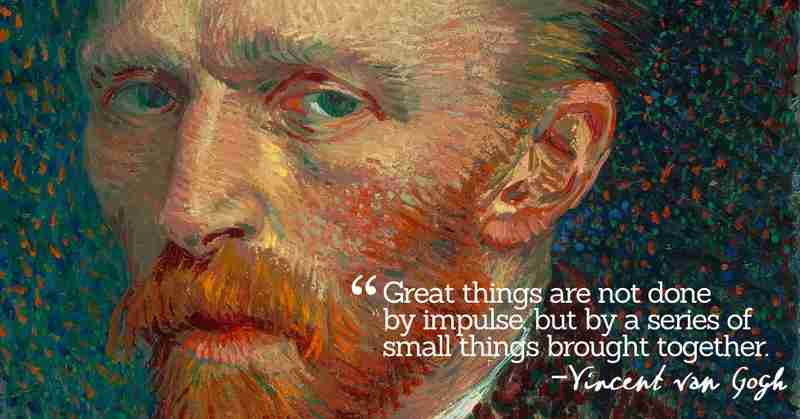
Great things are not done by impulse, but by a series of small things brought together.
—Vincent van Gogh (Dutch Painter)

It is with the reading of books the same as with looking at pictures; one must, without doubt, without hesitations, with assurance, admire what is beautiful.
—Vincent van Gogh (Dutch Painter)

Life is not long for anybody, and the problem is only to make something of it.
—Vincent van Gogh (Dutch Painter)

Wondering what to read next?

  1. Inspirational Mess, Creative Clutter
  2. You Never Know What’ll Spark Your Imagination (and When)
  3. Picasso’s Blue Period: A Serendipitous Invention
  4. Van Gogh Didn’t Just Copy—He Reinvented
  5. Invention is Refined Theft

Filed Under: Great Personalities, Inspirational Quotations, The Great Innovators Tagged With: Artists, Creativity

Creativity by Blending Ideas to Form New Ones: A Case Study of Gutenberg and the Printing Press

February 24, 2015 By Nagesh Belludi Leave a Comment


Ideas Evolve over Time by Blending with Other Ideas

One of the fascinating aspects of invention is tracking the continuity of ideas across an arc of time. Through education, exposure, and experimentation, people’s creative thoughts can stretch both temporally and across various disciplines of knowledge.

When people develop a new idea, they often share it with others, who may then use this idea to expand their own understanding of concepts, invent even fresher ideas, and spread them. Ideas thus evolve over time.

Building on Antecedent Inventions

Considering the collaborative nature of idea formation, every new idea is arguably a conceptual sum of its predecessors. The power of blending ideas to form new ones is shown in that most seminal inventions are based on antecedents—inventions that came before them. For instance,

  • James Watt’s “invention” of the steam engine (or, more precisely, his invention of the separate-condenser steam engine) was in fact an attempt to modify Thomas Newcomen’s steam engine. Newcomen’s work was itself based on Thomas Savery’s invention of a steam-powered pump to extract water from mine-shifts. Later, James Watt adapted his separate-condenser to produce continuous rotary motion and expanded its use far beyond pumping water. Continuous rotary motion sparked the transition from hand-production methods to machine-power and became the driving force of the Industrial Revolution.
  • The Wright brothers’ first heavier-than-air powered flight was the culmination of their experience with bicycles. This first flight demonstrated their ability to improve prior inventions by applying previously-reached solutions to controlled flight issues. [See my previous article on how the Wright brothers argued and developed their ideas.] Within fifty years of the Wright brothers’ first successful airplane, humankind’s concept of distance had changed dramatically: aircrafts could fly across continents in hours—sometimes faster than sound. Just a short time later, aircrafts were traveling into space.
  • British Mathematician Andrew Wiles’ much-celebrated proof of Pierre de Fermat’s Last Theorem was based on the work of some of the greatest mathematical minds who, over three centuries, had also puzzled over Fermat’s Last Theorem. Contemporaries Gerhard Frey, Jean-Pierre Serre, and Ken Ribet also influenced Wiles’ work. Until Wiles’ success in the mid-nineties, the theorem remained inaccessible to proof for 358 years. In the 1840s, German mathematician Richard Dedekind attempted to solve the theorem and in so doing, laid the foundations of algebraic number theory.

Idea for Impact: Creativity is accessible through the often-subconscious process of blending what you already know to form new ideas.

Gutenberg's Invention of Mechanized Printing: Blend of coin punch and mechanized wine press

Case Study: Gutenberg’s Invention of Mechanized Printing

In the 15th century, Johannes Gutenberg invented mechanized movable-type printing. His invention revolutionized the dissemination of knowledge throughout the Western World and played a pivotal role in the development of the Renaissance, the Protestant Reformation, the Age of Enlightenment, and the Scientific Revolution.

The earliest forms of printing evolved from letter and coin punches, which were in vogue even in the Neolithic era. Woodblock printing was fashionable in East Asia since the second century. At least two centuries prior to Gutenberg’s invention, manual block printing with movable type had existed. However, this technique was hardly known in Europe, where all manuscripts were laboriously copied out by hand or stamped out with woodblocks before Gutenberg’s invention.

Gutenberg blended the flexibility of a coin punch with the power of a mechanized wine press to invent mechanized printing. For each character to be printed, Gutenberg used his skills as a goldsmith to cast individual pieces of metal type. These pieces could be quickly assembled into blocks depending on the composition of characters on a page.

Gutenberg’s mechanized press was an adaptation of the wine press, a historical contraption used to crush grapes and extract their juice for winemaking. Gutenberg’s press consisted of a fixed lower bed and movable upper platen containing composed type blocks. The platen was inked, covered with a sheet of paper, and pressed by a small bar on a worm screw. Pressing the upper and lower surfaces together formed a vise and left a sharp impression of inked characters on the paper.

The hand-operated Gutenberg press was further mechanized in the 19th century. Engineers introduced James Watt’s invention of the double-acting rotary steam engine to create steam-powered rotary presses, altogether creating industrialized bulk printing.

Wondering what to read next?

  1. You Never Know What’ll Spark Your Imagination (and When)
  2. Make a Difficult Decision Like Benjamin Franklin
  3. How to Become a Broad-thinker: Principles and Methods
  4. Creativity by Imitation: How to Steal Others’ Ideas and Innovate
  5. Your Product May Be Excellent, But Is There A Market For It?

Filed Under: Mental Models, Sharpening Your Skills Tagged With: Creativity, Thought Process

Looking for Important Skills to Develop?

November 26, 2014 By Nagesh Belludi Leave a Comment

Whether you need to take on a new challenge, prepare yourself to become promotable, or enhance your performance at work, undertaking learning and development can help. You must continually be on the lookout for new talents to add to the vast fund of knowledge you’ve accumulated over the years and add to the reservoir of experiences from which to draw.

Some skills are critical to your success throughout your career and life. Chris Anderson recently suggested a set of vital topics that must be taught in school. Anderson is the founder and curator of the Ideas-Worth-Spreading TED conferences.

TED’s Chris Anderson propunds a “Syllabus of the Future”

  • How to nurture your curiosity.
  • How to Google intelligently and skeptically.
  • How to manage your money.
  • How to manage your time.
  • How to present your ideas.
  • How to make a compelling online video.
  • The secret life of a girl.
  • The secret life of a boy.
  • How to build a healthy relationship.
  • How to listen.
  • How to calm an argument.
  • Who do you want to be?
  • How to train your brain to be what you want to be.
  • 100 role models for the career you hadn’t thought of.
  • How to think like a scientist.
  • Why history matters.
  • Books that changed the world.
  • Why personal discipline is key to future success.
  • How your reflective self can manage your instinctual self.
  • How to defend the rights of people you care about.
  • 10 hours with a kid on the other side of the world.
  • The keys to a healthy diet.
  • Why exercise matters.
  • How generosity creates happiness.
  • How immersion in nature eases stress.
  • What are the questions no one knows the answer to?

Use his “Syllabus of the Future” list to evaluate your needs in development and educate yourself in a few selected topics. Design a development plan involving regular discussions, reading articles and books, watching instructional videos, attending courses offered by a professional association, and observing and apprenticing with a mentor proficient in the skill you seek.

Wondering what to read next?

  1. Howard Gardner’s Five Minds for the Future // Books in Brief
  2. This is Yoga for the Brain: Multidisciplinary Learning
  3. Four Ideas for Business Improvement Ideas
  4. Systems-Thinking as a Trait for Career Success
  5. Some Lessons Can Only Be Learned in the School of Life

Filed Under: Career Development, Sharpening Your Skills Tagged With: Creativity, Critical Thinking, Employee Development, Getting Ahead, Skills for Success, Thinking Tools, Winning on the Job

Systems-Thinking as a Trait for Career Success

February 12, 2009 By Nagesh Belludi Leave a Comment

In this Fast Company article, Gary Flake, Director of Live Labs at Microsoft identifies Systems Thinking as an important trait for career success.

There are three traits that will serve anyone wanting any role at any company, not just ours: systems thinking, passion, and clear communication. Systems thinking is a way of looking at the world that allows you to see how many small pieces come together to make a more complex whole. System thinkers see the hidden interconnections that bind together the parts and know how to make the best use of ambiguity and uncertainty as a result.

Gary’s reflection reiterates the importance of understanding context and perspective in our jobs. A previous blog article and a podcast discussed this indispensable trait for success.

Systems Thinking for a Big Picture Approach

From an early age, we’re taught to break apart problems in order to make complex tasks and subjects easier to deal with. But this creates a bigger problem . . . we lose the ability to see the consequences of our actions, and we lose a sense of connection to a larger whole.
* Peter Senge

Traditional methods of problem analysis concentrate on dividing problems into smaller, more comprehensible components. The drawback of understanding isolated or unrelated elements, functions, and events is that the effects of changes to one element on other elements of the whole are rarely considered.

In contrast, the discipline of Systems Thinking emphasizes analyzing the whole in terms of interrelationships of its elements. Examining structures, relationships, and outcomes facilitates taking into account any secondary consequences of decisions and actions pertaining individual elements.

We work in increasingly connected organizations where an event that affects one part of an organization is likely to have a meaningful effect–in the short-term or the long-term–on another part of the organization. The discipline of Systems Thinking enables us to develop a broader, holistic perspective of problems and opportunities in businesses and make effective decisions.

Resources, References

Over the last couple of decades, System Thinking has evolved into a formal discipline and has incorporated several rigorous analysis techniques. Here are two excellent resources to help you gain more knowledge of these methods.

  • The ‘Thinking’ in Systems Thinking: Seven Essential Skills, Barry Richmond
  • The Fifth Discipline: The Art and Practice of the Learning Organization, Peter Senge

Wondering what to read next?

  1. Howard Gardner’s Five Minds for the Future // Books in Brief
  2. This is Yoga for the Brain: Multidisciplinary Learning
  3. How to Stimulate Group Creativity // Book Summary of Edward de Bono’s ‘Six Thinking Hats’
  4. One of the Tests of Leadership is the Ability to Sniff out a Fire Quickly
  5. Creativity by Imitation: How to Steal Others’ Ideas and Innovate

Filed Under: Career Development, Sharpening Your Skills Tagged With: Creativity, Critical Thinking, Mental Models, Thinking Tools, Thought Process, Winning on the Job

How to Examine a Process and Ask the Right Questions

September 29, 2007 By Nagesh Belludi 2 Comments

Method Study and Critical Examination

Method study is a practice of examining methods of doing work: work-flows, processes, etc. The key component of method study is ‘critical examination.’ Author Michael Armstrong describes critical examination in his ‘Handbook of Management Techniques.’

Critical examination uses the questioning approach to find out what, how, when, where and, most importantly, why and activity is carried out, and who does it. From this analysis, two fundamental questions are posed: (1) Does the activity need to be done at all? If so, (2) Are there any better ways of doing it?

The questioning approach for critical examination is described in the following chart. This chart is also available as a hand-out (PDF download) for quick reference.

Questioning Approach Critical Examination

Call for Action

A great degree of professional work–in engineering, management, finances, and other functions of the modern corporation–involves analysis of products, procedures and systems. Here, thought-processes involve asking, and seeking answers to, a series of questions.

In my role as an engineer and manager, I carry the above chart of questions to meetings and brainstorming sessions. The chart helps me ask the right questions on the intent of a process or system and gain a big-picture perspective for my work or task at hand.

Download the critical examination handout, post it at your cubicle and refer to the chart for help on asking the right questions.

Wondering what to read next?

  1. The Solution to a Problem Often Depends on How You State It
  2. What the Rise of AI Demands: Teaching the Thinking That Thinks About Thinking
  3. Good Questions Encourage Creative Thinking
  4. Why You Get Great Ideas in the Shower
  5. Make Decisions Using Bill Hewlett’s “Hat-Wearing Process”

Filed Under: Mental Models, Sharpening Your Skills Tagged With: Creativity, Questioning, Thought Process

« Previous Page

Primary Sidebar

Popular Now

Anxiety Assertiveness Attitudes Balance Biases Coaching Conflict Conversations Creativity Critical Thinking Decision-Making Discipline Emotions Entrepreneurs Ethics Etiquette Feedback Getting Along Getting Things Done Goals Great Manager Innovation Leadership Lessons Likeability Mental Models Mindfulness Motivation Parables Performance Management Personal Growth Persuasion Philosophy Problem Solving Procrastination Psychology Relationships Resilience Simple Living Social Skills Stress Thinking Tools Thought Process Time Management Winning on the Job Wisdom

About: Nagesh Belludi [hire] is a St. Petersburg, Florida-based freethinker, investor, and leadership coach. He specializes in helping executives and companies ensure that the overall quality of their decision-making benefits isn’t compromised by a lack of a big-picture understanding.

Get Updates

Signup for emails

Subscribe via RSS

Contact Nagesh Belludi

RECOMMENDED BOOK:
On Writing Well

On Writing Well: William Zinsser

Journalist William Zinsser's bestselling manual has inspired generations of writers to perfect their skills in introducing clarity and brevity, and presenting their unique voice into prose.

Explore

  • Announcements
  • Belief and Spirituality
  • Business Stories
  • Career Development
  • Effective Communication
  • Great Personalities
  • Health and Well-being
  • Ideas and Insights
  • Inspirational Quotations
  • Leadership
  • Leadership Reading
  • Leading Teams
  • Living the Good Life
  • Managing Business Functions
  • Managing People
  • MBA in a Nutshell
  • Mental Models
  • News Analysis
  • Personal Finance
  • Podcasts
  • Project Management
  • Proverbs & Maxims
  • Sharpening Your Skills
  • The Great Innovators

Recently,

  • How to Deal with … Interrupters
  • How to Deal with … Overtalkers
  • Stress You Can’t Name Is Stress You Can’t Manage
  • Inspirational Quotations #1176
  • The Leader and the Legend
  • The Commercialization of Yoga: Downward Dog, Upward Profit
  • Write Your Constitution, Then Cut What Doesn’t Fit

Unless otherwise stated in the individual document, the works above are © Nagesh Belludi under a Creative Commons BY-NC-ND license. You may quote, copy and share them freely, as long as you link back to RightAttitudes.com, don't make money with them, and don't modify the content. Enjoy!