• Skip to content
  • Skip to primary sidebar

Right Attitudes

Ideas for Impact

Communication

Use Active Voice for Persuasive Communication

January 21, 2008 By Nagesh Belludi 1 Comment

Passive Voice Tends to be Indirect and Difficult

Consider the following messages.

  • In an email to a supplier, my engineer declared, “It was determined to use cast-iron instead of aluminum for this component.”
  • In a thank-you card, my colleague acknowledged, “Your thoughtfulness and assistance are greatly appreciated.”
  • In a facsimile cover letter, my attorney confirmed, “A copy of this letter will be sent to you by post.”

These sentences are in passive voice. Each sentence, although grammatically correct, seems impersonal and is rather obscure about responsibility of the respective actions or feelings conveyed.

In general, sentences in passive voice tend to be long-winded and indirect in expression.

Structures of Active and Passive Sentences

Sentences in active voice have the owner-verb-recipient structure. Here is an example: “Our assistant lost your project report.”

Sentences in the passive voice have the recipient-verb-owner structure. Sometimes, the owner is absent, leading to recipient-verb structures. Here are examples: “Your project report was lost by our assistant,” or just, “your project report was lost.”

‘Grammar Girl’ Promotes Active Voice

Grammar Girl, a popular blog for better written-communication skills, advocates active voice over passive voice.

Passive sentences aren’t incorrect; it’s just that they often aren’t the best way to phrase your thoughts. Sometimes passive voice is awkward and other times it’s vague.

When you put sentences in passive voice, it’s easy to leave out the agent doing the action. For example, “Amy is loved” is passive. The problem with that sentence is that you don’t know who loves Amy. In fact, politicians often use passive voice to intentionally obscure the idea of who is taking the action.

So, these are some of the reasons to avoid passive voice: the form can lead to awkward sentences and obscured meaning. Also, passive voice is wordy. You can tighten up your writing a lot if you use active voice more often than passive.

Active Voice is Ideal

Active voice is direct, simple and shorter in structure. Therefore, communications in active voice convey clarity of thought and hence are easier to understand.

Here are enhancements to the three examples in the first section of this article.

  • In his email to a supplier, the engineer could declare, “We determined to use cast iron instead of aluminum for this component.”
  • In her thank-you card, the colleague could acknowledge, “I appreciate your thoughtfulness and assistance.”
  • In her facsimile cover sheet, the attorney could confirm, “I will send you a copy of this letter by post.”

Concluding Thoughts

In our professional and personal lives, how we convey a message is just as important as the message itself. Communication is effective only when a speaker or writer and his/her audience can connect and understand the message alike. Consequently, clarity and ease-of-comprehension are two of the most important requisites to effective communication. Active voice can facilitate effective communication.

Wondering what to read next?

  1. How to Speak Persuasively and Influence Others
  2. Benefits, Not Boasts
  3. Why Good Founding Stories Sell: Stories That Appeal, Stories That Relate
  4. This Manager’s Change Initiatives Lacked Ethos, Pathos, Logos: Case Study on Aristotle’s Persuasion Framework
  5. Become a Smart, Restrained Communicator Like Benjamin Franklin

Filed Under: Effective Communication Tagged With: Communication, Confidence, Negotiation, Persuasion

Establish Credibility for Persuasion

November 18, 2007 By Nagesh Belludi Leave a Comment

‘Facts bridge the credibility gap.’

In “The McKinsey Way,” author Ethan M. Rasiel presents numerous insights to problem solving, analytical reasoning and effective communication practiced by consultants from McKinsey & Company, one of the foremost management-consulting firms.

When a typical associate joins McKinsey & Company, she “will have graduated near the top of her college class, spent two or three years working for a large company, then received her MBA from a top business school. She will be in her mid- to late-twenties. On her first engagement, she may have to present her analysis to the CEO of a Fortune 50 company, who will not give much credence to what some newly minted, 27-year-old MBA has to say—unless she has an overwhelming weight of facts to back her up. This is just as true for a junior executive presenting a proposal to his boss.

Call for Action

One of the primary facets of our work is to sell ideas—to lead and persuade an audience to appreciate our arguments or our perceptions on a certain topic or problem.

Credibility is the cornerstone of persuasive communication. Many of us mistakenly presume that credibility is an entitlement—a function of our positions or affiliations. We fail to realise that credibility is a virtue we earn and preserve over time.

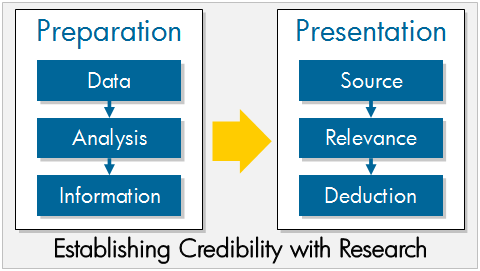
Establishing Credibility with Research

The single most effective approach to establishing credibility is to demonstrate concrete foundations to our proposed thoughts—to draw on meaningful information and deduce concrete inferences in support of our positions.

  • Collect facts and data from reliable sources. Interpret data and demonstrate its relevance. Deduce and structure your arguments in a logical manner to lead people to draw conclusions you would like them to.
  • Include particulars (data, analyses, information) of your background work in an appendix to your presentation or report.
  • Consider your position from every angle and prepare to answer questions. Address counter-arguments in your communication: “Some of you may argue that… Let me assess the risk and suggest a contingency plan.”

Bear in mind that people trust a person’s thoughts so long as they trust the underlying research.

Wondering what to read next?

  1. Use Active Voice for Persuasive Communication
  2. How to Mediate in a Dispute
  3. The Problem with Hiring Smart People
  4. Don’t Say “Yes” When You Really Want to Say “No”
  5. How to Speak Persuasively and Influence Others

Filed Under: Effective Communication Tagged With: Communication, Negotiation, Persuasion

Stephen King’s Tips for Writing Better

October 21, 2007 By Nagesh Belludi Leave a Comment

Here are tips on writing from the celebrated science-fiction author Stephen King’s popular book “On Writing–A Memoir of the Craft.” The first third of this book is a short memoir of the prolific author and the second section, the namesake “On Writing,” is unadulterated inspiration for serious authors and anybody with an inclination to improve their written communication skills.

  • Get to the point. Do not waste your reader’s time with too much back-story, long intros or longer anecdotes about your life. Reduce the noise.
  • 'On Writing--A Memoir of the Craft' by Stephen King (ISBN 1413818720) Write a draft. Then let it rest. King recommends that you crank out a first draft and then put it in your drawer to let it rest. This enables you to get out of the mindset you had when you wrote the draft and get a more detached and clear perspective on the text.
  • Cut down your text. When you revisit your text, it is time to kill your darlings and remove all the superfluous words and sentences. Removing will de-clutter your text and often get your message through with more clarity and a bigger emotional punch.
  • Be relatable and honest. One of the keys to doing that is to have an honest voice and honest characters with both bad and good sides to them. People we can relate to with all of their faults, passions, fears, weaknesses and good moments. Another key to being honest and relatable is keeping a conversational style.
  • Write a lot. To become a better writer you probably—and not so surprisingly – need to write more.

Communication is all about the audience: it is about directing the audience to identify with your point of view and comprehend the precise message you want to convey. The writing tips in Stephen King’s “On Writing” will help you focus on your message—be it in a speech, a blog post, an essay, or an email.

To echo the ideas summarized above, read my earlier blog article about beginning with the end: the most effective start to the communication process is to begin at the end and enumerate the outcome. List the conclusions the audience should draw from your effort. Setting a goal for your communication helps you collect and present ideas logically.

Wondering what to read next?

  1. The More You Write, The Better You Become
  2. Most Writing Is Bad Because It Doesn’t Know Why It Exists
  3. Persuade Others to See Things Your Way: Use Aristotle’s Ethos, Logos, Pathos, and Timing
  4. The Rule of Three
  5. Don’t Say “Yes” When You Really Want to Say “No”

Filed Under: Effective Communication Tagged With: Books for Impact, Communication, Writing

Unlock the Power of Communication: Start with the End in Mind!

February 12, 2007 By Nagesh Belludi 1 Comment

How can you ensure your message hits the mark when you’re about to deliver a speech, prepare a presentation, write a report, draft a résumé, or compose an email? The secret lies in a simple yet powerful technique: beginning at the end.

Instead of diving straight into the content, take a moment to step into the shoes of your recipients or audience. Shift your perspective and view your communication from the outside in. To kickstart this process, ask yourself a series of intriguing questions about the outcome you desire. Don’t hold back—jot down every potential outcome that comes to mind without filtering or limiting your creativity.

Let’s say you’re gearing up for a captivating speech. Picture yourself standing before your audience and delve into their minds. Who are they? What burning questions do they have? What nuggets of knowledge or insights will truly resonate with them? Envision the impact you want to make. What do you hope your listeners will take away from your speech? What action do you want them to take after hearing your words?

Once you’ve gathered a rich array of intended outcomes, it’s time to prioritize and distill the essence of your message. Zero in on the core conclusions you wish to convey to your audience. This is where the magic happens. Now, take a step back and embark on a journey backward. Begin assembling your ideas, anecdotes, and compelling statistics that bolster your conclusions. Weave them into a seamless tapestry of thoughts that guide your audience to those pivotal “aha” moments.

By starting with the end in mind, you gain a distinct advantage—a great perspective that empowers you to shape the direction of your thoughts as you prepare your communication. This approach allows you to discard ideas that don’t align with your desired messages, enabling you to deliver a focused and impactful presentation.

Idea for Impact: communication is an art that revolves around your audience. When you begin at the end, you effectively zero in on the messages you want to convey to your listeners or readers. It’s like fine-tuning a symphony, ensuring every note strikes a chord in their hearts and minds.

Wondering what to read next?

  1. Never Give a Boring Presentation Again
  2. What Happens When You Talk About Too Many Goals
  3. Avoid the Lectern in Presentations
  4. Jargon Has Its Place in Business Communication
  5. A Little-Known Public-Speaking Tip

Filed Under: Effective Communication Tagged With: Communication, Etiquette, Meetings, Networking, Presentations

« Previous Page

Primary Sidebar

Popular Now

Anxiety Assertiveness Attitudes Balance Biases Coaching Conflict Conversations Creativity Critical Thinking Decision-Making Discipline Emotions Entrepreneurs Etiquette Feedback Getting Along Getting Things Done Goals Great Manager Innovation Leadership Leadership Lessons Likeability Mental Models Mindfulness Motivation Networking Parables Performance Management Persuasion Philosophy Problem Solving Procrastination Psychology Relationships Simple Living Social Skills Stress Suffering Thinking Tools Thought Process Time Management Winning on the Job Wisdom

About: Nagesh Belludi [hire] is a St. Petersburg, Florida-based freethinker, investor, and leadership coach. He specializes in helping executives and companies ensure that the overall quality of their decision-making benefits isn’t compromised by a lack of a big-picture understanding.

Get Updates

Signup for emails

Subscribe via RSS

Contact Nagesh Belludi

RECOMMENDED BOOK:
The Wright Brothers

The Wright Brothers: David McCullough

Historian David McCullough's enjoyable, fast-paced tale of how the Wrights broke through against great odds to invent inventing powered flight.

Explore

  • Announcements
  • Belief and Spirituality
  • Business Stories
  • Career Development
  • Effective Communication
  • Great Personalities
  • Health and Well-being
  • Ideas and Insights
  • Inspirational Quotations
  • Leadership
  • Leadership Reading
  • Leading Teams
  • Living the Good Life
  • Managing Business Functions
  • Managing People
  • MBA in a Nutshell
  • Mental Models
  • News Analysis
  • Personal Finance
  • Podcasts
  • Project Management
  • Proverbs & Maxims
  • Sharpening Your Skills
  • The Great Innovators

Recently,

  • Book Summary: Hadley Freeman’s ‘Life Moves Pretty Fast’—How ’80s Movies Wrote America’s Story
  • Inspirational Quotations #1150
  • Corporate Boardrooms: The Governance Problem Everyone Knows and Nobody Fixes
  • Every Agreement Has a Loophole: What Puma’s Pele Gambit Teaches About Lateral Thinking
  • Five Simple Changes That Can Save You the Most Time
  • Inspirational Quotations #1149
  • Sadness Isn’t a Diagnosis

Unless otherwise stated in the individual document, the works above are © Nagesh Belludi under a Creative Commons BY-NC-ND license. You may quote, copy and share them freely, as long as you link back to RightAttitudes.com, don't make money with them, and don't modify the content. Enjoy!