• Skip to content
  • Skip to primary sidebar

Right Attitudes

Ideas for Impact

Search Results for: skills for success

Effective Goals Can Challenge, Motivate, and Energize

January 12, 2016 By Nagesh Belludi Leave a Comment

One of my blog readers asked me to write more about goal-setting and performance against goals. In response, I studied the work of University of Maryland’s Edwin Locke and University of Toronto’s Gary Latham, two renowned researchers on goal-setting. Here is a summary.

Goals Impact Performance in Several Ways

  • Goals can help direct: A person’s goals should direct his/her attention, effort, and action toward goal-relevant actions at the expense of less-relevant actions.
  • Goals can help motivate: A person’s goals can motivate him/her to pursue specific outcomes. The person can be motivated only when his/her goals are sufficiently challenging and can nudge him/her to put in special efforts.
  • Goals can help persist: A person is likely to persist at his/her efforts when his/her goal is worthy enough to attain.
  • Goals can trigger learning: Goals can either activate a person’s knowledge and skills that are relevant to performance or induce the person to acquire such knowledge or skills.

Best Practices for Goal-Setting and Performance

  • Specific, difficult, but attainable goals lead to better performance than easy, vague, or abstract goals such as the general-purpose exhortation to “do your best.” Hard goals motivate because they require a person to achieve more in order to be content with his/her own performance.
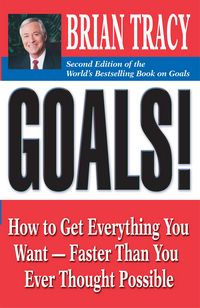
  • 'Goals' by Brian Tracy (ISBN 1605094110) Goal specificity and performance share a positive, linear relationship. When a person’s goals are specific, they direct and energize his/her behavior far more effectively than when they are vague and unspecific.
  • Performance is directly proportional to the difficulty of a goal as long as a person is committed to the goal, has the requisite ability and resources to achieve the goal, and does not have conflicting goals.
  • Taking on excess work without access to the necessary resources to realize the goals (“overload”) can moderate the effects of goals.
  • A team performs best when the goals of the individuals on the team are compatible with the team’s goal. Therefore, when an individual’s goals are incompatible with his team’s, his/her contribution to the team will be subpar.
  • The goal need not be in focal awareness all the time. Once a goal is accepted and understood, it resides in the periphery of the person’s consciousness and serves to guide and give meaning to his/her actions.
  • While long-term goals are relevant and helpful, most people find short-term goals more effective because they channel a person’s immediate and direct efforts and provide quick feedback. This suggests that it’s best to divide long-term goals into concrete short-term objectives.
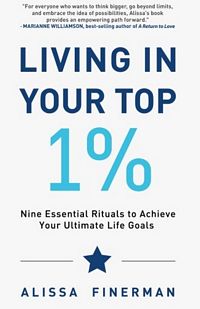
  • 'Living in Your Top 1%' by Alissa Finerman (ISBN 1453619232) Self-efficacy plays a key role in the achievement of goals. A person is much more likely to buy into and pursue goals if he/she believes himself/herself to be competent enough to reach those goals. The most effective goals must therefore embrace a person’s strengths—such goals help him/her strive towards success by leveraging the best of who he/she is and what he/she can do.
  • One reason a person may lack self-efficacy is his/her past failures with undertaking similar goals. Such a person may believe that he/she may never reach his/her goals and should first undertake a series of small, near-term goals instead of difficult, distant goals. The person’s success with a series of smaller goals can boost his/her confidence and can inspire him/her to undertake larger goals. For example, a chain-smoker will find the goal of smoking cessation daunting. He should therefore focus on smaller goals like gradually cutting down the number of cigarettes he smokes every day. Experiences of goal achievement can build up momentum to tackle the larger goal.
  • Goals are not effective by themselves. Feedback is the most important moderator of goal-setting because it tracks the progress of performance towards goals and creates new sub-goals. If a person finds his/her progress towards a goal unsatisfactory, the feedback he/she receives can drive corrective efforts to develop new skills or pursue the goal in a new way.

Filed Under: Leadership, Leading Teams, Sharpening Your Skills Tagged With: Goals, Motivation, Performance Management

Top Blog Articles of 2015

December 30, 2015 By Nagesh Belludi Leave a Comment

Here are this year’s most popular articles based on email- and feed-subscribership:

  1. Top Blog Articles of 2015 Reframe Your Thinking, Get Better Answers. By changing or adjusting your perception of an issue, you are likely to reevaluate your intentions and find alternative, acceptable solutions to your situations.
  2. How to Email Busy People. When you ask something of somebody, make it as convenient as possible for that person to respond to your request. Avoid imposing more busy work on already busy people.
  3. Seek Discipline, Not Motivation. People who actually get things done are those who find a way to work at whatever they are interested in even when they do not really feel like doing it. Focus on the ends rather than the means.
  4. When Delegating, Acknowledge Possible Errors. When delegating, empower your employees by letting them know that they aren’t expected to make optimal decisions every time and you’re not demanding perfection.
  5. The Opportunities in Customer Pain Points. Many innovative ideas are born of a reliable formula: prudent attention to customer pain points: customers are usually willing to pay a premium to have their frustrations with a product or a service resolved.
  6. Fear of Failure is an Obstacle to Growth. If you fear failure and limit your activities, you are acutely impeding the knowledge and wisdom that comes from opening yourselves up to the new and the unfamiliar.
  7. What Everybody Ought to Know about Writing Better Emails. Poorly written emails are a result of weaknesses in style and structure. Poor style is characterized by improper spelling and grammar, meandering and complex sentences and abstract, technical or indirect language. Poor structure refers to disparity between logical sentence order and the reader’s comprehension of those sentences.
  8. Coaching vs. Feedback. Coaching is about future behavior and feedback is about past (and current) behavior. Coaching is about assisting employees reach their goals for the future. Feedback is about helping employees understand what prevents them from reaching their current goals.
  9. The Truth Can Be Bitterer than a Sweet Illusion. Delaying action and putting off unpleasant confrontations will only make things harder. Especially when dealing with difficulties involving people, there is nothing more insidious than unresolved conflict and inaction.
  10. What Opportunities Are You Overlooking? What opportunities are you overlooking today that, months, years, or decades from now, you could come to regret with the perspective that comes with time or upon mature reflection?

And here are articles of yesteryear that continue to be popular:

  1. 25 Ways to Instantly Become a Better Boss. Bad management is not usually a result of bosses not knowing what to do to manage better. Rather, it stems largely from bosses not putting simple, conventional managerial skills into practice.
  2. How to Write Email Subject Lines that Persuade. By writing persuasive subject lines in emails, you can help your readers identify the importance of your message and the action you’re asking.
  3. Self-Assessment Quiz: How Stressed are You? The first step to overcome the causes and effects of stress is to acknowledge stress and become aware of its symptoms. By identifying a few telltale signs of stress, you can take steps to manage them.
  4. Maria Bartiromo’s “The 10 Laws of Enduring Success.” CNBC anchor and journalist Maria Bartiromo presents a longstanding blueprint of success as ten attitudes: self-awareness, foresight, ingenuity, audacity, integrity, flexibility, modesty, fortitude, tenacity of purpose, and resilience.
  5. 7 Easy Ways to Get More Done in Less Time. Divide and conquer. Fight procrastination. Put things in their place. Create checklists for all tasks. Start planning your day on the prior day. Pick up after yourself and clean your home and workspace. Maintain a ‘On-The-Go’ folder.

Filed Under: Announcements

Books I Read in 2015 & Recommend

December 23, 2015 By Nagesh Belludi Leave a Comment

In addition to a number of Rick Steves’ and Lonely Planet books for my summer-long travels across Europe, here are a few books that I read in 2015 and recommend.

  • Biography / Business: Brad Stone’s The Everything Store: Jeff Bezos and the Age of Amazon is an engrossing chronicle of the obsessive hard-driving personality of its founder-CEO and the company that has played the pivotal role in the shift from brick-and-mortar retail to online retail.
  • 'Onward: How Starbucks Fought for Its Life without Losing Its Soul' by Howard Schultz, Joanne Gordon (ISBN 1609613821)Biography / Leadership: Starbucks founder Howard Schultz’s Onward: How Starbucks Fought for Its Life without Losing Its Soul is an interesting depiction of Starbucks’ turnaround after Schultz returned as CEO in 2008. Read Onward for a case study of the founder’s syndrome in action and a self-congratulatory portrait of a charismatic entrepreneur and brilliant corporate cheerleader. Read my summary.
  • Biography / Business: Ashlee Vance’s Elon Musk: Tesla, SpaceX, and the Quest for a Fantastic Future is a biography of America’s current most audacious entrepreneur and Silicon Valley’s most prominent innovator. While the book details Musk’s bold leadership decisions, it also serves as a great reminder of how an extreme personality and intense success are not without their costs. Read my comments.
  • Decision-Making: Phil Rosenzweig’s Left Brain Right Stuff delineates distinct but complementary skills required for making winning decisions: logical analysis and calculation (left brain skills) and as well as the willingness to take risks, push boundaries, and go beyond what has been done before (right brain skills.)
  • 'Surely You're Joking, Mr. Feynman!' by Richard Feynman, Ralph Leighton (ISBN 0393316041)Biographies / Mental Models: Physicist and Nobel Laureate Richard Feynman’s scientific curiosity knew no bounds. His academic life, acuity, life-philosophy, and ability to communicate science are inspirational to anyone pursuing his/her own life’s fulfillment. The following biographies capture his many scientific achievements, playfulness, varied interests and hobbies, and—perhaps most notably—his many eccentricities.
    • Surely You’re Joking
    • What Do You Care What Other People Think
    • Genius Richard Feynman
    • The Pleasure of Finding Things Out
  • 'Sam Walton: Made In America' by Sam Walton (ISBN 0553562835)Biography / Business: Sam Walton’s bestseller autobiography Made in America is very educational, insightful, and stimulating. Walton inspired legions of other entrepreneurs who thrive on managing costs and prices to gain competitive advantage. Read about an important lesson from this book about cost and price as a competitive advantage.
  • Decision-Making: Suzy Welch’s 10-10-10 Rule advocates considering the potential positive and negative consequences of all decisions in the immediate present, the near term, and the distant future: or in 10 minutes, 10 months, and 10 years. Read my summary.
  • Biography / Mental Models: Walter Isaacson’s A Benjamin Franklin Reader is an excellent collection of the writings of Benjamin Franklin, one of America’s most beloved founding fathers. Franklin was a polymath renowned for his lifelong quest for self-improvement.
  • 'The Art of Stillness: Adventures in Going Nowhere' by Pico Iyer (ISBN 1476784728)Philosophy: Pico Iyer’s The Art of Stillness argues the importance of taking a timeout from busyness. Iyer contends, “In an age of speed … nothing could be more invigorating than going slow. In an age of distraction, nothing could feel more luxurious than paying attention.” Read my summary.
  • Biographies / Art / Philosophy: Steven Naifeh and Gregory Smith’s Van Gogh: The Life and Michael Howard’s Van Gogh: His Life & Works in 500 Images paint a vivid picture of the artistic genius and the troubled personal life of Vincent van Gogh. Ever Yours is an absorbing anthology of correspondence between Vincent and his brother Theo. Ever Yours sheds light on Vincent’s shifting moods, turbulent life, and philosophical evolution as an artist.
  • Management: Ken Blanchard and Spencer Johnson’s One Minute Manager is a best-selling introductory business book about goal-setting and giving feedback. Read my summary.
  • Biographies: Tenzing Norgay’s autobiography Man of Everest and Yves Malartic’s Tenzing of Everest portray the personal triumph of a poor and illiterate but ambitious, deeply religious explorer.

On a related note, read my article about reading hacks: How to Process that Pile of Books You Can’t Seem to Finish. Also see books I read in 2014 & recommend.

Filed Under: Leadership Reading, Sharpening Your Skills Tagged With: Books for Impact, Skills for Success

These Celebrities and Hollywood Actors Didn’t Just Wait Around for Dream Jobs to Turn up

July 21, 2015 By Nagesh Belludi 1 Comment

“He who lives uprightly and experiences true difficulty and disappointment and is nonetheless undefeated by it is worth more than someone who prospers and knows nothing but relative good fortune.”
—Vincent van Gogh

Stories of superstars who struggled in their early careers are very inspiring

Some superstars had it made. They came from privileged backgrounds and had spectacular starts to their careers. They were lucky enough to attend the best schools, get the right pedigree, make the right connections, get an early break, or join the fast track to the top.

Other superstars were not so lucky in their early careers. Most of these men and women—particularly the archetypical self-made person—came from humble backgrounds and struggled to establish themselves. They found productive jobs to eke out a living, all the while never losing sight of their ambitions. They took every opportunity to learn and prove themselves. They worked hard to get a foot in the door, toiled in the trenches, learned everything about their trades, and painstakingly built their spectacular careers from the ground up. In sum, they didn’t just while their time away waiting for their desired jobs and dream gigs to show up.

Jack Nicholson, Robin Williams, Brad Pitt

Consider three Hollywood superstars who struggled during their early careers and worked modest jobs to earn their living but never abandoned their ambitions.

  • Hollywood legend Jack Nicholson (b. 1937) ran errands and worked as a messenger at Hollywood’s MGM animation studios before being “discovered.” He had moved from New Jersey to pursue his dream of becoming an actor and lived with his wannabe-actress mother (whom he thought was his sister until he was 36, a full ten years after her death.)
  • Comedian and Hollywood actor Robin Williams (1951–2014) gained precious experience in his twenties working as a mime artist in front of New York’s Museum of Modern Art while trying to find acting gigs. As a child, Williams hardly fit the stereotype of someone who would later pursue comedy. Born to a successful Ford executive, Williams grew up a shy, lonely child playing by himself in an empty room of his family’s mansion. He overcame his shyness only after taking drama classes in high school.
  • Celebrated actor and producer Brad Pitt (b. 1963) worked a variety of odd jobs while struggling to establish himself in Hollywood. To pursue his passion for the big screen, he moved to Los Angeles from Missouri two weeks before he was about to earn his degree in Journalism. He took acting lessons and made contacts. Within months, Pitt got uncredited roles in three films. For the next seven years, he gained increasing recognition in supporting roles on television and in films before securing leading roles that catapulted him to worldwide fame.

Examine the purpose of these examples viz. to emphasize that successful people find something productive to do while improving themselves and waiting for their big break. Take note of a crucial nuance: we are not discussing humble part-time or casual summer jobs that later-superstars held in their youth—e.g., Pope Francis worked as a bouncer in Buenos Aires, German Chancellor Angela Merkel as a barmaid in Leipzig, Bill Gates as a page in the United States Congress, Warren Buffett as a newspaper delivery boy in Washington, D.C.

Albert Einstein, Soichiro Honda, Stephen King

Other disciplines also present plenty of superstars who pursued their ambitions while holding humble first-jobs.

  • Physicist and philosopher Albert Einstein (1879–1955) spent two frustrating post-college years searching for a teaching job before becoming a clerk at the Swiss Patent Office in Bern. In between examining patent applications and during his spare time, he worked on physics problems. In his third year at the job, he wrote four groundbreaking papers that transformed physics.
  • When Japanese engineer and industrialist Soichiro Honda (1906–1991) moved to Tokyo at age 15 to find work as an auto mechanic, a repair shop owner hired him as a nanny to his infant. With a child in tow, Honda often meandered about the garage, observing and learning from the mechanics. When the child was asleep, Honda tinkered with engines and started giving suggestions to the mechanics. He strengthened his passion for automotive engines just as the nascent industrial base of Japan was finding a new enthusiasm for machines.
  • 'Carrie' by Stephen King (ISBN 0307743667) Best-selling author Stephen King (b. 1947) struggled for years after graduating from college. He and his writer-wife grappled financially and lived in a trailer home. He worked hard at building a career as a writer and developed ideas for many novels. King sold short stories to men’s magazines and worked small jobs to make a living. When working as a janitor in a school locker room, he was inspired to write a novel titled “Carrie”. Set in a girls’ locker room, Carrie features a schoolgirl who exercises her newly-discovered telekinetic powers to exact revenge on her bullies. Carrie turned into King’s first published novel and lent him his big break.

Idea for Impact: Self-disciplined people don’t wait for the right answer or the golden path to present themselves. They understand that the best way to get unstuck is to start somewhere, focus on action, keep themselves productive, amend their course if necessary, and do all this without losing sight of their goals and ambitions.

A note of caution: Stories of superstars’ successes are but cherry-picked examples

“Welcome to Hollywood. What’s your dream?
Everybody comes here. This is Hollywood, the land of dreams.
Some dreams come true, some don’t. But keep on dreamin’.
This is Hollywood. Always time to dream, so keep on dreamin’.”
—From “Pretty Woman” (1990)

More than we possibly realize, so much of life’s success in life has to do with luck (or fate or destiny.) As I’ve written previously, success is often more about being at the right place, at the right time, and with the right person than about possessing the right skills and working hard.

The above are merely examples of a few lucky superstars who made it big in Hollywood or in their chosen disciplines and followed their passions as careers.

For every Stephen Hawking or J. K. Rowling, there are thousands of wannabe writers whose creative writing doesn’t even pay enough to buy the notebooks they use.

For every Jack Nicholson, Robin Williams, or Brad Pitt, there are countless Hollywood wannabes struggling in the “Land of a Million Dreams.” What’s more, among actors who manage to find work, an even smaller fraction of them actually make a living doing it. Part-timers are paid so little that they must work at stores, restaurants, or bars at night and on weekends. The cost of living in Southern California has hit the roof; even professionally-done headshots cost hundreds of dollars. The celebrity impersonators and street performers on Hollywood’s Walk of Fame have even started aggressively pestering tourists and photographers for bigger tips.

Celebrity impersonators and street artists on Hollywood's Walk of Fame pestering tourists for bigger tips

In the la-la land of Los Angeles, chances are that any random person you meet is an aspiring actor, model, designer, musician, songwriter, screenplay writer, director, stunt-double, makeup artist, or is trying to get some gig in the entertainment industry. Each aspirant is taking classes, trying to make contacts, looking for auditions, hoping to land jobs, wishing to be “discovered” by an actor or noticed by a talent agent at a restaurant, club, or elsewhere.

Competition is brutal and the market for fame is saturated

In Hollywood, anything is possible and yes, “some dreams come true.” However, in reality, there’s an infinitesimal chance that any aspirant will ever get a break. Even still, thousands of hopefuls flock to Hollywood every year (and thousands of rejects move out.) After endless auditions, rejections, or false starts, they wake up to the harsh realities of competition and get jobs that are more gratifying than chasing a near-impossible dream.

“He that lives upon hope will die fasting.”
—Benjamin Franklin

If you have a passion for something that will not pay adequately, pursue it on the side. Here’s some sage advice from my mentor Marty Nemko:

Do what you love, but don’t expect to get paid for it. Want to be on stage? Act in community theater. Want to be an artist? Convince a restaurant to let you decorate its walls with your creations. To make money, pick a field that pays decently and has few liabilities. Chances are, that will lead to more career contentment than pursuing a long-shot dream as your career. Treating a long-shot dream as an avocation gives you most of its pleasure without forcing you to endure a life of poverty.

Filed Under: Career Development, Great Personalities, Sharpening Your Skills Tagged With: Attitudes, Celebrities, Entrepreneurs, Scientists, Writers

Creativity by Blending Ideas to Form New Ones: A Case Study of Gutenberg and the Printing Press

February 24, 2015 By Nagesh Belludi Leave a Comment


Ideas Evolve over Time by Blending with Other Ideas

One of the fascinating aspects of invention is tracking the continuity of ideas across an arc of time. Through education, exposure, and experimentation, people’s creative thoughts can stretch both temporally and across various disciplines of knowledge.

When people develop a new idea, they often share it with others, who may then use this idea to expand their own understanding of concepts, invent even fresher ideas, and spread them. Ideas thus evolve over time.

Building on Antecedent Inventions

Considering the collaborative nature of idea formation, every new idea is arguably a conceptual sum of its predecessors. The power of blending ideas to form new ones is shown in that most seminal inventions are based on antecedents—inventions that came before them. For instance,

  • James Watt’s “invention” of the steam engine (or, more precisely, his invention of the separate-condenser steam engine) was in fact an attempt to modify Thomas Newcomen’s steam engine. Newcomen’s work was itself based on Thomas Savery’s invention of a steam-powered pump to extract water from mine-shifts. Later, James Watt adapted his separate-condenser to produce continuous rotary motion and expanded its use far beyond pumping water. Continuous rotary motion sparked the transition from hand-production methods to machine-power and became the driving force of the Industrial Revolution.
  • The Wright brothers’ first heavier-than-air powered flight was the culmination of their experience with bicycles. This first flight demonstrated their ability to improve prior inventions by applying previously-reached solutions to controlled flight issues. [See my previous article on how the Wright brothers argued and developed their ideas.] Within fifty years of the Wright brothers’ first successful airplane, humankind’s concept of distance had changed dramatically: aircrafts could fly across continents in hours—sometimes faster than sound. Just a short time later, aircrafts were traveling into space.
  • British Mathematician Andrew Wiles’ much-celebrated proof of Pierre de Fermat’s Last Theorem was based on the work of some of the greatest mathematical minds who, over three centuries, had also puzzled over Fermat’s Last Theorem. Contemporaries Gerhard Frey, Jean-Pierre Serre, and Ken Ribet also influenced Wiles’ work. Until Wiles’ success in the mid-nineties, the theorem remained inaccessible to proof for 358 years. In the 1840s, German mathematician Richard Dedekind attempted to solve the theorem and in so doing, laid the foundations of algebraic number theory.

Idea for Impact: Creativity is accessible through the often-subconscious process of blending what you already know to form new ideas.

Gutenberg's Invention of Mechanized Printing: Blend of coin punch and mechanized wine press

Case Study: Gutenberg’s Invention of Mechanized Printing

In the 15th century, Johannes Gutenberg invented mechanized movable-type printing. His invention revolutionized the dissemination of knowledge throughout the Western World and played a pivotal role in the development of the Renaissance, the Protestant Reformation, the Age of Enlightenment, and the Scientific Revolution.

The earliest forms of printing evolved from letter and coin punches, which were in vogue even in the Neolithic era. Woodblock printing was fashionable in East Asia since the second century. At least two centuries prior to Gutenberg’s invention, manual block printing with movable type had existed. However, this technique was hardly known in Europe, where all manuscripts were laboriously copied out by hand or stamped out with woodblocks before Gutenberg’s invention.

Gutenberg blended the flexibility of a coin punch with the power of a mechanized wine press to invent mechanized printing. For each character to be printed, Gutenberg used his skills as a goldsmith to cast individual pieces of metal type. These pieces could be quickly assembled into blocks depending on the composition of characters on a page.

Gutenberg’s mechanized press was an adaptation of the wine press, a historical contraption used to crush grapes and extract their juice for winemaking. Gutenberg’s press consisted of a fixed lower bed and movable upper platen containing composed type blocks. The platen was inked, covered with a sheet of paper, and pressed by a small bar on a worm screw. Pressing the upper and lower surfaces together formed a vise and left a sharp impression of inked characters on the paper.

The hand-operated Gutenberg press was further mechanized in the 19th century. Engineers introduced James Watt’s invention of the double-acting rotary steam engine to create steam-powered rotary presses, altogether creating industrialized bulk printing.

Filed Under: Mental Models, Sharpening Your Skills Tagged With: Creativity, Thought Process

There Isn’t a Shortcut to the Top

March 27, 2013 By Nagesh Belludi Leave a Comment

Good college basketball players are often persuaded not to turn pro during their junior years because, once they start professional basketball, they are expected to play regularly and will miss the chance to get extensive coaching and work on their fundamentals. Instead, they are encouraged to stay for another year at college and bear the opportunity costs.

Likewise, a sound understanding of the fundamentals of a business and worthwhile operating experience cannot be skipped.

The Fast Track to the Top May Look Attractive

Organizations are full of young high-performers who seem to have the right pedigree, are sharp and ambitious, and have impressed their managers with some early achievements. As soon as they have “proved” themselves, HR succession programs tend to fast-track high potentials to the next challenge even if they are not entirely prepared, thus unintentionally setting them up for stressful transitions, bitterness, or eventual failure.

In many instances, young employees are so determined to move up the corporate ladder quickly that they don’t remain in one position long enough to master the right skills and learn from mistakes. They thereby risk accumulating a very large gap in their knowledge and skills.

Idea for Impact: Work on the Fundamentals as You Build a Career

Before making your next career move, perform a realistic self-appraisal and consider how the move may support or impede your longer-term goals. See my previous article for a list of questions to assess your chance of a promotion or a lateral move.

One of the most important skills for career success is the ability to synthesize business requirements and adjust your management approach to the conditions at hand. Each new responsibility should involve an incremental challenge that requires new learning, new approaches, and a chance to demonstrate improvement in your managerial judgment. As a career coach, I recommend staying in one position for one or two business cycles to adequately learn about the nature of the business, test fresh approaches, impact the business, and get feedback on your work.

Furthermore, not all career moves need be up the ladder. Even though most careers follow an upward trajectory, many successful careers consist of a mixture of lateral and upward career moves, each with additional responsibilities or opportunities to build experiences in different market, product, or geographical contexts with prospects for promotion in the future.

Filed Under: Career Development, Managing People Tagged With: Career Planning

25 Ways to Instantly Become a Better Boss

August 2, 2010 By Nagesh Belludi 2 Comments

Bad management is not usually a result of bosses not knowing what to do to manage better. Rather, it stems largely from bosses not putting conventional managerial skills into practice. Little wonder, then, that despite the billions that organizations pour into managerial training, instances of shoddy management abound.

Here are a few simple and specific actions you can take now to become an effective boss.

  1. Smile more
  2. Appreciate more, judge less
  3. Compliment openly; critique and correct in private
  4. Don’t worry about who gets credit; give credit where due
  5. Give feedback now; don’t wait until the next performance review
  6. Reiterate employees’ strengths and make them feel smarter
  7. Get rid of busy work
  8. Simplify work and encourage expediency
  9. Establish deadlines and stick with them
  10. Organize employees’ time and priorities
  11. Explain what needs to be done and get out of the way
  12. Avoid giving conflicting orders
  13. Find the time to listen to your employees and follow-up
  14. Recognize the small picture
  15. Seek to understand what inhibits employee effectiveness
  16. Give employees adequate latitude
  17. Fix problems, not blames
  18. Encourage mistakes; own up to your mistakes
  19. Standup for your employees
  20. Encourage participation in decision-making
  21. Be tough-minded, not mean
  22. Do not play favorites; discourage sucking up
  23. Be accessible and friendly, yet consistent and objective
  24. Earn respect; don’t demand deference
  25. Attempt to influence by persuasion, not by wielding authority

Filed Under: Leading Teams Tagged With: Great Manager

Hiring: If You Pay Peanuts, You Get Monkeys

April 20, 2010 By Nagesh Belludi Leave a Comment

If You Pay Peanuts, You Get Monkeys During the economic slowdown last year, a manager had a choice between two consultants for a critical project to turnaround the prospects of his division. The first candidate was five years out of business school; his billing rate was $370 an hour. The second, more experienced candidate’s was $510 an hour. Without much deliberation, the manager hired the first candidate because he would fit in the manager’s budget. Things did not work out as well as the manager had expected. Three months later, after considerable delays and missed opportunities, the manager fired his consultant and recruited the second candidate anyway. This consultant had an earlier experience similar to the situation at hand and succeeded in his mission in due course.

The best don’t come cheap

Recruiting is the toughest responsibility of a manager. Prudent hiring processes start with a realization that talented professionals are the heart of successful organizational endeavors. Many managers simply do not take in this fact and signup those who cost the least instead.

Economic downturn or lower project budgets are no reasons for careless hiring decisions. It is exactly during though times that managers should recruit the best people. And, the best don’t come cheap.

Now, I am not saying that high-priced consultants and employees are necessarily good. The converse is not automatically true either. Market demand for talent often dictates billing rates and compensation of skilled professionals. There is often a strong reason for them being in demand and commanding premium fees. No manager dare overlook such considerations.

Filed Under: Managing People Tagged With: Great Manager, Hiring & Firing

Learn from the Top Performers in Every Field

April 13, 2010 By Nagesh Belludi Leave a Comment

Learn from the Top Performers in Every Field

During Q & A at a career-planning workshop that I led recently, a member of the audience asked me, “Where could I get the best education in life?” This article elaborates my response.

You learn best from imitating the techniques of the successful

“What the outstanding person does, others will try to do. The standards such people create will be followed by the whole world.”
* The Bhagavad Gita

The best way to educate yourself is by observing the top performers in every field and by identifying and applying their effectiveness techniques to your circumstances. Your inspiration may be somebody you interact with, somebody you can hear about in the media or a fictional character from a novel or movie.

Try to imitate the best performers in a discipline to be successful in that discipline. Study their educational and professional backgrounds, their work style, successes, and failures. Identify how they go about conducting their everyday affairs. Try to copy the stock picking and capital allocation skills of Warren Buffett to become a successful investor. Piggyback on the thinking of the best mutual fund managers; replicate their portfolios to benefit from their stock selection process.

Read about the techniques of Sherlock Holmes to improve your reasoning and problem-solving skills. Impersonate your favorite stand-up comedian ahead of a presentation or public speech to improve your delivery. Study the footprints of the leaders in your organization if you want to follow their lead.

Imitate different attributes of people you encounter every day: the cheerfulness of an administrative assistant, the persuasion skills of a seasoned negotiator, the resourcefulness of a car mechanic, and the dexterity of a customer service agent.

Role models are inspirational

Looking up to others is rather instinctive. As kids, you looked up to your siblings, parents, or family members. At work, you learn from observing your colleagues and bosses.

When we learn of role models, read their stories or watch of them on TV or in the movies, we identify in them a part of ourselves; we associate with their struggles and victories, their hopes and despairs.

When we identify with a role model who has accomplished what we seek yourselves, we not only learn from them but also become more confident in our abilities.

This technique has its limitations

Naturally, the influence of role models is neither always practical nor necessarily productive. Your perception of popular role models (sportsmen, artists, businesspeople and other celebrities) is often incomplete and based on cursory assessments of them. Media accounts of their trappings of wealth, fame, and success or their unseemly lifestyles can just as easily turn them into negative role models. Excesses and faults are as common in everyday life as they are in the news. Exercise judgment in what you identify and implement. Hence the corollary: Learn from the shortcomings of the unsuccessful.

Call for action

  • When people make a positive impression on you, reflect on what they did and how they did to impress you. Explore what you can learn from them.
  • Identify the top performers in your field. Seek to understand and adopt their techniques. Improve or tailor them to your personal circumstances and improve yourselves.
  • Study the biographies and memoirs of your favorite historical leaders. Read news stories and case studies of people you admire. Learn their techniques.
  • Think of personal and professional skills that you would like to improve upon. Identify one or two people in your organization who are especially skilled in these areas. Observe them or ask them for advice.

Learn everything you can from others, implement what appeals to you, and discard the rest.

Filed Under: Career Development, Great Personalities, Sharpening Your Skills Tagged With: Getting Ahead, Role Models

Not Everybody Wishes to Climb the Corporate Ladder

March 30, 2010 By Nagesh Belludi Leave a Comment

You have probably met corporate people who are five to ten years from retirement and have remained in their bottom-of-the-ladder “contributor” roles (as engineers, programmers, accountants, salespersons, etc.) for decades. Don’t they typically report to managers 10 to 15 years their juniors? Ever wonder why they never assumed managerial or leadership roles? Are they simply incompetent or unenthusiastic? Enquire around and you may be surprised to learn that they may have perhaps never desired to climb the corporate ladder. You will possibly learn that,

  • They are not aimless. In reality, at some point in their careers, they made a conscious choice to not pursue the traditional career advancement paths and stay in their roles as “senior contributors.” Their dominant priorities lie elsewhere: usually with family, community, faith, and creative interests. They view their careers as means to other ends. They set goals for what they seek to achieve, create a plan, and relate to their values in the right way, everyday.
  • They are quite influential in their organizations. They gain credibility not by virtue of positions or titles, but from years of experience, awareness of processes and historical perspectives. They seek to mentor young engineers and offer their opinions and judgments when consulted by management. They gain an immense sense of satisfaction by helping their organizations grow. They are widely respected.
  • Their salaries are quite comparable to people who have identical spans of service in their organizations and have assumed leadership roles. They are highly valuable contributors.

The “senior contributors” are not the only ones who have shunned the corporate ladder. Many women choose to work three days a week once they have kids. Husbands of career-minded moms have relinquished their rewarding careers to become stay-at-home dads and support their wives’ careers. Frequently, executives decline international assignments that could keep them away from family. All these people tend to feel in command of their life and career—they are more contented in their careers and have a stronger sense of work-life balance. For sure, they can teach the rest of us a thing or two about setting the course of our lives.

The long-hours culture is not for everybody

You probably recollect the days when corporate people had reasonably secure jobs, showed up at work every workday, clocked in, worked eight hours, clocked out, stopped thinking about work until the next workday, and enjoyed four weeks of vacation a year. They could maintain a healthy separation between work and personal time. Alas, those days are long over.

In today’s workplace, the demands on our energy, time, and creativity constantly overwhelm us, despite access to technology, computers, and other productivity tools. We have so much on our plates that we only rarely complete things WHEN and AS we would wish to. The workday is longer, the pace of work is faster, and most projects tend to be open-ended. The pressure to learn new skills is prominent. A successful corporate career demands a high-level of performance for sustained periods. At what cost, though? Unsurprisingly, the pressure to work harder and longer results in poor physical health, stress, anxiety, lesser time with family and friends, fewer opportunities to pursue hobbies and creative interests, and insufficient rest and relaxation.

Work or life or both—its your choice

“The price of anything is the amount of life you exchange for it.”
* Henry David Thoreau

There is no magic potion or canned method for balancing your work and life. Finding balance is rather an exercise in finding a healthy perspective that works for you. Nobody but you can make the right choices and work out what is best for you to bring about a sense of satisfaction of physical, mental, financial, intellectual, professional, and social well-being.

Everyone has to find his or her own individual balance

The quest for work-life balance begins with defining what balance means to you. Reflect on what you value most in life and prioritize them. Include your family in your contemplations of choices and consequences. Establish a set of boundaries between an adequate amount of effort and return. Consider your personal and professional aspirations, the family and social life you desire, your hobbies and interests and your goals and dreams.

Ask yourself, “How much is adequate?” and, “How much success and money is good enough?” Set boundaries and limits between what you must do and what you want to achieve in the short term and in the long term. The choices you make and your ability to respect the limits your set for yourself should shape your work and career, not the other way around.

Explore alternate arrangements at work

After you reflect on what could constitute a sense of individual balance for you, examine your career objectives. Once you are clear about what you want, consider the potential consequences to your employer. Discuss your options and proposals with a trusted advisor, the human resources / personnel department, and your boss. Most companies care for their employees enough to offer options for part-time or flexible schedules, working from home or sabbaticals.

Lead a life to your own script, not to others’

The world will shape your life, if you let it. Establish what you want to achieve in your life; do not let others impose their proposals for you. Make the right choices and live true to your values. This is, in essence, the key to finding the illusive work-life balance.

Filed Under: Career Development, Living the Good Life Tagged With: Balance, Career Planning, Work-Life

« Previous Page
Next Page »

Primary Sidebar

Popular Now

Anxiety Assertiveness Attitudes Balance Biases Coaching Conflict Conversations Creativity Critical Thinking Decision-Making Discipline Emotions Entrepreneurs Ethics Etiquette Feedback Getting Along Getting Things Done Goals Great Manager Innovation Leadership Lessons Likeability Mental Models Mindfulness Motivation Parables Performance Management Personal Growth Persuasion Philosophy Problem Solving Procrastination Psychology Relationships Resilience Simple Living Social Skills Stress Thinking Tools Thought Process Time Management Winning on the Job Wisdom

About: Nagesh Belludi [hire] is a St. Petersburg, Florida-based freethinker, investor, and leadership coach. He specializes in helping executives and companies ensure that the overall quality of their decision-making benefits isn’t compromised by a lack of a big-picture understanding.

Get Updates

Signup for emails

Subscribe via RSS

Contact Nagesh Belludi

RECOMMENDED BOOK:
Doing Business In China

Doing Business In China: Ted Plafker

The Economist's Beijing-correspondent Ted Plafker on the challenges of entering the Chinese market, conducting business in China, and not falling flat on your face.

Explore

  • Announcements
  • Belief and Spirituality
  • Business Stories
  • Career Development
  • Effective Communication
  • Great Personalities
  • Health and Well-being
  • Ideas and Insights
  • Inspirational Quotations
  • Leadership
  • Leadership Reading
  • Leading Teams
  • Living the Good Life
  • Managing Business Functions
  • Managing People
  • MBA in a Nutshell
  • Mental Models
  • News Analysis
  • Personal Finance
  • Podcasts
  • Project Management
  • Proverbs & Maxims
  • Sharpening Your Skills
  • The Great Innovators

Recently,

  • Inspirational Quotations #1177
  • How to Deal with … Interrupters
  • How to Deal with … Overtalkers
  • Stress You Can’t Name Is Stress You Can’t Manage
  • Inspirational Quotations #1176
  • The Leader and the Legend
  • The Commercialization of Yoga: Downward Dog, Upward Profit

Unless otherwise stated in the individual document, the works above are © Nagesh Belludi under a Creative Commons BY-NC-ND license. You may quote, copy and share them freely, as long as you link back to RightAttitudes.com, don't make money with them, and don't modify the content. Enjoy!