• Skip to content
  • Skip to primary sidebar

Right Attitudes

Ideas for Impact

Search Results for: creativity

“Leave Something in the Well”: Hemingway on The Productive Power of Strategic Incompletion

November 7, 2025 By Nagesh Belludi Leave a Comment

'Leave Something in the Well': Hemingway on The Productive Power of Strategic Incompletion

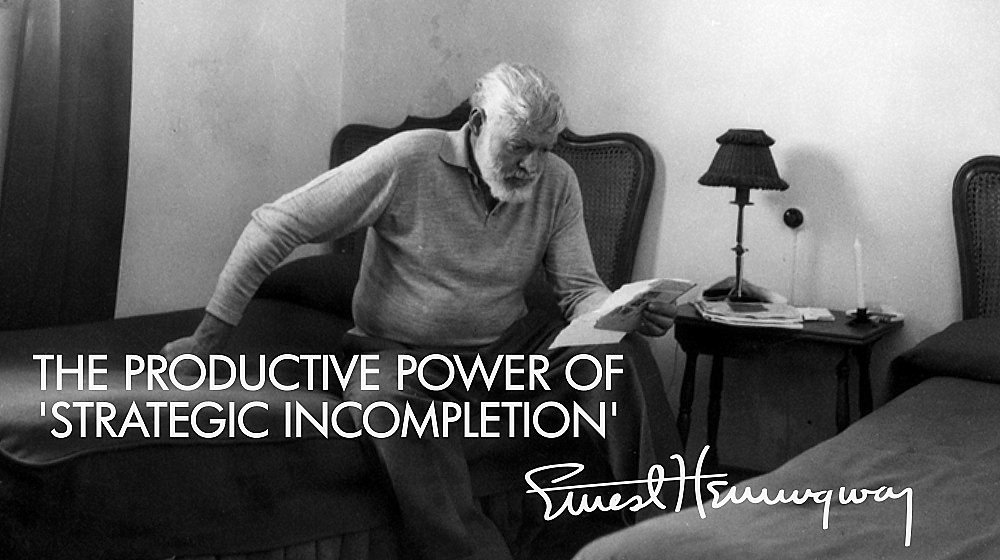
Ernest Hemingway claimed to have a disciplined writing routine. He wrote early each morning and always stopped while he still knew what came next—leaving something in the “well” for the following day. He shared this advice in various contexts, notably in a 1935 Esquire article, framing it as an antidote to creative block.

When the goal is sustained momentum in any creative or cognitive endeavor, one principle stands out: stop while the work is still alive. Hemingway wasn’t just advising writers when he said, “The best way is always to stop when you are going good and when you know what will happen next.” He was articulating a broader truth about motivation: friction.

The method is deceptively simple: pause while momentum remains. Finishing everything may feel productive, but it often kills clarity. Push past peak energy, and you return to dread. Pause midstream, and you resume with direction.

The Hemingway Principle of Continuity

This defies cultural instinct. We’re conditioned to chase closure—to exhaust ourselves chasing completion. But exhaustion isn’t discipline. The better move is knowing when to stop: at the crest of effort, when the next step is obvious—but untaken.

Hemingway distilled this perfectly: “I had learned already never to empty the well of my writing, but always to stop when there was still something there in the deep part of the well, and let it refill at night from the springs that fed it.”

He wasn’t preserving mystery—he was preserving momentum.

Applied broadly, the technique dulls resistance. Reentry becomes ritual—driven by anticipation, not obligation. You don’t resume reluctantly. You resume with hunger.

Idea for Impact: Leave your work unfinished on purpose. Not because you failed, but because the unfinished work remains fertile. Discipline isn’t about what you finish. It’s about the ability to return—again and again.

Filed Under: Mental Models, Sharpening Your Skills Tagged With: Discipline, Lifehacks, Motivation, Perfectionism, Procrastination, Task Management

Why You Get Great Ideas in the Shower

October 31, 2025 By Nagesh Belludi Leave a Comment

Why You Get Great Ideas in the Shower Ever stepped into the shower and suddenly cracked a lingering problem wide open? You turn on the water, and just like that, the perfect idea rushes in. That’s your subconscious at work, making wild connections you didn’t even know existed.
Psychologist Mihaly Csikszentmihalyi, famous for the idea of Flow, called this “Incubation.” Step away from the grind, relax a little, and your subconscious picks up the slack. In the shower, your brain slips into the Default Mode Network (DMN)—a calm, dreamy state where thoughts drift freely. You’re not forcing solutions. You’re letting your mind roam, blending ideas without limits.

Warm water also triggers a sweet dopamine boost, sparking creativity like crazy. Ideas bubble up out of nowhere. Plus, showers are rare distraction-free zones—no pings, no screens, just the steady hum of water and your wandering mind. A pure, golden moment for clarity and breakthroughs.

Routine plays its part too. Showering is simple, repetitive, almost meditative. You switch to autopilot. Perfect for letting your brain drift, tinker, and dream.

Idea for Impact: Embrace the magic tucked inside everyday moments—a quiet drive, a slow walk, a lazy hour in the park. Make space for “doing nothing.” Let your mind wander and see what brilliance bubbles up. The extraordinary often hides in the ordinary. Seize those idle moments and set your imagination loose.

Filed Under: Mental Models, Sharpening Your Skills Tagged With: Creativity, Critical Thinking, Discipline, Innovation, Mental Models, Motivation, Problem Solving, Thought Process

The ‘Small’ Challenge for Big Companies

September 19, 2025 By Nagesh Belludi Leave a Comment

Innovation: The 'Small' Challenge for Big Companies This HBR article highlights a compelling asymmetry in team dynamics: large teams excel at development and deployment, while small teams are better suited for disruption. Large teams execute. Small teams disrupt. The former march in formation; the latter think in rebellion.

Anecdotally, that rings true. Smaller teams, leaner in structure and tighter in cohesion, thrive at birthing radical ideas and reframing paradigms. They move quickly because they aren’t bogged down by bureaucracy and status meetings. They share context without memos, pivot without permission, and fail without fanfare. Their edge is subtraction: less red tape, fewer egos, and, mercifully, no corporate pep talks. That’s why Amazon swears by the “two-pizza team” rule—agility thrives in small bites.

Large teams thrive at refinement. They have the muscle to scale, test, and adapt ideas for customers. Their access to resources, infrastructure, and markets gives them an advantage in execution.

Disruption favors the quiet hum of concentrated minds, not the roar of crowded rooms. That’s why forward-thinking companies seed Skunkworks, nimble innovation cells within large organizations, designed to marry the agility of small teams with the power of big ones. A lightweight alternative is the ad hoc hackathon: short, focused bursts of innovation where small teams or cross-company partnerships can rapidly prototype with minimal overhead.

Filed Under: Leading Teams, Mental Models Tagged With: Biases, Creativity, Diversity, Group Dynamics, Innovation, Psychology, Social Dynamics, Teams

What the Rise of AI Demands: Teaching the Thinking That Thinks About Thinking

July 22, 2025 By Nagesh Belludi Leave a Comment

The Rise of AI Demands Teaching the Thinking That Thinks About Thinking Spellcheck doesn’t create bad spellers; it lets spelling atrophy. Autocorrect and red squiggles do the work, and users stop internalizing rules. Just as GPS dulls a sense of direction, spellcheck erodes linguistic instinct. Remove the tool, and spelling falters—not from ignorance, but from disuse.

Now, AI poses a deeper threat. Its danger isn’t power; it’s passivity. Overreliance produces a generation unprepared for work that demands creativity and critical thought. Intellectual laziness already plagues classrooms, and AI only intensifies it.

To resist that drift, education must evolve. It isn’t enough to teach information—we must also teach metacognition. Students need to examine their own thinking: to ask why they believe something, how they reach conclusions, and where their reasoning fails. AI can assist, but only if used deliberately. It should provoke thought rather than replace it. By offering counterarguments and exposing blind spots, it sharpens cognition.

Idea for Impact: The real danger isn’t AI itself. It’s what we stop doing when it takes over. The spellcheck lesson still holds: unused skills don’t vanish; they decay.

Filed Under: Mental Models, Sharpening Your Skills Tagged With: Biases, Creativity, Critical Thinking, Innovation, Problem Solving, Questioning, Thinking Tools, Thought Process

Disrupt Yourself, Expand Your Reach.

June 28, 2025 By Nagesh Belludi Leave a Comment

Realize Your Creative Potential: Do Something Unfamiliar Each Month Commit to doing something unfamiliar each month.

Enroll in an art class. Write a poem. Venture into a new part of town. Experience an unfamiliar culture. Ride pillion and see the road from another angle.

These moments of disruption do more than jolt you out of habit—they condition you for uncertainty, prime your instincts, and spark dormant creativity. The comfort zone shrinks as your perspective widens.

Facing discomfort reveals latent strengths. Each small challenge recalibrates how you see yourself—and what you’re capable of.

Disruption isn’t indulgence. It’s preparation. And the next step could redraw your path entirely.

Filed Under: Health and Well-being, Living the Good Life, Sharpening Your Skills Tagged With: Balance, Creativity, Goals, Innovation, Mindfulness, Pursuits, Work-Life

Why Doing a Terrible Job First Actually Works

June 5, 2025 By Nagesh Belludi Leave a Comment

Metamorphosis Concept Butterfly Life Cycle: Why Doing a Terrible Job First Actually Works

A fellow grad student once said, “I was stuck on my dissertation for six months until my advisor gave me two words that changed everything: ‘write drivel.'” The idea was simple. Starting with anything is easier than waiting for brilliance to strike.

This principle extends beyond writing: procrastination often arises from the fear of imperfection, making even simple tasks—whether drafting an essay, pitching an idea, or cleaning out the attic—feel overwhelming; the solution is to lower your expectations: scribble down whatever comes to mind, wash one dish, or toss one useless box, because even chaotic progress is still progress.

Once an imperfect first version exists, refinement becomes natural. The mind shifts from avoidance to problem-solving, and momentum builds. Perfectionism paralyzes. Iteration unlocks creativity. Masterpieces are never created in a single stroke—they begin as rough sketches.

Conquer initial friction by taking decisive steps. Start small, lower the bar, and welcome the imperfect. Let messy drafts, shaky attempts, and awkward beginnings propel you forward toward success.

Idea for Impact: Start badly—then make it better. That is how great things are made.

Filed Under: Mental Models, Sharpening Your Skills Tagged With: Decision-Making, Discipline, Getting Things Done, Lifehacks, Motivation, Perfectionism, Procrastination, Tardiness, Task Management

Van Gogh Didn’t Just Copy—He Reinvented

May 30, 2025 By Nagesh Belludi Leave a Comment

Vincent van Gogh Transformed Influences Into a Bold, Unmistakable Artistic Vision Vincent van Gogh’s journey as a largely self-taught artist shows the true power of absorbing influences to create something original. He studied Impressionist light and brushwork from Monet, the structured still lifes of Cézanne, and the bold, vibrant colors of Gauguin. He even drew inspiration from the flat, graphic beauty of Japanese printmakers. But Van Gogh didn’t simply copy. He blended, adapted, and refined these influences until his style became unmistakably his own.

This echoes the sentiment of a line widely attributed to Picasso: “Good artists copy, great artists steal.” True innovation isn’t about duplication. It’s about deep study, bold experimentation, and personal transformation. Van Gogh internalized what he learned, reshaped it through his own vision, and evolved it into a raw, expressive language unique to him.

Idea for Impact: Study. Imitate. Adapt. Create. Learn from masters in any craft. Absorb their techniques through practice. Keep what resonates. Discard what doesn’t. Let influence fuel originality.

Filed Under: Mental Models, Sharpening Your Skills, The Great Innovators Tagged With: Artists, Creativity, Critical Thinking, Entrepreneurs, Icons, Innovation, Luck, Parables, Thinking Tools, Thought Process

Question the Now, Imagine the Next

May 22, 2025 By Nagesh Belludi Leave a Comment

Critical and Creative Minds: Question the Now, Imagine the Next The critical mind questions the world as it is. The creative mind dares to envision what it could become.

The critical mind measures the real against the ideal. The creative mind brings the ideal to life, defying the limits of the possible.

The critical mind uncovers flaws and probes deeper. The creative mind hunts for solutions, testing uncharted paths.

The critical mind sees the parts as transient and malleable. The creative mind sees the whole as boundless, full of untapped potential.

The critical mind confronts authority and conformity. The creative mind builds new worlds that liberate and expand.

The critical mind shatters the old and the stagnant. The creative mind breathes life into what was once rigid, shaping it into new forms.

The critical mind questions the very limits of human capacity. The creative mind shatters them, reaching for what seems unreachable.

The critical mind tears down what is worn and dull. The creative mind forges what is vibrant and alive.

Together, they can drive you forward—each unfinished without the other.

Filed Under: Mental Models, Sharpening Your Skills, The Great Innovators Tagged With: Biases, Creativity, Critical Thinking, Decision-Making, Discipline, Innovation, Problem Solving, Thinking Tools, Thought Process

Airline Safety Videos: From Dull Briefings to Dynamic Ad Platforms

May 1, 2025 By Nagesh Belludi Leave a Comment

Air India's 'Safety Mudras' Video: Blend Of Safety And Cultural Heritage

On every flight, as the safety video or briefing commences, most passengers treat it as mere background noise, having seen it countless times. Yet, flight attendants deliver these life-saving instructions with the consistency and enthusiasm of Broadway performers. What began decades ago as a simple aviation mandate has lately transformed into a creative explosion.

For most people, time feels elastic—stretching painfully in moments of boredom and discomfort, yet slipping away too fast in joy or deep focus. We crave engagement. A well-known Harvard experiment demonstrated just how powerful this need is: when faced with an empty room and nothing to occupy them, most participants chose to administer painful electric shocks to themselves rather than endure the silence. This seemingly irrational response underscores a deep truth—humans will go to great lengths to avoid boredom, even if it means experiencing discomfort. When our attention isn’t engaged, even irritation feels preferable. This insight carries significant implications for how brands captivate audiences and sustain their focus.

Airline safety videos serve as a compelling illustration of this phenomenon. Initially, these videos were little more than regulatory formalities—a necessary briefing mandated by aviation authorities. In the 1980s, airlines presented these messages in a standard, unremarkable manner. Although the absence of strict presentation guidelines allowed for some creativity, airlines largely adhered to the conventional script, resulting in minimal innovation for many years.

Then, in 2007, Richard Branson’s Virgin America took a bold step by transforming the routine safety video into an unexpected and entertaining experience through the use of cartoons and humor. This creative risk not only reinforced the airline’s unconventional brand identity but also captivated a captive audience. Soon after, other airlines began to adopt similar approaches, initiating what could be described as a “novelty arms race.” By 2009, Air New Zealand further pushed the boundaries with its “Bare Essentials of Safety” video, featuring flight attendants adorned with body paint that cleverly integrated safety instructions with the brand’s identity. Delta’s “Deltalina” video, famous for a finger-wagging anti-smoking gesture, ironically let humor overshadow the actual safety spiel.

Delta's Iconic Flight Attendant Deltalina, Famous For Finger Wagging In Viral Safety Video In the subsequent years, confronted with a surplus of repetitive safety instructions, airlines sought increasingly innovative methods to engage passengers. This evolution extended beyond mere creative makeovers. By 2020, airlines began to view their safety videos as valuable advertising platforms for cross-promotional opportunities. For instance, United Airlines introduced a Spider-Man-themed safety video that incorporated iconic superhero imagery into its life-saving instructions. Air India’s latest, “Safety Mudrās,” beautifully blends essential safety instructions with India’s rich cultural heritage, using classical and folk dance forms to create a mesmerizing visual experience.

As airlines increasingly personalize these presentations—sometimes even tailoring content based on seating class or passenger data—they are tapping into a lucrative market that merges engagement with data-driven advertising. One example of this shift is United Airlines’s launch of Kinective Media last year, a platform that utilizes travel behavior insights and personal data from its MileagePlus loyalty program to tailor personalized ads and content. Spearheading this initiative is MileagePlus CEO Richard Nunn, who was appointed in 2023—an especially notable choice given his expertise in advertising technology and digital media, rather than the airline or loyalty industries. Ultimately, the transformation of airline safety videos from tedious regulatory exercises to dynamic, branded content demonstrates how the human desire to escape boredom can drive innovation.

Idea for Impact: As brands continue to refine their engagement strategies, the distinction between the essential and the creative increasingly blurs.

Filed Under: Business Stories, MBA in a Nutshell, Mental Models, The Great Innovators Tagged With: Aviation, Competition, Creativity, Customer Service, Innovation, Marketing, Parables, Persuasion, Psychology

Challenge the Cult of Overzealous Time Management

April 25, 2025 By Nagesh Belludi Leave a Comment

Reject Rigid Productivity---Embrace Purpose, Balance, And Spontaneity Without productive effort, purpose remains an untapped potential. Conversely, productivity devoid of purpose simply wastes time. Only when purpose aligns with action does boundless potential unfold over time.

While a life without coherent goals or aligned efforts may feel deficient, not every moment requires a grand purpose. Life is complex, and downtime or unstructured activities often foster creativity and nurture emotional well-being—even when they seem purposeless at first glance.

Embracing life’s inherent complexity means balancing structure with spontaneity. Approach daily routines with clear intention, yet remain open to the unpredictable moments that bring meaning.

Idea for Impact: Don’t let productivity overshadow the beauty of life’s unhurried moments. Keep purpose and action flexible. Evolve and adapt—don’t lock yourself into rigid patterns. Allow room for exploration; what seems “unproductive” today may be laying the groundwork for insights and growth tomorrow.

Filed Under: Living the Good Life, Mental Models, Sharpening Your Skills Tagged With: Balance, Creativity, Discipline, Mindfulness, Simple Living, Time Management, Work-Life

« Previous Page
Next Page »

Primary Sidebar

Popular Now

Anxiety Assertiveness Attitudes Balance Biases Coaching Conflict Conversations Creativity Critical Thinking Decision-Making Discipline Emotions Entrepreneurs Etiquette Feedback Getting Along Getting Things Done Goals Great Manager Innovation Leadership Leadership Lessons Likeability Mental Models Mentoring Mindfulness Motivation Networking Parables Performance Management Persuasion Philosophy Problem Solving Procrastination Relationships Simple Living Social Skills Stress Suffering Thinking Tools Thought Process Time Management Winning on the Job Wisdom

About: Nagesh Belludi [hire] is a St. Petersburg, Florida-based freethinker, investor, and leadership coach. He specializes in helping executives and companies ensure that the overall quality of their decision-making benefits isn’t compromised by a lack of a big-picture understanding.

Get Updates

Signup for emails

Subscribe via RSS

Contact Nagesh Belludi

RECOMMENDED BOOK:
The Effective Executive

The Effective Executive: Peter Drucker

Management guru Peter Drucker's insightful perspective and suggestions for making executives more effective managers of both themselves and others.

Explore

  • Announcements
  • Belief and Spirituality
  • Business Stories
  • Career Development
  • Effective Communication
  • Great Personalities
  • Health and Well-being
  • Ideas and Insights
  • Inspirational Quotations
  • Leadership
  • Leadership Reading
  • Leading Teams
  • Living the Good Life
  • Managing Business Functions
  • Managing People
  • MBA in a Nutshell
  • Mental Models
  • News Analysis
  • Personal Finance
  • Podcasts
  • Project Management
  • Proverbs & Maxims
  • Sharpening Your Skills
  • The Great Innovators

Recently,

  • Don’t Let Attachment Masquerade as Love
  • Say It Straight: Why Clarity Beats Precision in Everyday Conversation
  • Inspirational Quotations #1144
  • The Spotlight Effect: Why the World Is Less Interested Than You Think
  • The Small Detail That Keeps a Conversation From Running Dry
  • Design for the 80% Experience
  • Inspirational Quotations #1143

Unless otherwise stated in the individual document, the works above are © Nagesh Belludi under a Creative Commons BY-NC-ND license. You may quote, copy and share them freely, as long as you link back to RightAttitudes.com, don't make money with them, and don't modify the content. Enjoy!