• Skip to content
  • Skip to primary sidebar

Right Attitudes

Ideas for Impact

Search Results for: Amazon Principle

Management by Walking Around the Frontlines [Lessons from ‘The HP Way’]

October 25, 2016 By Nagesh Belludi Leave a Comment

President Abraham Lincoln visiting the Union Army troops during American Civil War In the early part of the American Civil War, President Abraham Lincoln regularly met the Union Army troops and made informal inquiries of their preparedness.

Decades later, on the eve of the Allied invasion of Normandy in June 1944, Dwight Eisenhower paid a visit to American and British paratroopers who were preparing to go into battle. As I described in two previous articles (here and here,) the Normandy invasion’s success was wholly dependent on the weather across the English Channel, something Eisenhower could not control. Eisenhower famously told his driver “I hope to God I’m right” about his wager with the weather in launching the Allied attack.

These two leaders were carrying out what is now called Management by Walking Around (MBWA.)

Without MBWA, managers rarely emerge from their offices-turned-fortresses

MBWA is a widespread management technique in which managers make frequent, unscheduled, learning-oriented visits to their organization’s frontlines. Managers interact directly with frontline employees, observe their work, solicit their opinions, seek ideas for improvement, and work directly with the frontline to identify and resolve problems.

Hewlett-Packard (HP) was the first company to adopt MBWA as a formal management technique. In The HP Way (1995,) co-founder David Packard attributes much of the success of his company’s remarkably employee-oriented culture to managers’ good listening skills, employees’ enthusiastic participation, and an environment where employees feel comfortable raising concerns—all cultural attributes directly engendered by MBWA.

Fostering open two-way communication

The American quality management pioneer Edwards Deming (1900–1993) once wrote of MBWA, “If you wait for people to come to you, you’ll only get small problems. You must go and find them. The big problems are where people don’t realize they have one in the first place.”

Acclaimed leadership guru Tom Peters popularized MBWA in his bestsellers In Search of Excellence and A Passion for Excellence. Even today, Peters advocates that leaders and managers use MBWA to not only personally spread the company’s values to the frontline but also to accelerate decision-making by helping employees on the spot.

Learning about problems and concerns at firsthand

'The HP Way' by David Packard (ISBN 0060845791) MBWA is comparable to the Toyota Production System’s concept of “gemba walks” where managers go to the location where work is performed, observe the process, and talk to the employees. By enabling managers to see problems in context, organizations can better understand a problem, its causes, and its negative impact. Gemba (Japanese for “the real place”) thus facilitates active problem solving.

Because of MBWA, managers’ presence on the frontlines sends a visible signal that a company’s management connects with the realities of the frontline and that leadership is serious about listening to employees’ opinions and resolving problems. MBWA thus complements an organization’s open-door management policy.

Idea for Impact: Practice MBWA

Employees will appreciate that their managers and leaders are open-minded and will sincerely listen to what employees have to say.

Don’t use MBWA to spy on employees or interfere unnecessarily with their work.

Filed Under: Managing People Tagged With: Abraham Lincoln, Books, Coaching, Conversations, Feedback, Goals, Great Manager

Beware of Advice from the Superstars

October 4, 2016 By Nagesh Belludi 1 Comment


Steve Jobs’s Eschewal of Market Research

Apple’s Steve Jobs said in a 1985 interview, “We built [the Mac] for ourselves. We were the group of people who were going to judge whether it was great or not. We weren’t going to go out and do market research.”

Twelve years later, he famously told BusinessWeek: “It’s really hard to design products by focus groups. A lot of times, people don’t know what they want until you show it to them.”

Throughout his illustrious career, Jobs eschewed market research and relied on his intuition. The aforementioned two quotes have become as legendary as the highly opinionated man himself. Reiterating Steve Jobs’ talent to see the needs of consumers before they themselves could, Apple’s Chief Design Officer and co-creator of Apple’s iconic products Jonathan Ive stated, “We don’t do focus groups—that is the job of the [product] designer. It’s unfair to ask people who don’t have a sense of the opportunities of tomorrow from the context of today to design.”

Take Away: Alas, many people who venerate Jobs have taken his message as a pretext to downplay the need for consumer research. Jobs may be correct, but his assertion is perhaps confined to the kind of pioneering products and services he introduced at Apple and Pixar. Most people who claim to be inspired by this lesson from Jobs’s career neither work in the narrow consumer electronics domain nor have their hero’s brilliant intuition and an extraordinarily gifted creative team to sidestep market research and customer input.

Stephen King’s Disdain for Outlines in Writing

'On Writing A Memoir of the Craft' by Stephen King (ISBN 1439156816) In the bestseller On Writing, celebrated American author Stephen King famously states that he never uses an outline to organize his thoughts. He describes the routine of outlining as “the good writer’s last resort and the dullard’s first choice. The story which results from it is apt to feel artificial and labored. … I don’t take notes; I don’t outline, I don’t do anything like that. I just flail away at the goddamn thing.” King advised other writers to keep from using outlines.

Take Away: Legions of King’s fans assumed that since this technique works so well for him, it must work for them too. Alas, they were mistaken: they aren’t as talented as him and cannot work without generating a detailed outline for a road map of creative writing. What works for writers—amateurs and professionals—is the advice of Terry Brooks, another famous American author, who wrote in his Sometimes the Magic Works, “Perhaps the best reason of all for outlining is that it frees you up immeasurably during the writing process to concentrate on matters other than plot.”

Sheryl Sandberg’s Privileged Work-Life Balance

'Lean In' by Sheryl Sandberg (ISBN 0385349947) Facebook’s Sheryl Sandberg wrote a prominent career advice book and feminist manifesto called Lean In. Sandberg urges women to fight for gender equality and be assertive to achieve career success.

Sandberg’s writing has been criticized for being out of touch with the reality that most women face. She establishes much of her “you-can-do-it-too” counsel on her own experience as a successful woman who’s balanced her career and family through high profile jobs at Google and Facebook.

Take Away: Few people come from as privileged a socio-economic background as Sandberg to obtain two Harvard degrees, get an illustrious mentor at college, work on prestigious research projects at the World Bank, and acquire hundreds of millions of personal wealth by their mid-careers. Few women can aspire to be as fairy-tale affluent, talented, and privileged as Sandberg. Few can afford to hire assistants and domestic help to help balance the demands of personal and professional life. Few people have the benefit of working in the upper echelons of progressive corporate environments such as those at Google and Facebook that make it as conducive to “lean in” like her.

What Worked for Them Won’t Work for You

If you read about how successful people get successful, remember that the career advice that works for the superstars is not necessarily what will work for most ordinary folks. So, don’t be misled by their “it worked for me” advice.

If a specific technique worked for Steve Jobs, Stephen King, Sheryl Sandberg, or anybody else who gives you advice, don’t assume it will work for you too. Alas, you are likely not as naturally brilliant, gifted, endowed, or disposed as they are. Neither are you as privileged to have access to the resources they can tap into.

In addition, in giving advice, superstars tend to understate—perhaps intentionally—the role that circumstances played in their success. On balance, much of success in life is a product of luck—being at the right time, at the right place, with the right people. Alas, what worked in their circumstances may not work in yours.

The Buddha taught prudence in such matters. He asked disciples to do what he taught only if it worked in the context of their own lives. He encouraged disciples to listen to his ideas, mull them over, try out what made sense, subsequently adapting what worked, and discarding what did not work.

The best way to educate yourself is by exposing yourself to a variety of success principles. Observe the top performers in your field. Then, identify, emulate, and adapt their effectiveness techniques to your circumstances. (See my previous article.)

Idea for Impact: Expose yourself to many success principles and consider what qualities, attributes, mental models, or approaches to life you may want to assimilate into who you are, even in part. Don’t expect to blatantly imitate a hero and expect the same outcomes: BE YOURSELF.

Filed Under: Sharpening Your Skills Tagged With: Learning, Personal Growth, Role Models, Skills for Success, Steve Jobs

Temper Your Expectations, Avoid Disappointments in Life

September 16, 2016 By Nagesh Belludi 1 Comment

The Buddha’s vision of existence is expressed in the truth of pain and suffering. He taught that redemption comes solely from knowledge, the root of which lies in awareness of the reasons for suffering.

'Wisdom of the Buddha' by Max Muller (ISBN 0486411206) According to the first of the Buddha’s Four Nobel Truths, worldly existence is fundamentally unsatisfactory: “This is the truth of pain: birth is painful, old age is painful, sickness is painful. Contact with unpleasant things is painful, not getting what one wishes is painful.”

Core to the Buddhist approach to life is to lower our expectations, thereby raising our joys. If pain and suffering constitute the gap between what we want and what we have, surely we have the power to change what we want.

Verse 94 in The Dhammapada (ref. Max Muller’s Wisdom of the Buddha) declares, “The gods even envy him whose senses, like horses well broken in by the driver, have been subdued, who is free from pride, and free from appetites.”

'The Discourses of Epictetus' by Arrian, George Long (ISBN 1934255319) Mirroring the Buddha’s teaching, the great Stoic philosopher Epictetus (55–135 CE) taught the following (ref. the Enchiridion or the Manual of Epictetus compiled by his disciple Arrian):

But, for the present, totally suppress desire: for, if you desire any of the things which are not in your own control, you must necessarily be disappointed; … If, for example, you are fond of a specific ceramic cup, remind yourself that it is only ceramic cups in general of which you are fond. Then, if it breaks, you will not be disturbed. If you kiss your child, or your wife, say that you only kiss things which are human, and thus you will not be disturbed if either of them dies. … Men are disturbed, not by things, but by the principles and notions which they form concerning things. … Don’t demand that things happen as you wish, but wish that they happen as they do happen, and you will go on well. … Whoever, then, would be free, let him wish nothing … wish things to be only just as they are, and him only to conquer who is the conqueror, for thus you will meet with no hindrance.”

Idea for Impact: Trying to change people will result in frustration and futility. They may change in a short time, but unless there is a compelling reason for change (e.g., a significant emotional event that shocks them,) people go back to their natural state. Find the people who have the behaviors you want and teach them the skills they need to be productive.

Filed Under: Health and Well-being, Living the Good Life Tagged With: Buddhism, Emotions, Mindfulness, Philosophy, Suffering

Inspirational Quotations by D. H. Lawrence (#649)

September 11, 2016 By Nagesh Belludi Leave a Comment

Today marks the birthday of D. H. Lawrence (1885–30,) an English author of provocative novels. Lawrence was also a successful poet, playwright, and short-story writer.

Lawrence is best known for inciting strong reactions in his readers for his radical narrative of familial and marital lives and for his brazen celebration of sexual relations. For these reasons, he waged an incessant battle with the censors.

Lawrence’s most famous novels are Sons and Lovers (1913), The Rainbow (1915), Women in Love (1920), and Lady Chatterley’s Lover (1928). The Rainbow was accused of obscenity and Scotland Yard seized a thousand copies of the book upon its publication. Women in Love chronicles the quest of multiple women to forge new types of liberated personal relationships.

Lady Chatterley’s Lover is the most influential and notorious of Lawrence’s novels. It features a young aristocrat whose husband is paralyzed from the waist down and impotent. He encourages her to find a lover but disapproves her choice of his gamekeeper. Lady Chatterley’s Lover was banned from publication for more than 30 years because of its obscene themes and language. In 1960, a famous court case cleared the book of obscenity after 35 prominent writers and literary critics testified in its favor. When Penguin Books published 200,000 copies of Lady Chatterley’s Lover, the book sold out within a day and most bookstores that carried the book ran out of copies within 15 minutes.

Inspirational Quotations by D. H. Lawrence

The living moment is everything.
—D. H. Lawrence (English Novelist)

The world is wonderful and beautiful and good beyond one’s wildest imagination. Never, never, never could one conceive what love is, beforehand, never. Life can be great—quite god-like. It can be so. God be thanked I have proved it.
—D. H. Lawrence (English Novelist)

One doesn’t know, till one is a bit at odds with the world, how much one’s friends who believe in one rather generously, mean to one.
—D. H. Lawrence (English Novelist)

We don’t exist unless we are deeply and sensually in touch with that which can be touched but not known.
—D. H. Lawrence (English Novelist)

Ethics and equity and the principles of justice do not change with the calendar.
—D. H. Lawrence (English Novelist)

Be still when you have nothing to say; when genuine passion moves you, say what you’ve got to say, and say it hot.
—D. H. Lawrence (English Novelist)

I shall always be a priest of love.
—D. H. Lawrence (English Novelist)

The cruelest thing a man can do to a woman is to portray her as perfection.
—D. H. Lawrence (English Novelist)

Never trust the artist. Trust the tale. The proper function of a critic is to save the tale from the artist who created it.
—D. H. Lawrence (English Novelist)

Love is the flower of life, and blossoms unexpectedly and without law, and must be plucked where it is found, and enjoyed for the brief hour of its duration.
—D. H. Lawrence (English Novelist)

One sheds one’s sicknesses in books—repeats and presents again one’s emotions, to be master of them.
—D. H. Lawrence (English Novelist)

Tragedy is like strong acid—it dissolves away all but the very gold of truth.
—D. H. Lawrence (English Novelist)

Filed Under: Inspirational Quotations

Choose Not to Be Offended, and You Will Not Be: What the Stoics Taught

August 16, 2016 By Nagesh Belludi Leave a Comment

When somebody offends you or causes you distress, think of the anxiety as their problem, not yours.

The Stoic philosophers taught that if you choose not to be offended by others’ actions, you will not be. An offense is up to your interpretation. Instead, treat others with kindness and assert your autonomy.

This moral is exemplified in the following clip from the movie Gandhi (1983) portraying racial discrimination in South Africa and Gandhi’s espousal of Christian values. A young Gandhi and his friend Charles Freer Andrews are walking in a Johannesburg suburb when they’re accosted by menacing louts who yell “Look what’s comin’!” and “A white shepherd leading a brown Sammy!” (Sammy—for swami—was a South African derogatory term for an Indian.) Despite Andrews’s misgivings, Gandhi strides along rather nervously and invokes the Christian principle of turning the other cheek. When one lout’s intentions of “cleaning up the neighborhood a little” are disrupted by his mother, Gandhi responds, “You’ll find there’s room for us all!”

Mastering an Offensive Situation Is Ultimately a Matter of Mastering Yourself

'Meditations: A New Translation' by Marcus Aurelius (ISBN 0812968255) In Meditations, the great Roman Emperor and Stoic Philosopher Marcus Aurelius wrote about taking responsibility for the things within your control:

Someone despises me. That’s their problem. Mine: not to do or say anything despicable. Someone hates me. Their problem. Mine: to be patient and cheerful with everyone, including them. Ready to show them their mistake. Not spitefully, or to show off my own self-control, but in an honest, upright way.

Marcus Aurelius counsels compassion for those who offend you:

When people injure you, ask yourself what good or harm they thought would come of it. If you understand that, you’ll feel sympathy rather than outrage or anger. Your sense of good and evil may be the same as theirs, or near it, in which case you have to excuse them. Or your sense of good and evil may differ from theirs. In which case they’re misguided and deserve your compassion. Is that so hard?

Strength dissipates when you choose to be offended, and harbor malice. Marcus Aurelius counsels acting compassionately towards those who offend you:

That kindness is invincible, provided it’s sincere—not ironic or an act. What can even the most vicious person do if you keep treating him with kindness and gently set him straight—if you get the chance—correcting him cheerfully at the exact moment that he’s trying to do you harm. “No, no, my friend. That isn’t what we’re here for. It isn’t me who’s harmed by that. It’s you.” And show him, gently and without pointing fingers, that it’s so. That bees don’t behave like this— or any other animals with a sense of community. Don’t do it sardonically or meanly, but affectionately—with no hatred in your heart. And not ex cathedra or to impress third parties, but speaking directly. Even if there are other people around.

Another Stoic Philosopher, Epictetus, who advocated integrity, self-management, and personal freedom, wrote in Discourses (transcribed and published by his pupil Arrian):

For there are two rules we should always have at hand: That nothing is good or evil, but choice, and, That we are not to lead events, but to follow them. “My brother ought not to have treated me so”. Very true, but it is for him to see to that. However he treats me, I am to act rightly with regard to him. For this is my concern, the other is somebody else’s; this no one can hinder, the other is open to hindrance.

Idea for Impact: To Be Offended Is a Choice You Make

When somebody insults, mistreats, snubs, or disrespects you, choose not to be upset. To be offended is an issue of the self—it’s a choice you intentionally make. Taking offense is about what you want them to be. It is about your desire to change their perspective and behavior.

Try to isolate offense by choosing to respond differently: by overlooking others’ wrongdoings with compassion and reminding yourself that you cannot change others, just your own self.

The Hebrew Bible (or the Old Testament) instructs, “A person’s wisdom yields patience; it is to one’s glory to overlook an offense” (Proverbs 19:11.) To be offended is a choice you make; it is not a condition inflicted or imposed upon you by someone or something else.

Choose not to let others dictate your emotions—purposely or otherwise. Live life with the wisdom that nobody can make you do anything and that you alone can control how you react to your surroundings and circumstances. Choose to be more at peace.

Filed Under: Health and Well-being, Living the Good Life, Mental Models Tagged With: Anger, Attitudes, Getting Along, Philosophy, Stoicism, Wisdom

Silicon Valley’s Founding Fathers // Book Summary of David Packard’s “HP Way”

August 9, 2016 By Nagesh Belludi Leave a Comment

'The HP Way' by David Packard (ISBN 0060845791) David Packard’s The HP Way recalls how he and Bill Hewlett started one of the world’s most successful corporations in 1937 with just $538 (today’s $8,850 when adjusted for inflation) and a rented one-car garage in Palo Alto, California. That garage is recognized today as the birthplace not only of Silicon Valley, but also of a new management approach.

Bill and David first met as electrical engineering students at Stanford University. Despite their different dispositions, they shared a passion for the outdoors and, with a professor’s encouragement, started Hewlett-Packard (HP) to commercialize the latest “radio engineering” theories. Over the decades, HP invented many groundbreaking electrical gadgets that were crucial to the development of radars, instrumentation devices, computers, and other technological revolutions.

In addition to their technical innovations, Bill and David established many progressive management practices that prevail even today. Starting in the initial days at the garage, the culture that Bill and David engendered at HP was unlike the hierarchical and egalitarian management practices that existed at other corporations of their day.

The essence of the “HP Way” was openness and respect for the individual. (Bill Hewlett once sawed a lock off a tool-room cabinet and left a note, “HP trusts its employees.”)

Management by objectives, managing by wandering about, nursing-mother facilities, flextime, decentralization, intrapreneurship, catastrophic medical insurance, profit sharing, employee stock ownership, tuition assistance, and many other management principles that dominate human resources practices today were all pioneered—if not invented—at HP.

Recommendation: Read. The HP Way tells the story how Bill and David built a company based on a framework of principles and the simplicity of their management methods. Good to Great author Jim Collins once wrote in commending David Packard’s The HP Way, “The greatest lesson to be divined from this book isn’t so much how to create a similar company but how creating a company based on a strong and clear set of values can lead to outstanding success.”

Postscript: Notes from ‘The HP Way’

  • Like Sam Walton, the other illustrious entrepreneur of their generation, Bill and David grew up witnessing Americans’ hardships during the Great Depression. This made them risk-averse; they vowed never to incur long-term debt to expand their fledgling company.
  • On the day Hewlett-Packard went public in 1961, David Packard took a subway instead of a taxi to Wall Street, lost his way, and reached the New York Stock Exchange late.
  • The foundations that Bill Hewlett and David Packard established individually with 95% of their stakes in HP are today two of the most prominent philanthropies in America.

Filed Under: Leadership Reading, Managing People, Mental Models, The Great Innovators Tagged With: Attitudes, Books, Entrepreneurs, Mental Models, Mentoring

Inspirational Quotations by Franz Kafka (#639)

July 3, 2016 By Nagesh Belludi Leave a Comment

Today marks the birthday of Franz Kafka (1883–1924,) the German-language writer from Prague who is considered a major figure of 20th-century literature.

Kafka described himself as a “peevish, miserable, silent, discontented, and sickly” man. His life was tragic. He grew up terrified of his tyrannical father. He graduated from law school; his job at an insurance company exhausted him. He suffered many mental illnesses and felt tormented by guilt and anxiety. He did not publish much of his written work during his lifetime, had a few love affairs but never got married, and died of tuberculosis at age 40.

Kafka wrote surreal, dark, pessimistic, and disturbing short stories and novels. His fictional world’s repressive nature inspired the adjective “Kafkaesque,” used to describe absurd, gloomy, bizarre, eerie, or nightmarish objects.

'Metamorphosis' by Franz Kafka (ISBN 0143105248) Kafka’s works feature strange and dreadful incidents in innocent people’s lives. In his most famous work Metamorphosis (1915, German: Die Verwandlung,) a young man dies out of guilt-ridden despair after being transformed into a monstrous and repulsive insect. The Judgment (1916, Das Urteil) is about a son who unquestioningly throws himself off a bridge after his father orders him to commit suicide. In the Penal Colony (1919, In der Strafkolonie) is about a machine that kills criminals by inscribing the nature of their offense on their skin.

Kafka was barely known during his lifetime, but attained great posthumous fame thanks to his close friend Max Brod. Just before death, Kafka asked Brod to destroy all unpublished manuscripts. Brod ignored Kafka’s wishes, made significant changes to three manuscripts, gave them better endings, and published The Trial (1925, Der Prozess) Amerika (1927,) and The Castle (1926, Das Schloss.) Only in the 1970s were the originals of these three novels published.

Inspirational Quotations by Franz Kafka

My guiding principle is this: Guilt is never to be doubted.
—Franz Kafka (Austrian Novelist)

Every revolution evaporates and leaves behind only the slime of a new bureaucracy.
—Franz Kafka (Austrian Novelist)

Life’s splendor forever lies in wait about each one of us in all its fullness, but veiled from view, deep down, invisible, far off. It is there, though, not hostile, not reluctant, not deaf. If you summon it by the right word, by its right name, it will come.
—Franz Kafka (Austrian Novelist)

A belief is like a guillotine, just as heavy, just as light.
—Franz Kafka (Austrian Novelist)

A book must be the ax for the frozen sea within us.
—Franz Kafka (Austrian Novelist)

For words are magical formulae. They leave finger marks behind on the brain, which in the twinkling of an eye become the footprints of history. One ought to watch one’ s every word.
—Franz Kafka (Austrian Novelist)

All human errors are impatience, a premature breaking off of methodical procedure, an apparent fencing-in of what is apparently at issue.
—Franz Kafka (Austrian Novelist)

I can prove at any time that my education tried to make another person out of me than the one I became. It is for the harm, therefore, that my educators could have done me in accordance with their intentions that I reproach them; I demand from their hands the person I now am, and since they cannot give him to me, I make of my reproach and laughter a drumbeat sounding in the world beyond.
—Franz Kafka (Austrian Novelist)

In theory there is a possibility of perfect happiness: To believe in the indestructible element within one, and not to strive towards it.
—Franz Kafka (Austrian Novelist)

It is not necessary that you leave the house. Remain at your table and listen. Do not even listen, only wait. Do not even wait, be wholly still and alone. The world will present itself to you for its unmasking, it can do no other, in ecstasy it will writhe at your feet.
—Franz Kafka (Austrian Novelist)

From a certain point onward there is no longer any turning back. That is the point that must be reached.
—Franz Kafka (Austrian Novelist)

Filed Under: Inspirational Quotations

To Inspire, Pay Attention to People: The Hawthorne Effect

May 27, 2016 By Nagesh Belludi

The Hawthorne Experiments

Sociologist Elton Mayo’s Hawthorne Experiments marked a sea change in industrial and organizational psychology. In the late 1920s and early 1930s, Mayo led this famous series of experiments on workers’ productivity at a Western Electric factory in the Chicago suburb of Hawthorne.

The experiments’ initial purpose was to study the effects of workers’ physical conditions on their productivity. The lighting in the work area for one group of workers was dramatically improved while another group’s lighting remained unchanged. The productivity of the workers with the better lighting increased.

The experimenters found similar productivity improvements when they improved other working conditions, viz., work hours, meal and rest breaks, etc. Surprisingly, the workers’ productivity increased even when the lights were dimmed again. In fact, even when everything about the workplace was restored to the way it was before the experiments had begun, the factory’s productivity was at its highest level.

Recognition and even simple acknowledgment can give people a boost

When Elton Mayo discussed his findings with the workers, he learned that the interest Mayo and his experimenters had shown in the workers made them feel more valued. They were accustomed to being ignored by management.

Mayo concluded that the workers’ productivity and morale had not improved because of the changes in physical conditions, but rather from a motivational effect—the workers felt encouraged when someone was actually concerned about their workplace conditions.

'The Social Problems of an Industrial Civilisation' by Elton Mayo (ISBN 0415436842) The Hawthorne Experiments understood the individual worker in a social context. The resulting insight was that employees’ performance was influenced not only by their own innate abilities but also by their work environment and the people they work with. Mayo wrote in The Social Problems of an Industrial Civilisation, “The desire to stand well with one’s fellows, the so-called human instinct of association, easily outweighs the merely individual interest and the logic of reasoning upon which so many spurious principles of management are based.”

Over the decades, the methodology and conclusions of the Hawthorne experiments have been widely debated. Yet the key takeaway is profound: when managers pay attention to people, better morale and productivity ensue.

Idea for Impact: Employee engagement is the very heart of effective management

Inspire your employees by asking them how they are doing. Let them in on the plans for your organization, seek their opinions, recognize them, appreciate their work, and coach and give them feedback.

Even a little appreciation and praise can go a long way to boost employee morale. The desire for recognition is a basic human need; and managers can easily fulfill this need with the aim of bringing out the best in people.

Filed Under: Leading Teams, Managing People, Sharpening Your Skills Tagged With: Coaching, Employee Development, Great Manager, Management, Mentoring, Motivation, Performance Management, Winning on the Job

Use Zero-Base Budgeting to Build a Culture of Cost Management

May 17, 2016 By Nagesh Belludi Leave a Comment


Traditional Incremental Budgeting

As part of the traditional budgeting process, managers tend to roll their budget over from one year to the next. In addition to accounting for any strategic initiatives or headcount changes, they simply add to every line-item in the previous year’s budget a certain percentage “and then some” to account for cost inflation. They assume that the ‘baseline’ is automatically approved, so they justify just the variances versus prior years.

The drawback of this budgeting process is that nobody questions the underlying ‘baseline’ costs. Further, these cost increases are carried from year to year.

Zero-Base Budgeting

'Zero-base Budgeting' by Peter A Pyhrr (ISBN 047170234X) In the 1970s, Peter Pyhrr, a Texas Instruments accountant, formally developed zero-base budgeting. In his influential Harvard Business Review article and a book titled Zero-base Budgeting, Pyhrr advocated that a prior year’s budget should not be used as a benchmark for the next year’s budgeted costs.

With zero-base budgeting, managers prepare a fresh budget every year without reference to the past. Consequently, they start every line-item in the budget from a zero-base even if the amount didn’t increase from the previous year. They are thus forced to justify all claims on their organization’s financial resources as if they were entirely new claims for entirely new projects.

Advantages and Disadvantages of Zero-Base Budgeting

Zero-base budgeting advocates say that it detects inflated budgets and unearths cost savings by focusing on priorities rather than simply relying on the precedent. Managers secure a tighter focus on operations by justifying each line-item in their budgets, thereby reducing the money they allocate to the lowest level possible. Managers can also contrast competing claims on their ever-scarce financial resources and therefore shift funds to more impactful projects.

Zero-base budgeting critics call attention to the many practical difficulties of implementing this time-consuming tool. More importantly, since zero-base involves give-and-take, the budgeting process is susceptible to favoritism, cronyism, and political influence.

3G Capital’s Success with Zero-Base Budgeting

'The 3G Way: An introduction to the management style of the trio' by Francisco S. Homem de Mello (ISBN B00MKKWZME) Zero-base budgeting has garnered much attention in the last few years as the centerpiece of an aggressive cost-cutting recipe used by 3G Capital, a thriving Brazilian buyout firm that’s renowned for its parsimonious operations. 3G’s predominant investment strategy is to acquire and then squeeze value out of companies, particularly in the food and restaurant industries.

At Anheuser-Busch, InBev, Tim Hortons, Burger King, Heinz, Kraft, and other acquired companies, 3G’s hard-nosed managers have used zero-base budgeting to initiate sweeping cost cuts. They’ve shut down factories, laid off thousands of factory workers, eliminated hundreds of management jobs, sold off corporate jets, forced executives to fly coach, restricted employees’ office supplies to $15 a month, and even asked employees to seek permission to take color printouts.

'Dream Big' by Cristiane Correa (ISBN 8543100836) Inspired by 3G, many other companies have adapted zero-base budgeting to root out bloat. Some have even gotten carried away—for example, Pilgrim’s Pride (an American meat-processing company) used zero-base budgeting to measure how much soap employees use to wash their hands and how much Gatorade hourly employees consume during breaks.

Idea for Impact: Zero-Base Budgeting Is an Effective Cost-Management Tool

Cutting operating costs is an ever-bigger priority at many organizations. For each line-item in your budget, ask “Should this be done at all?” and “Is this the most efficient and effective use of our resources?”

Consider zero-base budgeting to rigorously find cost-effective ways to improve your operations. It can bring about cost discipline, force your operations to become lean, and ultimately boost your bottom line.

Suggested Reading

  • For more on zero-base budgeting, read Peter Pyhrr’s Zero-base Budgeting.
  • For more on 3G Capital and their management principles, read Cristiane Correa’s Dream Big and Francisco de Mello’s The 3G Way. These books are recommended by Warren Buffett, who likes to partner with 3G.

Filed Under: Business Stories, Leading Teams, MBA in a Nutshell, Personal Finance Tagged With: Budgeting, Efficiency

How to Stimulate Group Creativity // Book Summary of Edward de Bono’s ‘Six Thinking Hats’

May 13, 2016 By Nagesh Belludi

Stimulate Group Creativity Using Edward de Bono's 'Six Thinking Hats'

In his bestselling book Six Thinking Hats, Edward de Bono describes a powerful problem-solving approach that enriches mental flexibility by encouraging individuals and groups to attack an issue from six independent but complementary perspectives.

Edward de Bono is a leading authority in creative thinking. He is widely regarded as the father of lateral thinking. De Bono has written over 70 books on thinking and creativity.

Using the ‘Six Thinking Hats’ for Structured Brainstorming

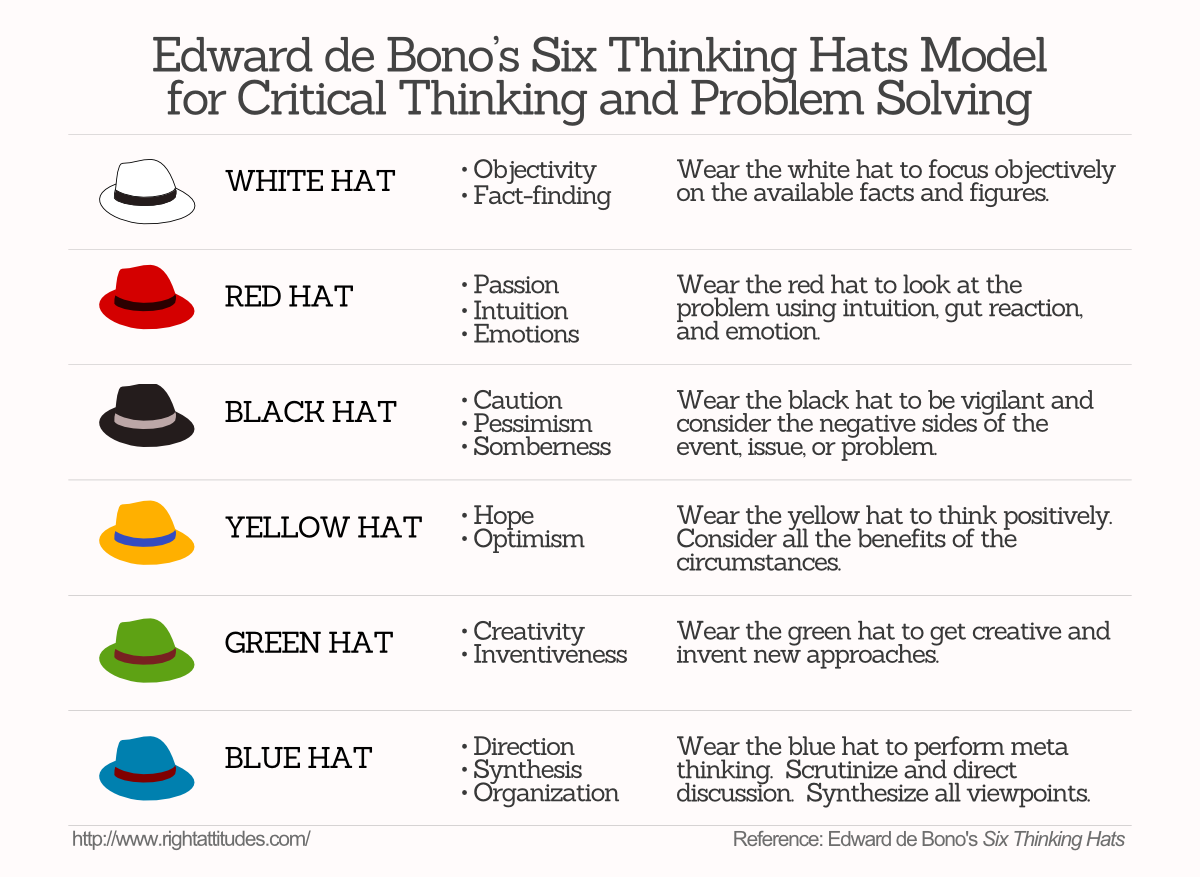
De Bono created the ‘six thinking hats’ method after identifying six distinct lines of human thought in problem solving. De Bono calls each approach a “hat” and assigns them different colors.

At the heart of the ‘six thinking hats’ method are six different colored hats that participants put on—literally or metaphorically—to represent the type of thinking they should concentrate on while wearing each.

  1. White is neutral, objective, and fact-based. A white hat is concerned with objective data: “What information do we have? What information do we need? What information are we missing? How can get the information we need? What objective questions should be asked?”
  2. Red denotes passion, anger, intuition, and emotions. A red hat considers the emotional side of problem solving, which is often neglected or masked in meetings: “What are our gut reactions to the matter at hand?”
  3. Black is somber, serious, and cautious. A black hat is vigilant, plays devil’s advocate, and encourages derogatory and judgmental behavior: “what are the weaknesses of these ideas? What are the risks? What could go wrong?”
  4. Yellow represents positive thinking, hope, and optimism to counteract the black hat’s power. A yellow hat plays “the angel’s advocate” and is cheerful and confident: “What are the best-case scenarios? What are the best aspects of this? What are the advantages? Who can benefit from this?”
  5. Green signifies abundance, growth, richness, and fertility. A green hat is the hat of creativity; it rejects established rules and norms, and invents new approaches: “What are some new ideas on this subject? What is interesting about this idea? What are the variances in these ideas?”
  6. Blue represents the sky and therefore provides the overarching perspective. A blue hat performs “meta thinking” and is concerned with the organization of the thinking process and the use of other hats. The blue hat synthesizes and reconciles different viewpoints. At the start of a brainstorming session, the blue hat sets the stage for where the discussion may go. The blue hat guides and sustains the discussion, often restating its purposes: “What are we thinking about? What is the goal? What should we do next? What have we achieved so far? What should we do to achieve more?” At the conclusion of the brainstorming session, the blue hat appraises the discussion, and proposes a plan of action.

Use De Bono’s Six Thinking Hats Model for Critical Thinking and Problem Solving

'Six Thinking Hats' by Edward de Bono (ISBN 0316178314) An individual working alone may use the approach to consider broader, distinct lines of thought. By changing hats, the individual can switch viewpoints and ensure that he/she is not stuck in specific thinking patterns.

However, the approach is best suited to group discussions (when chaired by a skilled facilitator) in which conflicting ideas may never otherwise be fully synthesized into plans of action. By persuading each participant to think constructively alongside other participants, the ‘six thinking hats’ method taps into group members’diverse perspectives and uses their collective knowledge without destructive conflict.

Using these hats nurtures creativity by letting participants step beyond their typical roles and contribute to developing, organizing, and progressing ideas. Participants can also identify how their cognitive state at any one time shapes how they approach problems.

Recommendation: Read. Edward de Bono’s Six Thinking Hats presents a very effective technique for stimulating group creativity. The method can remove mental blocks, organize ideas and information, foster cross-fertilization, and help conduct thinking sessions more productively than do other brainstorming methods.

Complement with Dan Ciampa’s Taking Advice for an excellent framework on the kind of advice network you need on strategic, operational, political, and personal elements of your work and life. Read my summary in this article.

Filed Under: Mental Models, Sharpening Your Skills Tagged With: Conversations, Creativity, Critical Thinking, Mental Models, Networking, Social Dynamics, Teams, Thinking Tools, Thought Process, Winning on the Job

« Previous Page
Next Page »

Primary Sidebar

Popular Now

Anxiety Assertiveness Attitudes Balance Biases Coaching Conflict Conversations Creativity Critical Thinking Decision-Making Discipline Emotions Entrepreneurs Etiquette Feedback Getting Along Getting Things Done Goals Great Manager Innovation Leadership Leadership Lessons Likeability Mental Models Mentoring Mindfulness Motivation Networking Parables Performance Management Persuasion Philosophy Problem Solving Procrastination Relationships Simple Living Social Skills Stress Suffering Thinking Tools Thought Process Time Management Winning on the Job Wisdom

About: Nagesh Belludi [hire] is a St. Petersburg, Florida-based freethinker, investor, and leadership coach. He specializes in helping executives and companies ensure that the overall quality of their decision-making benefits isn’t compromised by a lack of a big-picture understanding.

Get Updates

Signup for emails

Subscribe via RSS

Contact Nagesh Belludi

RECOMMENDED BOOK:
India After Gandhi

India After Gandhi: Ramachandra Guha

Historian Ramachandra Guha's chronicle of the political and socio-economic endeavors of post-independence India, and its burgeoning prosperity despite cultural heterogeneity.

Explore

  • Announcements
  • Belief and Spirituality
  • Business Stories
  • Career Development
  • Effective Communication
  • Great Personalities
  • Health and Well-being
  • Ideas and Insights
  • Inspirational Quotations
  • Leadership
  • Leadership Reading
  • Leading Teams
  • Living the Good Life
  • Managing Business Functions
  • Managing People
  • MBA in a Nutshell
  • Mental Models
  • News Analysis
  • Personal Finance
  • Podcasts
  • Project Management
  • Proverbs & Maxims
  • Sharpening Your Skills
  • The Great Innovators

Recently,

  • Inspirational Quotations #1132
  • What You’re Saying When You Say ‘Yes’
  • To-Do or Not To-Do?
  • Nice Ways to Say ‘No’
  • Inspirational Quotations #1131
  • Boundaries Define What You are—and What You’re Not
  • The Case Against Team Work

Unless otherwise stated in the individual document, the works above are © Nagesh Belludi under a Creative Commons BY-NC-ND license. You may quote, copy and share them freely, as long as you link back to RightAttitudes.com, don't make money with them, and don't modify the content. Enjoy!