• Skip to content
  • Skip to primary sidebar

Right Attitudes

Ideas for Impact

Inspirational Quotations #143

November 15, 2006 By Nagesh Belludi Leave a Comment

Character, in great and little things, means carrying through what you feel able to do.
—Johann Wolfgang von Goethe (German Poet)

It is what you do from now on that will either move our civilization forward a few tiny steps, or else… begin to march us steadily backward.
—Patrick Stewart

Write your life the way you want to. Life is a book. Each day is a day which you can’t rewrite.
—Unknown

The man who will use his skill and constructive imagination to see how much he can give for a dollar, instead of how little he can give for a dollar, is bound to succeed.
—Henry Ford (American Businessperson)

Love is like a beautiful flower which I may not touch, but whose fragrance makes the garden a place of delight just the same.
—Helen Keller (American Author)

Go confidently in the direction of your dreams! Live the life you’ve imagined! As you simplify your life, the laws of the Universe will be simpler, solitude will not be solitude, poverty will not be poverty, nor weakness weakness.
—Henry David Thoreau (American Philosopher)

In the land of the blind, the one-eyed man is king.
—Desiderius Erasmus (Dutch Catholic Humanist)

Life is divided into three terms – that which was, which is, and which will be. Let us learn from the past to profit by the present, and from the present to live better in the future.
—William Wordsworth (English Poet)

I am looking for a lot of men who have an infinite capacity to not know what can’t be done. If money is your hope for independence you will never have it. The only real security that a man will have in this world is a reserve of knowledge, experience, and ability.
—Henry Ford (American Businessperson)

Filed Under: Inspirational Quotations

The Legacy of Peter Drucker, the Original Management Guru

November 12, 2006 By Nagesh Belludi Leave a Comment

Yesterday was the first anniversary of the death of Peter Ferdinand Drucker, “the father of modern management.”

Drucker is arguably the most influential management philosopher of the modern era. He is the author of about forty books and innumerable essays on managerial skills, management concepts and social analyses. As a consultant, author and speaker for over sixty years, Drucker influenced the thinking of many executives in businesses, not-for-profits and faith-based organizations. Read his detailed biographies here, here and here.

Drucker wrote about many concepts and practices decades before the trends were discernable: knowledge workers, empowering employees, decentralization, management by objectives, focus on results instead of actions, the responsibility of the corporation in society, knowledge-based society, rise of multinational businesses, etc.

Drucker’s writings are devoid of buzzwords and management jargon and easily resonate with his readers. Today, we accept Drucker’s thoughts as conventional wisdom. Consequently, scores of business school courses require reading of his books.

My first exposure to Drucker’s thoughts was when I read his manual “The Effective Executive” during my undergraduate studies. Over the last few years, I have read and re-read many of his books and essays. Drucker’s unique style of expression and simple, clear language have left a deep impression on my pursuits, thoughts and actions. Below is one of my favorite Peter Drucker instructions. See my separate blog post on his inspirational quotations.

Successful leaders don’t start out asking, “What do I want to do?” They ask, “What needs to be done?” Then they ask, “Of those things that would make a difference, which are right for me?” They don’t tackle things they aren’t good at.

On a question about his legacy, Drucker once said that he has “helped a few good people be effective in doing the right things.” Just a few? Drucker’s farsighted insights and timeless thoughts will influence management thought for generations to come.

Wondering what to read next?

  1. Humility is a Mark of the Great

Filed Under: Great Personalities Tagged With: Peter Drucker

Inspirational Quotations by Peter Drucker

November 12, 2006 By Nagesh Belludi 1 Comment

Yesterday was the first anniversary of the death of Peter Ferdinand Drucker, “the father of modern management.” Here is a selection of inspirational quotations from one of the most influential management philosophers of modern era. For more details, please see my article “The Legacy of Peter Drucker“.

The most serious mistakes are not being made as a result of wrong answers. The truly dangerous thing is asking the wrong question.
—Peter Drucker (Austrian-born Management Consultant)

My greatest strength as a consultant is to be ignorant and ask a few questions.
—Peter Drucker (Austrian-born Management Consultant)

Rank does not confer privilege or give power. It imposes responsibility.
—Peter Drucker (Austrian-born Management Consultant)

We now accept the fact that learning is a lifelong process of keeping abreast of change. And the most pressing task is to teach people how to learn.
—Peter Drucker (Austrian-born Management Consultant)

Effective leadership is not about making speeches or being liked; leadership is defined by results not attributes.
—Peter Drucker (Austrian-born Management Consultant)

Plans are only good intentions unless they immediately degenerate into hard work.
—Peter Drucker (Austrian-born Management Consultant)

People who don’t take risks generally make about two big mistakes a year. People who do take risks generally make about two big mistakes a year.
—Peter Drucker (Austrian-born Management Consultant)

The only thing we know about the future is that it will be different.
—Peter Drucker (Austrian-born Management Consultant)

Filed Under: Inspirational Quotations Tagged With: Peter Drucker

The Twelve Most Persuasive Words in English

November 9, 2006 By Nagesh Belludi Leave a Comment

“Of the modes of persuasion furnished by the spoken word there are three kinds. The first kind depends on the personal character of the speaker; the second on putting the audience into a certain frame of mind; the third on the proof, provided by the words of the speech itself.”
– A Rephrasing of Aristotle’s Rhetoric

The choice of words is one of the key components of persuasive communication. In marketing, advertising, grant- or project proposal writing, or in most other interactions, we attempt to influence someone’s mind about an idea or a product.

The Twelve Most Persuasive Words in EnglishBelow is a list (in order) of the twelve most persuasive words that have proven to be most influential on listeners’ or readers’ minds. Often, advertisements consist of crafty constructions of these words. Surprisingly, the word ‘free’ is absent. The Language Log website at the University of Pennsylvania has an interesting thread on the source of this list.

  1. You
  2. Money
  3. Save
  4. New
  5. Results
  6. Health
  7. Easy
  8. Safety
  9. Love
  10. Discovery
  11. Proven
  12. Guarantee

How will we use these words in our verbal and written communications? How will we incorporate these words into our everyday vocabulary?

Wondering what to read next?

  1. Written Communication Tips #2: British English or American English?
  2. Most Writing Is Bad Because It Doesn’t Know Why It Exists
  3. Persuade Others to See Things Your Way: Use Aristotle’s Ethos, Logos, Pathos, and Timing
  4. How to Read the AP Stylebook
  5. Complexity Is a Hiding Place

Filed Under: Effective Communication Tagged With: Writing

The Abuse of Exclamation Marks

November 7, 2006 By Nagesh Belludi Leave a Comment

“My gosh!!! I was thinking about calling you the other night! It is exciting(!) to hear from you!!!!! How have you been!?!?!?! Congratulations on successfully defending your thesis!!!!!!”

The Abuse of Exclamation Marks in Written CommunicationExclamation marks are used at the end of sentences to express strong feelings of astonishment or emotion. Our generation has learned to use handfuls of emoticons, exclamation marks and question marks as substitutes for tone and body language in instant messaging and such. This communication style habitually creeps into our professional communications. Overuse of exclamation marks is a pet peeve of many professionals; some even consider exclamation marks minor annoyances.
In reality, exclamation marks are not necessary; they are usually inappropriate in professional written communication or in academic writing. Many professionals consider the excessive use of exclamation marks as signs of inexpressiveness and professional adolescence.

  • Use exclamation marks sparingly. Use only one exclamation mark, if necessary, for expressing very strong positive feelings. E.g., “Congratulations on finishing your first marathon!”
  • Do not use multiple exclamation marks to exaggerate your feelings. A single exclamation mark is sufficient.
  • Repeated use of exclamation marks is distracting to a reader. The reader cannot clearly differentiate the more exciting expressions.
  • Do not combine an exclamation mark with any other punctuation. Every sentence must end with a single punctuation—a period, a question mark, or an exclamation mark.
  • If you are tempted to use an exclamation mark to attract a reader’s attention, try to reword the sentence. E.g., restructure “The C++ shell sort implementation had an error!” to “We found an error in the C++ shell sort implementation.” Alternately, reorganize your thoughts in an independent paragraph or bullet point.
  • Avoid inserting exclamation marks within parentheses to emphasize a specific word within a sentence. E.g., “Coastal South India is excessively(!) hot and humid during summer.”

In the absence of facial or verbal cues, written communication can easily be misinterpreted. Resist the urge to convey emotion and feelings in email or in written communications. Avoid exclamation marks.

Filed Under: Effective Communication

Inspirational Quotations #141

November 5, 2006 By Nagesh Belludi Leave a Comment

The elephant passing through the market-place is always beset by curs, but he cares not. He goes straight on his own way. So it is always, when a great soul appears there will be numbers to bark after him.
—Tulsidas (Indian Hindu Composer)

You become a star not because of your title; you become a star because you are adding star value to the company.
—N. R. Narayana Murthy (Indian Businessperson)

The trouble with being in the rat race is that even if you win, you’re still a rat.
—Lily Tomlin

Reminding one another of the dream that each of us aspires to may be enough for us to set each other free.
—Antoine de Saint-Exupery (French Novelist, Aviator)

Our character is a reflection of the friends we keep.
—Unknown

Follow effective action with quiet reflection.
From the quiet reflection will come even more effective action.
—Peter Drucker (Austrian-born Management Consultant)

There is only one success – to be able to spend your life in your own way, and not to give others absurd maddening claims upon it.
—Christopher Morley (American Journalist)

One of the main barriers to turning knowledge into action is the tendency to treat talking about something as equivalent to doing something about it.
—Jeffrey Pfeffer

Filed Under: Inspirational Quotations

Resumé Tips #1: Best Fonts and Text Size for Your Resumé

October 31, 2006 By Nagesh Belludi Leave a Comment

Blog reader Michelle from the University of Kentucky, Lexington asked me

“I am preparing my résumé for an upcoming job fair, and I’d appreciate your suggestions on the choice of fonts.”

Serif and Sans-serif Fonts

Font families are classified according to their appearance: serif fonts, sans-serif fonts, mono-space fonts, cursive fonts, fantasy fonts, etc.

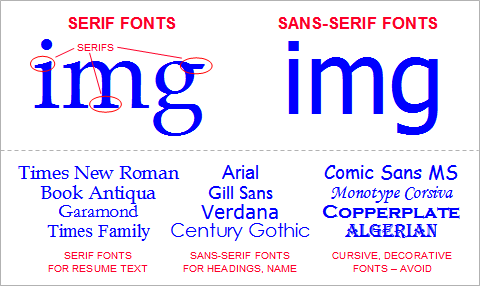
Characters in serif fonts have little projections or ‘tails’ (serif = tail in French) at the end of strokes and line widths that thin out on curves. The serifs guide a reader’s eyes to flow across lines of text. Conventionally, serif fonts are used for smaller text such as blocks of texts in newspapers. Serif fonts are harder to read from a distance.

Characters in sans-serif fonts have more consistent line widths and do not have tails (sans = without in French). Sans-serif fonts appear clear and balanced in shape and in form. Conventionally, sans-serif fonts are used for larger text such as headlines or text in posters. Sans-serif fonts are the most popular choice for on-screen (TV, computer, etc.) text because of their clarity in display.

Choice of Fonts and Text Size for Résumés

Fonts for a Résumé

Résumé reviewers expect résumés to be professional–readable and inviting. Serif fonts are the de-facto standard for résumé text. Times New Roman (the default font in Microsoft Word), Book Antiqua or Palatino (my personal favorite,) Garamond and Times are the most popular serif fonts for résumés. I would suggest using serif fonts for the entire résumé. You may use sans-serif fonts for section headings and/or your name.

Cursive or decorative fonts easily distract the eye and make the résumé look unprofessional. Explore fancier fonts only if you desire a career in fine arts or graphic design.

Font size: 10-, 11- or 12-point only

Choice of Fonts and Text Size for RésumésFont size is measured in points. A point represents 1/72 of an inch; text in 72 points prints to text of one-inch height. Use a 10-, 11- or a 12-point font for content. Begin with an 11-point font and increase to a 12-point font to fill up the page or decrease to a 10-point font if you cannot fit all the details on one page. (All primary details, academic backgrounds and professional accomplishments should fit into one page.)

Section headings can be one or two points larger than content. Subheadings, such as name of the university or employer or your job title, should be set in standard font size. Do not increase the font size for your name; your name will look disproportionate.

Consistency in Formatting

As with every other detail on the résumé, viz., content, structure, paragraph spacing, etc., use consistent font formatting. In Microsoft Word, the ‘Format Painter’ tool is handy to copy formatting to various sections of text or paragraphs.

Making your Résumé Standout

On my recruiting trips to colleges, one of the most common questions students ask me is how one could make his/her résumé stand out. You can make your résumé standout primarily based on the content in the résumé: your accomplishments, academic strengths, extra-curricular involvement, leadership activities, etc.

However, résumé reviewers form their first impressions, mostly subconsciously, on how well the content is structured and how well the text is presented. On average, reviewers spend as little as fifteen seconds before they decide to read your résumé further for detailed consideration. Hence, the value of preparing a résumé with an orderly, consistent, professional look-and-feel cannot be overstated.

Wondering what to read next?

  1. Resumé Tips #2: The One-page Résumé Rule
  2. Resumé Tips #3: References Not Necessary
  3. Resumé Tips #4: The Hurry-Burry Résumé
  4. Resumé Tips #5: Résumé or Curriculum Vitae?
  5. Resumé Tips #6: Avoid Clichéd Superlatives and Proclamations

Filed Under: Career Development, Sharpening Your Skills Tagged With: Resumé

Inspirational Quotations #140

October 30, 2006 By Nagesh Belludi Leave a Comment

Your chances of success in any undertaking can always be measured by your belief in yourself.
—Robert Collier (American Self-Help Author)

A merely fallen enemy may rise again, but the reconciled one is truly vanquished.
—Johan Christoph Schiller

He who knows Self as the enjoyer of|The honey from the flowers of the senses,|Ever present within, ruler of time,|Goes beyond fear. For this Self is Supreme!
—The Upanishads

Perpetual inspiration is as necessary to the life of good- ness, holiness and happiness as perpetual respiration is necessary to animal life.
—William Law

The first and most important step toward success is the feeling that we can succeed.
—Nelson Boswell

Knowledge has to be improved, challenged, and increased constantly, or it vanishes.
—Peter Drucker (Austrian-born Management Consultant)

We learn…
10%… of what we read
20%… of what we hear
30%… of what we see
50%… of what we see and hear
70%… of what we discuss with others
80%… of what we experience personally
95%… of what we teach others
—William Glasser (American Psychiatrist)

We are what our thoughts have made us; so take care about what you think. Words are secondary. Thoughts live; they travel far.
—Swami Vivekananda (Indian Hindu Mystic)

Filed Under: Inspirational Quotations

How to Prepare for Meetings

October 26, 2006 By Nagesh Belludi Leave a Comment

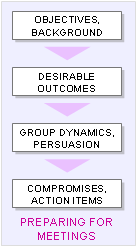
Preparing to Attend MeetingsMeetings are important organizational tools. Whether as one-on-one conversations or as larger all-employee information sharing sessions, meetings are integral components of getting work done. Despite some obvious benefits, most meetings are not very productive and are longer than necessary. One of the primary reasons for the lower productivity of meetings is that attendees come unprepared.

Assume you have consented to attend a meeting because your participation is critical to the objective of the meeting. What questions will you ask to prepare for the meeting?

  • Have I read the meeting agenda? What is the objective of the meeting? What is my role? How will I contribute to the meeting?
  • What segment of the meeting is relevant to me? Can I join late or leave early if I am not required throughout the length of the meeting?
  • Is this a follow-up to a previous meeting? What action items had I agreed on then? What results will I present? What questions will arise?
  • What relevant pre-reading material should I seek?
  • What research do I need to do? Whom on my team should I talk to regarding items on the agenda?
  • What is the desirable outcome? What is the undesirable outcome? Is there a compromise?
  • What positions am I prepared to take on key issues being discussed in this meeting? What facts and charts will I present to support my position?
  • Who are the other attendees? What positions are they likely to take on key issues? Why? What are the likely group dynamics: who will support me, who will oppose my positions? What counter arguments will I present?
  • What other attendees should I talk to prior to the meeting to garner support to my position? Can I invite additional attendees to the meeting to help support my position? How will I persuade other people to see my point of view?
  • What action items am I willing to take? Do I have the necessary resources? Will I participate in follow-up meetings, if scheduled?

Meetings are all about sharing thoughts in a collective setting. They are only as good as the ideas that attendees bring to the discussions. By asking the above questions, you will contribute to focused, productive meetings. You owe it to yourself, the meeting leaders and to your fellow-attendees.

Wondering what to read next?

  1. How to Be a Great Conversationalist: Ask for Stories
  2. Don’t Underestimate Others’ Willingness to Help
  3. How to … Gracefully Exit a Conversation at a Party
  4. Many Creative People Think They Can Invent Best Working Solo
  5. The Curse of Teamwork: Groupthink

Filed Under: Managing People, Sharpening Your Skills Tagged With: Meetings

Inspirational Quotations #139

October 22, 2006 By Nagesh Belludi Leave a Comment

Concentration can be cultivated. One can learn to exercise will-power, discipline one’s body and train one’s mind.
—Anil Ambani (Indian Businessperson)

Love your job, but never fall in love with your company because you never know when the company stops loving you.
—N. R. Narayana Murthy (Indian Businessperson)

Most of what we call management consists of making it difficult for people to get their work done.
—Peter Drucker (Austrian-born Management Consultant)

There are many truths of which the full meaning cannot be realized until personal experience has brought it home.
—John Stuart Mill (English Philosopher, Economist)

We become like those with whom we associate: a mirror reflects a man’s face, but what he is really like is shown by the kind of friends he chooses.
—The Holy Bible (Scripture in the Christian Faith)

The chief duty I long to accomplish great and noble tasks, but it is my chief duty to accomplish humble tasks as though they were great and noble. The world is moved along, not only by the mighty shoves of its heroes, but also by the aggregate of the tiny pushes of each honest worker.
—Helen Keller (American Author)

Do your work with your whole heart, and you will succeed—there’s so little competition.
—Elbert Hubbard (American Writer)

Not to be cheered by praise, not to be grieved by blame, but to know thoroughly one’s own virtues or powers are the characteristics of an excellent man.
—Sakya Pandita

Filed Under: Inspirational Quotations

« Previous Page
Next Page »

Primary Sidebar

Popular Now

Anxiety Assertiveness Attitudes Balance Biases Coaching Conflict Conversations Creativity Critical Thinking Decision-Making Discipline Emotions Entrepreneurs Ethics Etiquette Feedback Getting Along Getting Things Done Goals Great Manager Innovation Leadership Lessons Likeability Mental Models Mindfulness Motivation Parables Performance Management Persuasion Philosophy Problem Solving Procrastination Psychology Relationships Resilience Simple Living Social Skills Stress Suffering Thinking Tools Thought Process Time Management Winning on the Job Wisdom

About: Nagesh Belludi [hire] is a St. Petersburg, Florida-based freethinker, investor, and leadership coach. He specializes in helping executives and companies ensure that the overall quality of their decision-making benefits isn’t compromised by a lack of a big-picture understanding.

Get Updates

Signup for emails

Subscribe via RSS

Contact Nagesh Belludi

RECOMMENDED BOOK:
Taking Advice

Taking Advice: Dan Ciampa

Executive coach Dan Ciampa offers an excellent framework on the advice network you need on strategic, operational, political, and personal elements of your work and life.

Explore

  • Announcements
  • Belief and Spirituality
  • Business Stories
  • Career Development
  • Effective Communication
  • Great Personalities
  • Health and Well-being
  • Ideas and Insights
  • Inspirational Quotations
  • Leadership
  • Leadership Reading
  • Leading Teams
  • Living the Good Life
  • Managing Business Functions
  • Managing People
  • MBA in a Nutshell
  • Mental Models
  • News Analysis
  • Personal Finance
  • Podcasts
  • Project Management
  • Proverbs & Maxims
  • Sharpening Your Skills
  • The Great Innovators

Recently,

  • The Dividend of Waiting: Patience May Be the Best Bargain in Tech
  • The “Shadow Job Description”: The One Question That Changes the Interview Dynamic
  • Inspirational Quotations #1171
  • Enterprise Begins in Annoyance: How One Miserable Vacation Sparked a Global Hotel Chain
  • Wishful Thinking Is Free. Movement Pays.
  • Rumination Can Turn the Mind Into a Prison of Repetition
  • Inspirational Quotations #1170

Unless otherwise stated in the individual document, the works above are © Nagesh Belludi under a Creative Commons BY-NC-ND license. You may quote, copy and share them freely, as long as you link back to RightAttitudes.com, don't make money with them, and don't modify the content. Enjoy!