• Skip to content
  • Skip to primary sidebar

Right Attitudes

Ideas for Impact

How to Give A Compliment Sandwich Feedback

February 20, 2008 By Nagesh Belludi 23 Comments

Sandwich Feedback Technique

This article presents the popular ‘compliment sandwich technique’ for giving interpersonal feedback. Tomorrow’s follow-up article will critique this method and discuss three common mistakes that render the sandwich technique ineffective.

These discussions and examples focus on manager-to-employee feedback. This analysis is, however, relevant to other interpersonal contexts—between peers or spouses, for instance.

Managers Often Resent Giving Corrective Feedback

Feedback is a central component of the manager-employee relationship. Often, managers are reluctant resent giving corrective (or negative) feedback. They assume employee defensiveness and fear that negative feedback will offend the employee and thus affect their rapport with the employee. Such managers are likely to withhold criticism. They fail to provide timely, relevant feedback in various circumstances, from employee tardiness to inappropriate attire (especially if the employee is of the opposite gender.)

Sandwich Feedback & Purported Benefits

The sandwich feedback technique is a popular three-step procedure to help managers who are ill at ease with providing corrective feedback. The sandwich feedback method consists of praise followed by corrective feedback followed by more praise. In other words, the sandwich feedback method involves discussing corrective feedback that is “sandwiched” between two layers of praise.

The purported benefits of this technique are twofold: (1) it softens the impact of the criticism or corrective feedback, and, (2) given that a manager is probably more comfortable with praising the employee, the manager finds it easier to discuss problems with the employee’s behavior if this discussion begins and ends with praising the employee.

Compliment Sandwich Feedback: Example 1

Suppose that Andy, a new employee at a financial services firm, attended a week-long, offsite training program in New York. Each night during his stay at a hotel, Andy purchased on-demand movies in his room. He included the corresponding $65 charge in his expense report. Andy also dined at very pricey restaurants.

Jean, Andy’s manager, received the expense report for approval. Clearly, the charge for the movies had no business-justification. Jean uses the sandwich feedback technique to decline reimbursement for this expense and instruct Andy to be more prudent about expenses when traveling:

  • Praise: “Andy, I am impressed with your development since you joined my team last month. You have used the skills you learned during your training in New York to systematically review our customer’s accounts.”
  • Criticism: “By the way, earlier this morning, I was reviewing the expense report from your trip to New York. I notice a $65 charge for on-demand movies. I have to deny this expense since it has no business-justification. I also noticed very expensive meals. I will approve these charges this time. Given our limited travel budgets, I would ask you to be more careful about your trip expenses. You are probably not aware of our company’s travel policy. I have asked Human Resources to give you a copy of our travel policy booklet that details the acceptable expense report practices.”
  • Praise: “I am glad you were able to use the skills you learned at this training in New York. I appreciate your hard work and persistence with this customer. Keep up the good work.”

Compliment Sandwich Feedback: Example 2

Assume Sofia led a brainstorming meeting for an important project. Habitually, Sofia does not circulate the agendas prior to the meetings she leads. After one such meeting, Sofia’s manager uses the sandwich feedback technique to persuade her to be more organized:

  • Praise: “Sofia, we had a very productive meeting. We had the right participants and collected all the necessary inputs from other departments. Thanks for your coordination.”
  • Criticism: “Did you notice that the discussions were unsystematic? When you do not distribute an agenda prior to the meeting, the participants do not come prepared. During the meeting, they have to go back to their desks to collect information. Additionally, we tend to spend a lot of time digressing from the meeting objectives. How can you avoid this?” A discussion ensues.
  • Praise: “You are doing so well with gathering all the inputs. I am pleased about your diligence in circulating minutes of your meetings and following-up on action items. “

Concluding Thoughts

The sandwich feedback technique enables a manager to restructure feedback so it is easier to deliver. The technique also reinforces good behavior and asks for improvements.

Tomorrow’s article will discuss, with simple examples, three common mistakes that defeat the purpose of sandwiching corrective feedback between two layers of praise. In summary, it’s best to be direct when giving feedback, because the compliment sandwiches are easily spotted as inauthentic.
Wondering what to read next?

  1. Why the Compliment Sandwich Feedback Technique is Ineffective
  2. The Puppy Theory: Giving Feedback Too Late
  3. Fear of Feedback: Won’t Give, Don’t Ask
  4. Management by Walking Around the Frontlines [Lessons from ‘The HP Way’]
  5. Fire Fast—It’s Heartless to Hang on to Bad Employees

Filed Under: Managing People Tagged With: Conversations, Feedback

Inspirational Quotations #208

February 17, 2008 By Nagesh Belludi Leave a Comment

When you call yourself an Indian or a Muslim or a Christian or a European, or anything else, you are being violent. Do you see why it is violent? Because you are separating yourself from the rest of mankind. When you separate yourself by belief, by nationality, by tradition, it breeds violence. So a man who is seeking to understand violence does not belong to any country, to any religion, to any political party or partial system; he is concerned with the total understanding of mankind.
—Jiddu Krishnamurti (Indian Philosopher)

The hardest years in life are those between ten and seventy.
—Helen Hayes (American Actor)

We’re drowning in information and starving for knowledge.
—Rutherford D. Rogers

Make yourself an honest man, and then you may be sure that there is one less scoundrel in the world.
—Thomas Carlyle (Scottish Writer)

Behold the turtle. He makes progress only when he sticks his neck out.
—James Bryant Conant (American Chemist)

I’ve learned one thing during my time on the soccer fields:
It’s amazing how fast you can run
And the things you can do when you have a goal in mind.
It applies to the rest of my life, too.
—Unknown

Smile at each other, smile at your wife, smile at your husband, smile at your children, smile at each other—it doesn’t matter who it is—and that will help you to grow up in greater love for each other.
—Mother Teresa (Albanian Catholic Humanitarian)

Real difficulties can be overcome; it is only the imaginary ones that are unconquerable.
—Theodore Newton Vail

There is only one happiness in life–to love and be loved.
—George Sand (French Novelist, Dramatist)

Filed Under: Inspirational Quotations

The Power of Apology

February 15, 2008 By Nagesh Belludi Leave a Comment

Value of Apology in Customer Service

Southwest Airlines is perhaps one of best-run airlines in the world and a pioneer of the low-cost-carrier model. The company’s culture and focus on customer service are legendary. A recent article on the company’s official blog discusses the value of apologies.

Don’t be afraid to say “I’m sorry.”

People often misunderstand the intent of an apology. It is not an admission of fault. It’s an acknowledgment of a bad experience-no matter what happened. It’s doesn’t mean the Customer is always right-there’s no need to support, tolerate, or reward abusive behavior.

When things don’t go according to plan, an apology provides the opportunity to offer the Customer an assurance that you care about their feelings. An apology lets you reach out to the Customers who are affected by acknowledging the disruption/inconvenience, offering your assistance, providing an explanation, and letting them know you’re working to prevent a repeat performance (if applicable).

If you don’t know the answer to a question, it’s okay to admit that-just don’t speculate and be sure you let the Customer know that you will try to provide them with an answer within a reasonable timeframe.

Call for Action: Learn to Express Regret

In business, social or personal settings, many of us balk at offering apologies, even if we are wrong. We do not realize that a sincere expression of regret is healing: an honest ‘I am sorry’ can soften negative emotions (anger, resentment, etc.) our actions trigger in other people. An apology can restore goodwill and mend relationships.

Here are three steps to an apology.

  1. Take responsibility and acknowledge the impact of your actions. “I realize … I caused …”
  2. Express regret for your actions. “I am sorry.”
  3. Offer a remedy and pledge to change. “I will improve.”

Here is an example. Suppose you promised to watch a movie with your spouse on Valentine’s Day. However, your boss asked you to attend a late-evening teleconference with an international client. You could not go home in good time for the movie. Your spouse is upset. Say, “I realize I am late for the movie. I regret I did not excuse myself from the meeting early. I am sorry. Shall we watch the movie on Friday evening?”

The secret to truthful apologies is to keep your apology-statements straightforward and short. Do not attempt to explain or rationalize your behavior–these just dilute the sincerity of your apology.

Related Articles

  • Expressing regret or apologizing is critical component of leadership—excerpt from Marshall Goldsmith’s ‘What Got You Here Won’t Get You There.’

Filed Under: Managing People, Sharpening Your Skills

Inspirational Quotations #207

February 11, 2008 By Nagesh Belludi Leave a Comment

There is nothing so powerful as the truth.
—Anonymous

When one is out of touch with oneself, one cannot touch others.
—Anonymous

Take up one idea. Make that one idea your life—think of it, dream of it, live on that idea. Let the brain, muscles, nerves, every part of your body, be full of that idea, and just leave every other idea alone. This is the way to success, that is way great spiritual giants are produced.
—Swami Vivekananda (Indian Hindu Mystic)

Man is never helped in his suffering by what he thinks for himself, but only by revelation of a wisdom greater than his own. It is this which lifts him out of his distress.
—Carl Jung (Swiss Psychologist)

Hope for the best, but prepare for the worst.
—English Proverb

What is moral is what you feel good after, and what is immoral is what you feel bad after.
—Ernest Hemingway (American Author)

Never let a day go by without giving at least three people a compliment.
—H. Jackson Brown, Jr. (American Author)

I know only that what is moral is what you feel good after and what is immoral is what you feel bad after.
—Ernest Hemingway (American Author)

The average man plays to the gallery of his own self-esteem.
—Elbert Hubbard (American Writer)

Men should be judged, not by their tint of skin,
the Gods they serve, the Vintage they drink,
nor by the way they fight, or love, or sin,
But by the quality of the thought they think
—Adela Florence Nicolson (English Poet)

To succeed, you will soon learn, as I did, the importance of a solid foundation in the basics of education– literacy, both verbal and numerical, and communication skills.
—Alan Greenspan (American Economist)

Filed Under: Inspirational Quotations

Remembering Names at a Meeting

February 9, 2008 By Nagesh Belludi Leave a Comment

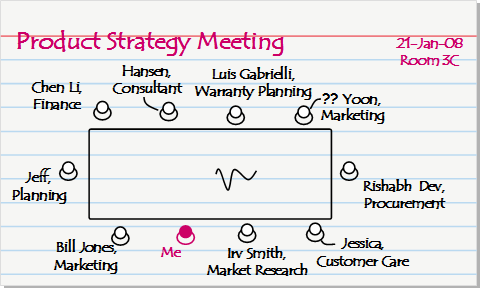
Ever wonder how a waiter/waitress serving an eight-seat table at a restaurant remembers each guest’s food orders? At many restaurants, the order-sheets contain a layout of the table and a letter or number associated with every seat. As each guest orders food, the waiter/waitress writes down the order along with the letter or number associated with that guest’s seat.

At Southwest Airlines, flight attendants go to every seat, ask customers for their choice of beverage, and record the passenger’s choice on a seat-map.

Remembering Names around a Table at a Meeting

Blogger Adam Gurno presents an extension of the two practices listed above for remembering names around a table at a meeting.

  1. Draw a quick map of the table/layout of the meeting. Place yourself on it, to give yourself a reference point.
  2. As people introduce themselves around the table, fill them in. If you feel last names are necessary add those too, but don’t do it at the expense of writing down someone else’s name. You can guess at the last names later. If you miss one, leave it blank and fill it in as soon as you can – if someone else refers to them, etc, etc.
  3. If everyone introduces themselves, try and jot down as much information as possible. If you think that you will run across them later, include information that will help you recognize them down the road.
  4. Refer back to the map during the meeting when you are going to need to speak. This way you will be prepared with a person’s name.

Positive impressions are invaluable. As we discussed in a previous blog article, remembering names is an important social skill—mastering this skill can offer a distinct advantage in networking and building relationships.

Wondering what to read next?

  1. Dining Out: Rule of Six
  2. How to … Gracefully Exit a Conversation at a Party
  3. Stop asking, “What do you do for a living?”
  4. Never Give a Boring Presentation Again
  5. A Little-Known Public-Speaking Tip

Filed Under: Sharpening Your Skills Tagged With: Etiquette, Meetings, Networking

General Electric’s Jack Welch Identifies Four Types of Managers

February 6, 2008 By Nagesh Belludi 5 Comments

Jack Welch's Four Types of Managers

Four Types of Managers

Jack Welch, Chairman and CEO of General Electric from 1981 to 2001, described four categories of managers in General Electric’s year 2000 annual report.

Type 1: shares our values; makes the numbers—sky’s the limit!

Type 2: shares the values; misses the numbers—typically, another chance, or two.

Type 3: doesn’t share the values; doesn’t make the numbers—gone.

Type 4 is the toughest call of all: the manager who doesn’t share the values, but delivers the numbers. This type is the toughest to part with because organizations always want to deliver and to let someone go who gets the job done is yet another unnatural act. But we have to remove these Type 4s because they have the power, by themselves, to destroy the open, informal, trust-based culture we need to win today and tomorrow.

We made our leap forward when we began removing our Type 4 managers and making it clear to the entire company why they were asked to leave—not for the usual “personal reasons” or “to pursue other opportunities,” but for not sharing our values. Until an organization develops the courage to do this, people will never have full confidence that these soft values are truly real.

Live by Corporate Values

Organizations face the challenge of developing and sustaining a culture that is both values-centered and performance-driven. They begin by developing mission and value statements that, in due course, become little more than wall decorations because the organization’s leaders and managers fail to uphold these values.

Nothing hurts morale more than when leaders tolerate employees who deliver results, but exhibit behaviors that are incongruent to values of the company. For instance, an organization that thrives on teamwork will suffer, over the long term, if a manager habitually claims all credit for his team’s accomplishments.

Idea for Impact: Core Values Matter!

As a manager, drive accountability. Hold employees responsible for their behaviors. Reward employees for proper behaviors and publicly discourage behaviors that do not uphold values. Do not make exceptions—exceptions signify your own indifference to the upholding of values.

As an employee, understand that an essential requirement for your success in your organization is your fit. Your behaviors must be congruent with the character and needs of your organization. Even if you are talented, you will not fare well if your behaviors are inconsistent with the values of your organization. Reflect on your behavior. On a regular basis, collect feedback from your managers, peers and employees. Seek change.

Keep the company values front and center in people’s mind.

Wondering what to read next?

  1. Seven Real Reasons Employees Disengage and Leave
  2. Fire Fast—It’s Heartless to Hang on to Bad Employees
  3. Eight Ways to Keep Your Star Employees Around
  4. How to Manage Overqualified Employees
  5. What To Do If Your New Hire Is Underperforming

Filed Under: Managing People, Sharpening Your Skills Tagged With: Coaching, Employee Development, Feedback, General Electric, Great Manager, Hiring & Firing, Human Resources, Jack Welch, Mentoring, Motivation, Performance Management

Inspirational Quotations #206

February 5, 2008 By Nagesh Belludi Leave a Comment

She didn’t know it couldn’t be done, so she went ahead and did it.
—Unknown

If you are patient in one moment of anger, you will escape a hundred days of sorrow.
—Chinese Proverb

Kindness is a language which the blind can see and the deaf can hear.
—Anonymous

A person is only as big as the dream they dare to live.
—Unknown

The basic thing about a man is not his specific but his fundamentum.
—Martin Luther King, Jr. (American Civil Rights Leader)

To enhance the quality of the day… that is the highest of the arts.
—Henry David Thoreau (American Philosopher)

Kindness is a language the deaf can hear and the dumb can understand.
—Paramahansa Yogananda (Indian Hindu Mystic)

But though I am an old man, I am but a young gardener.
—Thomas Jefferson (American Head of State)

Take Time
Take time to work … it is the price of success.
Take time to think … it is the source of power.
Take time to play, … it is the secret of perpetual youth.
Take time to read, … it is the foundation of wisdom.
Take time to be friendly, … it is the road to happiness.
Take time to dream, … it is hitching your wagon to a star.
Take time to love & be loved, … it is the privilege of the Gods.
Take time to look around … it is too short a day to be selfish.
Take time to laugh … it is the music of the soul.
—English Prayer

It is amazing what you can accomplish if you do not care who gets the credit.
—Harry S. Truman (American Head of State)

It is our experience that, 90% of the time, what passes for commitment is compliance.
—Peter Senge (American Management Consultant)

For every mountain, there is a miracle.
—Robert H. Schuller

Filed Under: Inspirational Quotations

Resumé Tips #4: The Hurry-Burry Résumé

February 3, 2008 By Nagesh Belludi Leave a Comment

Hurriedly-Prepared Résumés are Often Inadequate

Recently, I participated in a career fair at a large university. I staffed my company’s booth and collected résumés for interviews my colleagues would conduct later this month.

In collecting résumés, I observed that a fair number of students’ résumés had lots of errors: spelling mistakes, clutter, poor organization, and so on—overall, incoherent portrayals of their credentials and achievements.

Disappointedly, I asked a few students when they had prepared their résumés for the career fair. Not surprisingly, most students responded with a “over the weekend” or “earlier this morning” answer. “Last night, I looked at the résumé I had prepared for last year’s career fair and updated it,” one student revealed.

Overcome Procrastination: Keep Your Résumé Ready

For many of us, preparing a comprehensive résumé is an overwhelming—if not the most difficult—element of the job-search process. We feel intimidated by the challenge of discussing our credentials and achievements, presenting them in a manner that will impress hiring managers—and do all this in just one page.

The result is that we often procrastinate on preparing or updating our résumés. When we need to prepare a résumé ahead of a career fair or when we discover a lead, we tend to put something together in haste and expect it to work efficiently. We do not realize that our résumés may compete with hundreds of other résumés for every job offer out there.

Update your Résumé Frequently

  • If you are in college, revise your résumé at the beginning of each semester. Add relevant details from the past semester: particulars of your part-time work or course projects and update details such as your GPA or aggregate scores.
  • If you work, update your résumé after each quarterly-performance review with your supervisor. Add relevant details from your projects and assignments from the recent past. Every year, after your annual-performance review, update your résumé thoroughly.
  • Review each section of your résumé critically and question yourself, “Is this section relevant? Is there anything more worthwhile that I could replace this section with?”
  • Review the details in each section and ask yourself, “What else could I add to this section? How could I better present this detail?”
  • Get your résumé critiqued. If you are at college, consult a career counselor at your college’s career centre. If you are employed, show your résumé to colleagues, mentors, or others who may represent the intended audience for your résumé. Request them to critique every detail and make sure they understand details of your achievements.

Concluding Thoughts

By updating your résumé frequently, you can reduce the anxiety of preparing an impressive résumé at short notice. With reduced stress, you can focus on preparing for the other aspects of your job-search process—researching specific companies represented at the career fair or preparing to sell yourself to interesting companies.

Wondering what to read next?

  1. Resumé Tips #1: Best Fonts and Text Size for Your Resumé
  2. Resumé Tips #2: The One-page Résumé Rule
  3. Resumé Tips #3: References Not Necessary
  4. Resumé Tips #5: Résumé or Curriculum Vitae?
  5. Resumé Tips #6: Avoid Clichéd Superlatives and Proclamations

Filed Under: Career Development Tagged With: Resumé

Source of Mohandas K. Gandhi’s Quote, ‘You Must be the Change’

January 30, 2008 By Nagesh Belludi Leave a Comment

Mahatma Gandhi on Change

Today, (30-Jan-08,) is the 60th anniversary of the assassination of Mahatma Gandhi. A few months after India secured her independence from Britain, an extremist shot Gandhi point-blank after a prayer meeting at the Birla House in Delhi. Richard Attenborough’s much-admired motion picture ‘Gandhi’ narrates this event twice: once at the start of the movie illustrating the assassin walking towards Gandhi and a second time at the end of the movie depicting Gandhi walking out from the prayer meeting and facing the assassin.

A Quote, a Fable

One of Mahatma Gandhi’s most popular quotations is, “You must be the change you wish to see in the world.” Here is a widely believed—although unverified—story of the origin of this quotation.

During the 1930s, a young boy had become obsessed with eating sugar. His mother failed to convince him to kick the habit. She decided to take him to Gandhi. The Mahatma (Great Soul) was highly revered across the country—perhaps his instruction could convince her son to cut back on sugar.

At Gandhi’s ashram (hermitage,) the mother recounted her difficulty and requested Gandhi to direct her son. Gandhi deliberated for a minute and replied, “Please come back after a week. I will talk to your son.”

The mother and her son revisited Gandhi the following week. Gandhi smiled at the boy and directed him, “You must stop eating sugar.” The boy admitted, “Forgive me, bapu (father.) I will follow your advice.”

The mother was puzzled. She enquired, “Bapu, you could have asked my son to stop eating sugar when we visited you last week. Why did you ask us to come back this week?” Gandhi answered, “Ben (Sister,) last week, I, too, was eating a lot of sugar. … You must be the change you wish to see in the world.”

Effective Leaders ‘Walk the Talk’

Consider the following case. Ian joined a financial services company and assumed leadership of a group of analysts. In his first staff meeting, he declared, “Our people are our greatest asset.” He asserted that his primary objective as the manager of the organization was to keep them engaged, motivated and happy.

When one of Ian’s employees returned to work after a three-month maternity leave (she had had her first child,) Ian never enquired her about her child or her experiences. Becoming a mother was the most significant event of her life to date. The day she returned to work, Ian assigned her critical projects and demanded her full attention to these projects. Clearly, Ian’s behavior was incongruent with his stated mission of appreciating his people.

As the above example illustrates, frequently, leaders announce personal and organizational values and goals but fail to act on their words—their behaviors do not match their stated missions. Defining values and goals is often rather easy—conforming and getting others to conform to these initiatives is challenging. Leaders quickly lose their credibility by failing to ‘walk the talk.’

Call for Action

Audit yourself. At home or work, write down your objectives. Reflect on your actions. Analyze your behaviors. Do your actions uphold your objectives? Gather feedback from your people. Ask what you can do to achieve your objectives. Ask how you can walk your talk.

Wondering what to read next?

  1. Gandhi’s Wheel, Apple’s Spin: The Paradox of Apple’s ‘Think Different’ Campaign
  2. Gandhi on the Doctrine of Ahimsa + Non-Violence in Buddhism
  3. The Fallacy of Outsourced Sin: The Cow Paradox in India
  4. The Mere Exposure Effect: Why We Fall for the Most Persistent
  5. Persuasion’s Oldest Trick Isn’t the Promise of More—It’s the Threat of Loss

Filed Under: Sharpening Your Skills Tagged With: Gandhi, India, Parables

Inspirational Quotations #205

January 28, 2008 By Nagesh Belludi Leave a Comment

Accentuate the positive, Eliminate the negative, Latch on to the affirmative, And don’t mess with mister-in-between.
—Unknown

It is almost impossible to smile on the outside without feeling better on the inside.
—Unknown

It is Good to know; it is better to do; it is best to be. To be pure and strong, to be honest and earnest, to be kindly and thoughtful, and in all to be true, to be manly and womanly and Christly—this is the greatest ambition in life. It is not in knowing or having or doing, but through knowing and having and doing the best, it is in being, in what a man is in himself. He can do more for others who has done most with himself. Mastery of circumstances comes only through mastery of self.
—Samuel Dickey Gordon

Failure accepts no alibis. Success requires no explanation.
—Unknown

Two stonecutters were asked what they were doing.|The first said, I’m cutting this stone into blocks”.|The second replied, “I’m on a team that’s building a catherdral”.”
—Anonymous

There is material enough in a single flower for the ornament of a score of cathedrals.
—John Ruskin (English Art Critic)

Sloth makes all things difficult, but industry, all things easy.—He that rises late must trot all day, and hall scarce overtake his business at night, while laziness travels so slowly that poverty soon overtakes him.
—Benjamin Franklin (American Political leader)

There are no unimportant jobs, no unimportant people, no unimportant acts of kindness.
—H. Jackson Brown, Jr. (American Author)

I have come one step away from everything. And here I stay, far from everything, one step away.
—Antonio Porchia (Italian Poet)

We are what we think. All that we are arises with our thoughts. With our thoughts, we make the world.
—Buddhist Teaching

Filed Under: Inspirational Quotations

« Previous Page
Next Page »

Primary Sidebar

Popular Now

Anxiety Assertiveness Attitudes Balance Biases Coaching Conflict Conversations Creativity Critical Thinking Decision-Making Discipline Emotions Entrepreneurs Ethics Etiquette Feedback Getting Along Getting Things Done Goals Great Manager Innovation Leadership Lessons Likeability Mental Models Mindfulness Motivation Parables Performance Management Persuasion Philosophy Problem Solving Procrastination Psychology Relationships Resilience Simple Living Social Skills Stress Suffering Thinking Tools Thought Process Time Management Winning on the Job Wisdom

About: Nagesh Belludi [hire] is a St. Petersburg, Florida-based freethinker, investor, and leadership coach. He specializes in helping executives and companies ensure that the overall quality of their decision-making benefits isn’t compromised by a lack of a big-picture understanding.

Get Updates

Signup for emails

Subscribe via RSS

Contact Nagesh Belludi

RECOMMENDED BOOK:
Stumbling on Happiness

Stumbling on Happiness: Daniel Gilbert

Harvard psychologist Daniel Gilbert shares factual findings that will change the way you look at the world and seek happiness and joy.

Explore

  • Announcements
  • Belief and Spirituality
  • Business Stories
  • Career Development
  • Effective Communication
  • Great Personalities
  • Health and Well-being
  • Ideas and Insights
  • Inspirational Quotations
  • Leadership
  • Leadership Reading
  • Leading Teams
  • Living the Good Life
  • Managing Business Functions
  • Managing People
  • MBA in a Nutshell
  • Mental Models
  • News Analysis
  • Personal Finance
  • Podcasts
  • Project Management
  • Proverbs & Maxims
  • Sharpening Your Skills
  • The Great Innovators

Recently,

  • Inspirational Quotations #1171
  • Enterprise Begins in Annoyance: How One Miserable Vacation Sparked a Global Hotel Chain
  • Wishful Thinking Is Free. Movement Pays.
  • Rumination Can Turn the Mind Into a Prison of Repetition
  • Inspirational Quotations #1170
  • Conversational Narcissism: When You Make It About You
  • Reality is Messy—and Denial is Deadly

Unless otherwise stated in the individual document, the works above are © Nagesh Belludi under a Creative Commons BY-NC-ND license. You may quote, copy and share them freely, as long as you link back to RightAttitudes.com, don't make money with them, and don't modify the content. Enjoy!