• Skip to content
  • Skip to primary sidebar

Right Attitudes

Ideas for Impact

Inspirational Quotations #251

December 14, 2008 By Nagesh Belludi Leave a Comment

Face your deficiencies and acknowledge them; but do not let them master you. Let them teach you patience, sweetness, insight… When we do the best we can, we never know what miracle is wrought in our life, or in the life of another.
—Helen Keller (American Author)

Your biggest challenge isn’t someone else. It’s the ache in your lungs and the burning in your legs, and the voice inside you that yells “Can’t”, but you don’t listen. You just push harder. And then you hear the voice whisper “can”. And you discover that the person you thought you were is no match for the one you really are.
—Unknown

The man who does not read good books has no advantage over the man who can’t read them.
—Mark Twain (American Humorist)

Our loyalties must transcend our race, our tribe, our class, and our nation; and this means we must develop a world perspective.
—Martin Luther King, Jr. (American Civil Rights Leader)

Dreams are illustrations… from the book your soul is writing about you.
—Marsha Norman (American Playwright)

You wouldn’t worry so much about what people really thought of you if you knew just how seldom they actually do.
—Phil McGraw (American TV Personality)

He knows not his own strength that hath not met adversity.
—Ben Jonson (English Dramatist)

Challenges make you discover things about yourself that you never really knew. They’re what make the instrument stretch—what makes you go beyond the norm.
—Cicely Tyson (American Actor)

It is only doubt that creates. It is the minority that counts.
—H. L. Mencken (American Journalist)

Don’t let what you can’t do stand in the way of what you can.
—John Wooden (American Sportsperson)

Filed Under: Inspirational Quotations

To Make an Effective Argument, Explain Your Opponent’s Perspective

December 12, 2008 By Nagesh Belludi Leave a Comment

“The man who can hold forth on every matter under debate in two contradictory ways of pleading, or can argue for and against every proposition that can be laid down – such a man is the true, the complete, and the only orator.”
– Cicero

“If you can’t imagine how anyone could hold the view you are attacking, you just don’t understand it yet.”
– Anthony Weston, ‘Rulebook for Arguments’

Explaining the Other Side of the Argument

Entrepreneur and blogger Ben Casnocha presents an effective discussion / debating / interviewing technique:

Here is one of the simplest ways to test someone’s knowledge of an issue: ask them to explain the other side of the argument. Ask the person who’s in favor of spending more money on marketing project X to explain the thinking process behind those who oppose the budgetary move.

I have yet to find a more efficient and reliable way to probe the depths of a person’s knowledge and seriousness about an issue than asking them to explain the other side’s perspective.

How can you effectively argue for your side if you don’t understand the arguments of the other?

Never Limit Your Ability to Learn From Opposite Perspectives

Never Limit Your Ability to Learn From Opposite Perspectives Habitually, we discard contrasting opinions without making an effort to explore their significance. We shape our attitudes and seek facts to support our own beliefs without contemplating the merits of opposite perspectives. We fail to realize that, when we do not understand opposite perspectives enough to justify their merits, we almost certainly do not understand them enough to dismiss them either.

Develop the curiosity to see the world from new perspectives and discover opposite circumstances, whether you believe in them or not. If you follow faith X, attend services of faith Y; if you are conservative, explain the liberal outlook; if you hold the western philosophy on a particular subject, reason the eastern viewpoint; if you oppose a particular legislation, argue the merits of legislation. Instead of asking ‘ why ,’ ask ‘why not .’

When you pause arguing with an opposite perspective and try arguing for it, when you switch your point of view briefly, you will witness a profound shift in your thinking.

  • Your own attitudes may look different when seen from the opposite perspective. It can help you reinforce your own beliefs and attitudes. This approach may open your mind to discover the merits, similarities, and weaknesses of your arguments that may not be obvious from your own side of the board.
  • People are often glad to work with anyone who is accommodating and tries to understand their perspectives. Therefore, your ability to persuade others improves.

Wondering what to read next?

  1. How to Gain Empathic Insight during a Conflict
  2. How to Argue like the Wright Brothers
  3. Rapoport’s Rules to Criticize Someone Constructively
  4. Presenting Facts Can Sometimes Backfire
  5. Don’t Ignore the Counterevidence

Filed Under: Effective Communication, Mental Models, Sharpening Your Skills Tagged With: Conflict, Conversations, Critical Thinking, Getting Along, Persuasion, Thinking Tools, Thought Process

Inspirational Quotations #250

December 7, 2008 By Nagesh Belludi Leave a Comment

Even the greatest fool can accomplish a task if it were after his or her heart. But the intelligent ones are those who can convert every work into one that suits their taste.
—Swami Vivekananda (Indian Hindu Mystic)

The sense of humor is the oil of life’s engine. Without it, the machinery creaks and groans. No lot is so hard, no aspect of things is so grim, but it relaxes before a hearty laugh.
—George Spring Merriam

Think big, think fast, think ahead. Ideas are noone’s monopoly.
—Dhirubhai Ambani (Indian Businessperson)

A ship ought not to be held by one anchor, nor life by a single hope.
—Epictetus (Ancient Greek Philosopher)

They who dream by day are cognizant of many things which escape those who dream only by night.
—Edgar Allan Poe (American Poet)

As we express our gratitude, we must never forget that the highest appreciation is not to utter words, but to live by them.
—John F. Kennedy (American Head of State)

The height of your accomplishments will equal the depth of your convictions.
—William F. Scolavino

It is not what he has, or even what he does which expresses the worth of a man, but what he is.
—Henri Frederic Amiel (Swiss Philosopher)

He who knows that as both in one, the knowledge and the ignorance, by the ignorance crosses beyond death and by the knowledge enjoys immortality.
—Isha Upanishad

The most unfair practice is the equal treatment of unequals.
—Russ Walden

Filed Under: Inspirational Quotations

Inspirational Quotations #249

November 30, 2008 By Nagesh Belludi Leave a Comment

Advice is like snow; the softer it falls, the longer it dwells upon, and the deeper it sinks into the mind.
—Samuel Taylor Coleridge (English Poet)

To waken interest and kindle enthusiasm is the sure way to teach easily and successfully.
—Tryon Edwards (American Theologian)

The intuitive mind is a sacred gift and the rational mind is a faithful servant. We have created a society that honors the servant and has forgotten the gift.
—Albert Einstein (German-born Theoretical Physicist)

Among the things you can give and still keep are your word, a smile, and a grateful heart.
—Zig Ziglar (American Author)

To be yourself in a world that is constantly trying to make you something else is the greatest accomplishment.
—Ralph Waldo Emerson (American Philosopher)

They can take, by force as the case too often proves to be, the products of your energy. they can plunder what you have sown, by force as the case too often proves to be. but that you have produced, that you have sown anything at all, these are circumstances over which you, and no other, are the master.
—Unknown

It is not what he has, or even what he does which expresses the worth of a man, but what he is.
—Henri Frederic Amiel (Swiss Philosopher)

Between the wish and the thing, life lies waiting.
—Common Proverb

The artist is nothing without the gift, but the gift is nothing without work.
—Emile Zola (French Novelist)

In all things it is better to hope than to despair.
—Johann Wolfgang von Goethe (German Poet)

Filed Under: Inspirational Quotations

Inspirational Quotations #248

November 23, 2008 By Nagesh Belludi Leave a Comment

The virtue of obedience makes the will supple… it inspires the courage with which to fulfill the most difficult tasks.
—John Vianney (French Catholic Priest)

If you happen to be one of the fretful minority who can do creative work, never force an idea; you’ll abort it if you do. Be patient and you’ll give birth to it when the time is ripe. Learn to wait.
—Robert A. Heinlein (American Novelist)

He that chooses his own path needs no map.
—Christina, Queen of Sweden (Swedish Monarch)

The first step toward success is taken when you refuse to be a captive of the environment in which you first find yourself.
—Ask Ann Landers

Thoughts are but dreams till their effects be tried.
—William Shakespeare (British Playwright)

Hail thy brother’s boat across, and lo! thine own has reached the shore.
—Indian Proverb

Refuse to fall down. If you cannot refuse to fall down, refuse to stay down. If you cannot refuse to stay down, lift your heart toward heaven, and like a hungry beggar, ask that it be filled, and it will be filled. You may be pushed down. You may be kept from rising. But no one can keep you from lifting your heart toward heaven.
—Clarissa Pinkola Estes

Abandon the crowd of distractions and confusions, and rest in the boundless state without grasping or disturbance; firm in two practices: visualization and complete, at this time of meditation, one-pointed, free from activity. Fall not into the power of confused emotions.
—Tibetan Proverb

When you judge others,
you do not define them, you define yourself.
—Earl Nightingale (American Motivational Speaker)

Before you become a leader, success is all about growing yourself. After you become a leader, success is about growing others.
—Jack Welch (American Businessperson)

Filed Under: Inspirational Quotations

Inspirational Quotations #247

November 16, 2008 By Nagesh Belludi Leave a Comment

Words are just words and without heart they have no meaning.
—Chinese Proverb

A man who works with his hands is a laborer; a man who works with his hands and his brain is a craftsman; but a man who works with his hands and his brain and his heart is an artist.
—Louis Nizer

We often take for granted the very things that most deserve our gratitude.
—Cynthia Ozick

The process of living is the process of reacting to stress.
—Stanley J. Sarnoff (American Surgeon)

I still get wildly enthusiastic about little things… I play with leaves. I skip down the street and run against the wind.
—Leo Buscaglia (American Motivational Speaker)

One can have no smaller or greater mastery than mastery of oneself.
—Leonardo da Vinci (Italian Polymath)

Close friends contribute to our personal growth. They also contribute to our personal pleasure, making the music sound sweeter, the food taste better, and the humour richer, because they are there.
—Judith Viorst (American Psychoanalyst)

Don’t let life discourage you; everyone who got where he is had to begin where he was.
—Richard L. Evans (American Mormon Religions Leader)

Genuinely feeling successful is possible when you detach yourself from the things you desire and allow them to flow to you—and through you.
—Wayne Dyer (American Motivational Writer)

Never forget that life can only be nobly inspired and rightly lived if you take it bravely and gallantly, as a splendid adventure in which you are setting out into an unknown country, to face many a danger, to meet many a joy, to find many a comrade, to win and lose many a battle.
—Annie Besant (British-born Indian Theosophist)

Filed Under: Inspirational Quotations

Resumé Tips #6: Avoid Clichéd Superlatives and Proclamations

November 11, 2008 By Nagesh Belludi Leave a Comment

Self-Declarations on Résumés

Consider the following assertions from résumés that I reviewed recently:

  • “Ambitious, career oriented, uniquely qualified, results-driven professional with outstanding academic preparation and exceptional industrial experience in applied research and design.”
  • “Extremely strong, aggressive, self-sufficient writer with excellent technical skills and ability to learn new technologies quickly.”

The trouble with these statements is that they amount to unoriginal self-declarations. It is as though these candidates put on a crown and proclaimed themselves the kings and queens of the land of have-everything-an-employer-needs-skills. Most candidates do not realize such jargon can, in fact, be a turn-off.

Show than Tell

Avoid clichéd superlatives and proclamations on résumés A résumé is, in essence, a documentation of your achievements and recognitions. Your résumé should not explicitly declare such characteristics as hard-working, entrepreneurial, self-starting, etc. Instead, your résumé should describe your accomplishments in such a way that a reader infers these skills in you.
Admittedly, describing your accomplishments to imply you are a “hard worker,” “self-starter,” or “team player” is difficult.

  • To present yourself as “hard-working,” describe your part-time employment, serving as captain of the soccer team, leading a student club. Mention your high GPA and academic projects.
  • To present yourself as “results-driven,” show how your projects contributed to your organization’s goals and bottom line: include phrases like, “saved 10% costs,” or “improved capacity by 18%,” etc.

Avoid proclamations, jargon and clichéd superlatives. Write your résumé to include more than a mere assemblage of personal particulars. Help the reader connect to you through your résumé and get a picture of your personality, unique skills and characteristics.

Wondering what to read next?

  1. Resumé Tips #1: Best Fonts and Text Size for Your Resumé
  2. Resumé Tips #2: The One-page Résumé Rule
  3. Resumé Tips #3: References Not Necessary
  4. Resumé Tips #4: The Hurry-Burry Résumé
  5. Resumé Tips #5: Résumé or Curriculum Vitae?

Filed Under: Career Development Tagged With: Resumé

Inspirational Quotations #246

November 9, 2008 By Nagesh Belludi Leave a Comment

Hard work performed in a disciplined manner will in most cases keep the worker fit and also prolong his life.
—Mokshagundam Visvesvaraya (Indian Engineer)

To avoid criticism, do nothing, say nothing, be nothing.
—Elbert Hubbard (American Writer)

Love is life. And if you miss love, you miss life.
—Leo Buscaglia (American Motivational Speaker)

‘If something’s free, I’ll take two,’ a mentor of mine once said. His point was that people don’t value things they don’t pay for.
—Edwin Feulner (American Economist)

A great mentor is one who aims for others’ abilities to surpass his own.
—Unknown

We reap what we sow. We are the makers of our own fate. None else has the blame, none has the praise.
—Swami Vivekananda (Indian Hindu Mystic)

A journey of a thousand miles starts with a single step.
—Laozi (Chinese Philosopher)

Leadership is the art of getting someone else to do something you want done because he wants to do it.
—Dwight D. Eisenhower (American Head of State)

Throughout his life, a wise man engages in practice of all his useful, rarely used skills, many of them outside his discipline, as a sort of duty to his better self. If he reduces the number of skills he practices and, therefore, the number of skills he retains, he will naturally drift into error from man with a hammer tendency. … Skills of a very high order can be maintained only with daily practice.
—Charlie Munger

A cheerful thought in you produces cheerful thoughts in others. You are filled with joy and intense delight when you see a batch of hilarious children playing mirthfully and dancing in joy.
—Sivananda Saraswati

Be prepared to take some shit in life; just do not take more than a mouthful at a time.
—Movie: Forrest Gump

Filed Under: Inspirational Quotations

Identify and Eliminate Passive Voice in Microsoft Word

November 5, 2008 By Nagesh Belludi 4 Comments

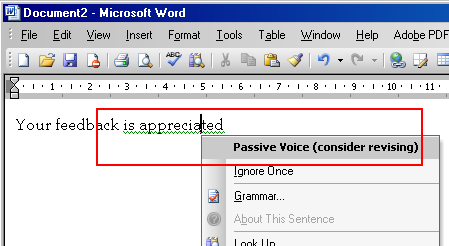
A previous article had promoted the use of active voice for persuasive communications. To summarize, sentences in passive voice (e.g., “Your feedback is appreciated,”) though grammatically correct, seem impersonal and obscure the responsibility of actions or feelings they convey. Sentences in active voice (e.g., ” I appreciate your feedback”) are simple, direct, persuasive, and easier to understand. See full article here.

You can use the ‘Grammar Check’ feature in MS-Word to identify and eliminate passive voice. To activate the check for passive voice, follow these three steps.

Identify and Eliminate Passive Voice in Microsoft Word

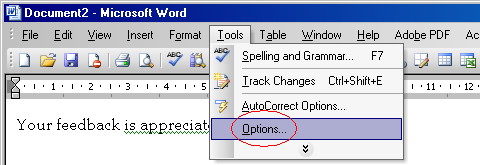
Step 1: Select ‘Tools’ from the ‘Options’ menu

Identify and Eliminate Passive Voice in Microsoft Word

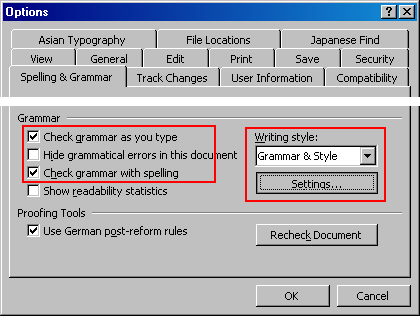
Step 2: In the ‘Spelling & Grammar’ tab of the Options dialog box, enable the ‘Check grammar as you type’ and ‘Check grammar with spelling’ options. Select ‘Grammar & Style’ from the ‘Writing style’ drop down and click on the ‘Settings’ button.

Identify and Eliminate Passive Voice in Microsoft Word

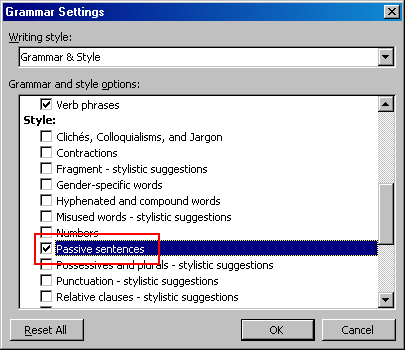
Step 3: In the ‘Grammar Settings’ dialog box, enable the ‘Passive sentences’ under the ‘Style’ category. ‘OK’ and close all the dialog boxes.

Once you configure the check for passive sentences, MS-Word will squiggly-underline (in green color) most instances of passive sentences as illustrated below, just like it does squiggly-underline (in red color) spelling mistakes.

Identify and Eliminate Passive Voice in Microsoft Word

Clarity and ease-of-comprehension are two of the most important requisites to effective communication. Active voice can facilitate effective communication.

Filed Under: Effective Communication

Inspirational Quotations #245

November 2, 2008 By Nagesh Belludi Leave a Comment

The best of a book is not the thought which it contains, but the thought which it suggests; just as the charm of music dwells not in the tones but in the echoes of our hearts.
—Oliver Wendell Holmes, Sr. (American Physician)

Men must be taught as if you taught them not, And things unknown propos’d as things forgot.
—Alexander Pope (English Poet)

Meditation consists in conducting consciousness beyond the point where it is the consciousness of a finite body or a finite mind, transferring the focus from level to level without losing its continuity or form.
—Vilayat Inayat Khan (British Sufi Mystic)

Difficulties are meant to rouse, not discourage. The human spirit is to grow strong by conflict.
—William Ellery Channing

It was much later that I realized Dad’s secret. He gained respect by giving it. He talked and listened to the fourth-grade kids in Spring Valley who shined shoes the same way he talked and listened to a bishop or a college president. He was seriously interested in who you were and what you had to say.
—Sara Lawrence-Lightfoot (American Sociologist)

To be yourself is an achievement in itself.
—Anonymous

Concern over criticism clogs creativity.
—Duane Alan Hahn

The tragedy of life is not that man loses,
but that he almost wins.
—Heywood Hale Broun (American Journalist)

Leaders establish the vision for the future and set the strategy for getting there; they cause change. They motivate and inspire others to go in the right direction and they, along with everyone else, sacrifice to get there.
—John Kotter (American Academic)

Before you can inspire with emotion, you must be swamped with it yourself. Before you can move their tears, your own must flow. To convince them, you must yourself believe.
—Winston Churchill (British Head of State)

Filed Under: Inspirational Quotations

« Previous Page
Next Page »

Primary Sidebar

Popular Now

Anxiety Assertiveness Attitudes Balance Biases Coaching Conflict Conversations Creativity Critical Thinking Decision-Making Discipline Emotions Entrepreneurs Ethics Etiquette Feedback Getting Along Getting Things Done Goals Great Manager Innovation Leadership Lessons Likeability Mental Models Mindfulness Motivation Parables Performance Management Persuasion Philosophy Problem Solving Procrastination Psychology Relationships Resilience Simple Living Social Skills Stress Suffering Thinking Tools Thought Process Time Management Winning on the Job Wisdom

About: Nagesh Belludi [hire] is a St. Petersburg, Florida-based freethinker, investor, and leadership coach. He specializes in helping executives and companies ensure that the overall quality of their decision-making benefits isn’t compromised by a lack of a big-picture understanding.

Get Updates

Signup for emails

Subscribe via RSS

Contact Nagesh Belludi

RECOMMENDED BOOK:
The Guide

The Guide: R. K. Narayan

R.K. Narayan's story of the transformation of Raju is a profound, yet dryly humorous assessment of the frailty of the human condition and the meaning and consequences of our actions

Explore

  • Announcements
  • Belief and Spirituality
  • Business Stories
  • Career Development
  • Effective Communication
  • Great Personalities
  • Health and Well-being
  • Ideas and Insights
  • Inspirational Quotations
  • Leadership
  • Leadership Reading
  • Leading Teams
  • Living the Good Life
  • Managing Business Functions
  • Managing People
  • MBA in a Nutshell
  • Mental Models
  • News Analysis
  • Personal Finance
  • Podcasts
  • Project Management
  • Proverbs & Maxims
  • Sharpening Your Skills
  • The Great Innovators

Recently,

  • Enterprise Begins in Annoyance: How One Miserable Vacation Sparked a Global Hotel Chain
  • Wishful Thinking Is Free. Movement Pays.
  • Rumination Can Turn the Mind Into a Prison of Repetition
  • Inspirational Quotations #1170
  • Conversational Narcissism: When You Make It About You
  • Reality is Messy—and Denial is Deadly
  • Don’t Exorcise Your Dark Thoughts, Examine Them

Unless otherwise stated in the individual document, the works above are © Nagesh Belludi under a Creative Commons BY-NC-ND license. You may quote, copy and share them freely, as long as you link back to RightAttitudes.com, don't make money with them, and don't modify the content. Enjoy!