• Skip to content
  • Skip to primary sidebar

Right Attitudes

Ideas for Impact

Inspirational Quotations #368

March 20, 2011 By Nagesh Belludi 1 Comment

To weep is to make less the depth of grief.
—William Shakespeare (British Playwright)

From the earliest times the old have rubbed it into the young that they are wiser than they, and before the young had discovered what nonsense this was they were old too, and it profited them to carry on the imposture.
—W. Somerset Maugham (French Playwright)

In the same degree that we overrate ourselves, we shall underrate others; for injustice allowed at home is not likely to be correct abroad.
—Washington Allston (American Poet)

Calm self-confidence is as far from conceit as the desire to earn a decent living is remote from greed.
—Channing Pollock

Arrogance is a killer, and wearing ambition on one’s sleeve can have the same effect. There is a fine line between arrogance and self-confidence. Legitimate self-confidence is a winner. The true test of self-confidence is the courage to be open—to welcome change and new ideas regardless of their source. Self-confident people aren’t afraid to have their views challenged. They relish the intellectual combat that enriches ideas.
—Jack Welch (American Businessperson)

The bottom line is that if you become a master at handling problems and overcoming obstacles, what can stop you from success? The answer is nothing! And if nothing can stop you, you become unstoppable!
—T. Harv Eker (American Motivational Speaker)

The most intolerable pain is produced by prolonging the keenest pleasure.
—George Bernard Shaw (Irish Playwright)

I remember hearing in a talk that the more we express our gratitude to God for our blessings, the more he will bring to our mind other blessings. The more we are aware of to be grateful for, the happier we become.
—Ezra Taft Benson (American Mormon Religious Leader)

There is only one time that is important—NOW! It is the most important time because it is the only time that we have any power.
—Leo Tolstoy (Russian Novelist)
Filed Under: Inspirational Quotations

Inspirational Quotations by Albert Einstein (#367)

March 14, 2011 By Nagesh Belludi Leave a Comment

It’s the birthday of theoretical physicist, humanist, and philosopher Albert Einstein (1879–1955.)

Einstein was born to Jewish parents in Ulm, Germany, in 1879. Encouraged by his uncle, Einstein started studying mathematics at school. He was an average student and his teachers predicted that he would never amount to much in life. He did not succeed in his first attempt at the entrance exam to a technical college at age 16.

Einstein barely made it through college and could not get a job in several science fields. He eventually joined the Swiss Patents Office in Bern as an examiner of patent applications and wrote scientific papers during his time off.

In 1905, at age 26, Einstein published four papers on the Special Theory of Relativity. These papers broke new ground in physics and included the legendary relation between mass and energy: E = mc-squared. In 1916, he published his work on the General Theory of Relativity. However, it was his work on the photoelectric effect that won Einstein the Nobel Prize in 1921.

Einstein immigrated to America in 1933 when Adolf Hitler came to power in 1933 and pursued an academic career at Princeton University. He died in 1955.

Einstein is best known for revolutionizing twentieth-century physics with his theories of relativity and contributions to photoelectric effect and the unification of the laws of physics. He was also a passionate humanist and advocated peace, political freedom, and social justice.

For more on Albert Einstein, I recommend Walter Isaacson’s excellent biography or DK Publishing’s biography. Also worth reading are Einstein’s “The World As I See It,” and his “Cosmic Religion and Other Opinions” with Irish playwright George Bernard Shaw.

Albert Einstein said, “Imagination is more important than knowledge.” This quote initiated my interest in inspirational quotes. My collection now includes 120,000 quotes.

Inspirational Quotations by Albert Einstein

You never fail until you stop trying.
—Albert Einstein (German-born Theoretical Physicist)

Small is the number of them that see with their own eyes and feel with their own hearts.
—Albert Einstein (German-born Theoretical Physicist)

Only one who devotes himself to a cause with his whole strength and soul can be a true master. For this reason mastery demands all of a person.
—Albert Einstein (German-born Theoretical Physicist)

Whoever is careless with the truth in small matters cannot be trusted with the important matters.
—Albert Einstein (German-born Theoretical Physicist)

We cannot solve our problems with the same thinking we used when we created them.
—Albert Einstein (German-born Theoretical Physicist)

Many of the things you can count, don’t count. Many of the things you can’t count, really count.
—Albert Einstein (German-born Theoretical Physicist)

Intellectuals solve problems; geniuses prevent them.
—Albert Einstein (German-born Theoretical Physicist)

The most important human endeavor is the striving for morality in our actions. Our inner balance and even our very existence depend on it. Only morality in our actions can give beauty and dignity to life.
—Albert Einstein (German-born Theoretical Physicist)

Knowledge is limited. Imagination encircles the world.
—Albert Einstein (German-born Theoretical Physicist)

A successful man is he who receives a great deal from his fellow men, usually incomparably more than corresponds to his service to them. The value of a man, however, should be seen in what he gives, and not in what he is able to receive.
—Albert Einstein (German-born Theoretical Physicist)

It can scarcely be denied that the supreme goal of all theory is to make the irreducible basic elements as simple and as few as possible without having to surrender the adequate representation of a single datum of experience.
—Albert Einstein (German-born Theoretical Physicist)

How strange is the lot of us mortals! Each of us is here for a brief sojourn; for what purpose he knows not, though he senses it. But without deeper reflection one knows from daily life that one exists for other people.
—Albert Einstein (German-born Theoretical Physicist)

I think that only daring speculation can lead us further and not accumulation of facts.
—Albert Einstein (German-born Theoretical Physicist)

One should guard against preaching to young people success in the customary form as the main aim in life. The most important motive for work in school and in life is pleasure in work, pleasure in its result, and the knowledge of the value of the result to the community.
—Albert Einstein (German-born Theoretical Physicist)

A man should look for what is, and not for what he thinks should be.
—Albert Einstein (German-born Theoretical Physicist)

The significant problems we face today cannot be solved at the same level of thinking we were at when we created them.
—Albert Einstein (German-born Theoretical Physicist)

Yes, we have to divide up our time like that, between our politics and our equations. But to me our equations are far more important, for politics are only a matter of present concern. A mathematical equation stands forever.
—Albert Einstein (German-born Theoretical Physicist)

The value of a man resides in what he gives and not in what he is capable of receiving.
—Albert Einstein (German-born Theoretical Physicist)

Learn from yesterday, live for today, hope for tomorrow. The important thing is not to stop questioning.
—Albert Einstein (German-born Theoretical Physicist)

Reading, after a certain age, diverts the mind too much from its creative pursuits. Any man who reads too much and uses his own brain too little falls into lazy habits of thinking.
—Albert Einstein (German-born Theoretical Physicist)

The true sign of intelligence is not knowledge but imagination.
—Albert Einstein (German-born Theoretical Physicist)

Filed Under: Inspirational Quotations Tagged With: Scientists

Inspirational Quotations #366

March 6, 2011 By Nagesh Belludi Leave a Comment

There are geniuses in trade as well as in war, or the state, or letters; and the reason why this or that man is fortunate is not to be told. It lies in the man: that is all anybody can tell you about it.
—Ralph Waldo Emerson (American Philosopher)

To dare to live alone is the rarest courage; since there are many who had rather meet their bitterest enemy in the field, than their own hearts in their closet.
—Charles Caleb Colton (English Angelic Priest)

To have read the greatest works of any great poet, to have beheld or heard the greatest works of any great painter or musician, is a possession added to the best things in life.
—Algernon Charles Swinburne (English Poet)

It is the easiest thing in the world to obey God when He commands us to do what we like, and to trust Him when the path is all sunshine. The real victory of faith is to trust God in the dark, and through the dark.
—Theodore L. Cuyler (American Presbyterian Clergyman)

The state of your life is nothing more than a reflection of your state of mind.
—Wayne Dyer (American Motivational Writer)

Before you go and criticize the younger generation, just remember who raised them.
—Unknown

Almost always it is the fear of being ourselves that brings us to the mirror.
—Antonio Porchia (Italian Poet)

A criminal becomes a popular figure because he unburdens in no small degree the consciences of his fellow man, for now they know once more where evil is to be found.
—Carl Jung (Swiss Psychologist)

Some men have a den in their home, while others just growl all over the house.
—Unknown

If a person is not of good conduct, his/her beauty is a waste. For a person with bad character, being born in noble family is a waste. If you do not achieve any feat, being educated is a waste. If you do not spend money, having wealth is a waste.
—Chanakya Neeti

Filed Under: Inspirational Quotations

Inspirational Writings of Henry Wadsworth Longfellow (#365)

February 27, 2011 By Nagesh Belludi Leave a Comment

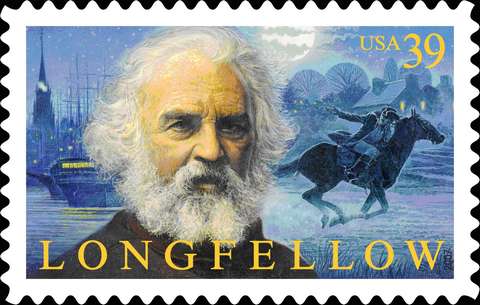
Henry Wadsworth Longfellow

It’s the birthday of one of the best known American poets, Henry Wadsworth Longfellow (1807—1882.) Longfellow is best remembered for poems such as “The Song of Hiawatha” (1855,) “Paul Revere’s Ride” (1861), long narrative poems such as “Evangeline” (1847) and “The Courtship of Miles Standish” (1858,) and his translation of Dante Alighieri’s “Divine Comedy.” Some of his poems such as “There was a little girl” remain familiar to this day as rhymes and melodies.

For more details on Henry Wadsworth Longfellow, see bio on the Poetry Foundation’s website. I also suggest collections of his poems and writings on Amazon, or these free downloads on the Internet Archive.

Inspirational Writings of Henry Wadsworth Longfellow

Thy fate is the common fate of all,|Into each life some rain must fall,|Some days must be dark and dreary.
—Henry Wadsworth Longfellow (American Poet)

The bravest are the tenderest. The loving are the daring.
—Henry Wadsworth Longfellow (American Poet)

Let nothing disturb thee, Let nothing affright thee, All things are passing, God changeth never.
—Henry Wadsworth Longfellow (American Poet)

All things come round to him who will but wait.
—Henry Wadsworth Longfellow (American Poet)

Tomorrow is the mysterious, unknown guest.
—Henry Wadsworth Longfellow (American Poet)

Some must follow and some command, though all are born of clay.
—Henry Wadsworth Longfellow (American Poet)

Hope has as many lives as a cat or a king.
—Henry Wadsworth Longfellow (American Poet)

Look not mournfully into the Past. It comes not back again. Wisely improve the Present. It is thine. Go forth to meet the shadowy Future, without fear, and with a manly heart.
—Henry Wadsworth Longfellow (American Poet)

Let us then be what we are, and speak what we think, and in all things keep ourselves loyal to truth.
—Henry Wadsworth Longfellow (American Poet)

Let us then be up and doing,|With a heart for any fate,|Still achieving, still pursuing,|Learn to labor and to wait.
—Henry Wadsworth Longfellow (American Poet)

Lives of great men all remind us|We can make our lives sublime,|And, departing, leave behind us|Footprints on the sands of time.
—Henry Wadsworth Longfellow (American Poet)

The talent of success is nothing more than doing what you can do well, and doing well whatever you do without thought of fame. If it comes at all it will come because it is deserved, not because it is sought after.
—Henry Wadsworth Longfellow (American Poet)

Give what you have. To someone, it may be better than you dare to think.
—Henry Wadsworth Longfellow (American Poet)

Love gives itself; it is not bought.
—Henry Wadsworth Longfellow (American Poet)

Great is the art of beginning, but greater is the art of ending.
—Henry Wadsworth Longfellow (American Poet)

Perseverance is a great element of success. If you only knock long enough and loud enough at the gate, you are sure to wake up somebody.
—Henry Wadsworth Longfellow (American Poet)

Sometimes we may learn more from a man’s errors than from his virtues.
—Henry Wadsworth Longfellow (American Poet)

Kind hearts are the gardens,|Kind thoughts are the roots,|Kind words are the flowers,|Kind deeds are the fruits.||Take care of your garden|And keep out the weeds,|Fill it with sunshine|Kind words and kind deeds.
—Henry Wadsworth Longfellow (American Poet)

The greatest grace of a gift, perhaps, is that it anticipates and admits of no return.
—Henry Wadsworth Longfellow (American Poet)

Give what you have. To someone, it may be better than you dare to think.
—Henry Wadsworth Longfellow (American Poet)

He spake well who said that graves are the footprints of angels.
—Henry Wadsworth Longfellow (American Poet)

The life of a man consists not in seeing visions and in dreaming dreams, but in active charity and in willing service.
—Henry Wadsworth Longfellow (American Poet)

Filed Under: Inspirational Quotations

Inspirational Quotations #364

February 20, 2011 By Nagesh Belludi Leave a Comment

We grow great by dreams. All big men are dreamers. They see things in the soft haze of a spring day or in the red fire of a long winter’s evening. Some of us let these dreams die, but others nourish and protect them; nurse them through bad days till they bring them to the sunshine and light which comes always to those who hope that their dreams will come true.
—Woodrow Wilson (American Head of State)

Genius is eternal patience.
—Michelangelo (Italian Painter)

Ours is a culture based on excess, on overproduction; the result is a steady loss of sharpness in our sensory experience. All the conditions of modern life—its material plenitude, its sheer crowdedness—conjoin to dull our sensory faculties.
—Susan Sontag (American Writer, Philosopher)

Humility is often only a feigned submission, of which we make use to render others submissive. It is an artifice of pride which abases in order to exalt itself.
—Francois de La Rochefoucauld

O Lord, you know what is best for me. Let this or that be done, as you please. Give what you will, how much you will, and when you will.
—Thomas A Kempis

You are at the top when you’ve made friends with the past, are focused on the present, and optimistic about your future. … .
—Zig Ziglar (American Author)

Even if a farmer intends to loaf, he gets up in time to get an early start.
—E. W. Howe (American Novelist)

A bodily disease, which we look upon as whole and entire within itself, may, after all, be but a symptom of some ailment in the spiritual part.
—Nathaniel Hawthorne (American Novelist)

No enterprise can exist for itself alone. It ministers to some great need, it performs some great service, not for itself, but for others; or failing therein, it ceases to be profitable and ceases to exist.
—Calvin Coolidge (American Head of State)

When the joy of the job’s gone, when it’s no fun trying anymore, quit before you’re fired.
—Malcolm Forbes (American Publisher)

I have found some of the best reasons I ever had for remaining at the bottom simply by looking at the men at the top.
—Frank Moore Colby (American Educator)

Filed Under: Inspirational Quotations

Inspirational Quotations by Abraham Lincoln (#363)

February 12, 2011 By Nagesh Belludi Leave a Comment

Lincoln Memorial in Washington D. C.

It’s the birthday of Abraham Lincoln, one of the world’s most recognized political leaders of all time. The 16th President of the United States was born in Hodgenville, Kentucky in 1809.

Not much is known about Lincoln’s early life. He was born in a log cabin in a poor family, lost his mother at nine, completed just a year of traditional schooling, and spent his youth in Indiana. He did manual labor until he was 21.

Lincoln pursued self-education by reading books on grammar and rhetoric and joined a debate society. After years of private study of law, he obtained a licensed to practice law at age 27 and, in time, became one of Illinois ablest lawyers. Concurrently, Lincoln worked his way through the Illinois state legislature and got elected to the United States House of Representatives. He gained popularity for his down-to-earth wit, integrity, and opposition to the institution of slavery.

Abraham Lincoln’s Presidency

Abraham Lincoln Lincoln’s political and military leadership during the Civil War held the country together through the worst crisis in its history and made him one of the most admired presidents of the United States. John Wilkes Booth, an actor who attended Lincoln’s second inauguration, fatally wounded Abraham Lincoln just six weeks later at Ford’s Theater in Washington D.C.

During his time, Lincoln was known for his compassionate nature, gentle spirit, and great oratory. Some of his speeches, most prominently, the Gettysburg Address of 1863, and writings are still widely quoted. Unlike most presidents, Abraham Lincoln never wrote his memoirs.

I recommend the following books for on the audacity of Lincoln in the face of widespread criticism his administration and his personal character and a discussion of his presidency.

  • With Malice Toward None: A Life of Abraham Lincoln, Stephen B. Oates
  • Lincoln’s Virtues: An Ethical Biography, William Lee Miller
  • A. Lincoln: A Biography, Ronald C. White Jr.
  • Tried by War: Abraham Lincoln as Commander in Chief, James M. McPherson
  • The Wit and Wisdom of Abraham Lincoln, Bob Blaisdell (ed)

Quotations by Abraham Lincoln

Be sure your feet are in the right place. Then stand firm.
—Abraham Lincoln (American Head of State)

The trouble with too many people is they believe the realm of truth always lies within their vision.
—Abraham Lincoln (American Head of State)

He has the right to criticize who has the heart to help.
—Abraham Lincoln (American Head of State)

If I care to listen to every criticism, let alone act on them, then this shop may as well be closed for all other businesses. I have learned to do my best, and if the end result is good then I do not care for any criticism, but if the end result is not good, then even the praise of ten angels would not make the difference.
—Abraham Lincoln (American Head of State)

You cannot bring about prosperity by discouraging thrift. You cannot help small men by tearing down big men. You cannot strengthen the weak by weakening the strong. You cannot lift the wage-earner by pulling down the wage-payer. You cannot help the poor man by destroying the rich. You cannot keep out of trouble by spending more than your income. You cannot further the brotherhood of man by inciting class hatred. You cannot establish security on borrowed money. You cannot build character and courage by taking away men’s initiative and independence. You cannot help men permanently by doing for them what they could and should do for themselves.
—Abraham Lincoln (American Head of State)

That some achieve great success, is proof to all that others can achieve it as well.
—Abraham Lincoln (American Head of State)

My great concern is not whether you have failed, but whether you are content with your failure.
—Abraham Lincoln (American Head of State)

Few can be induced to labor exclusively for posterity. Posterity has done nothing for us.
—Abraham Lincoln (American Head of State)

When I am getting ready to reason with a man, I spend one-third of my time thinking about myself and what I am going to say and two-thirds about him and what he is going to say.
—Abraham Lincoln (American Head of State)

Every man is said to have his peculiar ambition… I have no other so great as that of being truely esteemed of my fellow men, by rendering myself worthy of their esteem.
—Abraham Lincoln (American Head of State)

My concern is not whether God is on our side; my greatest concern is to be on God’s side, for God is always right.
—Abraham Lincoln (American Head of State)

What kills a skunk is the publicity it gives itself.
—Abraham Lincoln (American Head of State)

My old father used to have a saying: If you make a bad bargain, hug it all the tighter.
—Abraham Lincoln (American Head of State)

I claim not to have controlled events, but confess plainly that events have controlled me.
—Abraham Lincoln (American Head of State)

I have been driven many times to my knees by the overwhelming conviction that I had nowhere else to go. My own wisdom and that of all about me seemed insufficient for the day.
—Abraham Lincoln (American Head of State)

If you would win a man to your cause, first convince him that you are his true friend. Therein is a drop of honey that catches his heart, which, say what he will, is the greatest highroad to his reason, and which when once gained, you will find but little trouble in convincing his judgment of the justice of your cause, if, indeed, that cause be really a just one. On the contrary, assume to dictate to his judgment, or to command his action, or to make him as one to be shunned or despised, and he will retreat within himself, close all the avenues to his head and heart; and though your cause be naked truth itself, transformed to the heaviest lance, harder than steel and sharper than steel can be made, and though you throw it with more than Herculean force and precision, you shall be no more able to pierce him than to penetrate the hard shell of a tortoise with a rye straw.
—Abraham Lincoln (American Head of State)

The probability that we may fall in the struggle ought not to deter us from the support of a cause we believe to be just; it shall not deter me.
—Abraham Lincoln (American Head of State)

In this and like communities public sentiment is everything. With public sentiment nothing can fail; without it nothing can succeed; consequently he who moulds public sentiment goes deeper than he who enacts statutes and decisions. He makes statutes and decisions possible or impossible to be executed.
—Abraham Lincoln (American Head of State)

The strongest bond of human sympathy, outside of the family relation, should be one uniting all working people, of all nations, and tongues, and kindreds. Nor should this lead us to a war upon property, or the owners of property. Property is the fruit of labor; property is desirable; is a positive good in the world. That some should be rich shows that others may become rich and, hence, is just encouragement to industry and enterprise. Let not him who is houseless pull down the house of another, but let him labor diligently and build one for himself, thus, by example, assuring that his own shall be safe from violence when built.
—Abraham Lincoln (American Head of State)

If you intend to go to work, there is no better place than right where you are; if you do not intend to go to work, you cannot get along anywhere. Squirming and crawling about from place to place can do no good.
—Abraham Lincoln (American Head of State)

Folks are usually about as happy as they make their minds up to be.
—Abraham Lincoln (American Head of State)

Let no feeling of discouragement prey upon you, and in the end you are sure to succeed.
—Abraham Lincoln (American Head of State)

Filed Under: Inspirational Quotations Tagged With: Abraham Lincoln

The Best of the Chinese Proverbs (Inspirational Quotations #362)

February 3, 2011 By Nagesh Belludi 1 Comment

Chinese New Year, the Spring Festival

The Chinese New Year, or the Spring Festival, is the most important festival on the Chinese calendar. The festivities traditionally begin on the first day of the first month of the Chinese calendar and end with the Lantern Festival celebrated on the 15th day of the New Year.

The Chinese festival year follows a lunar calendar and consists of twelve moons; each moon lasts about 29 1/2 days. The Chinese calendar follows a 12-year cycle and each year relates to an animal in the Chinese zodiac. Year 4708, the year beginning February 3, 2011, is the Year of the Rabbit.

Festivities and Traditions

For the Chinese, the New Year is a time of great renewal. They devote the last few days of the old year to intense preparation. They clean their homes in a belief that, along with the dirt and debris around their homes, they can sweep away the mistakes and misfortunes of the past. They hang protective ornaments in their homes to welcome the good fortunes that the New Year brings.

The Chinese New Year is also a period of reunion. Scores of migrants return home to share the festivities with their families. The Chinese celebrate by partaking in divinatory readings at temples, sharing gifts, and bonding over elaborate family dinner parties. Children receive “lucky money” in red envelopes as part of the New Year’s gift-giving.

Outside of the Far East, ethnic Chinese celebrate the New Year in Chinatowns around the world with community parades and extravaganzas featuring fireworks, lion and dragon dance-shows, acrobatics, lanterns, and illuminated floats.

Chinese Proverbs

Patience is power; with time and patience the mulberry leaf becomes a silk gown.
—Chinese Proverb

Gold cannot be pure, and people cannot be perfect.
—Chinese Proverb

If you are patient in one moment of anger, you will escape a hundred days of sorrow.
—Chinese Proverb

Man who waits for roast duck to fly into mouth must wait very, very long time.
—Chinese Proverb

Slander cannot destroy the man … when the flood recedes, the rock is there.
—Chinese Proverb

I dreamed a thousand new paths… I woke and walked my old one.
—Chinese Proverb

If you must play, decide upon three things at the start: the rules of the game, the stakes, and the quitting time.
—Chinese Proverb

What you cannot avoid, welcome.
—Chinese Proverb

Man fools himself. He prays for a long life, and he fears an old age.
—Chinese Proverb

Never try to catch two frogs with one hand.
—Chinese Proverb

Flowers leave their fragrance on the hand that bestows them.
—Chinese Proverb

If you want your dinner, don’t offend the cook.
—Chinese Proverb

Talk doesn’t cook rice.
—Chinese Proverb

A wise man makes his own decisions, an ignorant man follows the public opinion.
—Chinese Proverb

Not the fastest horse can catch a word spoken in anger.
—Chinese Proverb

Spring is sooner recognized by plants than by men.
—Chinese Proverb

The best time to plant a tree was twenty years ago. But the second best time is today.
—Chinese Proverb

Wondering what to read next?

  1. Inspirational Epigrams by Oscar Wilde (#346)
  2. The Wit & Wisdom of Benjamin Franklin: The Best 100 Maxims from “Poor Richard’s Almanack”
  3. Dueling Maxims, Adages, and Proverbs
  4. Confucius on Dealing with People

Filed Under: Proverbs & Maxims Tagged With: China, Proverbs & Maxims

Inspirational Quotations by Franklin D. Roosevelt (#361)

January 30, 2011 By Nagesh Belludi 2 Comments

It’s the birthday of Franklin Delano Roosevelt, one of the most admired Presidents of the United States. The 32nd President is widely known by his initials, FDR.

Roosevelt led the United States during some of its most challenging times, both domestically and internationally. He is most renowned for his socio-economic policies to resolve the Great Depression, his decision to enter the war after Japan attacked Pearl Harbor in 1941, and the eventual victory of the Allied forces in World War II. His presidency transformed the President of the United States into the most powerful elected official in the world.

FDR is the longest-serving president of the United States. He died three months into his fourth term in office, just weeks before the surrender of Germany in World War II. Time Magazine named Franklin Roosevelt as a runner-up (along with Mohandas Gandhi) in the Person of the Century recognition.

Roosevelt was known for his warm-heartedness and humility. He triumphed over a physical disability—at age 39, FDR suffered a polio attack that practically paralyzed his legs and confined him to a wheelchair for the rest of his life.

FDR is also legendary for his collections of stamps, coins, medals, printings, models of various artifacts, walking sticks, paintings and photographs of naval vessels, stuffed animals, etc. He was the first president to set up a Presidential Library. The Franklin D. Roosevelt Presidential Library and Museum located in his birthplace of Hyde Park, New York, houses his presidential papers and collections.

See also quotes by his wife, Eleanor Roosevelt, and by his distant cousin, Theodore Roosevelt, the 26th President of the United States.

Inspirational Quotations by Franklin D. Roosevelt

The only limit to our realization of tomorrow will be our doubts of today. Let us move forward with strong and active faith.
—Franklin D. Roosevelt (American Head of State)

Happiness lies not in the mere possession of money; it lies in the joy of achievement, in the thrill of creative effort. The joy and moral stimulation of work no longer must be forgotten in the mad chase of evanescent profits. These dark days will be worth all they cost us if they teach us that our true destiny is not to be ministered unto but to minister to ourselves and to our fellow men.
—Franklin D. Roosevelt (American Head of State)

Those who have long enjoyed such privileges as we enjoy, forget in time that men have died to win them.
—Franklin D. Roosevelt (American Head of State)

If you treat people right they will treat you right—ninety percent of the time.
—Franklin D. Roosevelt (American Head of State)

Men are not prisoners of fate, but only prisoners of their own minds.
—Franklin D. Roosevelt (American Head of State)

A great man left a watchword that we can well repeat: There is no indispensable man.
—Franklin D. Roosevelt (American Head of State)

Human kindness has never weakened the stamina or softened the fiber of a free people. A nation does not have to be cruel in order to be tough.
—Franklin D. Roosevelt (American Head of State)

Remember you are just an extra in everyone else’s play.
—Franklin D. Roosevelt (American Head of State)

We can’t always build the future for our youth, but we can build our youth for the future.
—Franklin D. Roosevelt (American Head of State)

We have always known that heedless self-interest was bad morals; we know now that it is bad economics.
—Franklin D. Roosevelt (American Head of State)

The test of our progress is not whether we add more to the abundance of those who have much it is whether we provide enough for those who have little.
—Franklin D. Roosevelt (American Head of State)

Confidence… thrives on honesty, on honor, on the sacredness of obligations, on faithful protection and on unselfish performance. Without them it cannot live.
—Franklin D. Roosevelt (American Head of State)

Freedom to learn is the first necessity of guaranteeing that man himself shall be self-reliant enough to be free.
—Franklin D. Roosevelt (American Head of State)

Peace, like charity, begins at home.
—Franklin D. Roosevelt (American Head of State)

Filed Under: Inspirational Quotations

You Don’t Have to Be Chained to Your Desk to Succeed at Work

January 28, 2011 By Nagesh Belludi 1 Comment

The 40-hour workweek is a bygone. The workday is longer, the pace of work is faster, and most projects tend to be open-ended. A successful corporate career now demands a high-level of performance for sustained periods. At what cost, though?

The “Activity is Productivity” Fallacy

Regrettably, companies still tend to measure an employee’s commitment by how many hours he is willing to put in. In the absence of a meaningful yardstick for the productivity of knowledge workers, companies continue to cling to the outdated equation that time worked equals output, a residue from the mindsets of the Industrial Age. Late nights and shorter weekends have become implied signs of employee loyalty.

Companies strive to get more from their “right-sized” staffs and have come to depend on cadres of hard-working professionals. Therefore, companies look upon employees willing to put in long hours as assets. They bestow swift promotions and pay big bucks to employees who are willing to take on demanding assignments, be available around the clock, and forego a healthy separation between work and personal time.

The unspoken imperative is that employees have to work longer hours to get ahead, and defiant employees who wish for a balanced life may hurt their careers.

Our Society Endorses Overwork

As a society, we respect overwork. We praise hardworking, career-driven individuals, even if they have lost their sense of work-life balance. Canadian psychologist Barbara Killinger asserts in her book, “Workaholics: The Respectable Addicts,” that workaholism is now talked about as a virtue.

Overwork has become a social problem in many countries. Surveys have revealed that Americans put in more hours of work each year than employees in other countries put and do not use a fourth of their allotted vacation. Working mothers take shorter maternity leaves than they used to. Entrepreneurs sacrifice way too much for relatively modest payoffs.

In Japan, overwork has led to some of the highest rates of work-related deaths and suicides in the developed world. This social problem is rooted in the samurai culture that judged the allegiance and personal fortitude of its warriors by their willingness to work long hours and sacrifice self-interests. In the 1960s, the Japanese even coined the term karoshi to describe death by overwork. Currently, the Japanese government is considering regulating work hours.

Chinese employers have recently faced a spate of suicides and ill health caused by overwork and deteriorating employee welfare. Most newsworthy of these episodes is the deaths of many migrant workers at a factory that contract-manufactures iPods and iPhones for Apple. The Mandarin term guolaosi refers to the destructive consequences of this intense work ethic.

Long Work Hours Just Don’t Help

The all-work, no-play mentality is serving neither employees nor their employers.

Employees spend fewer hours at home, preoccupy their minds with work even when they are at home, ignore the emotional needs of their families, and ultimately strain their relationships with loved ones. Overworked employees suffer from a lack of sleep. Their unceasing fatigue debilitates their immune systems and results in serious health problems. Often, they resort to excessive smoking or alcohol and substance abuse, develop poor eating habits, and ignore physical fitness.

Long hours and lesser vacations are not good for the bottom line of companies either. Longer hours do not add up to better work.

Overwork weighs down on organizational effectiveness in terms of productivity loss, inaccuracies, poor relationships at work, and plummeting employee engagement. Employers also face increased medical costs from the decline in the physical and emotional health of their employees.

Please Stop Working So Hard!

Look, there is nothing wrong with working hard and having a passion for what you do. I agree that putting in the extra effort, undertaking challenging projects, and pursuing career growth are all very gratifying. Nevertheless, do not ignore the needs of the other aspects of your life. Here are seven suggestions that can help you work hard, but not indulge in overwork.

  1. Pace yourself. Do not think of your job as an endurance contest. As a knowledge worker, for the most part, you are paid for your intellectual work. Ingenuity and creative aptitude tend to spring in intense bursts. Therefore, your capacity for intellectual work drops dramatically when you are weary and stressed-out. Plan your day on how much you target to achieve before you can take a break and rest.
  2. Understand and cling to the critical path. Recognize the big picture of everything you work on from the customer’s perspective. Then, concentrate on the essentials. Remember, there are several things you can do, many things people want you to do, but only a few that you must do. Focus on what you must do, not what you can. Prioritize relentlessly.
  3. If you are struggling with managing your time, follow my simple, three-step process (time logging, time analysis, time budgeting) to discover how you tend to spend time currently and how you could focus on the things that matter the most. Remember, effective time management is truly about managing priorities, not about managing time.
  4. Stay on top of your tasks. Identify areas of inefficiency. Ask for help, delegate, outsource, or invest in tools and technologies that can help you achieve more in less time.
  5. Limit the amount of time you spend in meetings. Screen the agenda of each meeting for items that can be resolved by e-mail or delegation or a prior meeting.
  6. Learn to set limits on your workweek. Don’t take your time for granted. Reflect on what you would truly like to achieve and make the right work-life choices. No one can make the choices for you. Remember that the true yardstick of your performance assessment is not the number of hours you put in, but your accomplishment in these hours.
  7. Set aside personal time. Plan and use your vacation time meaningfully. Have the discipline to leave your laptop, blackberry, and other electronic devices behind. Disconnect from work and enjoy your time with loved ones.

The Right Choices for a Successful Career & a Balanced Life

Work as many hours as you think you need to achieve your goals, realize your aspirations and be happy. Do not overwork and let your career progression become an obsession.

Wondering what to read next?

  1. When Work Becomes Alibi: Turtle Workaholism and Excuse-making
  2. Great Jobs are Overwhelming, and Not Everybody Wants Them
  3. Task-Driven Living Is a Form of Self-Deception
  4. The Truth About Work-Life Balance
  5. The Hustle Delusion: Your Ambition is Another’s Insanity

Filed Under: Career Development, Health and Well-being, Living the Good Life Tagged With: Balance

Book Summary of John Bogle’s ‘Little Book of Common Sense Investing’

January 25, 2011 By Nagesh Belludi Leave a Comment

The Little Book of Common Sense Investing, John Bogle “In investing, the winning strategy for reaping the rewards of capitalism depends on owning businesses, not trading stocks,” argues John Bogle in making a strong case for low-cost index funds in his text, “The Little Book of Common Sense Investing.” With statistics and graphs, Bogle rationalizes that low-cost index funds outperform most investment professionals and offer better-than-average returns for investors over the long term.

John Bogle is the legendary founder of the investor-owned Vanguard Group, currently the world’s largest mutual fund company by total assets under management. Over the course of 25 years at the helm of Vanguard, until his retirement in 1999, he focused the efforts of Vanguard on offering cost-conscious investment choices to the masses. John Bogle is the bestselling author of many other books on investment advice.

Superiority of Low-Cost Index Funds

John Bogle founded the world’s first index mutual fund, the Vanguard 500 Index Fund in 1975. Since then, “Saint Jack” (as critics labeled Bogle mockingly) has untiringly promoted the virtues of low-fee, no-load, low-turnover, passively-managed index (or more precisely, index-tracking) mutual funds. Investing in such funds, he contends in “The Little Book,” is the simplest and most effective way to invest in a diversified portfolio of stocks and bonds, and profit from earnings growth of businesses and the dividends they yield.

John Bogle methodically discusses every theme relevant to successful investing: the myths of speculation and market timing, inflation, frictional costs (fees charged by brokers and investment advisors, costs of transactions, front-end and back-end loads,) and the effects of compounding and taxes. He then convincingly counters arguments against investing in total market index funds through easy-to-follow quantitative appraisals of investing in individual stocks and bonds, actively managed funds, hedge funds, and sector-specific funds. At the end of each chapter, Bogle reinforces his position with words of wisdom from some of the greatest minds in economics and investing: Ben Graham, Warren Buffet, John Maynard Keynes, Peter Lynch, and the like.

Invaluable Insights for Investors

The majority of people do not have the time, energy, determination, or aptitude for understanding economics, examining investments, managing risk, and building wealth for themselves. They are either overly cautious, or they invest heedlessly, submit to market trends, or engage in speculation. In reading John Bogle’s authoritative book, modest investors will recognize that low-cost index funds offer them broad diversification, reasonably good returns over the long-term, and the ability to outperform a majority of investment professionals.

Informed investors will find, notwithstanding many drawn-out discussions, a great reiteration of John Bogle’s now-familiar, commonsensical ideas on the merits of index investing.

Leadership Reader’s Bottom-line

  • “The Little Book of Common Sense Investing: The Only Way to Guarantee Your Fair Share of Stock Market Returns,” by John C Bogle
  • Subject: Personal finance, investment advice
  • Required reading for building wealth prudently through investments. The excellent insights in “The Little Book” deserve every investor’s considerations.
  • Recommended topics for further reading: asset allocation, financial planning, and retirement planning.
  • 4 out of 5 Stars

Wondering what to read next?

  1. Yes, Money Can Buy Happiness
  2. The Easier Way to Build Wealth
  3. Here’s the #1 Lesson from Secret Millionaires
  4. The Easy Tracking Spreadsheet That Can Transform Your Money Habits
  5. Is Day Trading and Speculation for You?

Filed Under: Leadership Reading, Personal Finance Tagged With: Books for Impact, Getting Rich, Personal Finance, Simple Living

« Previous Page
Next Page »

Primary Sidebar

Popular Now

Anxiety Assertiveness Attitudes Balance Biases Coaching Conflict Conversations Creativity Critical Thinking Decision-Making Discipline Emotions Entrepreneurs Ethics Etiquette Feedback Getting Along Getting Things Done Goals Great Manager Innovation Leadership Lessons Likeability Mental Models Mindfulness Motivation Parables Performance Management Personal Growth Persuasion Philosophy Problem Solving Procrastination Psychology Relationships Resilience Simple Living Social Skills Stress Thinking Tools Thought Process Time Management Winning on the Job Wisdom

About: Nagesh Belludi [hire] is a St. Petersburg, Florida-based freethinker, investor, and leadership coach. He specializes in helping executives and companies ensure that the overall quality of their decision-making benefits isn’t compromised by a lack of a big-picture understanding.

Get Updates

Signup for emails

Subscribe via RSS

Contact Nagesh Belludi

RECOMMENDED BOOK:
When Things Fall Apart

When Things Fall Apart: Pema Chödrön

Buddhist nun Pema Chodron's treasury of wisdom for overcoming life's pain and difficulties, and ways for creating effective social action.

Explore

  • Announcements
  • Belief and Spirituality
  • Business Stories
  • Career Development
  • Effective Communication
  • Great Personalities
  • Health and Well-being
  • Ideas and Insights
  • Inspirational Quotations
  • Leadership
  • Leadership Reading
  • Leading Teams
  • Living the Good Life
  • Managing Business Functions
  • Managing People
  • MBA in a Nutshell
  • Mental Models
  • News Analysis
  • Personal Finance
  • Podcasts
  • Project Management
  • Proverbs & Maxims
  • Sharpening Your Skills
  • The Great Innovators

Recently,

  • Inspirational Quotations #1178
  • Uncomfortable Taking Compliments? Just Say ‘Thank You.’
  • Before You Become an Entrepreneur, Talk Yourself Out of It
  • ‘In the Mood for Love’ and the Residue of Stoic Restraint
  • Inspirational Quotations #1177
  • How to Deal with … Interrupters
  • How to Deal with … Overtalkers

Unless otherwise stated in the individual document, the works above are © Nagesh Belludi under a Creative Commons BY-NC-ND license. You may quote, copy and share them freely, as long as you link back to RightAttitudes.com, don't make money with them, and don't modify the content. Enjoy!