• Skip to content
  • Skip to primary sidebar

Right Attitudes

Ideas for Impact

Effective Goals Can Challenge, Motivate, and Energize

January 12, 2016 By Nagesh Belludi Leave a Comment

One of my blog readers asked me to write more about goal-setting and performance against goals. In response, I studied the work of University of Maryland’s Edwin Locke and University of Toronto’s Gary Latham, two renowned researchers on goal-setting. Here is a summary.

Goals Impact Performance in Several Ways

  • Goals can help direct: A person’s goals should direct his/her attention, effort, and action toward goal-relevant actions at the expense of less-relevant actions.
  • Goals can help motivate: A person’s goals can motivate him/her to pursue specific outcomes. The person can be motivated only when his/her goals are sufficiently challenging and can nudge him/her to put in special efforts.
  • Goals can help persist: A person is likely to persist at his/her efforts when his/her goal is worthy enough to attain.
  • Goals can trigger learning: Goals can either activate a person’s knowledge and skills that are relevant to performance or induce the person to acquire such knowledge or skills.

Best Practices for Goal-Setting and Performance

  • Specific, difficult, but attainable goals lead to better performance than easy, vague, or abstract goals such as the general-purpose exhortation to “do your best.” Hard goals motivate because they require a person to achieve more in order to be content with his/her own performance.
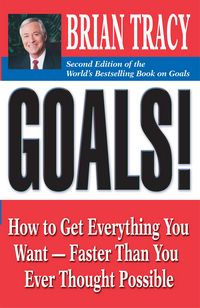
  • 'Goals' by Brian Tracy (ISBN 1605094110) Goal specificity and performance share a positive, linear relationship. When a person’s goals are specific, they direct and energize his/her behavior far more effectively than when they are vague and unspecific.
  • Performance is directly proportional to the difficulty of a goal as long as a person is committed to the goal, has the requisite ability and resources to achieve the goal, and does not have conflicting goals.
  • Taking on excess work without access to the necessary resources to realize the goals (“overload”) can moderate the effects of goals.
  • A team performs best when the goals of the individuals on the team are compatible with the team’s goal. Therefore, when an individual’s goals are incompatible with his team’s, his/her contribution to the team will be subpar.
  • The goal need not be in focal awareness all the time. Once a goal is accepted and understood, it resides in the periphery of the person’s consciousness and serves to guide and give meaning to his/her actions.
  • While long-term goals are relevant and helpful, most people find short-term goals more effective because they channel a person’s immediate and direct efforts and provide quick feedback. This suggests that it’s best to divide long-term goals into concrete short-term objectives.
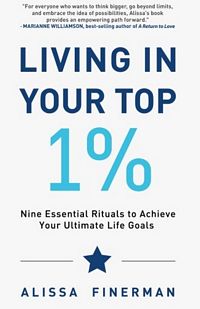
  • 'Living in Your Top 1%' by Alissa Finerman (ISBN 1453619232) Self-efficacy plays a key role in the achievement of goals. A person is much more likely to buy into and pursue goals if he/she believes himself/herself to be competent enough to reach those goals. The most effective goals must therefore embrace a person’s strengths—such goals help him/her strive towards success by leveraging the best of who he/she is and what he/she can do.
  • One reason a person may lack self-efficacy is his/her past failures with undertaking similar goals. Such a person may believe that he/she may never reach his/her goals and should first undertake a series of small, near-term goals instead of difficult, distant goals. The person’s success with a series of smaller goals can boost his/her confidence and can inspire him/her to undertake larger goals. For example, a chain-smoker will find the goal of smoking cessation daunting. He should therefore focus on smaller goals like gradually cutting down the number of cigarettes he smokes every day. Experiences of goal achievement can build up momentum to tackle the larger goal.
  • Goals are not effective by themselves. Feedback is the most important moderator of goal-setting because it tracks the progress of performance towards goals and creates new sub-goals. If a person finds his/her progress towards a goal unsatisfactory, the feedback he/she receives can drive corrective efforts to develop new skills or pursue the goal in a new way.

Wondering what to read next?

  1. Putting the WOW in Customer Service // Book Summary of Tony Hsieh’s Delivering Happiness
  2. Don’t Over-Measure and Under-Prioritize
  3. Why Sandbagging Your Goals Kills Productivity
  4. Why Incentives Backfire and How to Make Them Work: Summary of Uri Gneezy’s Mixed Signals
  5. Goals Gone Wild: The Use and Abuse of Goals

Filed Under: Leadership, Leading Teams, Sharpening Your Skills Tagged With: Goals, Motivation, Performance Management

Inspirational Quotations #614

January 10, 2016 By Nagesh Belludi Leave a Comment

If our life is unhappy it is painful to bear; if it is happy it is horrible to lose. So the one is pretty equal to the other.
—Jean de La Bruyere

Some troubles, like a protested note of a solvent debtor, bear interest.
—Honore de Balzac (French Novelist)

Nobody makes a greater mistake than he who does nothing because he could only do a little.
—Edmund Burke (Irish Political leader)

Whenever you are angry, be assured that it is not only a present evil, but that you have increased a habit.
—Epictetus (Ancient Greek Philosopher)

Kindness, I’ve discovered, is everything in life.
—Isaac Bashevis Singer (Polish-born American Children’s Books Writer)

Time will discover everything to posterity; it is a babbler, and speaks even when no question is put.
—Euripides (Ancient Greek Dramatist)

Those who are held wise among men, and who search for the reason of things, are those who bring the most sorrow upon themselves.
—Euripides (Ancient Greek Dramatist)

Read an hour every day in your chosen field. This works out to about one book per week, 50 books per year, and will guarantee your success.
—Brian Tracy (American Author)

Risk! Risk anything! Care no more for the opinion of others, for those voices. Do the hardest thing on earth for you. Act for yourself. Face the truth.
—Katherine Mansfield (New Zealand-born British Author)

The way to love anything is to realize that it may be lost.
—G. K. Chesterton (English Journalist)

Desire is the presentiment of our inner abilities, and the forerunner of our ultimate accomplishments.
—Johann Wolfgang von Goethe (German Poet)

Wisdom comes by disillusionment.
—George Santayana (Spanish Philosopher)

The main facts in human life are five: birth, food, sleep, love and death.
—E. M. Forster (English Novelist)

Filed Under: Inspirational Quotations

If You Want to Create Positive Change, Instill Pride

January 8, 2016 By Nagesh Belludi Leave a Comment

Eliciting top performance in employees is the essence of management.

And one of the most effective ways to motivate employees is to instill a sense of pride.

Very often, managers try to command and control by instilling a sense of shame or fear: managers use these emotions when they are either unwilling or unable to persuade employees to meet expectations. Sure, shame and fear get results, but they do so at a cost: employees not only behave irrationally when they’re afraid or put to shame, but also become stressed, lose self-confidence, and grow resentful towards the manager and the organization.

The best way to motivate positive change is to invoke pride; try, “Jeremy, I am disappointed with your performance [on this task]. Given how well you did [an excellent job] on [a previous assignment], I know you can do a lot better than this.” This technique conjures up in the employee a sense of pride about a great previous performance and invokes a sense of guilt about failing to excel as before.

Pride is the most prominent element of intrinsic motivation that can be levered effectively to instill change. Remember that extrinsic motivation is in itself pointless; people will change only if intrinsically motivated.

Idea for Impact: Whether you’re managing or parenting, if you want to penalize, instill shame or fear; if you want to create positive change, instill pride.

Wondering what to read next?

  1. Never Skip Those 1-1 Meetings
  2. Bringing out the Best in People through Positive Reinforcement
  3. Don’t Reward A While Hoping for B
  4. To Micromanage or Not?
  5. How to Listen, Really Listen

Filed Under: Leading Teams, Managing People Tagged With: Feedback

What Is the Point of Life, If Only to Be Forgotten?

January 5, 2016 By Nagesh Belludi Leave a Comment

While traveling around the magical Norwegian Fjords and contemplating life one day last summer, I recalled a young man’s story. He had spent many years in an Indian prison despite being acquitted because everyone had forgotten about him.

Forgotten

In 1988, Pratap Nayak was arrested at the age of 14 after getting caught in a violent clash between two rival families in his village in the state of Orissa. A corrupted lower court promptly sentenced him to life imprisonment.

Thanks to the Indian judicial system’s sluggishness, it took six years for a High Court to pronounce Nayak innocent. Unfortunately, nobody informed him or the prison officials about this judgment and his lawyer had died during the intervening years. Nayak’s family had assumed helplessness and lost touch with both him and with the lawyer.

Nayak remained in jail for eight more years after acquittal until a prison system auditor realized that Nayak wasn’t supposed to still be in prison. When he was finally freed at age 28, he was astonished and said, “no one bothered about me … not even my own family.”

When Nayak was finally reunited with his impoverished family of bamboo craftsmen, his father cried, “How shall I take care of him? We don’t get enough to eat ourselves. Had he completed his education, he would have had a good job by now. They ruined his life.”

“Life’s but a walking shadow … then is heard no more”

Shakespeare’s Macbeth (Act 5, Scene 5, Lines 22–31) contains one of the most eloquent expressions of our lives’ cosmic insignificance:

Tomorrow, and tomorrow, and tomorrow
Creeps in this petty pace from day to day
To the last syllable of recorded time,
And all our yesterdays have lighted fools
The way to dusty death. Out, out brief candle!
Life’s but a walking shadow, a poor player
That struts and frets his hour upon the stage
And then is heard no more. It is a tale
Told by an idiot, full of sound and fury,
Signifying nothing.

What Difference Does It Make What We Do with Our Lives?

Whenever I’m enjoying the splendor of the mountains and the waters—as I did in the Norwegian Fjords—and marvel at how these natural elements came to be millions of years ago, I meditate upon the fact that what we identify as our lifespan is but a tiny sliver in the grand timeline of the cosmos. We’re born, we live, we die, and then, as Shakespeare reminds us in Macbeth, we are “heard no more.”

In the grand scheme of things, everything is pointless, irrelevant, and ultimately insignificant. Our lives are impermanent and almost everything that most of us accomplish during our lives will someday become obsolete and be forgotten.

Yet, we rouse ourselves out of bed every day and engage in various activities that are all somehow tied to a purpose or mission—a mission we’ve either consciously created for ourselves or subconsciously accepted as an assignment from somebody. Central to this mission is that we hope to bring about more meaning to the lives of people around us.

This mission imbues us with a sense of purpose—invariably, it is a manifestation of a strong desire within ourselves to bring value, meaning, and joy for others and ultimately for ourselves as well. Even the prospect of smiling, complimenting, or expressing gratitude to another person feels good and adds to our own happiness because we know we’re adding more meaning to the other’s life.

Idea for Impact: The Key to a Life Well-led Is to Make as Big a Difference as You Can

The utmost measure of a life well-led is how you use your unique talents to do the most good you can. Enrich your life by trying to make a difference. Better yet, try to make the biggest difference you can. Perhaps if you’re fortunate enough—as the Buddha, Mahatma Gandhi, Albert Einstein, Richard Feynman, Bill Gates were/are—your contribution can create ripple effects and create an enduring legacy that lasts long after you’re gone.

If you want to be remembered and appreciated for having contributed something to the world, strive to live in the service of others and make the largest possible positive difference you can. That’s the key to a life well-led.

Wondering what to read next?

  1. The Dance of Time, The Art of Presence
  2. Buddhism is Really a Study of the Self
  3. Two Questions for a More Intentional Life
  4. What Do You Want to Be Remembered for?
  5. You Are Not Special

Filed Under: Living the Good Life, Sharpening Your Skills Tagged With: Balance, Buddhism, Life Plan, Meaning, Mindfulness, Philosophy, Virtues

Inspirational Quotations #613

January 3, 2016 By Nagesh Belludi Leave a Comment

It seems that the necessary thing to do is not to fear mistakes, to plunge in, to do the best that one can, hoping to learn enough from blunders to correct them eventually.
—Abraham Maslow (American Psychologist)

The weak in courage is strong in cunning.
—William Blake (English Poet)

Subtract from the great man all that he owes to opportunity, all that he owes to chance, and all that he has gained by the wisdom of his friends and the folly of his enemies, and the giant will often be seen to be a pigmy.
—Charles Caleb Colton (English Angelic Priest)

All sentient beings are seekers after happiness. He who does not violate other persons for the sake of his happiness will attain happiness afterwards.
—Buddhist Teaching

If you want to keep your memories, you first have to live them.
—Bob Dylan (American Singer)

It’s not the load that breaks you down—it’s the way you carry it.
—Lou Holtz

Do not expect to arrive at certainty in every subject which you pursue. There are a hundred things wherein we mortals… must be content with probability, where our best light and reasoning will reach no farther.
—Isaac Watts (English Hymn writer)

Success is not measured by what you accomplish, but by the opposition you have encountered, and the courage with which you have maintained the struggle against overwhelming odds.
—Orison Swett Marden (American New Thought Writer)

People need to be made more aware of the need to work at learning how to live because life is so quick and sometimes it goes away too quickly.
—Andy Warhol (American Painter)

Filed Under: Inspirational Quotations

A Prayer to Help You Deal with Annoying People: What the Stoics Taught

January 1, 2016 By Nagesh Belludi 1 Comment

The 18th Century French writer Nicolas Chamfort once urged, “A man must swallow a toad every morning if he wishes to be sure of finding nothing still more disgusting before the day is over.”

'Meditations: A New Translation' by Marcus Aurelius (ISBN 0812968255) If you’re not looking forward to annoying people who seem to elevate provocation to an art form, consider the following prayer offered by the great Stoic Philosopher-Emperor Marcus Aurelius (121 CE–180 CE) in Meditations (trans. Gregory Hays.)

When you wake up in the morning, tell yourself: The people I deal with today will be meddling, ungrateful, arrogant, dishonest, jealous, and surly. They are like this because they can’t tell good from evil. But I have seen the beauty of good, and the ugliness of evil, and have recognized that the wrongdoer has a nature related to my own—not of the same blood or birth, but the same mind, and possessing a share of the divine. And so none of them can hurt me. No one can implicate me with ugliness. Nor can I feel angry at my relative, or hate him. We were born to work together like feet, hands, and eyes, like the two rows of teeth, upper and lower. To obstruct each other is unnatural. To feel anger at someone, to turn your back on him: these are obstructions.

Along those lines, the Buddha taught his followers to transcend ignorance through knowledge by observing four practices of inner conduct: loving kindness, altruistic compassion, sympathetic joy, and equanimity with regard to the impure and the evil. And in the New Testament,

  • Luke 23:34 suggests, “Father, forgive them, for they do not know what they are doing.”
  • Peter 2:23 offers the example of Jesus, “When they hurled their insults at him, he did not retaliate; when he suffered, he made no threats. Instead, he entrusted himself to Him who judges justly.”
  • Romans 12:17–21 recommend, “Do not repay anyone evil for evil. Be careful to do what is right in the eyes of everyone. If it is possible, as far as it depends on you, live at peace with everyone. Do not take revenge, my dear friends, but leave room for God’s wrath … Do not be overcome by evil, but overcome evil with good.”

Considered Response, Not Naiveté

Aurelius’s urging tolerance, understanding, and patience towards difficult people may sound like naiveté at first glance, but what he urges is a wise and measured response.

Aurelius (121–180 CE) was one of the great Stoic philosophers. Stoic philosophy was founded by Zeno of Citium in the 3rd century BCE. Its core themes of inner solitude, forbearance in adversity, and acceptance of fate gained far-flung following and made it the dominant philosophy across the ancient Greek and Roman worlds.

One of Stoic philosophy’s central beliefs is that destructive emotions result from our errors in judgment. The Stoics argue that many things aren’t within our control, as I elaborated in previous articles (here and here.) The best way to deal with situations we have little control over is to anticipate and neutralize any negative feelings.

Stoic Forbearance through Emotional Detachment

The Stoics argued that our lives will be dramatically different if we realize that we can neither avoid annoying people nor change them. We must accept this reality and work on how we respond and interact with them. In On Tranquility of Mind, the other great Stoic philosopher Seneca (65 BCE–4 CE) wrote:

By looking forward to whatever can happen as though it would happen, he will soften the attacks of all ills, which bring nothing strange to those who have been prepared beforehand and are expecting them; it is the unconcerned and those that expect nothing but good fortune upon whom they fall heavily. Sickness comes, captivity, disaster, conflagration, but none of them is unexpected—I always knew in what disorderly company Nature had confined me.

As popular books on Stoicism expound, the Stoics encouraged a meditative practice of negative visualization called premeditatio malorum (premeditation of evils.) As suggested by Aurelius in his prayer, premeditatio malorum consists of contemplating the potential challenges of the day ahead, thinking about which of the four cardinal virtues (courage, equanimity, self-control and wisdom) we may have to engage and how. By rehearsing not to resign ourselves to adversities, we’re prepared for a more considered response—we could forgive, forget, appreciate and empathize.

As part of the premeditatio malorum practice, we’re to contemplate a priori potential difficulties, setbacks, and misfortunes. While envisaging all the difficulties and evils we could foresee seems like an unwholesome—perhaps even a morbid—exercise, the Stoics argue that this practice can help us react to bad news with equanimity and hence minimize the impact of bad news on our self-worth or confidence. If and when a bad thing should actually happen, our initial response would be to think that “this wasn’t totally unexpected.” While we’d rather it hadn’t happened, we would nevertheless not be surprised by it because this potential outcome was expected all along.

Idea for Impact: Cultivate Equanimity and Manage Yourself First

To handle a difficult person, prepare yourself by thinking of all the things that could go wrong. Don’t focus on how he behaves, but focus on how you can react to him. By ignoring his irritating behaviors, you can neutralize his effect on you. In other words, if someone is being difficult but you don’t feel the difficulty he’s imposed upon you, you don’t have a problem.

The cognitive reframing suggested by the Stoics can be particularly effective in situations where you have little to no control. It’s far more productive to focus on your own behavior because you can control it. And by managing yourself first, you’ll come to appreciate that the annoying person isn’t as annoying anymore. As the other Stoic philosopher Epictetus reminds us, “Man is shaped not by events but the meaning he gives them.”

Wondering what to read next?

  1. Life Is to You as to Everyone Else: What the Stoics Taught
  2. Choose Not to Be Offended, and You Will Not Be: What the Stoics Taught
  3. The More You Can Manage Your Emotions, the More Effective You’ll Be
  4. To Love Without Risk Is to Live Without Meaning
  5. Why Others’ Pride Annoys You

Filed Under: Managing People, Mental Models Tagged With: Anger, Attitudes, Getting Along, Philosophy, Relationships, Stoicism

Top Blog Articles of 2015

December 30, 2015 By Nagesh Belludi Leave a Comment

Here are this year’s most popular articles based on email- and feed-subscribership:

  1. Top Blog Articles of 2015 Reframe Your Thinking, Get Better Answers. By changing or adjusting your perception of an issue, you are likely to reevaluate your intentions and find alternative, acceptable solutions to your situations.
  2. How to Email Busy People. When you ask something of somebody, make it as convenient as possible for that person to respond to your request. Avoid imposing more busy work on already busy people.
  3. Seek Discipline, Not Motivation. People who actually get things done are those who find a way to work at whatever they are interested in even when they do not really feel like doing it. Focus on the ends rather than the means.
  4. When Delegating, Acknowledge Possible Errors. When delegating, empower your employees by letting them know that they aren’t expected to make optimal decisions every time and you’re not demanding perfection.
  5. The Opportunities in Customer Pain Points. Many innovative ideas are born of a reliable formula: prudent attention to customer pain points: customers are usually willing to pay a premium to have their frustrations with a product or a service resolved.
  6. Fear of Failure is an Obstacle to Growth. If you fear failure and limit your activities, you are acutely impeding the knowledge and wisdom that comes from opening yourselves up to the new and the unfamiliar.
  7. What Everybody Ought to Know about Writing Better Emails. Poorly written emails are a result of weaknesses in style and structure. Poor style is characterized by improper spelling and grammar, meandering and complex sentences and abstract, technical or indirect language. Poor structure refers to disparity between logical sentence order and the reader’s comprehension of those sentences.
  8. Coaching vs. Feedback. Coaching is about future behavior and feedback is about past (and current) behavior. Coaching is about assisting employees reach their goals for the future. Feedback is about helping employees understand what prevents them from reaching their current goals.
  9. The Truth Can Be Bitterer than a Sweet Illusion. Delaying action and putting off unpleasant confrontations will only make things harder. Especially when dealing with difficulties involving people, there is nothing more insidious than unresolved conflict and inaction.
  10. What Opportunities Are You Overlooking? What opportunities are you overlooking today that, months, years, or decades from now, you could come to regret with the perspective that comes with time or upon mature reflection?

And here are articles of yesteryear that continue to be popular:

  1. 25 Ways to Instantly Become a Better Boss. Bad management is not usually a result of bosses not knowing what to do to manage better. Rather, it stems largely from bosses not putting simple, conventional managerial skills into practice.
  2. How to Write Email Subject Lines that Persuade. By writing persuasive subject lines in emails, you can help your readers identify the importance of your message and the action you’re asking.
  3. Self-Assessment Quiz: How Stressed are You? The first step to overcome the causes and effects of stress is to acknowledge stress and become aware of its symptoms. By identifying a few telltale signs of stress, you can take steps to manage them.
  4. Maria Bartiromo’s “The 10 Laws of Enduring Success.” CNBC anchor and journalist Maria Bartiromo presents a longstanding blueprint of success as ten attitudes: self-awareness, foresight, ingenuity, audacity, integrity, flexibility, modesty, fortitude, tenacity of purpose, and resilience.
  5. 7 Easy Ways to Get More Done in Less Time. Divide and conquer. Fight procrastination. Put things in their place. Create checklists for all tasks. Start planning your day on the prior day. Pick up after yourself and clean your home and workspace. Maintain a ‘On-The-Go’ folder.

Filed Under: Announcements

Inspirational Quotations #612

December 27, 2015 By Nagesh Belludi Leave a Comment

If we examine our thoughts, we shall find them always occupied with the past and the future.
—Blaise Pascal (French Catholic Mathematician)

The confidence in another man’s virtue is no light evidence of a man’s own, and God willingly favors such a confidence.
—Michel de Montaigne (French Philosopher)

You gain strength, courage, and confidence by each experience in which you really stop to look fear in the face. You are able to say to yourself, “I have lived through this horror. I can take the next thing that comes along.” You must do the thing you think you cannot do.
—Eleanor Roosevelt (American First Lady)

A chief is a man who assumes responsibility. He says, “I was beaten”. He does not say, “My men were beaten”. Thus speaks a real man.
—Antoine de Saint-Exupery (French Novelist, Aviator)

Reading is equivalent to thinking with someone else’s head instead of with one’s own.
—Arthur Schopenhauer (German Philosopher)

Self-education is, I firmly believe, the only kind of education there is.
—Isaac Asimov (Russian-born American Children’s Books Writer)

Poverty is a veil that obscures the face of greatness. An appeal is a mask covering the face of tribulation.
—Khalil Gibran (Lebanese-born American Philosopher)

As we grow in wisdom, we pardon more freely.
—Anne Louise Germaine de Stael

Our faith comes in moments… yet there is a depth in those brief moments which constrains us to ascribe more reality to them than to all other experiences.
—Ralph Waldo Emerson (American Philosopher)

What is the imagination? Only an arm or weapon of the interior energy; only the precursor of the reason.
—Ralph Waldo Emerson (American Philosopher)

Filed Under: Inspirational Quotations

Books I Read in 2015 & Recommend

December 23, 2015 By Nagesh Belludi Leave a Comment

In addition to a number of Rick Steves’ and Lonely Planet books for my summer-long travels across Europe, here are a few books that I read in 2015 and recommend.

  • Biography / Business: Brad Stone’s The Everything Store: Jeff Bezos and the Age of Amazon is an engrossing chronicle of the obsessive hard-driving personality of its founder-CEO and the company that has played the pivotal role in the shift from brick-and-mortar retail to online retail.
  • 'Onward: How Starbucks Fought for Its Life without Losing Its Soul' by Howard Schultz, Joanne Gordon (ISBN 1609613821)Biography / Leadership: Starbucks founder Howard Schultz’s Onward: How Starbucks Fought for Its Life without Losing Its Soul is an interesting depiction of Starbucks’ turnaround after Schultz returned as CEO in 2008. Read Onward for a case study of the founder’s syndrome in action and a self-congratulatory portrait of a charismatic entrepreneur and brilliant corporate cheerleader. Read my summary.
  • Biography / Business: Ashlee Vance’s Elon Musk: Tesla, SpaceX, and the Quest for a Fantastic Future is a biography of America’s current most audacious entrepreneur and Silicon Valley’s most prominent innovator. While the book details Musk’s bold leadership decisions, it also serves as a great reminder of how an extreme personality and intense success are not without their costs. Read my comments.
  • Decision-Making: Phil Rosenzweig’s Left Brain Right Stuff delineates distinct but complementary skills required for making winning decisions: logical analysis and calculation (left brain skills) and as well as the willingness to take risks, push boundaries, and go beyond what has been done before (right brain skills.)
  • 'Surely You're Joking, Mr. Feynman!' by Richard Feynman, Ralph Leighton (ISBN 0393316041)Biographies / Mental Models: Physicist and Nobel Laureate Richard Feynman’s scientific curiosity knew no bounds. His academic life, acuity, life-philosophy, and ability to communicate science are inspirational to anyone pursuing his/her own life’s fulfillment. The following biographies capture his many scientific achievements, playfulness, varied interests and hobbies, and—perhaps most notably—his many eccentricities.
    • Surely You’re Joking
    • What Do You Care What Other People Think
    • Genius Richard Feynman
    • The Pleasure of Finding Things Out
  • 'Sam Walton: Made In America' by Sam Walton (ISBN 0553562835)Biography / Business: Sam Walton’s bestseller autobiography Made in America is very educational, insightful, and stimulating. Walton inspired legions of other entrepreneurs who thrive on managing costs and prices to gain competitive advantage. Read about an important lesson from this book about cost and price as a competitive advantage.
  • Decision-Making: Suzy Welch’s 10-10-10 Rule advocates considering the potential positive and negative consequences of all decisions in the immediate present, the near term, and the distant future: or in 10 minutes, 10 months, and 10 years. Read my summary.
  • Biography / Mental Models: Walter Isaacson’s A Benjamin Franklin Reader is an excellent collection of the writings of Benjamin Franklin, one of America’s most beloved founding fathers. Franklin was a polymath renowned for his lifelong quest for self-improvement.
  • 'The Art of Stillness: Adventures in Going Nowhere' by Pico Iyer (ISBN 1476784728)Philosophy: Pico Iyer’s The Art of Stillness argues the importance of taking a timeout from busyness. Iyer contends, “In an age of speed … nothing could be more invigorating than going slow. In an age of distraction, nothing could feel more luxurious than paying attention.” Read my summary.
  • Biographies / Art / Philosophy: Steven Naifeh and Gregory Smith’s Van Gogh: The Life and Michael Howard’s Van Gogh: His Life & Works in 500 Images paint a vivid picture of the artistic genius and the troubled personal life of Vincent van Gogh. Ever Yours is an absorbing anthology of correspondence between Vincent and his brother Theo. Ever Yours sheds light on Vincent’s shifting moods, turbulent life, and philosophical evolution as an artist.
  • Management: Ken Blanchard and Spencer Johnson’s One Minute Manager is a best-selling introductory business book about goal-setting and giving feedback. Read my summary.
  • Biographies: Tenzing Norgay’s autobiography Man of Everest and Yves Malartic’s Tenzing of Everest portray the personal triumph of a poor and illiterate but ambitious, deeply religious explorer.

On a related note, read my article about reading hacks: How to Process that Pile of Books You Can’t Seem to Finish. Also see books I read in 2014 & recommend.

Wondering what to read next?

  1. Books I Read in 2014 & Recommend
  2. Book Summary of Maria Bartiromo’s ‘The 10 Laws of Enduring Success’
  3. Book Summary of Nassim Taleb’s ‘Fooled by Randomness’
  4. Book Summary of Viktor Frankl’s ‘Man’s Search for Meaning’
  5. Crucible Experiences Can Transform Your Leadership Skills

Filed Under: Leadership Reading, Sharpening Your Skills Tagged With: Books for Impact, Skills for Success

Inspirational Quotations #611

December 20, 2015 By Nagesh Belludi Leave a Comment

Sin writes histories, goodness is silent.
—Johann Wolfgang von Goethe (German Poet)

The height of cultivation runs to simplicity. Halfway cultivation runs to ornamentation.
—Bruce Lee (Hong-Kong-born American Sportsperson)

Only a stomach that rarely feels hungry scorns common things.
—Horace (Quintus Horatius Flaccus) (Roman Poet)

He that lives upon hope will die fasting.
—Benjamin Franklin (American Political leader)

You cannot be friends upon any other terms than upon the terms of equality.
—Woodrow Wilson (American Head of State)

There seems to be a kind of order in the universe, in the movement of the stars and the turning of the earth and the changing of the seasons, and even in the cycle of human life. But human life itself is almost pure chaos. Everyone takes his stance, asserts his own rights and feelings, mistaking the motives of others, and his own.
—Katherine Anne Porter (American Journalist)

Let death be daily before your eyes, and you will never entertain any abject thought, nor too eagerly covet anything.
—Epictetus (Ancient Greek Philosopher)

No man has ever risen to the real stature of spiritual manhood until he has found that it is finer to serve somebody else than it is to serve himself.
—Woodrow Wilson (American Head of State)

If you don’t design your own life plan, chances are you’ll fall into someone else’s plan. And guess what they have planned for you? Not much.
—Jim Rohn (American Entrepreneur)

Some virtues are only seen in affliction and others only in prosperity.
—Joseph Addison (English Essayist)

Formal education will make you a living. Self-education will make you a fortune.
—Jim Rohn (American Entrepreneur)

Filed Under: Inspirational Quotations

« Previous Page
Next Page »

Primary Sidebar

Popular Now

Anxiety Assertiveness Attitudes Balance Biases Coaching Conflict Conversations Creativity Critical Thinking Decision-Making Discipline Emotions Entrepreneurs Ethics Etiquette Feedback Getting Along Getting Things Done Goals Great Manager Innovation Leadership Lessons Likeability Mental Models Mindfulness Motivation Parables Performance Management Personal Growth Persuasion Philosophy Problem Solving Procrastination Psychology Relationships Resilience Simple Living Social Skills Stress Thinking Tools Thought Process Time Management Winning on the Job Wisdom

About: Nagesh Belludi [hire] is a St. Petersburg, Florida-based freethinker, investor, and leadership coach. He specializes in helping executives and companies ensure that the overall quality of their decision-making benefits isn’t compromised by a lack of a big-picture understanding.

Get Updates

Signup for emails

Subscribe via RSS

Contact Nagesh Belludi

RECOMMENDED BOOK:
How Asia Works

How Asia Works: Joe Studwell

Joe Studwell on how Asia’s post-war economic miracles emerged via land reform, government-backed manufacturing, and financial repression.

Explore

  • Announcements
  • Belief and Spirituality
  • Business Stories
  • Career Development
  • Effective Communication
  • Great Personalities
  • Health and Well-being
  • Ideas and Insights
  • Inspirational Quotations
  • Leadership
  • Leadership Reading
  • Leading Teams
  • Living the Good Life
  • Managing Business Functions
  • Managing People
  • MBA in a Nutshell
  • Mental Models
  • News Analysis
  • Personal Finance
  • Podcasts
  • Project Management
  • Proverbs & Maxims
  • Sharpening Your Skills
  • The Great Innovators

Recently,

  • Uncomfortable Taking Compliments? Just Say ‘Thank You.’
  • Before You Become an Entrepreneur, Talk Yourself Out of It
  • ‘In the Mood for Love’ and the Residue of Stoic Restraint
  • Inspirational Quotations #1177
  • How to Deal with … Interrupters
  • How to Deal with … Overtalkers
  • Stress You Can’t Name Is Stress You Can’t Manage

Unless otherwise stated in the individual document, the works above are © Nagesh Belludi under a Creative Commons BY-NC-ND license. You may quote, copy and share them freely, as long as you link back to RightAttitudes.com, don't make money with them, and don't modify the content. Enjoy!