Marshall Goldsmith, one of the world’s leading executive coaches, will release a new book on leadership skills next week. In ‘What Got You Here Won’t Get You There,’ Marshall focuses on interpersonal skills essential to lead people to get ahead in our careers.
In the current issue of the Business Week magazine, Marshall offers previews of two of the twenty critical interpersonal skills he covers in his book: (1) clinging to the past, and, (2) refusing to express regret.
On Refusing To Express Regret
Here are highlights of Marshall’s write-up on apologizing. Read the full article on Business Week magazine’s website.
- Many of us have difficulty with expressing regret, or apologizing; we think apologizing means we have lost a contest. Refusing to apologize causes as much ill will in the workplace, and at home, as any other interpersonal flaw. [My note: I paraphrased the first sentence.]
- Apologizing is one of the most powerful and resonant gestures in the human arsenal–almost as powerful as a declaration of love. If love means, “I care about you, and I’m happy about it,” then an apology means, “I hurt you, and I’m sorry about it.” It compels people to move forward into something new and, perhaps, wonderful together.
- The best thing about apologizing is that it forces everyone to let go of the past. In effect, you are saying: “I can’t change the past. All I can say is I’m sorry for what I did wrong. I’m sorry it hurt you. There’s no excuse and I will try to do better in the future.” That’s tough for even the most cold-hearted to resist.
Making Mistakes is Human Nature
We all err from time to time. Our reaction and follow-up to our errors and missteps reflects greatly on our character. Recognize your slip-ups, express regret and say ‘Sorry.’
Humbly admitting mistakes and apologizing is a critical component of leadership, both in our personal and professional lives. Admission of mistakes and careful distillation of lessons learned, in fact, can strengthen the bond between you and the people around you.
 Look out for deer crossing signs in areas of high deer population. Slow down and be more vigilant.
 The entire incident, from the moment I spotted the deer to when I hit the deer, happened in less than two seconds. Here is the sequence of events; see the accompanying illustration. (I used present tense to recall the incident.)
 In retrospect, I was very fortunate that I survived the accident.
 All of us have an innate desire to be appreciated and valued for our contributions at work, home and elsewhere. However, we often fail to recognize the positive contributions of people around us. We neglect opportunities to talk about them in positive regard, appreciate their work and encourage them.

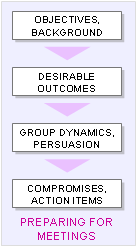 Meetings are important organizational tools. Whether as one-on-one conversations or as larger all-employee information sharing sessions, meetings are integral components of getting work done. Despite some obvious benefits, most meetings are not very productive and are longer than necessary. One of the primary reasons for the lower productivity of meetings is that attendees come unprepared.