• Skip to content
  • Skip to primary sidebar

Right Attitudes

Ideas for Impact

Mental Models

How to Process that Pile of Books You Can’t Seem to Finish [+ 5 Other Reading Hacks]

April 21, 2015 By Nagesh Belludi 1 Comment

If you’re an avid reader, you most likely have a stack of books you’ve started reading but never seem to complete. You may have the habit of eagerly devouring a book until another arrives. Consumed by enthusiasm, you start reading that new book and set the first aside. Continually finding more to read, this shortcoming repeats itself. Inevitably, you are left with a pile of books on your nightstand.

The following tips will help you read more than one book at a time, process a pile of books, and finish all the works you’ve ever wanted to read.

  1. Rotate your reading and stick to a pile before adding more books to your reading list. To process a pile of three to five books, use this disciplined system: when you’re in the mood to read, choose the book on top of your pile. Then, read it as long as you feel like reading it. When you’re done reading, don’t put back the book back on the top of your pile. Instead, put the book at the bottom of the pile. During your next reading session, pick up the second book, which is now at the top of the pile. Rotate your reading. In this way, you can progressively read every book and finish everything before taking on a new pile.
  2. Don’t add new books to your reading list until you’ve finished the texts at hand. As you process each group of books, don’t add anything to your reading list before you’ve finished everything in the existing pile. Focus on one pile of books at a time.
  3. You may not need to read every page or chapter to “read” a book. Pre-read a book by finding its summary on the Internet. Customer reviews on Amazon.com often have useful summaries or a list of significant ideas. To read a book quickly, first skim through its preface, table of contents, and index. Next, browse its substance by scanning section titles, subtitles and chapters, and by glossing over any pictures and illustrations. Read the first and last paragraphs of each chapter, and executive summaries. If you feel like reading any section of the book, read each paragraph’s first line to develop a conceptual understanding before reading the content more closely. Consider taking a speed-reading course to improve reading speed and comprehension.
  4. Give up if you find a volume uninteresting or unnecessary. You’re not obligated to finish a book just because you’ve committed to reading it.
  5. Choose books with a variety of topics, themes, or genres. The variety will keep your interest.
  6. Abraham Lincoln reading to his son Tadd at the White House Review what you’ve read. If you’re not sure which book to read next, instead of choosing from a wealth of new titles, consider rereading a book that you’ve previously read and found useful. A good book’s valuable concepts can’t be entirely absorbed with just one reading. As film critic Dana Stevens once wrote, “Going back to a book is a way of daring that past self to find new evidence for that old love.” Some books invite periodic perusing for further intellectual stimulation or for reinforcement of various insights. Moreover, it often takes multiple exposures to a useful concept for you to store it in your “little brain attic” (to borrow Sherlock Holmes’s term for mental models) and incorporate it in your behavior.

If you’re looking for something good to read, here’s a list of books I read in 2014 and recommended in an earlier article.

While we’re on the topic of reading, I recommend How to Read a Book, American educator Mortimer Adler’s classic guide to intelligent reading.

Wondering what to read next?

  1. A Guide to Intelligent Reading // Book Summary of Mortimer Adler’s ‘How to Read a Book’
  2. How to Read Faster and Better
  3. How to … Read More Books
  4. Rip and Read During Little Pockets of Time
  5. How to Read the AP Stylebook

Filed Under: Mental Models, Sharpening Your Skills Tagged With: Books, Reading

Creativity by Synthesis (Combining Ideas): A Case Study on the Darwin & Mendel Theorems in Biology

April 14, 2015 By Nagesh Belludi Leave a Comment

One of the fascinating aspects of invention is tracking the continuity of ideas across an arc of time and tracing the progression of ideas over time. My previous article examined how blending antecedent ideas to form new ones led to the invention of the Gutenberg’s press, the rotary steam engine, and the Wright Brothers‘ first powered flight. In this article, we will explore a related mental model for creativity.

A fundamental component of creative thinking is combining whole ideas (or just certain elements of ideas) to create a new concept. When we synthesize—i.e. fuse ideas to forge new ones—we mirror the footsteps of some of humankind’s most imaginative breakthroughs.

James Maxwell’s work on electromagnetic radiation developed from the synthesis of seemingly unrelated concepts such as electricity, magnetism, light, and motion. His theory of electromagnetism was one of the most significant discoveries of the nineteenth century. Albert Einstein described Maxwell’s work on electromagnetism as “the most profound and the most fruitful that physics has experienced since the time of Newton.”

Even more profoundly, Darwin and Mendel’s work exemplifies the most groundbreaking synthesis of ideas. Combined more than four decades after their deaths, their ideas shaped the foundation of life sciences, as we know it. Allow me to elaborate.

Theory of the Descent of Man - Darwin's Theories of Evolution

Charles Darwin’s Theory of Evolution

The word “evolution” was first used in English as early as 1647. Long before that, pre-Socratic Greek philosopher Anaximander (611–546 B.C.E) speculated that humans must have evolved from an animal and that this evolution must have sprung from the sea. By the end of the 18th century, naturalists conjectured that different life forms develop progressively from more primitive forms. They also hypothesized that all life forms were interrelated. Erasmus Darwin (1731–1802,) Charles Darwin’s grandfather and a natural philosopher and physiologist, as well as the French naturalist Jean-Baptiste Lamarck (1744–1829) argued along those lines. However, most of their thoughts on evolution and the relatedness of all life forms were purely speculative.

'The Origin of Species' by Charles Darwin (ISBN 0451529065) Darwin’s most notable scientific contribution was his vast body of evidence supporting the aforementioned hypotheses. Even more significantly, Darwin identified natural selection as the mechanism that determines evolutionary change. In his seminal treatise, “Origin of Species” (1859,) Darwin distilled the theory of evolution through two foundational concepts:

  1. In any ecosystem, individuals of the same species are likely to differ in their measurable characteristics. Such variations tend to be inherited.
  2. Living beings—plants and animals—reproduce more quickly than nature can impart the resources for their survival. Individuals of a species must therefore compete in order to live and reproduce in a competitive ecosystem.

Charles Darwin’s work on evolution was really a synthesis of concepts from comparative anatomy, paleontology, geology, geography, and animal breeding.

Advancing his theories further, in “The Descent of Man” (1871,) Darwin described humans as an outcome of evolution. Humans have the same general anatomical and physiological principles as animals and are in fact an advanced animal form whose superior traits are a consequence of evolutionary progression. Darwin hypothesized that humans share a common ancestry with animals, more specifically evolving from primates.

The Big Gap in Darwin’s Theory: Lack of an Explanation for Heredity

'The Descent Of Man' by Charles Darwin (ISBN 1463645961) In the introduction to The Descent of Man, Darwin wrote, “It has often and confidently been asserted, that man’s origin can never be known: but ignorance more frequently begets confidence than does knowledge: it is those who know little, and not those who know much, who so positively assert that this or that problem will never be solved by science.”

Darwin’s theories about the evolution of humankind created an instant uproar among advocates of Christian theology and its concept of a wise, benevolent, and omnipotent Creator as laid out in the Book of Genesis. Since then, few scientific theories have been as hotly debated among nonscientists as evolution and its opponent, creationism (and recently, intelligent design.)

After The Descent of Man, it was more than a decade before Darwin’s work came to be scientifically established. Darwin’s work remained deficient—if natural selection was to have lasting effects, these advances had to be conserved and passed on from one generation to the next. He agreed with scientists who argued that his evolutionary theory failed to explain how variations are transmitted from parents to their offspring.

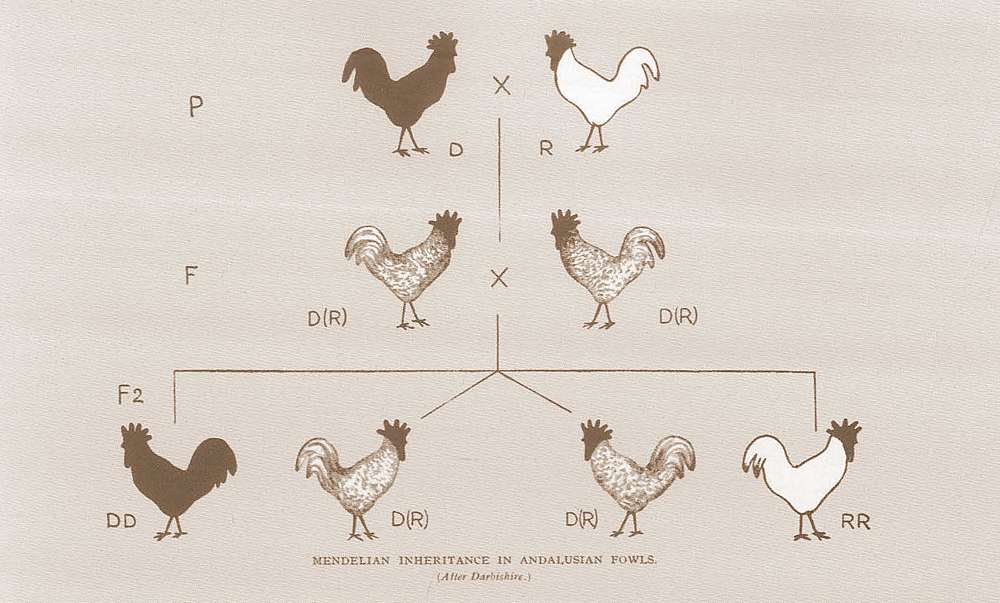
Mendelian Inheritance in Andalusian Fowls - Cross-breeding Experiments by Gregor Mendel

Cross-breeding Experiments by Gregor Mendel: Evidence of Heredity

Between 1856 and 1863, independent of Charles Darwin (1809–1882,) Moravian monk Gregor Mendel (1822–1884) conducted extensive pea plant breeding experiments in his monastery’s garden. He systematically studied what farmers had known for centuries: that crossbreeding animals and plants creates “hybrid” offspring with desirable traits. Based on his pea plant experiments, Mendel laid the foundational rules of genetic inheritance and heredity.

Synthesis of Darwin and Mendel’s Work as the Foundation of Life Sciences

It was not until the 1930s, long after both Darwin and Mendel’s deaths, that biologists started to study Mendel’s work on heredity in conjunction with Darwin’s theory of natural selection. Scientists were then able to understand how variation of characteristics is passed on to new generations and how evolution is a process of descent with modification. Mendel’s laws provided justification of inheritance, thereby completing Darwin’s theory of natural selection. Subsequently, Darwin’s theory became the basic mechanism of evolution—evolutionary genetics was established as biology’s central theorem and the bedrock concept of all life sciences. From that point on, Darwin became one of the most influential persons in human history.

Scientists continue to fine-tune humankind’s understanding of evolutionary biology as new evidence and fresh insights pour in from biochemistry, genetics, archaeology, neuroscience, and various other disciplines.

Wondering what to read next?

  1. What James Watt and the Steam Engine Teach You about Creativity and Invention
  2. You Can’t Develop Solutions Unless You Realize You Got Problems: Problem Finding is an Undervalued Skill
  3. How to Examine a Process and Ask the Right Questions
  4. Good Questions Encourage Creative Thinking
  5. Four Ideas for Business Improvement Ideas

Filed Under: Mental Models, Sharpening Your Skills Tagged With: Creativity, Scientists, Thought Process

Creativity by Blending Ideas to Form New Ones: A Case Study of Gutenberg and the Printing Press

February 24, 2015 By Nagesh Belludi Leave a Comment


Ideas Evolve over Time by Blending with Other Ideas

One of the fascinating aspects of invention is tracking the continuity of ideas across an arc of time. Through education, exposure, and experimentation, people’s creative thoughts can stretch both temporally and across various disciplines of knowledge.

When people develop a new idea, they often share it with others, who may then use this idea to expand their own understanding of concepts, invent even fresher ideas, and spread them. Ideas thus evolve over time.

Building on Antecedent Inventions

Considering the collaborative nature of idea formation, every new idea is arguably a conceptual sum of its predecessors. The power of blending ideas to form new ones is shown in that most seminal inventions are based on antecedents—inventions that came before them. For instance,

  • James Watt’s “invention” of the steam engine (or, more precisely, his invention of the separate-condenser steam engine) was in fact an attempt to modify Thomas Newcomen’s steam engine. Newcomen’s work was itself based on Thomas Savery’s invention of a steam-powered pump to extract water from mine-shifts. Later, James Watt adapted his separate-condenser to produce continuous rotary motion and expanded its use far beyond pumping water. Continuous rotary motion sparked the transition from hand-production methods to machine-power and became the driving force of the Industrial Revolution.
  • The Wright brothers’ first heavier-than-air powered flight was the culmination of their experience with bicycles. This first flight demonstrated their ability to improve prior inventions by applying previously-reached solutions to controlled flight issues. [See my previous article on how the Wright brothers argued and developed their ideas.] Within fifty years of the Wright brothers’ first successful airplane, humankind’s concept of distance had changed dramatically: aircrafts could fly across continents in hours—sometimes faster than sound. Just a short time later, aircrafts were traveling into space.
  • British Mathematician Andrew Wiles’ much-celebrated proof of Pierre de Fermat’s Last Theorem was based on the work of some of the greatest mathematical minds who, over three centuries, had also puzzled over Fermat’s Last Theorem. Contemporaries Gerhard Frey, Jean-Pierre Serre, and Ken Ribet also influenced Wiles’ work. Until Wiles’ success in the mid-nineties, the theorem remained inaccessible to proof for 358 years. In the 1840s, German mathematician Richard Dedekind attempted to solve the theorem and in so doing, laid the foundations of algebraic number theory.

Idea for Impact: Creativity is accessible through the often-subconscious process of blending what you already know to form new ideas.

Gutenberg's Invention of Mechanized Printing: Blend of coin punch and mechanized wine press

Case Study: Gutenberg’s Invention of Mechanized Printing

In the 15th century, Johannes Gutenberg invented mechanized movable-type printing. His invention revolutionized the dissemination of knowledge throughout the Western World and played a pivotal role in the development of the Renaissance, the Protestant Reformation, the Age of Enlightenment, and the Scientific Revolution.

The earliest forms of printing evolved from letter and coin punches, which were in vogue even in the Neolithic era. Woodblock printing was fashionable in East Asia since the second century. At least two centuries prior to Gutenberg’s invention, manual block printing with movable type had existed. However, this technique was hardly known in Europe, where all manuscripts were laboriously copied out by hand or stamped out with woodblocks before Gutenberg’s invention.

Gutenberg blended the flexibility of a coin punch with the power of a mechanized wine press to invent mechanized printing. For each character to be printed, Gutenberg used his skills as a goldsmith to cast individual pieces of metal type. These pieces could be quickly assembled into blocks depending on the composition of characters on a page.

Gutenberg’s mechanized press was an adaptation of the wine press, a historical contraption used to crush grapes and extract their juice for winemaking. Gutenberg’s press consisted of a fixed lower bed and movable upper platen containing composed type blocks. The platen was inked, covered with a sheet of paper, and pressed by a small bar on a worm screw. Pressing the upper and lower surfaces together formed a vise and left a sharp impression of inked characters on the paper.

The hand-operated Gutenberg press was further mechanized in the 19th century. Engineers introduced James Watt’s invention of the double-acting rotary steam engine to create steam-powered rotary presses, altogether creating industrialized bulk printing.

Wondering what to read next?

  1. How to Examine a Process and Ask the Right Questions
  2. The Myth of the First-Mover Advantage
  3. Good Questions Encourage Creative Thinking
  4. The Power of Counterintuitive Thinking
  5. Four Ideas for Business Improvement Ideas

Filed Under: Mental Models, Sharpening Your Skills Tagged With: Creativity, Thought Process

To Make an Effective Argument, Explain Your Opponent’s Perspective

December 12, 2008 By Nagesh Belludi Leave a Comment

“The man who can hold forth on every matter under debate in two contradictory ways of pleading, or can argue for and against every proposition that can be laid down – such a man is the true, the complete, and the only orator.”
– Cicero

“If you can’t imagine how anyone could hold the view you are attacking, you just don’t understand it yet.”
– Anthony Weston, ‘Rulebook for Arguments’

Explaining the Other Side of the Argument

Entrepreneur and blogger Ben Casnocha presents an effective discussion / debating / interviewing technique:

Here is one of the simplest ways to test someone’s knowledge of an issue: ask them to explain the other side of the argument. Ask the person who’s in favor of spending more money on marketing project X to explain the thinking process behind those who oppose the budgetary move.

I have yet to find a more efficient and reliable way to probe the depths of a person’s knowledge and seriousness about an issue than asking them to explain the other side’s perspective.

How can you effectively argue for your side if you don’t understand the arguments of the other?

Never Limit Your Ability to Learn From Opposite Perspectives

Never Limit Your Ability to Learn From Opposite Perspectives Habitually, we discard contrasting opinions without making an effort to explore their significance. We shape our attitudes and seek facts to support our own beliefs without contemplating the merits of opposite perspectives. We fail to realize that, when we do not understand opposite perspectives enough to justify their merits, we almost certainly do not understand them enough to dismiss them either.

Develop the curiosity to see the world from new perspectives and discover opposite circumstances, whether you believe in them or not. If you follow faith X, attend services of faith Y; if you are conservative, explain the liberal outlook; if you hold the western philosophy on a particular subject, reason the eastern viewpoint; if you oppose a particular legislation, argue the merits of legislation. Instead of asking ‘ why ,’ ask ‘why not .’

When you pause arguing with an opposite perspective and try arguing for it, when you switch your point of view briefly, you will witness a profound shift in your thinking.

  • Your own attitudes may look different when seen from the opposite perspective. It can help you reinforce your own beliefs and attitudes. This approach may open your mind to discover the merits, similarities, and weaknesses of your arguments that may not be obvious from your own side of the board.
  • People are often glad to work with anyone who is accommodating and tries to understand their perspectives. Therefore, your ability to persuade others improves.

Wondering what to read next?

  1. How to Gain Empathic Insight during a Conflict
  2. How to Argue like the Wright Brothers
  3. Rapoport’s Rules to Criticize Someone Constructively
  4. Presenting Facts Can Sometimes Backfire
  5. Don’t Ignore the Counterevidence

Filed Under: Effective Communication, Mental Models, Sharpening Your Skills Tagged With: Conflict, Conversations, Critical Thinking, Getting Along, Persuasion, Thinking Tools, Thought Process

How to Examine a Process and Ask the Right Questions

September 29, 2007 By Nagesh Belludi 2 Comments

Method Study and Critical Examination

Method study is a practice of examining methods of doing work: work-flows, processes, etc. The key component of method study is ‘critical examination.’ Author Michael Armstrong describes critical examination in his ‘Handbook of Management Techniques.’

Critical examination uses the questioning approach to find out what, how, when, where and, most importantly, why and activity is carried out, and who does it. From this analysis, two fundamental questions are posed: (1) Does the activity need to be done at all? If so, (2) Are there any better ways of doing it?

The questioning approach for critical examination is described in the following chart. This chart is also available as a hand-out (PDF download) for quick reference.

Questioning Approach Critical Examination

Call for Action

A great degree of professional work–in engineering, management, finances, and other functions of the modern corporation–involves analysis of products, procedures and systems. Here, thought-processes involve asking, and seeking answers to, a series of questions.

In my role as an engineer and manager, I carry the above chart of questions to meetings and brainstorming sessions. The chart helps me ask the right questions on the intent of a process or system and gain a big-picture perspective for my work or task at hand.

Download the critical examination handout, post it at your cubicle and refer to the chart for help on asking the right questions.

Wondering what to read next?

  1. The Solution to a Problem Often Depends on How You State It
  2. What the Rise of AI Demands: Teaching the Thinking That Thinks About Thinking
  3. Good Questions Encourage Creative Thinking
  4. You Never Know What’ll Spark Your Imagination (and When)
  5. Creativity by Synthesis (Combining Ideas): A Case Study on the Darwin & Mendel Theorems in Biology

Filed Under: Mental Models, Sharpening Your Skills Tagged With: Creativity, Questioning, Thought Process

« Previous Page

Primary Sidebar

Popular Now

Anxiety Assertiveness Attitudes Balance Biases Coaching Conflict Conversations Creativity Critical Thinking Decision-Making Discipline Emotions Entrepreneurs Ethics Etiquette Feedback Getting Along Getting Things Done Goals Great Manager Innovation Leadership Leadership Lessons Likeability Mental Models Mindfulness Motivation Parables Performance Management Persuasion Philosophy Problem Solving Procrastination Psychology Relationships Simple Living Social Skills Stress Suffering Thinking Tools Thought Process Time Management Winning on the Job Wisdom

About: Nagesh Belludi [hire] is a St. Petersburg, Florida-based freethinker, investor, and leadership coach. He specializes in helping executives and companies ensure that the overall quality of their decision-making benefits isn’t compromised by a lack of a big-picture understanding.

Get Updates

Signup for emails

Subscribe via RSS

Contact Nagesh Belludi

RECOMMENDED BOOK:
The Power of a Positive No

The Power of a Positive No: William Ury

Harvard's negotiation professor William Ury details a simple, yet effective three-step technique for saying 'No' decisively and successfully, without destroying relationships.

Explore

  • Announcements
  • Belief and Spirituality
  • Business Stories
  • Career Development
  • Effective Communication
  • Great Personalities
  • Health and Well-being
  • Ideas and Insights
  • Inspirational Quotations
  • Leadership
  • Leadership Reading
  • Leading Teams
  • Living the Good Life
  • Managing Business Functions
  • Managing People
  • MBA in a Nutshell
  • Mental Models
  • News Analysis
  • Personal Finance
  • Podcasts
  • Project Management
  • Proverbs & Maxims
  • Sharpening Your Skills
  • The Great Innovators

Recently,

  • The Akbar-Birbal Parable of the Pulling of the Emperor’s Beard Is a Master Class in Critical Thinking
  • Inspirational Quotations #1159
  • Shed Your Past
  • Your Brain Is Lying to You. Here’s How to Catch It.
  • How to Ask for a Raise—and Negotiate in a Way That Commands Respect
  • Inspirational Quotations #1158
  • There’s a Time for Everything

Unless otherwise stated in the individual document, the works above are © Nagesh Belludi under a Creative Commons BY-NC-ND license. You may quote, copy and share them freely, as long as you link back to RightAttitudes.com, don't make money with them, and don't modify the content. Enjoy!