 Few phrases in the sales playbook are as overused and quietly harmful as “going after the low-hanging fruit.” It promises quick wins, fast cash flow, and a morale boost. In the short term, it delivers. These easy deals validate a pitch, energize a team, and keep the lights on. When immediacy becomes a guiding belief, the damage begins.
The problem isn’t the fruit itself. It’s the fixation. A sales team addicted to speed risks becoming a parody of its own purpose. It chases volume over value and responds to demand instead of shaping it. The deals come fast, but they lack depth. Customers become transactional, loyal only to the lowest bidder. Revenue rises and then stalls. What looks like momentum is often churn in disguise.
The same holds true for ideas and opportunities.
What the low-hanging fruit mindset compromises most is your people. Skill depth begins to thin. Curiosity fades. The stamina needed to handle layered challenges and the vision required to shape change gradually diminishes. Progress shifts into performance—routine, not resilient.
There’s also a built-in expiration date. Once the orchard of obvious opportunities is picked clean, what remains are the nuanced paths and long-term plays. These require patience, insight, and a different kind of strength. Without the muscle to pursue them, the journey falters.
Plans start centering around what’s easy, rather than what’s essential. Strategy narrows into short-term cycles. Big-picture thinking gives way to checking boxes. When we overlook deeper opportunities, we lose sight of what’s possible.
Idea for Impact: Prospect ideas with purpose. Start with what’s within reach, but don’t let it define your ceiling. Use low-hanging fruit to gain momentum. Then channel that energy toward richer, less obvious opportunities. This is where growth lives. Here, legacy takes shape. And in the stretch beyond ease, intention transforms into impact.
 Ever stepped into the shower and suddenly cracked a lingering problem wide open? You turn on the water, and just like that, the perfect idea rushes in. That’s your subconscious at work, making
  Performance proves you belong. But it doesn’t earn influence, open strategic doors, or attract sponsorship. Those privileges follow likeability—not charm, not flattery, but emotional fluency grounded in trust.
.jpg "'The Charisma Myth' by Olivia Fox Cabane (ISBN 1591845947)")

 The
The 
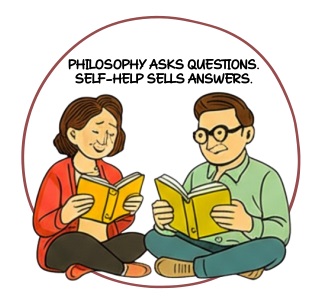 Self-help and philosophy both claim to enhance life, but they approach the task from opposite ends. Self-help assumes you know what you want—success, happiness, confidence—and hands you the tools to get there. Philosophy asks whether those goals are worth wanting in the first place.
 Consider the Ritz-Carlton. Every employee—from housekeeper to concierge—is authorized to spend up to $2,000 per guest, per incident, without managerial approval, to
  Life is not a cradle of comfort but a crucible of experience. To be conscious is to be vulnerable—to injury, to loss, to the slow erosion of certainty. Suffering is not a glitch in the system; it is the system. And yet, the modern mind, coddled by convenience and narcotized by distraction, recoils from this fact as if it were an indecency rather than a reality.