Today marks the birthday of Maya Angelou (1928-2014.) Born Marguerite Ann Johnson, the renowned African-American author adopted an extraordinary range of roles: she was a poet, memoirist, singer, dancer, playwright, director, actor, and even a civil rights activist.
Through all of these lenses, Angelou inspired generations of fans. She enthusiastically shared the great wisdom she acquired from many hardships, including an abusive childhood, the oppressive 1930s Deep South, and various experiences during her early adulthood.
Angelou famously channeled this hard-won wisdom through writing. Her seven autobiographies, three collections of essays and books of poetry chronicle the African American experience. Here are four must-reads from the late American author and poet:
.jpg "'I Know Why the Caged Bird Sings' by Maya Angelou (ISBN 0345514408)") “I Know Why the Caged Bird Sings” (1969,) Angelou’s first autobiography, particularly garnered critical acclaim and international recognition. This work tells her life story of suffering and human endurance up until her teenage years and paints a stirring portrait of a young Angelou. Sent away by her parents to live with grandparents, Angelou faces and overcomes racism and deprivation. She is raped by her mother’s lover, who is later murdered. After his death, Angelou withdraws into herself, taking on a nearly mute state for the next 5 years. Later, with a mentor’s guidance, she develops a passion for books and finds her own voice. Throughout the piece, Angelou steadily gains strength of character, transforms into a dignified young woman, and is even appointed as San Francisco’s first African-American and first woman streetcar conductor. At the conclusion of this moving coming-of-age story, Angelou becomes a 16-year-old mother.
“I Know Why the Caged Bird Sings” (1969,) Angelou’s first autobiography, particularly garnered critical acclaim and international recognition. This work tells her life story of suffering and human endurance up until her teenage years and paints a stirring portrait of a young Angelou. Sent away by her parents to live with grandparents, Angelou faces and overcomes racism and deprivation. She is raped by her mother’s lover, who is later murdered. After his death, Angelou withdraws into herself, taking on a nearly mute state for the next 5 years. Later, with a mentor’s guidance, she develops a passion for books and finds her own voice. Throughout the piece, Angelou steadily gains strength of character, transforms into a dignified young woman, and is even appointed as San Francisco’s first African-American and first woman streetcar conductor. At the conclusion of this moving coming-of-age story, Angelou becomes a 16-year-old mother.- “And Still I Rise” (1978,) Angelou’s third volume of poetry, contains her iconic titular poem. “Still I Rise” provides rousing commentary on her ancestors’ struggles and expresses hope for a better future. The poem concludes, “I am the dream and the hope of the slave … I rise … I rise … I rise.” In 1994, Nelson Mandela recited this poem at his inauguration as President of South Africa.
- “The Heart of a Woman” (1981,) Angelou’s fourth autobiographical installment, recounts the years between 1957 and 1962, during which she was politically active in the civil rights movement and travelled the world. The book reflects on the meaning and enormous responsibilities of motherhood as well as Angelou’s relationship with her teenage son, who, at the book’s end, leaves for college.
- “On the Pulse of Morning” (1993.) In January 1993, at Bill Clinton’s first inauguration, Angelou once again made history. She became the second poet, the first African-American, and the first woman to recite a poem at a presidential inauguration. Angelou wrote and recited the poem “On the Pulse of Morning” to emphasize unity, social change, and public responsibility.
Inspirational Quotations by Maya Angelou
Each person deserves a day away in which no problems are confronted, no solutions searched for.
—Maya Angelou (American Poet)
The desire to reach the stars is ambitious. The desire to reach hearts is wise and most possible.
—Maya Angelou (American Poet)
We may encounter many defeats but we must not be defeated.
—Maya Angelou (American Poet)
Courage is the most important of all the virtues … One isn’t necessarily born with courage, but one is born with potential. Without courage, we cannot practice any other virtue with consistency. We can’t be kind, true, merciful, generous, or honest.
—Maya Angelou (American Poet)
If we lose love and self respect for each other, this is how we finally die.
—Maya Angelou (American Poet)
No sun outlasts its sunset but will rise again and bring the dawn.
—Maya Angelou (American Poet)
The first time someone shows you who they are, believe them.
—Maya Angelou (American Poet)
Love recognizes no barriers. It jumps hurdles, leaps fences, penetrates walls to arrive at its destination full of hope.
—Maya Angelou (American Poet)
There’s a world of difference between truth and facts. Facts can obscure the truth.
—Maya Angelou (American Poet)
History, despite its wrenching pain, cannot be unlived, but if faced with courage, need not be lived again.
—Maya Angelou (American Poet)
Try to be a rainbow in someone’s cloud.
—Maya Angelou (American Poet)
I’ve learned that people will forget what you said, people will forget what you did, but people will never forget how you made them feel.
—Maya Angelou (American Poet)
A woman who is convinced that she deserves to accept only the best, challenges herself to give the best. Then she is living phenomenally.
—Maya Angelou (American Poet)
Children’s talent to endure stems from their ignorance of alternatives.
—Maya Angelou (American Poet)
I am overwhelmed by the grace and persistence of my people.
—Maya Angelou (American Poet)
Ask For What You Want And Be Prepared To Get It.
—Maya Angelou (American Poet)
It is the belief in a power larger than myself and other than myself which allows me to venture into the unknown and even the unknowable.
—Maya Angelou (American Poet)
I’ve learned that you can tell a lot about a person by the way (s)he handles these three things: a rainy day, lost luggage, and tangled Christmas tree lights.
—Maya Angelou (American Poet)
My great hope is to laugh as much as I cry; to get my work done and try to love somebody and have the courage to accept the love in return.
—Maya Angelou (American Poet)
Love is like a virus. It can happen to anybody at any time.
—Maya Angelou (American Poet)
Live life as if it were created just for you.
—Maya Angelou (American Poet)
Life loves to be taken by the lapel and told: “I’m with you kid. Let’s go.”
—Maya Angelou (American Poet)
Never make someone a priority when all you are to them is an option.
—Maya Angelou (American Poet)
You may not control all the events that happen to you, but you can decide not to be reduced by them.
—Maya Angelou (American Poet)
I’ve learned that you shouldn’t go through life with a catchers mitt on both hands. You need to be able to throw something back.
—Maya Angelou (American Poet)
I love to see a young girl go out and grab the world by the lapels. Life’s a bitch. You’ve got to go out and kick ass.
—Maya Angelou (American Poet)
Bitterness is like cancer. It eats upon the host. But anger is like fire. It burns it all clean.
—Maya Angelou (American Poet)
Stepping onto a brand-new path is difficult, but not more difficult than remaining in a situation, which is not nurturing to the whole woman.
—Maya Angelou (American Poet)
We allow our ignorance to prevail upon us and make us think we can survive alone, alone in patches, alone in groups, alone in races, even alone in genders.
—Maya Angelou (American Poet)
If you don’t like something, change it. If you can’t change it, change your attitude. Don’t complain.
—Maya Angelou (American Poet)
It’s one of the greatest gifts you can give yourself, to forgive. Forgive everybody.
—Maya Angelou (American Poet)
There is a very fine line between loving life and being greedy for it.
—Maya Angelou (American Poet)
We delight in the beauty of the butterfly, but rarely admit the changes it has gone through to achieve that beauty.
—Maya Angelou (American Poet)
You are the sum total of everything you’ve ever seen, heard, eaten, smelled, been told, forgot – it’s all there. Everything influences each of us, and because of that I try to make sure that my experiences are positive.
—Maya Angelou (American Poet)
Jealousy in romance is like salt in food. A little can enhance the savor, but too much can spoil the pleasure and, under certain circumstances, can be life-threatening.
—Maya Angelou (American Poet)
I do not trust people who don’t love themselves and yet tell me, “I love you.” There is an African saying which is: “Be careful when a naked person offers you a shirt.”
—Maya Angelou (American Poet)
If one is lucky, a solitary fantasy can totally transform one million realities.
—Maya Angelou (American Poet)
Nothing can dim the light which shines from within.
—Maya Angelou (American Poet)
My mission in life is not merely to survive, but to thrive; and to do so with some passion, some compassion, some humor, and some style.
—Maya Angelou (American Poet)
There is no greater agony than bearing an untold story inside you.
—Maya Angelou (American Poet)
No matter what happens, or how bad it seems today, life does go on, and it will be better tomorrow.
—Maya Angelou (American Poet)
Nothing will work unless you do.
—Maya Angelou (American Poet)
The most called-upon prerequisite of a friend is an accessible ear.
—Maya Angelou (American Poet)
The love of the family, the love of the person can heal. It heals the scars left by a larger society. A massive, powerful society.
—Maya Angelou (American Poet)
Something made greater by ourselves and in turn that makes us greater.
—Maya Angelou (American Poet)
When an interviewer asked Angelou in 1985 what she’d like to read in her own obituary, Angelou replied, “What I would really like said about me is that I dared to love. By love, I mean that condition in the human spirit so profound it encourages us to develop courage and build bridges, and then to trust those bridges and cross the bridges in attempts to reach other human beings.”
“Caged Bird”—A Poem by Maya Angelou
.jpg "'Conversations with Maya Angelou' by Jeffrey M. Elliot (ISBN 087805362X)") Here is a snippet of Maya Angelou’s poem “Caged Bird” from the collection “Shaker, Why Don’t You Sing?”
Here is a snippet of Maya Angelou’s poem “Caged Bird” from the collection “Shaker, Why Don’t You Sing?”
The free bird thinks of another breeze
and the trade winds soft through the sighing trees
and the fat worms waiting on a dawn bright lawn
and he names the sky his ownBut a caged bird stands on the grave of dreams
his shadow shouts on a nightmare scream
his wings are clipped and his feet are tied
so he opens his throat to sing.The caged bird sings
with a fearful trill
of things unknown
but longed for still
and his tune is heard
on the distant hill
for the caged bird
sings of freedom.

.jpg "'Ever Yours: The Essential Letters' by Vincent van Gogh (ISBN 0300209479)")
 Vincent embarked upon his artistic career at the somewhat advanced age of 27. According to


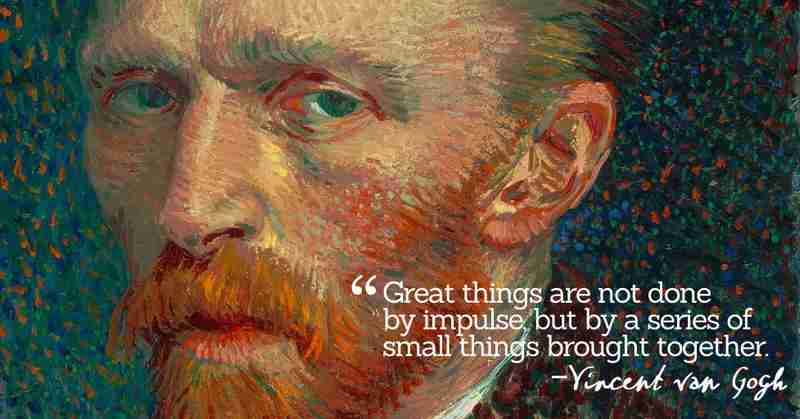
 Vincent was raised in a religious and cultured atmosphere. Growing up, he possessed a difficult temper and lacked self-confidence. All through youth, Vincent struggled to find his place in the world. This was a precursor to his life-long struggle to find meaning and establish some kind of harmonious relationship with the outer world.
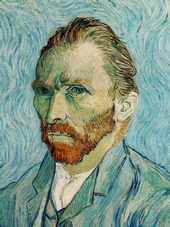 For the next nine years, with Theo’s financial and emotional support, Vincent traveled around Europe teaching himself to draw and paint. He struggled financially and even starved sometimes after spending the entire stipend that Theo sent him on art supplies rather than on the necessities of living. After a great deal of meticulous experimentation and assiduous practice, Vincent developed his artistic expertise to a level where he could execute art swiftly.
.jpg "'Sam Walton: Made In America' by Sam Walton (ISBN 0553562835)")