• Skip to content
  • Skip to primary sidebar

Right Attitudes

Ideas for Impact

Nagesh Belludi

How to Network

March 16, 2007 By Nagesh Belludi 1 Comment

Developing a network of business and social contacts is vital for personal and professional success. In our professional lives, our network can facilitate us secure a job, seek advice on job opportunities and work problems, get support, and ensure career progress. Statistics have shown that about three out of four United States-executives that earn more than $100,000 annually got their jobs through networking.

Steve Fishman on how to network

‘Leadership’ by William Safire and Leonard Safir attributes the following five steps for networking to an author by name Steve Fishman. My research has indicated that this is an excerpt from a ’80s issue of the ‘Success’ magazine.

  • Meet as many people as you can.
  • When you meet someone, tell him what you do. Networking is low-cost advertising.
  • Don’t do business while networking. Make a date to meet your contact for drinks or lunch.
  • Give and get. You can’t always be a buyer. Do favors. They’re like a savings account!
  • Make friends even when you don’t need them.

Call for action

Tending to our business and social network is not time-consuming as some of us might expect. Through our daily interactions, we are developing our network at all times. We never know with whom we could strike up an important conversation. Therefore, quite often, networking involves just being open to interacting with new people and staying in touch with people we already know.

Use Steve Fishman’s five guidelines to build your network. Develop a few one-minute statements that can help you introduce yourself to people you may meet. Spend a few minutes every day to call people you already know. Reach out, connect, stay in touch and develop your network. How can you help people in your network? How can you be of value to them?

Wondering what to read next?

  1. Who Told You That Everybody Was Going to Like You?
  2. How to Reduce Thanksgiving Stress
  3. How to Get Good Advice and Use It Effectively
  4. Save Yourself from Email Overload by Checking Email Just Three Times a Day
  5. The Curse of Teamwork: Groupthink

Filed Under: Sharpening Your Skills Tagged With: Networking

Inspirational Quotations #160

March 11, 2007 By Nagesh Belludi Leave a Comment

Beauty is power; a smile is its sword.
—Charles Reade

Little drops of water, little grains of sand,|Make the mighty ocean, and the pleasant land:|So the little minutes, humble though they be,|Make the mighty ages of eternity.|Little deeds of kindness, little words of love,|Help to make earth happy, like Heaven above.
—Julia Abigail Fletcher Carney (American Educator)

It is a waste of energy to be angry with a man who behaves badly, just as it is to be angry with a car that won’t go.
—Bertrand A. Russell (British Philosopher)

Don’t let life discourage you; everyone who got where he is had to begin where he was.
—Richard L. Evans (American Mormon Religions Leader)

Intensity coupled with commitment is magnetic.
—Warren Bennis (American Scholar)

For those who believe, no proof is necessary. For those who don’t believe, no proof is possible.
—Unknown

It’s good to have money and the things that money can buy, but it’s good, too, to check once in awhile and make sure that you haven’t lost the things that money can’t buy.
—George Horace Lorimer (American Editor)

The person who figures out how to harness the collective genius of his or her organization is going to blow the competition away.
—Walter Wriston

When you love someone all your saved-up wishes start coming out.
—Elizabeth Bowen (Irish Novelist)

Filed Under: Inspirational Quotations

General Electric’s Jack Welch on Acting Quickly

March 9, 2007 By Nagesh Belludi Leave a Comment

General Electric's Jack Welch on Acting Quickly

Jack Welch was the Chairman and CEO of General Electric (GE) from 1981 to 2001. During Welch’s twenty-year tenure, GE grew into one of the largest and most admired companies in the world. Jack Welch is widely recognized as one of the greatest business leaders of our time. In 1999, Fortune magazine named him the ‘Manager of the Century.’

In an interview with Spencer Stuart executive headhunters Thomas Neff and James Citrin for the book “Lessons from the Top”, Jack Welch regrets not taking action quickly during his tenure at General Electric.

I think the biggest mistake I made is a fundamental one. I went too slow in everything I did. … If I had done in two years what took five, we would have been ahead of the curve even more.

You rarely do things too fast. If you think about your life and the decisions you’ve made, you can’t come up with too many where you said, “I wish I took another year to do it.” But you can sure come up with a list where you say, “I wish I had done a bunch of things six months earlier.”

Call for Action

Procrastinators sabotage themselves. However, procrastination is a learned behavior and therefore can be unlearned.

In all spheres of life, competition has transitioned from “big-eat-small” to “fast-eat-slow.” Good ideas are relatively easy to come up with. However, quick and efficient execution is primary to the success of these ideas. When a hundred people probably have the same idea, execution in a fast timeframe is just about the only thing that matters.

Are you holding back on your ideas? Do the tasks look daunting? Do you lack confidence? Are you uncertain of the direction or afraid of failure? How can you overcome these hesitations? Develop a set of ideas to reach your goals, prioritize them, and commence working on your ideas right away. Why delay?

Wondering what to read next?

  1. Book Summary: Jack Welch, ‘The’ Man Who Broke Capitalism?
  2. Innovation Without Borders: Shatter the ‘Not Invented Here’ Mindset
  3. The Checkered Legacy of Jack Welch, Captain of Quarterly Capitalism
  4. General Electric Blame Must Be Shared: Summary of Ex-CEO Jeff Immelt’s ‘Hot Seat’
  5. Big Shifts Start Small—One Change at a Time

Filed Under: Sharpening Your Skills, The Great Innovators Tagged With: Change Management, Decision-Making, General Electric, Jack Welch, Leadership Lessons, Procrastination

Seven Habits to Beat Monday Morning Blues

March 5, 2007 By Nagesh Belludi 5 Comments

Ring. Ringggg. RRRRRRING. It is 6:30 on a Monday morning. Your alarm clock goes off. You can’t bear the thought of getting out of bed and going to work. You suddenly remember that you promised your boss an important status report by noon and realize you are yet to begin a test to gather data for the report. Perhaps, you partied all weekend with family and friends, and dread going back to your uncooperative co-workers and a cold boss. You wish you could stay at home and escape from your commitments. You push the snooze button yet again as you cover yourself with your blanket.

Does the above experience sound familiar? If it does, you probably suffer from Monday morning blues. In other words, it sounds like you have the “Case of the Mondays,” to borrow a phrase from the movie ‘Office Space.’

Mondays are a bit of a drag for many of us. We feel our weekends are inadequate to accomplish everything that we want to—we tend to over-plan and underachieve. We wish we had relaxed more, completed more errands and spent more time with family and friends. When we return to work on Monday, we are hung-over from the out-of-work rhythm of the weekend.

Here are seven habits to beat Monday morning blues.

Habit 1: Prepare for Your Weekend

  • Plan all your weekend activities after consulting family and friends. Be realistic in what you can achieve; do not over-plan.
  • Before leaving work on Friday evening, clean and organize your desk and prepare a to-do list for Monday morning.

Habit 2: Have an Organized Weekend

  • Enjoy a stress-free, relaxed Sunday by planning entertainment and fun activities for Sunday. Spend time with family and friends–go shopping or walking or take your children to the science museum. Or, just be lazy. Focus on recreation on Sunday.
  • Complete your home projects and errands on Saturday. This will enable you to unwind on Sunday, before you start your workweek. Instead, if you relax on Saturday, you will realize on Sunday morning that you will need to complete all your household tasks by Sunday night. You will then hurry through Sunday and feel tired by Sunday night: you will not feel well rested on Monday morning.

Habit 3: Maintain a Regular Sleep Pattern

  • During the weekend, we tend to go to bed late and wake-up late because we are not required to be at work by 8:00am on Saturday or Sunday. With our sleep out-of-rhythm during the weekend, we find it difficult to wake-up promptly on Monday morning. Maintain your wake-up time on Saturday and Sunday mornings. If you desire to ‘catch-up with sleep,’ get to bed earlier on Friday and Saturday.
  • Try not to nap on Sunday afternoon—you will be able to get into sleep early on Sunday night and prevent drowsiness on Monday afternoon.

Habit 4: Prepare on Sunday Night

  • Pack your bags, prepare your clothes and setup the breakfast table on Sunday night. If you brought work home, pack-up and organize your workbag. You will not feel hurried or leave important papers at home on Monday morning.
  • If possible, review your agenda for the rest of the week and your to-do list for Monday morning. Reviewing your commitments will make you more conscious of your plans for the week ahead.

Habit 5: Relax as you Prepare on Monday Morning

  • Go to bed early on Sunday night and wake-up early on Monday morning. You will be able to relax as you wake-up, get prepared and have your breakfast.
  • Start from home early. Beat the traffic and listen to good music during your drive to work. By coming to work early, you can concentrate and get high-priority work done with fewer interruptions or before your co-workers stop-by your cubicle to discuss their weekends and developments from across the world.

Habit 6: Choose Work You Enjoy for Monday Morning

  • Having a productive start-of-week is critical to having a great week ahead. If you prepare your to-do list on Friday evening, you can start working as soon as you reach your desk on Monday morning. Firstly, choose the kind of work you enjoy doing for Monday morning. For example, if you like preparing illustrations, work on a presentation of your new proposal for the project workflow.
  • Secondly, avoid negative interactions that may make you feel glum at the start of the workweek. For example, avoid meeting people who may have counterarguments on your project plans or avoid working on emails or memos with arguments against your idea. Experiencing positive interactions will make you feel good about yourself and your work.

Habit 7: Organize the Rest of the Workweek

  • If possible, do not have important deadlines or schedule update meetings early in the week. If you have a major project deadline on Tuesday or need to meet your boss on Monday afternoons to discuss test results, you may not feel relaxed during the weekend. On Sunday, you will be concerned about how you will prepare for these commitments. Instead, schedule important meetings for the later part of the week. You will feel good: you have the early part of the week to prepare and you can enjoy the weekend with a sense of accomplishment.
  • Plan for fun on Monday evenings: plan on watching a movie or eating-out or taking a walk along the beach on Monday evening. You will have something to look forward to throughout the day on Monday.
  • Take a mini-break during midweek. See my earlier blog article on taking Wednesday afternoon time-offs: leave early on Wednesday and do something out-of-your-routine and relax.

Concluding Thoughts

The key to beating Monday morning blues is organizing your work for maximum leisure during the weekend. By following the above seven habits, you will enjoy relaxed weekends and prepare yourself for a week of action when your alarm clock goes-off on Monday mornings.

Wondering what to read next?

  1. Yes, Money Can Buy Happiness
  2. How to … Nap at Work without Sleeping
  3. How to Avoid the Sunday Night Blues
  4. The Simple Life, The Good Life // Book Summary of Greg McKeown’s ‘Essentialism’
  5. Five Simple Changes That Can Save You the Most Time

Filed Under: Sharpening Your Skills Tagged With: Balance, Lifehacks, Productivity, Time Management

Inspirational Quotations #159

March 4, 2007 By Nagesh Belludi Leave a Comment

Man is a rational animal—so at least I have been told. Throughout a long life, I have looked diligently for evidence in favor of this statement, but so far I have not had the good fortune to come across it, though I have searched in many countries spread over three continents.
—Bertrand A. Russell (British Philosopher)

What does not kill me makes me stronger.
—Friedrich Nietzsche (German Philosopher, Scholar)

The best thing about the future is that it comes only one day at a time.
—Abraham Lincoln (American Head of State)

We swallow greedily any lie that flatters us, but we sip only little by little at a truth we find bitter.
—Denis Diderot (French Philosopher)

The most important thing in communication is to hear what isn’t being said.
—Peter Drucker (Austrian-born Management Consultant)

The greatest mistake you can make in life is to be continually fearing you will make one.
—Elbert Hubbard (American Writer)

Happiness is not achieved by the conscious pursuit of happiness; it is generally the byproduct of other activities.
—Aldous Huxley (English Humanist)

My main job was developing talent. I was a gardener providing water and other nourishment to our top 750 people. Of course, I had to pull out some weeds, too.
—Jack Welch (American Businessperson)

In peace, love tunes the shepherd’s reed; in war, he mounts the warrior’s steed; in halls, in gay attire is seen; in hamlets, dances on the green. Love rules the court, the camp, the grove, and men below, and saints above; for love is heaven, and heaven is love.
—Walter Scott (Scottish Novelist)

One ought to look a good deal at oneself before thinking of condemning others.
—Moliere (French Playwright)

Not a day passes over the earth but men and women of no note do great deeds, speak great words, and suffer noble sorrows. Of these obscure heroes, philosophers, and martyrs the greater part will never be known till that hour when many that were great shall be small, and the small great.
—Charles Reade

Filed Under: Inspirational Quotations

How to Conduct Reference Checks

March 3, 2007 By Nagesh Belludi Leave a Comment

Following a job interview, many managers do not feel comfortable extending an offer to a candidate of choice without talking to the candidate’s references. Conducting reference checks is indispensable to validate perceptions of the candidate from an hour-long interview and to discover minutiae that may not be evident from the candidate’s resume or interview. Hence, talking to references gives the manager a distinct perspective of people who may have observed the candidate at his/her work.

Candidates often list as references only individuals who will present upbeat reviews. Further, many references hesitate to provide precise information on the candidate to minimise legal risk (defamation, privacy, etc.) Consequently, some organisations believe that talking to references hardly ever has value. Despite the bias, however, references frequently drop inferences or provide details that may point to important clues to the candidate’s credentials or personality.

Conducting a Reference Check

Ask the candidate for professional references and obtain his/her permission to contact former employers. Setup a twenty to thirty minute telephone meeting with the reference. At the appointed hour, describe the background of the discussion to the reference, inform that the information he/she will provide is valuable and guarantee confidentiality. Consider questions such as the following.

  • “What was your relationship with the candidate? Did you supervise him/her? How frequently did you interact with him/her?”
  • “What kind of supervision did the candidate expect? Did he/she learn quickly? Was he/she open to feedback and change?”
  • “What were the candidate’s strengths and weaknesses? How would you compare him/her to his/her peers?”
  • “Was he/she good at working with people, negotiating, etc.?” Pick a few important professional traits that you believe are critical for success in the position for which you are considering the candidate.
  • “Would you hire (or rehire) the candidate for a similar position in your company?”

Important Guidelines

  • When the references state general observations such as “Sujay is creative” or “Smitha is a good communicator,” ask for specific examples.
  • Try to read between the lines. Be careful of potential misinterpretations; ask for further details and clarify your understanding of the reference’s information.
  • Check independent references, wherever possible. Talk to a friend or people within your network who may know the candidate.

Obtaining meaningful data from reference checks and interpreting this information in the context of the rest of the interviewing process helps managers make objective decisions on job candidates.

Wondering what to read next?

  1. Interviewing Candidates: Stale Questions Get Stale Answers
  2. On Recruiting from a Competitor
  3. Books in Brief: The Power of Introverts
  4. Don’t Use Personality Assessments to Sort the Talented from the Less Talented
  5. How to Hire People Who Are Smarter Than You Are

Filed Under: Managing People Tagged With: Hiring

On the Use of ‘But’ in Interpersonal Feedback

February 28, 2007 By Nagesh Belludi 1 Comment

Dale Carnegie's classic, How to Win Friends and Influence PeopleDale Carnegie’s classic, “How to Win Friends and Influence People,” is one of the most popular self-help books ever written. The book was first published in 1936 and has since sold millions of copies worldwide. In all my personality development seminars, I recommend this book as a must-read for improving interpersonal dynamics. Here is a detailed summary of the book.

Dale Carnegie on the Choice of Words in Giving Feedback

Many people begin their criticism with sincere praise followed by the word ‘but’ and ending with a critical statement. For example, in trying to change a child’s careless attitude toward studies, we might say, “We’re really proud of you, Johnnie, for raising your grades this term. But if you had worked harder on your algebra, the results would have been better.”

In this case, Johnnie might feel encouraged until he heard the word ‘but.’ He might then question the sincerity of the original praise. To him, the praise seemed only to be a contrived lead-in to a critical inference of failure. Credibility would be strained, and we probably would not achieve our objectives of changing Johnnie’s attitude toward his studies.

This could be easily overcome by changing the word ‘but’ to ‘and.’ “We’re really proud of you, Johnnie, for raising your grades this term, and by continuing the same conscientious efforts next term, your algebra grade can be up with all the others.”

Now, Johnnie would accept the praise because there was no follow-up of an inference of failure. We have called his attention to the behavior we wished to change indirectly and the chances are he will try to live up to our expectations.

Call for Action

Giving interpersonal feedback and facilitating change is a critical people-skill. Prior to delivering feedback, we rarely plan exactly what we want to say and how we want to say. The words we choose to use are important.

Observe how you deliver feedback. Use the “You are good and if you improve at this skill, you will be better” structure for effective feedback.

Wondering what to read next?

  1. How to Give A Compliment Sandwich Feedback
  2. Never Skip Those 1-1 Meetings
  3. Employee Surveys: Perceptions Apart
  4. How to … Lead Without Driving Everyone Mad
  5. To Micromanage or Not?

Filed Under: Managing People Tagged With: Conversations, Feedback

Inspirational Quotations #158

February 26, 2007 By Nagesh Belludi Leave a Comment

Thinking is the hardest work there is, which is probably the reason why so few engage in it.
—Henry Ford (American Businessperson)

Nothing is a waste of time if you use the experience wisely.
—Auguste Rodin (French Sculptor)

I will not follow where the path may lead, but I will go where there is no path, and I will leave a trail.
—Muriel Strode (American Author, Businesswoman)

If there is one thing upon this earth that mankind loves and admires better than another, it is a brave man, it is the man who dares to look the devil in the face and tell him he is a devil.
—James A. Garfield (American Head of State)

Don’t worry about people stealing your ideas. If your ideas are any good, you’ll have to ram them down people’s throats.
—Howard H. Aiken (American Physicist)

Life is about not knowing, having to change, taking the moment and making the best of it, without knowing what’s going to happen next. Delicious ambiguity.
—Gilda Radner

I just want to leave a committed life behind.
—Martin Luther King, Jr. (American Civil Rights Leader)

The fastest way to succeed is to look as if you’re playing by other people’s rules, while quietly playing by your own.
—Michael Korda

Filed Under: Inspirational Quotations

Presentation Tips #3: Compressing Photos in PowerPoint

February 21, 2007 By Nagesh Belludi Leave a Comment

Suppose you are preparing a PowerPoint presentation with pictures from prototype testing of a design or pictures from your vacation. When you insert pictures into the PowerPoint file, you may realize that the file’s size will balloon with addition of each picture. You may end-up with a large PowerPoint file that may perhaps be difficult to distribute or email.

The reason for larger PowerPoint files is twofold. Firstly, Microsoft PowerPoint may not store picture data in an optimum format. Secondly, while today’s digital cameras can capture pictures at high resolutions (between three to five megapixels per picture,) on-screen display requires pictures of just 96 DPI (dots per inch) resolutions. In addition, typical office-document printing requires pictures of no more than 200 to 300 DPI resolutions.

The more-recent versions of Microsoft PowerPoint facilitate compressing pictures easily to create smaller files.

Compressing Photos in PowerPoint

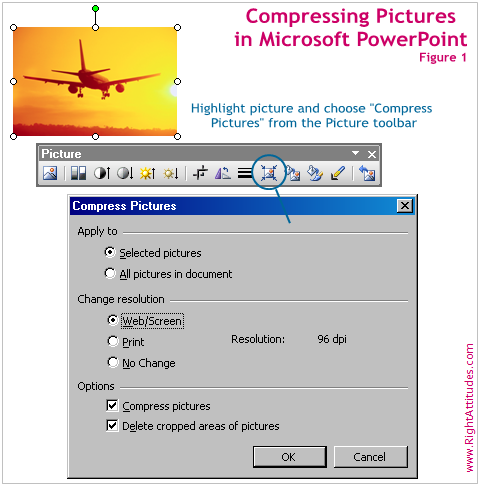
If you desire to compress a single picture or a group of pictures, highlight the pictures. The Picture toolbar will appear, as illustrated in Figure 1. Now, choose “Compress Pictures” from the Picture toolbar. In the resulting dialogue box, make appropriate selections to execute the command.

Compressing Photos in PowerPoint

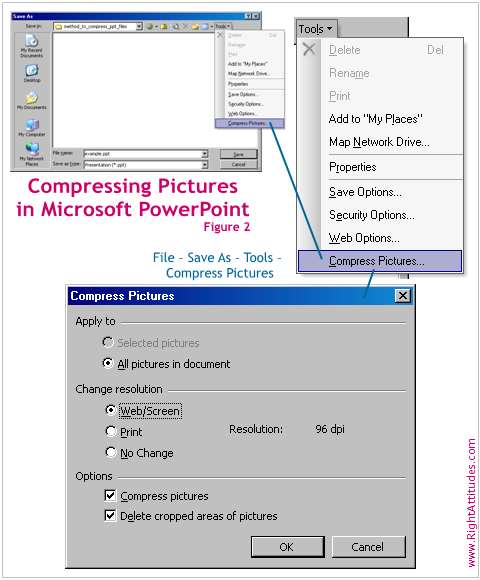
If you desire to compress all the pictures in your PowerPoint file, an easier approach involves the “Save As” dialogue. From the menu bar, choose “File” – “Save As … .” In the resulting dialogue box, open the “Tools” dropdown and choose the “Compress Pictures” command, as illustrated in Figure 2.

Wondering what to read next?

  1. An Essential Secret of Great Speakers: Pauses in Talking
  2. [Presentation Skills #5] Effective Fonts for Presentations
  3. Why Amazon Banned PowerPoint
  4. Lessons from Procter & Gamble: ‘One-Page Memo’ to Sell an Idea
  5. Say It Straight: Why Clarity Beats Precision in Everyday Conversation

Filed Under: Effective Communication Tagged With: Presentations

Inspirational Quotations #157

February 20, 2007 By Nagesh Belludi Leave a Comment

Enthusiasm is one of the most powerful engines of success. When you do a thing, do it with all your might. Put your whole soul into it. Stamp it with your own personality. Be active, be energetic, be enthusiastic and faithful, and you will accomplish your object. Nothing great was ever achieved without enthusiasm.
—Ralph Waldo Emerson (American Philosopher)

The joys we expect are not so bright, nor the troubles so dark as we fancy they will be.
—Charles Reade

“I am alone and helpless. I am old and destite”. Such thoughts do not worry a lion even in its dreams.
—Subhashita Manjari

The sages do not consider that making no mistakes is a blessing. They believe, rather, that the great virtue of man lies in his ability to correct his mistakes and continually make a new man of himself.
—Wang Yangming

Experience teaches only the teachable.
—Aldous Huxley (English Humanist)

Let your enthusiasm radiate in your voice, your actions, your facial expressions, your personality, the words you use, and the thoughts you think! Nothing great was ever achieved without enthusiasm.
—Ralph Waldo Emerson (American Philosopher)

It is what you do from now on that will either move our civilization forward a few tiny steps, or else… begin to march us steadily backward.
—Patrick Stewart

Take a chance! All life is a chance. The man who goes the furthest is generally the one who is willing to do and dare. The “sure thing” boat never gets far from shore.
—Dale Carnegie (American Author)

Shoot for the moon. Even if you miss it, you will land among the stars.
—Les Brown

There are souls in this world which have the gift of finding joy everywhere and of leaving it behind them when they go.
—Frederick William Faber (British Hymn writer)

Filed Under: Inspirational Quotations

« Previous Page
Next Page »

Primary Sidebar

Popular Now

Anxiety Assertiveness Attitudes Balance Biases Coaching Conflict Conversations Creativity Critical Thinking Decision-Making Discipline Emotions Entrepreneurs Ethics Etiquette Feedback Getting Along Getting Things Done Goals Great Manager Innovation Leadership Leadership Lessons Likeability Mental Models Mindfulness Motivation Parables Performance Management Persuasion Philosophy Problem Solving Procrastination Psychology Relationships Simple Living Social Skills Stress Suffering Thinking Tools Thought Process Time Management Winning on the Job Wisdom

About: Nagesh Belludi [hire] is a St. Petersburg, Florida-based freethinker, investor, and leadership coach. He specializes in helping executives and companies ensure that the overall quality of their decision-making benefits isn’t compromised by a lack of a big-picture understanding.

Get Updates

Signup for emails

Subscribe via RSS

Contact Nagesh Belludi

RECOMMENDED BOOK:
On Writing Well

On Writing Well: William Zinsser

Journalist William Zinsser's bestselling manual has inspired generations of writers to perfect their skills in introducing clarity and brevity, and presenting their unique voice into prose.

Explore

  • Announcements
  • Belief and Spirituality
  • Business Stories
  • Career Development
  • Effective Communication
  • Great Personalities
  • Health and Well-being
  • Ideas and Insights
  • Inspirational Quotations
  • Leadership
  • Leadership Reading
  • Leading Teams
  • Living the Good Life
  • Managing Business Functions
  • Managing People
  • MBA in a Nutshell
  • Mental Models
  • News Analysis
  • Personal Finance
  • Podcasts
  • Project Management
  • Proverbs & Maxims
  • Sharpening Your Skills
  • The Great Innovators

Recently,

  • The Fallacy of Outsourced Sin: The Cow Paradox in India
  • Inspirational Quotations #1151
  • Don’t Ruin Your Brilliant Idea by Talking About It
  • Gandhi’s Wheel, Apple’s Spin: The Paradox of Apple’s ‘Think Different’ Campaign
  • Book Summary: Hadley Freeman’s ‘Life Moves Pretty Fast’—How ’80s Movies Wrote America’s Story
  • Inspirational Quotations #1150
  • Corporate Boardrooms: The Governance Problem Everyone Knows and Nobody Fixes

Unless otherwise stated in the individual document, the works above are © Nagesh Belludi under a Creative Commons BY-NC-ND license. You may quote, copy and share them freely, as long as you link back to RightAttitudes.com, don't make money with them, and don't modify the content. Enjoy!