• Skip to content
  • Skip to primary sidebar

Right Attitudes

Ideas for Impact

Nagesh Belludi

Resumé Tips #6: Avoid Clichéd Superlatives and Proclamations

November 11, 2008 By Nagesh Belludi Leave a Comment

Self-Declarations on Résumés

Consider the following assertions from résumés that I reviewed recently:

  • “Ambitious, career oriented, uniquely qualified, results-driven professional with outstanding academic preparation and exceptional industrial experience in applied research and design.”
  • “Extremely strong, aggressive, self-sufficient writer with excellent technical skills and ability to learn new technologies quickly.”

The trouble with these statements is that they amount to unoriginal self-declarations. It is as though these candidates put on a crown and proclaimed themselves the kings and queens of the land of have-everything-an-employer-needs-skills. Most candidates do not realize such jargon can, in fact, be a turn-off.

Show than Tell
Avoid clichéd superlatives and proclamations on résumés A résumé is, in essence, a documentation of your achievements and recognitions. Your résumé should not explicitly declare such characteristics as hard-working, entrepreneurial, self-starting, etc. Instead, your résumé should describe your accomplishments in such a way that a reader infers these skills in you.

Admittedly, describing your accomplishments to imply you are a “hard worker,” “self-starter,” or “team player” is difficult.

  • To present yourself as “hard-working,” describe your part-time employment, serving as captain of the soccer team, leading a student club. Mention your high GPA and academic projects.
  • To present yourself as “results-driven,” show how your projects contributed to your organization’s goals and bottom line: include phrases like, “saved 10% costs,” or “improved capacity by 18%,” etc.

Avoid proclamations, jargon and clichéd superlatives. Write your résumé to include more than a mere assemblage of personal particulars. Help the reader connect to you through your résumé and get a picture of your personality, unique skills and characteristics.
Wondering what to read next?

  1. Resumé Tips #1: Best Fonts and Text Size for Your Resumé
  2. Resumé Tips #2: The One-page Résumé Rule
  3. Resumé Tips #3: References Not Necessary
  4. Resumé Tips #4: The Hurry-Burry Résumé
  5. Resumé Tips #5: Résumé or Curriculum Vitae?

Filed Under: Career Development Tagged With: Resumé

Inspirational Quotations #246

November 9, 2008 By Nagesh Belludi Leave a Comment

Hard work performed in a disciplined manner will in most cases keep the worker fit and also prolong his life.
—Mokshagundam Visvesvaraya (Indian Engineer)

To avoid criticism, do nothing, say nothing, be nothing.
—Elbert Hubbard (American Writer)

Love is life. And if you miss love, you miss life.
—Leo Buscaglia (American Motivational Speaker)

‘If something’s free, I’ll take two,’ a mentor of mine once said. His point was that people don’t value things they don’t pay for.
—Edwin Feulner (American Economist)

A great mentor is one who aims for others’ abilities to surpass his own.
—Unknown

We reap what we sow. We are the makers of our own fate. None else has the blame, none has the praise.
—Swami Vivekananda (Indian Hindu Mystic)

A journey of a thousand miles starts with a single step.
—Laozi (Chinese Philosopher)

Leadership is the art of getting someone else to do something you want done because he wants to do it.
—Dwight D. Eisenhower (American Head of State)

Throughout his life, a wise man engages in practice of all his useful, rarely used skills, many of them outside his discipline, as a sort of duty to his better self. If he reduces the number of skills he practices and, therefore, the number of skills he retains, he will naturally drift into error from man with a hammer tendency. … Skills of a very high order can be maintained only with daily practice.
—Charlie Munger

A cheerful thought in you produces cheerful thoughts in others. You are filled with joy and intense delight when you see a batch of hilarious children playing mirthfully and dancing in joy.
—Sivananda Saraswati

Be prepared to take some shit in life; just do not take more than a mouthful at a time.
—Movie: Forrest Gump

Filed Under: Inspirational Quotations

Identify and Eliminate Passive Voice in Microsoft Word

November 5, 2008 By Nagesh Belludi 4 Comments

A previous article had promoted the use of active voice for persuasive communications. To summarize, sentences in passive voice (e.g., “Your feedback is appreciated,”) though grammatically correct, seem impersonal and obscure the responsibility of actions or feelings they convey. Sentences in active voice (e.g., ” I appreciate your feedback”) are simple, direct, persuasive, and easier to understand. See full article here.

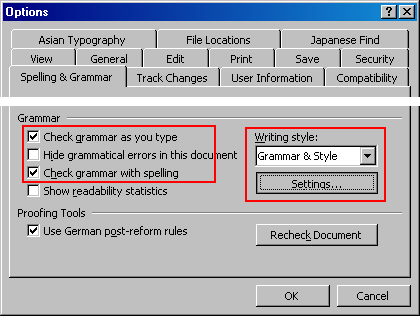
You can use the ‘Grammar Check’ feature in MS-Word to identify and eliminate passive voice. To activate the check for passive voice, follow these three steps.

Identify and Eliminate Passive Voice in Microsoft Word

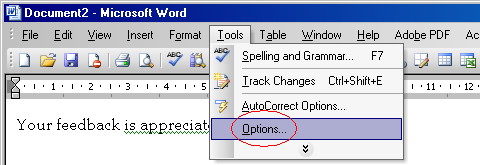
Step 1: Select ‘Tools’ from the ‘Options’ menu

Identify and Eliminate Passive Voice in Microsoft Word

Step 2: In the ‘Spelling & Grammar’ tab of the Options dialog box, enable the ‘Check grammar as you type’ and ‘Check grammar with spelling’ options. Select ‘Grammar & Style’ from the ‘Writing style’ drop down and click on the ‘Settings’ button.

Identify and Eliminate Passive Voice in Microsoft Word

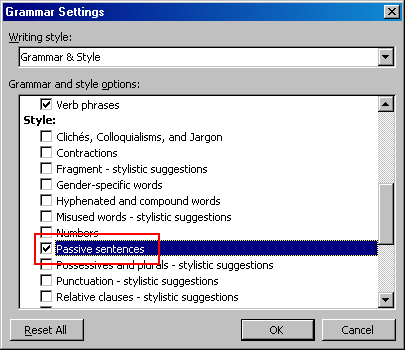
Step 3: In the ‘Grammar Settings’ dialog box, enable the ‘Passive sentences’ under the ‘Style’ category. ‘OK’ and close all the dialog boxes.

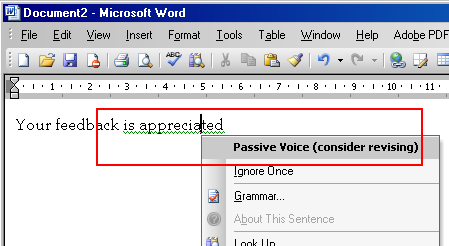
Once you configure the check for passive sentences, MS-Word will squiggly-underline (in green color) most instances of passive sentences as illustrated below, just like it does squiggly-underline (in red color) spelling mistakes.

Identify and Eliminate Passive Voice in Microsoft Word

Clarity and ease-of-comprehension are two of the most important requisites to effective communication. Active voice can facilitate effective communication.

Filed Under: Effective Communication

Inspirational Quotations #245

November 2, 2008 By Nagesh Belludi Leave a Comment

The best of a book is not the thought which it contains, but the thought which it suggests; just as the charm of music dwells not in the tones but in the echoes of our hearts.
—Oliver Wendell Holmes, Sr. (American Physician)

Men must be taught as if you taught them not, And things unknown propos’d as things forgot.
—Alexander Pope (English Poet)

Meditation consists in conducting consciousness beyond the point where it is the consciousness of a finite body or a finite mind, transferring the focus from level to level without losing its continuity or form.
—Vilayat Inayat Khan (British Sufi Mystic)

Difficulties are meant to rouse, not discourage. The human spirit is to grow strong by conflict.
—William Ellery Channing

It was much later that I realized Dad’s secret. He gained respect by giving it. He talked and listened to the fourth-grade kids in Spring Valley who shined shoes the same way he talked and listened to a bishop or a college president. He was seriously interested in who you were and what you had to say.
—Sara Lawrence-Lightfoot (American Sociologist)

To be yourself is an achievement in itself.
—Anonymous

Concern over criticism clogs creativity.
—Duane Alan Hahn

The tragedy of life is not that man loses,
but that he almost wins.
—Heywood Hale Broun (American Journalist)

Leaders establish the vision for the future and set the strategy for getting there; they cause change. They motivate and inspire others to go in the right direction and they, along with everyone else, sacrifice to get there.
—John Kotter (American Academic)

Before you can inspire with emotion, you must be swamped with it yourself. Before you can move their tears, your own must flow. To convince them, you must yourself believe.
—Winston Churchill (British Head of State)

Filed Under: Inspirational Quotations

Fight Clutter and Simplify Life

October 28, 2008 By Nagesh Belludi Leave a Comment

Classic Clutter-Busting Strategies

This ‘Unclutterer’ blog article lists essential strategies to get and stay organized. Below is an abridgment; see full article here.

  1. A place for everything, and everything in its place. If an object doesn’t have an official home, then it will always be out of place. Once you’re finished using an object, immediately put it back in its place.
  2. Establish routines. Set up a regular schedule for tasks that have to be completed daily and weekly: laundry, cleaning, cooking, organizing, filing, home and auto maintenance, etc. The more methodical you are, the simpler it is to maintain your home and office.
  3. If you don’t use it, need it, love it, or feel inspired by it, get rid of it. Just because you might have space to store something, doesn’t mean you have to keep it. Your home and office should be filled with useful and inspiring things, not objects that cause you stress and anger. Plus, the less you own, the less you have to worry about, clean, organize, finance, and maintain.

Call for Action

One of the primary drivers of the feeling of not being on “top of things” is disorder and clutter. Given our busy lives, we tend to let things get out of hand. This can frequently lead to a chronic preoccupation over the lack of orderliness in our lives.

Set aside some time, perhaps just 30 minutes, and

  • Eliminate. Toss out things you have not used in the last two years. If you are not using something on a regular basis, you probably do not need it. Consider donating to charity or let somebody else have things you do not need.
  • Organize. After eliminating unneeded and unwanted things, store articles close to where you use them. Consider investing in filing cabinets, cupboards or storage boxes.
  • Simplify. One of the biggest hindrances to “getting things done” is complexity and redundancy. In today’s consumer driven societies, we tend to buy things we don’t need or, worse, things we already have and cannot remember. Use common sense to prioritize what you will own and what you will do and fight complexity.

Control your ‘stuff’—do not let them control you.

Wondering what to read next?

  1. A Key to Changing Your Perfectionist Mindset
  2. In Imperfection, the True Magic of the Holidays Shines
  3. The Liberating Power of Embracing a Cluttered Space
  4. Dear Hoarder, Learn to Let Go
  5. Thinking Straight in the Age of Overload // Book Summary of Daniel Levitin’s ‘The Organized Mind’

Filed Under: Sharpening Your Skills Tagged With: Clutter, Simple Living, Stress, Tardiness

Inspirational Quotations #244

October 26, 2008 By Nagesh Belludi Leave a Comment

The fraction of life can be increased in value not so much by increasing your numerator as by lessening your denominator. Nay, unless my algebra deceives me, unity itself divided by zero will give infinity.
—Thomas Carlyle (Scottish Writer)

Men are like pillow-cases. The colour of one may be red, that of another blue, and that of the third black; but all contain the same cotton within. So it is with man; one is beautiful, another is ugly, a third holy , and a fourth wicked; but the Divine Being dwells in them all.
—Ramakrishna Paramahamsa (Indian Hindu Philosopher)

Wisely and slow;—they stumble that run fast.
—William Shakespeare (British Playwright)

Life is not holding a good hand; life is playing a poor hand well.
—Danish Proverb

Hold yourself responsible for a higher standard than anybody else expects of you. Never excuse yourself. Never pity yourself. Be a hard master to yourself—and be lenient to everybody else.
—Henry Ward Beecher (American Protestant Clergyman)

An expert is a person who has found out by his own painful experience all the mistakes that one can make in a very narrow field.
—Niels Bohr (Danish Physicist)

Life is the only real counselor; wisdom unfiltered through personal experience does not become a part of the moral tissue.
—Edith Wharton

An expert is a person who has found out by his own painful experience all the mistakes that one can make in a very narrow field.
—Niels Bohr (Danish Physicist)

It is a miracle that curiosity survives formal education.
—Albert Einstein (German-born Theoretical Physicist)

Charity sees the need, not the cause.
—German Proverb

It is the nature of man to rise to greatness if greatness is expected of him.
—John Steinbeck (American Novelist)

Filed Under: Inspirational Quotations

[Time Management #4] Budgeting Your Time by Your Priorities

October 23, 2008 By Nagesh Belludi 2 Comments

Preamble

This article is the final article in a series of four articles that presents the basics of diagnosing how you tend to spend your time and how you can develop the discipline of spending your time on what really matters to you. Here is a synopsis of the preceding three articles.

  1. The first article established that effective time management is truly not about managing time as such; rather, it is about managing priorities. See full article here.
  2. The second article outlined a simple exercise to help you track how you use your hours and minutes during a suitably long period of time, ideally a whole week. See full article here.
  3. Yesterday’s article described three steps to tally up your time logs, analyze how you actually use your time, and recognize non-productive tasks and activities. See full article here.

Today’s closing article details a simple process to list your life’s values and priorities and create a time budget to help you center your actions on the truly important aspects of your life and career.

Define Your Values and Priorities

A great deal of anxiety and stress in your life is largely from doing things that are inconsistent with what you believe and what you know you should be doing. Your lack of control over your time stems from doing things that are incoherent with your core values and priorities in life and career.

Matching your actions to the truly important aspects of your life will help you be more focused, more disciplined and more effective. With this objective, spend about 15 minutes to reflect on your life and career, clarify your short- and long-term goals and discover your overriding priorities.

Identify Your Priorities in Life

  1. With the help of your spouse or significant other, catalog the core values that you hold dear—the guiding principles of your life. Include personal characteristics, traits and achievements you desire to realize in the short-term and the long-term. Your list many include family, career success, well-being and happiness, prestige, wealth, sense of community or anything else that you feel is important.
  2. Rank your values and goals. Sort your list in order of their importance to you. Begin with most important value or goal and end with the least important. Judge between conflicting values to help you commit to ideas and activities that are truly important. Condense your list to 7 to 10 priorities.
  3. Rewrite your priorities in terms of actions and achievements that would satisfy each priority or the associated value. Consider the following example.

Example 1: Top Three Priorities of Linda, a Housewife

The previous article on time analysis featured Linda, a housewife who works part-time. Consider this list of her top three priorities in life.

  1. Husband and daughter. “Love and care for my husband. Support his career and goals. Nurture our daughter and give her the best upbringing.”
  2. Family and friends. “Provide for my aging parents. Support my entrepreneur-brother. Spend more time with dear friends.”
  3. Part-time work. “Learn and contribute in my profession as an accountant. Supplement family income.”

Identify Your Priorities at Work

Your desire to be productive at work should begin with understanding your most important tasks in terms of what your role demands of you.

  1. Collect your job description, your boss’s and your employees’ job descriptions, your organization’s objectives, any metrics that you report on a regular basis, your recent performance reviews, and your documented career plan. Review these documents.
  2. List and rank your priorities. What does your role require of you? What goals have your boss and your organization set for you? What are your key projects and initiatives? How your organizational objectives direct impact your own work? Do not list any more than three major priorities (priorities that require 25% of your time or more) and two minor, comparatively less-significant priorities.

Example 2: Top Priorities of Kumar, a Middle-Level Manager

The previous article on time analysis featured Kumar, a middle-level manager at an aerospace company. Kumar aspires to reorganize his time, adopt productive means to get his work completed by working no more than 45-48 hours per week. Consider the following list of his projects, in order.

  1. Project A
  2. Project B
  3. Coaching and developing team members
  4. Initiative M
  5. Project C

Realize How Your Current Actions and Priorities are Incoherent

The root of the feeling of being under constant time pressure is the disparity between your actions and priorities. You tend to take advantage of almost every opportunity that comes your way, irrespective of the significance of these opportunities in relation to your core values.

Compare your time log and time analysis report with your list of priorities and decide objectively how much time each of your activities was worth to you in contrast to the time you actually spent on it. You may realize that, perhaps, 80% – 90% of your time is wasted in non-effective activities.

As you review your time analysis report, think about everything that you do that should not be done at all or should not be done by you and recognize all the non-productive, wasteful activities. You will realize that you have been spending time instead of investing time in what really matters.

Resolve to eliminate all activities and commitments that are not aligned to your priorities. For example, Linda—the housewife referred above—spent six hours each week volunteering on the curriculum committee at her daughter’s school “just to be involved.” She realized the lack of value in spending six hours every week on an activity she did not contribute much and decided to withdraw from the committee. Kumar, the middle-level manager, spent way too much time attending meetings. He decided to attend only the most important meetings where his presence was truly required, participated via telephone wherever possible and spared 10 hours on his weekly calendar.

Prepare a Time Budget to Schedule Your Priorities

A time budget helps you decide how your hours should be used given the priorities you have identified for yourself. This is the first step in exercising more control over your time and your life. Preparing a time budget could be as simple as deciding how many hours you would devote to each of your priorities, or could be as complex as setting up your weekly calendar to reflect your priorities.

  1. Beginning with your top priority, setup appointments in your calendar and block-off as many hours of the week that are necessary for your priorities. If your most important priority in life is family (it should be,) first allot time for all the activities you desire to do or share your family—set aside time to coach your kids in basketball, set aside time to help your spouse with chores around the home, etc. At work, schedule time to work on your most important projects and initiatives.
  2. Locate your most important tasks hours when you tend to be most efficient. For example, if you tend to work best in the mornings, schedule your most important projects for the mornings.
  3. Schedule time for your minor projects and lower priorities around your major projects and higher priorities. Decide on the right time to do email, run errands, conduct regular staff meetings, etc.

Your time budget should essentially serve as a guide for how you will spend your time. As with a financial budget, you may not necessarily comply with your time budget. Nevertheless, it is important to prepare a time budget to help you direct how you should spend your time.

Your time budget will help you decide how you can live your priorities. You will realize that by complying with your time budget, your use of your personal time improves dramatically; you are able to focus and reduce anxiety.

Example 1: Time Budget for Linda, the Housewife

Linda prepared the following time budget to help her comply with her stated priorities in life. She eliminated or reduced activities that did not directly contribute to her priorities or were not as productive. For example, she

  • ‘found’ six hours by quitting from the curriculum committee at her daughter’s school
  • saved four hours by seeking her husband’s help to clean her home and hiring a landscaping service to tend to her yard.
  • reduced her time watching TV and on the internet.
  • ‘discovered’ more time for her family and friends, exercise and well-being.

Time budget example: mother with part-time work

Example 2: Time Budget for Kumar, the Middle-Level Manager

Kumar, who previously could not “get it all done” in over 65 hours each week at work, reorganized his calendar around his most important projects and prepared the following budget for 45-48 hours of productive work per week.

Time budget example: middle-level manager

Wrap-up: Managing Priorities (and Time) Effectively

This series of articles on the basics of time management described a simple and effective process of logging and analyzing how you use your time, and budgeting your time around your priorities. This process reveals time wastefulness and provides a structure to help you focus on your chosen priorities.

Your personal and professional values and priorities change often based on your progress in life and career. Plan to perform a detailed time analysis regularly—ideally once every six months,—monitor your time, review your priorities and adjust your time budget. Keep your focus on achieving the top priorities.

In sum, time management is, simply, an orderly discipline of controlling how you spend your most valuable resource. The singular purpose of this quest is to regulate the pace of life, reduce unwarranted stress, organize your actions and responsibilities according to the main values and priorities in your life, and realize a meaningful, purpose-driven life.

Wondering what to read next?

  1. To be More Productive, Try Doing Less
  2. Don’t Let the Latecomers Ruin Your Meeting
  3. Don’t Let Interruptions Hijack Your Day
  4. Don’t Ruminate Endlessly
  5. This Question Can Change Your Life

Filed Under: Sharpening Your Skills Tagged With: Discipline, Life Plan, Time Management

[Time Management #3] Analyzing How You Currently Use Your Time

October 22, 2008 By Nagesh Belludi Leave a Comment

Preamble

This article is the third in a series of four articles that presents the basics of diagnosing how you tend to spend your time and how you can develop the discipline of spending your time on what really matters to you.

  1. The first article established that effective time management is truly not about managing time as such; rather, it is about managing priorities. See full article here.
  2. Yesterday’s article outlined a simple exercise to help you track how you use your hours and minutes during a suitably long period of time, ideally a whole week. See full article here. Here is what your log should look like.

Log where time actually goes---Time Log Example

This article describes three simple steps to tally up your time logs, analyze how you actually use your time, and recognize non-productive tasks and activities.

Step 1: Tally up Time-Use by Purpose or Project

Following an entire week of logging your time in 10- or 15-minute intervals, spend an hour at the end of the week to compile your logs.

The third column in your time log chart had identified the purpose and project of each 10- or 15-minute interval. Consolidate these projects and purposes into meaningful categories, ideally 10-15 categories. Review each day’s time log chart and add the time spent in each category, calculate percent of total time, and tabulate the results as illustrated in the following two examples.

Example 1: Time Analysis for Linda, a Housewife & Part-time Worker

Below is the time analysis for an entire week (168 hours) for Linda, a housewife who works part-time as an accountant at a law firm. Linda feels that she does not spend enough time with her friends and family.

Time Analysis Example---Mother, Part-time Worker

Example 2: Time Analysis for Kumar, a Middle-Level Manager

Kumar, a middle-level manager at an aerospace company, feels he spends too much time at work and yet cannot “get it all done.” Below is the time analysis of his work week (67 hours.) Kumar aspires to reorganize his time, adopt productive means to get his work completed by working no more than 45-48 hours per week.

Time Analysis Example---Middle-Level Manager

Step 2: Examine Wastefulness

As you tally your time by categories, ascertain the time you spent unproductively. Understand all your non-productive, wasteful activities. Identify,

  1. Time spent doing things that do not directly contribute to your short- and long-term goals and, hence, should not be done at all.
  2. Time spent on activities that need a lot of work, but have very little return in comparison to other necessities. These are activities that may not make any difference if you eliminate them.
  3. Time spent doing others’ work—time spent doing things that could have been and should be done by someone else. For instance, the 1.5 hours that Kumar spent on booking tickets and accommodation for an upcoming trip could have been done by an administrative assistant.
  4. Time wasted in transitions—for instance, time wasted when waiting for an appointment with your dentist, time wasted for a meeting to start, time lost due to a computer crash.
  5. Time spent doing things that you could more productively by using the right tools, learning a new skill, changing a process (developing a standard system,) seeking somebody’s help, or using a new software program.
  6. Time wasted from being disorganized. Time wasted in figuring out what to work on, or time wasted by not collecting all the resources when they could have been collected earlier, for instance.
  7. Time spent handling interruptions and distractions, such as when colleagues stop-by your desk to discuss their weekends.
  8. Time spent fighting fires caused by your earlier inaction or careless work. And, time spent doing things that could have been avoided had you taken the appropriate actions earlier.
  9. Time spent doing things that were probably better suited for other parts of the day. For example, checking email first thing in the mornings when you, like the majority of people, tend to be most efficient.

After taking into account time wasted, the remainder of time on your time logs should be time actually spent doing something useful or meaningful at the right time—as defined by your priorities in life or your role in your organization. Contemplate habits you can develop to avoid wasting time. (Future blog articles will discuss such habits in detail.)

Step 3: Investigate Time Demands to Seek Better Habits

“Many executives know all about these unproductive and unnecessary time demands; yet they are afraid to prune them. They are afraid to cut out something important by mistake. But this mistake, if made, can be speedily corrected. If one prunes too harshly, one usually finds out fast enough.”
-Peter Drucker in ‘The Effective Executive’

For each task in your time log, ask the following three themes of questions to assess the nature of everything you spend time on.

  • Theme 1: Questions to examine the necessity. Ask, “Should I do this at all? Does this relate to my priorities? Does this help me achieve my goals or my organization’s objectives?”
  • Theme 2: Questions to examine the ownership. Ask, “Is this required of me? Am I the right person to do this? Do I have the right tools to do this? Can I delegate? Can I seek help?”
  • Theme 3: Questions to examine the prioritization. Ask, “Can I spend less time on this? Should I do this during the part of the day when I can focus/concentrate better? Can I do this during some other part of the day or week?”

Concluding Thoughts

Asking the above questions helps you identify the nature of your activities and prepares you to discover to spend a significant portion of your time more effectively.

Tomorrow’s article will help you reflect on your life and career and catalog the principal values that you hold dear. These values define your priorities—what is really important to you in the context of your professional and personal life. You can then prepare a ‘Time Budget’ which prescribes how you should spend your time on things that are congruent with your priorities in life or at work.

Wondering what to read next?

  1. Seven Habits to Beat Monday Morning Blues
  2. [Time Management #2] Time Logging: Log Where Your Time Actually Goes
  3. How to Clear Your Mental Horizon
  4. Plan Tomorrow, Plus Two
  5. How to … Incorporate Exercise into Your Daily Life

Filed Under: Sharpening Your Skills Tagged With: Time Management

[Time Management #2] Time Logging: Log Where Your Time Actually Goes

October 21, 2008 By Nagesh Belludi 11 Comments

Preamble

This article is the second in a series of four articles that presents the basics of diagnosing how you tend to spend your time and how you can develop the discipline of spending your time on what really matters to you. Yesterday’s article established that effective time management is truly not about managing time as such; rather, it is about managing priorities. See full article here.

Log How You Spend Your Time

“Effective executives, in my observation, do not start with their tasks. They start with their time. And they do not start out with planning. They start by finding out where their time actually goes.”
—Peter Drucker in ‘The Effective Executive’

Before you begin managing your time effectively, you need to develop an idea of how you spend time currently.

Below is a simple exercise to help you track how you use your hours and minutes during a suitably long period of time, ideally a whole week. If you follow a specific routine everyday, you may be able to approximate your time analysis by doing this exercise for a couple of weekdays and a Saturday or a Sunday. Alternatively, you may choose to do this only during your time at work. Again, more data leads to a more comprehensive analysis; hence, try to log an entire week.

Log where time actually goes---Time Log Template

  1. Create a simple chart that consists of four columns as in the above illustration. Column 1 contains labels for time intervals, in 10- or 15-minute increments. Column 2 records your activity. Column 3 identifies the project or purpose that activity served. Column 4 rates the effectiveness of time spent. Itemizing all these details is the key to identifying time wasted and time effectively used.
  2. Make as many photocopies of this chart as required for a whole week.
  3. Carry your time log charts around with you wherever you go. Record every activity—significant or insignificant, large or small—during the entire week. Include time spent at your morning ablutions, travel time, time spent chitchatting around the water cooler, time spent helping your daughter with homework, telephone time, time spent on the internet—your sleeping time too.

Time Log Forms

Here are two PDF forms you could download and use:

  • A time log form for a full day (24 hours) in 10-minute intervals
  • A time log form for a work day (11 hours) in 15-minute intervals

You need not necessarily stop every 10th or 15th minute to record your activity. You can fill up the relevant rows once every hour or so. If you spend two hours on an airplane, you can mark 12 rows (of 10 minutes each) with a single comment. You need not be very precise: if you spend 7 minutes on the phone with a customer, you can record spending an entire 10 minutes.

Here is what your log should look like.

Log where time actually goes---Time Log Example

Benefits of Time Logging

The immediate benefit of time logging is that it induces a sense of significance of your time. It compels you into the right mindset to consider habits you need to develop, avoid or change and start using your hours and minutes more effectively.

The more significant advantage is that your time logs will serve as a foundation for structuring your time according to your priorities and thus enable effective time management.

Tomorrow’s article will focus on time-analysis to help you review results from your time logs and prepare you for budgeting time according to your priorities.

Wondering what to read next?

  1. Zen in a Minute: Centering with Micro-Meditations
  2. Challenge the Cult of Overzealous Time Management
  3. What Do You Want to Be Remembered for?
  4. Lessons from Peter Drucker: Quit What You Suck At
  5. Ask This One Question Every Morning to Find Your Focus

Filed Under: Sharpening Your Skills Tagged With: Mindfulness, Peter Drucker, Time Management

[Time Management #1] The Basis for Managing Your Time Effectively

October 20, 2008 By Nagesh Belludi 2 Comments

Preamble

“Time is totally perishable and cannot be stored. Yesterday’s time is gone forever and will never come back. Time is, therefore, always in exceedingly short supply. … Time is totally irreplaceable.”
-Peter Drucker in ‘The Effective Executive’

This article is the first in a series of four articles that presents the basics of diagnosing how you tend to spend your time and how you can develop the discipline of spending your time on what really matters to you.

The Basis for Managing Your Time

Life is all about values and the priorities you assign to these values. Life entails continually managing these priorities. Effective time management, therefore, necessitates figuring out your short-term and long-term priorities and appropriating your time according to these priorities.

Consider two examples from work.

  • Imagine that you lead projects A and B for your company. Say, using some metrics, you establish a 60:40 relative priority between these two projects. Clearly, this ratio should influence how you allot your time to projects A and B.
  • Suppose that client M generates $100M in revenue to your organization and client N generates just $2M in revenue. No matter how hard N pushes you to serve her, your priorities compel you to spend significantly higher resources serving M. It follows that your priorities will change if client N has the potential to grow to $40M in two years—you will then reorganize your resources accordingly.

Concluding Thoughts

In effect, effective time management is truly not about managing time as such; rather, it is about managing priorities. It is the discipline of focussing on the essentials and eliminating the non-essentials.

Before you begin to manage your time, you need to develop an idea of how you spend time currently. Tomorrow’s article will outline a simple technique for ‘time logging.’

Wondering what to read next?

  1. How to Help an Employee Who Has Too Many Loops Open at Once
  2. How to Avoid the Sunday Night Blues
  3. Wife asks “When is it going to be time? Our time? My time?” and Google CFO chooses to retire
  4. Don’t Say “Yes” When You Really Want to Say “No”
  5. How to … Tame Your Calendar Before It Tames You

Filed Under: Sharpening Your Skills Tagged With: Time Management

« Previous Page
Next Page »

Primary Sidebar

Popular Now

Anxiety Assertiveness Attitudes Balance Biases Coaching Conflict Conversations Creativity Critical Thinking Decision-Making Discipline Emotions Entrepreneurs Ethics Etiquette Feedback Getting Along Getting Things Done Goals Great Manager Innovation Leadership Leadership Lessons Likeability Mental Models Mindfulness Motivation Parables Performance Management Persuasion Philosophy Problem Solving Procrastination Psychology Relationships Simple Living Social Skills Stress Suffering Thinking Tools Thought Process Time Management Winning on the Job Wisdom

About: Nagesh Belludi [hire] is a St. Petersburg, Florida-based freethinker, investor, and leadership coach. He specializes in helping executives and companies ensure that the overall quality of their decision-making benefits isn’t compromised by a lack of a big-picture understanding.

Get Updates

Signup for emails

Subscribe via RSS

Contact Nagesh Belludi

RECOMMENDED BOOK:
The Art of Stillness

The Art of Stillness: Pico Iyer

Travel writer Pico Iyer’s argues the importance of taking a timeout from busyness. Examples of a privileged few who have found peace through stillness in practice.

Explore

  • Announcements
  • Belief and Spirituality
  • Business Stories
  • Career Development
  • Effective Communication
  • Great Personalities
  • Health and Well-being
  • Ideas and Insights
  • Inspirational Quotations
  • Leadership
  • Leadership Reading
  • Leading Teams
  • Living the Good Life
  • Managing Business Functions
  • Managing People
  • MBA in a Nutshell
  • Mental Models
  • News Analysis
  • Personal Finance
  • Podcasts
  • Project Management
  • Proverbs & Maxims
  • Sharpening Your Skills
  • The Great Innovators

Recently,

  • The Fallacy of Outsourced Sin: The Cow Paradox in India
  • Inspirational Quotations #1151
  • Don’t Ruin Your Brilliant Idea by Talking About It
  • Gandhi’s Wheel, Apple’s Spin: The Paradox of Apple’s ‘Think Different’ Campaign
  • Book Summary: Hadley Freeman’s ‘Life Moves Pretty Fast’—How ’80s Movies Wrote America’s Story
  • Inspirational Quotations #1150
  • Corporate Boardrooms: The Governance Problem Everyone Knows and Nobody Fixes

Unless otherwise stated in the individual document, the works above are © Nagesh Belludi under a Creative Commons BY-NC-ND license. You may quote, copy and share them freely, as long as you link back to RightAttitudes.com, don't make money with them, and don't modify the content. Enjoy!