• Skip to content
  • Skip to primary sidebar

Right Attitudes

Ideas for Impact

Nagesh Belludi

Inspirational Quotations #633

May 22, 2016 By Nagesh Belludi Leave a Comment

Who dares do all that may become a man, and dares no more, he is a man indeed.
—William Shakespeare (British Playwright)

Failure can be bought on easy terms; success must be paid for in advance.
—Cullen Hightower (American Humorist)

Forgive, forget. Bear with the faults of others as you would have them bear with yours. Be patient and understanding. Life is too short to be vengeful or malicious.
—Phillips Brooks (American Episcopal Clergyman)

When you ascend the hill of prosperity, may you not meet a friend.
—Mark Twain (American Humorist)

Being busy does not always mean real work. The object of all work is production or accomplishment and to either of these ends there must be forethought, system, planning, intelligence, and honest purpose, as well as perspiration. Seeming to do is not doing.
—Thomas Edison (American Inventor)

A ship at harbor is safe, but that’s not what the ship was built for.
—Unknown

Peace and friendship with all mankind is our wisest policy, and I wish we may be permitted to pursue it.
—Thomas Jefferson (American Head of State)

If you wish success in life, make perseverance your bosom friend, experience your wise counselor, caution your elder brother and hope your guardian genius.
—Joseph Addison (English Essayist)

Quarrels are the dowry which married folk bring one another.
—Ovid (Publius Ovidius Naso) (Roman Poet)

We believe that if men have the talent to invent new machines that put men out of work, they have the talent to put those men back to work.
—John F. Kennedy (American Head of State)

Life is ten percent what happens to you and ninety percent how you respond to it.
—Lou Holtz

Filed Under: Inspirational Quotations

Don’t Reject Your Spiritual Traditions Altogether in Favor of Another

May 20, 2016 By Nagesh Belludi Leave a Comment

All over the world, organized religion is on a protracted decline. However, in Western societies, Buddhism is one of the fastest growing “religions” in terms of new converts.

In these Western societies, many people take to Buddhism because of the appeal of meditation and the substantial self-help benefits attributed to persistent meditative practice. Some Neo-Buddhists are motivated enough to warm up slowly but surely to the fact that Buddhism is much more than mere meditation. They come to understand that the Buddhist way of life is atheistic and emphasizes ethics. They draw inspiration from the realization that they alone are responsible for their own attitudes, intentions, decisions, actions, and behaviors. As University of St. Thomas’s Stephen Laumakis wrote in An Introduction to Buddhist Philosophy,

The single most important or most basic insight of the historical Buddha is the claim that who we are and what we think exists is a function of our mind and its cognitive powers. In other words, it is our mind and our uses of it that determine how we see and understand our self, the world, and other things.

On the other hand, some new Buddhist practitioners have misgivings especially as regards the religious or esoteric philosophical aspects of Buddhism. They continue to seek and practice meditation techniques in a secular, non-Buddhist context.

Buddhism has never sought strength in number of adherents

As I have mentioned in my previous article, Buddhism is more of a philosophy of life—a “spiritual practice”—than a religion in the Abrahamic sense.

When Thich Nhat Hanh, the Dalai Lama, and other prominent Buddhist teachers started teaching Buddhism in the West during the ’80s, they did not intend to establish a beachhead. Rather, they intended to help educate enthusiasts and help Westerners return, with renewed spirit, to their own religions. In Teachings on Love, Thich Nhat Hanh wrote:

'Teachings on Love' by Thich Nhat Hanh (ISBN 1888375000) Many Westerners attracted to Buddhist practice have abandoned their own spiritual traditions. They reject the churches and clergy of their own traditions because they feel constricted and uncomfortable with the attitudes and practices they have encountered there. They have suffered within their own tradition and so have sought another. They approach Buddhist practice with the hope of replacing their own tradition and may wish to break away from their own tradition forever.

According to Buddhist wisdom, such wishing is in vain. A person severed from her own culture and traditions is like a tree pulled out by the roots. Such a person will find it hard to be happy. Buddhist practice can offer effective means to heal, reconcile, and reunite with one’s blood and spiritual families, in order to discover the precious gems in one’s own traditions. Thanks to the practice, people will see that Buddhism and their own spiritual tradition have many things in common, and therefore it is not necessary to reject their own spiritual tradition. They will see that there are things that need to be transformed in Buddhism as well as in their own tradition.

Idea for Impact: Forcefully rejecting one’s religious, spiritual, or cultural tradition in favor of another is not conducive to happiness and peace of mind. Buddhism encourages the Neo-Buddhists to employ insights from their Buddhist practices to find what may have been previously overlooked in their long-established beliefs.

Wondering what to read next?

  1. Was the Buddha a God or a Superhuman?
  2. Gandhi on the Doctrine of Ahimsa + Non-Violence in Buddhism
  3. Is Buddhism Pessimistic?
  4. Making Exceptions “Just Once” is a Slippery Slope
  5. Why I Don’t Drink Alcohol

Filed Under: Belief and Spirituality, Ideas and Insights Tagged With: Belief, Buddhism, Faith, Religiosity, Values

Use Zero-Base Budgeting to Build a Culture of Cost Management

May 17, 2016 By Nagesh Belludi Leave a Comment


Traditional Incremental Budgeting

As part of the traditional budgeting process, managers tend to roll their budget over from one year to the next. In addition to accounting for any strategic initiatives or headcount changes, they simply add to every line-item in the previous year’s budget a certain percentage “and then some” to account for cost inflation. They assume that the ‘baseline’ is automatically approved, so they justify just the variances versus prior years.

The drawback of this budgeting process is that nobody questions the underlying ‘baseline’ costs. Further, these cost increases are carried from year to year.

Zero-Base Budgeting

'Zero-base Budgeting' by Peter A Pyhrr (ISBN 047170234X) In the 1970s, Peter Pyhrr, a Texas Instruments accountant, formally developed zero-base budgeting. In his influential Harvard Business Review article and a book titled Zero-base Budgeting, Pyhrr advocated that a prior year’s budget should not be used as a benchmark for the next year’s budgeted costs.

With zero-base budgeting, managers prepare a fresh budget every year without reference to the past. Consequently, they start every line-item in the budget from a zero-base even if the amount didn’t increase from the previous year. They are thus forced to justify all claims on their organization’s financial resources as if they were entirely new claims for entirely new projects.

Advantages and Disadvantages of Zero-Base Budgeting

Zero-base budgeting advocates say that it detects inflated budgets and unearths cost savings by focusing on priorities rather than simply relying on the precedent. Managers secure a tighter focus on operations by justifying each line-item in their budgets, thereby reducing the money they allocate to the lowest level possible. Managers can also contrast competing claims on their ever-scarce financial resources and therefore shift funds to more impactful projects.

Zero-base budgeting critics call attention to the many practical difficulties of implementing this time-consuming tool. More importantly, since zero-base involves give-and-take, the budgeting process is susceptible to favoritism, cronyism, and political influence.

3G Capital’s Success with Zero-Base Budgeting

'The 3G Way: An introduction to the management style of the trio' by Francisco S. Homem de Mello (ISBN B00MKKWZME) Zero-base budgeting has garnered much attention in the last few years as the centerpiece of an aggressive cost-cutting recipe used by 3G Capital, a thriving Brazilian buyout firm that’s renowned for its parsimonious operations. 3G’s predominant investment strategy is to acquire and then squeeze value out of companies, particularly in the food and restaurant industries.

At Anheuser-Busch, InBev, Tim Hortons, Burger King, Heinz, Kraft, and other acquired companies, 3G’s hard-nosed managers have used zero-base budgeting to initiate sweeping cost cuts. They’ve shut down factories, laid off thousands of factory workers, eliminated hundreds of management jobs, sold off corporate jets, forced executives to fly coach, restricted employees’ office supplies to $15 a month, and even asked employees to seek permission to take color printouts.

'Dream Big' by Cristiane Correa (ISBN 8543100836) Inspired by 3G, many other companies have adapted zero-base budgeting to root out bloat. Some have even gotten carried away—for example, Pilgrim’s Pride (an American meat-processing company) used zero-base budgeting to measure how much soap employees use to wash their hands and how much Gatorade hourly employees consume during breaks.

Idea for Impact: Zero-Base Budgeting Is an Effective Cost-Management Tool

Cutting operating costs is an ever-bigger priority at many organizations. For each line-item in your budget, ask “Should this be done at all?” and “Is this the most efficient and effective use of our resources?”

Consider zero-base budgeting to rigorously find cost-effective ways to improve your operations. It can bring about cost discipline, force your operations to become lean, and ultimately boost your bottom line.

Suggested Reading

  • For more on zero-base budgeting, read Peter Pyhrr’s Zero-base Budgeting.
  • For more on 3G Capital and their management principles, read Cristiane Correa’s Dream Big and Francisco de Mello’s The 3G Way. These books are recommended by Warren Buffett, who likes to partner with 3G.

Wondering what to read next?

  1. 3G Capital and the Fringes of Cost Management // Summary of Bob Fifer’s ‘How to Double Your Profits in 6 Months or Less’
  2. ‘Use it or Lose it’ Budget Syndrome
  3. A Tagline for Most Meetings: Much Said, Little Decided
  4. How to … Deal with Meetings That Get Derailed
  5. Why Major Projects Fail: Summary of Bent Flyvbjerg’s Book ‘How Big Things Get Done’

Filed Under: Business Stories, Leading Teams, MBA in a Nutshell, Personal Finance Tagged With: Budgeting, Efficiency

Inspirational Quotations #632

May 15, 2016 By Nagesh Belludi Leave a Comment

Since we had nothing to do with our arrival and usually are not consulted about our departure, what makes so many of us think we’re entitled to so much while we’re here?
—Malcolm Forbes (American Publisher)

He who waits upon fortune is never sure of dinner.
—Benjamin Franklin (American Political leader)

The soul that is within me no man can degrade.
—Frederick Douglass (American Abolitionist)

Honesty is for the most part less profitable than dishonesty.
—Plato (Ancient Greek Philosopher)

Liberty is not merely a privilege to be conferred; it is a habit to be acquired.
—David Lloyd George (British Head of State)

I admire men of character and I judge character not by how men deal with their superiors, but mostly how they deal with their subordinates. And that, to me, is where you find out what the character of a man is.
—H. Norman Schwarzkopf (American Military Leader)

We are all geniuses up to the age of ten.
—Aldous Huxley (English Humanist)

People throughout the world may look different or have a different religion, education, or position, but they are all the same. They are the people to be loved. They are all hungry for love.
—Mother Teresa (Albanian Catholic Humanitarian)

Never mind searching for who you are. Search for the person you aspire to be.
—Robert Brault

If you share your friend’s crime, you make it your own.
—Publilius Syrus (Syrian-born Latin Writer)

Mediocrity obtains more with application than superiority without it.
—Baltasar Gracian

No evil is intolerable but a guilty conscience.
—William Ellery Channing

Filed Under: Inspirational Quotations

How to Stimulate Group Creativity // Book Summary of Edward de Bono’s ‘Six Thinking Hats’

May 13, 2016 By Nagesh Belludi

Stimulate Group Creativity Using Edward de Bono's 'Six Thinking Hats'

In his bestselling book Six Thinking Hats, Edward de Bono describes a powerful problem-solving approach that enriches mental flexibility by encouraging individuals and groups to attack an issue from six independent but complementary perspectives.

Edward de Bono is a leading authority in creative thinking. He is widely regarded as the father of lateral thinking. De Bono has written over 70 books on thinking and creativity.

Using the ‘Six Thinking Hats’ for Structured Brainstorming

De Bono created the ‘six thinking hats’ method after identifying six distinct lines of human thought in problem solving. De Bono calls each approach a “hat” and assigns them different colors.

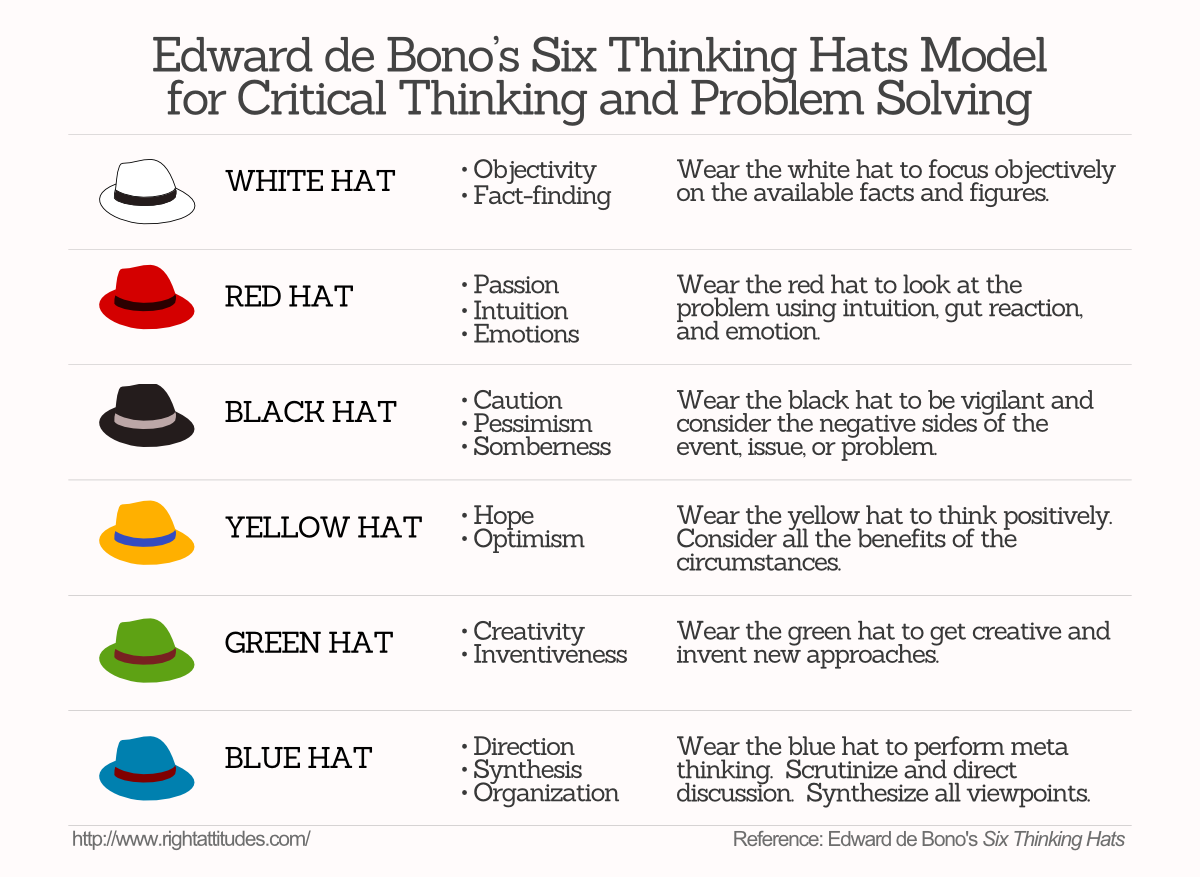
At the heart of the ‘six thinking hats’ method are six different colored hats that participants put on—literally or metaphorically—to represent the type of thinking they should concentrate on while wearing each.

  1. White is neutral, objective, and fact-based. A white hat is concerned with objective data: “What information do we have? What information do we need? What information are we missing? How can get the information we need? What objective questions should be asked?”
  2. Red denotes passion, anger, intuition, and emotions. A red hat considers the emotional side of problem solving, which is often neglected or masked in meetings: “What are our gut reactions to the matter at hand?”
  3. Black is somber, serious, and cautious. A black hat is vigilant, plays devil’s advocate, and encourages derogatory and judgmental behavior: “what are the weaknesses of these ideas? What are the risks? What could go wrong?”
  4. Yellow represents positive thinking, hope, and optimism to counteract the black hat’s power. A yellow hat plays “the angel’s advocate” and is cheerful and confident: “What are the best-case scenarios? What are the best aspects of this? What are the advantages? Who can benefit from this?”
  5. Green signifies abundance, growth, richness, and fertility. A green hat is the hat of creativity; it rejects established rules and norms, and invents new approaches: “What are some new ideas on this subject? What is interesting about this idea? What are the variances in these ideas?”
  6. Blue represents the sky and therefore provides the overarching perspective. A blue hat performs “meta thinking” and is concerned with the organization of the thinking process and the use of other hats. The blue hat synthesizes and reconciles different viewpoints. At the start of a brainstorming session, the blue hat sets the stage for where the discussion may go. The blue hat guides and sustains the discussion, often restating its purposes: “What are we thinking about? What is the goal? What should we do next? What have we achieved so far? What should we do to achieve more?” At the conclusion of the brainstorming session, the blue hat appraises the discussion, and proposes a plan of action.

Use De Bono’s Six Thinking Hats Model for Critical Thinking and Problem Solving

'Six Thinking Hats' by Edward de Bono (ISBN 0316178314) An individual working alone may use the approach to consider broader, distinct lines of thought. By changing hats, the individual can switch viewpoints and ensure that he/she is not stuck in specific thinking patterns.

However, the approach is best suited to group discussions (when chaired by a skilled facilitator) in which conflicting ideas may never otherwise be fully synthesized into plans of action. By persuading each participant to think constructively alongside other participants, the ‘six thinking hats’ method taps into group members’diverse perspectives and uses their collective knowledge without destructive conflict.

Using these hats nurtures creativity by letting participants step beyond their typical roles and contribute to developing, organizing, and progressing ideas. Participants can also identify how their cognitive state at any one time shapes how they approach problems.

Recommendation: Read. Edward de Bono’s Six Thinking Hats presents a very effective technique for stimulating group creativity. The method can remove mental blocks, organize ideas and information, foster cross-fertilization, and help conduct thinking sessions more productively than do other brainstorming methods.

Complement with Dan Ciampa’s Taking Advice for an excellent framework on the kind of advice network you need on strategic, operational, political, and personal elements of your work and life. Read my summary in this article.

Wondering what to read next?

  1. Howard Gardner’s Five Minds for the Future // Books in Brief
  2. You Can’t Develop Solutions Unless You Realize You Got Problems: Problem Finding is an Undervalued Skill
  3. Finding Potential Problems & Risk Analysis: A Case Study on ‘The Three Faces of Eve’
  4. Group Polarization: Like-Mindedness is Dangerous, Especially with Social Media
  5. Charlie Munger’s Iron Prescription

Filed Under: Mental Models, Sharpening Your Skills Tagged With: Conversations, Creativity, Critical Thinking, Mental Models, Networking, Social Dynamics, Teams, Thinking Tools, Thought Process, Winning on the Job

How to Promote Employees

May 10, 2016 By Nagesh Belludi Leave a Comment

Job Promotions Can Be Stressful

A job promotion is generally cause for celebration and gratification. However, it can be a source of deep anxiety for many employees: they tend to suffer additional mental strain and are less likely to find time to go to the doctor. Research at the University of Warwick found that “the mental health of managers typically deteriorates after a job promotion, and in a way that goes beyond merely a short-term change.”

Promote Employees Who’ve Shown Some Evidence of Success

Before you decide to promote an employee, ask yourself the following six questions about the candidate. The more affirmative answers to these questions, the better the chances for the promotion to succeed. Examine and resolve any “no” answers before considering the employee for other job transitions.

  • Is the candidate performing her current duties well enough to justify a promotion?
  • Can she hand over her current responsibilities to a new person?
  • Does she possess a sound understanding of the fundamentals of a business and have the requisite operating experience?
  • Is she keen to take on a new job? Is she familiar with the responsibilities and priorities of the new job? Is she willing to make decisions and be accountable for results?
  • Is she qualified and experienced enough to do at least part of the new job? Is she adequately trained or ready to be trained in the new job’s requirements?
  • Are her interpersonal skills adequate to work with employees, customers, suppliers, peers, and bosses in the new job?

Idea for Impact: If employees are not entirely prepared for new assignments, you are unintentionally setting them up for stressful transitions, bitterness, or eventual failure. Beware of the perils of promoting people too quickly.

Wondering what to read next?

  1. Fire Fast—It’s Heartless to Hang on to Bad Employees
  2. Seven Real Reasons Employees Disengage and Leave
  3. General Electric’s Jack Welch Identifies Four Types of Managers
  4. How to Manage Overqualified Employees
  5. Why Hiring Self-Leaders is the Best Strategy

Filed Under: Career Development, Leading Teams, Managing People Tagged With: Coaching, Great Manager, Hiring & Firing, Human Resources, Mentoring, Performance Management

Inspirational Quotations #631

May 8, 2016 By Nagesh Belludi Leave a Comment

Slavery is a system of the most complete injustice.
—Plato (Ancient Greek Philosopher)

The most heated defenders of a science, who cannot endure the slightest sneer at it, are commonly those who have not made very much progress in it and are secretly aware of this defect.
—Georg Christoph Lichtenberg (German Scientist)

Prayer draws us near to our own souls.
—Herman Melville (American Novelist)

Education is hanging around until you’ve caught on.
—Robert Frost (American Poet)

In private conversation between intimate friends the wisest men very often talk like the weakest; for, indeed, the talking with a friend is nothing else but thinking aloud.
—Joseph Addison (English Essayist)

Situated in some nebulous distance I do what I do so that the universal balance of which I am a part may remain a balance.
—Antonio Porchia (Italian Poet)

Love is a fruit in season at all times, and in reach of every hand.
—Mother Teresa (Albanian Catholic Humanitarian)

Success is simply a matter of luck. Ask any failure.
—Earl Nightingale (American Motivational Speaker)

Once you have permission to talk to someone, finding new products or services for them is a smart way to grow.
—Seth Godin (American Entrepreneur)

Fear is the absence of faith.
—Paul Tillich (American Lutheran Theologian)

To deny, to believe, and to doubt absolutely—this is for man what running is for a horse.
—Blaise Pascal (French Catholic Mathematician)

The how” thinker gets problems solved effectively because he wastes no time with futile “ifs” but goes right to work on the creative “how”.”
—Norman Vincent Peale (American Clergyman, Self-Help Author)

Let the wife make the husband glad to come home, and let him make her sorry to see him leave.
—Martin Luther (German Protestant Theologian)

There is no education like adversity.
—Benjamin Disraeli (British Head of State)

The life of wisdom must be a life of contemplation combined with action.
—M. Scott Peck (American Psychiatrist)

Character is a perfectly educated will.
—Novalis

Happy people plan actions, they don’t plan results.
—Dennis Wholey

Filed Under: Inspirational Quotations

Party Etiquette: Can you take your leftovers home?

May 6, 2016 By Nagesh Belludi 5 Comments

A reader’s question about party etiquette: at the end of a party, could you expect to return home with leftovers of the food or the drink you contributed to the party?

No, not unless the host offers.

You’re a guest in your host’s home and anything you contributed to the party is tantamount to a gift. Unless the host decides not to preserve the remainder of your contribution and suggests that you take your leftovers home, don’t expect to return with your leftovers. Just return with your empty dish.

At potluck parties, however, you can take your leftovers home, but first offer to leave some or all of the leftovers for the host.

Wondering what to read next?

  1. What to Do When an Invitation Says “No Gifts”
  2. How to Reduce Thanksgiving Stress
  3. Party Etiquette for the Vegetarian Guest
  4. Witty Comebacks and Smart Responses for Nosy People
  5. Office Chitchat Isn’t Necessarily a Time Waster

Filed Under: Ideas and Insights Tagged With: Etiquette, Networking, Social Life

Party Etiquette for the Vegetarian Guest

May 3, 2016 By Nagesh Belludi Leave a Comment

  • When RSVPing to a party, mention your dietary restrictions and allergies: “Thanks for the invitation. I must tell you that I am vegan and gluten-free. I am also allergic to peanuts.” Be as specific as possible; mention if you can consume milk products and eggs. Elaborate if you can’t eat anything particular: butter, marshmallows, honey, gelatin, chicken stock, or lard in desserts.
  • Offer to provide for yourself and help out: “May I bring my five-bean and avocado salad with baked nachos? That should also cover the appetizer course for you!” If you’re comfortable with meat substitutes, offer to bring the meat-alternative dish that’s most suitable for the occasion: “May I bring a Tofurky dish? I’ve heard it mimics the taste and texture of a Thanksgiving meal.”
  • If the party is in your honor and the host insists upon cooking for you, suggest an easy dish they could prepare for you. Don’t make the host search for a dish that best suits your preferences.
  • Understand that your hosts can’t cater to every guest’s preferences. Don’t be offended if your host forgets about your dietary restrictions. Appreciate that they’ll be spending a lot of time preparing for and cleaning up after the party. If your host hasn’t made any accommodations to cover your dietary needs, just eat salad, quick-and-easy canned soup, or whatever is practical for the host to organize quickly for you. Don’t grumble.

Wondering what to read next?

  1. What to Do When an Invitation Says “No Gifts”
  2. How to Reduce Thanksgiving Stress
  3. Party Etiquette: Can you take your leftovers home?
  4. Witty Comebacks and Smart Responses for Nosy People
  5. Office Chitchat Isn’t Necessarily a Time Waster

Filed Under: Ideas and Insights Tagged With: Etiquette, Networking, Social Life

Inspirational Quotations #630

May 1, 2016 By Nagesh Belludi Leave a Comment

I believe in liberty for all men: the space to stretch their arms and their souls; the right to breathe and the right to vote, the freedom to choose their friends, enjoy the sunshine, and ride on the railroads, uncursed by color; thinking, dreaming, working as they will in a kingdom of beauty and love.
—W. E. B. Du Bois (American Civil Rights Activist)

The more you express gratitude for what you have the more you will have to express gratitude for.
—Zig Ziglar (American Author)

The best of a book is not the thought which it contains, but the thought which it suggests; just as the charm of music dwells not in the tones but in the echoes of our hearts.
—Oliver Wendell Holmes, Sr. (American Physician)

Happiness will never be any greater than the idea we have of it.
—Maurice Maeterlinck (Belgian Playwright)

He who lives in the future lives in a featureless blank; he lives in impersonality; he lives in Nirvana. The past is democratic, because it is a people. The future is despotic, because it is a caprice. Every man is alone in his prediction, just as each man is alone in a dream.
—G. K. Chesterton (English Journalist)

Some dying men are the most tyrannical; and certainly, since they will shortly trouble us so little for evermore, the poor fellows ought to be indulged.
—Herman Melville (American Novelist)

The deepest definition of youth is life as yet untouched by tragedy.
—Alfred North Whitehead (English Mathematician)

Every man of genius sees the world at a different angle from his fellows, and there is his tragedy.
—Havelock Ellis (British Sexologist)

Filed Under: Inspirational Quotations

« Previous Page
Next Page »

Primary Sidebar

Popular Now

Anxiety Assertiveness Attitudes Balance Biases Coaching Conflict Conversations Creativity Critical Thinking Decision-Making Discipline Emotions Entrepreneurs Etiquette Feedback Getting Along Getting Things Done Goals Great Manager Innovation Leadership Leadership Lessons Likeability Mental Models Mentoring Mindfulness Motivation Networking Parables Performance Management Persuasion Philosophy Problem Solving Procrastination Relationships Simple Living Social Skills Stress Suffering Thinking Tools Thought Process Time Management Winning on the Job Wisdom

About: Nagesh Belludi [hire] is a St. Petersburg, Florida-based freethinker, investor, and leadership coach. He specializes in helping executives and companies ensure that the overall quality of their decision-making benefits isn’t compromised by a lack of a big-picture understanding.

Get Updates

Signup for emails

Subscribe via RSS

Contact Nagesh Belludi

RECOMMENDED BOOK:
The Power of a Positive No

The Power of a Positive No: William Ury

Harvard's negotiation professor William Ury details a simple, yet effective three-step technique for saying 'No' decisively and successfully, without destroying relationships.

Explore

  • Announcements
  • Belief and Spirituality
  • Business Stories
  • Career Development
  • Effective Communication
  • Great Personalities
  • Health and Well-being
  • Ideas and Insights
  • Inspirational Quotations
  • Leadership
  • Leadership Reading
  • Leading Teams
  • Living the Good Life
  • Managing Business Functions
  • Managing People
  • MBA in a Nutshell
  • Mental Models
  • News Analysis
  • Personal Finance
  • Podcasts
  • Project Management
  • Proverbs & Maxims
  • Sharpening Your Skills
  • The Great Innovators

Recently,

  • The Inopportune Case of the Airbus A340 Aircraft: When Tomorrow Left Yesterday Behind
  • You Don’t Know If a Good Day is a Good Day
  • Inspirational Quotations #1147
  • Life Isn’t Black and White
  • The Setting Shapes the Story
  • Ridicule Is Often the Tax Levied on Originality: The Case of Ice King Frederic Tudor
  • Inspirational Quotations #1146

Unless otherwise stated in the individual document, the works above are © Nagesh Belludi under a Creative Commons BY-NC-ND license. You may quote, copy and share them freely, as long as you link back to RightAttitudes.com, don't make money with them, and don't modify the content. Enjoy!