• Skip to content
  • Skip to primary sidebar

Right Attitudes

Ideas for Impact

Nagesh Belludi

Inspirational Quotations #762

November 11, 2018 By Nagesh Belludi

The memories of long love gather like drifting snow, poignant as the mandarin ducks who float side by side in sleep.
—Murasaki Shikibu (Japanese Diarist, Novelist)

The test of all beliefs is their practical effect in life. If it be true that optimism compels the world forward, and pessimism retards it, then it is dangerous to propagate a pessimistic philosophy.
—Helen Keller (American Author)

Each of us, face to face with other men, is clothed with some sort of dignity, but we know only too well all the unspeakable things that go on in the heart.
—Luigi Pirandello (Italian Dramatist)

A rolling stone can gather no moss.
—Publilius Syrus (Syrian-born Latin Writer)

No matter how complicated a problem is, it usually can be reduced to a simple, comprehensible form which is often the best solution.
—An Wang (Chinese-born American Engineer)

Now is now. It can never be a long time ago.
—Laura Ingalls Wilder (American Author of Children’s Novels)

Better remain silent, better not even think, if you are not prepared to act.
—Annie Besant (British-born Indian Theosophist)

Do not give way to useless alarm; though it is right to be prepared for the worst, there is no occasion to look on it as certain.
—Jane Austen (English Novelist)

I do not believe in a fate that falls on men however they act; but I do believe in a fate that falls on them unless they act.
—G. K. Chesterton (English Journalist)

Sympathy is never wasted except when you give it to yourself.
—John W. Raper (American Journalist, Aphorist)

As long as I am back in my military life for a second, I should like to observe one thing about leadership that one of the great has said—Napoleon. He said, the great leader, the genius in leadership, is the man who can do the average thing when everybody else is going crazy.
—Dwight D. Eisenhower (American Head of State)

May we agree that private life is irrelevant? Multiple, mixed, ambiguous at best—out of it we try to fashion the crystal clear, the singular, the absolute, and that is what is relevant; that is what matters.
—May Sarton (American Children’s Books Writer)

The water drop playing on a lotus petal has an extremely uncertain existence; so also is life ever unstable. Understand, the very world is consumed by disease and conceit, and is riddled with pangs.
—Adi Shankaracharya (Indian Hindu Philosopher)

The nice thing about egotists is that they don’t talk about other people.
—Lucille S. Harper (American Freelance Writer)

There’s a difference between a philosophy and a bumper sticker.
—Charles M. Schulz (American Cartoonist)

Without moral and intellectual independence, there is no anchor for national independence.
—David Ben-Gurion (Russian-born Israeli Head of State)

Where there is charity and wisdom, there is neither fear nor ignorance. Where there is patience and humility, there is neither anger nor vexation. Where there is poverty and joy, there is neither greed nor avarice. Where there is peace and meditation, there is neither anxiety nor doubt.
—Saint Francis of Assisi (Italian Monk)

Filed Under: Inspirational Quotations

How to Prevent Employee Exhaustion

November 8, 2018 By Nagesh Belludi Leave a Comment

Feeling exhausted, irritated, unhappy, and lacking in control are all signs of burnout—a temporary decline in an employee’s well-being.

If you notice a drop in energy, motivation, or productivity, try these simple ways to help combat employee exhaustion:

  • Clarify expectations
  • Where possible, lower the standards and relax the deadlines. Encourage less perfection.
  • Give employees the right tools and resources that they need to do their job effectively
  • Allocate some tasks to other employees
  • Appreciate, reward, recognize
  • Give employees some time off
  • Reduce travel and meetings
  • Offer counseling and mentoring

Employee stress and problems at work that are not dealt with effectively can quickly spill out into other parts of an employee’s life. In fact, many marriages go bad when stress at work is at its worst: people use up all their willpower on the job; their home lives suffer because they give much to their work.

Make employee welfare a key area of focus to promote better work environments and keep employees engaged.

Wondering what to read next?

  1. Managing the Overwhelmed: How to Coach Stressed Employees
  2. Four Telltale Signs of an Unhappy Employee
  3. How to Clear Your Mental Horizon
  4. Don’t Push Employees to Change
  5. Do Your Team a Favor: Take a Vacation

Filed Under: Health and Well-being, Leading Teams, Managing People, Sharpening Your Skills Tagged With: Balance, Coaching, Emotions, Great Manager, Mentoring, Stress, Targets, Time Management

When Stress is Good

November 5, 2018 By Nagesh Belludi Leave a Comment

Stress and Anxiety Can Lead to Improved Performance

Why Some Stress Is Good for You Many people claim that they work best under pressure. There’s some truth to that. Stress is a natural response in highly competitive environments. Before an exam, important meeting, or contest, your heart rate rises and so does your blood pressure. You become more absorbed, alert, and efficient.

However, this favorable relationship applies only up to a certain level of stress. Past this level, stress impairs your performance—and eventually your heart.

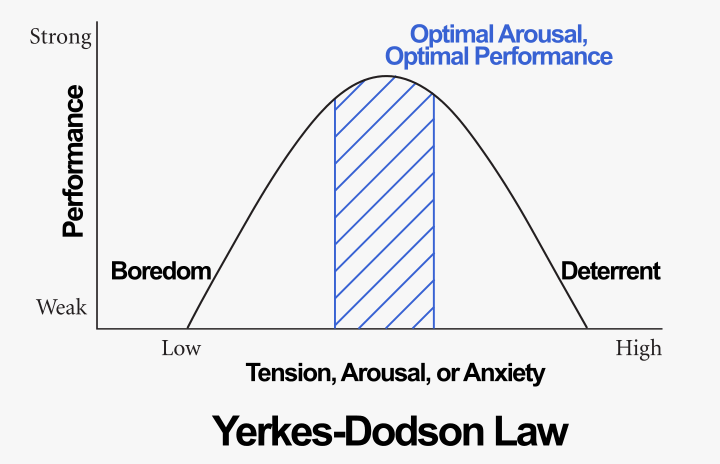
In 1908, Harvard psychologists Robert Yerkes and John Dodson first described the beneficial and harmful effects of stress (“psychological arousal”) on performance in a graph the shape of an upside-down U. According to the Yerkes-Dodson Law, the ascendant curve reflects the energizing effect of arousal. The descendant curve reflects the negative effects of stress on thinking and learning, or performance in general.

Too Much Anxiety and Stress Impairs Performance, but so Does Too Little: The Yerkes-Dodson Law

Many physiological studies have demonstrated that stress enhances your performance by causing your brain to use more of its capabilities, improve memory and intelligence, and increase productivity. Without stress, athletes, performers, executives, and students are likely to underachieve.

There is an optimum level of arousal for every kind of task. So how do you find the right balance? How do you get yourself into the performance zone where stress is most helpful? How much stress is good? The answers depend on individual disposition, the types of stressors, the nature of the task itself, and perceptions of what is stressful to you.

When Stress is Good: The Yerkes-Dodson Law

Idea for Impact: Stress at Work May Be Inevitable but it Doesn’t Have to Be Detrimental

Stress can be a motivator. But don’t seek out stress—less of it is better. Make the stress you do have work for you. Becoming conscious of stress as a potential positive can reduce the harm it causes.

  • Develop an awareness of when you hit the limits beyond which working longer or harder is counter-productive (sportsmen tend to choke under intense pressure.) When you feel overwhelmed, look for ways to reduce or eliminate the stressors so you can become more productive again. Ask for help.
  • Performance deteriorates when your stress level is either too high or too low for a given task. Seek the optimal level of anxiety that can impel you forward without causing you to fight back or give up.

Idea for Impact: The Right Level of Anxiety Can Be a Positive Force for Driving Employees Forward

Anxiety and optimal performance is an individual affair. The Yerkes-Dodson Curve shifts as the performers become established and experienced with the undertaking.

Astute managers repeatedly assess and re-assess where their team members land on the Yerkes-Dodson Curve. Managers can identify over-stressed or under-motivated circumstances with employees and intervene quickly to tailor the level of stress.

Wondering what to read next?

  1. Lessons from the World’s Worst Aviation Disaster // Book Summary of ‘The Collision on Tenerife’
  2. Beware the Opportunity Cost of Meditating
  3. What Airline Disasters Teach About Cognitive Impairment and Decision-Making Under Stress
  4. Ask This One Question Every Morning to Find Your Focus
  5. The Law of Petty Irritations

Filed Under: Managing People, Sharpening Your Skills Tagged With: Anxiety, Decision-Making, Introspection, Mindfulness, Motivation, Procrastination, Stress, Targets, Worry

Inspirational Quotations #761

November 4, 2018 By Nagesh Belludi

We Japanese enjoy the small pleasures, not extravagance. I believe a man should have a simple lifestyle—even if he can afford more.
—Masaru Ibuka (Japanese Entrepreneur, Engineer)

Silence accompanies the most significant expressions of happiness and unhappiness: those in love understand one another best when silent, while the most heated and impassioned speech at a graveside touches only outsiders, but seems cold and inconsequential to the widow and children of the deceased.
—Anton Chekhov (Russian Short Story Writer)

A lie told often enough becomes truth.
—Vladimir Lenin (Russian Revolutionary Leader)

To be or not to be is not a question of compromise. Either you be or you don’t be.
—Golda Meir (Israeli Head of State)

The art of leadership is saying no, not yes. It is very easy to say yes.
—Tony Blair (British Statesman)

I know no better augury of a young man’s future than true filial devotion. Very rarely does one go morally wrong, whose passionate love to his mother is a ruling force in his life, and whose continual desire is to gladden her heart. Next to the love of God, this is the noblest emotion. I do not remember a single instance of a young fellow going to the bad who was tenderly devoted to his parents.
—John Thain Davidson (British Presbyterian Preacher)

Look for the woman in the dress. If there is no woman, there is no dress.
—Coco Chanel (French Fashion Designer)

The opposite of good is not evil, it is indifference.
—Abraham Joshua Heschel (American Jewish Rabbi)

Maybe it was because like not only finds like; it can’t even escape from being found by its like. Even when it’s just like in one thing, because even them two with the same like was different.
—William Faulkner (American Novelist)

From the Hindu perspective, each soul is divine. All religions are branches of one big tree. It doesn’t matter what you call Him just as long as you call. Just as cinematic images appear to be real but are only combinations of light and shade, so is the universal variety a delusion. The planetary spheres, with their countless forms of life, are naught but figures in a cosmic motion picture. One’s values are profoundly changed when he is finally convinced that creation is only a vast motion picture and that not in, but beyond, lays his own ultimate reality.
—George Harrison (English Singer)

There are two kinds of people who lose money: those who know nothing and those who know everything.
—Henry Kaufman (American Economic, Financial Consultant)

Hatred ever kills, love never dies; such is the vast difference between the two. What is obtained by love is retained for all time. What is obtained by hatred proves a burden in reality for it increases hatred.
—Mohandas K. Gandhi (Indian Hindu Political leader)

Rhythm is the basis of life, not steady forward progress. The forces of creation, destruction, and preservation have a whirling, dynamic interaction.
—Kabbalah Teaching (Jewish Mystical, Theosophical Tradition)

That man is richest whose pleasures are the cheapest.
—Henry David Thoreau (American Philosopher)

Filed Under: Inspirational Quotations

Four Ideas for Business Improvement Ideas

November 1, 2018 By Nagesh Belludi Leave a Comment

  1. Four Ideas for Business Improvement Ideas Seek fresh eyes. Ask new employees and interns to make a note of every question they have about how things get done in your organization. If anything—reports, approvals, meetings, reviews—doesn’t seem sensible, let them record those inefficiencies. After a few weeks, when they’ve become familiar with the organization and its workflow, have them reassess and report their observations. The best improvement ideas come from people who aren’t stuck in the established ways.
  2. Notice something? Fix it quickly or delegate. Never walk absentmindedly by something that could be improved. A cluttered instruments cabinet in a warehouse? A loose tile in a walkway? A broken link on your customer service website? Don’t take inconveniences and unpleasant situations for granted.
  3. Explore the outsider’s perspective. Notice how trivial stuff can really frustrate you when you’re standing in line at the Bureau of Motor Vehicles or dealing with a slow bureaucracy? While running errands, do others’ rules, regulations, and procedures annoy you? Bump into something that doesn’t have to be laborious, arduous, expensive, or annoying, but is? Examine if your business imposes any of those inconveniences on your customers.
  4. Make it easy for customers to complain. Seek customer feedback in such a way that it encourages people to share their negative experiences. As I’ve illuminated before, many innovative ideas have their roots in prudent attention to and empathy with customers’ experiences.

Idea for Impact: Problem-finding is one of the most significant—and overlooked—parts of innovation. Learn to pay attention to the subtle clues to opportunities all around.

Wondering what to read next?

  1. Howard Gardner’s Five Minds for the Future // Books in Brief
  2. You Can’t Develop Solutions Unless You Realize You Got Problems: Problem Finding is an Undervalued Skill
  3. This is Yoga for the Brain: Multidisciplinary Learning
  4. Wide Minds, Bright Ideas: Book Summary of ‘Range: Why Generalists Triumph’ by David Epstein
  5. Finding Potential Problems & Risk Analysis: A Case Study on ‘The Three Faces of Eve’

Filed Under: Mental Models, Sharpening Your Skills, The Great Innovators Tagged With: Creativity, Critical Thinking, Mental Models, Problem Solving, Skills for Success, Thinking Tools, Thought Process, Winning on the Job

A Guide to Intelligent Reading // Book Summary of Mortimer Adler’s ‘How to Read a Book’

October 29, 2018 By Nagesh Belludi Leave a Comment

'How to Read a Book' by Mortimer Adler (ISBN 0671212095) If you’re interested in sharpening up your ability to read, comprehend, and debate, Mortimer Adler and Charles Van Doren’s bestselling How to Read a Book: The Classic Guide to Intelligent Reading (1972; first published in 1940 under only Adler’s name) is the definitive guidebook.

The book stemmed from Adler’s belief that students of liberal education needed to be grounded in the “great ideas” of humankind, as represented in the canon of Western classic literature. To Adler, the art of reading well is deeply correlated to the art of thinking clearly, critically, and freely.

After the publication of How to Read a Book (1940,) Adler advanced his ideas on educational theory further by starting the Great Books of the Western World program and the Great Books Foundation. His later successes as a University of Chicago philosopher and an educator had an colossal influence on American education in the twentieth century.

Take-away Lesson #1: Active Reading is the Effort to Understand

How to Read a Book is divided into four parts:

  • Part one discusses the first two levels of reading: elementary reading (the level of reading taught in elementary schools and high schools) and inspectional reading (methodical skimming and cursory reading.)
  • Part two contains the third level of reading, analytical reading: classifying the author’s arguments and information, coming to terms with the book’s line of reasoning, establishing the author’s implications, criticizing the book, and critiquing the author.
  • Abraham Lincoln and son reading a book Part three covers the particular nuances of reading various types of literature: practical books, creative literature, stories, plays, poems, history, philosophy, science, mathematics, and social science.
  • Part four of the book is earmarked to the ultimate goals of reading—viz., expanding one’s mind for further understanding—a goal facilitated by “synoptical reading.” Since, per Carl Jung, “one book opens another,” a determined reader should peruse several works on the same subject with the intention of establishing a broader outlook of the subject matter. According to Adler, syntopical reading is the hallmark of scholarship: “Knowing that more than one book is relevant to a particular question is the first requirement in any project of syntopical reading. Knowing which books should be read, in a general way, is the second requirement.”

The essence of reading’s comprehension and appreciation lies in how best the reader can answer four questions during the course of reading a book:

  • During elementary reading: “What does the book say?”
  • During inspectional reading: “What is the book about?” How the author is trying to say it? What methodologies, narratives, substantiations, and examples does he use?
  • During analytical reading: “What does the book mean?” And, “Are the author’s arguments and claims valid—in whole or part? What is the significance of the author’s theses?”
  • During syntopical reading: “How does this book compare with other books?” And, “What other sources of knowledge could be pursued?”

How to Read a Book concludes with two appendices: (1) a list of titles in the “Great Books of the Western World” program, and (2) a number of exercises and tests on all four levels of reading.

Take-away Lesson #2: A Reader Must Suspend Judgment Until He Can Express the Author’s Positions

  • “You must be able to say, with reasonable certainty, ‘I understand,’ before you can say any one of the following things: ‘I agree,’ or ‘I disagree,’ or ‘I suspend judgment.'”
  • “Students who plainly do not know what the author is saying seem to have no hesitation in setting themselves up as his judges. They not only disagree with something they do not understand but, what is equally bad, they also often agree to a position they cannot express intelligibly in their own words.” As I’ve elaborated on this blog before (here, here, here, here, and here,) you must be able to accurately state—in your own words—the position of those you’re debating, before you can challenge them.
  • “When you disagree, do so reasonably, and not disputatiously or contentiously.” And, “Most people think that winning the argument is what matters, not learning the truth. He who regards conversation as a battle can win only by being an antagonist, only by disagreeing successfully, whether he is right or wrong.”

Take-away Lesson #3: Reading Well is Better Than Reading Widely

  • The objective of reading a book is to evolve to the level of the author: “In the case of good books, the point is not to see how many of them you can get through, but rather how many can get through to you.” Additionally, “Enlightenment is achieved only when, in addition to knowing what an author says, you know what he means and why he says it.”
  • Read a “difficult” book multiple times. Each time you read a specific book, you’ll discover more—new ideas, new concepts, and deeper truths.
    • “In tackling a difficult book for the first time, read it through without ever stopping to look up or ponder the things you do not understand right away.”
    • “It is generally desirable to skim even a book that you intend to read carefully, to get some idea of its form and structure.”
    • “Ask questions while you read—questions that you yourself must try to answer in the course of reading.”
  • Regarding the “ignorance of those who have misread many books”, Adler asserts that such people, “are, as Alexander Pope rightly calls them, bookful blockheads, ignorantly read. There have always been literate ignoramuses who have read too widely and not well.”

Recommendation: Mortimer Adler and Charles Van Doren’s How to Read a Book: The Classic Guide to Intelligent Reading is a smart reading that should be on everybody’s library. It is a goldmine of invaluable insights into the art of reading, debate, and persuasion.

Wondering what to read next?

  1. How to Read Faster and Better
  2. Curate Wisely: Navigating Book Overload
  3. How to Read the AP Stylebook
  4. How to Process that Pile of Books You Can’t Seem to Finish [+ 5 Other Reading Hacks]
  5. How to … Read More Books

Filed Under: Leadership Reading, Mental Models, Sharpening Your Skills Tagged With: Books, Critical Thinking, Reading

Inspirational Quotations #760

October 28, 2018 By Nagesh Belludi

A wise man will make haste to forgive, because he knows the full value of time and will not suffer it to pass away in unnecessary pain.
—Samuel Johnson (British Essayist)

The man who questions opinion is wise; the man who quarrels with fact is a fool.
—Frank A. Garbutt (American Inventor, Movie Pioneer)

Failure is, in a sense, the highway to success, inasmuch as every discovery of what is false leads us to seek earnestly after what is true, and every fresh experience points out some form of error which we shall afterward carefully avoid.
—John Keats (English Poet)

Rarely do more than three or four variables really count. Everything else is noise.
—Marty Whitman (American Investment Advisor)

The problem in this world is to avoid concentration of power—we must have a dispersion of power.
—Milton Friedman (American Economist)

Really, in the end, the only thing that can make you a writer is the person that you are, the intensity of your feeling, the honesty of your vision, the unsentimental acknowledgment of the endless interest of the life around and within you. Virtually nobody can help you deliberately-many people will help you unintentionally.
—Santha Rama Rau (Indian-American Novelist, Travel Writer)

Three things you can be judged by, your voice, your face and your disposition.
—Ignaz Bernstein (Russian-Jewish Bibliophile, Philanthropist)

It is far better to know our own weaknesses and failings than to point out those of another.
—Jawaharlal Nehru (Indian Head of State)

Hope is like a road in the country; there was never a road, but when many people walk on it, the road comes into existence.
—Lu Xun (Chinese Writer)

Ideas are somewhat like babies—they are born small, immature, and shapeless. They are promise rather than fulfillment. In the innovative company executives do not say, “This is a damn-fool idea.” Instead they ask, “What would be needed to make this embryonic, half-baked, foolish idea into something that makes sense that is an opportunity for us?”
—Peter Drucker (Austrian-born Management Consultant)

I detest that man, who hides one thing in the depths of his heart, and speaks forth another.
—Homer (Ancient Greek Poet)

A vigorous five-mile walk will do more good for an unhappy but otherwise healthy adult than all the medicine and psychology in the world.
—Paul Dudley White (American Cardiologist)

On the outside one is a star. But in reality, one is completely alone, doubting everything. To experience this loneliness of soul is the hardest thing in the world.
—Brigitte Bardot (French Film Star)

When the ox is down, many are the butchers.
—The Talmud (Sacred Text of the Jewish Faith)

The capacity of man himself is only revealed when, under stress and responsibility, he breaks through his educational shell, and he may then be a splendid surprise to himself no less than to his teachers.
—Harvey Williams Cushing (American Neurosurgeon, Biographer)

Filed Under: Inspirational Quotations

Don’t Use Personality Assessments to Sort the Talented from the Less Talented

October 25, 2018 By Nagesh Belludi Leave a Comment

Personality assessments have featured in personality development and career counseling for almost a century. Myers-Briggs Type Indicator (MBTI) and other tests form the basis for helping people deal with conflict, understand team interplay, outline career search, sharpen decision-making skills, and cope with stress.

Personality Assessments Cannot Predict Performance

Even as their use has grown significantly over the last two decades, personality assessments—including strengths inventories, and emotional intelligence assessments—have been criticized at length:

  • An individual’s personality cannot be summed up by a personality assessment. Individuality is described best by continuous (not discrete), normally-distributed attributes. For example, the MBTI Step I classification of individuals into 16 categories (or 4 dichotomies from Carl Jung‘s book Psychological Types (1921)) does not encapsulate the full range of personality variance.
  • An individual’s behavior cannot be limited to one side of a dichotomy. For instance, every person can be outgoing and assertive in the external world (extraversion,) while requiring time for some contemplation (introversion).
  • Many academic studies question the tests’ predictive validity and poor reliability. Moreover, personality assessments have poor test-retest consistency. Test takers have been shown to change at least one dichotomy when they take the MBTI Step I survey a second time.
  • Personality assessments can initiate confirmation bias (“Barnum Effect”)—the test scores are self-fulfilling because people tend to behave in ways that are predicted for them. In other words, a person who learns that he or she is “outgoing” according to MBTI may behave that way.
  • Personality tests are decidedly fakeable, especially when used to evaluate future career opportunities. All personality assessments are contingent on a degree of honesty, but MBTI test-takers are often motivated to match up to extraverted, sensing, thinking, and judging (ESTJ) proclivities in the modern organization.
  • Assessments are regularly offered as universally applicable. Not only do they tend to mirror the biases of the test developers, but also they are skewed in preference of the social groups the developer studied.

Personality Assessments are Starting Points for Change, Not a Predictor of the Outcome

Academics have long acknowledged the previously mentioned criticisms of personality assessments. They’ve argued fruitfully that many of the criticisms should be directed to how HR practitioners understand personality tests and use them in the development arena.

MBTI and many other personality assessments were never intended to sort the talented from the less talented. They are designed for the individual who takes the assessment, and not for the HR practitioner. In other words, personality assessments were designed to help individuals discover their underlying preferences regarding learning styles, problem-solving styles, self-awareness, ethical inclinations, emotional intelligence, and stress management.

Intended for Increasing Self-awareness, Not Appraisal

On the contrary, HR practitioners tend to interpret test scores speciously to gauge behavior, rather than as pointers of categorical preferences. Besides, HR practitioners often fail to factor in the test-takers’ past and current environmental influences.

And then there’s the risk of people being pigeonholed or pushed into a particular course regardless of his or her preferences. HR practitioners and career counsellors who put too much emphasis on personality assessments may compartmentalize people into rigid categories. This flies in the face of a central tenet of the MBTI premise—that individuals could choose to act against their preferred type if the occasion demands it. People’s attitudes and behaviors often change over time because of emotional experiences or socialization into specific work and social cultures.

Idea for Impact: Use Personality Assessments to Facilitate Self-Awareness, Not for Categorization or as Predictors of Achievement

If you’re a manager or a HR practitioner, don’t use personality assessments to categorize people or as predictors of achievement. Encourage people to take personality tests, but help them interpret these pieces of data about themselves—only they could make sense of test results in the context of their life history, social environment, and ambitions for career and life.

Wondering what to read next?

  1. Before Jumping Ship, Consider This
  2. Five Questions to Keep Your Job from Driving You Nuts
  3. Some Lessons Can Only Be Learned in the School of Life
  4. What Every Manager Should Know Why Generation Y Quits
  5. What’s Next When You Get Snubbed for a Promotion

Filed Under: Career Development, Leading Teams, Managing People, Mental Models Tagged With: Career Planning, Employee Development, Hiring, Job Search, Job Transitions, Managing the Boss, Mentoring, Personal Growth, Winning on the Job

Creativity by Imitation: How to Steal Others’ Ideas and Innovate

October 22, 2018 By Nagesh Belludi 2 Comments

Emulating others’ ideas is an underappreciated learning tool. Many creative innovators set forth as remarkably astute mimics of others. “Good artists copy, great artists steal,” prods a creator’s maxim often misattributed to Picasso.

Imitation is a leading pathway to business innovation, even if being an imitator is anchored by a sense of derision. Ever more businesses are nicking great ideas wherever they can obtain them—in their own industries or beyond. Hospitals have adapted safety and efficiency procedures from the military and the airline industry. Aircraft manufacturers have adopted the car industry’s lean supply chain management concepts. Ritz-Carlton, the luxury chain of hotels and resorts, runs the Ritz-Carlton Leadership Center that has helped trained its legendary cult of customer service and employee empowerment best practices to managers from companies across industries.

Creativity by Taking Existing Ideas: Applying Them in a New Context

The most prominent example of innovating by imitation is Ford’s development of the automobile assembly line—a system Henry Ford copied (and improved) from the Chicago meat processing business.

Henry Ford’s relentless ambition to build his Model T a high-volume-low-cost automobile, together with his engineering knowledge and manufacturing experience provided the leadership and creative environment that nurtured the development of the moving mechanical assembly line. Today, the moving assembly line is the epitome of manufacturing. Almost everything that is now industrially manufactured—automobiles, aircrafts, toys, furniture, food—passes down assembly lines before landing in our homes and offices.

The genesis of the moving assembly line is in the American agricultural products industry. During the late 18th century, the movement of grains changed from hand labor to belts and later moving hoppers.

Innovation by Imitation: Many Innovations Come from the Outside

By 1873, Chicago’s meat-processing industry adapted belts and hoppers to transform beef and pork production into a standardized, mechanized, and centralized business. After cows and pigs travelled to their fate in train cars from farms throughout the Midwest, they were dropped into hoppers and killed. Conveyor belts then moved carcasses past meat cutters, who progressively removed various sections of the animal, cut them into appropriate sizes, and repackaged and dispatched processed meat across the United States.

The meat processors’ task was disassembly (as opposed to putting together automobile parts in Ford’s plants.) Each worker had a specific, specialized job. Production moved swiftly. The American writer Upton Sinclair famously described this industry’s ghastly working conditions in his acclaimed novel The Jungle and said, “They use everything about the hog except the squeal.”

Chicago Slaughter Houses Were the Pioneers of the Moving Disassembly Line Before Henry Ford Started His Assembly Line

In the early 1900s, when Henry Ford wanted to keep Model T production up with demand and lower the price, Ford’s team explored other industries and found four ideas that could advance their goal: interchangeable parts, continuous flow, division of labor, and cutting wasted effort. Ford’s engineers visited Swift & Company’s Slaughterhouse in Chicago and decided to adopt the “disassembly line” method to build automobiles.

The introduction of the moving assembly line process in 1913 enabled increased production up to 1,000 Model Ts a day and decreased assembly time from 13 hours to 93 minutes. Additional refinement of the process, thanks to reliable precision equipment and standardized shop practices, shortened production time radically: within a few years, a new Model T rolled off the assembly line every 24 seconds. First produced in 1908, the Model T kept the same design until the final one—serial number 15,000,000 rolled off the line in 1927.

Auschwitz-Birkenau and Victims of the Holocaust

Sadly, just as Henry Ford copied the Chicago meat processing and perfected the moving assembly line, the Nazi apparatus copied Ford’s methods of mass production to massacre six million people. While Midwestern butchers processed the livestock carcasses, the Nazis systematically handled corpses of the victims of the Holocaust. Nazi operatives removed victims’ hair, clothing, shoes, gold teeth, hairbrushes, glasses, suitcases, and anything of value to be repurposed for the Reich. The atrocities of this inexpressibly shocking disaster are on display at the train tracks and the museums of Auschwitz-Birkenau, Poland.

Formal Strategic-Benchmarking Programs

Smart businesses have formal strategic-benchmarking programs to achieve significant efficiency improvements: they pinpoint the strategic capabilities that matter most to their businesses, seek out companies or businesses that currently manage those capabilities best, and try to copy and deploy those capabilities as rapidly as possible. But time is of the essence for the success of these undertakings, as the management guru Tom Peters warns,

I hate Benchmarking! Benchmarking is stupid! Why is it stupid? Because we pick the current industry leader and then we launch a five-year program, the goal of which is to be as good as whoever was best five years ago, five years from now. Which to me is not an Olympian aspiration.

Imitation is a Key Characteristic of Highly Creative People: The Case of Steve Jobs Copying from Xerox

One of the key characteristics of highly creative people is their exposure to and experience with working in several related domains. They are very good at crossing domain boundaries, relating their creativeness in new and perhaps unexpected ways, and adapting knowledge into new domains. The following case of one of history’s most famous innovators illustrates this distinguishing characteristic.

Steve Jobs of Apple introduced the revolutionary Lisa computer in 1983. It featured such innovations as the graphical user interface, a mouse, and document-centric computing. Jobs had taken—and refined—all these inventions from Xerox’s PARC research labs and introduced by Xerox on its commercially-unsuccessful Alto and Star computers in 1981. The biographer Walter Isaacson writes in his best-selling Steve Jobs: “The Apple raid on Xerox PARC is sometimes described as one of the biggest heists in the chronicles of industry.” Isaacson cites Jobs: “Picasso had a saying—‘good artists copy, great artists steal’—and we have always been shameless about stealing great ideas… They [Xerox management] were copier-heads who had no clue about what a computer could do… Xerox could have owned the entire computer industry.”

Idea for Impact: Borrow Ideas from Others and Combine Them with Your Own Creativity

Interestingly, many “benchmarking” exercises in the world of business—even academia—do not come “top-down” out of strategy. In other words, innovations by imitation are typically not driven from the top down. Instead, they materialize from everyday operational challenges—those painful experiences that send managers scuttling for solutions in a hurry.

Look outside your industry. To improve your creativity, try spending time researching other smart companies—even those outside of your industry. Learning directly from other companies is a useful, underutilized form of research for finding ways to improve performance.

Attend to developments at your competitors and in other industries. Look for potential opportunities that have been discovered elsewhere. Avoid the “not invented here” syndrome—don’t reject other’s great ideas. Keep an open mind.

Wondering what to read next?

  1. Howard Gardner’s Five Minds for the Future // Books in Brief
  2. This is Yoga for the Brain: Multidisciplinary Learning
  3. Many Businesses Get Started from an Unmet Personal Need
  4. Innovation Without Borders: Shatter the ‘Not Invented Here’ Mindset
  5. Van Gogh Didn’t Just Copy—He Reinvented

Filed Under: Business Stories, Mental Models, Sharpening Your Skills Tagged With: Creativity, Critical Thinking, Decision-Making, Entrepreneurs, Icons, Leadership Lessons, Mental Models, Thinking Tools, Thought Process, Winning on the Job

Inspirational Quotations #759

October 21, 2018 By Nagesh Belludi

History is a guide to navigation in perilous times. History is who we are and why we are the way we are.
—David McCullough (American Historian)

The most striking quality that humans and animals have in common is the capacity to experience suffering. Why do we still blind ourselves, now at the beginning of the twenty-first century, to the immeasurable suffering that we inflict on animals, knowing that a great part of the pain that we cause them is neither necessary nor unavoidable? Certainly we should know that there is no moral justification for inflicting needless pain and death on any being.
—Matthieu Ricard (French Buddhist Monk)

The hero’s choice is made in a flash. To him the larger vision is closer than the near. Within an instant, he strikes for eternity, strikes and is done.
—Sister Nivedita (Irish-born Indian Social Worker)

I don’t know anything, but I do know that everything is interesting if you go into it deeply enough.
—Richard Feynman (American Physicist)

Technical knowledge is not enough. One must transcend techniques so that the art becomes an artless art, growing out of the unconscious.
—D. T. Suzuki (Japanese Buddhist Philosopher)

When you first start to study a field, it seems like you have to memorize a zillion things. You don’t. What you need is to identify the core principles—generally three to twelve of them—that govern the field. The million things you thought you had to memorize are simply various combinations of the core principles.
—John Reed (American Journalist, Poet)

In our sleep, pain which cannot forget falls drop by drop upon the heart until, in our own despair, against our will, comes wisdom through the awful grace of God.
—Aeschylus (Greek Poet)

All the way to heaven is heaven.
—Teresa of Avila (Spanish Carmelite Nun, Mystic)

Filed Under: Inspirational Quotations

« Previous Page
Next Page »

Primary Sidebar

Popular Now

Anxiety Assertiveness Attitudes Balance Biases Coaching Conflict Conversations Creativity Critical Thinking Decision-Making Discipline Emotions Entrepreneurs Etiquette Feedback Getting Along Getting Things Done Goals Great Manager Innovation Leadership Leadership Lessons Likeability Mental Models Mentoring Mindfulness Motivation Networking Parables Performance Management Persuasion Philosophy Problem Solving Procrastination Relationships Simple Living Social Skills Stress Suffering Thinking Tools Thought Process Time Management Winning on the Job Wisdom

About: Nagesh Belludi [hire] is a St. Petersburg, Florida-based freethinker, investor, and leadership coach. He specializes in helping executives and companies ensure that the overall quality of their decision-making benefits isn’t compromised by a lack of a big-picture understanding.

Get Updates

Signup for emails

Subscribe via RSS

Contact Nagesh Belludi

RECOMMENDED BOOK:
India After Gandhi

India After Gandhi: Ramachandra Guha

Historian Ramachandra Guha's chronicle of the political and socio-economic endeavors of post-independence India, and its burgeoning prosperity despite cultural heterogeneity.

Explore

  • Announcements
  • Belief and Spirituality
  • Business Stories
  • Career Development
  • Effective Communication
  • Great Personalities
  • Health and Well-being
  • Ideas and Insights
  • Inspirational Quotations
  • Leadership
  • Leadership Reading
  • Leading Teams
  • Living the Good Life
  • Managing Business Functions
  • Managing People
  • MBA in a Nutshell
  • Mental Models
  • News Analysis
  • Personal Finance
  • Podcasts
  • Project Management
  • Proverbs & Maxims
  • Sharpening Your Skills
  • The Great Innovators

Recently,

  • Life Isn’t Black and White
  • The Setting Shapes the Story
  • Ridicule Is Often the Tax Levied on Originality: The Case of Ice King Frederic Tudor
  • Inspirational Quotations #1146
  • Offering a Chipotle Burrito at a Dollar is Not a Bargain but a Betrayal of Dignity
  • Gut Instinct as Compressed Reason—Why Disney Walked Away from Twitter in 2016
  • The Tyranny of Previous Success: How John Donahoe’s Tech Playbook Made Nike Uncool

Unless otherwise stated in the individual document, the works above are © Nagesh Belludi under a Creative Commons BY-NC-ND license. You may quote, copy and share them freely, as long as you link back to RightAttitudes.com, don't make money with them, and don't modify the content. Enjoy!