
Arthur Miller‘s Death of a Salesman (1949) is a devastating indictment of the American Dream and the relentless demands of work. It endures as more than a period piece about postwar consumerism. It speaks to anyone whose identity has been tied entirely to productivity and who senses, quietly and with growing alarm, that the arrangement is failing.
The play follows Willy Loman, an aging salesman whose success is fading and who holds on to illusions of grandeur. His sons, Biff and Happy, struggle with disappointments of their own, and his wife, Linda, remains loyal but can’t stop his decline. The play ends with Willy’s suicide. Through that decline, Miller shows how the pursuit of success, status, and material comfort can erode dignity and strain family bonds. Willy’s identity consists entirely of his work, so he can’t separate self-worth from professional achievement. His disillusionment shows the human cost of a culture that values ambition and output over authenticity.
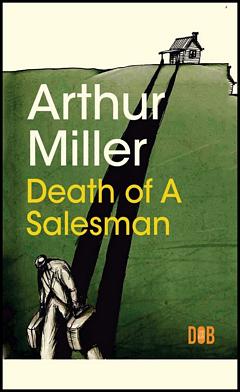 Miller wrote the play when postwar America was booming economically and increasingly defined by hypercompetition and corporate commodification. He believed theater should raise hard questions about morality and responsibility. Read today, the play’s deepest concern is philosophical as much as economic. If meaning rests solely on achievement, production, or physical capability, the later stages of life produce an existential crisis.
Obsolescence is one of the most disturbing themes Miller takes up. Sooner or later, every worker discovers that skills that were once sufficient no longer meet the market’s demands. The decline arrives as a gradual loss of energy, ability, and confidence, and it raises a serious question about the nature of work itself. Willy Loman embodies that struggle. He loved his work, and part of the play’s poignancy comes from its respect for the dignity and joy of labor. Dave Singleman, the salesman Willy admires, died on a train during a sales trip and drew hundreds of mourners to his funeral. His life suggests an era when society valued labor deeply. Willy’s own funeral, by contrast, draws only his family and a handful of friends. The ambivalence that remained shows in Willy as well: pride in his work alongside despair at being reduced to output. When a worker can no longer perform at peak level, the company’s logic takes over, and a person who can’t produce gets discarded.
This relentless demand for productivity reflects a wider cultural flaw. Traditional societies revered elders as holders of wisdom. Youth-oriented, efficiency-driven systems tend to dismiss aging workers, and modern culture can be unforgiving toward people as they grow older, expecting a level of performance that biology can’t sustain. Anyone who has watched a parent or senior colleague approach retirement knows how disorienting that can be. When a person’s entire sense of agency depends on a rising career, the decline feels like total erasure. Control and physical and mental capacity are finite, and the search for meaning has to adapt to the shrinking authority and resources that accompany aging.
The Fallacy of Lifelong Production
Willy Loman’s tragedy is that he couldn’t adapt. He had one direction, forward, louder and bigger, and when his capacity diminished he had nothing else to rely on. The later stages of life don’t have to be a story of defeat. They require a fundamental change in how a person measures progress. Meaning comes from how one relinquishes or transforms power, not from holding onto it.
A better measure locates meaning in endurance, relationships, and legacy, the things that remain when the body and career fade. Meaning across a life comes from adjusting what success looks like as capacity declines, rather than from pursuing it in a straight line.
 Growing old should mean more than physical or professional decline. It should include expansion in moral, spiritual, emotional, and imaginative life. Professional effectiveness may taper, while maturity brings harmony, perspective, and deeper understanding. Older employees may no longer deliver the same measurable output, but many find lasting satisfaction in mentoring younger colleagues: guiding them, sharing hard-earned lessons, and watching them develop. Passing on knowledge ensures continuity and shows that a career’s value extends beyond individual performance reviews.
Outside the workplace, aging brings richness in family and community life. As grandparents, elders, and mentors, people can find depth in relationships that wasn’t available during the ambitious years of youth. Age lets a person see the full course of life, including its relationships, failures, and emotional dimensions, and that perspective offers something no technical skill replaces.
Miller’s play endures because it exposes the emptiness behind the promise of prosperity and the toll of misplaced ideals. The answer to Willy Loman’s fate lies in redefining a life well lived. The most meaningful achievements often belong to later life, in the grace with which a person handles decline.
Idea for Impact: Take inventory now of the parts of your identity that don’t depend on your job title, and invest in them while your career is still strong. Organizations can do the same for their senior employees by creating formal mentoring roles, so that experience has a defined place to go when output is no longer the main measure.
Leave a Reply