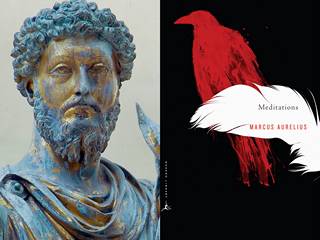
 Most people who pick up Meditations read it wrong.
Not because they misunderstand the words. The words are plain enough. They read it wrong because they don’t know what they’re holding—who wrote it, where, and why.
Meditations has spent the last decade becoming a foundational text for Pop Stoicism. Cited in boardrooms and bootcamps. Quoted in LinkedIn posts alongside photos of cold plunges. Treated as a manual. It isn’t a manual.
Marcus Aurelius was emperor of Rome at its height, ruler of the known world, commander of its most powerful military. He was also, by most historical accounts, a man who found all of that genuinely exhausting and not particularly meaningful. He dealt with plagues, wars, political betrayal, the deaths of children. And in the middle of all of it, he kept a private journal that he never intended anyone to read.
He left no preface. No title. No instructions for what to do with it when he was gone.
The most established Greek title “Ta eis heauton” translates as “To Himself” or “Things Unto Himself.” That title isn’t even his. It’s first recorded around 900 CE, attributed to a scholar named Arethas, likely derived from a manuscript that’s since been lost. Even the name we gave it came centuries later, from someone else trying to make sense of what they were looking at.
That matters. Because what they were looking at wasn’t philosophy. Not exactly. It was a man talking to himself.
Marcus wrote most of what we now call Meditations in military camps along the Danube during the Marcomannic Wars, fighting Germanic tribes on the northern frontier, far from Rome, in conditions that were cold and uncertain. He could’ve retreated into the comforts empire afforded. Emperors did. Instead he sat down, probably by lamplight, and wrote the same few things over and over: remember you’ll die, your problems are small, stop complaining, be useful. Not because he’d just discovered these ideas. He already knew them. He wrote them because he kept forgetting. Because anyone does, under enough pressure, for long enough.
The repetitions, which first-time readers sometimes mistake for redundancy, were the whole point. This wasn’t a man polishing an argument. It was mental triage. A daily correction against the drift that power and grief and exhaustion quietly produce. He wasn’t writing for legacy. He was writing to get through the week.
That the text survived at all is its own story. Whoever held it last couldn’t destroy it, deciding that something in those pages was worth preserving. Across centuries, a chain of hands kept it moving: copied by monks, passed between scholars, eventually printed and placed into millions of hands that Marcus never imagined and would probably have found baffling.
What began as a private coping mechanism became one of history’s most intimate portraits of power and restraint. A man who commanded everything, trying quietly to command himself.
Read it that way and it changes completely. The lines that read like motivational quotes—“you have power over your mind, not outside events”—weren’t written to inspire anyone. They were written by a man who needed to believe them on a specific bad day, in a specific cold camp, with a war outside and grief he couldn’t put down. The repetition isn’t weakness. It’s honesty about how hard it is to actually live this way, even when you already know you should.
This isn’t a self-help book. It’s a record of a man failing, catching himself, and trying again. Every day. For years. With no audience and no reward.
That’s what makes it enduring.
Leave a Reply