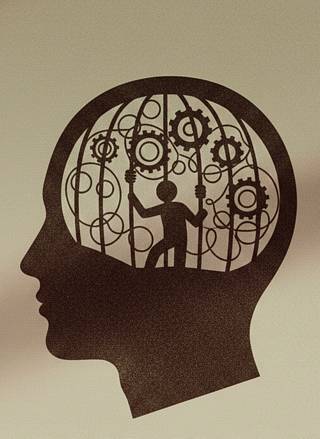
 When attention collapses entirely inward, the mind becomes a prison of repetition. Worries replay without resolution. Self-criticism resurfaces in the same forms. Familiar narratives run on a loop, and the inner voice grows louder and more absolute—until it feels less like a voice and more like the walls.
Most people assume the solution is to think harder: examine the problem more carefully, find the flaw in the logic, reason your way out. This is the central trap. The effort to stop ruminating often intensifies it. Attention directed at a loop tends to reinforce the loop.
The brain offers a clue about why. Neuroscientists have identified a network of regions called the Default Mode Network (DMN)—active when we’re not focused on external tasks—that governs self-referential thought: memories, future projections, imagined conversations. In a healthy mind, this network alternates with task-focused attention, a fluid oscillation between interior and exterior. In chronic rumination, that alternation breaks down. The DMN dominates, and the mind loses its natural movement. The loop isn’t a sign of weakness. It is a specific pattern of neural entrenchment—a groove worn deep by repetition. You cannot think your way out of a thought pattern that thinking itself is perpetuating.
A Mind That Endlessly Rehearses Grievances Becomes Its Own Misery’s Propaganda
People ruminate because it feels productive. If they think about the problem long enough, they believe they will solve it. This illusion is remarkably persistent, and worth naming directly: rumination masquerades as problem-solving while actually preventing it. The loop feels urgent and purposeful. It is neither.
There is also an emotional dimension that purely cognitive accounts miss. Rumination is often a feeling problem wearing thought’s clothes. Unprocessed grief, anger, or fear can fuel loops that behavioral redirection alone won’t touch. When the same thought keeps returning despite repeated attempts to dismiss it, it may be carrying emotional weight that wants acknowledgment, not suppression. The thought is a messenger. Ignoring the messenger rarely silences it.
Since the loop sustains itself through attention, the most effective interruptions redirect attention genuinely—not by suppressing the thought, but by replacing the conditions that feed it.
- Interrupt the narrative, but know what you’re doing. There is a difference between grounding yourself in the present and simply avoiding discomfort. Avoidance tends to worsen rumination over time. Grounding—returning attention to the immediate, sensory, external world—does something different. Step outside. Feel the temperature. Have a conversation about something unrelated to what is circling. Each interruption does not resolve the underlying concern, but it weakens the authority of the inner monologue. That authority is what sustains repetition.
- Prioritize genuine engagement, not mere distraction. Spend more time in activities that absorb you completely: a project with real stakes, physical exertion, creative work, time with people who hold your full attention. The more often attention rests in genuine engagement, the less foothold habitual rumination finds.
- Pressure-test the harsh thoughts. When a critical belief repeats—I always fail at this. No one actually values me. I’ll never feel different—treat it as a claim requiring evidence rather than a fact requiring acceptance. Ask what you would say to a friend who believed this about themselves. Ask what evidence actually contradicts it. The inner critic is not objective. It is simply persistent. Persistence is not authority. A trusted friend, or a therapist when the loops run deep, can offer perspectives your inner critic will never generate on its own.
You are neither as catastrophic nor as exceptional as your inner monologue suggests. That voice is a narrator, not an oracle—shaped by repetition, emotional residue, and the tunnel vision that rumination produces.
Idea for Impact: Protecting mental health means refusing to remain trapped in self-absorption. The goal is not silence—it is proportion. As attention grows more fluid, the inner monologue loses authority. The loop does not disappear. It just stops being the only thing in the room.
Leave a Reply