There’s a genre of world literature built around quick-witted figures who outsmart the powerful and leave everyone else in the room looking slow. India has Birbal and, in the south, Tenali Ramakrishna. The Middle East has Mullah Nasruddin. West Africa has Anansi. Different characters, different traditions, but one shared quality: they solve problems by refusing to accept the problem as it was handed to them.
Birbal was born Mahesh Das in 1528, a Brahmin poet with a sharper gift for reading people than for verse. When Emperor Akbar—the great Mughal ruler who built one of the most powerful empires in history, reigning 1556–05—recognized what he was dealing with, he gave the young scholar a title: Birbal, meaning “the quick thinker.” He became one of Akbar’s Navaratnas, the inner circle of nine jewels, earning his place not through flattery or lineage but through the quality of his thinking. In a court full of advisors with rank, religious standing, and long memories, Birbal had clarity.
The folk tales that grew around him, passed down through generations and embellished in the telling, share a consistent quality. Birbal never answers the question everyone else is answering. He thrived by refusing to accept the frame that came with the problem.
One story in particular has been told to children across India for generations. It’s short, it’s funny, and it contains a lesson that most adults in positions of authority never quite learn.
Sometimes the Deepest Wisdom Is Found by Stepping Outside the Obvious Frame
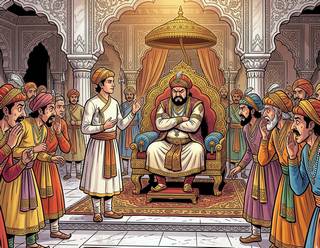 One morning, Emperor Akbar enters his court in a foul mood. He announces to his courtiers: someone dared to pull his beard. What punishment should be given to such a person?
The courtiers compete to demonstrate their loyalty. Beheading. Life imprisonment. Banishment from the kingdom. Each suggestion more severe than the last, each one a direct answer to the question exactly as asked.
Birbal says nothing.
Akbar notices. He asks Birbal directly: what punishment do you suggest for this grave offense?
Birbal replies, calmly, that the person who pulled the emperor’s beard should be given a box of sweets.
The court erupts. The other courtiers assume Birbal has either lost his mind or lost his nerve. Akbar asks him to explain.
Birbal smiles. No one in this court or kingdom would dare pull Your Majesty’s beard knowing the consequences, he says. The only person who could do it playfully, without fear of your wrath, is your own beloved grandson.
Akbar’s expression softens. Birbal was right. It had been his young grandson, playing on his lap that morning, who’d innocently tugged at the great emperor’s beard.
The other courtiers, so eager to suggest harsh penalties, are left with nothing to say. They’d answered the wrong question with tremendous conviction.
One of the Best Ways to Solve a Problem Is to Change the Question
What Birbal did wasn’t magic and it wasn’t instinct. It was a method, one that anyone can learn and most people never bother to use.
Every other courtier accepted the premise: someone pulled the emperor’s beard, therefore someone must be punished, therefore the only question is how severely. They moved immediately to answering without pausing to ask whether the question itself was correctly formed.
 Birbal stopped at the premise. What he did next has a name in lateral thinking: deconstruction, sometimes called fractionation. Rather than treating the situation as a single unified assertion, he broke it into its smallest component parts and examined each one independently. Who has physical access to the emperor’s beard? Who could pull it without being immediately seized? Who would do something that disrespectful without understanding it was disrespectful? He didn’t judge the list. He worked through each element separately, freeing each piece from the meaning imposed by the whole.
This is the analytical phase that precedes the leap. Edward de Bono, who championed lateral thinking, argued that the mind gets trapped by the fixed meaning of a complete assertion. You see “the emperor’s beard was pulled” and immediately load it with context: offense, perpetrator, punishment. Deconstruction breaks that fixedness. By investigating each component independently, you find what de Bono called the point of entry, the specific element where an assumption everyone is making turns out not to hold.
For Birbal, the point of entry was access. The assumption of a malicious adult perpetrator collapsed the moment he asked who could actually get close enough. By the time he’d worked through the list, there was only one possible answer, and it made the original question absurd.
This is what people mean when they talk about thinking outside the box, though they rarely explain it this honestly. The phrase gets repeated in corporate settings as though naming the thing is sufficient, as though the box will obligingly dissolve if you wish at it hard enough. It won’t. The box is made of assumptions. The way out is to name them one by one, lay them flat, and find the one that doesn’t hold. That’s the unglamorous reality behind what sounds thrilling on a motivational poster.
 Here’s what never makes it onto the poster: this is genuinely hard to do under pressure. The courtiers weren’t stupid. They were experienced advisors to one of the most powerful rulers in the world. What stopped them wasn’t lack of intelligence. It was the situation itself. Under pressure, the mind defaults to answering the question as given, because questioning the question feels like stalling, like weakness. The court was competing to respond faster and more dramatically because that’s what the moment rewarded. Birbal resisted that pull. He let the silence sit. He took the time the situation was pressuring him not to take, and used it to deconstruct the problem while everyone else was busy solving the wrong one.
That required courage as much as cleverness. Suggesting sweets as punishment in a room full of people competing to recommend execution wasn’t just an intellectual move. It was a risk. Birbal knew his emperor well enough to know that Akbar would ask for the explanation rather than react to the surface of the answer. Most environments don’t offer that luxury. Most organizations reward the person who answers quickly and confidently, not the one who says the question needs rethinking. Birbal’s method works best when the person asking the original question is willing to hear that they may have asked the wrong one. That’s rarer than it sounds.
Idea for Impact: Next time you feel pressure to answer a question quickly, try Birbal’s method first. Write down what the question is assuming to be true, every component, every piece of context embedded in it. Then look for the element where the assumption has shifted or where the context doesn’t actually hold. That’s your point of entry. Birbal’s genius wasn’t that he knew more than the other courtiers. It was that he questioned what they’d already decided they knew, piece by piece, while the room waited—and had the nerve to say what he found.
Leave a Reply